How to scan crypto for chart patterns: 4 methods compared
Scanning crypto for chart patterns means checking price charts for formations that signal probable price moves - triangles, head and shoulders, double tops, and more. Four methods: manual scanning, TradingView screeners, Pine Script indicators, or automated scanners. Manual works for under 50 pairs. Beyond that, automation covers 1,000+ pairs in real-time.
You know chart patterns work. Head and shoulders formations have an 81% success rate according to Bulkowski's research. Ascending triangles break upward 63% of the time. The problem is not whether patterns are profitable - it's finding them before they complete across a market with thousands of trading pairs.
The scale problem
Binance, Bybit, KuCoin, and MEXC list over 5,600 spot pairs combined. Scanning each pair across 5 timeframes means reviewing 28,000+ charts. Here is what each method actually covers.
This guide walks through every realistic approach to scanning crypto for chart patterns. You will learn what each method can and cannot do, what skills matter regardless of method, and at what point automation becomes a mathematical necessity. No theory - just the practical realities of finding patterns at scale.
What patterns to scan for (and why it matters)
Before choosing a scanning method, you need to define what you are scanning for. Trying to find every pattern on every chart is a recipe for analysis paralysis. The most effective approach is narrowing your focus to 5-10 patterns with documented statistical edges.
“There are good trading systems out there, but they have to be monitored and adjusted using individual judgment.”
- Alexander Elder, The New Trading for a LivingThe classical chart patterns with the strongest statistical backing include reversal patterns like head and shoulders (81% success rate), double tops and double bottoms, and continuation patterns like ascending triangles (63% upward breakout rate), flags, and pennants.
The scanning priority list
Rank your patterns by two criteria: statistical reliability and how easy they are to identify quickly. Here is a practical tiering:
Tier 1 - scan first (clear geometry, high reliability)
Ascending/descending/symmetrical triangles, double tops and bottoms, channels. These have well-defined trendlines that are straightforward to spot visually or detect algorithmically.
Tier 2 - scan second (more complex validation)
Head and shoulders, rising and falling wedges, cup and handle. These require validating multiple peaks/troughs and are more prone to subjective interpretation.
Tier 3 - supplementary (best as confirmation)
Flags, pennants, diamond tops. These are useful but tend to have shorter formation times and require quick action, making them better suited for automated detection.
Common mistake: Scanning for 20+ patterns across every timeframe simultaneously. This leads to pattern blindness - you start seeing formations that are not there. Pick your top 5, master them, then expand. As Murphy writes in Technical Analysis of the Financial Markets, the key is to “identify the patterns that keep appearing in various guises and learn them thoroughly.”
Method 1: manual chart scanning
Manual scanning means opening each chart individually, drawing trendlines, and visually identifying patterns. This is where every trader starts, and it builds essential skills that no other method can replace.
A focused trader can review one chart in about 2-3 minutes with proper analysis - checking structure, drawing trendlines, confirming volume. At that pace, scanning 50 pairs on a single timeframe takes roughly 2.5 hours. Across 3 timeframes, you are looking at a 7-8 hour session to cover just 50 pairs - and Binance alone lists 1,400+.
Now, experienced traders can scan a chart in seconds. After thousands of hours of screen time, your brain builds its own pattern detection system - you glance at a chart and instantly know whether something is forming. I have this. Most veteran traders do. But speed per chart does not fix the actual problem: you still cannot watch 1,000 pairs across 5 timeframes simultaneously. Even at 10 seconds per chart, 5,000 charts take 14 hours. And while you scan the 4-hour timeframe, patterns are completing on the 15-minute. This is exactly why I built ChartScout - not because I cannot read charts fast enough, but because no human can be everywhere at once in a 24/7 market.
The math that breaks manual scanning
Assume you want to scan 1,000 crypto pairs across 5 timeframes (15m, 1h, 4h, daily, weekly):
1,000 pairs x 5 timeframes = 5,000 charts
5,000 charts x 2 min/chart = 10,000 minutes
10,000 minutes = 166 hours
That is over 20 eight-hour workdays to scan just 1,000 pairs. Binance, Bybit, KuCoin, and MEXC list over 5,600 pairs combined. By the time you finish, the patterns from day one have already completed or failed.
When manual scanning still wins
Manual scanning is the right choice when you are learning (there is no substitute for screen time), when you trade a focused watchlist of fewer than 30 pairs, or when you need to evaluate context that algorithms miss - like a pattern forming right before a major protocol upgrade. For a deeper breakdown of where manual analysis adds the most value, see our manual vs automated scanning comparison.
Key takeaway
Manual chart reading is not optional - even with automation. Every pattern an automated scanner flags still needs a human to open the chart, check the context, and decide whether the setup is worth trading. Automation changes what you scan for (everything) but not how you validate (manually). The skill is irreplaceable.
Method 2: TradingView screeners
TradingView is the most popular charting platform among crypto traders, and its screener is powerful for filtering by technical indicators. However, there is a critical distinction most traders miss: TradingView's screener filters by indicators, not by geometric chart patterns.
What TradingView screeners can do
The crypto screener lets you filter pairs by RSI levels, MACD crossovers, moving average positions, volume thresholds, Bollinger Band squeezes, and dozens of other indicator-based conditions. This is useful for finding pairs in specific technical states - for example, all coins with RSI below 30 and price above the 200-day moving average.
What TradingView screeners cannot do
The screener cannot detect that BTC/USDT is forming a symmetrical triangle on the 4-hour chart, or that ETH/USDT has a head and shoulders with a neckline at $3,200. Chart patterns are geometric formations defined by the relationship between price pivots and trendlines. TradingView's screener does not analyze chart geometry.
You can use indicator proxies to approximate pattern conditions - for example, narrowing Bollinger Bands might correlate with triangle formations - but these are indirect signals, not pattern detection. You still need to open each flagged chart and confirm visually whether a pattern actually exists.
This is where indicator-based scanning and pattern scanning serve different purposes. If you are looking for MACD crossovers, golden cross/death cross signals, or TD Sequential setups and countdowns, those are indicator-based signals - and tools exist that automate their detection across hundreds of pairs (ChartScout detects golden cross, death cross, and TD Sequential signals automatically alongside its 20 geometric patterns). But if you are looking for triangles, head and shoulders, or wedges, indicator screeners cannot help.
The gap: TradingView screeners narrow the haystack but do not find the needle. You go from 600 charts to maybe 50-100 that meet your indicator criteria, then manually scan those for actual patterns. It saves time, but it is still a manual process.
Method 3: Pine Script custom indicators
Pine Script is TradingView's built-in programming language that lets you create custom indicators and strategies. With enough coding skill, you can write scripts that detect specific chart patterns directly on a chart.
What Pine Script can do
Pine Script can identify pivot highs and lows, calculate trendline slopes, detect support and resistance levels, and flag when price action matches predefined geometric criteria. Skilled programmers have built Pine Script indicators for triangles, double tops, and even more complex patterns like head and shoulders. But these detections are still lagging - the script only runs when you manually load a chart. It cannot scan multiple timeframes across multiple symbols at once. You have to open each chart, wait for the script to execute, check the result, and move to the next one.
The limitations
Pine Script runs on the chart you are currently viewing. It does not scan across multiple pairs simultaneously. If you want to check 200 pairs, you need to open 200 charts. This makes Pine Script excellent for validation (“does this specific chart have a pattern?”) but impractical for discovery (“which of these 1,000 pairs have patterns right now?”).
There are also hard technical constraints. Pine Script enforces a 5,000-bar lookback limit, a 20-second execution timeout (40 seconds on paid plans), and a maximum of 40 request.security() calls per script - the only way to reference other symbols. The Pine Screener caps at 1,000 symbols per scan. Complex pattern detection with pivot validation, trendline fitting, and volume confirmation pushes against these limits on lower timeframes. And writing reliable detection code is genuinely hard - detecting that two peaks are “roughly equal” in a double top requires handling tolerances, noise filtering, and edge cases that take significant development time.
Pine Script: effort vs. coverage
Method 4: automated pattern scanners
Automated pattern scanners run server-side algorithms that continuously monitor price data across hundreds or thousands of pairs. Unlike Pine Script, which runs on your browser, these systems process candle data independently and alert you when a pattern meets their detection criteria.
How automated detection works
The technical approach varies by platform, but credible scanners use signal processing to identify price pivots, fit trendlines to those pivots using regression algorithms, and validate the geometric relationship between peaks and troughs against pattern-specific rules. Volume analysis, formation duration, and breakout proximity are layered on top as confirmation filters.
“The chartist can easily follow as many markets as desired, which is generally not true of his or her fundamental counterpart.”
- John J. Murphy, Technical Analysis of the Financial MarketsMurphy wrote that about manual chartists decades ago. Automated scanners take the principle further - instead of one analyst following many markets sequentially, the scanner follows all of them simultaneously on every candle close. ChartScout covers over 5,600 pairs across Binance, Bybit, KuCoin, and MEXC this way, running independent detectors for each of the 20 pattern types in real-time.
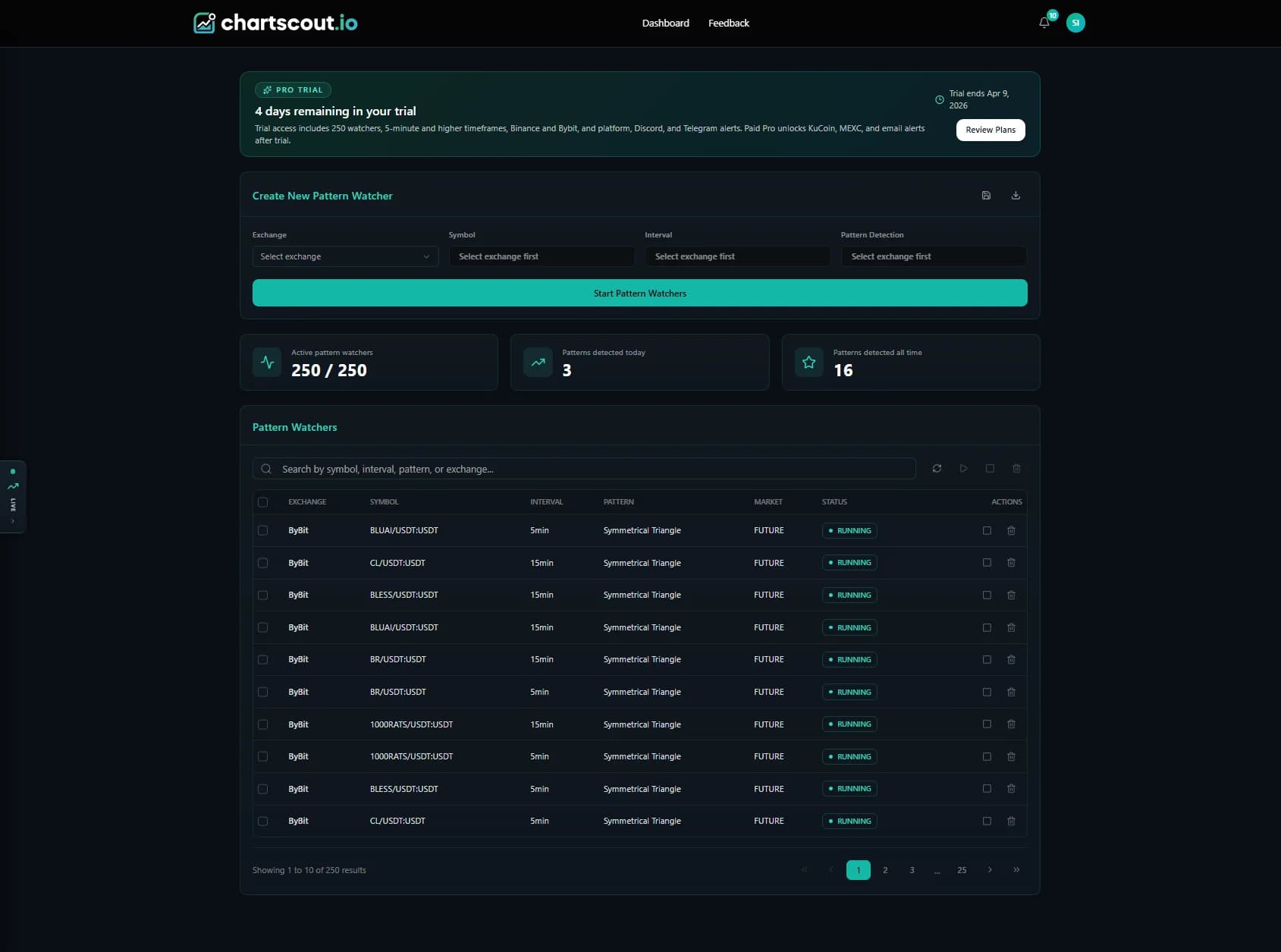
ChartScout dashboard - 250 active pattern watchers scanning for symmetrical triangles across multiple pairs and timeframes

Real-time detections on the notifications page - TD setups, falling wedges, ascending triangles, and symmetrical triangles flagged automatically on Binance and Bybit during a free trial
The coverage advantage
The fundamental advantage is coverage. Where a manual trader scans 30-50 pairs in a session, an automated scanner monitors 1,000+ pairs across every configured timeframe simultaneously and continuously. In a 24/7 market like crypto, this means patterns that form at 3 AM get flagged just as reliably as patterns during your normal trading hours.
Key takeaway
Automated scanners are the only method that scales to full-market coverage. Of the four approaches in this guide, this is the only one that can monitor every pair on every timeframe without human bottlenecks. The trade-off: you still need human judgment to validate what they flag.
Volume confirmation: the filter that matters most
Regardless of which scanning method you use, volume is the single most important filter for separating real patterns from noise. The core principle: volume should decline during pattern formation (showing compression) and spike on breakout (showing conviction). Patterns that break out on low volume fail at roughly double the rate of volume-confirmed ones. If you take one thing from this guide, make it this: never act on a pattern without checking volume first. For a complete breakdown of how volume behaves across every major pattern type, see our dedicated guide on chart patterns and volume analysis.
Timeframe selection for pattern scanning
The timeframe you scan determines the quality and type of patterns you find. Each timeframe has a different signal-to-noise ratio, and choosing the wrong one for your trading style wastes scanning time and produces setups you cannot trade effectively.
Timeframe guide by trading style
Scalpers and Day Traders
Highest pattern frequency but most noise. Expect more false breakouts. Best for experienced traders who can validate quickly and manage tight stops.
Swing Traders (Most Popular)
Best balance of signal quality and opportunity frequency. Patterns on these timeframes tend to have cleaner structures and more reliable breakouts. Most crypto pattern scanners focus here.
Position Traders
Fewest patterns but highest reliability. A head and shoulders on the daily chart carries more weight than on the 15-minute chart. Fewer opportunities means you can cover more pairs per session manually.
Multi-timeframe alignment: The most reliable setups occur when a pattern on your trading timeframe aligns with the trend on the next higher timeframe. An ascending triangle on the 1-hour chart inside a daily uptrend has a meaningfully higher success rate than the same pattern against the daily trend. Always check one timeframe up before committing to a trade.
Building your scanning workflow
The best scanning approach for most traders combines methods rather than relying on a single one. Here is a practical workflow that scales with your trading activity.
Step 1: define your pattern list
Pick 5-10 patterns you understand well. Know their entry triggers, stop-loss rules, and target calculations. Scanning for patterns you cannot trade confidently is wasted effort. If you are not sure where to start, begin with reading crypto charts fundamentals.
Step 2: choose your timeframes
Select 2-3 timeframes that match your holding period. Scanning more than 3 timeframes per pair increases workload dramatically without proportional benefit.
Step 3: use automation for discovery, manual for validation
Let an automated scanner handle the grunt work of checking 1,000+ pairs continuously. When it flags a pattern, open the chart yourself - check volume, assess multi-timeframe alignment, and evaluate context the scanner cannot see. You spend your time evaluating setups rather than hunting for them. For a detailed breakdown of this hybrid workflow, see our guide on manual vs automated chart pattern scanning.
Step 4: set up alerts, not watchlists
Instead of maintaining a static watchlist that you scan daily, configure alerts that notify you when patterns are detected. This shifts your workflow from “scan, scan, scan, maybe find something” to “get notified, validate, trade.” For a deeper look at alert-based workflows, see our guide on alert-driven trading.
Stop scanning. Start finding.
ChartScout scans 1,000+ pairs for 20 chart patterns in real-time. Start a free 7-day trial.
Start 7-Day TrialSet up your first pattern watcher in under 2 minutes. Full Pro access for 7 days.
Frequently asked questions
What is the fastest way to scan crypto for chart patterns?
Automated pattern scanners are the fastest method. They monitor hundreds of pairs across multiple timeframes simultaneously using algorithmic detection. Manual scanning of 50 pairs across 3 timeframes takes 2-3 hours. An automated scanner covers the same ground continuously in real-time.
Can TradingView scan for chart patterns automatically?
TradingView's built-in screener filters by indicators like RSI, MACD, and moving averages, but it cannot scan for geometric chart patterns such as triangles, head and shoulders, or double tops. You can write Pine Script indicators to flag specific patterns, but this requires coding knowledge and runs only on charts you have open.
How many crypto pairs should I scan for chart patterns?
For manual scanning, start with 30-50 high-volume pairs. This is the realistic limit for thorough daily analysis across 2-3 timeframes. With automated tools, you can monitor 500-1,000+ pairs without compromising on analysis quality, since the scanner applies the same detection criteria to every chart.
Which chart patterns are easiest to scan for in crypto?
Triangles (ascending, descending, symmetrical), double tops and bottoms, and channels are the easiest to scan for because they have clearly defined geometric rules. Patterns like head and shoulders or cup and handle require more complex validation of multiple peaks and troughs, making them harder to identify quickly during manual scanning.
What timeframes work best for crypto pattern scanning?
The 1-hour and 4-hour timeframes offer the best balance of signal quality and opportunity frequency for most crypto traders. The 15-minute timeframe produces more patterns but higher false-positive rates. Daily charts provide the most reliable patterns but fewer setups. Most traders scan 2-3 timeframes that match their holding period.
How do I confirm a chart pattern is valid before trading it?
Confirm with three filters: volume (declining during formation, spike on breakout), multi-timeframe alignment (pattern direction matches higher timeframe trend), and pattern maturity (at least 3-5 touches on trendlines). Patterns that pass all three filters have significantly higher completion rates than unconfirmed setups.
Is Pine Script good enough for scanning crypto chart patterns?
Pine Script can detect simple patterns like moving average crossovers and basic trendline breaks, but geometric pattern detection (triangles, head and shoulders, wedges) requires significant coding complexity. Pine Script also only runs on the chart you are viewing, so it cannot scan across multiple pairs simultaneously without manual chart switching.
Sources & references
- Murphy, John J. Technical Analysis of the Financial Markets. New York Institute of Finance, 1999. ISBN: 978-0735200661.
Foundational reference for chart pattern identification, volume analysis, and technical trading methodology. - Bulkowski, Thomas N. Encyclopedia of Chart Patterns, 2nd Edition. John Wiley & Sons, 2005. ISBN: 978-0471668268.
Statistical analysis of chart pattern success rates, failure rates, and measured move targets across thousands of trades. - Elder, Alexander. The New Trading for a Living. John Wiley & Sons, 2014. ISBN: 978-1118443927.
Trading psychology, systematic approaches to market analysis, and risk management principles.
Related guides
Manual vs automated scanning
An honest comparison of manual and automated chart pattern scanning methods for crypto traders.
Alert-driven trading
How real-time pattern alerts replace screen-watching and improve your trading consistency.
Chart patterns & volume analysis
Master volume confirmation across every major chart pattern - the #1 signal for valid breakouts.
How to read crypto charts
From candlestick basics to advanced technical analysis - everything you need to read crypto charts.
How to spot fake breakouts
Learn to identify fakeouts with a verification checklist, probability tables, and real case studies.
Why crypto alerts are always late
The three layers of latency in crypto alerts and how pre-breakout detection fixes them.

Stjepan Ivanović
Founder of ChartScout · Crypto Trader Since 2013
Trading crypto since 2013 with his first Bitcoin bought at ~$200. Four complete bull/bear market cycles, traded on early exchanges like Mt.Gox and BTC-e, on-chain trading on IDEX and EtherDelta, and ~70 crypto project investments. Built ChartScout after 18+ months of development to automate what no trader can do manually - watch hundreds of charts 24/7.