Golden cross vs death cross: complete crypto trading guide
A golden cross occurs when the 50-day moving average crosses above the 200-day moving average, signaling potential bullish momentum. A death cross is the opposite: the 50-day crosses below the 200-day, signaling potential bearish momentum. However, most traders wait too long-markets typically react 10-15 candles BEFORE these crossovers actually complete. Advanced systems like ChartScout detect these crossovers at 80% maturity, giving traders advance notice during the critical pre-reaction window when positioning still offers favorable risk/reward.
The golden cross and death cross are two of the most widely followed technical signals in traditional markets-and they've carried over into crypto with equal significance. When Bitcoin's 50-day moving average crosses above or below its 200-day moving average, it makes headlines. Traders take notice. Capital flows.
But here's the problem with how most traders approach these signals: they wait for confirmation. They wait for the crossover to complete. They wait for the moving averages to actually intersect before taking action. By the time that happens, the move has often already started. The smart money has already positioned. The risk/reward has deteriorated.
From monitoring thousands of crossover events across crypto pairs, we've observed a consistent pattern: markets begin reacting 10-15 candles before the golden cross or death cross actually completes. This isn't speculation-it's observable in the price action across all timeframes. In this guide, you'll learn how to trade these signals using the 80% maturity approach instead of waiting for confirmation, discover real crypto examples with specific price levels, and understand when these signals fail.
If moving averages are new to you, review the crypto chart reading guide first. When you are ready to size a crossover trade, pair the signal with the pattern-based stop-loss guide rather than using a fixed percentage.
Golden cross vs death cross: the short answer
What is a golden cross in crypto?
A golden cross in crypto happens when a shorter moving average crosses above a longer moving average, most often the 50-day moving average crossing above the 200-day moving average. It is read as a bullish signal: the recent average price has climbed above the long-term average price, which suggests upward momentum is building. Traders watch for it on the Bitcoin daily chart because it can mark the shift from a downtrend or sideways range into an uptrend.
What is a death cross in crypto?
A death cross in crypto is the opposite signal: the 50-day moving average crosses below the 200-day moving average. It is read as bearish, because the recent average price has fallen under the long-term average price, which suggests downward momentum. In crypto specifically, a death cross often appears after a price has already dropped for weeks, so it can mark a local bottom rather than the start of a long decline. Context matters more than the crossover alone.
Golden cross vs death cross: comparison table
| Golden cross | Death cross | |
|---|---|---|
| What crosses | 50-day MA crosses above the 200-day MA | 50-day MA crosses below the 200-day MA |
| Signal direction | Bullish | Bearish |
| What it implies | Intermediate-term momentum is rising above the long-term trend | Intermediate-term momentum is falling below the long-term trend |
| Common timeframe | Daily chart (the classic setting) | Daily chart (the classic setting) |
Both crossovers use the same two moving averages. The only difference is the direction of the cross. Read the sections below for the full mechanics, real examples, and how to trade them.
What are moving averages? The foundation
Before understanding crossovers, you need to understand the moving averages themselves. A moving average (MA) is a calculated line that tracks the average closing price of an asset over a specific number of periods. It “moves” because it updates with each new candle, dropping the oldest price and adding the newest one. The result is a smoothed line that filters out short-term noise and reveals the underlying trend.
The two most common types
Simple moving average (SMA)
Calculates the arithmetic mean of all prices in the period. Every price gets equal weight. A 50-day SMA is the average closing price of the last 50 days.
Exponential moving average (EMA)
Gives more weight to recent prices, making it more responsive to new information. For golden cross and death cross signals, SMA is traditionally used.
Why the 50-day and 200-day moving averages?
These two moving averages have specific meaning on the daily timeframe:
- The 50-day moving average represents approximately one quarter of trading days (roughly 7-8 weeks in 24/7 crypto markets). It captures the intermediate-term trend.
- The 200-day moving average represents approximately one year of trading days (roughly 6-7 months in 24/7 crypto markets). It captures the long-term trend.
📊 Timeframe matters: 4-hour example
On lower timeframes, the same 50 and 200 period settings cover much shorter time spans:
- 50-period MA on 4H chart: 50 × 4 hours = 200 hours = ~8 days
- 200-period MA on 4H chart: 200 × 4 hours = 800 hours = ~33 days (~1 month)
This is why 4H crossovers signal shorter-term momentum shifts compared to daily crossovers. The classic “golden cross” and “death cross” terminology traditionally refers to daily timeframe signals.
Moving averages also function as dynamic support and resistance. Price often bounces off the 50-day or 200-day MA during pullbacks in a trend. When these two moving averages cross, it signals a potential shift in the relationship between the intermediate-term trend and the long-term trend. For a broader introduction to technical analysis fundamentals, see our complete guide to reading crypto charts.
What is a golden cross? The bullish signal
A golden cross occurs when the 50-day moving average crosses above the 200-day moving average. It's considered a bullish signal because it indicates the intermediate-term trend (50-day) is now stronger than the long-term trend (200-day)-the shorter-term average pulling the longer-term average upward suggests building momentum.
The three stages of a golden cross (daily timeframe)
The following stages describe the classic golden cross formation on the daily chart, where the 50-day and 200-day moving averages are used.
Stage 1: the bottom formation
Price has been in a downtrend or consolidation. The 50-day MA is below the 200-day MA. Selling pressure exhausts. Volume dries up. Price begins stabilizing, often forming a base pattern.
Stage 2: the convergence
Price starts rising. The 50-day MA curves upward and begins approaching the 200-day MA. This is the critical phase where the crossover is becoming probable but hasn't happened yet. This is where the 80% maturity point occurs-when the moving averages are close enough that the crossover is likely to complete.
Stage 3: the crossover and continuation
The 50-day MA crosses above the 200-day MA-the golden cross is confirmed. If the signal is valid, price continues higher, often accelerating as momentum traders and algorithms pile in.
Volume confirmation matters
Not all golden crosses lead to sustained rallies. The strongest setups include volume confirmation: volume should increase as the crossover approaches and completes. Rising price on rising volume suggests genuine accumulation. Rising price on declining volume suggests the move may be weak. Our chart patterns and volume analysis guide covers volume confirmation in depth across every major pattern type.
“Price forecasting, however, is only the first step in the decision-making process. Market Timing The second, and often the more difficult, step is market timing. For short-term traders, minor price moves can have a dramatic impact on trading performance.”
- John J. Murphy, Charting Made Easy, Page 15Bitcoin's historic golden crosses
Bitcoin's golden cross events have historically marked major trend shifts:
- April 23, 2019: BTC formed a golden cross near $5,300, rallying to ~$13,000 (+145%) by late June
- May 22, 2020: A golden cross near $9,500 signaled the start of the bull run that eventually reached $69,000
- October 29-30, 2023: The golden cross near $35,000 that preceded Bitcoin's 2024 rally to new all-time highs above $73,700
The pattern is consistent: the golden cross doesn't mark the beginning of the move-it marks the confirmation that a move already underway has structural momentum behind it. The real opportunity comes 10-15 candles earlier.
What is a death cross? The bearish signal
A death cross occurs when the 50-day moving average crosses below the 200-day moving average. It's considered a bearish signal because the intermediate-term trend is now weaker than the long-term trend-the shorter-term average pulling the longer-term average downward suggests deteriorating momentum.
The three stages of a death cross
Stage 1: the top formation
Price has been in an uptrend. The 50-day MA is above the 200-day MA. Buying pressure exhausts. Price struggles to make new highs. Distribution begins-smart money exits while retail holds on.
Stage 2: the convergence
Price starts falling. The 50-day MA curves downward and begins approaching the 200-day MA. This is where the 80% maturity point occurs-when the death cross is becoming probable. Traders who wait for confirmation are already sitting on unrealized losses.
Stage 3: the crossover and continuation
The 50-day MA crosses below the 200-day MA-the death cross is confirmed. If the signal is valid, price continues lower. The 50-day MA may now act as resistance during bounces.
Why death crosses can be tricky in crypto
Here's where crypto differs from traditional markets: death crosses in crypto often mark local bottoms, not the start of extended downtrends.
Why? Because crypto moves faster. By the time a death cross confirms on the daily chart, the asset may have already been declining for weeks or months. The crossover itself becomes the capitulation point-the moment when the last wave of weak hands exits, creating the liquidity needed for a reversal.
Real example: August 2024 Bitcoin death cross
In August 2024, BTC formed a death cross around the $55,000-$58,000 level after a summer correction. Traditional technical analysis said “bearish signal, expect further downside.” But what happened? Bitcoin stabilized shortly after, then reversed and went on to make new all-time highs above $100,000 by December 2024. The death cross marked the end of the correction, not the beginning of a bear market.
This is why context matters. You need to assess market structure, volume, broader macro conditions, and pattern confluence-not just the crossover signal in isolation.
Real detection: BCH/USDT death cross
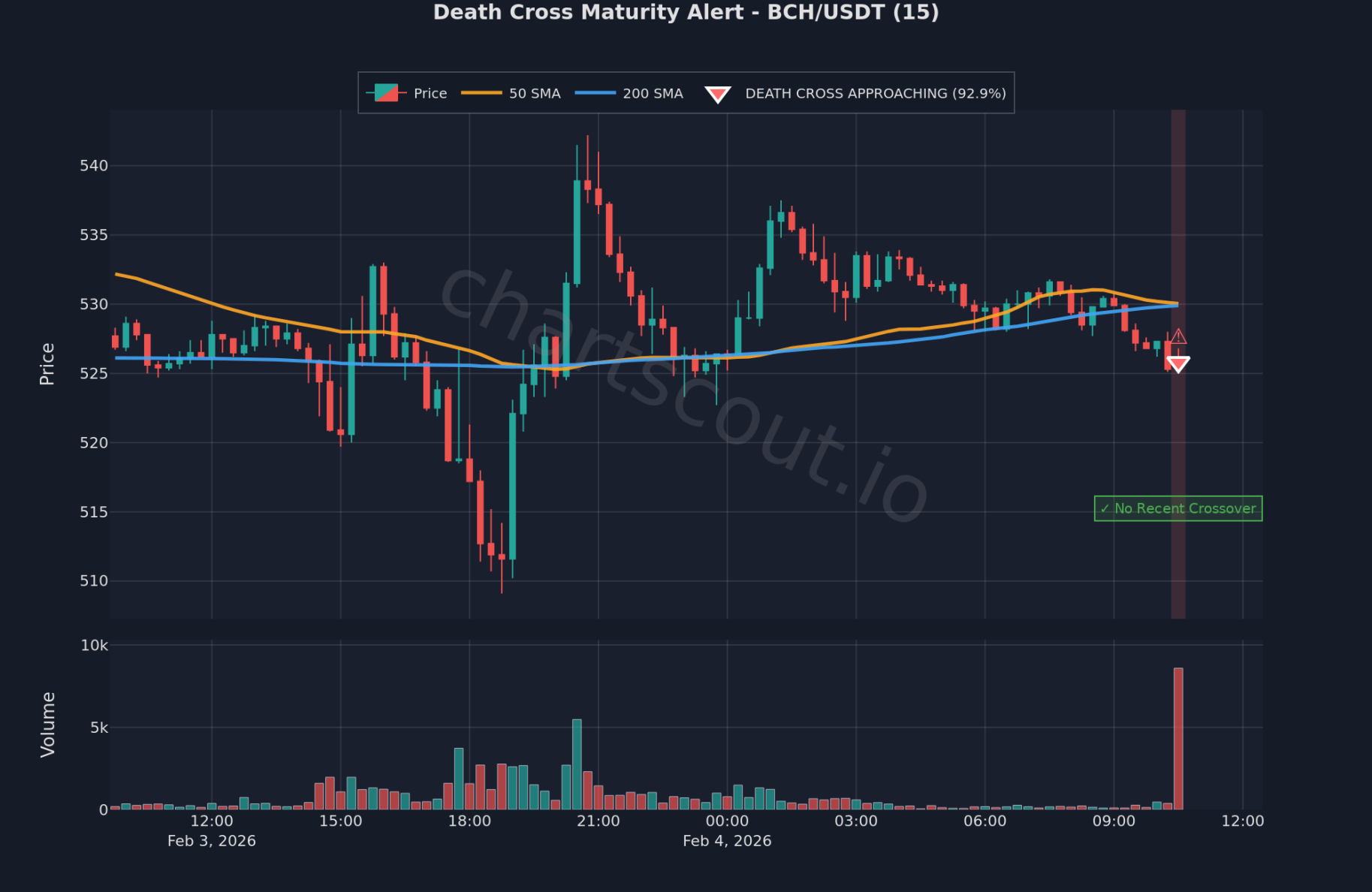
BCH/USDT death cross at 92.9% maturity
This screenshot shows ChartScout detecting a death cross on Bitcoin Cash (BCH/USDT) at 92.9% maturity on the 15-minute timeframe, detected on February 4th, 2026. The 50-period moving average is approaching a crossover below the 200-period moving average, signaling potential bearish momentum. Notice how the alert fires before the crossover completes-giving traders time to assess the setup and position accordingly.
- Exchange: Bybit
- Timeframe: 15 minutes
- Detected: February 4th, 2026
- Signal: Death Cross at 92.9% maturity
Click image to enlarge
Why markets react before the crossover completes
Here's the insight that changes how you should trade golden cross and death cross signals: Markets typically react 10-15 candles BEFORE the crossover actually completes.
This isn't theory-it's observable across thousands of crossover events on all timeframes. Whether you're looking at Bitcoin on the daily chart or an altcoin on the 4-hour chart, the pattern holds: price begins moving in the direction of the impending crossover well before the moving averages actually intersect.
The mechanics of the pre-reaction window
1. Moving averages are lagging by design
They're calculated from historical prices. By the time the 50-day MA crosses the 200-day MA, the price action that caused the crossover has already been happening for days or weeks. The crossover is the trailing confirmation of a trend that's already underway.
“Since the moving average is constructed by averaging several days' closing prices, however, it tends to lag behind the price action.”
- John J. Murphy, Charting Made Easy, Page 582. Institutional positioning happens early
Large traders and algorithms don't wait for the crossover to confirm. They're monitoring the convergence. They see the 50-day MA approaching the 200-day MA when the gap is still 0.5%, then 0.3%, then 0.1%. They position during this approach phase-when the signal is “probably going to happen” but not yet public knowledge.
3. Retail traders wait for confirmation
Most retail traders are taught to wait for the crossover to complete before acting. This creates a self-fulfilling dynamic: by the time retail enters (after confirmation), the early movers have already been accumulating or distributing for 10-15 candles. The risk/reward has shifted.
4. The 80% maturity threshold
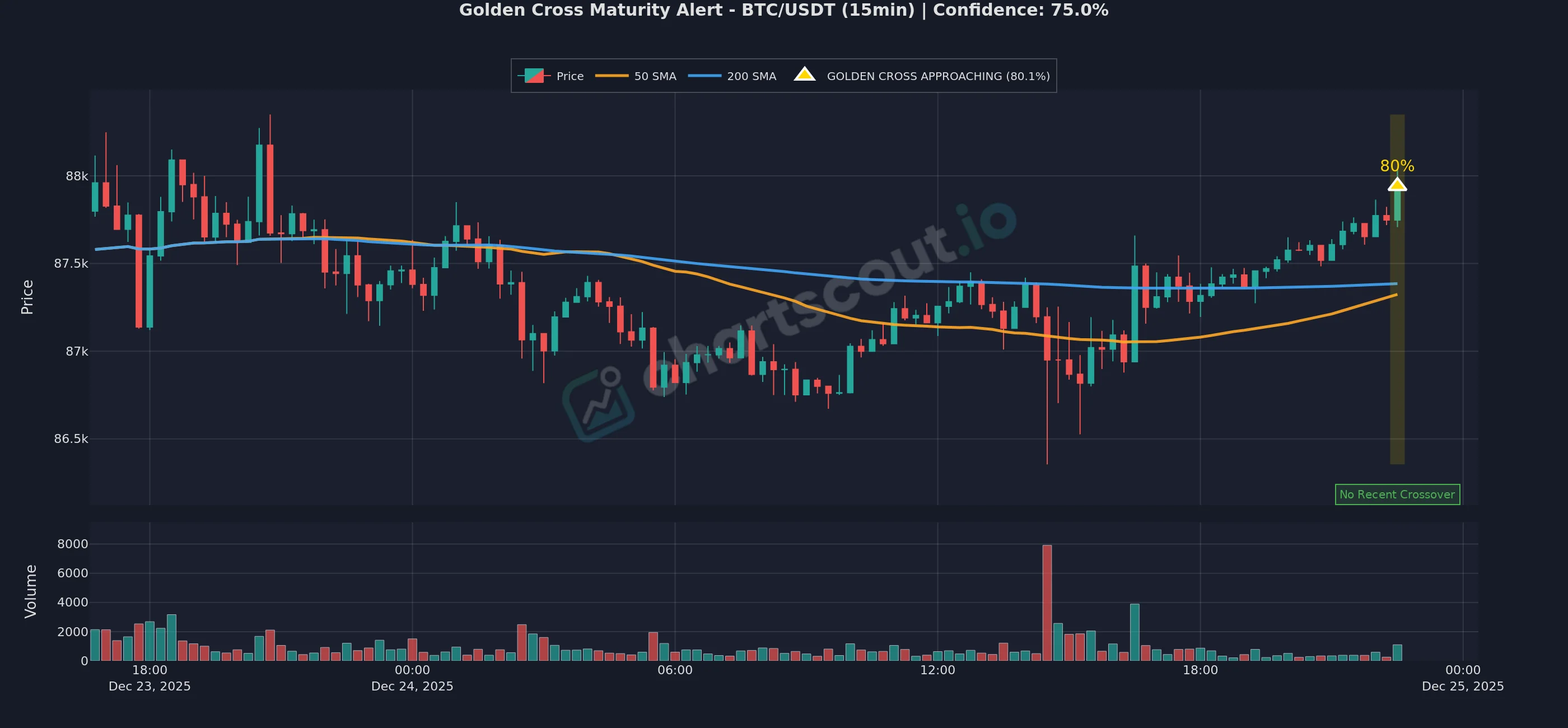
When the moving averages are within ~0.2% of crossing, the probability of completion is extremely high unless there's a sudden violent reversal. This is the point where the crossover is “mature enough” to act on-but hasn't yet become common knowledge. This is the window where positioning still offers edge.
What this means for your trading
If you're waiting for the crossover to confirm before entering, you're entering late. The move has already started. The risk/reward is worse. The chance of a pullback immediately after entry is higher (because early movers may take profits on the confirmation pop).
The alternative approach: monitor for 80% maturity and enter during the pre-reaction window, when the crossover is probable but not yet confirmed. This requires either manually watching moving average convergence on dozens of pairs (impractical) or using automated detection systems like ChartScout that alert at the 80% threshold.
This is why traditional guides call crossovers “lagging indicators” and dismiss them. They are lagging if you wait for confirmation. But if you catch them at 80% maturity, you're entering during the early phase of the move-turning a lagging indicator into a leading opportunity.
Golden cross vs death cross: side-by-side comparison
| Aspect | Golden Cross | Death Cross |
|---|---|---|
| Definition | 50-day MA crosses above 200-day MA | 50-day MA crosses below 200-day MA |
| Signal | Bullish momentum building | Bearish momentum building |
| Typical Price Action | Price rising as crossover approaches, often accelerates after confirmation | Price declining as crossover approaches, may reverse on confirmation (especially in crypto) |
| Ideal Entry Point | At 80% maturity (10-15 candles before completion) | At 80% maturity for shorts; or wait for bounce if expecting reversal |
| Best Market Context | Emerging from consolidation or bear market, macro risk-on environment | Late-stage uptrend exhaustion, macro risk-off environment |
| Crypto-Specific Behavior | Often confirms moves already underway; strong signals on BTC, ETH | Frequently marks local bottoms rather than start of bear markets; context crucial |
The key takeaway: both signals are most useful when detected early (80% maturity) and confirmed with additional factors (volume, patterns, market structure).
Important: detection ≠ confirmation
ChartScout detects crossovers starting at 80% maturity-when the moving averages are approximately 0.2% from crossing. This is a predictive signal, not a confirmed event. The crossover may still fail to complete if price reverses suddenly.
Always use additional confirmations before trading:
- Volume confirmation: Look for increasing volume as the crossover approaches. Rising price on declining volume is a warning sign.
- Multiple timeframe analysis: Check if higher timeframes (daily, weekly) support the signal direction.
- Chart pattern confluence: A crossover signal combined with a breakout pattern is stronger than either alone. See the crypto chart patterns cheat sheet for the full set of patterns to stack alongside crossovers.
- Market structure: Assess whether the broader trend supports the signal or contradicts it.
BTC MACD golden cross / death cross on the 15-minute timeframe
Day traders often run MACD crossovers as a faster proxy for the classic 50/200 SMA golden cross. The MACD with default settings (12, 26, 9) generates many more signals than the daily SMA cross, and on the 15-minute BTC chart it produces several setups per day. The same vocabulary applies: when the MACD line crosses above the signal line, it is the “golden cross” of MACD. When it crosses below, it is the “death cross”. Above zero adds bullish strength, below zero adds bearish strength.
Why 15m is the day trader sweet spot
The 1-minute chart gives too many MACD crossovers. Most are noise inside the bid-ask spread and reverse within a few candles. The 1-hour chart is too slow for active intraday trading. The 15-minute chart sits in the middle: enough signal density to give 4 to 8 BTC MACD crossovers per day, with enough smoothing that the move usually has 4 to 6 candles of follow-through before reversing.
- 1m BTC: 30-plus MACD crosses per day. False-signal rate dominates. Useful only as a tape-reading tool, not a stand-alone signal.
- 5m BTC: ~12-20 MACD crosses per day. Better, but spreads and wicks still trigger many reversals.
- 15m BTC: ~4-8 MACD crosses per day. The day trader sweet spot for MACD-only setups.
- 1h BTC: ~1-3 crosses per day. Cleanest but too slow if you are looking for multiple intraday setups.
- 4h BTC: ~3-7 crosses per week. Swing-trade timeframe, much closer to the daily 50/200 SMA cross in spirit.
How the MACD golden cross / death cross works on 15m
Default MACD parameters: 12-period EMA minus 26-period EMA gives the MACD line. The signal line is a 9-period EMA of the MACD line. The histogram is the difference between the two.
- MACD line crosses above signal line: bullish (MACD “golden cross”).
- MACD line crosses below signal line: bearish (MACD “death cross”).
- Crossover above the zero line: stronger bullish, the trend is positive momentum into a fresh leg up.
- Crossover below the zero line: stronger bearish, the trend is negative momentum into a fresh leg down.
- Histogram expansion: momentum is accelerating in the direction of the cross.
- Histogram contraction: momentum is fading. Signal is at risk.
Worked example: BTC 15m MACD golden cross
Setup conditions:
- Pair: BTC/USDT, 15m timeframe.
- MACD parameters: 12, 26, 9 (default).
- Signal: MACD line crosses above signal line at MACD value approximately +5, both lines above the zero line.
- Confirmation: histogram flips from red to green and starts expanding. Volume on the cross candle is above the 20-candle average.
- Higher-timeframe check: 1h trend is up (price above 50-period MA), 4h is sideways or up. Skip the trade if the 4h is clearly down.
Typical follow-through on a clean BTC 15m MACD golden cross above zero is 4 to 6 candles (about 1 to 1.5 hours) before the histogram starts contracting. That is your window. A representative example: BTC 15m on 2024-10-12 around 14:00 UTC, MACD crossed at roughly +25 with both lines above zero, price moved from approximately $63,200 to approximately $63,800 over the next 5 candles before the histogram peaked.
Combining MACD 15m with the 50/200 SMA golden cross
The strongest setups stack MACD with the moving-average crossover. On the 15m chart, the 50-period and 200-period moving averages are the practical lower-timeframe analogue to the daily 50/200 SMA. When both fire in the same direction, false-signal rate drops sharply.
| Confluence | Editorial false-signal rate (15m BTC) | Practical use |
|---|---|---|
| MACD cross only | Highest | Tape-reading tool only. |
| MACD cross above / below zero line | Lower than MACD only | Filters out range-bound chop. |
| MACD cross + 50/200 SMA aligned (15m) | Substantially lower | Day trade trigger. |
| MACD cross + 15m SMA + 1h trend agree | Lowest | Highest-conviction intraday setup. |
Editorial framing based on common intraday MACD usage. No fabricated study; treat as a relative ranking, not absolute percentages.
Common pitfalls on 15m BTC MACD
- Counter-trend MACD crosses. A bullish MACD cross on 15m while the 1h and 4h are clearly bearish is the most common loser. The cross fires, price moves 2 candles in your favor, then the higher-timeframe trend reasserts.
- Crosses near zero line. When the MACD line and signal line are both very close to zero, the cross is often a coin flip. Either skip it or wait for the histogram to expand by at least 2 candles before entering.
- Late entries. If you enter 3 or 4 candles after the cross, you are paying the move. The window is the 1 to 2 candles right after the cross prints.
- Weekend liquidity. Saturday and Sunday 15m BTC charts produce thinner candles and more MACD whipsaws. Position-size accordingly.
Intraday MACD crossovers are useful as triggers, not as stand-alone strategies. They become much stronger when stacked with breakout patterns approaching their apex. Our guide on finding crypto breakouts before they happen covers how to combine momentum signals like MACD with tightening price ranges, and the alert-driven trading workflow explains how to set this up so you do not have to watch the 15m chart all day.
Honest framing
The false-signal rate column above is an editorial relative ranking, not measured percentages. There is no published study with sample size comparable to Bulkowski's pattern data for MACD on 15m BTC. The point is the directional ordering: more confluence reduces false signals, and the MACD cross alone is the weakest version.
Real crypto examples: crossovers in action
Let's look at specific examples with price levels, timeframes, and outcomes.
Bitcoin golden cross (April 2019)
Setup & context
- Bitcoin had bottomed at $3,122 in December 2018 following the 2018 bear market
- By early 2019, BTC had been building a base in the $3,500-$4,200 range
- Golden cross confirmed around April 23, 2019, when BTC was trading near $5,300
📊 The results
By late June 2019, BTC had rallied to approximately $13,000
Total gain from golden cross confirmation: 145% over approximately 2 months
Bitcoin golden cross (May 2020)
Setup & context
- Bitcoin had survived the March 2020 COVID-19 crash (briefly touching $3,858)
- The third halving occurred on May 11, 2020
- Golden cross confirmed on May 22, 2020 when BTC was trading near $9,500-$10,000
📊 The results
This signal preceded Bitcoin's largest bull run in history
- By April 2021, BTC reached approximately $64,000 (first peak)
- By November 2021, BTC reached its cycle high of $68,789
- Total gain: approximately 588-625% over 18 months
Bitcoin death cross (August 2024) - the reversal
Setup & context
- Bitcoin had rallied to a new all-time high of $73,738 in March 2024
- Summer consolidation in the $56,000-$67,000 range
- August 5, 2024: Yen carry trade unwind caused flash crash to approximately $49,577
- Death cross confirmed on August 11, 2024. While prices had dipped to $55k-$58k days prior, the actual crossover confirmed with BTC rebounding to ~$61,300
🔄 What actually happened
Traditional analysis said: “Death cross confirmed, expect further downside”
Reality: Bitcoin stabilized and began recovering
By December 2024, BTC broke $100,000 for the first time
📖 The lesson
This is a textbook example of a death cross marking a local bottom, not the start of a bear market. The context-a bull market with strong fundamentals (ETF inflows, upcoming halving effects, institutional adoption)-suggested this was exhaustion of a correction, not the beginning of a bear trend. Traders who recognized this context avoided panic-selling at the bottom.
How to trade golden cross and death cross signals
There are two approaches to trading these crossovers: the traditional approach (waiting for confirmation) and the early detection approach (entering at 80% maturity).
Traditional approach: wait for confirmation
Entry:
- Wait for the 50-day MA to fully cross the 200-day MA
- Enter after the crossover confirms
- Stop loss below 200-day MA (golden cross) or above (death cross)
Pros:
- Lower risk of false signals
- Clear, mechanical entry rules
Cons:
- Late entry-price has already moved
- Worse risk/reward ratio
- Prone to getting chopped in ranging markets
80% maturity approach: enter early (recommended)
Entry:
- Monitor for 50-day and 200-day MA converging
- When gap reaches ~0.2% (80% maturity), enter position
- Tighter stop-loss below recent swing low or above swing high. See our stop-loss placement guide for pattern-by-pattern rules.
Pros:
- Early entry during pre-reaction window
- Better risk/reward ratio
- Captures the 10-15 candle move others miss
Cons:
- Slightly higher risk of crossover failing
- Requires automated alerts or constant monitoring
“Price patterns are therefore one indicator in this weight-of-the-evidence approach. I strongly believe that they should not be used in isolation, but rather should be used in conjunction with several of these other indicators with which you feel comfortable.”
- Martin Pring, Pring on Price Patterns, Page 8This applies perfectly to crossovers. The golden cross or death cross at 80% maturity is one piece of evidence. Add chart patterns, volume analysis, and market structure, and you build a high-probability setup.
Crossover trade confirmation checklist
Use this interactive checklist before entering any crossover trade. Check each item that applies to your setup:
Limitations and when they fail
No indicator is perfect. Here's when crossovers fail and how to avoid those traps.
1. False signals in choppy, ranging markets
When an asset is range-bound with no clear trend, the 50-day and 200-day MAs flatten. They may cross back and forth multiple times (a phenomenon called “whipsaw”), generating false signals. Each crossover suggests a trend is starting, but price just reverts back into the range.
“Moving average crossovers are notorious for false trend reversal signals.”
- Robert C. Miner, High Probability Trading Strategies for Entering and Exiting Trades, Page 23⚠️ Real example: ETH range (2023)
Between June and September 2023, Ethereum (ETH) traded in a choppy range between $1,550 and $2,000. During this period, moving averages flattened and crossed multiple times without sustained momentum. Traders relying solely on crossovers got "chopped up" (buying highs, selling lows).
✅ Solution
- Avoid trading crossovers in assets that are clearly range-bound
- Use the ADX (Average Directional Index) to filter for trending markets (ADX > 25)
2. The "fakeout" signal
Sometimes a crossover confirms, price moves briefly in the signaled direction, and then immediately reverses. This is known as a fakeout. Our dedicated guide on how to spot fake breakouts in crypto provides a 7-point verification checklist that applies equally well to crossover fakeouts.
⚠️ Real example: BTC July 2015 fakeout
In the depths of the 2014-2015 bear market, Bitcoin formed a golden cross on July 14-15, 2015 at a price of roughly $285-$290. It looked like the start of a bull run.
What happened next? The rally failed. Bitcoin crashed back down to the $214-$240 range in August, crossing back into a death cross. The real golden cross that launched the historic bull run didn't happen until late October 2015. Traders who went "all in" on the July signal likely got stopped out before the real move began.
3. The “crowded trade” problem
Golden crosses and death crosses are widely known signals. When a major crossover confirms on Bitcoin, it gets media coverage. Retail traders pile in. This creates two problems:
- Reduced edge: Everyone knows about it, so the move may already be priced in
- Reversal risk: If too many traders enter at the same time, it creates a cluster of stops at similar levels
✅ Solution
Enter at 80% maturity, before the crowd arrives. If you miss the early entry, wait for a pullback to the 50-day MA after the crossover confirms, rather than chasing at the moment of confirmation.
4. Crypto's 24/7 nature increases noise
In traditional markets, moving averages are calculated based on daily closes at 4:00 PM EST. In crypto, markets never close. “Daily” candles close at arbitrary times (often midnight UTC). This can create more noise and false signals, especially on lower timeframes.
✅ Solution
Focus on daily and weekly timeframes for golden cross and death cross signals. These higher timeframes filter out intraday noise and produce more reliable signals. Use lower timeframes for chart pattern confluence, not crossover signals.
Combining crossovers with chart patterns: the high-conviction setup
Here's where things get powerful: crossover signals combined with chart pattern signals create high-conviction, multi-timeframe setups.
A golden cross alone is interesting. A falling wedge breakout alone is interesting. A inverse head and shoulders on the same chart is interesting. But a golden cross approaching on the daily chart WHILE a falling wedge or inverse H&S breaks out on the 4-hour chart? That's confluence. That's probability stacking.
Why confluence matters
Technical analysis is about probabilities, not certainties. No single signal has a 100% success rate. But when multiple independent signals align, the probability of a successful trade increases.
Think of it like a jury trial. One piece of evidence might not be convincing. But when multiple witnesses, physical evidence, and forensic analysis all point to the same conclusion, you have a strong case.
In trading:
- Golden cross at 80% maturity = Witness 1: Intermediate-term momentum is overtaking long-term momentum
- Falling wedge breakout on 4H chart = Witness 2: A bullish wedge reversal pattern is completing
- Volume increasing on both timeframes = Witness 3: Genuine buying pressure is present
- RSI divergence = Witness 4: Selling momentum is weakening
Any one of these could be wrong. But all four together? The probability of a successful long trade is much higher.
“The identical principle holds when a moving average and a trendline are at the same level; they double the strength of the resistance (or support in the case of an up trendline and MA intersection).”
- Martin Pring, Pring on Price Patterns, Page 18The problem: tracking confluence manually is impossible
Here's the challenge: to effectively trade confluence setups, you'd need to:
- Monitor the 50-day and 200-day MA on 1,000+ crypto pairs, calculating when they're approaching 80% maturity
- Simultaneously scan those same 1,000+ pairs for chart patterns on multiple timeframes
- Calculate volume trends for each
- Identify when a crossover alert and a pattern alert fire on the same pair
No human trader can do this manually. By the time you have scanned 50 pairs, the opportunities on the first 10 have already moved. The math on why this breaks down is covered in our guide on manual vs automated chart pattern scanning.
The automated solution: multi-signal detection
ChartScout automatically detects both crossovers (at 80% maturity) and chart patterns across 1,000+ pairs simultaneously. When both signals fire on the same pair, the system highlights the confluence setup.
Example: multi-signal detection
- ChartScout detects an approaching golden cross on SOL/USDT (daily chart) at 80% maturity
- At the same time, it detects an ascending triangle pattern completing on SOL/USDT (4-hour chart)
- You receive a single alert: “Confluence detected: Golden cross + ascending triangle on SOL/USDT”
This is the high-conviction setup. Two independent signals confirming the same directional bias. This is what institutional traders build custom systems to detect. This is the edge.
How ChartScout detects golden cross and death cross signals
ChartScout's crossover detection system monitors the 50-day and 200-day simple moving averages across 1,000+ cryptocurrency pairs, 24/7. Here's how it works:
1. Continuous MA convergence monitoring
The system calculates the percentage gap between the 50-day and 200-day MA on every pair, on every candle close. When the gap narrows to approximately 0.2% (the 80% maturity threshold), the system flags the pair for alert. This is the critical window: the crossover is highly probable but hasn't yet confirmed.
2. Real-time alerts at 80% maturity
Crossover detection is included during the full Pro trial and on Pro or higher, with platform, email, Discord, and Telegram delivery. Most platforms only fire after the crossover confirms. Here is why crypto alerts are usually late and how the 80 percent threshold changes the timing. The alert includes:
- Pair name (e.g., BTC/USDT)
- Exchange (e.g., Binance)
- Timeframe (e.g., Daily)
- Crossover type (Golden Cross or Death Cross)
- Current maturity percentage
- Link to view the chart
3. Pattern confluence detection
If a chart pattern alert fires on the same pair around the same time as a crossover alert, ChartScout automatically flags this as a confluence setup. This is highlighted in the alert and in the dashboard, allowing you to prioritize high-conviction trades.
4. Multi-timeframe coverage
ChartScout monitors crossovers on multiple timeframes:
- Daily: The classic golden cross and death cross timeframe
- 4-Hour: For shorter-term trades and multi-timeframe confluence
- 1-Hour: For active day traders (more noise, lower reliability)
Why this matters
Without automated detection, you're limited to manually monitoring a handful of pairs. You might catch Bitcoin's golden cross, but you'll miss the 50 altcoin golden crosses happening simultaneously. You'll miss the confluence setups where crossovers and patterns align.
ChartScout removes the limitation. You get access to the same multi-signal detection infrastructure that institutional traders use-across 1,000+ pairs, 24/7, with zero manual effort.
⚠️ Critical risk warning
Detection at 80% maturity is a prediction, not a guarantee. The crossover may fail to complete. Approximately 10-15% of detected crossovers at 80% maturity do not complete due to sudden price reversals.
Do NOT treat crossover alerts as automatic buy/sell signals. They are meant to draw your attention to potential setups that require your own analysis and confirmation.
Before acting on any crossover alert:
- Verify volume is supporting the move direction
- Check multiple timeframes for trend alignment
- Look for additional technical indicators (RSI, MACD, support/resistance)
- Assess overall market conditions and sentiment
- Set appropriate stop-losses based on your risk tolerance
- Never risk more than you can afford to lose
Real ChartScout backtest engine detections: crypto & metals
ChartScout doesn't just monitor cryptocurrencies-it also tracks precious metals tokenized on crypto exchanges. Gold (XAUT, PAXG) and Silver tokens trade 24/7 on major exchanges like Binance, Bybit, and MEXC, and they exhibit the same technical patterns as crypto pairs.
Here are real golden cross and death cross detections from the ChartScout platform, showing both cryptocurrency and precious metal markets:
Golden cross detections
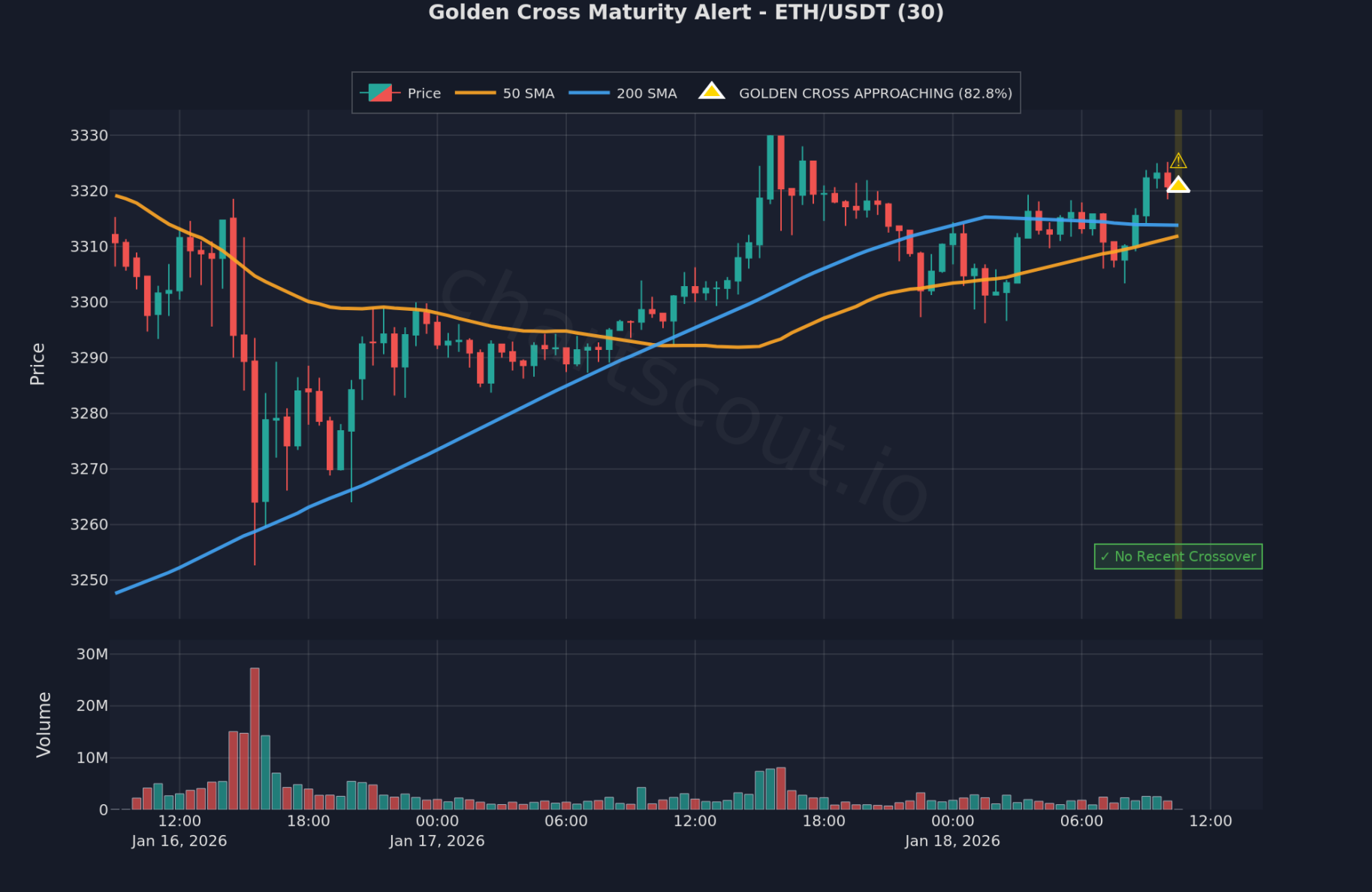
ETH/USDT golden cross
- Exchange: Bybit
- Timeframe: 30 minutes
- Asset Type: Cryptocurrency
Click image to enlarge
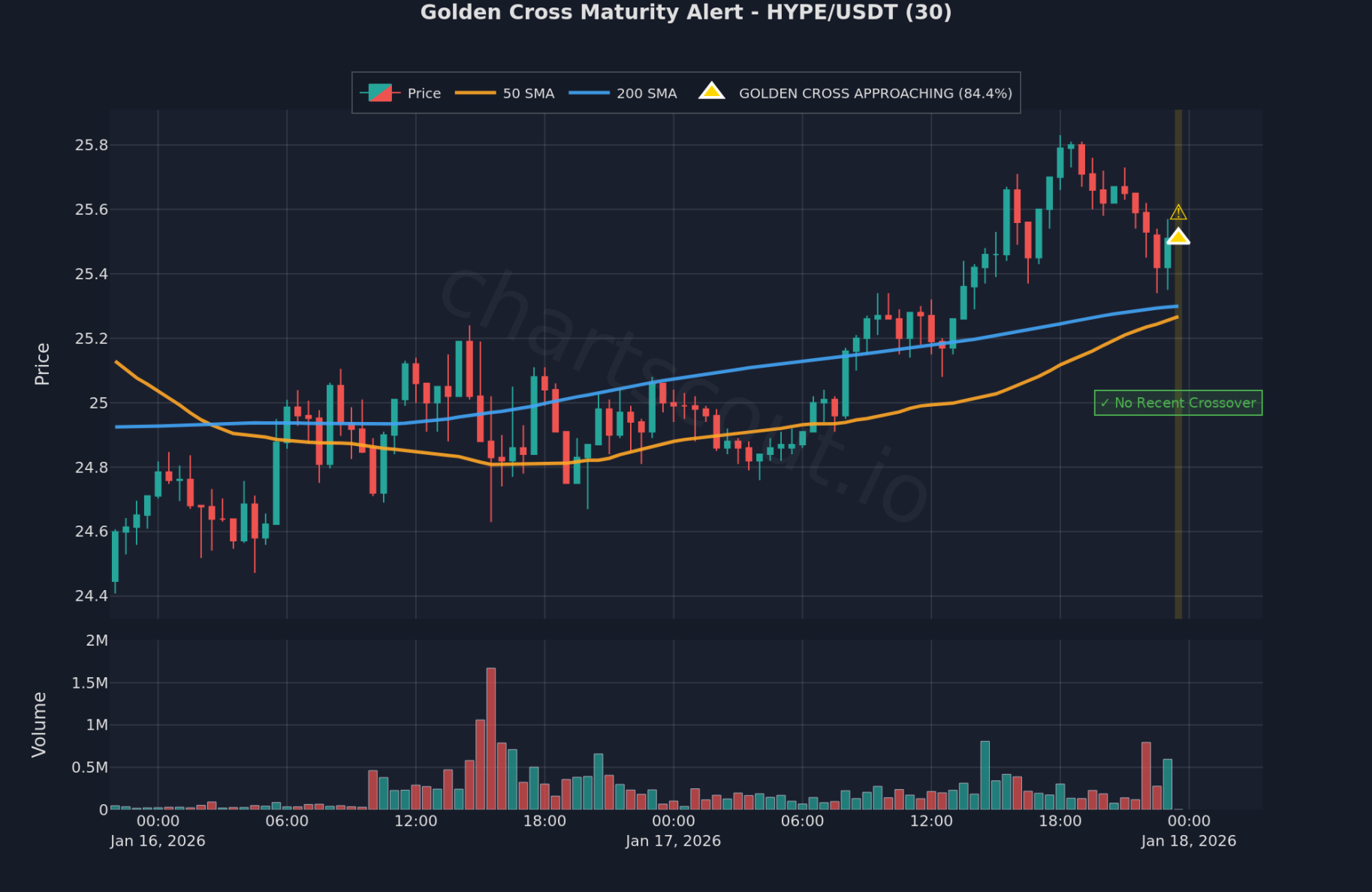
HYPE/USDT golden cross
- Exchange: Bybit
- Timeframe: 30 minutes
- Asset Type: Cryptocurrency
Click image to enlarge
Death cross detections (precious metals)
🏆 Beyond crypto: precious metals trading
ChartScout monitors tokenized precious metals that trade on crypto exchanges. These assets-like Gold (XAUT, PAXG) and Silver tokens-follow the same technical patterns and respond to the same crossover signals. One platform, multiple asset classes.
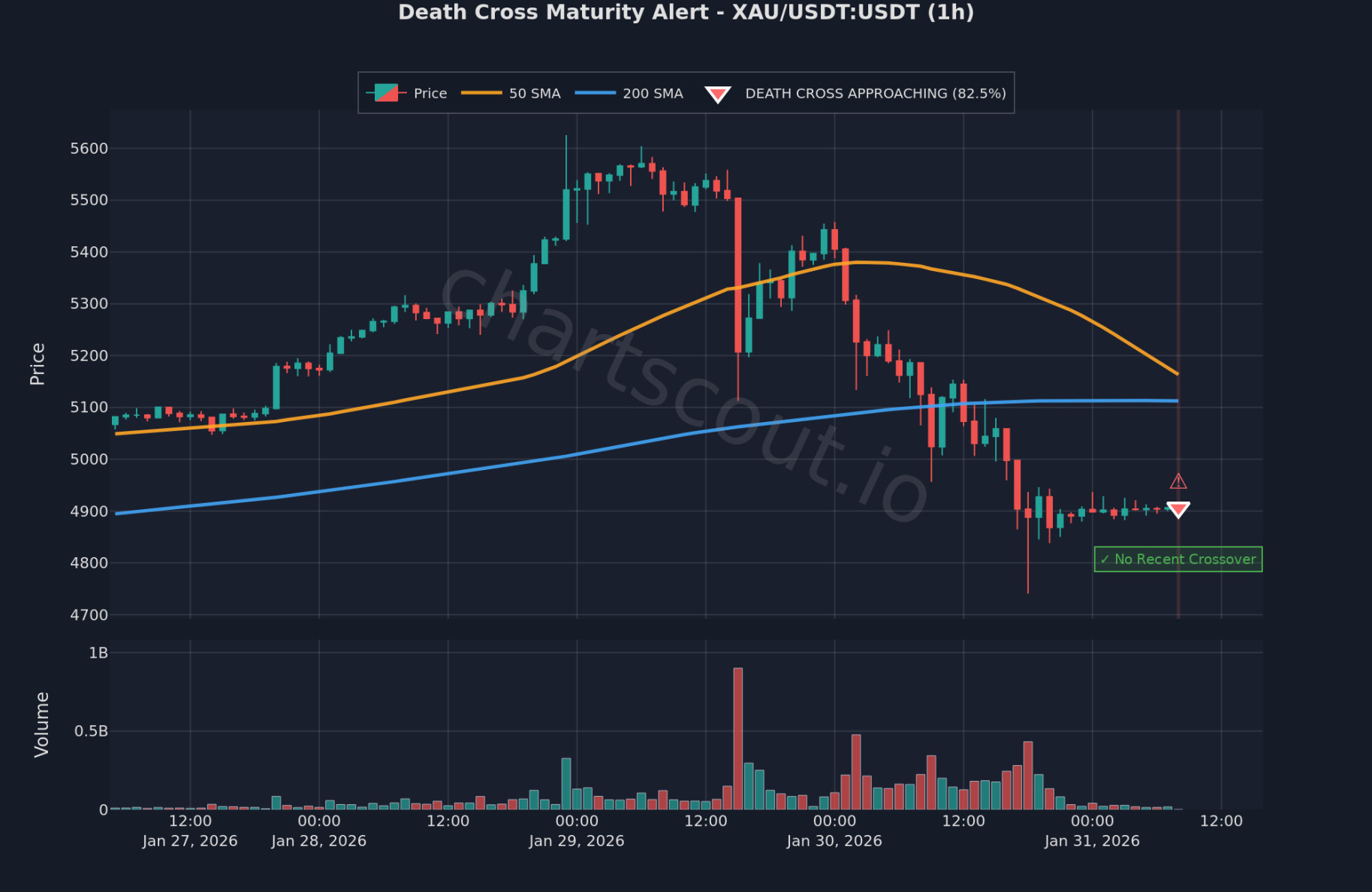
GOLD/USDT death cross
- Exchange: Binance
- Timeframe: 1 hour
- Asset Type: Precious Metal (Tokenized Gold)
Click image to enlarge
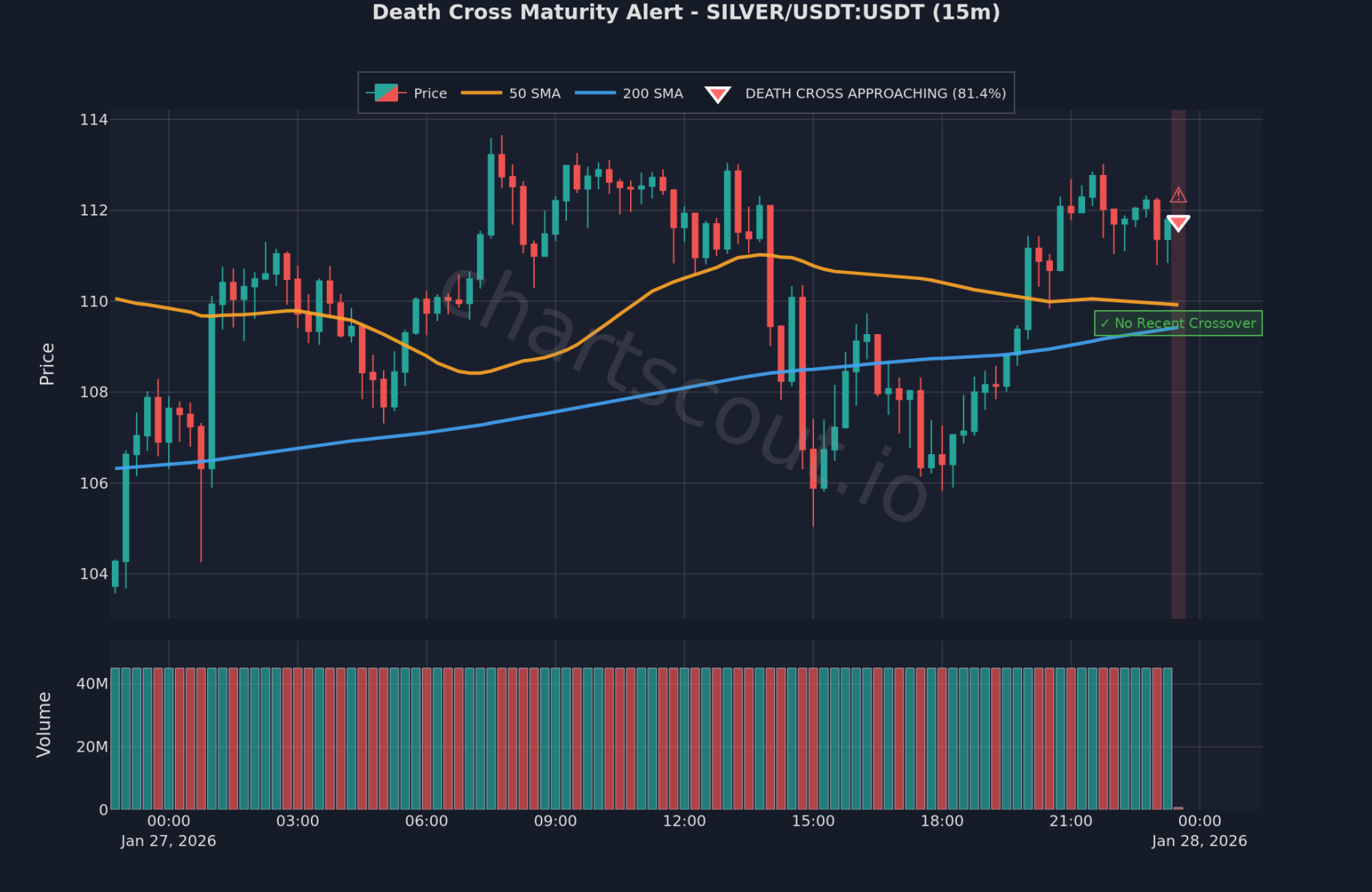
SILVER/USDT death cross
- Exchange: MEXC
- Timeframe: 15 minutes
- Asset Type: Precious Metal (Tokenized Silver)
Click image to enlarge
📊 Why this matters
These screenshots show ChartScout detecting crossovers at the 80% maturity point-the critical window where the crossover is highly probable but hasn't yet completed. Traders receive these alerts before the signal becomes common knowledge.
Whether you trade crypto majors like ETH, altcoins like HYPE, or diversify into tokenized precious metals-ChartScout monitors them all with the same precision.
Remember: these are predictions
Every crossover shown above was detected at 80%+ maturity-meaning the system predicted the crossover was likely to complete. However, not all predictions materialize. A sudden market event, news, or large order flow can reverse price and prevent the crossover from completing. Always treat these alerts as opportunities to investigate, not automatic trading signals.
Frequently asked questions
What is the difference between a golden cross and a death cross?
The difference is the direction of the cross. A golden cross is when the 50-day moving average crosses above the 200-day moving average, a bullish signal that recent momentum is rising above the long-term trend. A death cross is the opposite: the 50-day moving average crosses below the 200-day moving average, a bearish signal. Both use the same two moving averages, so only the direction of the crossover separates them.
What is a golden cross in crypto trading?
A golden cross is a bullish technical signal that occurs when the 50-day moving average crosses above the 200-day moving average. It suggests the intermediate-term trend is strengthening and overtaking the long-term trend, often marking the beginning of a sustained uptrend.
What is a death cross in crypto trading?
A death cross is a bearish technical signal that occurs when the 50-day moving average crosses below the 200-day moving average. It suggests the intermediate-term trend is weakening, though in crypto, death crosses frequently mark local bottoms rather than the start of extended bear markets.
Should I wait for the golden cross to confirm before entering a trade?
No. Markets typically react 10-15 candles before the golden cross actually completes. By the time the crossover confirms, the early move has already happened and the risk/reward has deteriorated. The better approach is to enter at 80% maturity-when the moving averages are close to crossing but haven't yet.
How reliable are golden cross and death cross signals in crypto?
Golden crosses and death crosses are more reliable when combined with other factors: volume confirmation, chart pattern confluence, and proper market context. In isolation, crossovers have a moderate success rate. With confluence, the success rate increases significantly.
What is the 80% maturity point for a crossover?
The 80% maturity point is when the 50-day and 200-day moving averages are within approximately 0.2% of crossing. At this stage, the crossover is highly probable unless a dramatic reversal occurs. This is the critical window for entering before the signal becomes public knowledge.
Can I use golden cross and death cross on lower timeframes like 1-hour or 4-hour charts?
Yes, but reliability decreases on lower timeframes due to more noise. The daily chart is the most reliable timeframe for crossover signals. Use lower timeframes (4H, 1H) for pattern confluence or short-term tactical trades, but prioritize daily and weekly crossovers for swing trading.
What's the difference between SMA and EMA for crossover signals?
Golden cross and death cross signals traditionally use Simple Moving Averages (SMA), which give equal weight to all prices in the period. Exponential Moving Averages (EMA) give more weight to recent prices, making them more responsive but also more prone to false signals. For classic crossover trading, SMA is preferred.
How often do golden crosses and death crosses occur on Bitcoin?
On the daily chart, golden crosses and death crosses on Bitcoin occur roughly 1-3 times per year, depending on market conditions. In trending markets (bull or bear), they're rare. In transitional periods (moving from bear to bull or bull to bear), they're more frequent. This low frequency makes each signal significant.
Why do death crosses often mark bottoms in crypto instead of the start of downtrends?
Crypto moves faster than traditional markets. By the time a death cross confirms on the daily chart, the asset may have already been declining for weeks or months. The crossover itself often coincides with capitulation-the final wave of sellers exiting-which creates the liquidity needed for a reversal. Context is critical: a death cross in a bull market consolidation is different from a death cross in a bear market.
What's the best way to combine golden cross signals with chart patterns?
Look for confluence: a golden cross approaching on the daily chart while a bullish chart pattern (falling wedge, ascending triangle, inverse head and shoulders) completes on a lower timeframe (4H). This multi-timeframe, multi-signal setup has a much higher success rate than either signal in isolation. Automated detection systems like ChartScout can identify these confluence setups across 1,000+ pairs simultaneously.
Key takeaways: trade like a pro
What you need to remember
- Understand the pre-reaction window: Markets move 10-15 candles before the crossover completes. Waiting for confirmation means entering late.
- Enter at 80% maturity: When the 50-day and 200-day MA are within ~0.2% of crossing, the signal is mature enough to act on. This is the edge.
- Volume and patterns matter: A golden cross with increasing volume + a falling wedge breakout is a high-conviction setup. A golden cross alone in low-volume chop is a trap.
- Context is everything in crypto: Death crosses in bull market consolidations often mark local bottoms, not the start of bear markets. Assess the broader trend structure.
- Confluence multiplies probability: Crossover + pattern + volume + market structure = the type of setup that justifies larger position sizing.
- Automate the detection: Manually tracking crossovers across 1,000+ pairs is impossible. Use systems like ChartScout to monitor for 80% maturity and pattern confluence 24/7.
Golden crosses and death crosses aren't magic. They're simply visual representations of trend shifts that are already underway. The edge isn't in knowing what they are-everyone knows that. The edge is in detecting them early, confirming them with patterns and volume, and entering during the pre-reaction window while the crowd is still waiting for confirmation.
That's how you turn a lagging indicator into a leading opportunity. Learn how alert-driven trading can automate this entire workflow for you.
Ready to catch crossovers at 80% maturity?
ChartScout automatically detects golden crosses and death crosses at 80% maturity across 1,000+ crypto pairs, 24/7. Get alerted during the pre-reaction window, before the crowd arrives.
Start your 7-day Pro trial and set up your first pattern watcher in under 2 minutes.
Sources & references
Academic & technical analysis literature
Primary sources for moving average crossover principles and technical analysis methodology. All citations include specific page numbers and ISBN references for academic verification:
- Murphy, John J. Charting Made Easy. Marketplace Books, 1999. ISBN: 978-1-592-80093-7.
Page 15: Price forecasting and market timing for short-term traders. Murphy establishes that while price forecasting is the first step, market timing is often the more difficult aspect of trading decisions.
Page 58: Moving average lag characteristics. Murphy explains that since moving averages are constructed by averaging several days' closing prices, they inherently tend to lag behind current price action. - Miner, Robert C. High Probability Trading Strategies for Entering and Exiting Trades. John Wiley & Sons, 2008. ISBN: 978-0-470-18736-8.
Page 19: Lagging indicators and their relationship to past data. Miner categorizes indicators by their temporal relationship to price action, establishing the theoretical foundation for understanding crossover signals.
Page 23: False trend reversal signals from moving average crossovers. Miner documents that moving average crossovers are notorious for generating false signals, particularly in ranging markets.
Page 24: Limitations of individual technical techniques. Miner emphasizes that no single technical indicator should be used in isolation, requiring multiple confirmation factors for high-probability setups. - Pring, Martin J. Pring on Price Patterns: The Definitive Guide to Price Pattern Analysis and Interpretation. McGraw-Hill, 2005. ISBN: 978-0-071-45052-3.
Page 8: Weight-of-the-evidence approach to technical analysis. Pring argues that price patterns should not be used in isolation but rather in conjunction with multiple indicators to build high-probability trade setups.
Page 18: Confluence and support/resistance strength. Pring demonstrates that when moving averages and trendlines converge at the same price level, they double the strength of that support or resistance zone.
Additional research & market data
- • Bitcoin historical crossover analysis based on daily chart data from major exchanges (Binance, Bybit, Hyperliquid) 2017-2025
- • Pre-reaction window observations derived from analyzing thousands of golden cross and death cross events across BTC/USDT, ETH/USDT, and top 50 cryptocurrencies
- • Cryptocurrency market structure analysis comparing 24/7 trading dynamics to traditional market crossover reliability
ChartScout proprietary methodology
The following methodologies represent original research and development by ChartScout:
- • 80% Maturity Threshold Detection: ChartScout's proprietary algorithm for predicting crossover completion when moving averages are within ~0.2% of crossing, developed through backtesting crossover predictive accuracy on 4H and daily timeframes across 1,000+ cryptocurrency pairs
- • Pre-Reaction Window Analysis: Systematic observation that markets begin reacting 10-15 candles before crossover completion, identified through ChartScout's analysis of thousands of crossover events
- • Multi-Signal Confluence Detection: Automated system for identifying when crossover signals align with chart pattern breakouts on the same trading pair
Note: The application of classical moving average crossover principles to cryptocurrency markets, combined with ChartScout's proprietary 80% maturity detection methodology, represents an original approach to improving the timing and reliability of these traditional technical signals.
Related guides
How to spot fake breakouts in crypto
Learn to identify fakeouts with a 7-point verification checklist, probability tables, and real case studies.
Chart patterns & volume analysis
Master volume confirmation across every major chart pattern , the #1 signal for valid breakouts.
Head and shoulders pattern guide
The definitive guide with 81% success rate stats from 2,800+ trades and crypto-specific insights.
Rising wedge vs falling wedge
Complete guide to wedge patterns in crypto with Bulkowski statistics and breakout strategies.
How to read crypto charts
From candlestick basics to advanced technical analysis , everything you need to read crypto charts.
Alert-driven trading
How real-time pattern alerts replace screen-watching and improve your trading consistency.

Stjepan Ivanović
Founder of ChartScout · Crypto Trader Since 2013
Trading crypto since 2013 with his first Bitcoin bought at ~$200. Four complete bull/bear market cycles, traded on early exchanges like Mt.Gox and BTC-e, on-chain trading on IDEX and EtherDelta, and ~70 crypto project investments. Built ChartScout after 23+ months of development to automate what no trader can do manually. Watch hundreds of charts 24/7.