How to combine chart patterns with volume analysis
Volume confirms chart pattern validity by revealing conviction behind price moves. Research shows patterns with proper volume confirmation tend to achieve better post-breakout performance. The key principle: volume should contract during pattern formation and expand on breakout. This guide applies that rule to eight major chart patterns and the false-breakout checks that keep low-conviction moves out of your trade plan.
Note: Thomas Bulkowski's extensive research demonstrates that breakouts accompanied by above-average volume consistently show better post-breakout performance across pattern types.
The missing piece in pattern trading
Two traders spot the same ascending triangle on ETH/USDT. One enters on the breakout and profits. The other enters on the same breakout and gets stopped out on a false move. Same pattern. Same pair. Different outcomes.
The difference? Volume.
Most traders learn to identify patterns but never learn to read what volume tells them about those patterns. They're reading half the story. If you're still building your foundation, start with our complete guide to reading crypto charts first. When a breakout lacks confirmation, compare the setup with our fake-breakout checklist. This guide shows you exactly how volume behaves during pattern formation and breakout for 8 major chart patterns, with 4,000 words of deep-dive analysis backed by statistical research.
What you'll learn:
- Why volume contracts during formation
- Bullish and bearish volume signatures
- How to spot divergence warnings
- Crypto-specific volume thresholds
- Advanced volume indicator combinations
- How to avoid false breakouts using volume
- Real-world trading examples
The foundation - why volume confirms patterns
Price shows what happened. Volume shows how real it is.
Volume represents conviction. When price moves on high volume, many participants agree with that direction. When price moves on low volume, few participants are involved - making the move suspect. The relationship between price and volume reveals the underlying strength or weakness of a move. A breakout that occurs on light volume suggests that only a small number of participants are driving the move, which often leads to failure. Conversely, when a breakout happens with a significant surge in volume, it indicates widespread agreement and participation, making the move more likely to sustain.
“Volume should expand in the direction of the trend.”
- Charles Dow, foundational principle of market analysisThe volume-price matrix
| Price Movement | Volume | Interpretation |
|---|---|---|
| Price Up | Volume Up | Bullish - buyers stepping in |
| Price Up | Volume Down | Warning - weak conviction |
| Price Down | Volume Up | Bearish - sellers in control |
| Price Down | Volume Down | Warning - selling exhausted |
Source: Adapted from John Murphy's "Technical Analysis of the Financial Markets"
Why this matters for patterns
Chart patterns are consolidation zones where buyers and sellers battle. Volume tells you who's winning that battle - and when one side is about to give up. The accumulation or distribution that occurs within the pattern is only revealed through volume analysis. Without understanding volume, traders are essentially blind to the forces building up behind the pattern.
The universal rule - contraction and expansion
Volume contracts during formation, expands on breakout
Nearly all chart patterns share one volume characteristic: volume decreases as the pattern develops, then surges when price breaks out. This “coiling” effect stores energy as uncertainty increases and traders wait for resolution.
During formation:
- Uncertainty increases as pattern develops
- Traders wait on sidelines for resolution
- Lower participation = lower volume
- Smart money accumulates or distributes quietly
At breakout:
- Uncertainty resolves
- Sidelined traders enter (FOMO)
- Stops trigger on trapped traders
- Momentum traders pile in
The confirmation rule
Thomas Bulkowski's research found that breakouts with above-average volume showed better follow-through. A reasonable threshold: breakout volume should exceed the 20-day average by at least 25-30% for traditional markets. In crypto, we look for 2-3x average.
Understanding volume indicators
While raw volume analysis is valuable, volume indicators can provide additional insight and make volume trends easier to identify.
On-balance volume (OBV)
Cumulative line showing volume flow. “Volume precedes price.” Watch for OBV breaking out before price as an early confirmation signal.
VWAP
Volume-Weighted Average Price. Acts as dynamic support/resistance. Breakouts with price staying above VWAP are significantly stronger.
Accumulation/Distribution
Combines price and volume to show if an asset is being bought or sold. Rising A/D during pattern formation confirms accumulation.
Bullish patterns + volume signatures
Ascending triangle
Flat resistance + rising support. Bullish continuation.
| Phase | Expected Volume |
|---|---|
| During formation | Declining (each test of resistance shows less volume) |
| Breakout above resistance | Sharp expansion (above-average volume) |
| Pullback to breakout level | Lower than breakout volume |
“The volume trend is downward, too, until the upward breakout.”
- Thomas Bulkowski, Encyclopedia of Chart Patterns (p. 740)Breakout Timing: Bulkowski's research shows breakouts typically occur between 2/3 and 3/4 of the distance to the apex. Breakouts that occur too early or too close to the apex have lower reliability. A breakout on weak volume frequently fails. Symmetrical triangles are notorious for false breakouts - volume confirmation is essential.
Trading Tip: Wait for the close above resistance with volume at least 1.5x the 20-day average. Enter on the breakout or on a pullback to the breakout level if it occurs on diminished volume.
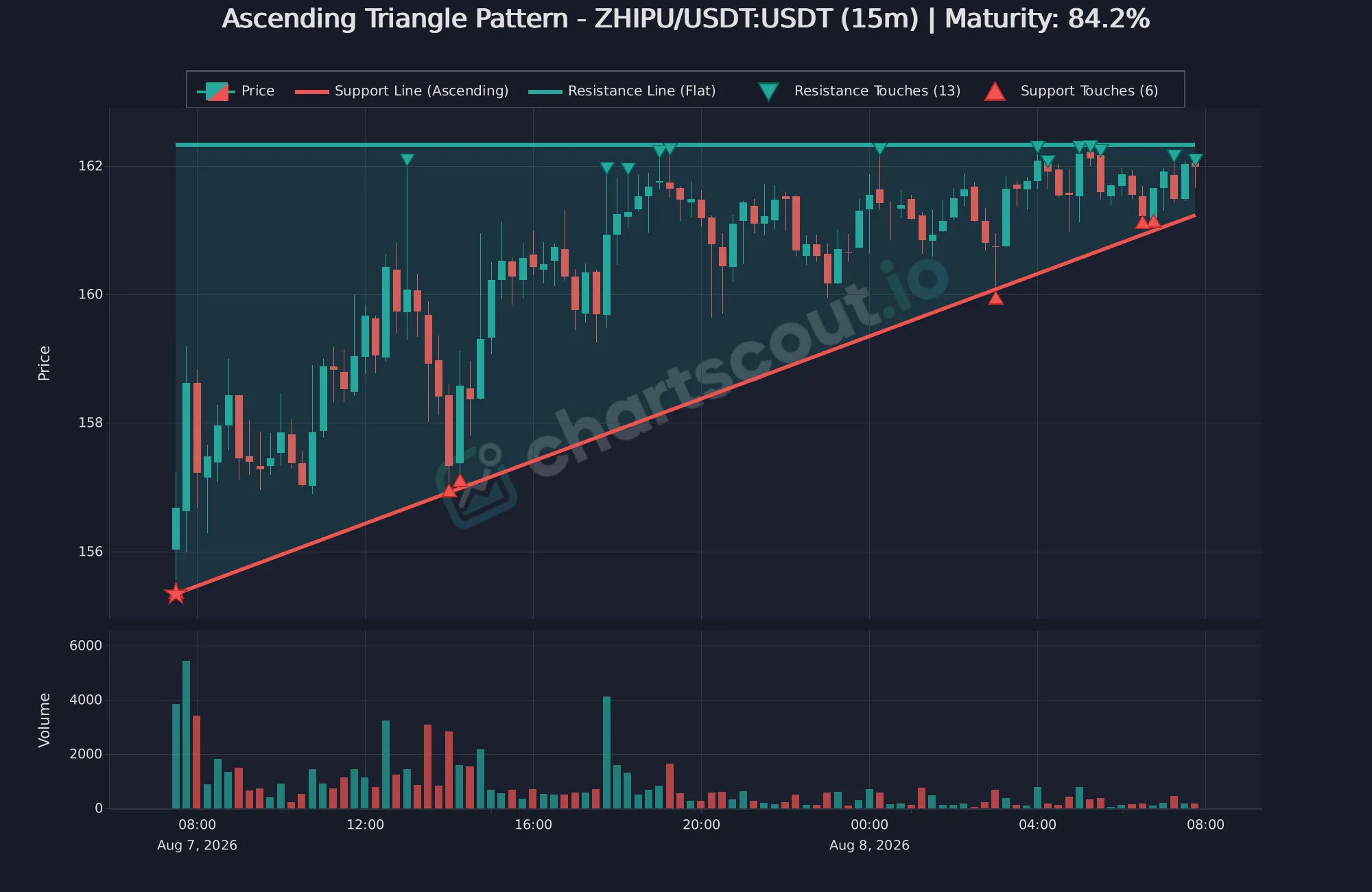
ZHIPU/USDT shows rising support pressing into flat resistance, with touch markers and volume visible on this 15-minute Binance ascending triangle detected August 8, 2026.
Double bottom
Two lows at similar price level. Bullish reversal.
| Phase | Expected Volume |
|---|---|
| First bottom | High (selling climax) |
| Second bottom | LOWER than first bottom |
| Breakout above neckline | Expansion confirms |
“The left bottom usually shows higher volume.”
- Thomas Bulkowski, Encyclopedia of Chart Patterns (p. 239)Key Insight: The first bottom represents panic selling or a climax of bearish sentiment. The second bottom, occurring on lighter volume, shows that even at the same low price, fewer traders are willing to sell. This exhaustion of selling pressure sets the stage for a reversal.
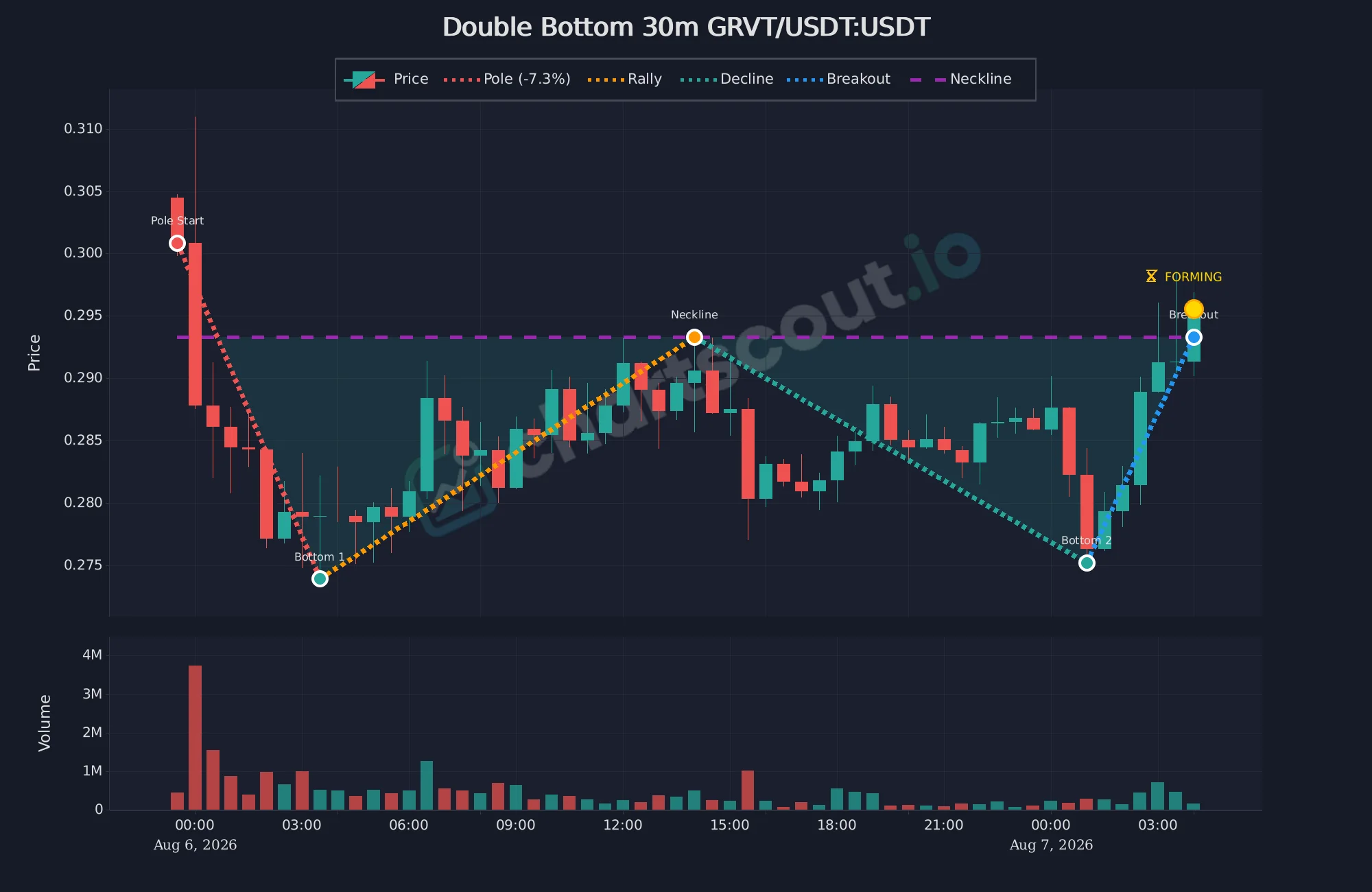
GRVT/USDT forms two labeled lows beneath a shared neckline on this 30-minute Bybit double bottom detected August 7, 2026.
Key indicator: bullish divergence
Price makes equal lows, but volume makes a LOWER low. This shows selling pressure is exhausted - fewer sellers remain. If second bottom has HIGHER volume than first, pattern may fail.
Bull flag
Sharp move up (pole) + tight consolidation (flag). Continuation pattern.
| Phase | Expected Volume |
|---|---|
| Flagpole (initial surge) | Very high (impulse move) |
| Flag (consolidation) | Very low (should dry up) |
| Breakout from flag | Expansion (not as high as pole) |
“The volume trend nearly always recedes over the course of the formation.”
- Thomas Bulkowski, Encyclopedia of Chart Patterns (p. 357)Key Insight: Flag volume should be less than 50% of flagpole average volume. If volume stays high during the flag, it's likely distribution - not consolidation. The flag represents profit-taking after a strong move, but if too many participants are selling, the pattern will fail.
Common Mistake: Many traders enter during the flag thinking they're getting a good price. Instead, wait for the breakout confirmation with volume. Entering during consolidation exposes you to unnecessary risk.
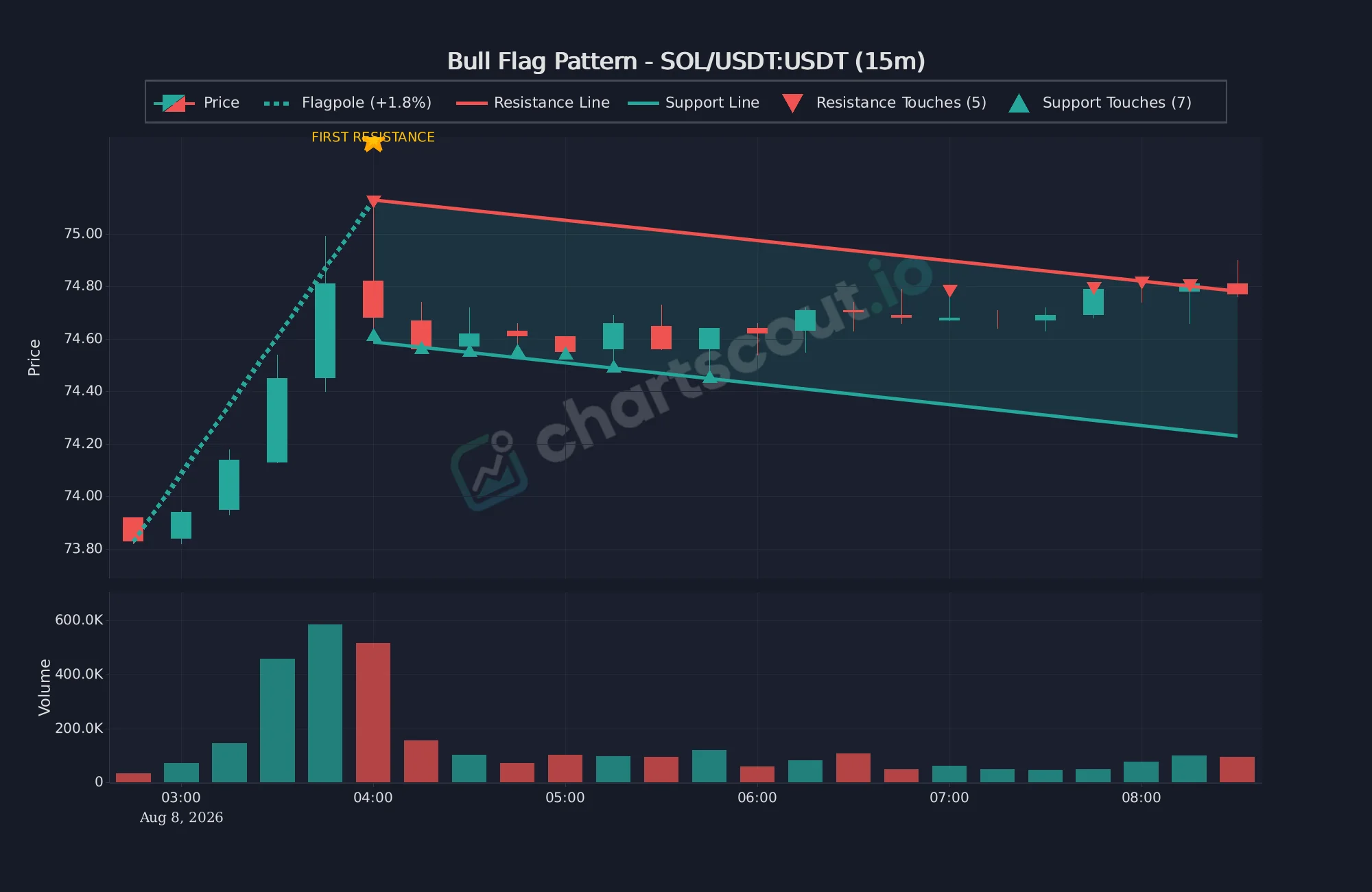
SOL/USDT shows a sharp flagpole followed by a downward-sloping consolidation channel on this 15-minute Binance bull flag detected August 8, 2026.
Falling wedge
Converging trendlines sloping downward. Bullish reversal pattern.
| Phase | Expected Volume |
|---|---|
| During formation | Declining steadily |
| Breakout above upper trendline | Moderate expansion (1.5-2x) |
“Volume trend. The volume trend should be downward...7 out of every 10 formations show a downward volume pattern.”
- Thomas Bulkowski, Encyclopedia of Chart Patterns (p. 821)Key Insight: Volume decline during a falling wedge shows selling pressure is weakening. Each push lower happens on less conviction. Wedge breakouts can occur on lighter volume than triangles - 70% of formations display this downward volume pattern. For a complete breakdown of wedge identification and trading strategies, see our rising wedge vs falling wedge guide.
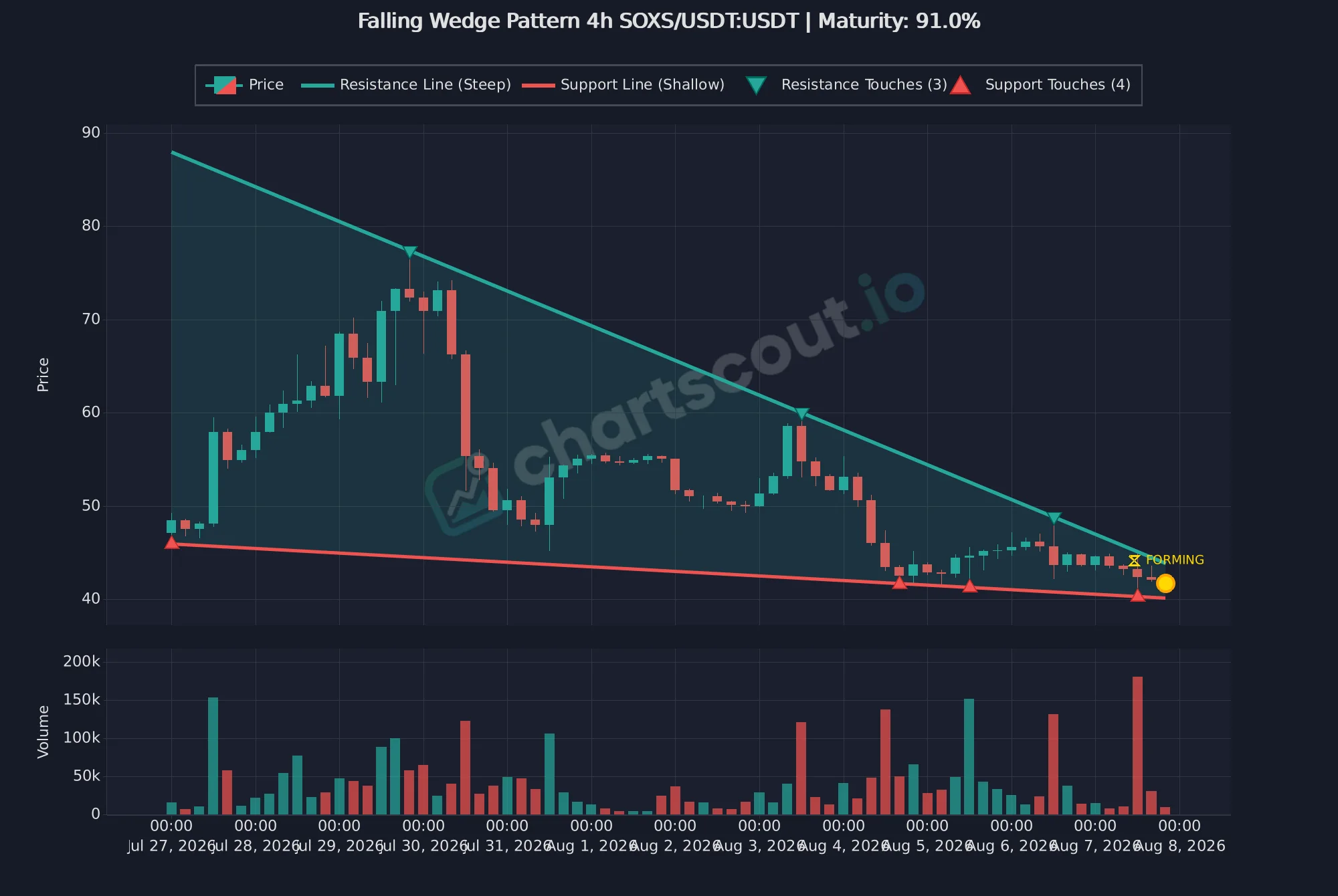
SOXS/USDT compresses between two downward-sloping converging trendlines on this 4-hour Bybit falling wedge detected August 8, 2026.
Triple bottom
Three lows at similar price level. Stronger bullish reversal than double bottom.
| Phase | Expected Volume |
|---|---|
| First bottom | Highest (selling climax) |
| Second bottom | Lower than first |
| Third bottom | Lowest of the three |
| Breakout above neckline | Strong expansion |
“Each of the three bottoms usually shows volume that peaks above the days leading to the bottom, with the first bottom usually having the highest volume of the trio.”
- Thomas Bulkowski, Encyclopedia of Chart Patterns (p. 790)Warning Sign: If volume INCREASES on the third bottom compared to the second, sellers may be returning - pattern reliability decreases. The overall volume trend should be downward.
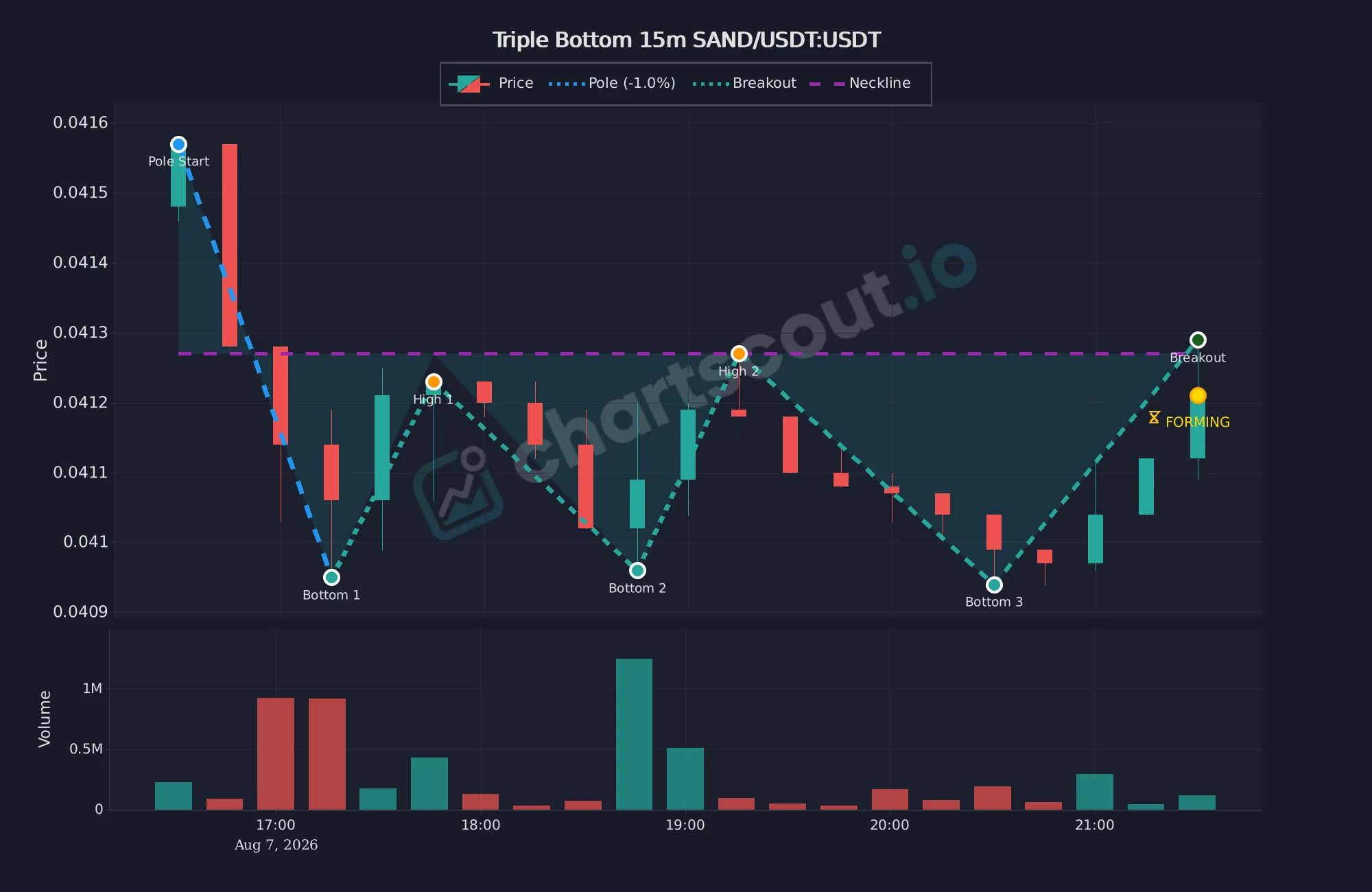
SAND/USDT shows three labeled tests of support below a common neckline on this 15-minute Bybit triple bottom detected August 7, 2026.
Bull pennant
Sharp move up (pole) + small symmetrical triangle (pennant). Continuation pattern.
| Phase | Expected Volume |
|---|---|
| Flagpole (initial surge) | Very high (impulse move) |
| Pennant (consolidation) | Downward trending - should dry up |
| Breakout from pennant | Expansion confirms continuation |
“Most of the time, pennants will have a downward volume trend.”
- Thomas Bulkowski, Encyclopedia of Chart Patterns (p. 545)Pennant vs Flag: Pennants typically resolve faster than flags - expect 1-3 weeks duration. Volume contraction should be more pronounced and rapid. Heavy breakout volume propels prices farther.
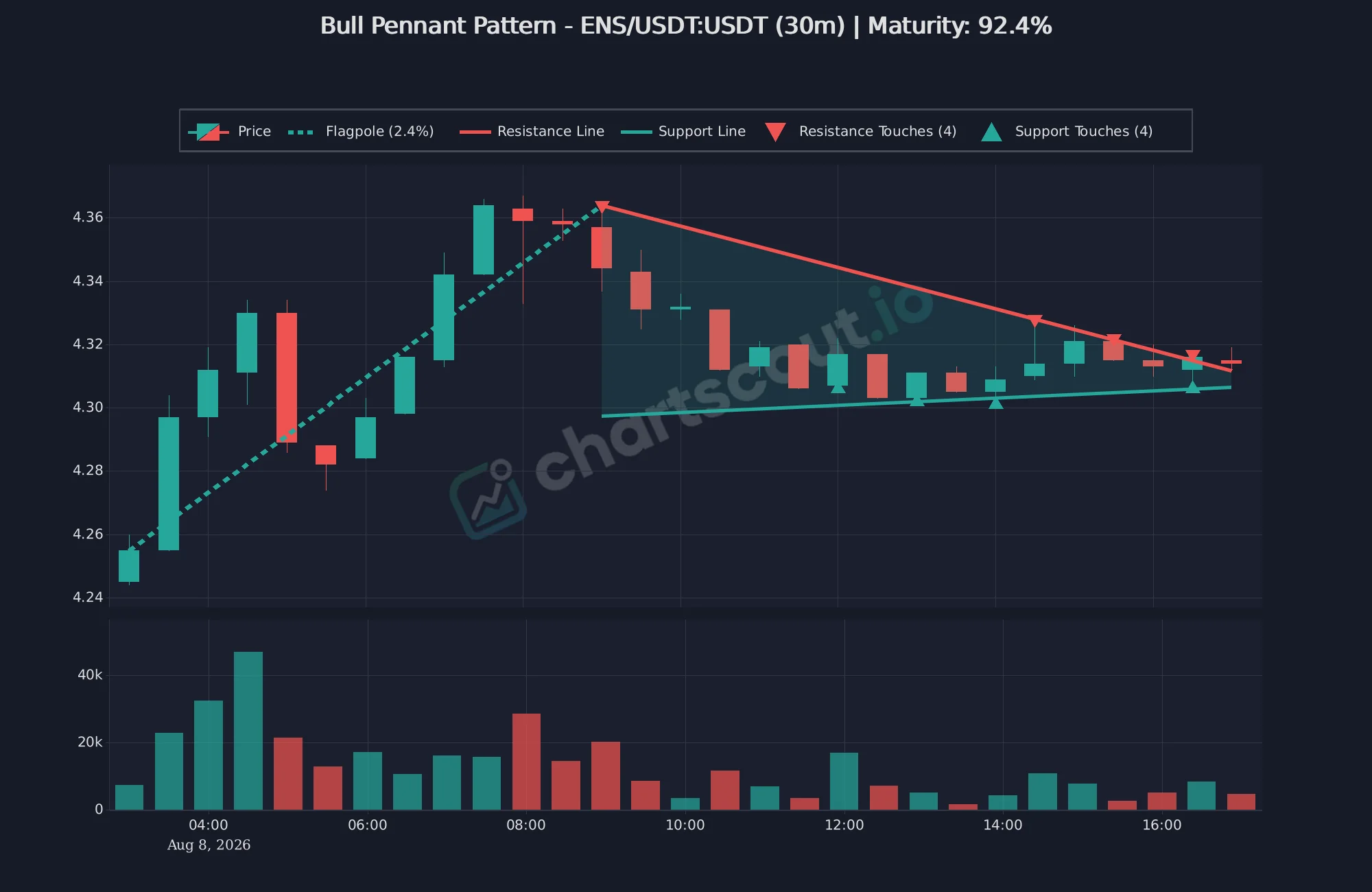
ENS/USDT shows an upward flagpole followed by a tight converging consolidation on this 30-minute Binance bull pennant detected August 8, 2026.
Symmetrical triangle
Converging trendlines with no directional bias. Can break either direction but slightly favors continuation.
| Phase | Expected Volume |
|---|---|
| During formation | Declining steadily (critical) |
| Breakout (either direction) | Strong surge required |
“Volume trend splits between those triangles with breakouts in the direction of the prevailing trend and the countertrend triangles.”
- Thomas Bulkowski, Encyclopedia of Chart Patterns (p. 782)Breakout Timing: Bulkowski's research shows breakouts typically occur between 2/3 and 3/4 of the distance to the apex. Breakouts that occur too early or too close to the apex have lower reliability. A breakout on weak volume frequently fails. Symmetrical triangles are notorious for false breakouts - volume confirmation is essential.
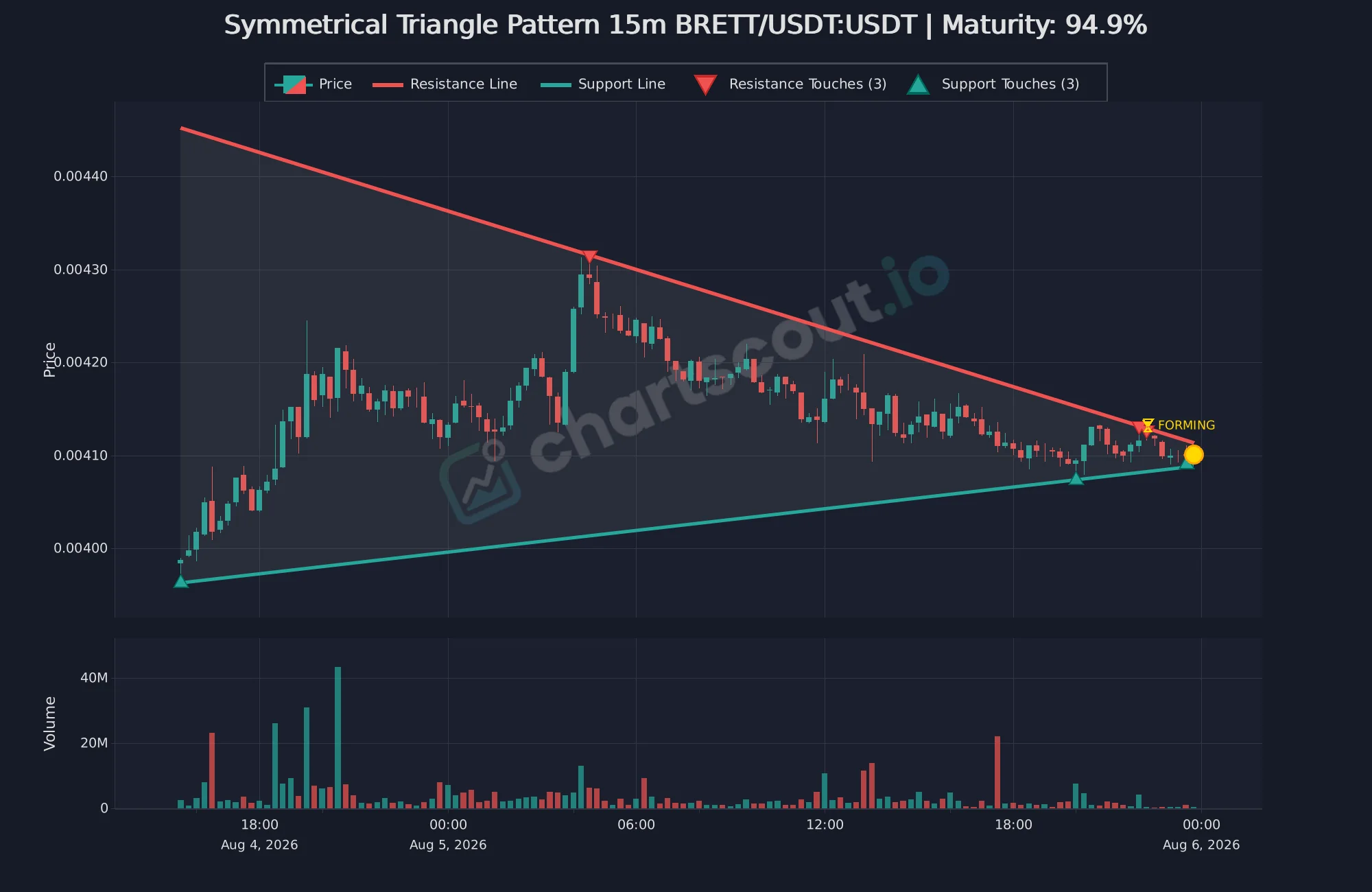
BRETT/USDT contracts between descending resistance and rising support on this 15-minute Binance symmetrical triangle detected August 6, 2026.
Channel up (ascending channel)
Price moves between two parallel upward-sloping trendlines. Bullish trend continuation.
| Phase | Expected Volume |
|---|---|
| Rallies to upper trendline | Higher volume |
| Pullbacks to lower trendline | Lower volume |
| Breakout above upper channel | Strong expansion |
Warning Sign: If volume starts expanding on pullbacks toward the lower trendline, the channel may be weakening - potential breakdown ahead.
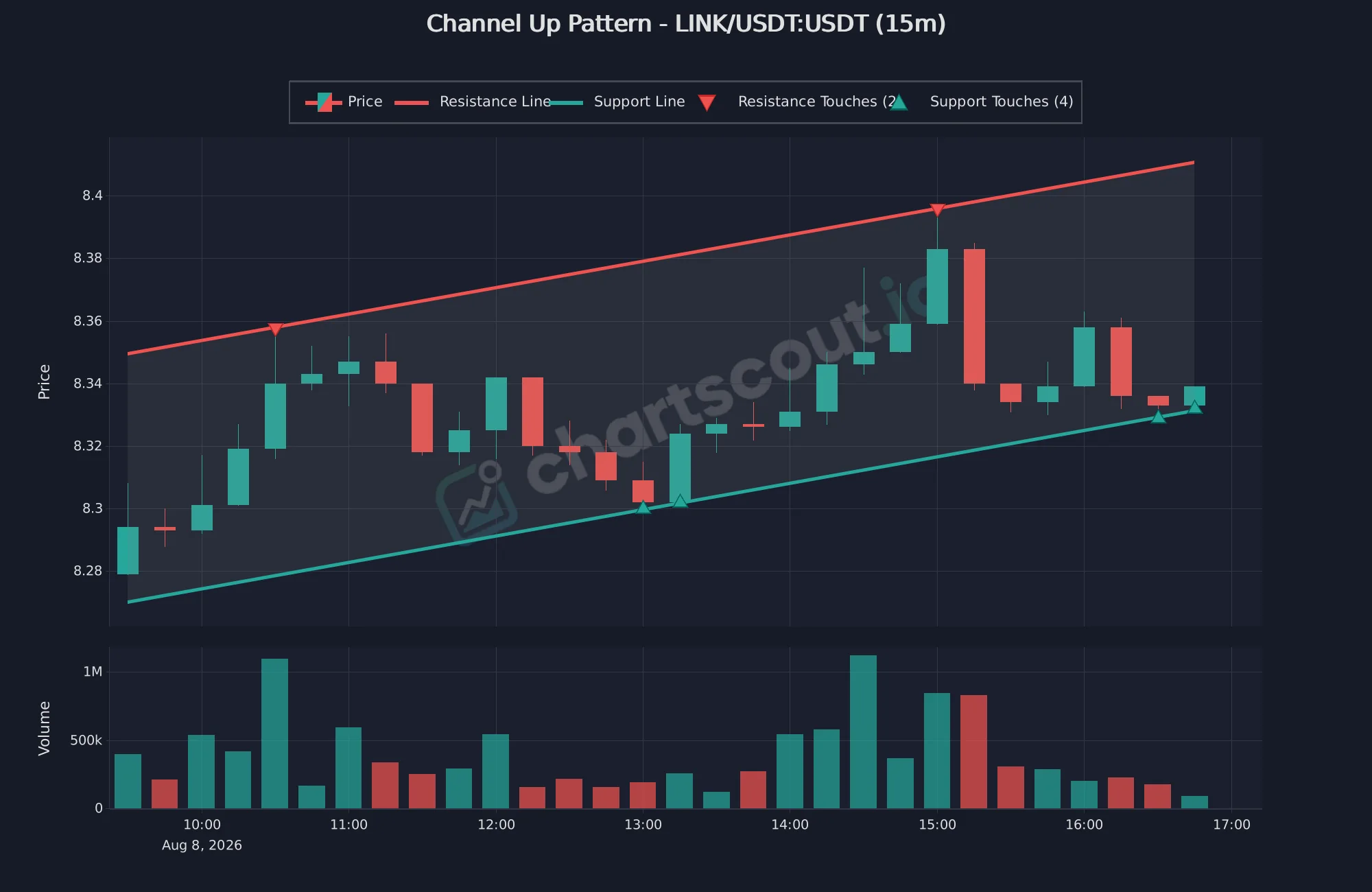
LINK/USDT moves between parallel rising support and resistance lines on this 15-minute MEXC ascending channel detected August 8, 2026.
Bearish patterns + volume signatures
Head and shoulders
Three peaks - middle (head) higher than two shoulders. Bearish reversal.
| Phase | Expected Volume |
|---|---|
| Left shoulder | Highest |
| Head | Lower than left shoulder |
| Right shoulder | Lowest of the three |
| Neckline break | Expansion confirms breakdown |
“The real tip-off that an H&S pattern is developing comes with the formation of the right shoulder, which is invariably accompanied by distinctly lower volume than the head or the left shoulder.”
- Martin Pring, Pring on Price PatternsCritical Confirmation: The neckline break must occur on expanding volume to confirm the pattern. Without this volume surge, the pattern may fail or produce only a minor decline.
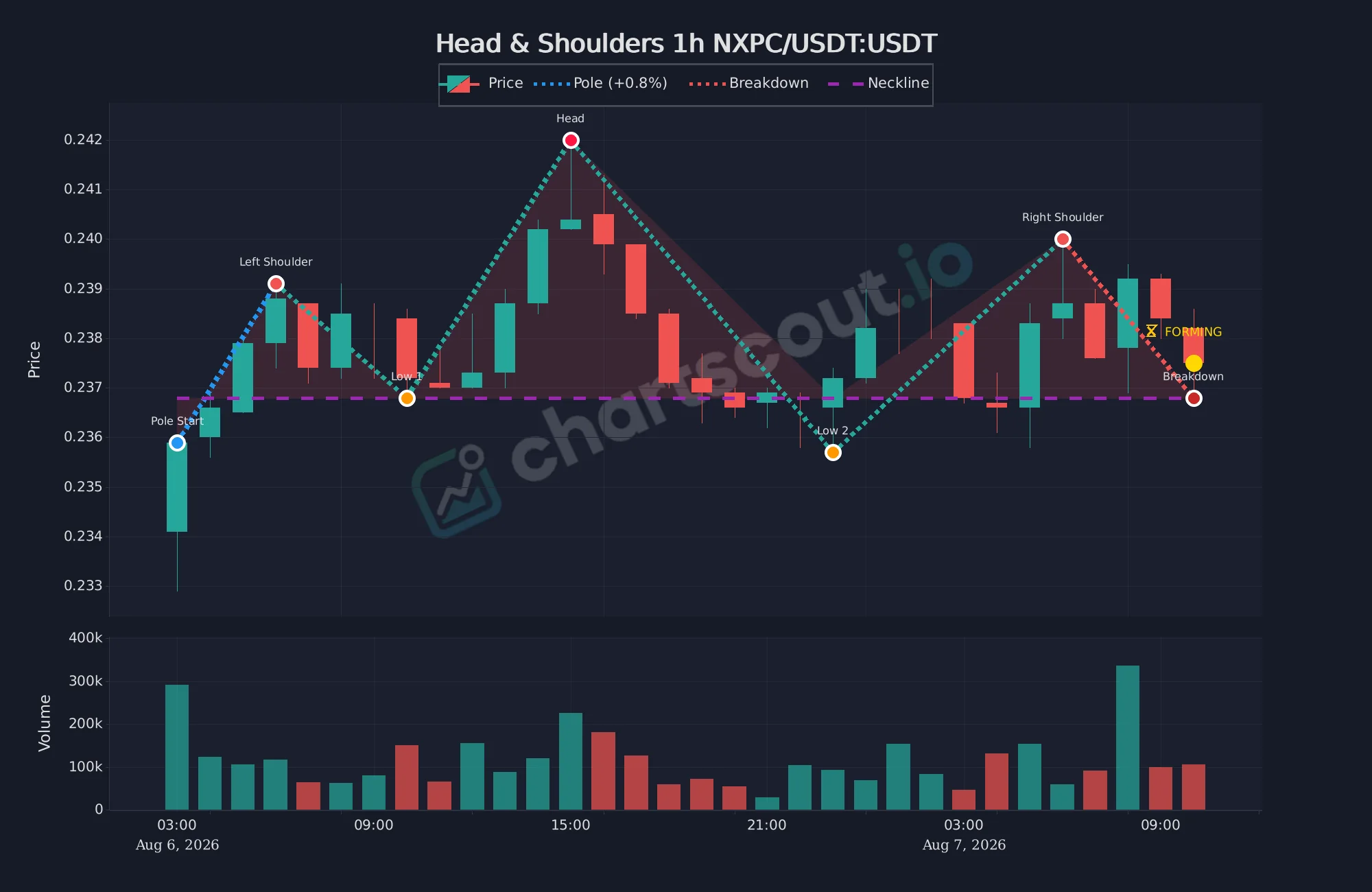
NXPC/USDT shows labeled left shoulder, head, right shoulder, and neckline on this 1-hour Binance formation detected August 7, 2026.
Descending triangle
Flat support + declining resistance. Bearish continuation.
| Phase | Expected Volume |
|---|---|
| During formation | Declining |
| Breakdown below support | Expansion confirms |
“Volume trend: Receding.”
- Thomas Bulkowski, Encyclopedia of Chart Patterns (p. 758)Key Insight: Mirror image of ascending triangle - volume should decline on each successive test of support. If volume INCREASES on later tests, sellers are getting more aggressive.
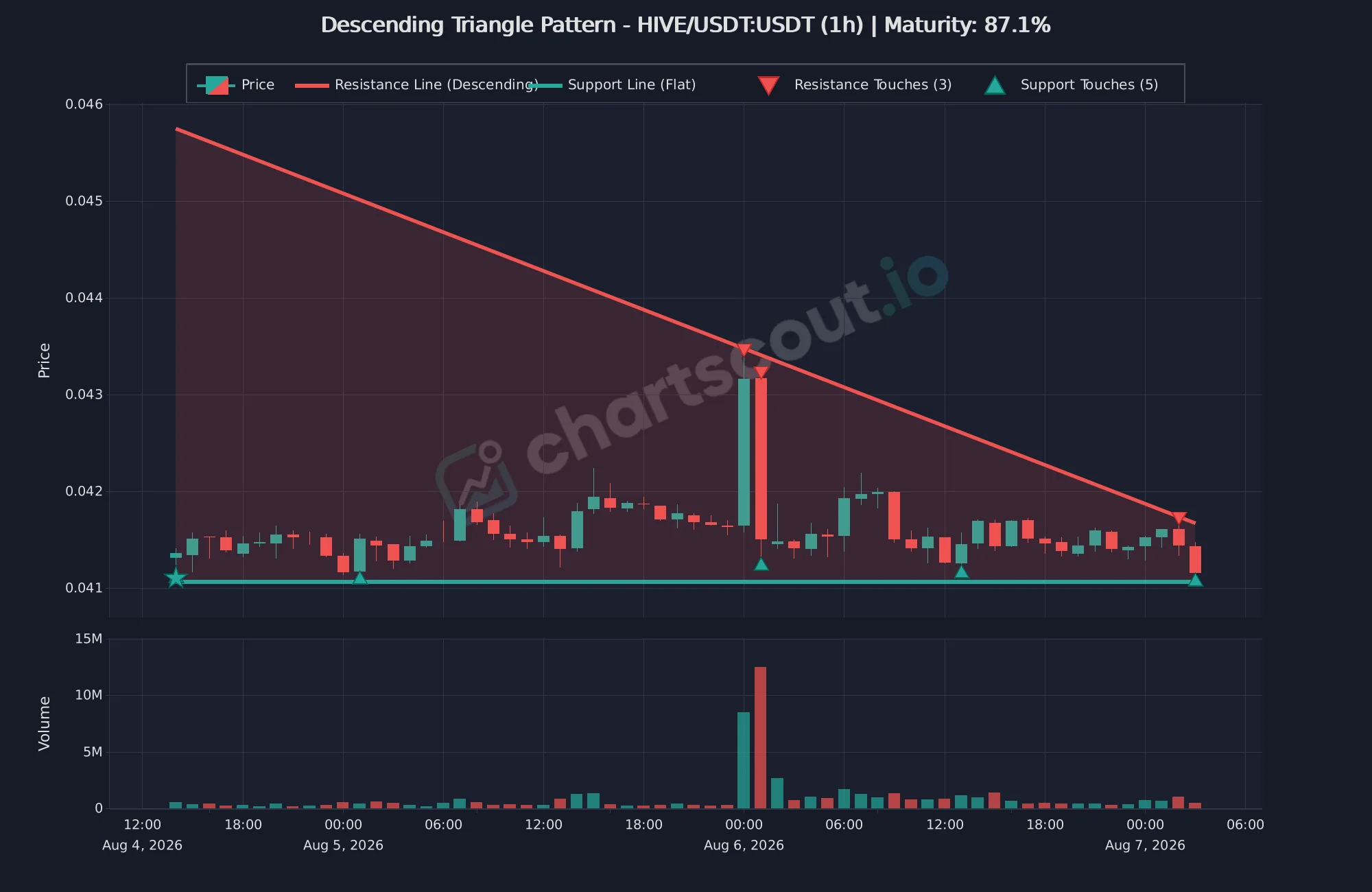
HIVE/USDT shows descending resistance converging toward flat support on this 1-hour Binance descending triangle detected August 7, 2026.
Rising wedge
Converging trendlines sloping upward. Bearish reversal pattern.
| Phase | Expected Volume |
|---|---|
| During formation | Declining steadily |
| Breakdown below lower trendline | Moderate expansion (1.5-2x) |
“The receding volume pattern is another key element in correctly identifying a rising wedge.”
- Thomas Bulkowski, Encyclopedia of Chart Patterns (p. 837)Key Insight: Rising wedges are deceptive because price is moving up, but declining volume reveals weakening buying pressure. The pattern shows buyers losing conviction with each new high. Our wedge patterns guide covers Bulkowski's statistics and breakout strategies for both rising and falling wedges.
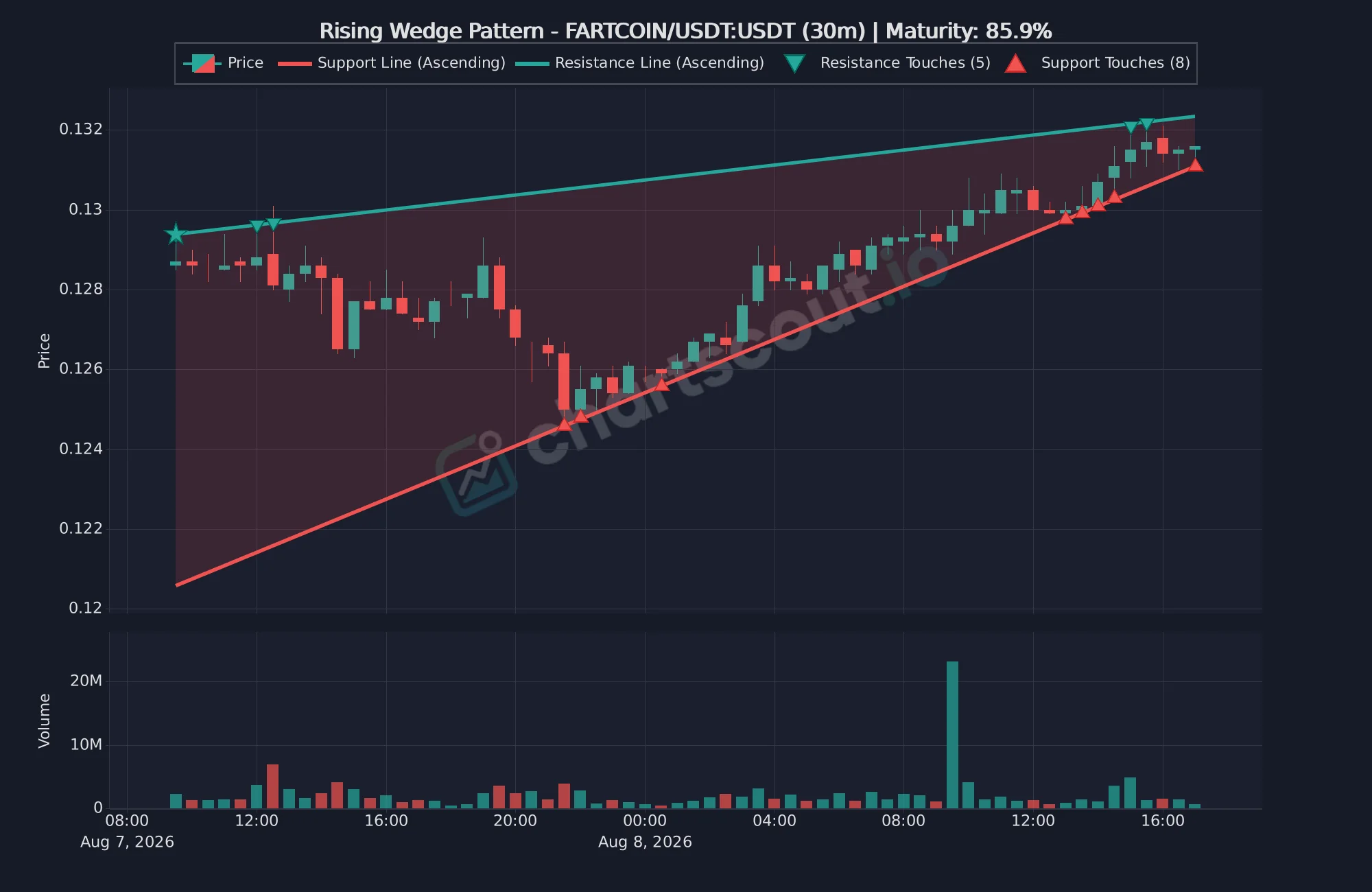
FARTCOIN/USDT narrows between two rising trendlines as price advances on this 30-minute Binance rising wedge detected August 8, 2026.
Bear flag
Sharp move down (pole) + tight upward consolidation (flag). Bearish continuation.
| Phase | Expected Volume |
|---|---|
| Flagpole (initial drop) | Very high (panic selling) |
| Flag (consolidation) | Very low (should dry up) |
| Breakdown from flag | Expansion (can be lighter than pole) |
“The volume trend nearly always recedes over the course of the formation.”
- Thomas Bulkowski, Encyclopedia of Chart Patterns (p. 357)Key Insight: Low volume during the flag shows the bounce is just short-covering, not genuine buying interest. If volume stays high during the flag, buyers may be stepping in - be cautious.
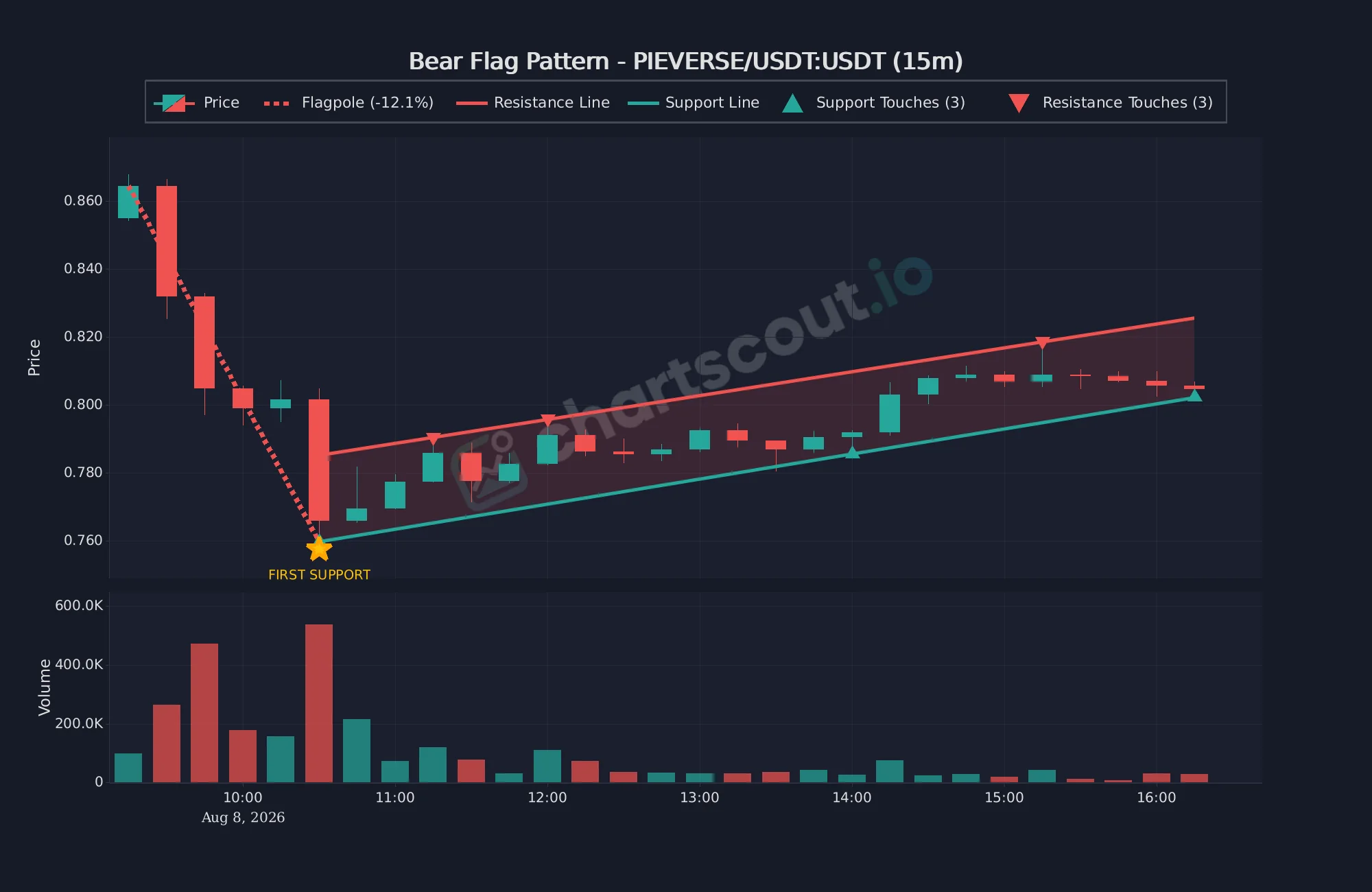
PIEVERSE/USDT shows a steep decline followed by an upward-sloping consolidation channel on this 15-minute Bybit bear flag detected August 8, 2026.
Double top
Two highs at similar price level. Bearish reversal.
| Phase | Expected Volume |
|---|---|
| First top | High (buying climax) |
| Second top | LOWER than first top |
| Breakdown below neckline | Expansion confirms |
“Top volume. Volume is usually higher on the left peak than on the right.”
- Thomas Bulkowski, Encyclopedia of Chart Patterns (p. 280)Warning Sign: If second top has HIGHER volume than first, buyers are still aggressive - pattern may fail or evolve into continuation. Performance improves with declining volume trend.
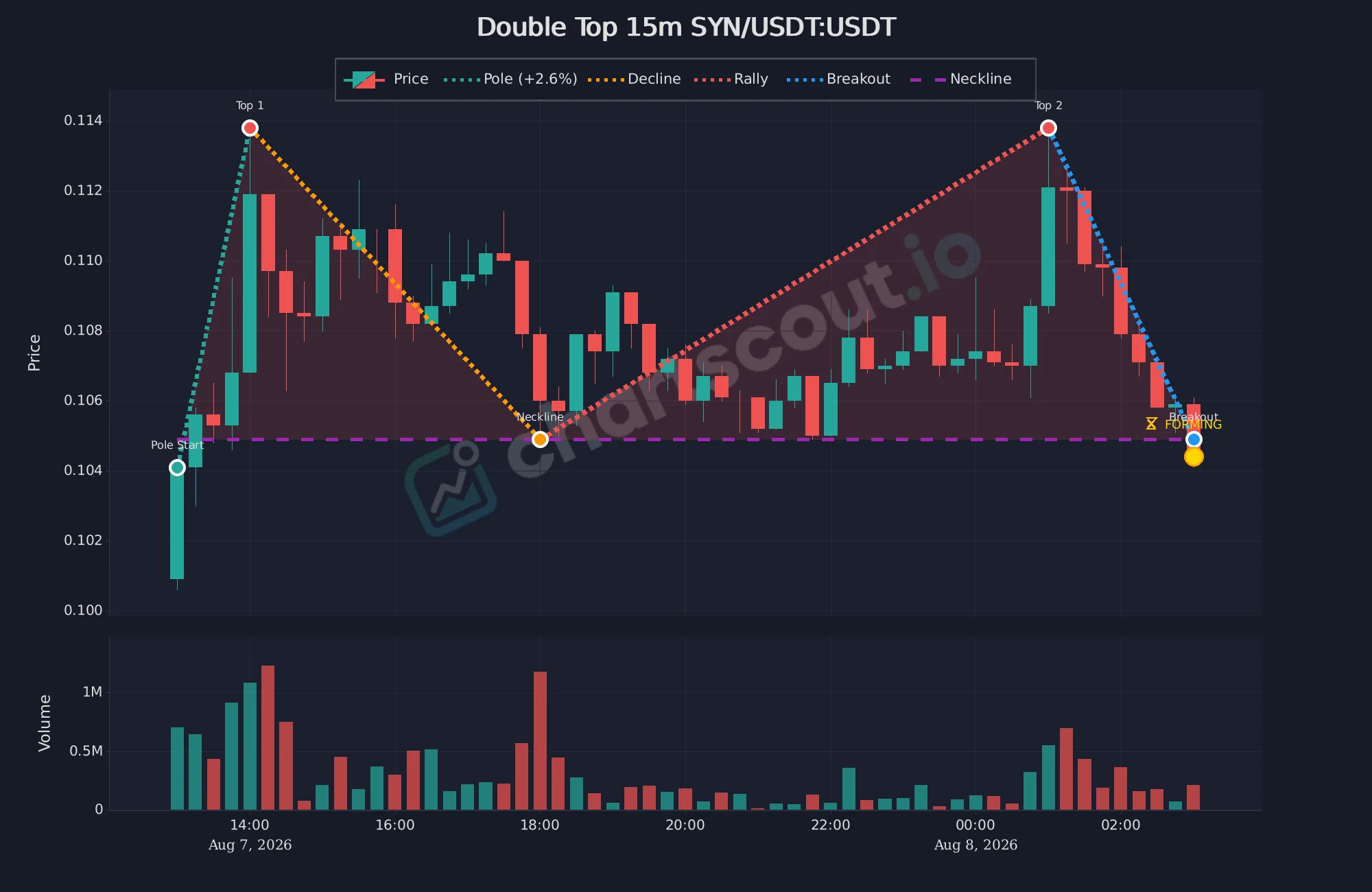
SYN/USDT forms two labeled peaks above a shared neckline on this 15-minute MEXC double top detected August 8, 2026.
Key indicator: bearish divergence
Price makes equal highs, but volume makes a LOWER high. This shows buying pressure is exhausted - fewer buyers remain at resistance. This divergence is your early warning before breakdown.
Triple top
Three highs at similar price level. Stronger bearish reversal than double top.
| Phase | Expected Volume |
|---|---|
| First top | Highest (buying climax) |
| Second top | Lower than first |
| Third top | Lowest of the three |
| Breakdown below neckline | Strong expansion |
“Volume trend: Downward.”
- Thomas Bulkowski, Encyclopedia of Chart Patterns (p. 801)Warning Sign: If volume INCREASES on the third top compared to the second, buyers may be returning - pattern reliability decreases significantly. The overall volume trend should be downward.
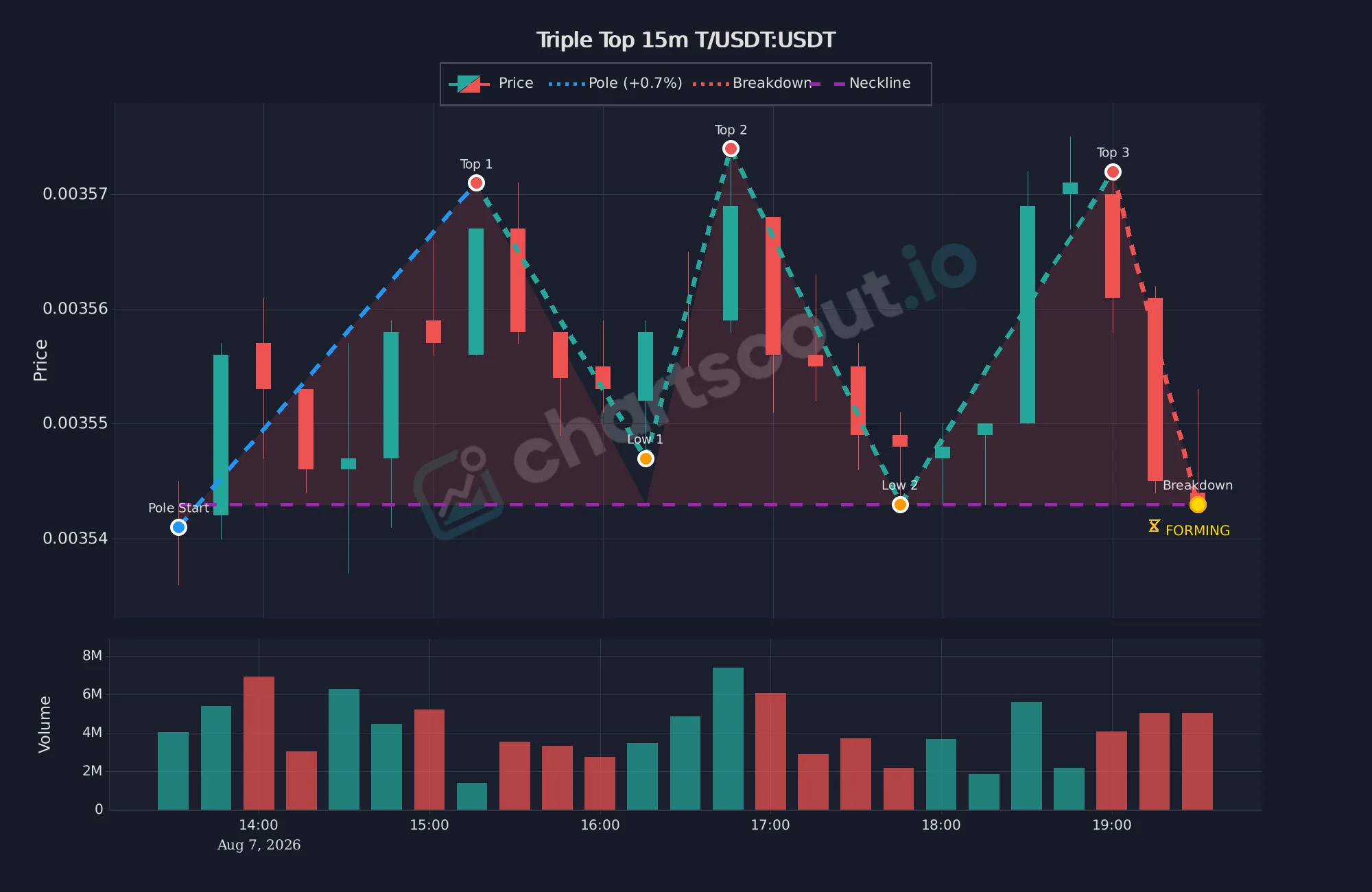
T/USDT shows three labeled resistance peaks above common support on this 15-minute Binance triple top detected August 7, 2026.
Bear pennant
Sharp move down (pole) + small symmetrical triangle (pennant). Bearish continuation.
| Phase | Expected Volume |
|---|---|
| Flagpole (initial drop) | Very high (panic selling) |
| Pennant (consolidation) | Downward trending - should dry up |
| Breakdown from pennant | Expansion confirms continuation |
“Most of the time, pennants will have a downward volume trend.”
- Thomas Bulkowski, Encyclopedia of Chart Patterns (p. 545)Pennant vs Flag: Bear pennants typically resolve faster than bear flags - expect 1-3 weeks duration. The symmetrical consolidation shows balanced short-term uncertainty before sellers regain control. Heavy breakdown volume propels prices farther.
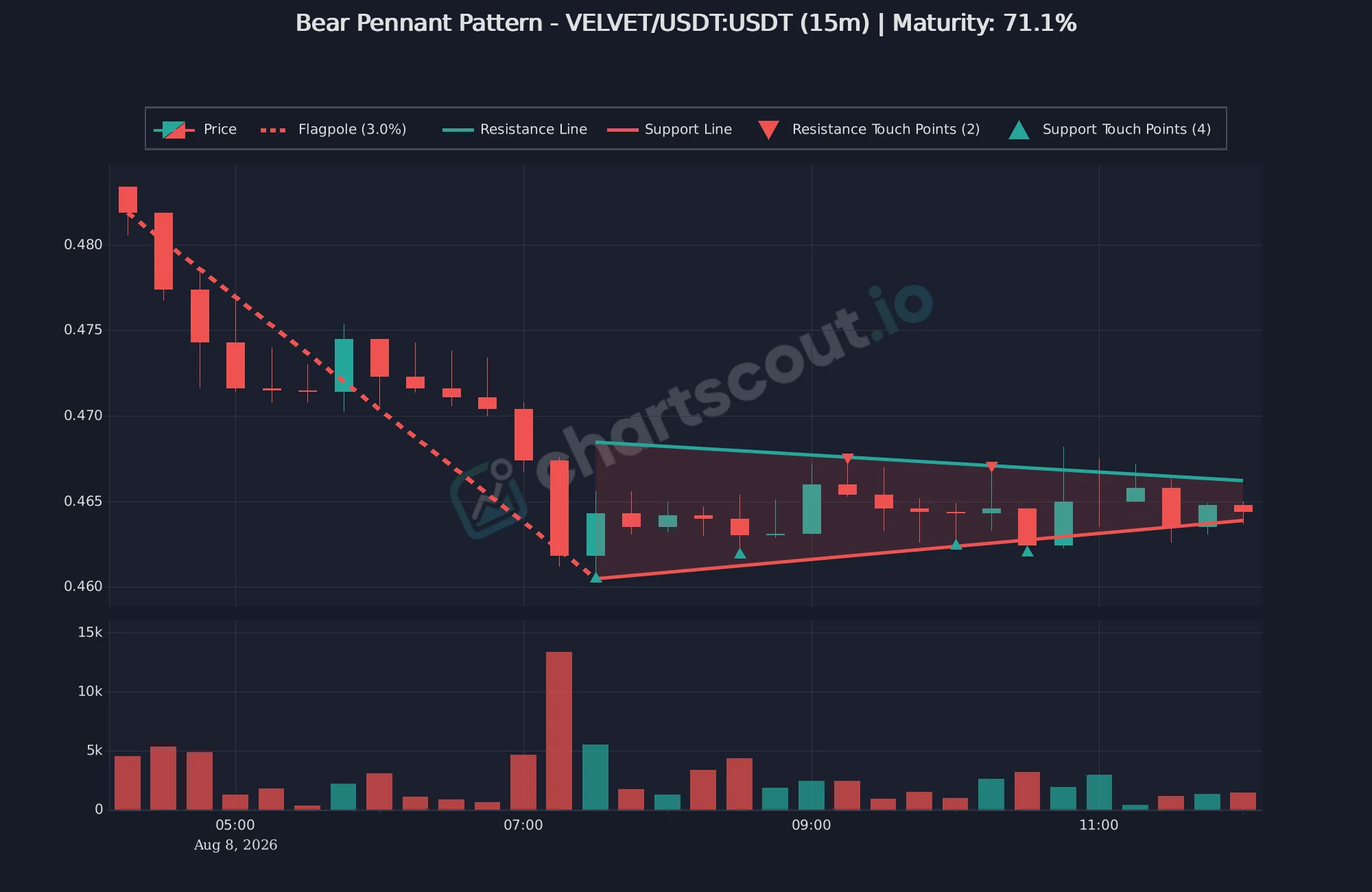
VELVET/USDT shows a sharp downward flagpole followed by converging consolidation on this 15-minute MEXC bear pennant detected August 8, 2026.
Channel down (descending channel)
Price moves between two parallel downward-sloping trendlines. Bearish trend continuation.
| Phase | Expected Volume |
|---|---|
| Declines to lower trendline | Higher volume |
| Rallies to upper trendline | Lower volume |
| Breakdown below lower channel | Strong expansion |
Warning Sign: If volume starts expanding on rallies toward the upper trendline, the channel may be weakening - potential reversal ahead.
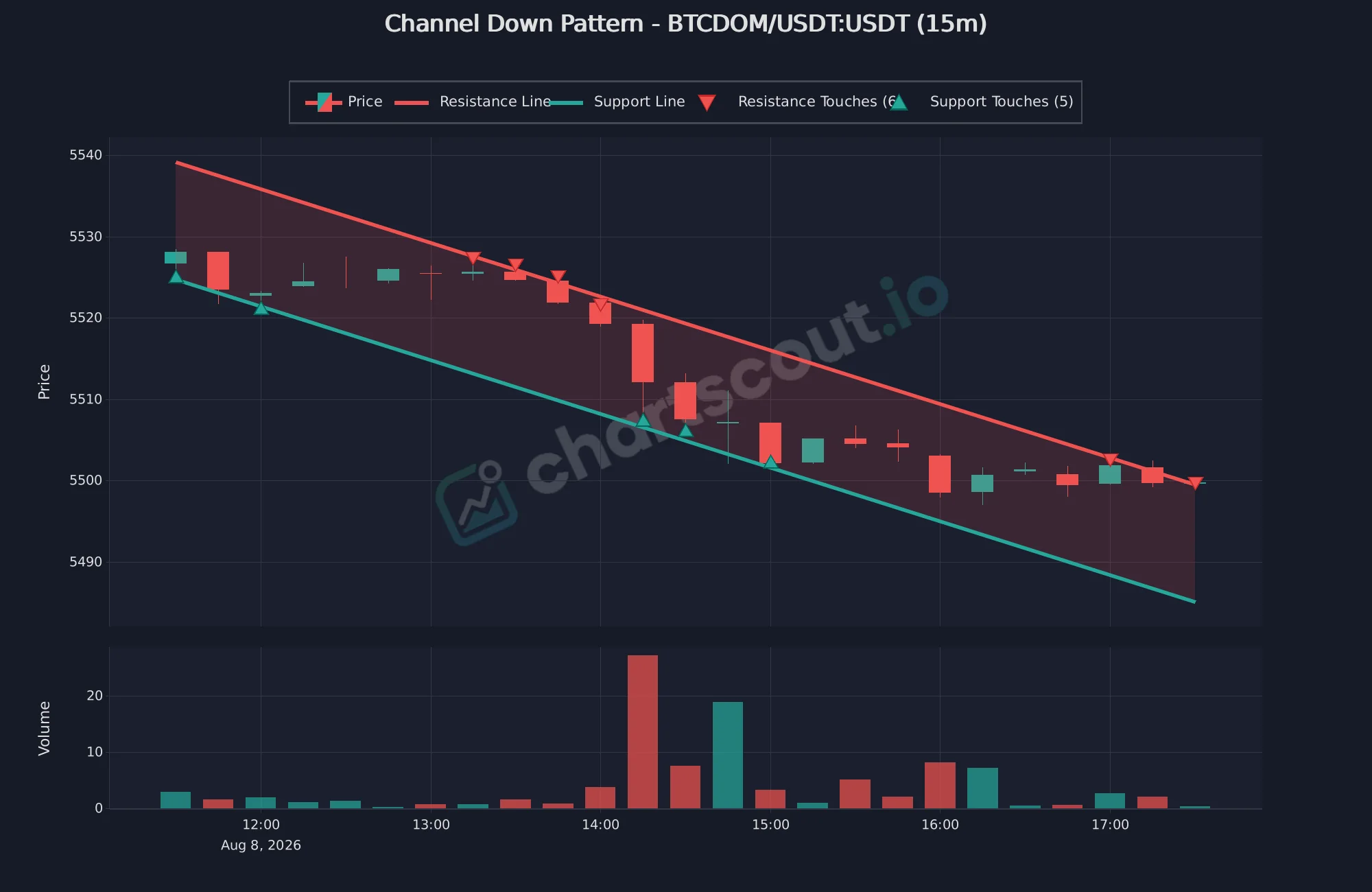
BTCDOM/USDT moves between parallel falling resistance and support lines on this 15-minute Binance descending channel detected August 8, 2026.
Volume divergence - the early warning system
Volume divergence occurs when price and volume move in opposite directions. This disconnect often signals an impending reversal before price confirms it. It reveals what's happening beneath the surface - price may appear to be making a new extreme, but if volume doesn't confirm, it signals that the move lacks conviction.
Bullish divergence
Price makes lower lows, but volume makes higher lows.
- Selling pressure is exhausting (fewer sellers)
- Common at major market bottoms
- Watch for reversal patterns forming
Bearish divergence
Price makes higher highs, but volume makes lower highs.
- Buying pressure is weakening (fewer buyers)
- Common at major market tops
- Watch for distribution patterns
Using divergence with patterns
Divergence is most powerful when it appears at pattern boundaries. For example, a double bottom with bullish volume divergence (second bottom on lower volume) has significantly higher success probability than one without.
Climax volume - exhaustion signals
Climax volume represents extreme participation - typically 5x or more above average. It often marks the end of a trend as the last buyers or sellers exhaust themselves.
| Climax Type | Characteristics | What It Signals |
|---|---|---|
| Selling Climax | Huge volume spike on sharp price drop | Panic selling exhausted - potential bottom |
| Buying Climax | Huge volume spike on sharp price rise | FOMO buying exhausted - potential top |
Identifying climax volume
- • Volume exceeds 5x the 20-day average
- • Often accompanied by gap moves
- • Occurs after extended trends
- • Creates exhaustion candlesticks (long wicks)
Critical context
Climax volume alone is not a trade signal. Wait for a pattern to form after the climax. A selling climax followed by a double bottom with volume divergence is a high-probability setup.
“The climax marks the point where supply overwhelms demand (or vice versa). After the climax, the market needs time to absorb the excess before a new trend can begin.”
- Richard Wyckoff, foundational principle of volume analysisFalse breakouts and volume
False breakouts are one of the biggest challenges in pattern trading. Price breaks through a key level, then reverses sharply. Volume analysis can help identify these traps before they cause damage. For a deep dive into fakeout identification with a 7-point verification checklist and real case studies, read our dedicated guide to spotting fake breakouts in crypto.
Signs of a false breakout
- Low volume on breakout (below 1.5x average)
- Quick reversal within 1-3 bars
- No follow-through in the second bar
- Volume divergence as price tries to extend
How to avoid them
- Wait for the close - don't react intrabar
- Require volume (minimum 1.5x-2x average)
- Watch for follow-through in the next bar
- Confirm on higher timeframes
Combining indicators for confirmation
The most reliable signals come from combining multiple volume indicators. This multi-layered approach reduces false signals and increases confidence in pattern breakouts. Moving average crossovers like the golden cross and death cross can serve as additional confluence signals alongside volume confirmation.
The three-indicator confirmation system:
1. Raw volume
Check volume relative to 20-day average. Confirm declining volume during formation and expansion on breakout.
2. On-balance volume
Ensure OBV is trending with anticipated breakout direction. Look for OBV breaking out before price.
3. Accumulation/Dist.
Confirm A/D line supports the pattern type (accumulation for bullish, distribution for bearish).
Crypto-specific adjustments
Due to higher volatility and 24/7 nature, crypto markets often exhibit more extreme volume characteristics than traditional markets. The following thresholds are practical guidelines based on observed crypto market behavior:
| Confirmation Level | Volume vs 20-period Average |
|---|---|
| Moderate | ~2x average* |
| Strong | ~3x average* |
| Climax | 5x+ average* |
*Practical thresholds based on observed crypto market behavior. Adjust based on the specific asset's typical volatility.
Three golden rules for crypto volume:
- 1
Relative Comparison: Compare volume to the same hour on previous days, not just the daily average, to account for intraday liquidity cycles.
- 2
Aggregate View: Volume is scattered across exchanges. Use ChartScout to get an aggregated view across Binance, Bybit, KuCoin, MEXC, and Hyperliquid.
- 3
Trend Over Value: Focus on relative changes (spikes) rather than absolute numbers to filter out wash trading effects.
Crypto volume patterns to watch:
- Weekend Volume: Typically 20-30% lower than weekdays.
- Holiday Volume: Can drop 40-50% during major holidays.
- News-Driven Spikes: Regulatory news can create 10x+ volume spikes.
- Listing Announcements: Massive volume surges on new listings.
Practical trading examples
Example 1: Bitcoin ascending triangle (win)
BTC/USD forms an ascending triangle over 3 weeks. Resistance at $45,000. Volume declines from 25K BTC/day to 12K BTC/day during formation.
Result: Breakout above $45,000 on 65K BTC volume (5.4x average). Move extended to $52,000 (+15.5%). Clear contraction followed by massive expansion confirmed the trade.
Example 2: Ethereum double bottom (fail)
ETH/USD forms double bottom. First bottom at $1,800 on 180K ETH volume. Second bottom at $1,795 on 195K ETH volume (HIGHER volume!).
Result: Price broke neckline briefly, then reversed sharply to $1,720. Trade was avoided because increasing volume at the second bottom showed sellers were not exhausted.
Risk management with volume
Volume analysis improves trade selection, but proper risk management remains essential. Use volume quality to determine position sizing and stop loss placement.
Sizing based on confirmation:
- A+
3+ Confirmations: 2-3% of capital. Stop below pattern boundary.
- B
2 Confirmations: 1-2% of capital. Tighter stop placement.
- C
1 Confirmation: 0.5% of capital or skip. Very tight stop.
Volume-based exits:
- Volume climax at target = Take full profit
- Volume declining during move = Trail stop tightly
- Volume divergence appears = Scale out partials
- Volume expands in opposite direction = Exit immediately
Bulkowski's scaling-out backtest results
The list above tells you when to scale out. Bulkowski's research speaks directly to whether scaling out is a net win versus exiting all at once at a fixed target. The honest answer from his backtests is that it's a tradeoff, not a free lunch.
In Trading Basics: Evolution of a Trader (Wiley, 2012, Chapter 4), Bulkowski reports the results of testing partial-exit (scaling out) strategies against single-target full exits across thousands of trades from his pattern database. The headline finding: scaling out at intermediate price levels (typically 1R, 2R, and 3R, where R is the initial risk distance from entry to stop) reliably reduces drawdown and equity-curve volatility, but it also reduces total return on average compared to letting the full position run to a single measured-move target.
The structural reason is straightforward: a small number of pattern outcomes account for the bulk of total profit (the long right tail of moves that exceed the measured-move target by 2x or more), and scaling out caps your participation in those tail outcomes. In return you get a higher win rate, smoother equity curve, and a far easier psychological experience. Bulkowski explicitly frames it as a personality and capital-management decision, not a mathematical optimum.
Where this lands for crypto. Three things change the calculus on a 24/7 alt-heavy market: (1) limit orders at 1R, 2R, and 3R execute reliably on liquid pairs without you watching, which makes scaling out practically free in attention cost; (2) overnight gap risk is real even though stocks don't gap weekends - thin weekend liquidity on alts produces flash wicks that can hit a single target and reverse before you can react; (3) leveraged perpetuals create deeper liquidation-driven throwbacks that erase paper profits faster than spot moves do. All three favor a partial-exit approach in crypto more than they do in Bulkowski's stock dataset, even though the stock dataset still shows full-target exits with the highest expected return on average.
Honest framing: Bulkowski's backtests are stock data. There is no equivalent crypto-wide scaling-out study with comparable sample size, so treat his finding (scaling out reduces drawdown and reduces total return) as a directional rule rather than a precise crypto number. The right answer for your account depends on whether you're willing to trade some expected return for a calmer ride.
Practical checklist
Green flags (A+ setup)
- ✓Volume declining during formation
- ✓Clear volume divergence at peaks/troughs
- ✓Breakout volume 2-3x average
- ✓Pullback happens on significantly lower volume
Red flags (consider passing)
- ✕Breakout on below-average volume
- ✕Pattern forms with INCREASING volume
- ✕Pullback has HIGHER volume than breakout
- ✕No divergence at reversal boundaries
Frequently asked questions
How much volume increase confirms a breakout?
For traditional markets, Bulkowski's research suggests breakouts with above-average volume show better follow-through. For crypto markets, due to higher volatility, many traders look for approximately 2x the average for moderate confirmation, and 3x+ for strong confirmation.
Does volume matter more for upside or downside breakouts?
Volume confirmation is more critical for upside breakouts. Buying requires active participation. Prices can fall on lighter volume simply from lack of buying support, but active buying pressure is needed to push prices higher. However, strong volume on downside breaks still indicates aggressive selling and reduces the likelihood of false breakdowns.
What if the pattern looks perfect but volume doesn't confirm?
Pass or reduce size. A technically perfect pattern without volume confirmation has significantly higher failure rate. Volume tells you whether the market agrees with what the pattern suggests. Without that agreement, the probability of success drops dramatically.
Should I use on-balance volume (OBV) with chart patterns?
OBV can complement pattern analysis by showing cumulative buying/selling pressure. Look for OBV to confirm the breakout direction - if price breaks up but OBV is trending down, the breakout may fail. However, raw volume spikes at breakout remain the primary confirmation signal.
How do I adjust for wash trading in crypto markets?
Focus on relative volume changes (spikes) rather than absolute numbers. A sudden 5x volume spike is significant regardless of underlying wash trading levels. Aggregating volume across multiple major exchanges also helps filter out exchange-specific manipulation.
Conclusion: mastering the volume-pattern synergy
Trading chart patterns without volume analysis is like flying an airplane without an altimeter. You can see where you're headed, but you have no idea how much ground is beneath you. Volume provides the depth and context required to turn a speculative observation into a high-probability trade setup.
Core principles to remember:
Volume is conviction
Price moves on low volume are merely suggestions; price moves on high volume are commitments. Always look for the “smart money” to leave their footprint through volume spikes.
The coiling effect
The contraction of volume during pattern formation is as important as the breakout itself. It represents the building of potential energy. The quieter the consolidation, the more explosive the eventual resolution.
Expansion at breakout
A breakout is only valid when it is accompanied by a significant surge in participation. In crypto, aim for 2x to 3x the average volume to filter out noise and false signals.
By integrating these volume signatures into your technical analysis, you transition from reactive trading to proactive decision-making. Remember that volume isn't just a secondary indicator; it is the fuel that drives the market's engine. Master the volume, and you master the conviction behind the move. To put these principles into practice without staring at charts all day, consider an alert-driven trading approach that notifies you when patterns form with proper volume signatures.
Stop watching charts manually
ChartScout monitors all 23 detectors across 1,000+ crypto pairs on Binance, Bybit, KuCoin, MEXC, and Hyperliquid, surfacing formations with their available volume context for your review.
Compare plans and start monitoring in minutes. Alerts delivered in under 20 seconds.
Sources & references
Academic & technical analysis literature
Primary sources for pattern and volume analysis principles:
- Bulkowski, Thomas N. Encyclopedia of Chart Patterns, 2nd Edition. Wiley, 2005. ISBN: 978-0471668268.
Chapters 24-27 (Triangles), 35 (Double Bottoms), 37 (Double Tops), 48 (Flags), 54 (Pennants), 63 (Triple Bottoms), 64 (Triple Tops), 66 (Wedges). Volume analysis based on statistical research across thousands of patterns. - Pring, Martin J. Pring on Price Patterns: The Definitive Guide to Price Pattern Analysis and Interpretation. McGraw-Hill, 2005. ISBN: 978-0071440387.
Chapter 7: Head & Shoulders volume characteristics and confirmation signals. - Murphy, John J. Technical Analysis of the Financial Markets: A Comprehensive Guide to Trading Methods and Applications. New York Institute of Finance, 1999. ISBN: 978-0735200661.
Chapters 7-8: Volume analysis principles and price-volume relationships. - Bulkowski, Thomas N. Trading Basics: Evolution of a Trader. John Wiley & Sons, 2012. ISBN: 978-1118464212.
Chapter 4 (“Money Management”): partial-exit (scaling out) backtest results. Source for the finding that scaling out at 1R/2R/3R reduces drawdown and equity-curve volatility but also reduces total return on average across his pattern database. - Wyckoff, Richard D. Original works and market studies, 1910-1931.
Selling Climax (SC) and Buying Climax (BC) concepts, accumulation/distribution phase analysis. - Dow, Charles H. Wall Street Journal editorials, 1899-1902.
Foundational principle: “Volume should expand in the direction of the trend.”
Crypto market research
Industry research on cryptocurrency volume dynamics:
- Chainalysis. Crypto Market Manipulation 2025: Suspected Wash Trading, Pump and Dump Schemes. February 2025.
Key finding: $2.57 billion in suspected wash trading on DEXs in 2024, with 4.52% of launched tokens displaying wash trading patterns. Most manipulation concentrated among a small number of sophisticated actors. - Advances in Consumer Research (ACR Journal). The Weekend Effect in Crypto Momentum: Does Momentum Change When Markets Never Sleep? September 2025.
Key finding: Weekend trading volume is 20-25% lower than weekdays, creating thinner markets where momentum-driven trades exert greater price impact. - CCData (CoinDesk Data). Exchange Review. March 2023.
Key finding: Derivatives market represents 72.7% of total crypto market volume - an all-time high. Spot-driven markets tend to be more resistant to short-term volatility.
Related guides
How to spot fake breakouts (fakeouts) in crypto
Learn to identify fakeouts with a 7-point verification checklist, probability tables, and real case studies.
Head and shoulders pattern guide
The definitive guide with 81% success rate stats from 2,800+ trades and crypto-specific insights.
Golden cross vs death cross guide
Combine moving-average crossovers with chart patterns for higher-probability crypto trades.
Rising wedge vs falling wedge guide
Complete guide to wedge patterns in crypto with Bulkowski statistics and breakout strategies.
How to read crypto charts
From candlestick basics to advanced technical analysis, everything you need to read crypto charts.
Alert-driven trading
How real-time pattern alerts replace screen-watching and improve your trading consistency.

Stjepan Ivanović
Founder of ChartScout · Crypto Trader Since 2013
Trading crypto since 2013 with his first Bitcoin bought at ~$200. Four complete bull/bear market cycles, traded on early exchanges like Mt.Gox and BTC-e, on-chain trading on IDEX and EtherDelta, and ~70 crypto project investments. Built ChartScout after 23+ months of development to automate what no trader can do manually. Watch hundreds of charts 24/7.