Rising wedge vs falling wedge: crypto trading guide 2026
Rising wedges and falling wedges are converging trendline patterns that allegedly signal reversals - but Bulkowski's updated 2020 stats show both are below-average performers. The rising wedge ranks 36 out of 36 bearish patterns (dead last), with downward breakouts failing the break-even test 51% of the time and averaging just 9% decline. The falling wedge ranks 31 out of 39 bullish patterns, breaks upward only 68% of the time (not 100%), and posts a 26% break-even failure rate. Both still require declining formation volume and volume-confirmed breakouts to be tradeable at all.
In the volatile world of cryptocurrency trading, wedge formations are among the most commonly discussed chart patterns. Whether you're trading Bitcoin's macro moves or catching altcoin swings, understanding the difference between rising wedges and falling wedges - including their vastly different reliability rates - can mean the difference between profitable trades and costly mistakes.
This comprehensive guide provides everything you need to master wedge patterns: the anatomy of both patterns, statistical success rates, step-by-step identification, volume analysis, three entry strategies, real crypto case studies, and the common mistakes that cause traders to fail.
What are wedge patterns in crypto trading?
A wedge pattern is a chart formation characterized by two converging trendlines that both slope in the same direction - either upward (rising wedge) or downward (falling wedge). Unlike triangles, where trendlines slope toward each other or one line is horizontal, wedge trendlines move in tandem while gradually converging.
“The wedge differs from a triangle in that both boundary lines slant in the same direction-either up or down. The rising wedge is bearish and the falling wedge is bullish.”
- Robert D. Edwards & John Magee, Technical Analysis of Stock TrendsWedge patterns form when price makes a series of higher highs and higher lows (rising wedge) or lower highs and lower lows (falling wedge), but the range between highs and lows narrows progressively. This “compression” of price action signals that momentum is weakening and a breakout is approaching.
Key characteristics of all wedge patterns
| Characteristic | Description | Importance |
|---|---|---|
| Converging Trendlines | Both lines slope same direction but converge | Defines the pattern |
| Duration | Typically 10-50 periods (hours to days on crypto timeframes) | Shorter = less reliable |
| Minimum Touches | 2-3 on each trendline (5 total ideal) | More touches = stronger |
| Volume Decline | Volume decreases during formation | Critical confirmation |
| Breakout Volume | Volume expands at breakout | Confirms validity |
“Volume trend. The volume trend should be downward...7 out of every 10 formations show a downward volume pattern.”
- Thomas Bulkowski, Encyclopedia of Chart PatternsWhy wedge patterns matter more in crypto
Cryptocurrency markets exhibit characteristics that make wedge patterns particularly effective:
- 24/7 Trading Creates Cleaner Patterns: Traditional markets close overnight and on weekends, creating gaps that can distort pattern formations. Crypto markets trade continuously, producing smoother price action and cleaner trendlines.
- Higher Volatility Accelerates Formation: What takes 6 weeks to form in stock markets might complete in 2-3 weeks in crypto. This faster formation doesn't reduce reliability - it simply compresses the timeline.
- Retail Concentration at Obvious Levels: Crypto markets have a higher proportion of retail traders who use technical analysis. When wedge patterns become obvious, the concentration of orders at breakout levels often creates self-fulfilling prophecies with strong follow-through.
The rising wedge pattern explained
A rising wedge is a bearish chart pattern formed by two upward-sloping converging trendlines. Despite its upward appearance, it signals weakening buying momentum and typically breaks to the downside.
“The rising wedge is deceptive. It appears to be bullish because of its upward slant, but in fact it is one of the most bearish chart patterns.”
- John J. Murphy, Technical Analysis of the Financial Markets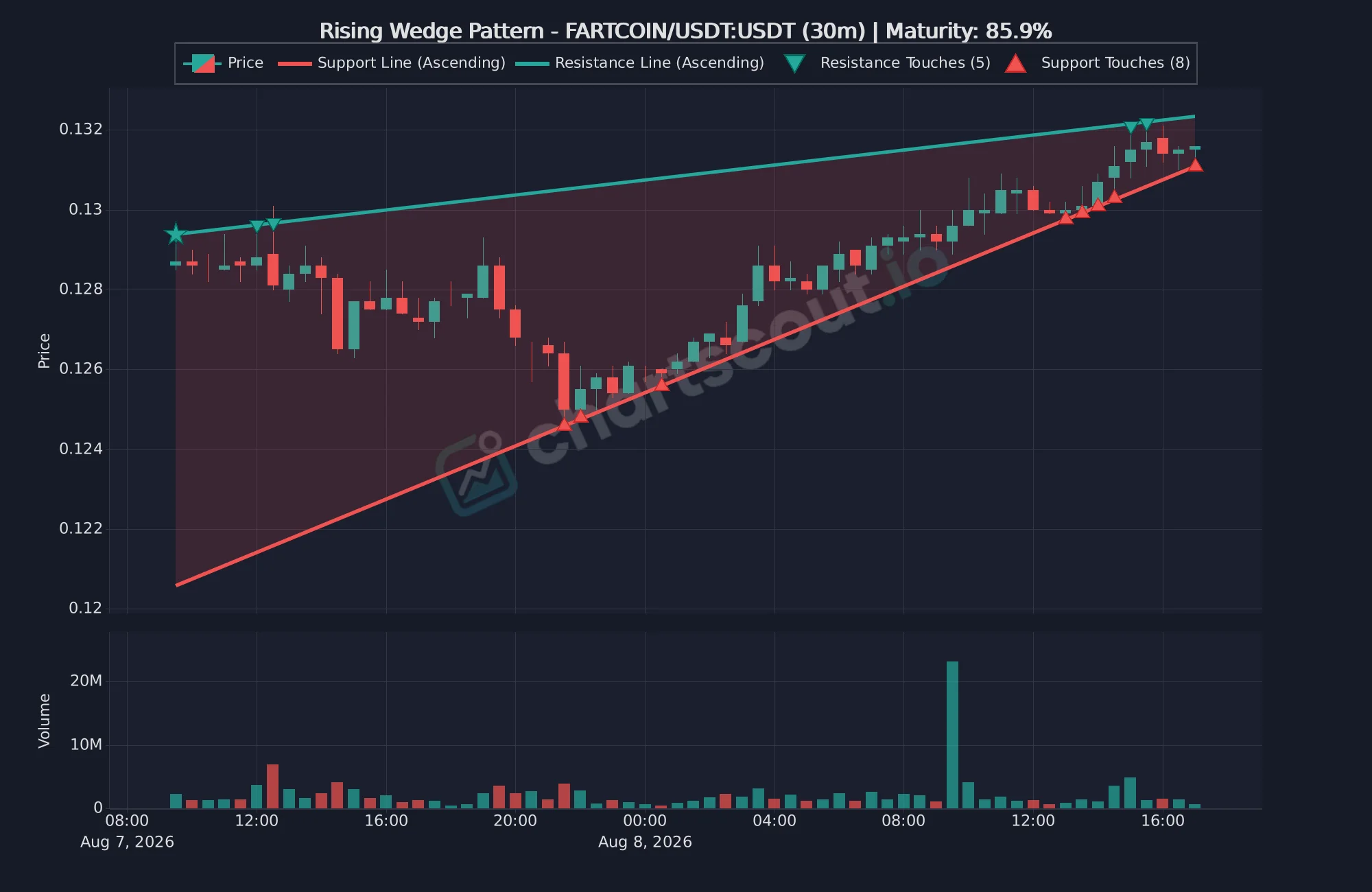
This chart shows a rising wedge on FARTCOIN/USDT at the 30-minute timeframe on Binance, detected August 8, 2026. Both visible trendlines slope upward.
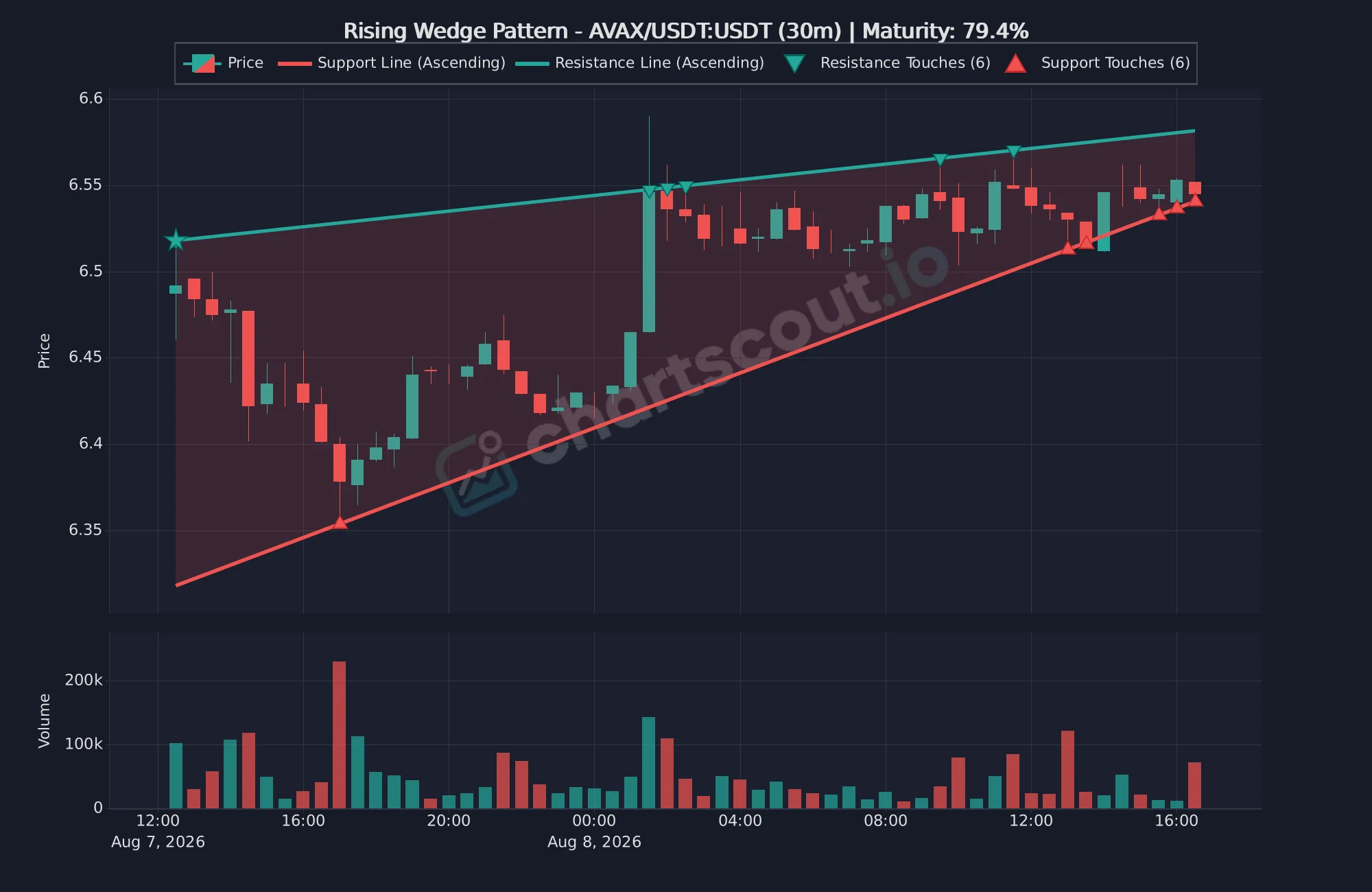
This chart shows a rising wedge on AVAX/USDT at the 30-minute timeframe on KuCoin, detected August 8, 2026. The two visible trendlines slope upward as the range narrows.
Anatomy of a rising wedge
| Component | Description | What It Tells You |
|---|---|---|
| Upper Trendline (Resistance) | Connects higher highs; slopes upward at gentler angle | Shows slowing upward momentum |
| Lower Trendline (Support) | Connects higher lows; slopes upward at steeper angle | Buyers losing conviction |
| Apex | Theoretical point where trendlines meet | Pattern must break before this point |
| Breakout Point | Price breaks below lower trendline | Entry signal for shorts |
Rising wedge psychology: the bull trap
Rising wedges are often called “bull traps” because they lure traders into believing the uptrend will continue. Here's the psychological sequence:
- Initial Optimism: Price is rising, making higher highs and higher lows - classic uptrend behavior
- Gradual Weakening: Each rally gains less ground; momentum indicators begin showing divergence
- Compression: The narrowing pattern creates anticipation - bulls expect an upside breakout
- The Trap: When price breaks support instead of resistance, trapped bulls rush to exit
- Cascade: Selling pressure accelerates as stops trigger, confirming the bearish reversal
“As prices move higher within the wedge, the buying becomes progressively weaker. This is a pattern of distribution, where informed traders are selling to less-informed buyers.”
- Alexander Elder, Trading for a LivingCritical pattern reliability notice
Rising wedge performance reality (thepatternsite.com, updated 8/26/2020):
- • Performance rank: 36 out of 36 bearish patterns - the worst-performing bearish chart pattern in Bulkowski's entire catalog.
- • Breakout direction: downward 60% of the time, upward 40% (so it does NOT always break down).
- • Downward breakouts (the “expected” case): 51% break-even failure rate - price fails to move 5% beyond the trendline. Worse than a coin flip.
- • Average decline on downward breakouts: only 9% (one of the smallest moves of any bearish pattern).
- • Target hit rate (down breaks): 32% - measured-move targets get reached less than a third of the time.
- • Throwback/pullback rate: 72% - most breakouts pull back to the trendline before continuing (or failing).
- • Upward breakouts (40% of cases): 19% break-even failure rate, 38% average rise - paradoxically, when a rising wedge breaks UP it performs better than when it breaks DOWN.
Bulkowski's own words: “Rising wedges are lousy performers. In all market conditions and breakout directions, the average rise or decline is below the average for all other chart patterns.”
Trading recommendation: Treat the rising wedge as a low-conviction signal. If you trade it at all, require multi-timeframe alignment, clear RSI bearish divergence, volume-confirmed close beyond the lower trendline, very tight stops, and reduced position size. Many experienced traders skip this pattern entirely.
Source: Thomas Bulkowski, thepatternsite.com/wedger.html (updated 8/26/2020).
Rising wedge trading setup
- Entry: Below lower trendline with volume confirmation
- Stop loss: Above the most recent high within the wedge
- Target 1: 38.2% Fibonacci retracement of the wedge
- Target 2: 61.8% Fibonacci retracement
- Target 3: Starting point of the wedge (full measured move)
The falling wedge pattern explained
A falling wedge is a bullish chart pattern formed by two downward-sloping converging trendlines. Despite its downward appearance, it signals weakening selling momentum and typically breaks to the upside.
“The falling wedge represents the last gasp of sellers. Each new low attracts fewer participants, while buyers become increasingly confident at higher levels.”
- Martin J. Pring, Pring on Price Patterns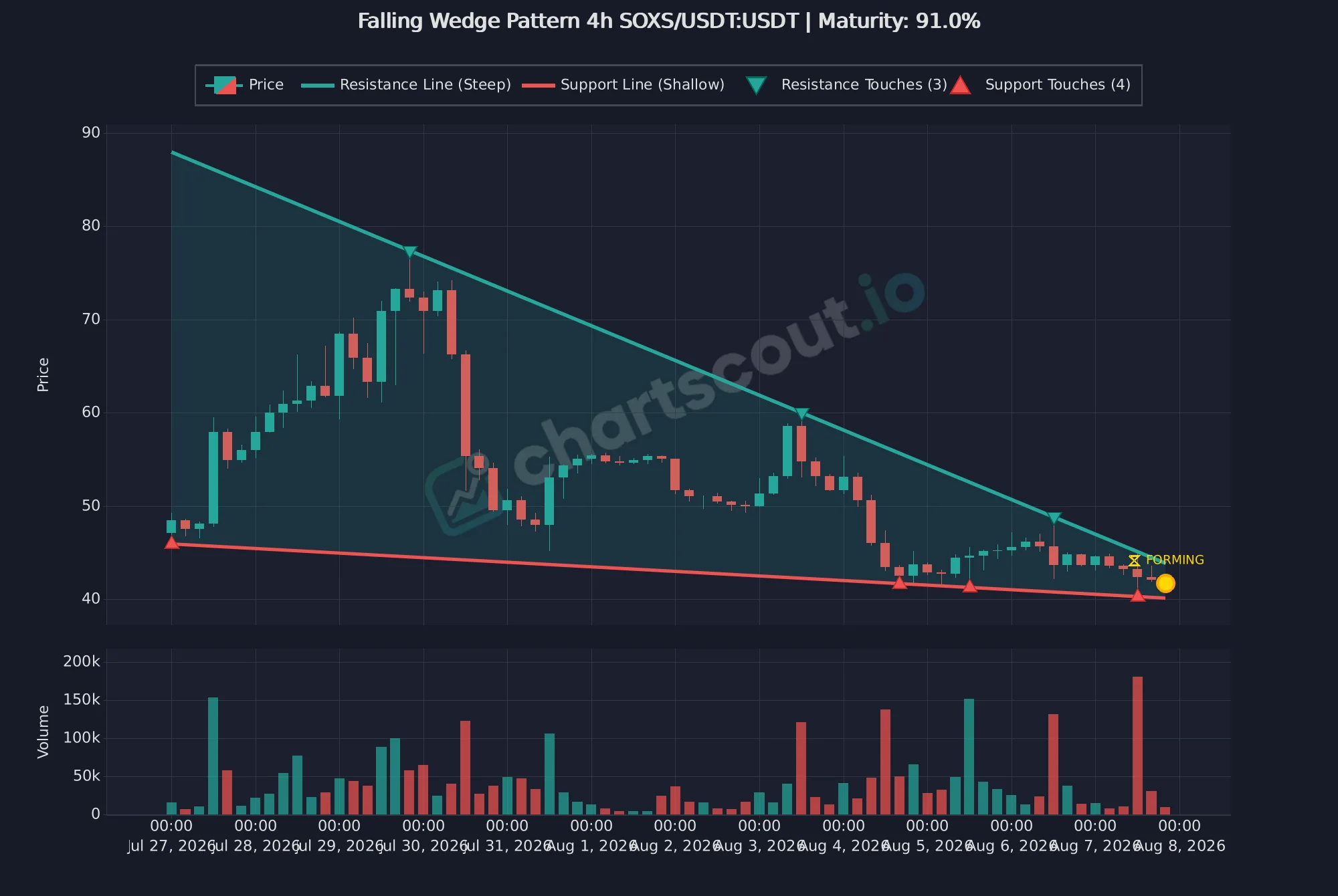
This chart shows a falling wedge on SOXS/USDT at the 4-hour timeframe on Bybit, detected August 8, 2026. Both visible trendlines slope downward.
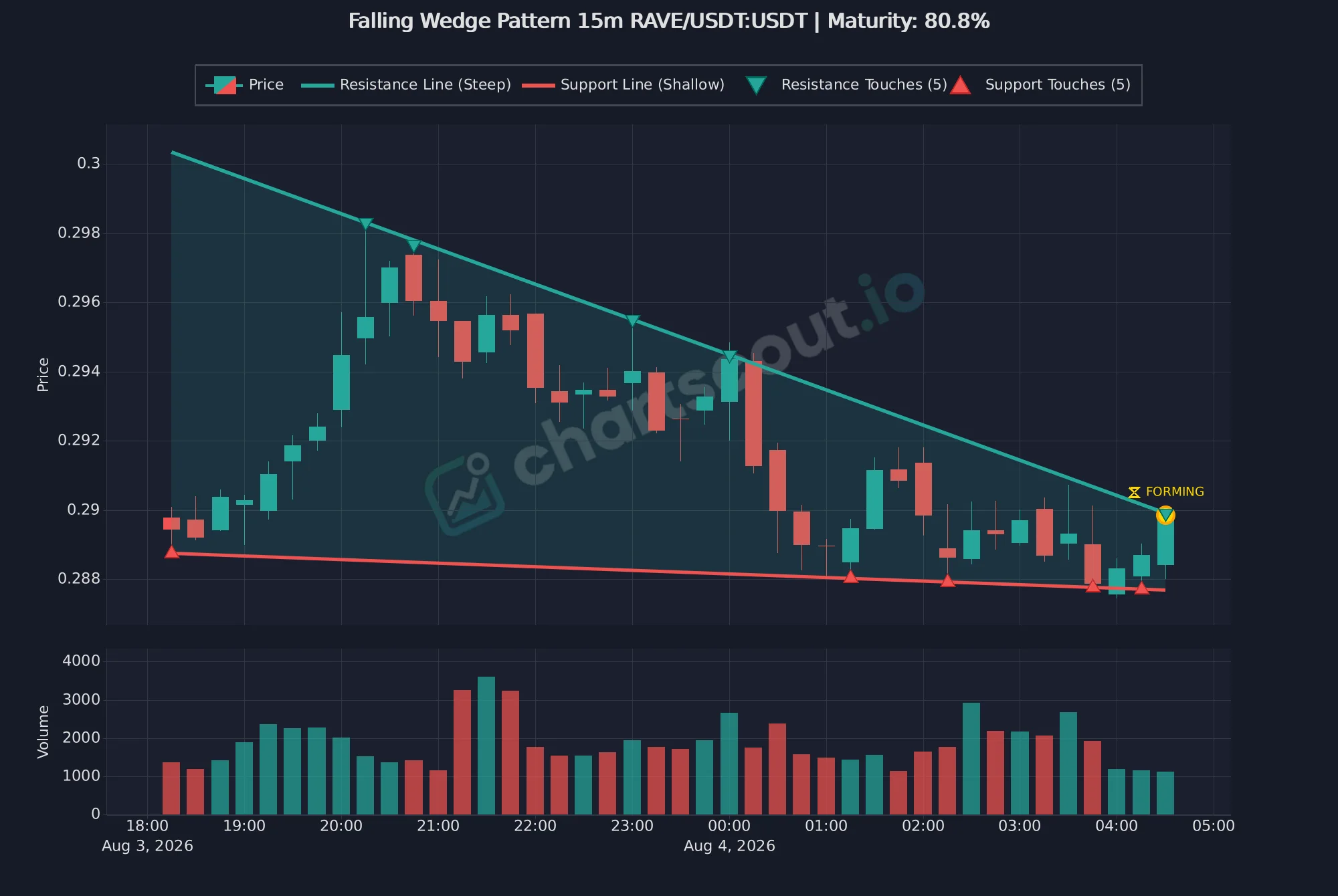
This chart shows a falling wedge on RAVE/USDT at the 15-minute timeframe on KuCoin, detected August 4, 2026. The visible trendlines slope downward and converge.
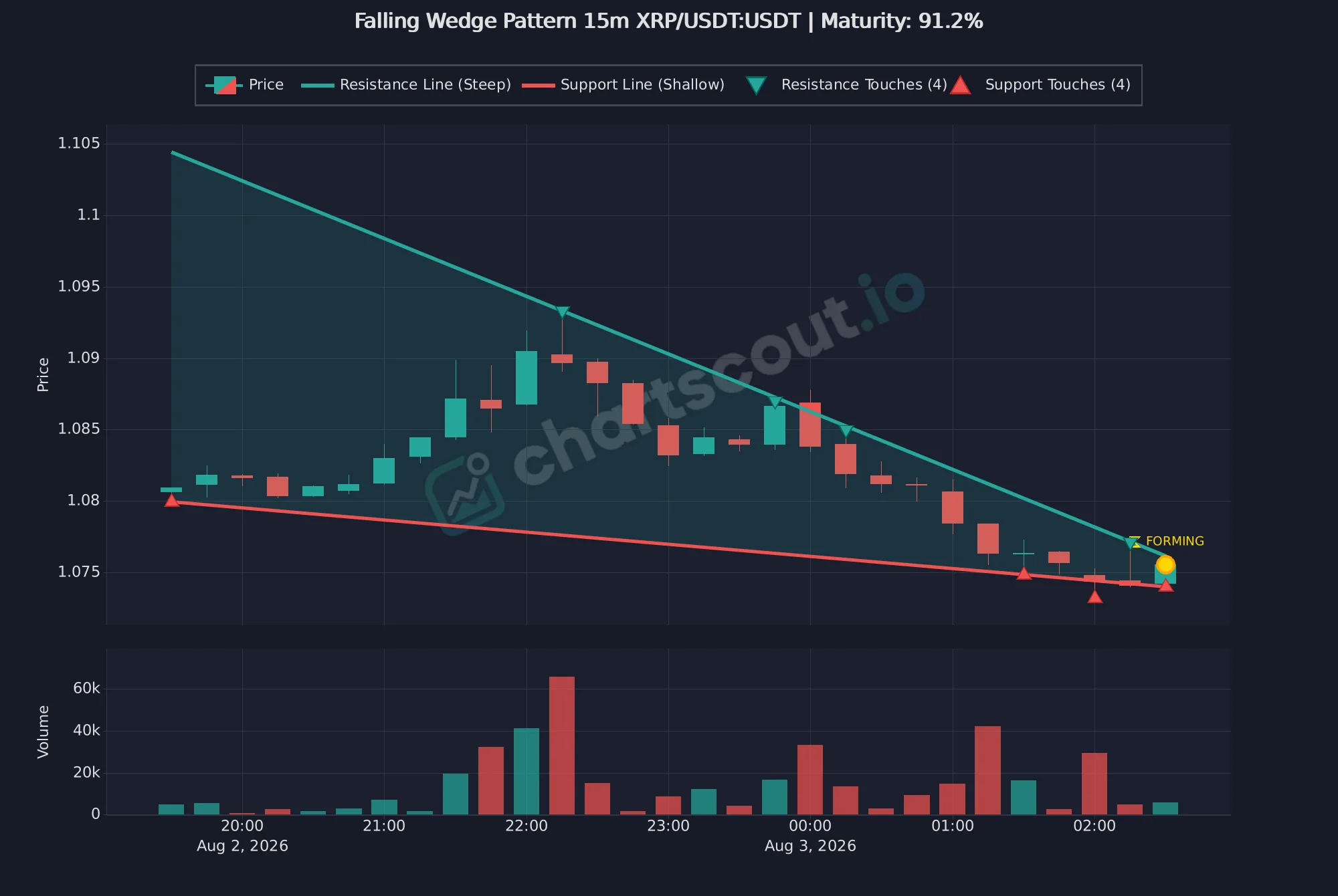
This chart shows a falling wedge on XRP/USDT at the 15-minute timeframe on KuCoin, detected August 3, 2026. The visible trendlines slope downward and converge.
Anatomy of a falling wedge
| Component | Description | What It Tells You |
|---|---|---|
| Upper Trendline (Resistance) | Connects lower highs; slopes downward at steeper angle | Sellers losing conviction |
| Lower Trendline (Support) | Connects lower lows; slopes downward at gentler angle | Shows slowing downward momentum |
| Apex | Theoretical point where trendlines meet | Pattern must break before this point |
| Breakout Point | Price breaks above upper trendline | Entry signal for longs |
Falling wedge psychology: the bear trap
Falling wedges are the mirror image of bull traps - they're “bear traps” that convince traders the downtrend will continue:
- Initial Pessimism: Price is falling, making lower highs and lower lows - classic downtrend behavior
- Gradual Stabilization: Each decline achieves less ground; selling pressure visibly weakens
- Compression: The narrowing pattern creates anticipation - bears expect continued breakdown
- The Trap: When price breaks resistance instead of support, trapped shorts rush to cover
- Surge: Buying pressure accelerates as short covering combines with new longs
“Fear and greed create the wedge pattern. In a falling wedge, fear drives prices lower, but each wave of selling is met by stronger buying interest-greed begins to overcome fear.”
- Alexander Elder, Trading for a LivingFalling wedge: the honest stats
Per Bulkowski's updated 2020 dataset (thepatternsite.com):
- • Bullish rank: 31 out of 39 bullish patterns - below average, NOT a top-tier reversal pattern.
- • Breakout direction: upward 68% of the time (not 100% - falling wedges do break down 32% of the time).
- • Break-even failure rate (up breaks): 26% - so 74% of upward breakouts move at least 5% before reversing.
- • Average rise on up breakouts: 38%.
- • Throwback rate: 62% - most breakouts retest the trendline, giving conservative traders a second-chance entry.
- • Target hit rate: 62% - measured moves reach target less than two-thirds of the time.
Bulkowski's own words: “Coupled with their rare appearance and the difficulty in spotting these patterns in the bush, falling wedges are beasts you probably will not want to trade.”
Falling wedge trading setup
- Entry: Above upper trendline with volume confirmation
- Stop loss: Below the most recent low within the wedge
- Target 1: 38.2% Fibonacci retracement of the wedge
- Target 2: 61.8% Fibonacci retracement
- Target 3: Starting point of the wedge (full measured move)
Rising wedge vs falling wedge: complete comparison
| Feature | Rising Wedge | Falling Wedge |
|---|---|---|
| Trendline Direction | Both slope upward | Both slope downward |
| Steeper Line | Support (lower) | Resistance (upper) |
| Signal | Bearish | Bullish |
| Expected Breakout | Downward (below support) | Upward (above resistance) |
| Breakout direction (actual) | Down 60%, Up 40% | Up 68%, Down 32% |
| Break-even failure rate (expected direction) | 51% (down breaks) | 26% (up breaks) |
| Bulkowski performance rank | 36 of 36 bearish (last) | 31 of 39 bullish (below avg) |
| Bulkowski's verdict | “Lousy performers” | “Beasts you probably will not want to trade” |
| Average move (expected direction) | 9% decline (small) | 38% rise |
| Target hit rate (expected direction) | 32% (down breaks) | 62% (up breaks) |
| Throwback / pullback frequency | 72% (down breaks) | 62% (up breaks) |
| Best Timeframes (Crypto) | 4H, Daily | 4H, Daily |
Source: Thomas Bulkowski, thepatternsite.com (rising wedges and falling wedges, statistics updated 8/26/2020).
Visual difference summary
The easiest way to distinguish the patterns:
- Rising Wedge ↗: Looks like it's pointing up-right - but it's BEARISH
- Falling Wedge ↘: Looks like it's pointing down-right - but it's BULLISH
Both patterns are counter-intuitive for beginners. Remember: the direction of the wedge shows weakening momentum, not future direction.
Rising wedge cautions
- 51% break-even failure rate on the “expected” downward break
- Ranked worst-performing bearish pattern in Bulkowski's catalog (36/36)
- Average decline of only 9% on successful down breaks
- Breakout direction is only 60% downward - 40% break up
- Many experienced traders skip this pattern entirely
Falling wedge cautions
- Ranks 31/39 bullish patterns - below average, NOT a top reversal
- Breaks upward only 68% of the time (not 100% as often claimed)
- 26% break-even failure rate on upward breaks
- 62% throwback rate - pullback offers a second-chance entry
- Hard to spot reliably - Bulkowski says “you probably will not want to trade” them
How to identify wedge patterns (step-by-step)
The 6-step wedge identification process
Step 1: identify the prior trend
Look left on the chart - was price rising or falling before the wedge began? The prior trend should be clear and sustained (not choppy consolidation). Duration of prior trend matters: longer trends = more significant wedge patterns.
Step 2: draw the trendlines
Connect at least 2-3 price highs to form the upper trendline (resistance). Connect at least 2-3 price lows to form the lower trendline (support). Both lines must slope in the SAME direction (both up or both down).
“The most important aspect of pattern recognition is context. A wedge pattern means nothing in isolation-you must consider where it appears within the larger trend.”
- Martin J. Pring, Pring on Price PatternsStep 3: verify convergence
The trendlines must be converging - getting closer together over time. Measure the vertical distance between trendlines at the start and current point. The distance should be narrowing. If lines are parallel, it's a channel, not a wedge.
Step 4: count the touches
| Touches | Reliability |
|---|---|
| 4 total (2+2) | Minimum valid |
| 5 total (3+2 or 2+3) | Good |
| 6+ total (3+3 or more) | Excellent |
Step 5: analyze volume
Compare volume during pattern formation to 20-period average. Volume should be declining overall - each successive rally or decline shows less volume. Use a simple volume moving average overlay for visual confirmation.
“Volume is your confirmation tool. Without declining volume during formation and expanding volume at breakout, you're trading hope, not evidence.”
- John J. Murphy, Technical Analysis of the Financial MarketsStep 6: classify the wedge type
Based on your analysis:
- Both trendlines slope UPWARD = Rising Wedge (bearish signal)
- Both trendlines slope DOWNWARD = Falling Wedge (bullish signal)
The wedge pattern validation checklist
- Both trendlines slope in the same direction
- Trendlines are clearly converging (not parallel)
- Minimum 4-5 touches on the trendlines combined
- Volume is declining during pattern formation
- Pattern duration is 10-50 periods (hours to days on crypto timeframes)
- Prior trend is clearly established
- Pattern is visible on your trading timeframe or higher
A+ setups: All criteria met - full position size
B setups: 6-7 criteria - reduced position size
C setups: Fewer than 6 - consider passing
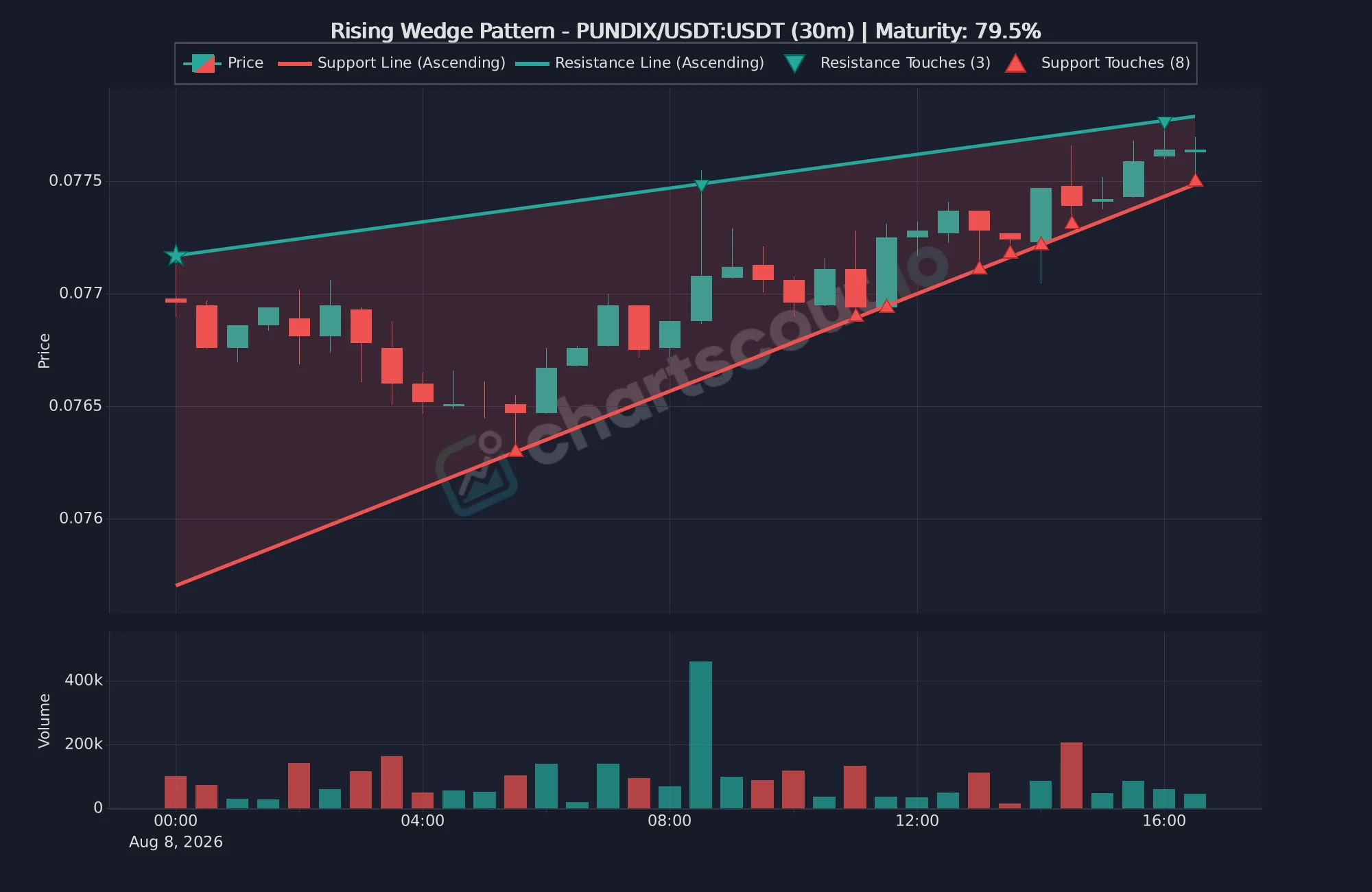
This chart shows a rising wedge on PUNDIX/USDT at the 30-minute timeframe on Binance, detected August 8, 2026. Both visible trendlines slope upward toward the apex.
Volume analysis for wedge patterns
Price shows what happened. Volume shows how real it is. When price moves on high volume, many participants agree with that direction. When price moves on low volume, fewer participants are involved - making the move suspect. For a deeper dive into how volume interacts with all major chart patterns, see our complete guide to chart patterns and volume analysis.
“Volume goes with the trend. In a healthy uptrend, volume expands on rallies and contracts on pullbacks. When you see volume drying up during a pattern formation, it signals that the current move is losing steam.”
- Alexander Elder, Trading for a LivingVolume patterns during wedge formation
| Phase | Expected Volume | What It Means | Warning If... |
|---|---|---|---|
| Early Formation | Normal/High | Pattern starting to develop | N/A |
| Mid Formation | Declining | Momentum exhaustion building | Volume increasing |
| Near Apex | Low (below average) | Maximum compression | Volume spiking |
| At Breakout | Spike (2-3x average) | Confirmation of direction | Below average |
| Post-Breakout | Sustained above average | Follow-through momentum | Immediately declining |
The volume confirmation rule
A wedge breakout without volume expansion is suspect. Here are the thresholds for crypto markets:
| Confirmation Level | Volume vs 20-Period Average |
|---|---|
| Moderate | 2x average |
| Strong | 3x average |
| Climax | 5x+ average |
Volume warning signs
- During Formation: Volume increasing = Pattern may fail
- At Breakout: Below-average volume = Likely false breakout (fakeout)
- After Breakout: Immediate volume collapse = Breakout may fail, consider early exit
Trading strategies for wedge patterns
Three entry strategies based on risk tolerance
Strategy 1: aggressive entry
When to Use: Experienced traders comfortable with higher risk for higher reward.
- Entry Point: At the 3rd or 4th touch of the far trendline
- Stop loss: Just beyond the opposite trendline
- Risk/Reward: Potential for 3:1 or better if pattern completes
- Danger: Pattern may not complete - you're trading anticipation, not confirmation
“Trading before confirmation requires experience and discipline. The potential reward is higher, but so is the probability of being wrong. Never allocate more than you can afford to lose on anticipation trades.”
- Al Brooks, Trading Price Action TrendsStrategy 2: conservative entry (recommended)
When to Use: Most traders, most situations.
- Entry Point: On trendline break with volume confirmation - after a candle CLOSES beyond the trendline with above-average volume
- Stop loss: Above the most recent high (rising wedge) or below recent low (falling wedge)
- Risk/Reward: Typically 2:1 to 2.5:1
- Advantage: High confirmation level reduces false signals
Strategy 3: very conservative entry
When to Use: Swing traders, position traders, or when pattern confirmation is uncertain.
- Entry Point: After breakout AND successful retest of the broken trendline
- Stop loss: Just beyond the retest level
- Risk/Reward: May be 1.5:1 to 2:1 (tighter stop compensates)
- Advantage: Lowest risk of false breakout - broken support becomes resistance (or vice versa)
Profit targets (Fibonacci-based)
| Target | Level | Method |
|---|---|---|
| T1 | 38.2% retracement | Measure wedge height, project in breakout direction |
| T2 | 61.8% retracement | Scale out 1/3 position |
| T3 | 100% (wedge start) | Full measured move |
Position sizing rules
Position size example
- Max per trade: 1-2% of total account
- $10,000 account, 1% risk: $100 max loss
- Stop distance: $500 (e.g., BTC entry at $42,000, stop at $42,500)
- Position size: $100 ÷ $500 = 0.2 BTC ($8,400 position)
Wedge patterns vs other chart patterns
Wedges vs triangles
This is the most common confusion for new traders:
| Feature | Wedge | Triangle |
|---|---|---|
| Trendline Direction | Both slope same way (both up or both down) | One horizontal OR both slope toward each other |
| Types | Rising (bearish), Falling (bullish) | Ascending, Descending, Symmetrical |
| Primary Signal | Usually reversal | Usually continuation |
| Typical Duration | 3-6 weeks | 1-3 months |
“Do not confuse wedges with triangles. In a triangle, one boundary is horizontal or the lines converge from opposite directions. In a wedge, both lines slope in the same direction.”
- Robert D. Edwards & John Magee, Technical Analysis of Stock TrendsKey distinction
Ascending triangle (flat resistance + rising support) ≠ Rising wedge
Descending triangle (flat support + falling resistance) ≠ Falling wedge
Wedges vs flags
| Feature | Wedge | Flag |
|---|---|---|
| Shape | Converging trendlines | Parallel trendlines (rectangle/parallelogram) |
| Duration | 3-6 weeks | 1-3 weeks (short) |
| Prior Move | Gradual trend | Sharp impulsive move (flagpole required) |
| Signal | Reversal (usually) | Continuation (always) |
Wedges vs channels
| Feature | Wedge | Channel |
|---|---|---|
| Trendline Relationship | Converging (narrowing) | Parallel (constant width) |
| Breakout Expectation | High probability near apex | Can continue indefinitely |
Using technical indicators with wedge patterns
RSI (relative strength index)
RSI divergence combined with wedge patterns creates powerful signals:
- Rising Wedge + RSI Bearish Divergence: Price makes higher high, RSI makes LOWER high - high-probability short setup
- Falling Wedge + RSI Bullish Divergence: Price makes lower low, RSI makes HIGHER low - high-probability long setup
- Overbought/Oversold at Apex: Rising wedge with RSI > 70 = Strong sell signal; Falling wedge with RSI < 30 = Strong buy signal
MACD (moving average convergence divergence)
- At Wedge Breakout: MACD crossover in direction of breakout = Confirmation
- Histogram expansion: In breakout direction = Momentum building
- MACD divergence during formation: Early warning signal
Moving averages
- Rising wedge breaking below 20 and 50 EMA: Stronger bearish signal
- Falling wedge breaking above 20 and 50 EMA: Stronger bullish signal
- EMA crossover in breakout direction: Confirmation of trend change
Indicator confirmation hierarchy
| Priority | Indicator | Weight |
|---|---|---|
| 1 | Volume (primary) | Required |
| 2 | RSI divergence | Strong confirmation |
| 3 | MACD direction | Moderate confirmation |
| 4 | Moving average position | Context |
Rule
Volume is always #1. Never trade a wedge breakout without volume confirmation, regardless of what other indicators show.
Common wedge pattern mistakes (and how to avoid them)
Mistake #1: trading before pattern completion
The Error: Entering a trade while the wedge is still forming, hoping to catch the breakout early.
Why It Fails: Wedge patterns can extend longer than expected. They can also fail entirely - what looked like a wedge may morph into a channel.
The Solution: Wait for a confirmed breakout - a candle close beyond the trendline with volume confirmation.
“Patience is the hardest part of trading. Waiting for confirmation feels like missing opportunity, but it's actually your edge-you're trading evidence rather than hope.”
- Al Brooks, Trading Price Action TrendsMistake #2: ignoring volume analysis
The Error: Trading based on price action alone without checking volume characteristics.
The Solution: Always overlay volume. Check for declining trend during formation. Confirm expansion at breakout. No volume confirmation = no trade.
“The receding volume pattern is another key element in correctly identifying a rising wedge.”
- Thomas Bulkowski, Encyclopedia of Chart PatternsMistake #3: confusing wedges with triangles
The Error: Calling any converging pattern a “wedge” without checking trendline direction.
The Solution: Before labeling any pattern, ask: “Do BOTH trendlines slope the same direction?” If yes, it's a wedge. If one is horizontal or they slope toward each other, it's a triangle.
Mistake #4: wrong stop loss placement
The Error: Placing stops inside the wedge or at arbitrary levels.
The Solution: Place stops beyond the opposite trendline - above recent high for rising wedge shorts, below recent low for falling wedge longs.
Mistake #5: ignoring higher timeframe trend
The Error: Trading a wedge pattern that contradicts the larger trend.
The Solution: Check one or two timeframes higher. A falling wedge in a weekly uptrend (pullback) has better odds than one in a weekly downtrend.
Mistake #6: ignoring retest opportunities
The Error: FOMO-ing into a trade after missing the initial breakout.
The Solution: Many wedge breakouts pull back to test the broken trendline. Wait for this retest - it offers a second-chance entry with tighter stop and better risk/reward.
Mistake #7: overtrading every wedge pattern
The Error: Trading every wedge you identify, regardless of quality.
The Solution: Use the validation checklist. Only trade A+ setups with full size. Reduce size or skip B and C setups. Quality over quantity.
Timeframe considerations for crypto wedge patterns
Timeframe reliability table
| Timeframe | Reliability | Best For |
|---|---|---|
| 5-15 minute | Very Low | Not recommended - high noise |
| 1-Hour | Low-Moderate | Day traders (experienced) |
| 4-Hour | High | Swing traders - sweet spot for crypto |
| Daily | Very High | Position traders - most reliable signals |
“The higher the timeframe, the more significant the pattern. A wedge on a weekly chart signals a major trend change; a wedge on a 5-minute chart is often just noise.”
- John J. Murphy, Technical Analysis of the Financial MarketsMulti-timeframe analysis for wedges
The 3-Screen Approach:
- Higher Timeframe (Daily): Identify the larger trend context. Is this wedge a reversal in a major trend or a continuation pattern?
- Trading Timeframe (4H/Daily): Identify and validate the wedge pattern. Apply the 6-step process and validation checklist.
- Lower Timeframe (1H/4H): Fine-tune entry timing. Look for lower timeframe confirmation of the breakout.
Crypto-specific timing considerations
- Weekend Volume: Volume often drops on weekends. Weekend breakouts may be less reliable - consider waiting for weekday confirmation.
- News Events: Major announcements (FOMC, exchange listings, protocol upgrades) can invalidate technical patterns. Avoid holding through known volatility events.
- Session Overlap: Highest volume in crypto typically occurs during US market hours (9 AM - 4 PM EST). Breakouts during this window often have better follow-through.
Crypto timeframe translation: candle counts by TF
Bulkowski's wedge data describes patterns that take 3-6 weeks to form on a daily stock chart. That doesn't mean a 4h crypto wedge is “wrong” - it just means you should think in candle counts, not calendar weeks. A typical wedge runs roughly 60-120 trading candles. Translated across the timeframes ChartScout scans:
| Timeframe | 60-120 candles equals | Practical use |
|---|---|---|
| 1m | ~1-2 hours | Scalping, highest noise, expect false breakouts |
| 5m | ~5-10 hours | Intraday scalping, confirm against higher TF |
| 15m | ~15-30 hours | Day trading, viable for experienced traders |
| 1h | ~2.5-5 days | Swing trading, decent reliability with volume |
| 4h | ~10-20 days | Sweet spot for crypto wedges |
| 1d | ~2-4 months | Position trading, closest to Bulkowski baseline |
| 1w | ~14-28 months | Cycle-defining, very rare on alts |
Bulkowski stock baseline vs crypto expectation
Bulkowski's wedge stats are derived from US stock-market data. Crypto behaves differently in several specific ways. Here's an honest factor-by-factor translation so you know what to expect.
| Factor | Bulkowski baseline (stocks) | Crypto expectation |
|---|---|---|
| Pattern pace | 3-6 weeks on daily | Same candle count, compressed wall-clock time on lower TFs |
| Average move (rising wedge down) | 9% decline | Likely amplified on volatile alts, comparable on BTC/ETH |
| Average move (falling wedge up) | 38% rise | Likely amplified on volatile alts, comparable on BTC/ETH |
| Failure rate (rising wedge break-even) | 51% (rank 36/36 bearish) | Likely higher on 1m-15m, comparable on 4h-1d |
| Failure rate (falling wedge break-even) | 26% (rank 31/39 bullish) | Likely higher on 1m-15m, comparable on 4h-1d |
| Volume confirmation | Single-exchange tape | Fragmented across 4+ exchanges; wash trading on low-volume alts |
| Throwback / pullback rate | Mid-50s percent | Likely similar; leveraged perps create deeper liquidation throwbacks |
| Gap risk | Overnight + weekend gaps | 24/7, but weekend liquidity drops cause fakeouts |
| Participant mix | Institutional dominated | Retail dominated on alts; sharper, more emotional moves |
Honest framing
No crypto-wide wedge study exists with sample size comparable to Bulkowski's thousands of stock pattern outcomes. ChartScout is building its own crypto study from the same detector scripts that power the live scanner, but it isn't published yet. Until then, treat Bulkowski's numbers as a relative reliability ranking, not as exact crypto predictions. The wedge family is a below-average performer in stocks, and that ranking is the most useful takeaway: it should make you more skeptical, not less, when a wedge fires on your chart. The fact that the wedge ranks worst among bearish reversal patterns matters more than the exact 9% number.
Frequently asked questions
Is a rising wedge bullish or bearish?
A rising wedge is BEARISH in textbook terms - but it is the worst-performing bearish pattern in Bulkowski's catalog. Per thepatternsite.com (updated 2020), it ranks 36 out of 36 bearish patterns, breaks downward only 60% of the time, has a 51% break-even failure rate on those down breaks, and averages just 9% decline. Bulkowski himself calls rising wedges “lousy performers.” Treat the bearish bias as weak, not a high-conviction short signal.
Is a falling wedge bullish or bearish?
A falling wedge is BULLISH, but only modestly so. Bulkowski's 2020 statistics rank it 31 out of 39 bullish patterns - below average, not a top-tier reversal. It breaks upward 68% of the time (not 100%), the break-even failure rate on upward breaks is 26%, average rise is 38%, and the throwback rate is 62%. Bulkowski's own assessment: “Coupled with their rare appearance and the difficulty in spotting these patterns in the bush, falling wedges are beasts you probably will not want to trade.”
What are the actual Bulkowski stats for wedge patterns?
Per Thomas Bulkowski's most recent published statistics on thepatternsite.com (updated 8/26/2020): Rising wedge - rank 36/36 bearish, downward break 60%, break-even failure on down breaks 51%, average decline 9%, target hit 32%, throwback 72%. Falling wedge - rank 31/39 bullish, upward break 68%, break-even failure on up breaks 26%, average rise 38%, target hit 62%, throwback 62%. Both are below-average performers. For higher-probability bullish setups, see the cup and handle pattern (rank 3/39) instead.
How long do wedge patterns take to form?
Wedge patterns typically take 10-50 periods (hours to days on crypto timeframes) to form. In crypto markets with lower timeframes (4H, Daily), patterns complete faster than in traditional markets. Patterns with fewer than 10 periods are less reliable with higher failure rates.
Can wedge patterns fail?
Yes, often. Per Bulkowski's 2020 thepatternsite.com data: rising wedge downward breakouts have a 51% break-even failure rate (price fails to move 5% beyond the trendline) - worse than a coin flip. Falling wedge upward breakouts have a 26% break-even failure rate. Failure scenarios include false breakouts (price reverses back inside the pattern), low-volume breakouts, and the pattern morphing into a channel. Always use stop losses and never risk more than 1-2% per trade.
What's the difference between a wedge and a triangle?
The key distinction is trendline direction. In a wedge, both trendlines slope in the SAME direction (both up for rising wedge, both down for falling wedge). In a triangle, one trendline is horizontal OR both trendlines slope TOWARD each other. Ascending triangle (flat top, rising bottom) is NOT a rising wedge.
Which wedge pattern is more reliable?
Falling wedges are more reliable than rising wedges, but neither is a top-tier pattern. Per Bulkowski's 2020 stats: falling wedge ranks 31/39 bullish (26% break-even failure rate, 38% average rise), while rising wedge ranks 36/36 bearish (51% break-even failure rate, 9% average decline - dead last). If you want a high-probability bullish reversal setup, the cup and handle (rank 3/39) or head-and-shoulders bottom is statistically much better than a falling wedge. Wedges are best treated as confluence factors, not standalone signals.
How do I avoid false wedge breakouts?
To avoid false breakouts: 1) Wait for candle close beyond the trendline (not just wick penetration), 2) Confirm volume expansion (2x+ average for crypto), 3) Check multiple timeframes for alignment, 4) Use the validation checklist, 5) Consider the retest - second-chance entries after pullback are more reliable, 6) Avoid trading during major news events.
Conclusion
Wedge patterns are widely taught in technical analysis - but Bulkowski's updated 2020 statistics show both wedges are below-average performers. The rising wedge is dead last among bearish patterns (36/36) and the falling wedge sits well below average among bullish ones (31/39). Their counter-intuitive directional bias creates opportunities, but only when paired with strong confirmation and treated as confluence factors rather than standalone trade signals.
Key takeaways
- Honest stats first: Rising wedge ranks 36/36 bearish (51% break-even failure on down breaks, 9% average decline). Falling wedge ranks 31/39 bullish (26% break-even failure on up breaks, 38% average rise). Source: thepatternsite.com, updated 8/26/2020.
- Direction is not guaranteed: Rising wedges break down only 60% of the time; falling wedges break up only 68%. Wait for the actual close beyond the trendline before assuming direction.
- Volume is critical: Declining volume during formation, expanding volume at breakout. Without volume confirmation, skip the trade.
- Use throwbacks: 72% of rising wedge down breaks and 62% of falling wedge up breaks pull back to the trendline. Conservative traders can wait for the retest for a tighter stop.
- Risk management: Never risk more than 1-2% per trade. Place stops beyond the opposite trendline. Use Fibonacci or measured-move targets to scale out (target hit rates are 32% for rising wedge down breaks and 62% for falling wedge up breaks - plan accordingly).
- Better alternatives exist: If you want a high-probability bullish reversal, the cup and handle (rank 3/39) or head-and-shoulders bottom is statistically far better than a falling wedge.
Ready to catch wedge patterns as they form?
ChartScout monitors 1,000+ trading pairs across five exchanges and surfaces wedge formations before completion so you can review more markets without scanning each chart manually.
Start 7-day trial→Set up your first wedge pattern watcher in under 2 minutes.
Sources & references
Data source note: All break-even failure rates, average rises and declines, throwback rates, target-hit percentages, breakout-direction percentages, and Bulkowski rankings in this guide come from Thomas Bulkowski's most recent published statistics at thepatternsite.com (data updated 8/26/2020). Earlier editions of Bulkowski's printed Encyclopedia of Chart Patterns (2005) used a smaller sample and reported different figures (for example a higher rising-wedge downward breakout rate); we cite the updated thepatternsite.com numbers throughout.
- Bulkowski, Thomas N. ThePatternSite.com - Rising Wedges. Updated 8/26/2020. thepatternsite.com/wedger.html.
Primary statistical source for the rising wedge. Current figures: rank 36 of 36 bearish patterns (last place), 60% downward breakout rate, 51% break-even failure on down breaks, 9% average decline, 32% target-hit rate, 72% throwback rate. Bulkowski's verdict: “Rising wedges are lousy performers. In all market conditions and breakout directions, the average rise or decline is below the average for all other chart patterns.” - Bulkowski, Thomas N. ThePatternSite.com - Falling Wedges. Updated 8/26/2020. thepatternsite.com/wedgef.html.
Primary statistical source for the falling wedge. Current figures: rank 31 of 39 bullish patterns (below average), 68% upward breakout rate, 26% break-even failure on up breaks, 38% average rise, 62% target-hit rate, 62% throwback rate. Bulkowski's verdict: “Coupled with their rare appearance and the difficulty in spotting these patterns in the bush, falling wedges are beasts you probably will not want to trade.” - Bulkowski, Thomas N. Encyclopedia of Chart Patterns, 2nd Edition. John Wiley & Sons, 2005. ISBN: 978-0471668268.
Chapter 66 (“Wedges, Falling”) and Chapter 67 (“Wedges, Rising”). Historical baseline using the older trade samples. Cited for the qualitative pattern-identification rules and volume-trend observations not covered on the current thepatternsite.com pages. Numerical statistics in this article use the 2020 updated figures, not the 2005 book. - Edwards, Robert D., and John Magee. Technical Analysis of Stock Trends, 10th Edition. CRC Press, 2012. ISBN: 978-1439898185.
Foundational definition of wedge patterns and the rule that both boundary lines must slope in the same direction. Source for the quoted distinction between wedges and triangles. - Murphy, John J. Technical Analysis of the Financial Markets. New York Institute of Finance, 1999. ISBN: 978-0735200661.
Chapter 6 (“Continuation Patterns”) on rising and falling wedges. Chapter 7 (“Volume and Open Interest”) for the volume-confirmation rule and the “volume precedes price” principle. - Pring, Martin J. Pring on Price Patterns. McGraw-Hill, 2005. ISBN: 978-0071440387.
Volume characteristics in pattern formations and market psychology of converging trendline patterns. - Elder, Alexander. Trading for a Living. John Wiley & Sons, 1993. ISBN: 978-0471592242.
Psychology of distribution and accumulation patterns, volume analysis, and risk management principles. - Brooks, Al. Trading Price Action Trends. John Wiley & Sons, 2012. ISBN: 978-1118066515.
Price action methodology and the discipline of waiting for confirmed breakouts rather than anticipating them.
Related guides
Chart patterns & volume analysis
Learn how volume confirms or invalidates every major chart pattern, including wedges.
How to spot fake breakouts in crypto
Avoid false wedge breakouts with our 7-point verification checklist and volume thresholds.
Head & shoulders pattern guide
Master the most reliable reversal pattern with Bulkowski's statistics and real crypto examples.
Golden cross vs death cross
Combine moving average crossovers with wedge patterns for stronger confluence signals.
How to read crypto charts
Complete beginner's guide covering candlesticks, chart types, and technical analysis fundamentals.
Alert-driven trading
Stop staring at charts. Let ChartScout detect wedge patterns and alert you automatically.

Stjepan Ivanović
Founder of ChartScout · Crypto Trader Since 2013
Trading crypto since 2013 with his first Bitcoin bought at ~$200. Four complete bull/bear market cycles, traded on early exchanges like Mt.Gox and BTC-e, on-chain trading on IDEX and EtherDelta, and ~70 crypto project investments. Built ChartScout after 23+ months of development to automate what no trader can do manually. Watch hundreds of charts 24/7.