How to spot fake breakouts (fakeouts): crypto trading guide 2026
A fake breakout, also called a fakeout or fake out, occurs when price briefly moves beyond a significant technical level but fails to sustain the move and quickly reverses direction. Confirm a breakout only after a candle closes beyond the level, volume supports the move, and a retest holds. If price closes back inside the range, treat it as a failed breakout and reassess before entering. The seven-point checklist below turns those checks into a repeatable process.
You've seen it happen countless times. The chart shows a perfect breakout above resistance-every indicator aligns, social media is buzzing with excitement, and you pull the trigger. Within minutes, the price reverses violently, triggering your stop loss and leaving you wondering what just happened. You've been caught in a fake breakout, also known as a fakeout, and you're far from alone.
The ability to distinguish real breakouts from fake ones separates consistently profitable traders from those who perpetually give back their gains. While losing traders chase every spike in price, professionals wait patiently for confirmation, understanding that missing a few real breakouts is far less costly than getting trapped in multiple fakeouts.
This comprehensive guide will teach you exactly how to spot fake breakouts before they trap you. You'll learn the 7-point verification checklist used by professional traders, understand why crypto markets experience more fakeouts than stocks or forex, master volume analysis techniques that reveal the truth behind price moves, and discover how to actually profit from false breakouts instead of just avoiding them.
Whether you're a day trader watching 15-minute charts or a swing trader focused on daily timeframes, the principles in this guide apply universally. The cryptocurrency market's unique characteristics-24/7 trading, fragmented liquidity across dozens of exchanges, and high retail participation-create an environment where fakeouts aren't just common, they're systematic. Understanding these dynamics transforms fakeouts from frustrating losses into predictable opportunities. By the time you finish reading, you'll have a complete framework for evaluating any breakout with professional-grade rigor.
“A micro trend line breakout is a trend line on any time frame that is drawn across from two to about 10 bars where most of the bars touch or are close to the trend line, and then one of the bars has a false breakout through the trend line. This false breakout sets up a with-trend entry. If it fails within a bar or two, then there is usually a countertrend trade.”
- Al Brooks, Trading Price Action TrendsWhat is a fake breakout (fakeout)?
A fake breakout (also called a “fakeout” or “false breakout”) occurs when price briefly moves beyond a significant technical level-such as support, resistance, a trendline, or chart pattern boundary-but fails to sustain the move and quickly reverses direction. Rather than continuing in the breakout direction as expected, price snaps back through the broken level, often accelerating in the opposite direction and trapping traders who entered on the initial break.
“I am a firm believer that the markets act randomly. Not every pattern develops as expected, not all support levels hold, and there certainly are plenty of instances of head fakes, false breakouts, and just plain old bad trading days.”
- John L. Person, A Complete Guide to Technical Trading TacticsThe three-phase fakeout anatomy
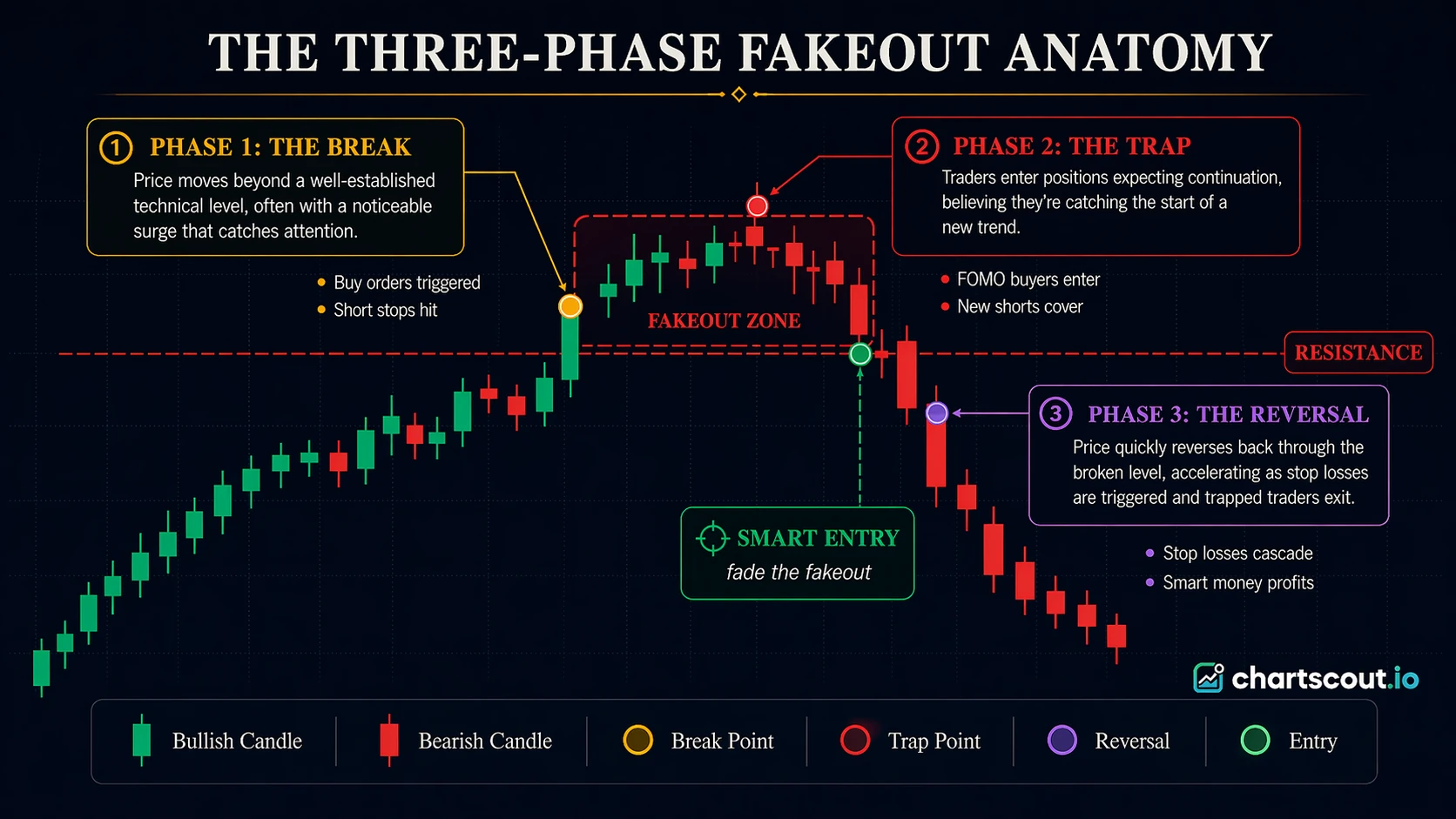
The three phases of a bull trap fakeout: break above resistance, trap retail buyers, then reverse sharply
- The Break - Price moves beyond a well-established technical level, often with a noticeable surge that catches attention
- The Trap - Traders enter positions expecting continuation, believing they're catching the start of a new trend
- The Reversal - Price quickly reverses back through the broken level, accelerating as stop losses are triggered and trapped traders exit
Types of fake breakouts
| Type | Description | Where It Occurs |
|---|---|---|
| Bull trap | Price breaks above resistance, then reverses sharply down | At resistance after uptrend |
| Bear trap | Price breaks below support, then reverses sharply up | At support after downtrend |
| Range fakeout | Price breaks out of consolidation, returns to range | Sideways markets |
| Trendline fakeout | Price pierces trendline, then continues original trend | Trending markets |
| Pattern fakeout | Chart pattern breaks wrong direction first | Triangles, H&S, wedges |
Bull trap
Price breaks above resistance, luring in bulls. It then reverses sharply downward.
- Breaks resistance level
- FOMO buyers enter
- Short sellers hit stops (buy to cover)
- Result: Smart money sells into this buying liquidity
Bear trap
Price breaks below support, luring in bears. It then reverses sharply upward.
- Breaks support level
- Panic sellers / breakout shorters enter
- Longs hit stops (sell to exit)
- Result: Smart money buys this selling liquidity
Bull trap vs bear trap: detailed anatomy
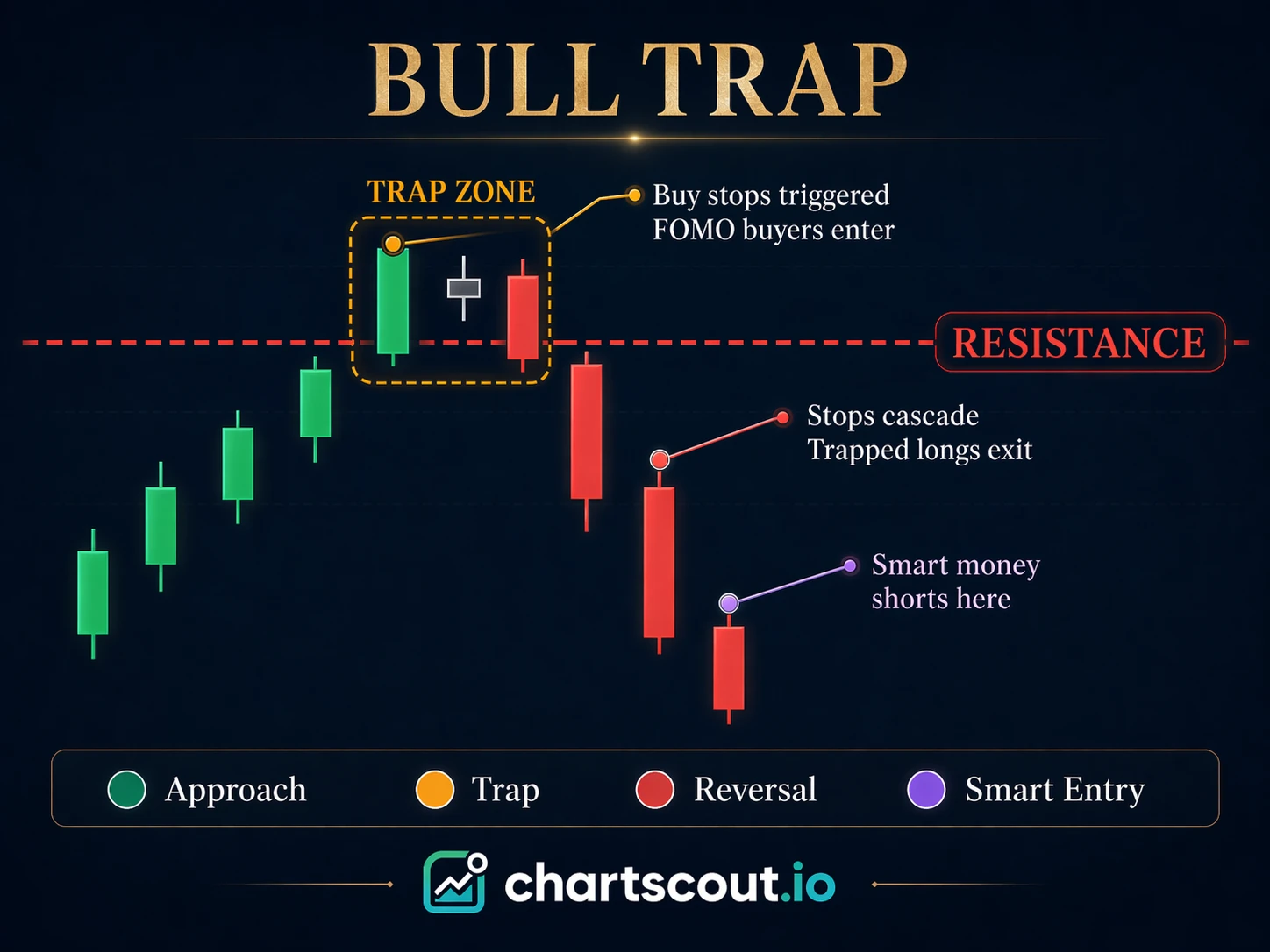
Bulls get trapped above resistance, then price reverses sharply down
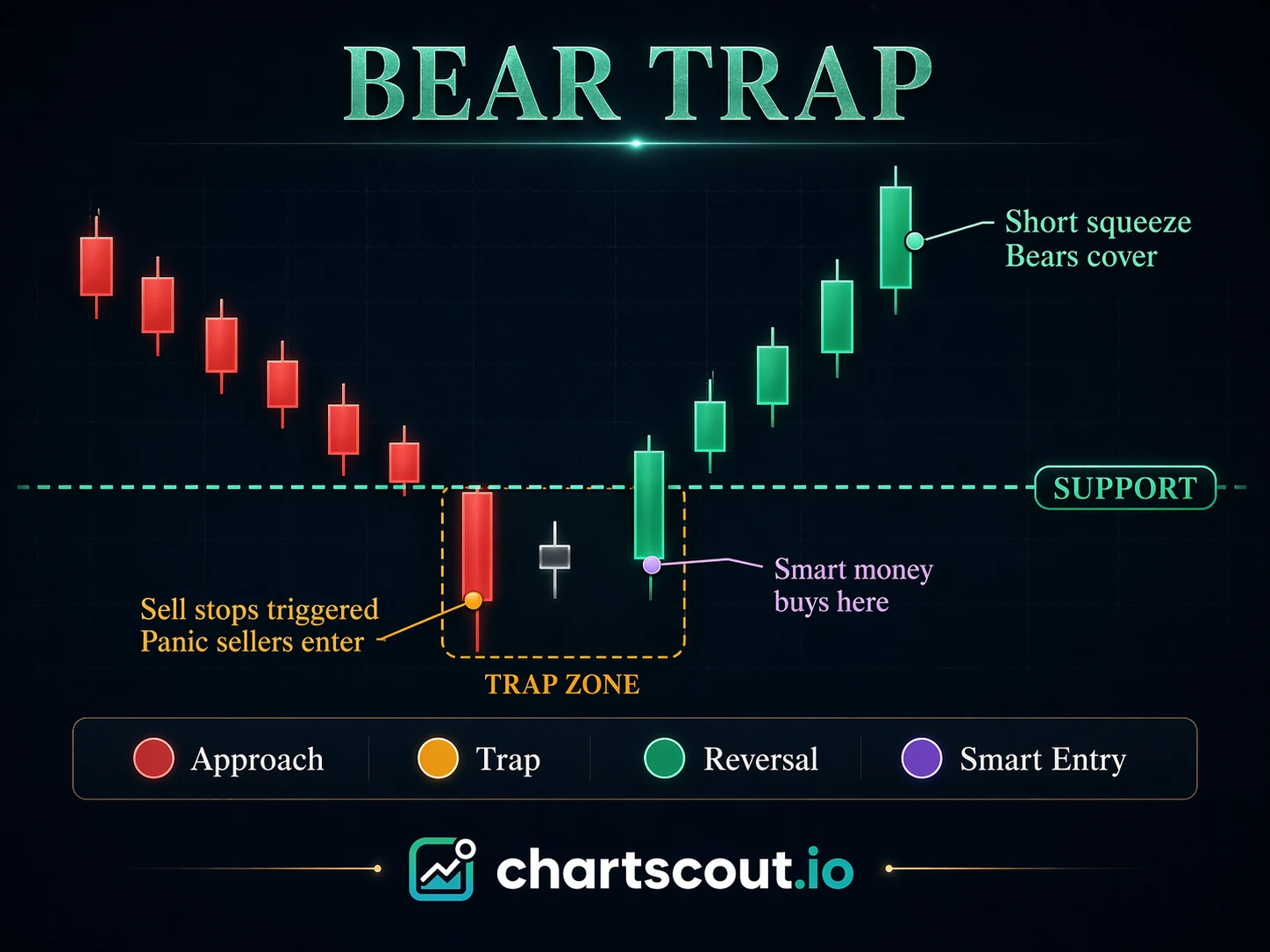
Bears get trapped below support, then price reverses sharply up
The psychology behind fake breakouts
Fake breakouts exploit fundamental human emotions that every trader battles: fear of missing out (FOMO) and the competitive urge to be “first” into a winning position. When price approaches a major resistance level that's been tested multiple times, anticipation builds. Traders place buy orders just above the level, hoping to catch the breakout the moment it happens. This concentration of orders at obvious levels is precisely what creates the trap.
“Jump in the shoes of those who act prematurely and visualize where they will likely give up. That level probably represents the market turn and best opportunity to get on board for a trip through the breakout. Many participants find this timing shift very difficult. The competitive market atmosphere ingrains a natural bias toward being early into new positions.”
- Alan S. Farley, The Master Swing TraderFarley's observation reveals the core paradox of breakout trading: the best entries often come from waiting for the premature traders to fail. When you identify where early entrants will capitulate-typically just beyond the obvious breakout level-you've found the zone where fakeouts reverse into genuine moves. This requires suppressing the instinct to chase and instead watching for the trap to spring before positioning yourself.
This psychological dimension explains why technical analysis alone cannot protect you from fakeouts. You must also understand your own emotional vulnerabilities. The fear of missing a legitimate breakout creates a powerful pull toward premature entry, while the pain of recent losses creates hesitation at precisely the wrong moments. Managing these competing pressures is what separates consistently profitable traders from those who oscillate between overconfidence and paralysis.
“If you are unable to trade without the slightest bit of emotional discomfort (specifically, fear), then you have not learned how to accept the risks inherent in trading. This is a big problem, because to whatever degree you haven't accepted the risks, you will avoid them.”
- Mark Douglas, Trading in the ZoneCrypto fakeout examples (illustrated scenarios)
Theory only goes so far. The four illustrated scenarios below are the patterns you will see again and again across active crypto charts. They are described in deliberately generic terms (no fabricated dates or exact prices) because the visual signature, not the calendar date, is what matters when a fakeout is forming in front of you.
A fakeout is not the same as a failed breakout
Worth being precise here. A fakeout is a deliberate-looking trap: a wick that pierces an obvious level, then reverses inside the same candle or within a candle or two. A failed breakout is just a low-conviction signal that quietly fades over many candles. Both can stop you out, but only the first one is engineered to do so. Treating every losing breakout trade as “hunted” is one of the fastest ways to misdiagnose your own setup.
Example 1: wick-only fakeout above a key resistance
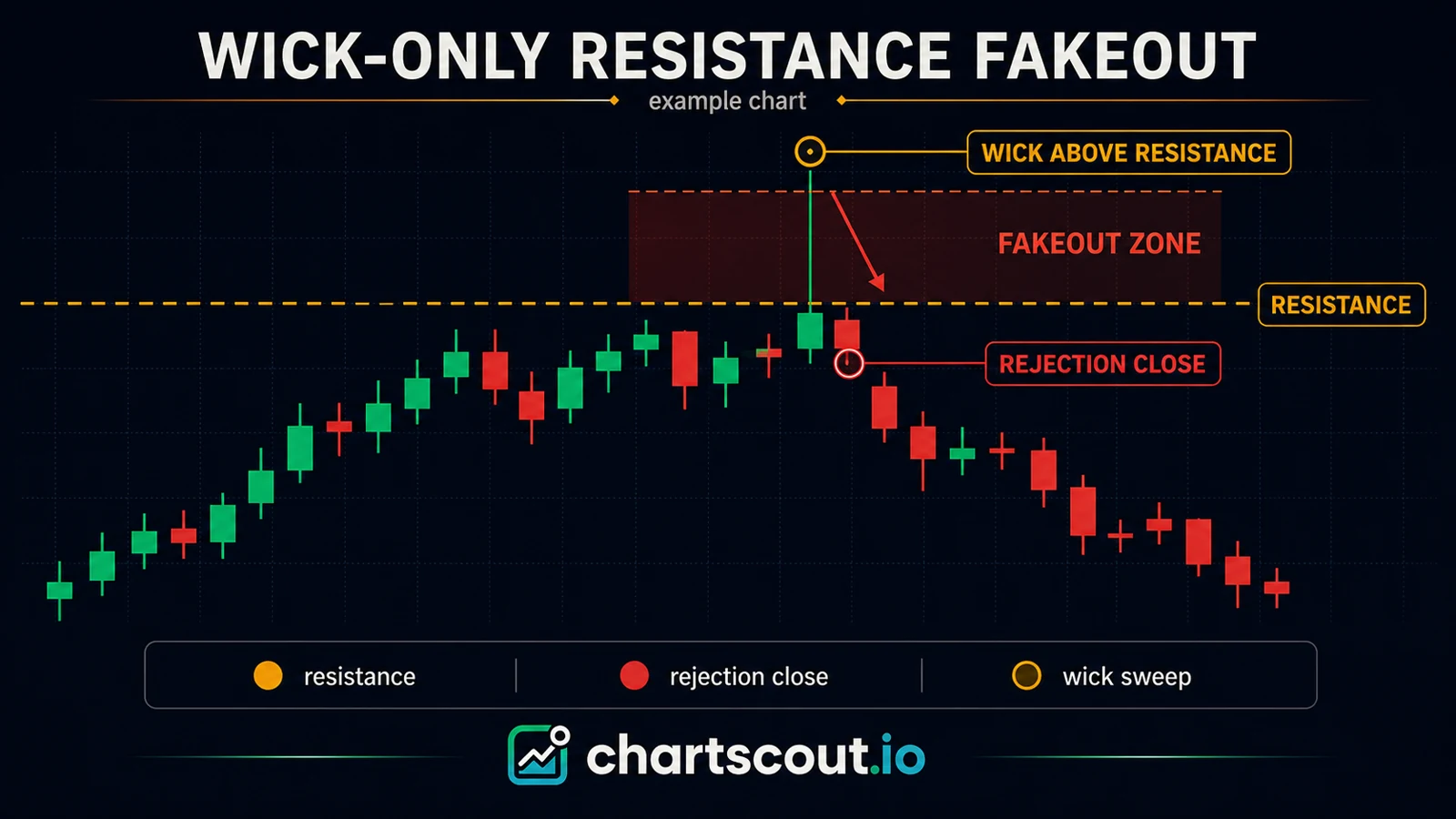
The most common upside fakeout. Price grinds up to a multi-week resistance, prints one explosive candle that pierces the level by 0.5-1.5%, and the same candle closes back below the resistance with an upper wick equal to roughly 60-80% of its range. Volume spikes hard on the wick candle, then collapses on the candle that follows.
What would have warned you: the candle did not close above the level. Wait for two consecutive closes above resistance before treating the breakout as real. Correct trade: short the close back inside the range, with the stop a few ticks above the wick high.
Example 2: succeeded then failed (close above, reversal within two candles)
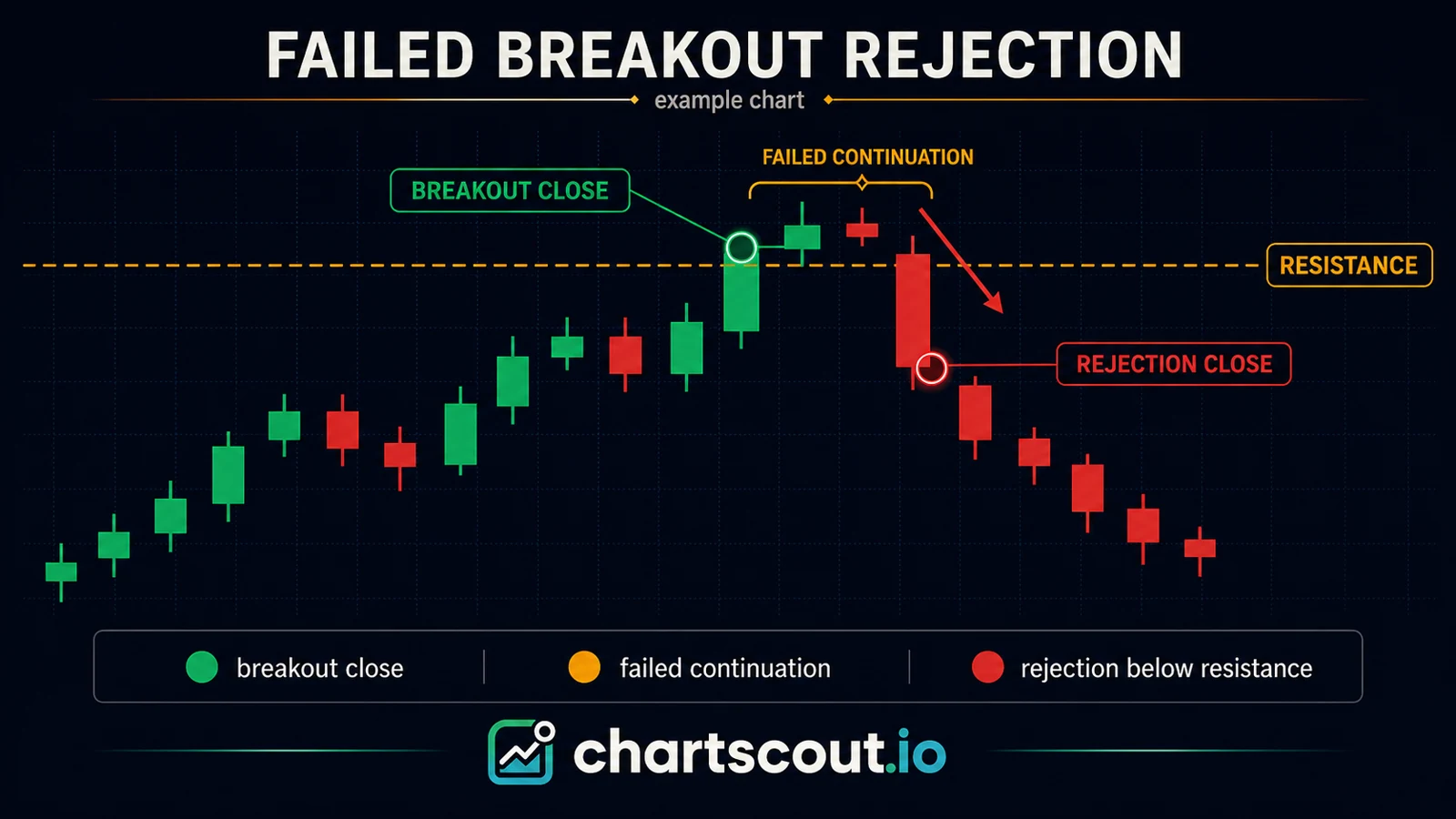
The harder fakeout to spot. The breakout candle closes cleanly above resistance. Volume looks acceptable. The next one or two candles fail to extend, then a wide-bodied red candle closes back below the level. This is the trap that catches traders who follow the “wait for the close” rule but skip the follow-through check.
What would have warned you: the breakout candle was not followed by a continuation candle of similar or greater size. Order book showed the new bids being lifted then withdrawn rather than absorbed. Correct trade: exit longs the moment the next candle closes red back inside the range. Re-evaluate before re-entering on a retest.
Example 3: pre-news fakeout (CPI, FOMC, jobs print)
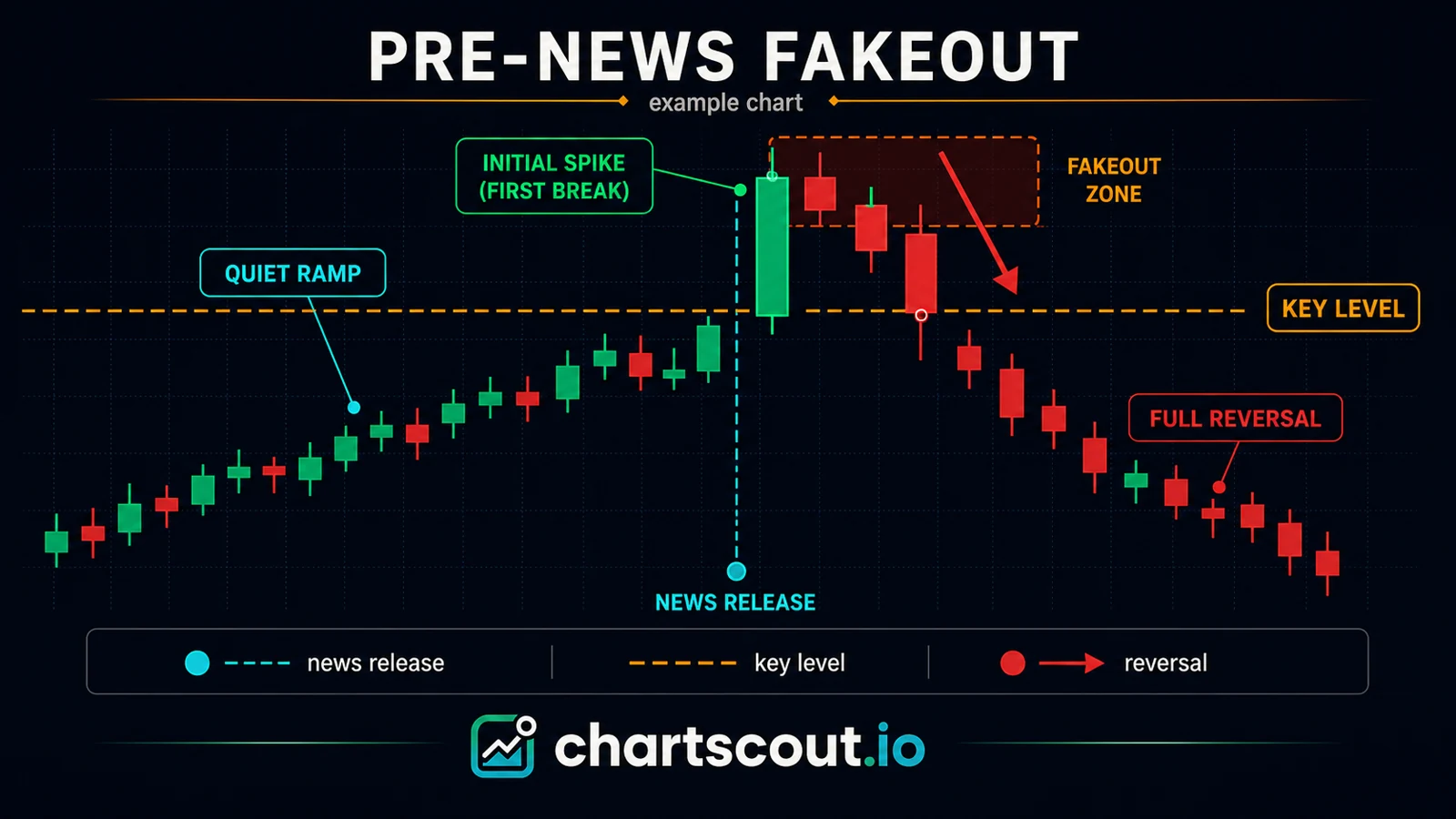
In the 4-12 hours before a high-impact macro print (US CPI, FOMC decision, NFP), an active crypto pair often ramps into a key level on quiet volume. The print lands, the first reaction breaks the level decisively, and within one to three candles the move fully reverses. Pre-news fakeouts have an unusually clean signature because the pre-print positioning is visible in funding rates and open interest.
What would have warned you: never enter a breakout in the 30-minute window around a scheduled macro print. Volatility expansion eats stops in both directions before settling. Correct trade: wait for the post-print whipsaw to settle (typically two to four candles), then trade the direction of the close after the dust clears.
Example 4: liquidation-cascade fakeout
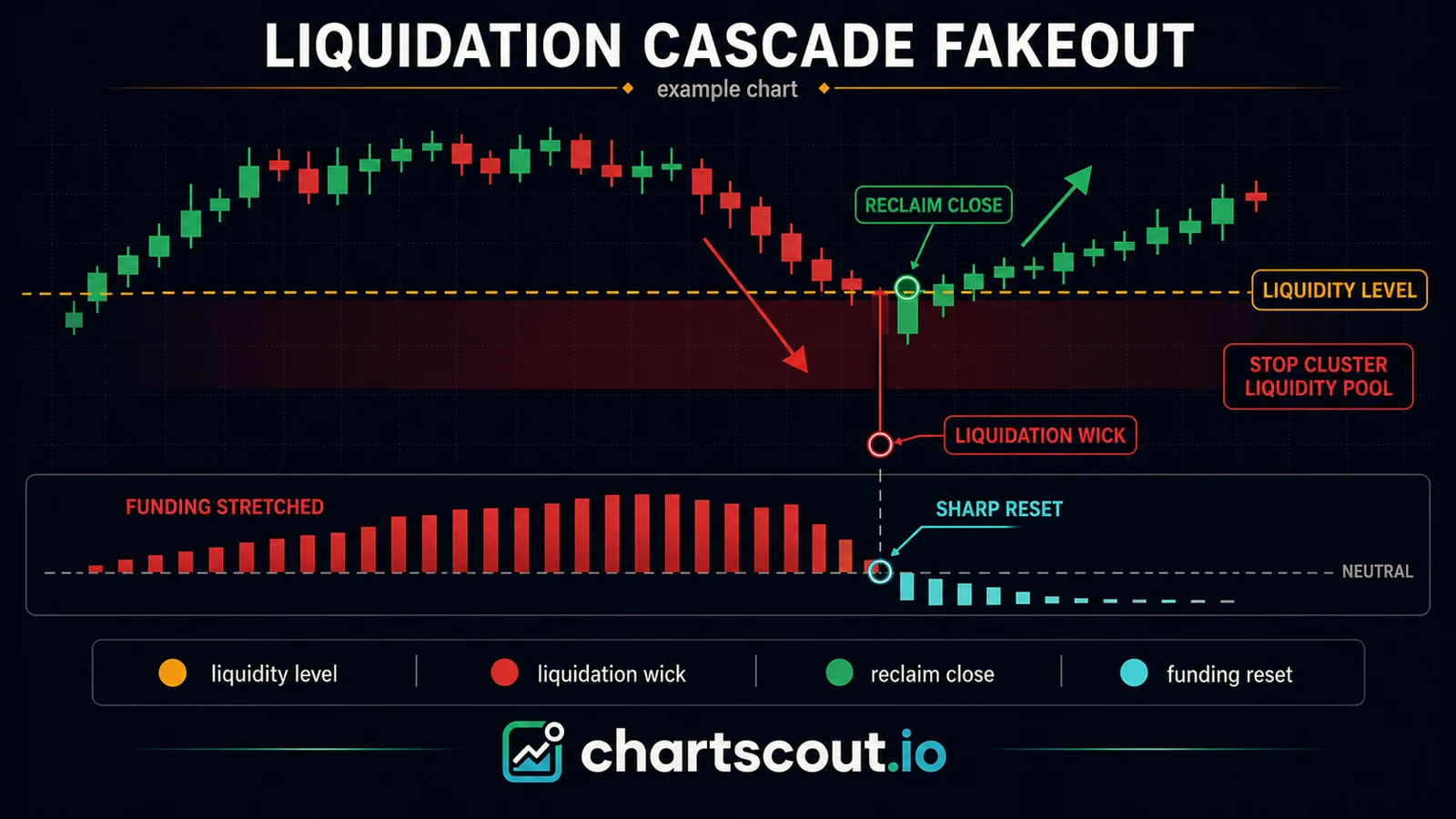
Heavily-leveraged perp markets on Binance and Bybit produce a specific crypto fakeout: aggressive funding (positive or negative, both work), open interest at multi-week highs, then a single sharp move that flushes the over-leveraged side. The wick can be 3-6% on a lower-timeframe candle. Within an hour or two, price has recovered most of the move.
What would have warned you: funding rate sitting at one extreme for several days, with open interest climbing into the move. Public liquidation heatmaps light up at the level the wick pierces. Correct trade: fade the cascade after the wick reclaims its open. Stops go just past the wick extreme. This is one of the highest risk-reward setups in crypto perps, but only when the cluster on the heatmap actually exhausts.
What the four examples share
In every case the warning signal arrived before the reversal: an unconvincing candle close, a missing follow-through candle, a known macro event, or a leverage extreme on the perp book. None of these signals are exotic. They are visible in real time on any chart, on any of the five exchanges ChartScout scans (Binance, Bybit, KuCoin, MEXC, Hyperliquid). The discipline is not detecting the fakeout. It is waiting for confirmation before sizing into the original breakout in the first place.
How a bitcoin fakeout typically forms
A bitcoin fakeout is the same mechanic as any crypto fakeout: price pierces an obvious level on BTC, fails to hold, and snaps back through it. What makes a bitcoin fakeout worth its own section is that BTC has structural traits no altcoin shares. Bitcoin is the market leader, it has the deepest 24/7 liquidity in crypto, and its obvious levels are watched by more traders than any other chart. That combination makes BTC's round numbers and prior swing highs the most heavily targeted liquidity in the entire market. You do not need a fabricated price example to see the pattern, the mechanic repeats regardless of where price happens to be.
Why bitcoin attracts fakeouts more than any other coin
- It is the market leader. Altcoins follow BTC. When bitcoin pierces a level, thousands of traders position on the same side across hundreds of pairs, which concentrates stops and entries exactly where a fakeout pays the most.
- Its levels are the most obvious in crypto. Round numbers and prior all-time highs on the BTC chart are posted everywhere. The “if it's obvious, it's obviously wrong” paradox hits bitcoin hardest because no level in crypto is more crowded.
- It trades 24/7 with no closing bell. A bitcoin breakout can fire at 3 AM UTC on a Sunday into a thin order book. With institutional desks offline, far less capital is needed to push BTC through a level and pull it straight back.
- It has the deepest perp liquidity in crypto. BTC perpetuals on Binance and Bybit carry the largest open interest in the market. Public liquidation heatmaps make the clusters above obvious highs and below obvious lows visible to everyone, including the participants who target them.
The repeatable bitcoin fakeout mechanic
Stripped of dates and price levels, a bitcoin fakeout almost always runs through the same four steps:
- A crowded level forms. BTC grinds toward a round number, a prior swing high, or a long-tested range edge that retail traders are openly watching.
- A low-conviction break sweeps the liquidity. Price pushes a wick past the level, often on weekend or overnight liquidity, triggering the resting stop and breakout orders parked just beyond it. This is the liquidity sweep, the break exists to collect orders, not to start a trend.
- Volume fails to confirm. The break candle either does not close beyond the level, or it closes beyond but the next candle does not extend. There is no sustained volume expansion, which is the single clearest tell that the move was a sweep and not a breakout.
- Price reclaims the level. BTC closes back inside the prior range within a candle or two, and the trapped side gets squeezed out as price accelerates the other way.
The candle-close rule matters most on bitcoin
Because BTC's levels are so crowded, wick-only breaks above them are routine. Wait for a full candle to close beyond the level on your trading timeframe, then wait for one more candle to confirm follow-through. A bitcoin fakeout is defeated less by a clever indicator and more by the discipline to not act on the wick that pierced the level.
The verified case studies later in this guide (Bitcoin's failed $10,500 breakout in September 2019 and the spot ETF “sell the news” reversal in January 2024) are real, dated examples of this exact mechanic playing out on BTC. They show that the warning signs, an unconvincing break, stretched positioning, and a euphoric crowd, are visible before the reversal, not only after it.
Why fake breakouts are more common in crypto
If you've traded both traditional markets and cryptocurrency, you've likely noticed that crypto seems particularly prone to violent fakeouts. This isn't just bad luck or confirmation bias-there are specific structural characteristics of crypto markets that make false breakouts significantly more common than in stocks, forex, or futures.
24/7 markets create more fake out opportunities
Unlike traditional markets with defined opening and closing times, cryptocurrency markets trade continuously. This creates unique vulnerabilities:
- No Opening/Closing Anchors: Price action is more susceptible to manipulation at any hour
- Weekend Fakeouts: The most dangerous period-volume drops significantly as institutional desks close
- Session Overlap Volatility: Regional transitions create volatility spikes that can produce temporary breakouts
High-risk timeframes
The period between 12 AM - 6 AM UTC typically sees the lowest volume in major crypto pairs. Breakouts during these hours carry significantly higher fakeout risk. Conversely, 12 PM - 8 PM UTC (European/US overlap) tends to produce more reliable breakouts.
Lower liquidity = easier manipulation
While major crypto assets like Bitcoin and Ethereum maintain reasonable liquidity on major exchanges, altcoins outside the top 20 by market cap are exceptionally vulnerable to manipulation. A mid-cap altcoin might have only $500,000 - $2,000,000 in total order book depth within 2% of the current price across all exchanges.
Order book depth and exchange fragmentation
Understanding order book dynamics is essential for recognizing fakeout conditions. In traditional markets, most volume flows through centralized exchanges with deep liquidity. Cryptocurrency markets are fundamentally different-trading occurs across dozens of exchanges simultaneously, each with its own order book and liquidity pool.
This fragmentation creates several vulnerabilities that sophisticated manipulators exploit:
- Thin Order Books: Even major assets can have gaps in the order book where a single large order moves price significantly
- Cross-Exchange Arbitrage Delays: Price discrepancies between exchanges can persist for seconds, allowing coordinated manipulation
- Aggregated Volume Illusions: Total market volume appears high, but any single exchange may have insufficient depth to absorb large orders
- Liquidity Fragmentation: A $10M order that would barely move price in equities can move a crypto asset 2-5% due to split liquidity
💡 Practical application: checking order book depth
Before trading any breakout, check the order book depth on your primary exchange. Look at the cumulative volume within 1-2% of the current price. If this volume is less than 5x your intended position size, the asset is vulnerable to manipulation and fakeouts are more likely. For altcoins, consider requiring 10x your position size in nearby depth.
Whale manipulation and liquidity hunting
The concentration of cryptocurrency holdings in relatively few wallets creates opportunities for manipulation that simply don't exist in traditional markets:
- Stop-Loss Hunting: Whales spike price through obvious levels to trigger cascading stop loss orders
- Painting the Tape: Coordinated trades between accounts create the appearance of breakout momentum
- Order Book Spoofing: Large orders placed with no intention of execution, then canceled
“Beware False Breakouts, Shake Outs, and Other Fake Outs. False breakouts often occur at widely anticipated breakout points like the neckline of a double or triple bottom. Vast flocks of inexperienced traders will attempt to go long at these points. So, big experienced players may attempt to use these breakout points to fool you into selling too early near the bottom or buying too late near the top.”
- Cliff Wachtel, The Sensible Guide to ForexThe “too obvious” paradox
Professional traders have an aphorism: “If it's obvious, it's obviously wrong.” When a chart pattern or breakout level is so clear that thousands of retail traders are posting about it, you should increase your confirmation requirements significantly. The most reliable breakouts are those that only become clear in hindsight, not those telegraphed for days in advance.
The 7-point fakeout detection checklist
Most traders fail at breakout trading not because they can't identify potential breakouts, but because they enter too early without proper confirmation. The following 7-point framework represents the minimum confirmation requirements before entering any breakout trade.
1Volume confirmation
Volume on the breakout candle should spike to at least 50-100% above the 20-period volume average. For high-confidence breakouts, look for 150-200%+ volume spikes.
Red Flag: Volume spikes on the initial breakout candle, then immediately drops on subsequent candles.
2Candle close beyond level
Never trade a breakout until at least one full candle closes cleanly beyond the technical level on your trading timeframe. The stronger the candle body relative to its wick, the better.
Weak: Long upper wick, small body closing near the open = rejection. Strong: Large body with small wick closing near the high = conviction.
3Timeframe alignment
Before entering any breakout, check at least one higher timeframe to confirm trend alignment. A breakout that contradicts the higher timeframe trend is fighting institutional positioning.
- • 15-minute breakouts → Check 1H and 4H
- • 1-hour breakouts → Check 4H and Daily
- • 4-hour breakouts → Check Daily and Weekly
4Market structure context
Assess: Is this breakout moving WITH or AGAINST the dominant trend? How many times has the level been tested? (Ideal: 3-5x). Where are we in the broader market cycle?
5Momentum indicator confirmation
RSI: Should be above 50 for bullish breakouts (ideally 50-70). MACD: Histogram should be expanding in breakout direction.
Critical Warning: If price makes a new high while RSI makes a lower high, this bearish divergence suggests the breakout will fail.
6Retest behavior
The strongest breakouts often retest the broken level before continuing. If former resistance holds as new support (or vice versa), this provides high-confidence confirmation.
7Time of day/week considerations
Highest Risk: Weekends, Late Night UTC (12 AM - 6 AM), Major holidays
Highest Confidence: European/US Overlap (12 PM - 8 PM UTC), Tuesday-Thursday
“Although the action on day 3 suggests an upthrust, it's not unusual for them to fail within an uptrend just as downtrends are littered with failed springs. In summary, the trend is of paramount concern when evaluating upthrusts. It's the price/volume behavior on the preceding and succeeding bars that often reveal if a potential upthrust will actually develop.”
- David H. Weis, Trades About to HappenBreakout confirmation flowchart
Use this decision tree to systematically evaluate every breakout opportunity
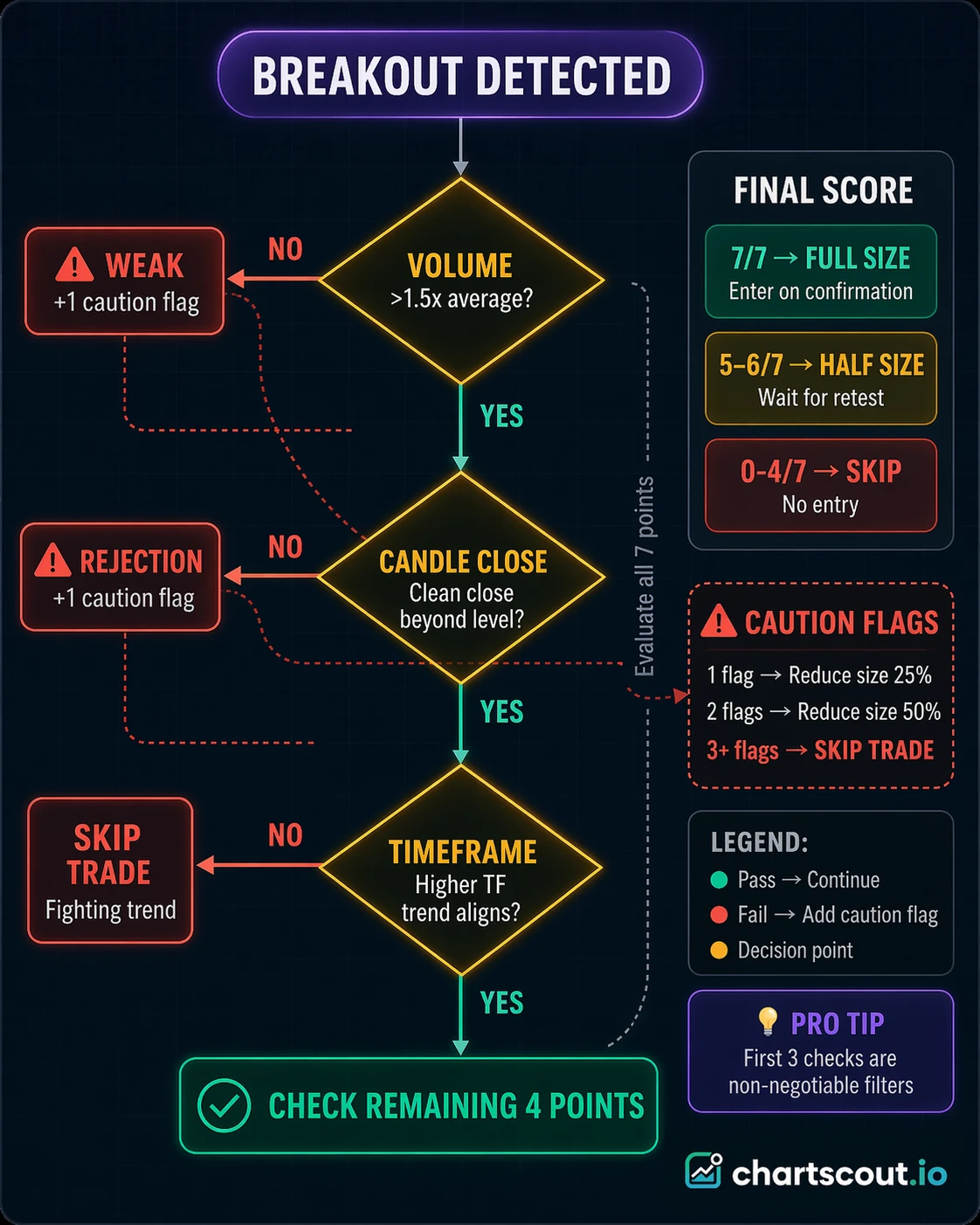
Work through each decision point systematically-never skip steps even when a setup “feels” right
Volume analysis: your #1 fakeout detector
Volume is the single most reliable indicator for distinguishing real breakouts from fakeouts. Price can be manipulated with relatively small capital, indicators can be painted, and patterns can deceive-but volume reveals the truth about institutional participation. For a deeper dive into how volume interacts with every major chart pattern, see our complete guide to chart patterns and volume analysis.
“Your vertical line chart of these averages should also show the volume of the day's trading - the total sales for the day. This is very important because it aids in forming your judgment of the prevailing trend.”
- Richard D. Wyckoff, Tape Reading and Active TradingVolume acceleration principles
The most important volume concept for breakout trading isn't just the absolute level-it's the rate of change. Volume acceleration tells you whether momentum is building or fading, often before price action makes it obvious.
Healthy breakout volume pattern: Volume should increase progressively as price approaches and breaks the level, then remain elevated for at least 2-3 candles after the break. This sustained participation indicates that new money is entering the market, not just stops being triggered.
Fakeout volume pattern: A sudden, isolated spike that immediately collapses back to average or below-average levels. This pattern indicates that the breakout was driven by stop-loss triggers or a single large order, rather than genuine accumulation by multiple market participants.
Volume pattern comparison: real vs fake breakout
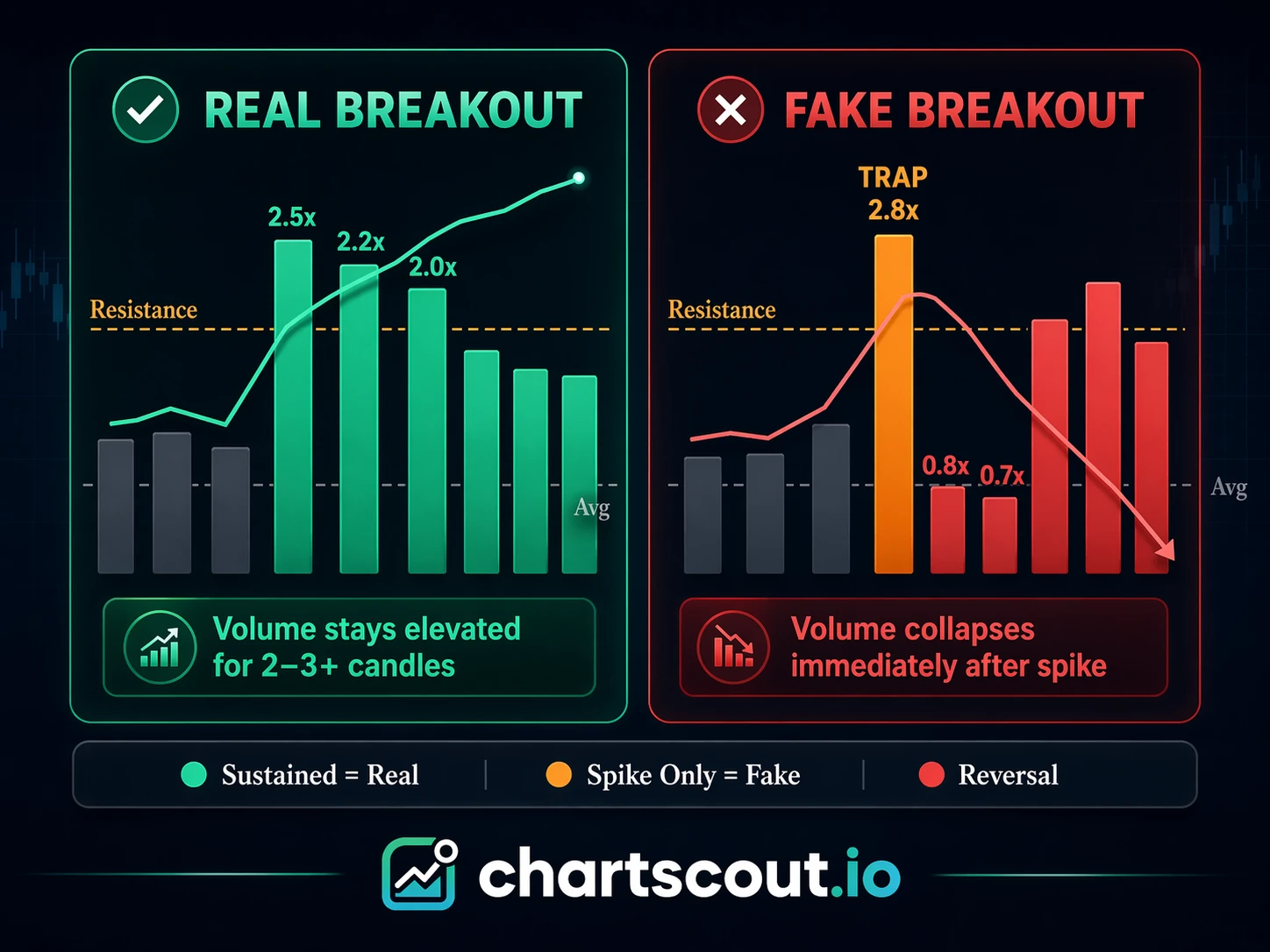
Real breakouts show sustained volume expansion; fake breakouts show isolated spikes followed by volume collapse
Volume deceleration warning
If the breakout candle shows high volume but the second candle shows declining volume by more than 30%, treat this as a major warning sign. Genuine breakouts attract follow-through buyers; fakeouts exhaust available interest on the initial move.
Volume patterns that signal fakeouts
| Volume Pattern | What It Means | Fakeout Probability |
|---|---|---|
| Spike on break, immediate drop | Retail FOMO triggered stops, no institutional follow-through | Very High (80%+) |
| Declining volume into breakout | Lack of conviction; move not attracting new participants | High (70%+) |
| Average volume, no spike | Weak participation; not generating institutional interest | Moderate-High (60%+) |
| High volume sustained 2-3 candles | Institutional participation; genuine accumulation/distribution | Low (30%+) |
| Volume climax reversal | Exhaustion move; all buyers consumed, reversal imminent | Very High (85%+) |
On-balance volume (OBV) for breakout confirmation
When price breaks to a new high, OBV should simultaneously make a new high. If price breaks resistance to a new high but OBV fails to confirm with its own new high, this bearish divergence warns that the breakout lacks accumulation support and is likely to fail.
💡 Pro tip: anticipating breakouts with OBV
Sometimes OBV breaks to new highs before price breaks resistance. This early OBV breakout reveals that accumulation is occurring even though price hasn't moved yet-a strong signal that the eventual price breakout will be genuine.
Candlestick patterns that signal fakeouts
Individual candles and candlestick combinations provide early warning signals that a breakout lacks genuine conviction and is likely to reverse. If you're still building your chart reading foundations, our guide on how to read crypto charts covers candlestick basics, chart types, and essential indicators.
Rejection candles at breakout levels
The most powerful fakeout signal is the rejection candle-a candle that attempts to break a level but gets violently pushed back, leaving a long wick in the direction of the attempted breakout.
Upper rejection (long upper wick)
Price breaks above resistance but closes well below the high. The long upper wick reveals that sellers overwhelmed buyers at the higher price. If the upper wick is more than twice the size of the candle body, this is a strong rejection signal.
Lower rejection (long lower wick)
Price breaks below support but closes well above the low. The long lower wick shows that buyers aggressively defended the lower prices. This is often the first sign of a bear trap forming.
Doji and indecision candles
Doji candles at breakout levels represent equilibrium and indecision. If price breaks above resistance but the breakout candle forms a doji, this reveals that neither buyers nor sellers could establish control-this uncertainty almost always resolves against the breakout direction.
Engulfing patterns after breakouts
A bearish engulfing pattern immediately after a resistance break confirms that sellers have seized control and the breakout was a trap. Conversely, a bullish engulfing after a support break confirms the bear trap.
Multiple rejection wicks: the cluster warning
One of the most reliable fakeout warnings is the appearance of multiple rejection wicks at the same price level. When you see 2-3 candles in succession, each attempting to break through a level but leaving long wicks in the breakout direction, this clustering of failed attempts signals strong institutional defense of that level.
The psychology behind this pattern is clear: buyers (or sellers) are repeatedly attempting to push through, but each time they're met with overwhelming opposing force. After 2-3 failed attempts, the side that's been absorbing these attacks often has enough trapped counterparties to fuel an aggressive move in the opposite direction.
💡 The “third touch“ rule
Professional traders often wait for the third failed attempt at a level before trading the reversal. The first touch might be coincidence, the second confirms the level matters, but the third failed attempt-especially with declining volume on each push-signals exhaustion of the breakout attempt.
Wick-to-body ratio analysis
For any breakout candle, calculate the ratio between the wick in the breakout direction and the candle body. A ratio greater than 2:1 (wick twice as long as body) is a significant warning. A ratio greater than 3:1 almost always precedes a reversal. This simple metric quantifies the rejection strength and removes subjectivity from your analysis.
The “classic fakeout candle” pattern
Watch for these 5 characteristics:
- Strong initial break through the technical level
- Weak close relative to the extreme (closes near opening)
- Large wick in the breakout direction (larger than the body)
- Mediocre volume (less than 100% above average)
- Location at an obvious, widely-watched level
Timeframe analysis for fakeout detection
The relationship between timeframe and fakeout probability is inverse and powerful: the lower the timeframe, the higher the fakeout rate. This occurs because lower timeframes capture more noise, are more susceptible to manipulation, and lack institutional participation.
Timeframe reliability comparison
| Timeframe | Fakeout Frequency | Reliability | Best For |
|---|---|---|---|
| 1-5 minute | Very High (70%+) | Low | Scalpers only (not recommended) |
| 15-30 minute | High (60%+) | Low-Moderate | Experienced day traders |
| 1 Hour | Moderate (50%+) | Moderate | Day traders, active swing traders |
| 4 Hour | Lower (40%+) | Moderate-High | Swing traders (recommended) |
| Daily | Low (30%+) | High | Position traders, investors |
| Weekly | Very Low (20%+) | Very High | Long-term trend followers |
Multi-timeframe confirmation strategy
The 4-step multi-timeframe workflow
- Identify Breakout on your trading timeframe
- Zoom Out to higher timeframe for trend confirmation
- Check for Higher Timeframe Resistance/Support that might block the move
- Use Lower Timeframe for precise entry (retest bounce)
Full breakdown: multi-timeframe analysis for crypto covers the 1:4 ratio rule, HTF/MTF/LTF roles, and how to size each alignment tier.
When timeframes conflict
Always defer to the higher timeframe. A 15-minute bullish breakout cannot succeed if it contradicts a 4-hour downtrend except in rare circumstances. Options: (1) Skip the trade entirely, (2) Reduce position size by 50-75%, (3) Wait for higher timeframe confirmation.
How to trade false breakouts for profit
Sophisticated traders don't just avoid fakeouts - they trade them. When a false breakout traps traders on the wrong side, their eventual capitulation creates explosive moves in the opposite direction.
“Since big players like to fade breakouts, individual traders have a higher chance of success if they fade breakouts as well. Fading breakouts is not an instinctive thing to do as a trader, because the prospect of reaping massive gains from a price breakout outweighs the prospect of a failed breakout. Even though fading breakouts is counter-intuitive, it can be a very profitable strategy for capturing short-term gains.”
- Grace Cheng, 7 Winning Strategies For Trading Forex“Few patterns bust, so the performance numbers are not solid. Still, they show how much better a busted pattern does than one that works. If you see prices move less than 5% after the breakout and then return to the pattern, consider trading the new direction, but only if it breaks out the other side.”
- Thomas Bulkowski, Encyclopedia of Chart Patterns, 2nd EditionWyckoff springs and upthrusts
“«Springs» or «shakeouts» usually occur late within the trading range and allow the dominant players to make a definitive test of available supply before a markup campaign will unfold. If the amount of supply that surfaces on a break of support is very light (low volume), this indicates that the way is clear for a sustained advance.”
- Roman Bogomazov, Practical Applications of the Wyckoff MethodBogomazov's insight into Wyckoff springs reveals the volume signature that distinguishes genuine breakdowns from manufactured shakeouts. When support breaks on light volume, it suggests the move is a trap rather than genuine distribution. This principle applies equally to cryptocurrency markets, where whales frequently engineer false breakdowns during low-liquidity periods specifically to harvest stop losses before reversing higher.
The counterpart to the spring is the upthrust-a false break above resistance that serves the same purpose for bearish setups. Understanding both patterns gives you the conceptual framework to recognize fakeouts in either direction and position yourself for the reversal rather than getting trapped.
“Wyckoff terminology for these patterns, springs and upthrusts, can be confusing at first glance. A spring is a quick drop below support, which immediately finds enough demand to push prices back above support. An upthrust is a push above resistance, followed by an immediate failure as the market meets sufficient supply to push it back down. Both of these are essentially fake-outs, which do nothing more than run stops outside of support and resistance.”
- Adam Grimes, The Art and Science of Technical AnalysisWyckoff spring vs upthrust: visual guide
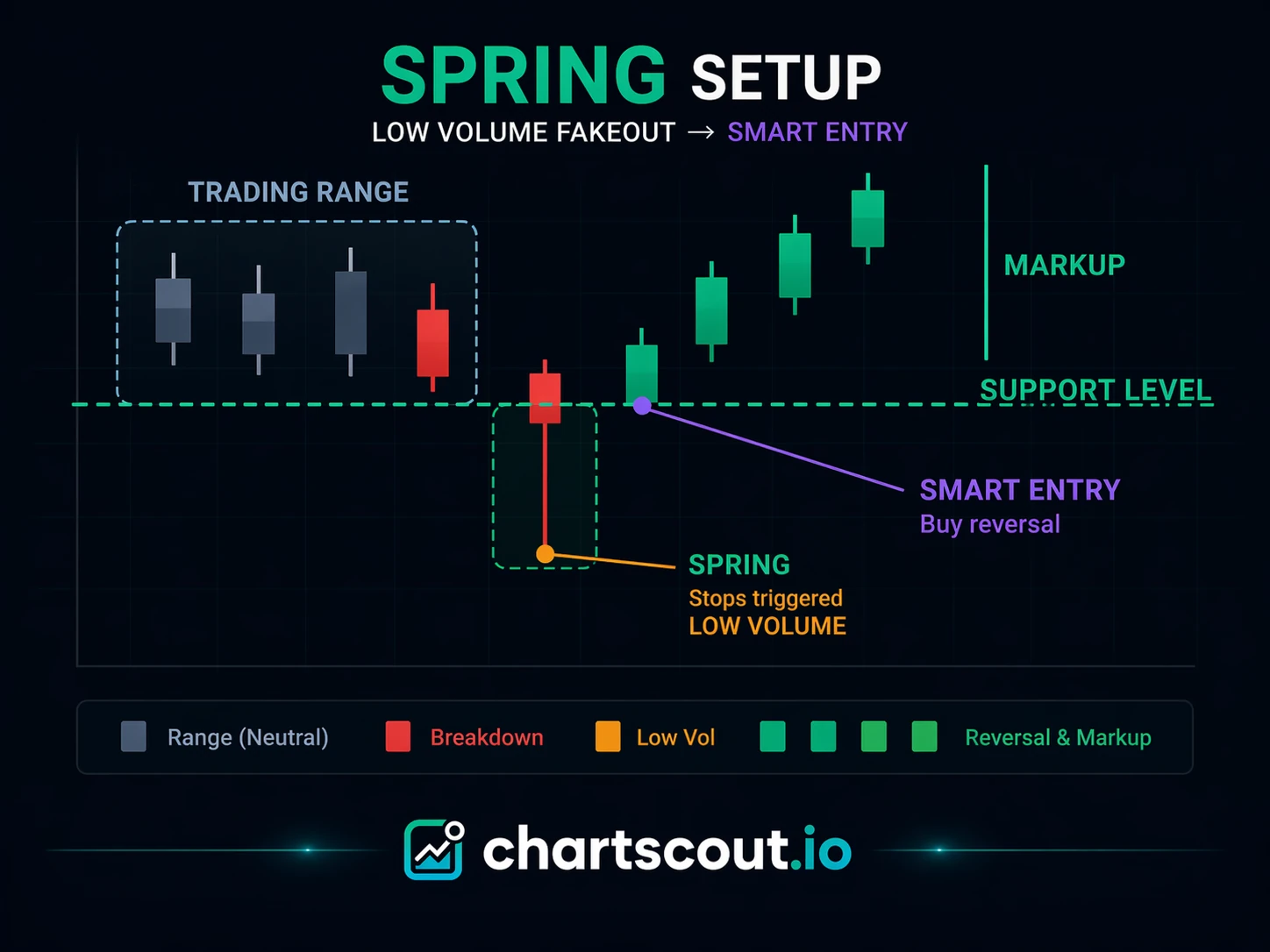
Price dips below support on low volume, reverses sharply up
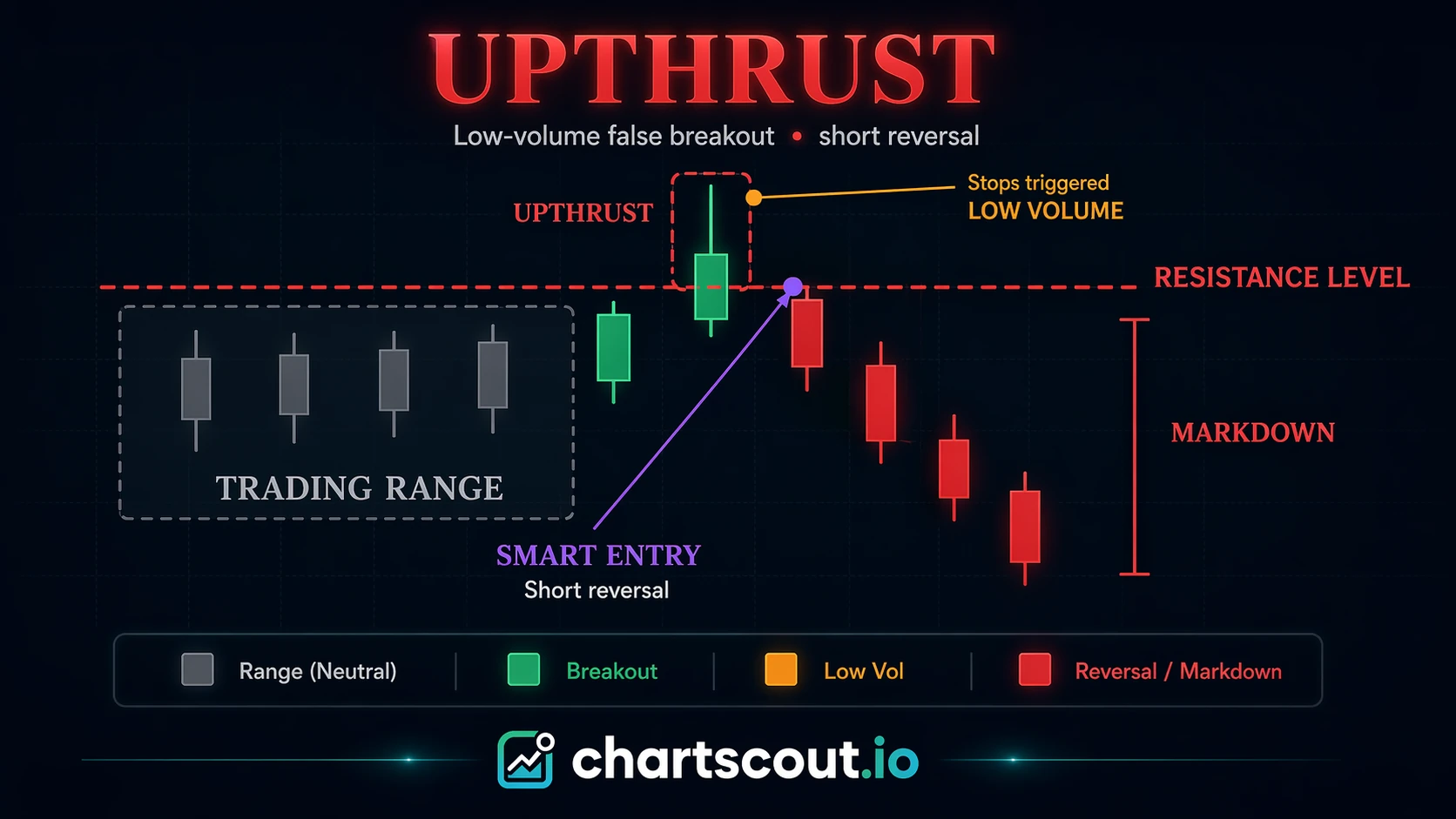
Price spikes above resistance on low volume, reverses sharply down
Key Insight: The signature of both patterns is low volume on the false break followed by high volume on the reversal. This reveals that the initial break was manufactured, not genuine institutional activity.
Entry rules for fakeout reversals
The 4-rule entry framework
- Wait for Price to Close Back Inside the Range - The body must close back inside, not just the wick
- Confirm with Volume Spike on the Reversal - Indicates trapped traders exiting and new traders entering the reversal
- Enter on the First Confirming Candle - Don't wait for further confirmation once you have it
- Look for Candlestick Confirmation - Engulfing patterns strengthen the signal
Stop loss placement
For pattern-by-pattern stop placement rules across head and shoulders, triangles, wedges, and flags, see our full crypto stop loss guide. The two reversal-trade defaults below come straight out of those rules.
For bull trap reversals (shorting): Place stop 0.5-1% above the fakeout high.
For bear trap reversals (buying): Place stop 0.5-1% below the fakeout low.
Profit targets
- Primary Target: Opposite side of the range or pattern
- Extended Target: Prior swing point or structural level
- Maximum Target: 1.618 Fibonacci extension from the fakeout
📊 Partial profit strategy
- 50% of position at minimum target (opposite side of range)
- 25% of position at extended target (prior swing point)
- 25% of position at maximum target (Fibonacci extension)
Common chart pattern fakeouts
Certain chart patterns are particularly notorious for producing false breaks because they're so widely recognized. When thousands of traders watch the same pattern, that concentration of attention creates perfect conditions for manipulation. For a one-page reference of every major pattern with break-even rates and timeframe rules, see our crypto chart patterns cheat sheet.
Triangle breakout fakeouts
Triangles frequently break in one direction first (triggering entries and stops), then reverse and break in the opposite direction for the “real” move. The initial break from a symmetrical triangle has an exceptionally high failure rate. The same dynamic shows up on ascending triangles, where the obvious flat-resistance breakout often fails before the real move. Wedge patterns face similar breakout challenges, see our rising wedge vs falling wedge guide for detailed breakout confirmation strategies specific to wedge formations.
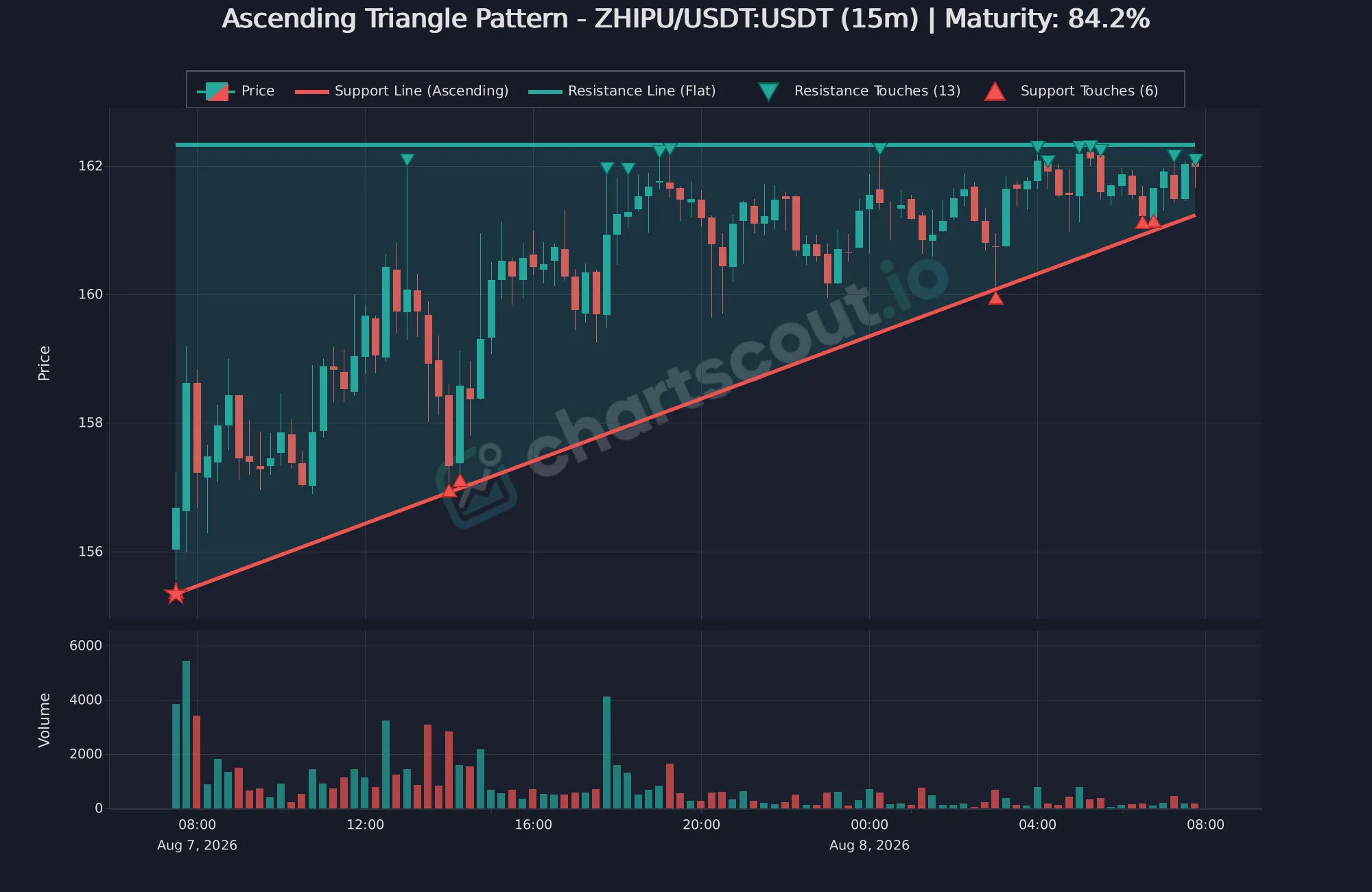
Ascending triangle: ZHIPU/USDT 15m
Rising support presses into flat resistance on Binance. Detected August 8, 2026; wait for a close, volume, and retest before treating the breakout as confirmed.
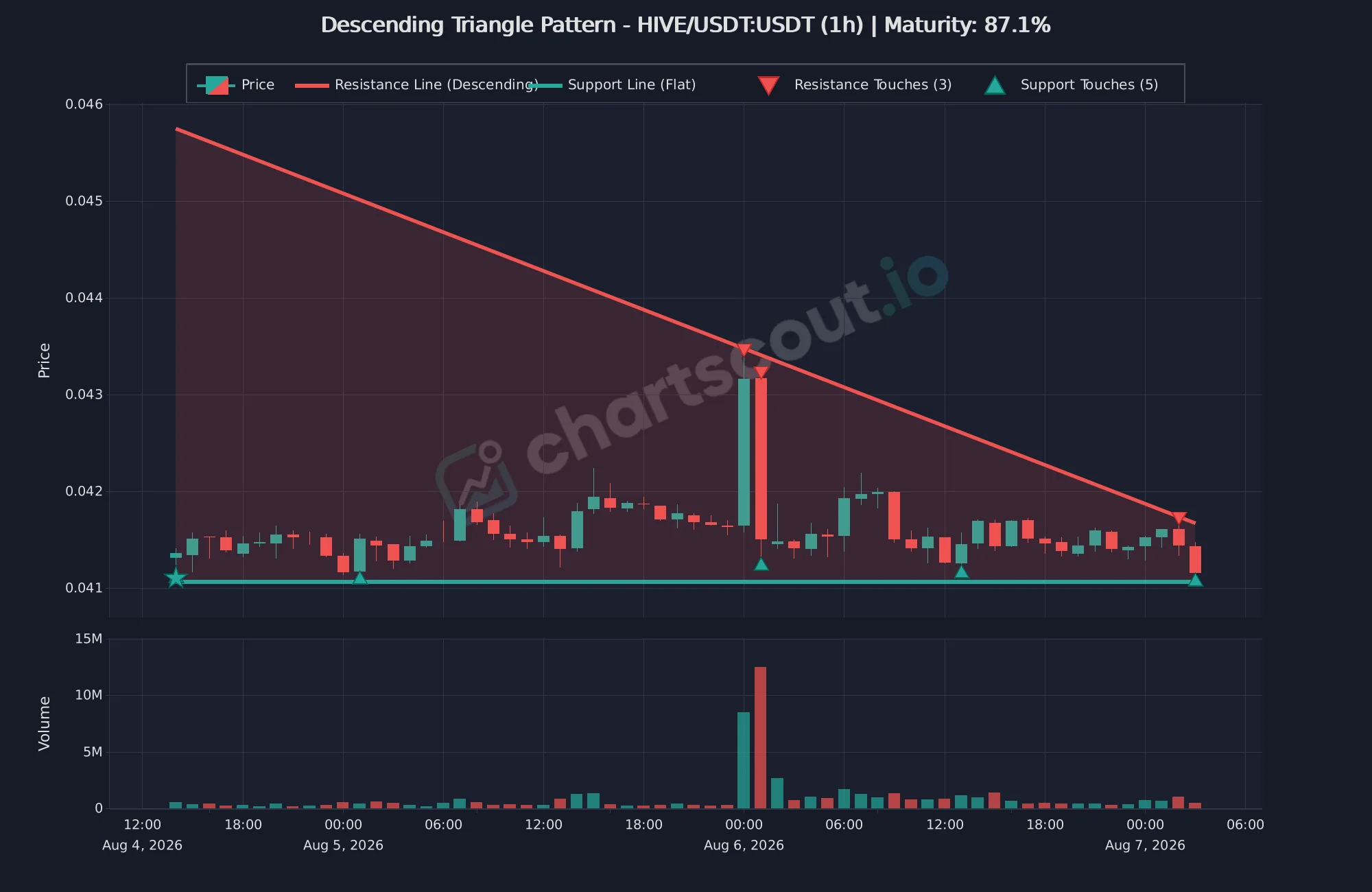
Descending triangle: HIVE/USDT 1h
Descending resistance converges toward flat support on Binance. Detected August 7, 2026; a brief support break alone does not confirm continuation.
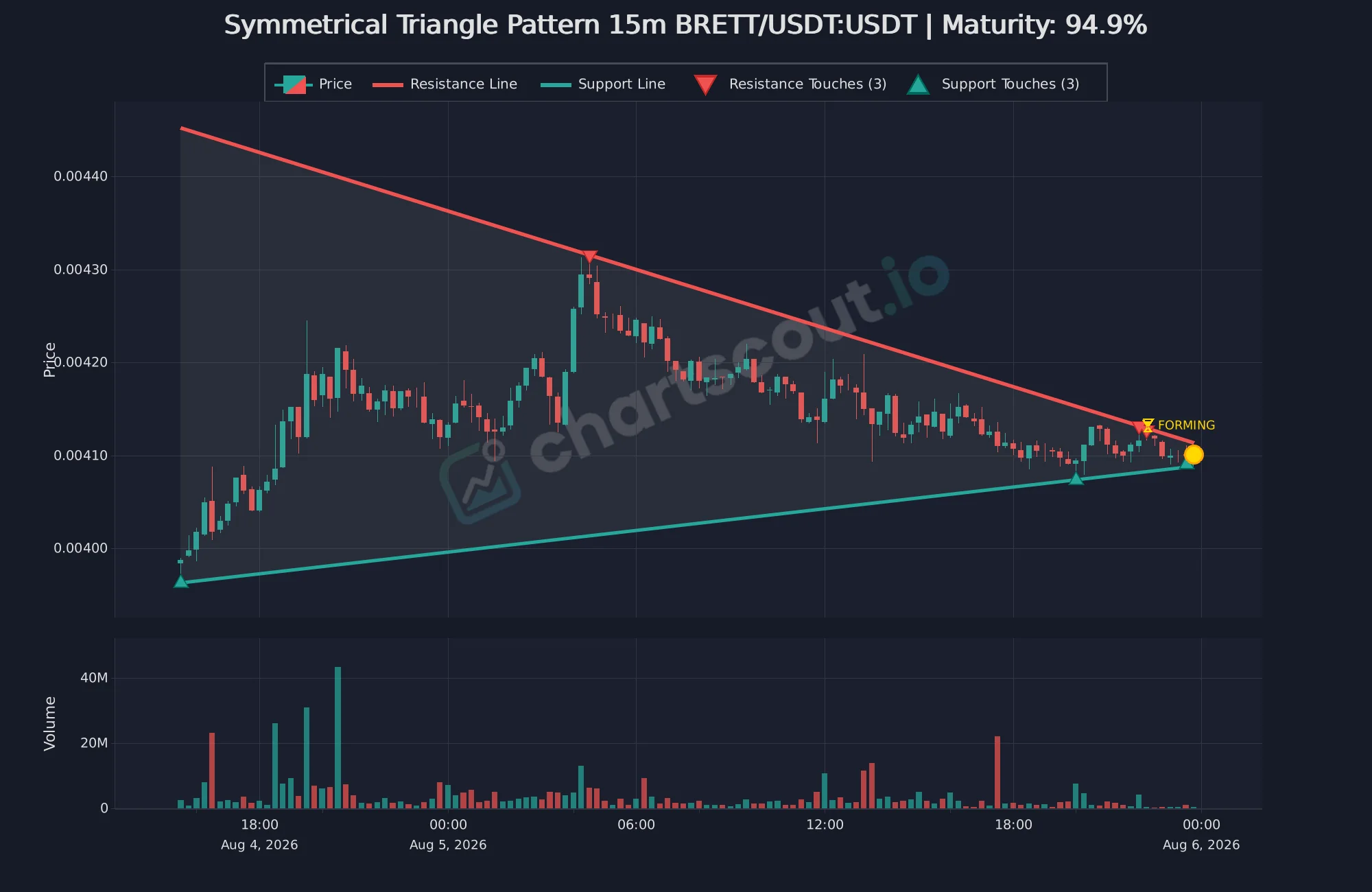
Symmetrical triangle: BRETT/USDT 15m
Rising support and descending resistance compress price on Binance. Detected August 6, 2026; either trendline can become the first fakeout zone.
Ascending triangle fakeouts
The difference between consistently profitable traders and those who perpetually give back their gains isn't the ability to identify breakout opportunities-it's the discipline to wait for proper confirmation before entering. Fakeouts aren't anomalies or bad luck; they're systematic features of how markets operate.
Throughout this guide, you've learned that fakeout detection isn't about finding a single magic indicator. It's about systematically verifying multiple confirmation signals before risking capital. Volume remains your most reliable detector-institutions cannot move large capital without leaving footprints.
Descending triangle fakeouts
Descending triangles (flat support, declining resistance) carry bearish implications, but false breakdowns are common traps for short sellers. The pattern often shakes out weak hands with a brief dip below support before reversing higher. This is particularly common when the broader market trend is bullish-the descending triangle acts as a consolidation before continuation higher rather than a reversal pattern.
Symmetrical triangle fakeouts
Symmetrical triangles are the most notorious for fakeouts because they lack directional bias. Research suggests the initial break from a symmetrical triangle fails roughly 50% of the time. The pattern represents genuine uncertainty, and sophisticated traders often wait for the first breakout to fail before positioning in the opposite direction.
The “whipsaw“ sequence is common: price breaks above the upper trendline, traders enter long, then price reverses and breaks below the lower trendline, triggering stops and trapping a new set of short sellers before finally moving in the ultimate direction. The solution is patience-wait for the breakout, the retest, and confirmed follow-through before committing capital.
Solution: wait for retest or second confirmation
Option 1: Wait for the initial break, then for price to pull back and retest the trendline. Enter on the bounce.
Option 2: If the first breakout fails, wait for the break in the opposite direction with higher volume requirements.
Head and shoulders pattern fakeouts
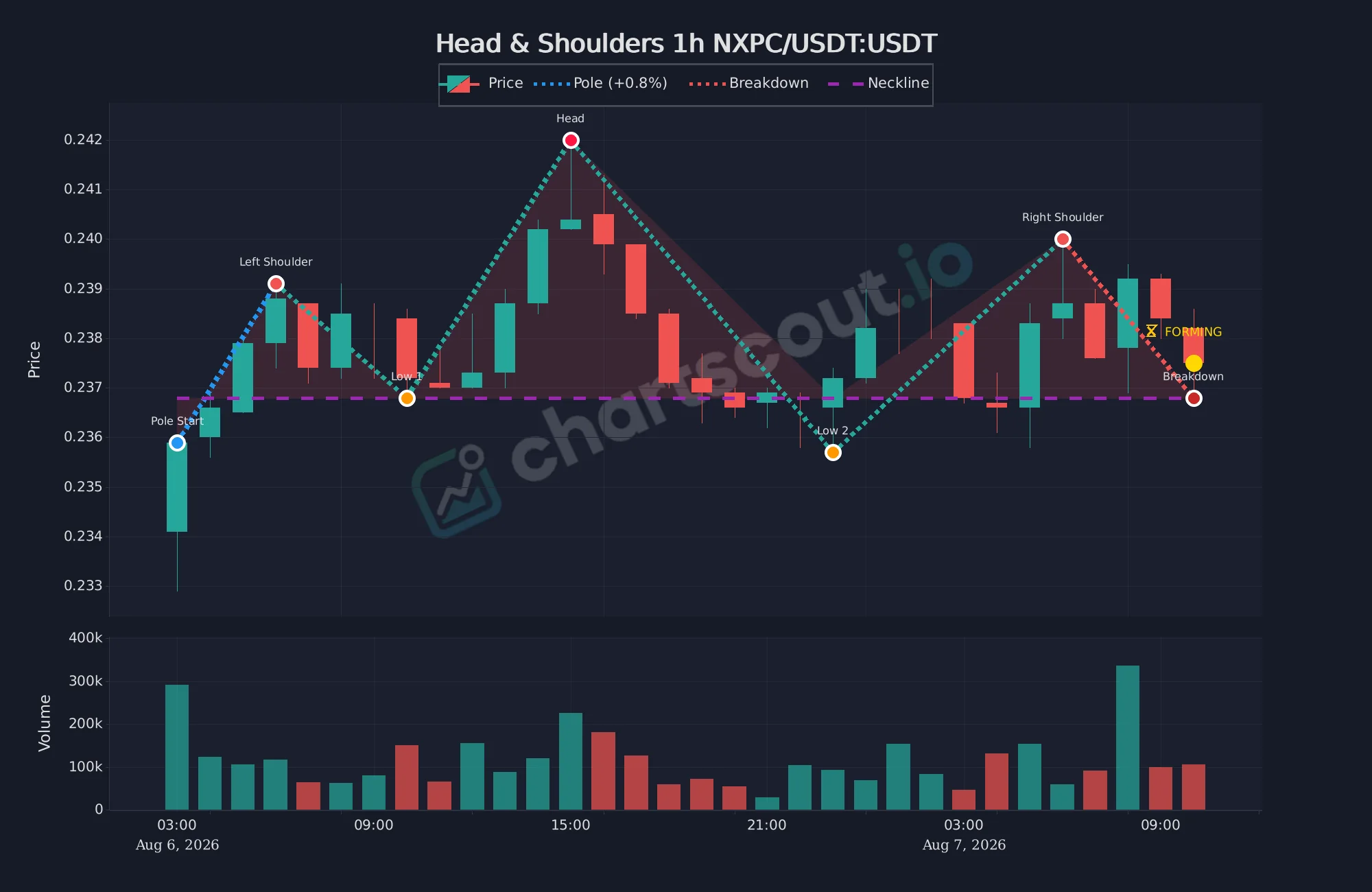
Head and shoulders: NXPC/USDT 1h
The left shoulder, head, right shoulder, and neckline are labeled on Binance. Detected August 7, 2026; the neckline is the level that still needs close and retest confirmation.
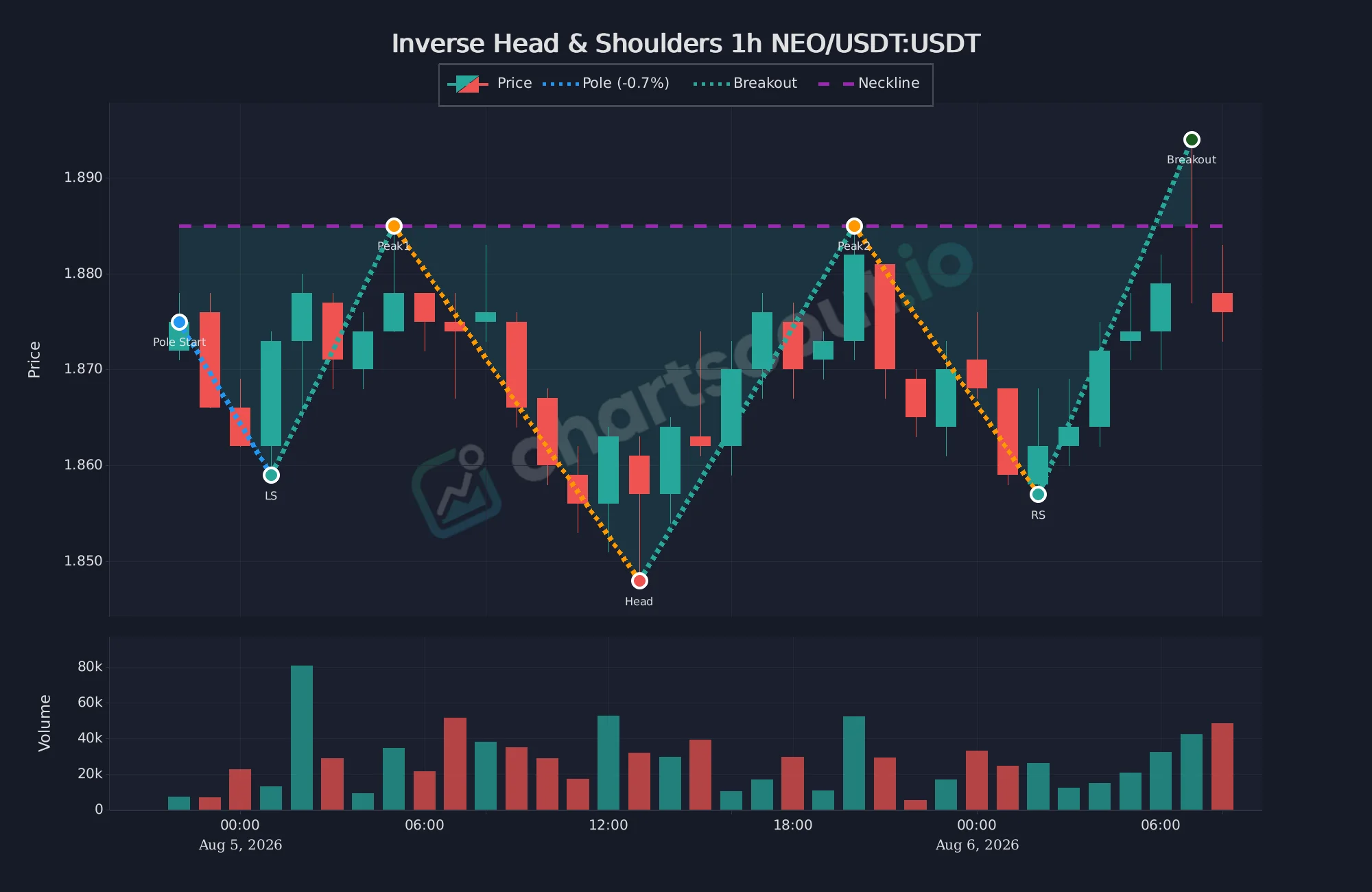
Inverse head and shoulders: NEO/USDT 1h
Three labeled troughs sit below a common neckline on Binance. Detected August 6, 2026; an upside wick without follow-through can still be a fakeout.
False neckline breaks are extremely common because this is the most obvious level in the entire pattern. Every trader has orders clustered at that exact level, creating the perfect liquidity target. For a complete statistical breakdown of H&S pattern success rates , including Bulkowski's data from 814 analyzed patterns , see our dedicated head and shoulders pattern guide.
Volume confirmation is critical: Genuine H&S breakdowns show volume spikes of at least 50-100% above average on the neckline break. Additionally, the right shoulder should show declining volume compared to the head.
Double top and double bottom fakeouts
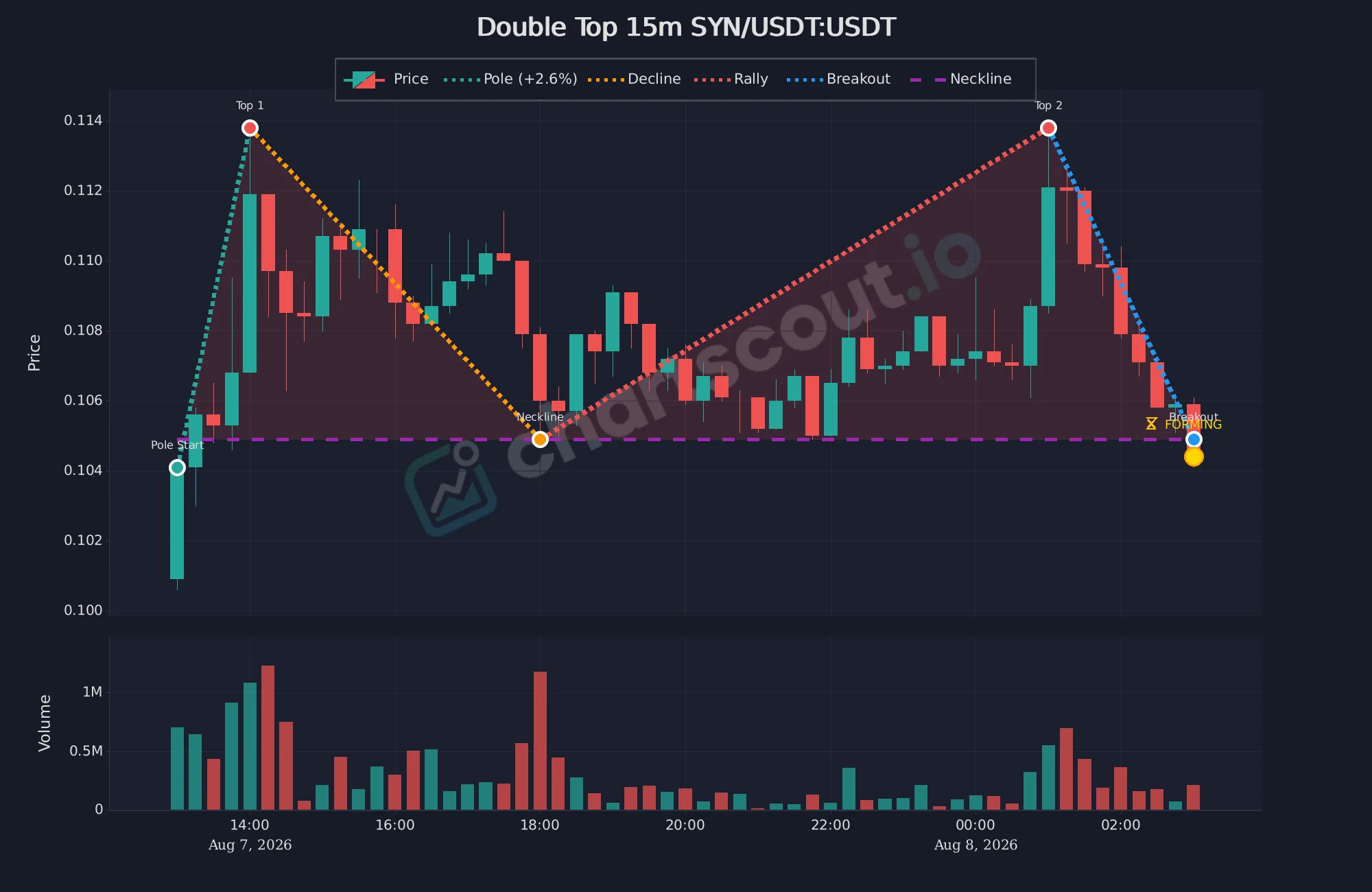
Double top: SYN/USDT 15m
Two labeled peaks form above shared neckline support on MEXC. Detected August 8, 2026; confirmation requires more than a temporary move below that line.
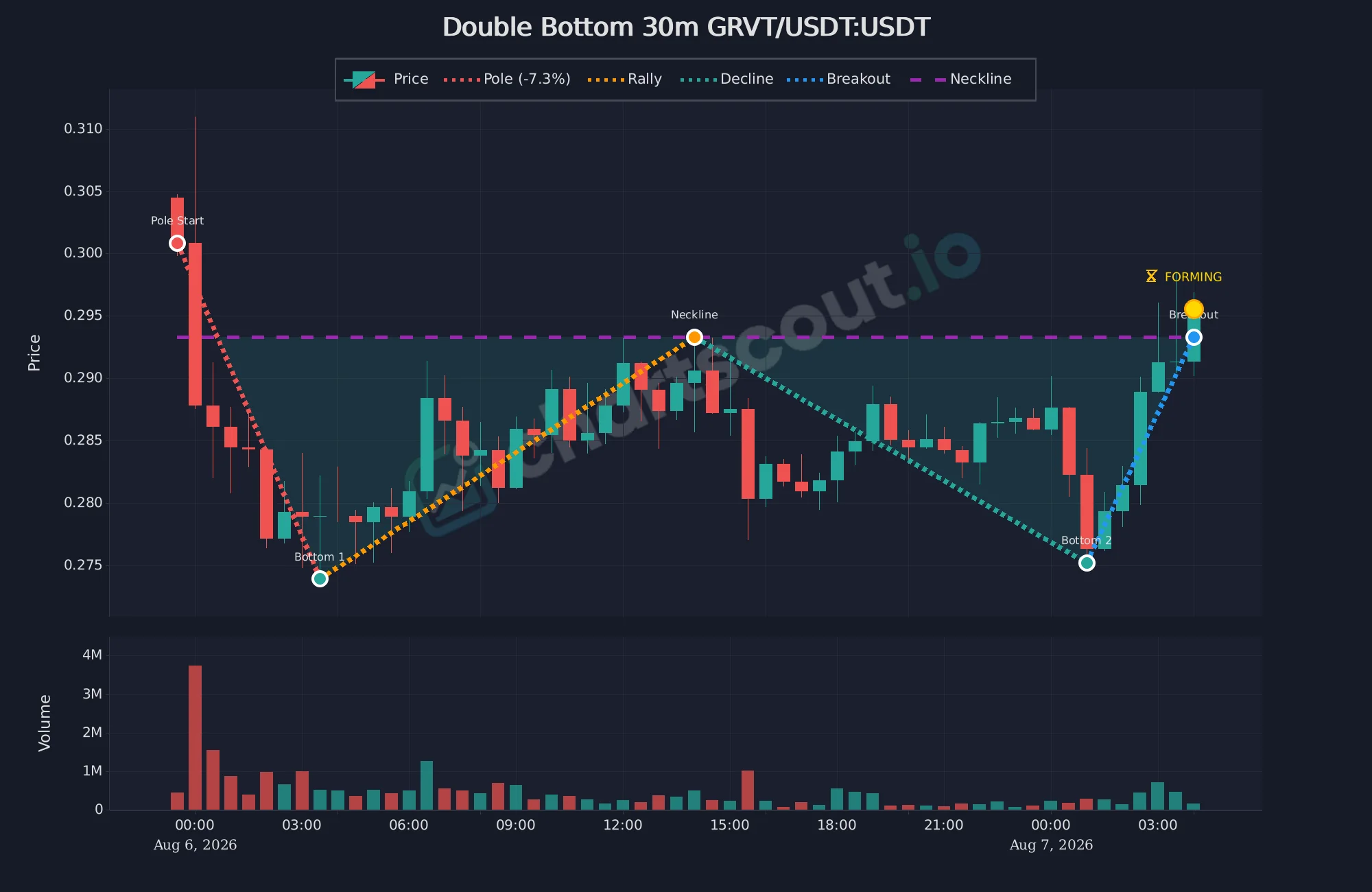
Double bottom: GRVT/USDT 30m
Two labeled lows form below shared neckline resistance on Bybit. Detected August 7, 2026; confirmation depends on a sustained neckline break.
The most common fakeout involves price exceeding the prior high/low by 0.5-2% before reversing sharply. This “slight exceed and reverse” pattern appears to invalidate the double pattern but is actually the final liquidity grab before the reversal.
Range breakout fakeouts
Range-bound markets produce fakeout rates that can exceed 70-80%. The longer a range persists, the more obvious it becomes, and the higher the fakeout probability for initial breaks.
Solution: wait for 2+ day close outside range
On daily timeframes, require at least two full candle closes beyond the range boundary before entry. For 1H or 15m charts, require 4-6 candle closes. Volume must expand to at least 100-150% above average.
Risk management for breakout trading
No amount of technical analysis skill can compensate for poor risk management. The unique challenge of breakout trading is that it combines high potential rewards with high initial uncertainty.
“The elements of good trading are: (1) cutting losses, (2) cutting losses, and (3) cutting losses. If you can follow these three rules, you may have a chance.”
- Ed Seykota, quoted in Trade Your Way to Financial Freedom by Van K. TharpStop loss strategies
- Just inside the broken level: Tight stops for better R/R but may get stopped by minor pullbacks
- ATR-based stops (1.5-2x ATR): Adjusts to market volatility dynamically
- Candle-close stops: Only exit if price closes beyond your stop level
For a deeper breakdown of which approach fits which pattern, including buffer distances and ATR multipliers per pattern type, see the pattern-by-pattern stop loss guide.
The “half position” method
Enter 50% of your position on the initial breakout close. Reserve the remaining 50% for a retest entry. This reduces FOMO, lowers average risk, and provides flexibility.
What to do when trapped in a fakeout
The cardinal rule: don't hope for recovery
If you identify fakeout signs before your stop is hit, exit at market immediately. Taking a 2% loss is superior to hoping it recovers and taking a 5% loss.
Set a time stop: “If this breakout hasn't made progress toward target within the next 2 hours, I'm exiting regardless.”
“The Successful Investor Is 90 Percent Psychologist. Only about 10 percent of success relates to what they think of as trading. The other 90 percent relates to psychology and personal issues, plus managing their money.”
- Van K. Tharp, Trade Your Way to Financial FreedomReal crypto fakeout case studies
Theory provides the foundation, but nothing teaches like real examples. These case studies demonstrate how multiple warning signs typically cluster before major fakeouts.
Case study 1: Bitcoin's failed $10,500 breakout (September 2019)
Bitcoin broke above the closely watched $10,500 resistance level in early September, reaching approximately $10,950 by September 6. Social media erupted with bullish proclamations, and traders anticipated a sustained move toward $12,000. But over the following two and a half weeks, the breakout slowly deteriorated. The much-anticipated Bakkt physically-settled Bitcoin futures launched on September 22-and flopped spectacularly, trading just 71 contracts on day one versus the thousands expected.
On September 24, Bitcoin crashed 15% in less than 24 hours, plunging from approximately $9,750 to below $8,000. Between $600 to $800 million in positions were liquidated on BitMEX alone, with the OKEx exchange reportedly deploying 84% of its insurance fund to manage the cascade. The selling continued into October, with BTC eventually bottoming near $7,400-a roughly 32% decline from the September 6 high of $10,950.
Warning signs present:
- Breakout lacked conviction. Rather than surging decisively past $10,500, BTC spent nearly three weeks drifting between $10,000 and $10,950 without establishing a clear new range-a sign of exhaustion, not strength.
- “Buy the rumor” dynamics around Bakkt. The Bakkt futures launch had been hyped for months as the catalyst that would bring institutional money into Bitcoin. When the actual launch massively underwhelmed, the narrative collapsed.
- Macro headwinds ignored. The Nasdaq and Dow Jones were struggling amid Trump impeachment proceedings and threats to delist Chinese companies from U.S. exchanges. Bitcoin's correlation with risk-on assets meant the deteriorating macro backdrop was a headwind.
- Broader downtrend intact. Bitcoin had peaked at $13,785 in June 2019 and had been making lower highs since. The $10,950 high was another lower high in a multi-month downtrend-a classic bull trap setup.
- Miner selling pressure. Despite the breakout, miners had been increasing their selling activity, contributing to overhead supply that genuine breakouts typically absorb.
Case study 2: Ethereum's “Merge” fakeout (August to October 2022)
Ethereum broke above $1,700 resistance following the successful Goerli testnet merge on August 11, eventually reaching approximately $2,030 by August 14-a 129% rally from the June lows near $883. Volume was genuinely strong, and indicators looked bullish. The crypto community was euphoric, with widespread predictions of $3,000+ post-Merge prices and some calling it the most important event in crypto history.
The Merge itself executed flawlessly at 6:43 AM UTC on September 15, 2022. On Merge day, ETH was trading around $1,635-already down nearly 20% from the August high. Within 24 hours of the Merge completing, ETH dropped sharply to approximately $1,450. The selling continued relentlessly through October, with ETH reaching a low of roughly $1,220 by mid-October. From the $2,030 pre-Merge peak to the October low, ETH lost approximately 40% of its value over two months.
This was a textbook “buy the rumor, sell the news” event-one that multiple analysts had explicitly warned about beforehand.
Warning signs present:
- Breakout driven entirely by anticipated news, not organic demand. The entire rally from $883 to $2,030 was predicated on Merge excitement. When the event arrived, there was no remaining catalyst to sustain buying pressure.
- Euphoric sentiment with “guaranteed” price predictions. Social media was flooded with predictions of $3,000 to $5,000 post-Merge targets. When consensus becomes this one-sided, the opposite outcome becomes more likely.
- Macro downtrend still dominant. The 2022 crypto bear market was firmly in control-ETH had fallen from its $4,815 all-time high in November 2021. The Merge rally was a countertrend bounce within a punishing macro downtrend, not a trend reversal.
- Historical precedent ignored. Both Bitcoin's CME futures launch (December 2017) and Bakkt futures launch (September 2019) were widely anticipated catalysts that became sell-the-news events. Crypto has a well-documented pattern of rallying into major events and selling off once they occur.
- Sell pressure from unlocked positions. The Merge itself did not immediately enable staked ETH withdrawals (that came later with the Shapella upgrade in April 2023), but the uncertainty around this and post-Merge selling from short-term speculators added persistent overhead supply.
Case study 3: Bitcoin's spot ETF “sell the news” (January 2024)
After a decade of rejected applications, the SEC approved 11 spot Bitcoin ETFs on January 10, 2024. Bitcoin had rallied from approximately $27,000 in October 2023 to a two-year high of $49,021 on January 11-the first day the ETFs began trading. Eight products hit the market simultaneously, including offerings from BlackRock, Fidelity, and other institutional heavyweights. The moment was hailed as crypto's most important regulatory milestone.
Within 48 hours, the celebration turned to carnage. Bitcoin plunged nearly 10% on January 12 alone, crashing below $42,000. CoinDesk reported that crypto-focused stocks also plummeted as ETF euphoria gave way to a full-blown rout. The selling persisted for nearly two weeks, with Bitcoin reaching its lowest closing price of $38,507 on January 23-representing a roughly 21% decline from the $49,021 peak.
The irony was not lost on market observers: Bitcoin's price action after the spot ETF approval almost perfectly mirrored its behavior following the CME futures approval in December 2017 and the Bakkt launch in September 2019. Once again, a widely anticipated institutional catalyst became a sell-the-news event.
Warning signs present:
- Months of front-running. Bitcoin had already rallied 80%+ from October 2023 to January 2024 on ETF speculation alone. By the time approval arrived, much of the bullish impact was already priced in.
- Near-universal consensus on bullishness. Analysts, influencers, and institutions were overwhelmingly aligned on a bullish post-approval outcome-a reliable contrarian signal. CryptoQuant had specifically warned that short-term holders were sitting on 30% unrealized profits, a level that historically preceded corrections.
- Repeated historical pattern. Every major crypto institutional milestone-CME futures (2017), Bakkt futures (2019)-had followed the same “buy the rumor, sell the news” script. The spot ETF was a third iteration of an established pattern.
- GBTC outflows. Grayscale's Bitcoin Trust (GBTC), newly converted to an ETF, saw massive outflows as holders who had been locked in at a discount finally exited. These redemptions created substantial selling pressure that overwhelmed inflows into the new ETFs.
- No remaining catalyst. Once the ETF was approved and trading, the market faced the classic “now what?” problem. The next major narrative catalyst-the April 2024 halving-was still three months away, leaving a vacuum that sellers filled.
Key patterns across all three case studies
These three fakeouts span five years and involve different assets and catalysts, yet they share striking commonalities:
- Anticipated events become exit liquidity. In all three cases, a widely known and heavily hyped catalyst (Bakkt, the Merge, spot ETFs) attracted massive speculative positioning ahead of the event-and then became the trigger for selling once the event occurred.
- Countertrend rallies within downtrends are fragile. The September 2019 breakout and the August 2022 Merge rally both occurred within broader bearish trends. Even the January 2024 ETF spike, while occurring in a broader bull market, had stretched far ahead of sustainable support levels.
- Euphoric consensus is a reliable contrarian signal. In every case, near-unanimous bullish sentiment preceded the reversal. When “everyone knows” the price is going up, the market has often already priced in the move.
- The decline is rarely immediate. None of these fakeouts reversed within hours. The September 2019 breakout held for nearly three weeks before crashing. The Merge selloff unfolded over two months. Even the ETF selloff took 12 days to reach its low. Fakeouts can lure traders into complacency before the real damage begins.
- Volume and price action on the reversal tell the truth. In each case, the reversal candles carried significantly more conviction than the breakout-massive liquidation cascades, exchange insurance fund drawdowns, and aggressive selling volume that dwarfed the preceding breakout activity.
Technical indicators for fakeout detection
The effective approach is to select two or three complementary indicators that measure different aspects of market behavior-momentum, trend strength, and buying/selling pressure. Moving average crossovers like the golden cross and death cross can also provide valuable trend context for breakout validation , see our golden cross vs death cross crypto trading guide.
RSI (relative strength index) divergence
Bearish Divergence: Price breaks to new high, but RSI makes a lower high-reveals weakening momentum despite higher prices.
Bullish Divergence: Price breaks to new low, but RSI makes a higher low-indicates selling pressure is exhausting.
RSI divergence: the ultimate fakeout warning signal
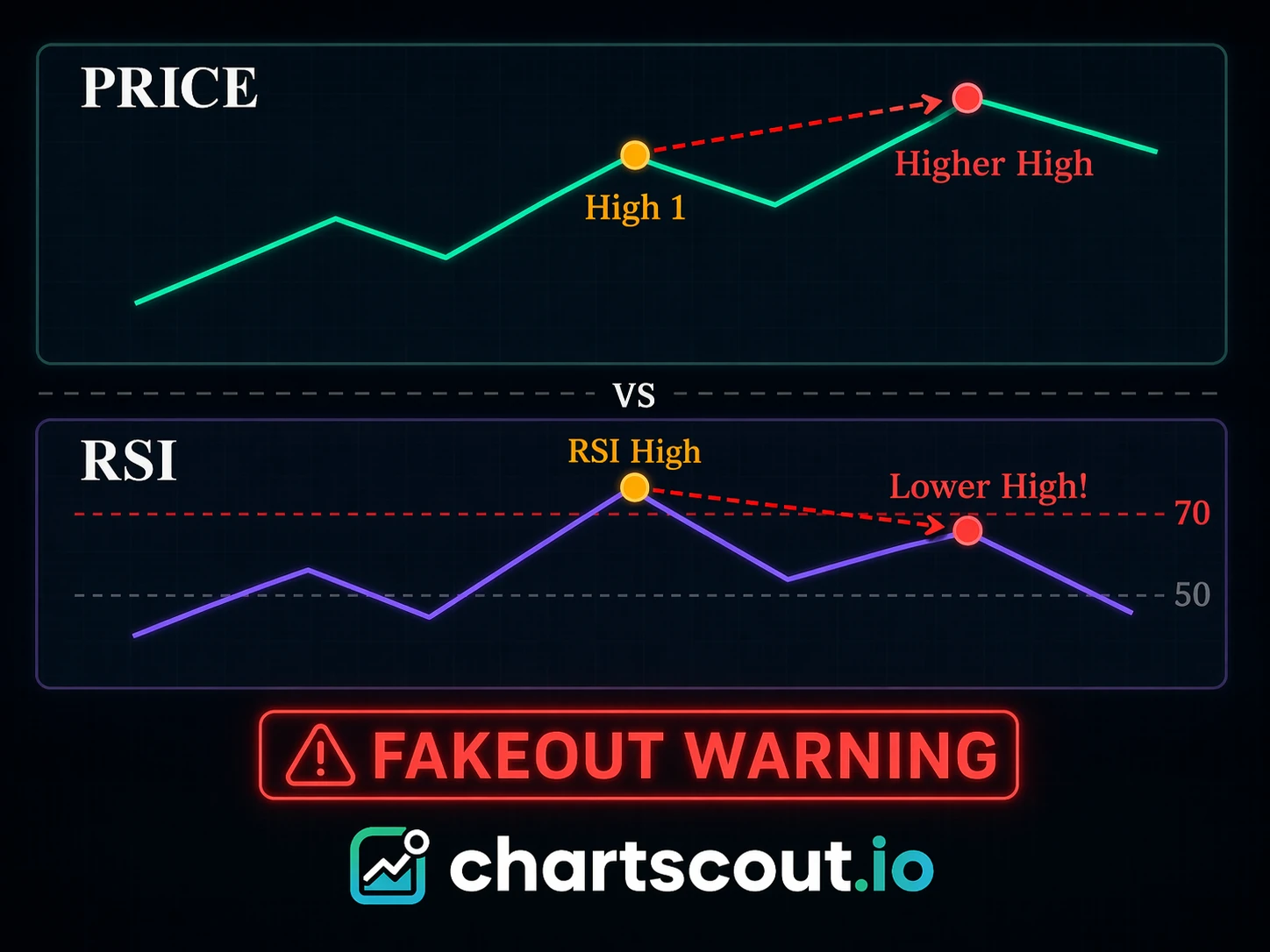
Price makes higher high but RSI makes lower high = weakening momentum
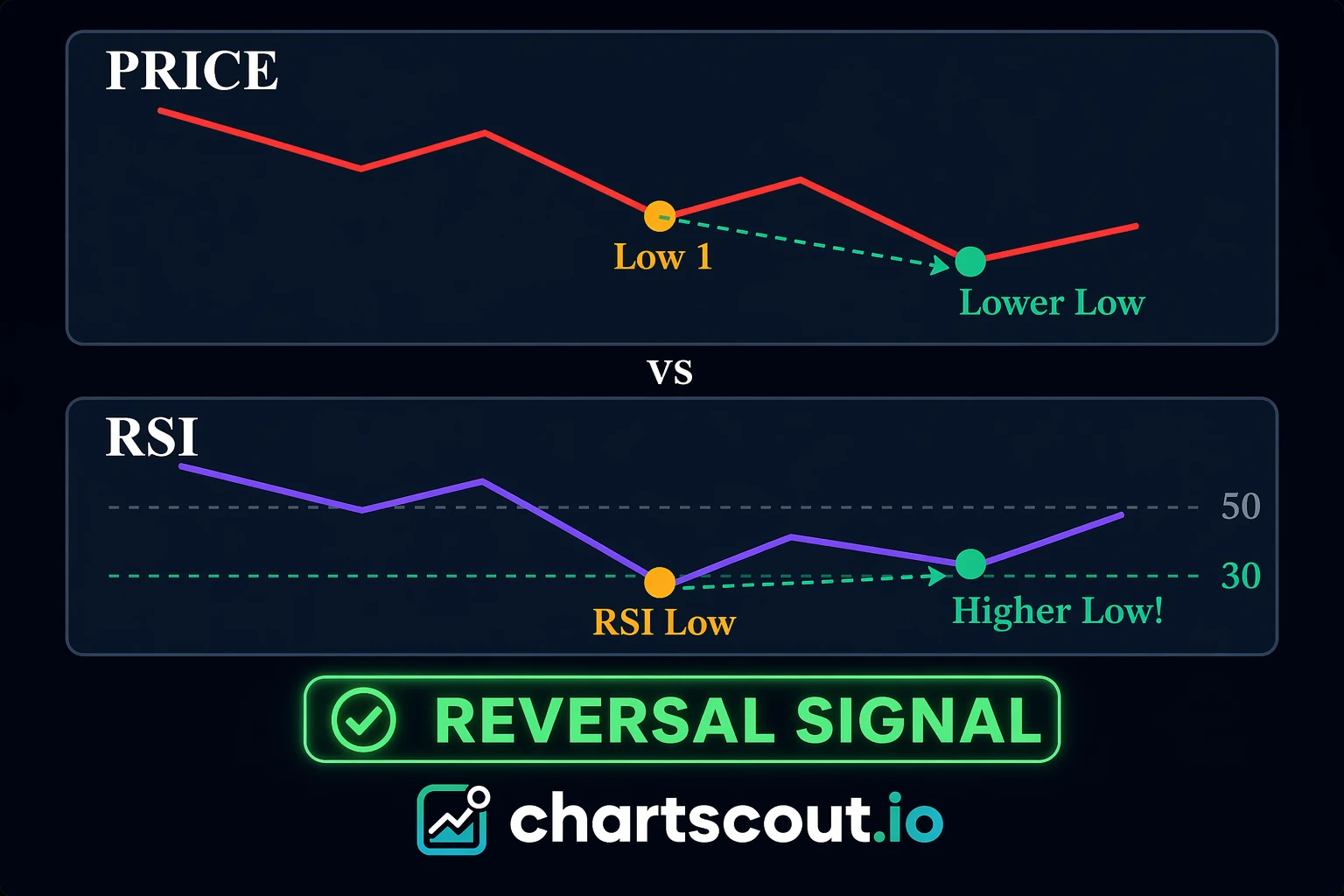
Price makes lower low but RSI makes higher low = selling exhaustion
🔑 Key Insight: Divergence signals that momentum is not confirming the price move. When a breakout occurs with RSI divergence, treat it as a high-probability fakeout warning-require additional confirmation before entering.
RSI confirmation rules
- Bullish breakouts: RSI should be above 50 (ideally 50-70)
- Bearish breakdowns: RSI should be below 50
- RSI above 80 at breakout = overbought, higher reversal risk
- Divergence = high-probability fakeout warning
MACD analysis
The histogram should be expanding in the direction of the breakout. If it's shrinking despite the breakout, momentum is fading. Ideally, breakouts occur shortly after a MACD line crosses above the signal line.
The “2 out of 3” rule
Require at least 2 out of 3 momentum indicators (RSI, MACD, Stochastic) to confirm before entering. If only one confirms while the other two show divergence, skip the trade.
Advanced fakeout detection techniques
For traders who have mastered the fundamentals and are looking to optimize their approach.
Order book analysis
- Resistance Wall Identification: Large sell walls ($5M+) indicate high fakeout probability without exceptional buying pressure
- Bid/Ask Imbalance: Expanding bid depth with contracting asks = genuine support for bullish breakout
- Spoofing Detection: Orders that appear/disappear within seconds are manipulation
Correlation analysis
- Bitcoin Dominance: Rising BTC.D makes altcoin breakouts less reliable
- Sector Correlation: Individual token breakout without sector confirmation is weaker
- Macro Context: During risk-off periods, even technically perfect crypto breakouts often fail
Market microstructure
- Funding Rate Extremes: Extreme positive funding = overleveraged longs, higher bull trap risk
- Open Interest: Rising OI during breakout = new capital entering (bullish sign)
- Exchange Flows: Large inflows = potential distribution pressure
Building your fakeout detection system
Clear, objective review rules can reduce emotional decisions in fast markets. Automated pattern detection can supplement your manual analysis; learn how alert-driven trading can expand coverage while keeping each detection subject to your own checklist.
Create your pre-trade checklist
Breakout trade checklist template
Skip this trade
Insufficient confirmation - wait for better setup
Share your checklist score:
7/7 = Full size | 5-6/7 = Half size | 4/7 or less = Skip
Position sizing for breakout trades
Professional traders typically risk between 0.5-2% of total trading capital on any single trade. This percentage refers to the actual dollar amount you'll lose if your stop loss is hit, not your position size. Your checklist score directly determines how much of your standard position size you should use.
Position size by confirmation level
- 7/7 points confirmed: Full position size (1.5-2% risk)
- 5-6/7 points confirmed: Reduced position (0.75-1% risk)
- 4/7 or fewer: Skip the trade entirely
Position sizing based on checklist score
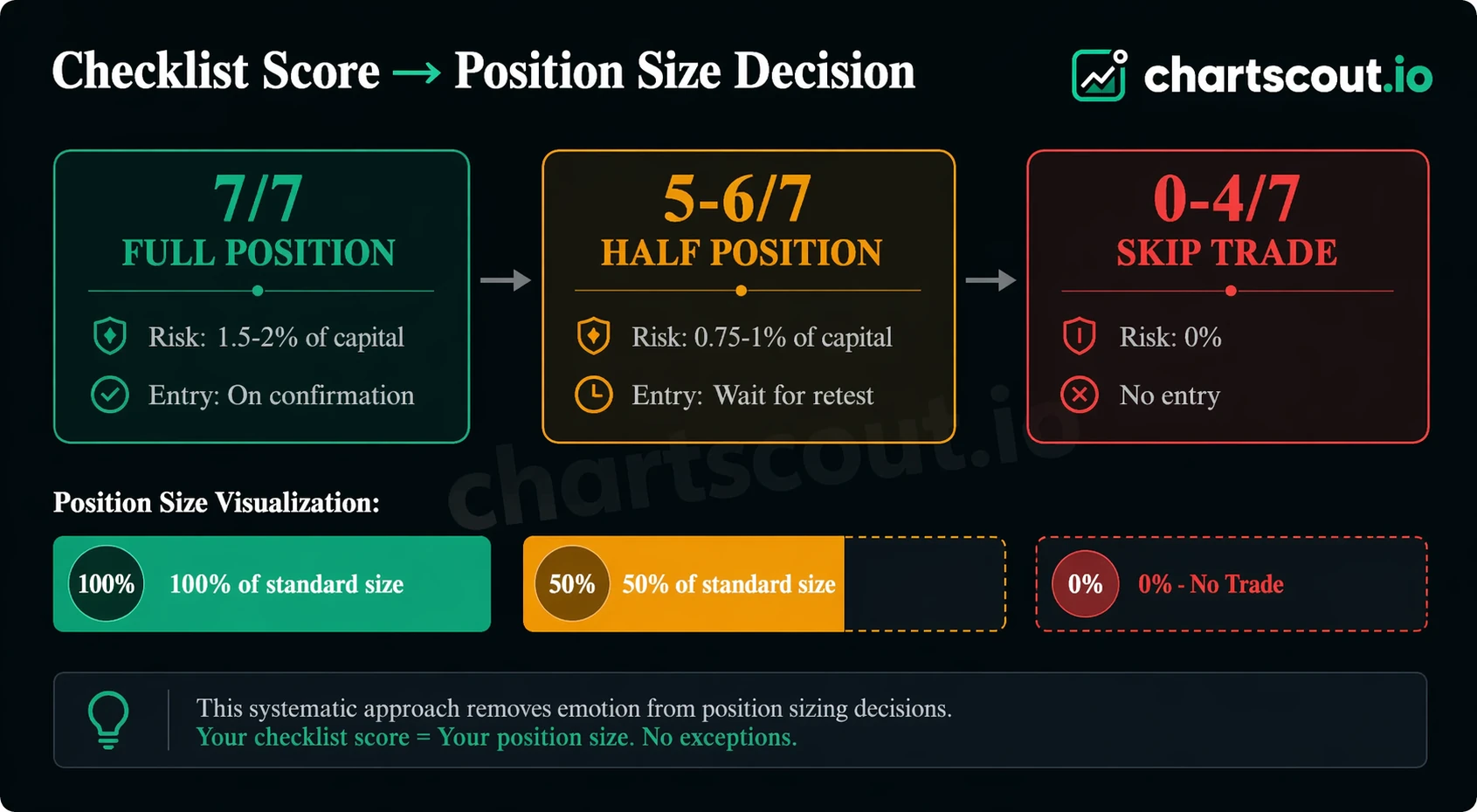
Position sizing based on confirmation level protects capital during uncertain setups while maximizing exposure on high-conviction trades
Weekly review routine
- Wins: What did you do right? Which checklist points were strongest?
- Losses: Which warning signs did you ignore?
- Missed Opportunities: Were there high-quality setups you didn't take?
- Rule Violations: Did you break your own rules?
- System Adjustments: Do any rules need refinement?
Frequently asked questions
What is a fakeout in crypto?
A fakeout in crypto is a price move that breaks past an obvious level, such as support, resistance, a trendline, or a range edge, and then quickly reverses back through it instead of continuing. It is the same thing as a fake breakout or a false breakout, just the colloquial one-word term. The break exists to trigger the stop and breakout orders parked at the level, which is why fakeouts are also described as liquidity sweeps. The clearest tells are a candle that fails to close beyond the level and volume that does not expand to confirm the move.
What is a bitcoin fakeout?
A bitcoin fakeout is a fakeout that happens on the BTC chart specifically. The mechanic is identical to any crypto fakeout, but bitcoin is more prone to it because BTC is the market leader, its round numbers and prior highs are the most watched levels in crypto, and it trades 24/7 so a break can fire into a thin weekend or overnight order book. Price pierces a crowded level, fails to close and confirm beyond it on volume, then reclaims the level within a candle or two and squeezes out the trapped side.
How can I tell the difference between a genuine breakout and a fakeout in real-time?
You can't be 100% certain in real-time-which is why the 7-point checklist exists. The key differentiators are: volume that sustains for 2-3 candles, strong-bodied candle closes beyond the level, higher timeframe alignment, and timing during peak liquidity hours. If 5-7 confirmations align, you have a high-probability genuine breakout.
What's the most reliable single indicator for spotting fakeouts?
Volume. Genuine institutional participation requires substantial volume-you simply cannot move large capital without leaving volume footprints. A breakout with 2-3x average volume that sustains for multiple candles has a much higher success rate than one with mediocre volume.
Should I ever take breakout trades on weekends in crypto?
The data strongly suggests avoiding weekend breakouts unless the setup is exceptionally compelling (all 7 checklist points confirmed with 3x+ volume). Weekend volume drops 40-60%, making manipulation far easier. For most traders, “no weekend breakouts” will save more capital than it costs.
How long should I wait for a retest before giving up?
On 4-hour timeframes, retests typically occur within 1-5 candles (4-20 hours). On daily, 1-5 days. If a breakout continues beyond this without any pullback, the probability of a retest decreases significantly. Never chase a breakout that's already extended 3-5% beyond the level without any retest.
Can fakeouts be completely avoided with enough analysis?
No. The goal isn't 100% success rate (impossible), but to improve your win rate from 30-40% (untrained) to 50-60% (systematic) while optimizing risk/reward ratios. Even the most sophisticated institutional traders get trapped occasionally. Focus on process over outcome.
What should I do if I spot a fakeout forming but I'm already in the trade?
Exit immediately. Don't wait for your stop loss; don't hope it recovers. Taking a 2% loss is superior to taking a 5% loss when your stop finally triggers. This discipline separates professionals from amateurs.
Are fakeouts more common in bull markets or bear markets?
Fakeouts occur in both, but their character differs. In bull markets, bear traps are more common. In bear markets, bull traps dominate. The highest fakeout rates occur during transition periods between bull and bear markets-these range-bound periods can produce 70-80% fakeout rates.
How many fakeouts in a row should I endure before questioning my system?
With proper execution, your win rate should be 45-60%. This means 3-5 losses in a row will happen occasionally through variance. However, if you experience 10+ consecutive failures following your system correctly, something is wrong-either market conditions have changed or your confirmation requirements need adjustment.
Conclusion
The difference between consistently profitable traders and those who perpetually give back their gains isn't the ability to identify breakout opportunities-it's the discipline to wait for proper confirmation before entering. Fakeouts aren't anomalies or bad luck; they're systematic features of how markets operate.
Throughout this guide, you've learned that fakeout detection isn't about finding a single magic indicator. It's about systematically verifying multiple confirmation signals before risking capital. Volume remains your most reliable detector-institutions cannot move large capital without leaving footprints.
The traders who master fakeout detection understand something crucial: avoiding traps is only half the game. By the time you visually see a fakeout firing on a chart, the wick is usually already done. Real-time alerts on the lower timeframe candle that triggered it are the difference between trapping the move and being the trapped retail buyer, which is part of why crypto alerts are always late on most platforms. By learning to recognize false breakouts early, you position yourself to profit from the reversal moves that inevitably follow.
Key takeaways
- Estimated 60-70% of crypto breakouts fail - Based on general market statistics showing 60-80% failure rates (Bulkowski, Tradeciety), crypto likely experiences similar or higher rates due to structural vulnerabilities
- Volume is your #1 detector - Require 50-100%+ above average, sustained for 2-3 candles
- Wait for candle closes - Never trade wicks; always wait for clean closes beyond the level
- Higher timeframes win - Always defer to the dominant higher timeframe trend
- Avoid low-liquidity periods - Weekends and overnight hours have dramatically higher fakeout rates
- Fakeouts are opportunities - Trade reversals for excellent risk/reward ratios
- Cut losses immediately - If you spot fakeout signs, exit before your stop is hit
If you've traded both traditional markets and cryptocurrency, you've likely noticed that crypto seems particularly prone to violent fakeouts. This isn't just bad luck or confirmation bias-there are specific structural characteristics of crypto markets that make false breakouts significantly more common than in stocks, forex, or futures. While general breakout trading research (Bulkowski's Encyclopedia of Chart Patterns, Tradeciety studies) shows 60-80% failure rates across traditional markets, crypto's unique environment likely produces failure rates at the higher end of this spectrum or beyond.
Use it wisely. Trade less, confirm more, and let the impatient majority become your counterparty.
Let ChartScout detect fakeouts for you
Our algorithms analyze volume patterns, candlestick formations, and multi-timeframe structure in real-time. Get alerted when a breakout shows fakeout warning signs, before you enter the trap.
Start your 7-day Pro trial and set up your first pattern watcher in under 2 minutes.
Sources & references
Technical analysis & trading literature
Primary sources for breakout trading and fakeout detection principles. All citations include specific page numbers, chapters, and ISBN references for academic verification:
- Brooks, Al. Trading Price Action Trends: Technical Analysis of Price Charts Bar by Bar for the Serious Trader. John Wiley & Sons, 2012. ISBN: 978-1-118-06651-5.
Chapter 2, p.21: Micro trend line breakouts and false breakout setups. Brooks defines false breakouts as entries that fail within 1-2 bars, establishing the foundation for countertrend trading opportunities. - Person, John L. A Complete Guide to Technical Trading Tactics: How to Profit Using Pivot Points, Candlesticks & Other Indicators. John Wiley & Sons, 2004. ISBN: 978-0-471-58455-0.
Chapter 7, p.127: Market randomness and fakeout acknowledgment. Person emphasizes that not all support levels hold and false breakouts are inherent to market behavior, not anomalies. - Farley, Alan S. The Master Swing Trader: Tools and Techniques to Profit from Outstanding Short-Term Trading Opportunities. McGraw-Hill, 2001. ISBN: 978-0-07-136309-2.
Chapter 8, pp.134-135: Psychology of fakeouts and timing shift strategies. Farley introduces the concept of visualizing where premature traders will capitulate to identify optimal entry points after false breakouts. - Douglas, Mark. Trading in the Zone: Master the Market with Confidence, Discipline, and a Winning Attitude. Prentice Hall Press, 2000. ISBN: 978-0-7352-0144-6.
Chapter 2, p.21: Risk acceptance and emotional discipline. Douglas establishes that inability to trade without fear indicates incomplete risk acceptance, which leads to avoidance behaviors that exacerbate fakeout losses. - Cheng, Grace. 7 Winning Strategies For Trading Forex: Real and Actionable Techniques for Profiting from the Currency Markets. Harriman House, 2007. ISBN: 978-1-897-59747-5.
Strategy 4, p.89: Fading breakouts as institutional strategy. Cheng documents that large players systematically fade breakouts, providing individual traders edge when aligning with this behavior. - Bulkowski, Thomas N. Encyclopedia of Chart Patterns, 2nd Edition. John Wiley & Sons, 2005. ISBN: 978-0-471-66851-3.
Chapter 3, p.41: Statistical analysis of busted patterns. Bulkowski's research shows busted patterns often outperform successful breakouts, recommending traders watch for sub-5% moves that reverse back into patterns. - Wachtel, Cliff. The Sensible Guide to Forex: Safer, Smarter Ways to Survive and Prosper from the Start. John Wiley & Sons, 2012. ISBN: 978-1-118-15830-1.
Chapter 9, p.156: Whale manipulation at breakout levels. Wachtel warns that experienced players use widely-anticipated breakout points (like necklines) to trap inexperienced traders into buying tops or selling bottoms. - Weis, David H. Trades About to Happen: A Modern Adaptation of the Wyckoff Method. John Wiley & Sons, 2013. ISBN: 978-0-470-48780-1.
Chapter 5, p.87: Upthrust analysis and trend context. Weis demonstrates that upthrusts frequently fail within uptrends, emphasizing that preceding and succeeding price/volume behavior reveals whether potential upthrusts will develop. - Wyckoff, Richard D. Studies in Tape Reading. Originally published 1910; reprinted by Fraser Publishing, 1982. ISBN: 978-0-870-34066-3.
Section 4, p.1: Volume analysis fundamentals. Wyckoff establishes that daily volume is “very important“ for judging prevailing trend, forming the foundation for modern volume confirmation requirements. - Bogomazov, Roman. “Practical Applications of the Wyckoff Method of Trading and Investing.“ Wyckoff Associates Educational Series, 2016.
Section 2, p.11: Springs, shakeouts, and low-volume fakeout identification. Bogomazov codifies that springs on light volume indicate the path is clear for sustained advance, providing the volume signature for bear trap identification. - Grimes, Adam. The Art and Science of Technical Analysis: Market Structure, Price Action, and Trading Strategies. John Wiley & Sons, 2012. ISBN: 978-1-118-11512-0.
Chapter 9, p.187: Wyckoff springs and upthrusts as stop-hunting mechanisms. Grimes clarifies that both patterns are “essentially fake-outs“ designed to run stops outside of support and resistance. - Tharp, Van K. Trade Your Way to Financial Freedom, 2nd Edition. McGraw-Hill, 2006. ISBN: 978-0-071-47871-7.
Chapter 4, pp.50, 93: Risk management psychology and loss-cutting discipline. Tharp quotes Ed Seykota's three rules of trading (cutting losses) and establishes that 90% of trading success relates to psychology rather than technical analysis.
Additional research & market data
- • Cryptocurrency market structure analysis based on order book depth studies from major exchanges (Binance, Bybit, Hyperliquid) 2020-2025
- • Weekend volume reduction statistics derived from CryptoCompare aggregate volume data
- • Fakeout frequency estimates based on historical pattern performance across BTC/USDT and ETH/USDT pairs on 4H timeframes
Related guides
Head and shoulders pattern: Bulkowski's data
Success rates, failure analysis, and trading strategies backed by 814 analyzed patterns.
Golden cross vs death cross: crypto guide
How moving average crossovers signal trend changes and confirm breakout direction.
Rising wedge vs falling wedge: crypto guide
Wedge pattern breakout strategies, volume confirmation rules, and common mistakes to avoid.
Chart patterns and volume analysis
Master volume confirmation for every major chart pattern , the #1 tool for filtering fakeouts.
How to read crypto charts [2026]
Candlestick basics, chart types, indicators, and everything you need to start reading charts.
Alert-driven trading: expand pattern coverage
Automate your pattern detection and get real-time alerts when high-probability setups form.

Stjepan Ivanović
Founder of ChartScout · Crypto Trader Since 2013
Trading crypto since 2013 with his first Bitcoin bought at ~$200. Four complete bull/bear market cycles, traded on early exchanges like Mt.Gox and BTC-e, on-chain trading on IDEX and EtherDelta, and ~70 crypto project investments. Built ChartScout after 23+ months of development to automate what no trader can do manually. Watch hundreds of charts 24/7.