Descending triangle pattern: 78% success rate crypto trading guide (2026)
A descending triangle is a chart pattern formed by a flat horizontal support line and a downward-sloping resistance line of lower highs. Despite its bearish appearance, Bulkowski's research on 1,300+ trades shows it breaks upward 53% of the time, with a 78% success rate (22% break-even failure) and 38% average rise on upward breakouts in bull markets. The pattern signals a tightening battle between buyers and sellers where the breakout direction -not the pattern shape -determines whether it's bullish or bearish.
Statistical note: Pattern statistics in this guide come from Thomas Bulkowski's thepatternsite.com (data updated 8/26/2020, based on 1,300+ perfect bull-market trades) and his Encyclopedia of Chart Patterns (3rd Edition, 2021). Cryptocurrency markets exhibit higher volatility and lower liquidity, which can impact pattern reliability. Always combine pattern analysis with proper risk management.
Most descending triangle content still claims the pattern “breaks down 80% of the time.” That number is wrong. Bulkowski's updated thepatternsite.com data (1,300+ trades, refreshed 8/26/2020) shows descending triangles actually break upward 53% of the time and downward only 47%. The 77-78% break-even rate that gets quoted as a “success rate” is a separate metric from breakout direction. The “always bearish” framing is a myth. Direction depends on the prior trend context, not the pattern shape.
The descending triangle is one of the most misunderstood patterns in crypto trading. Most traders see the declining highs, the flat support, and immediately think: "bearish - short it." The data tells a completely different story.
Thomas Bulkowski studied over 1,300 descending triangles and found they actually break upward more often than downward. The upward breakouts produced an average 38% gain with a 78% success rate (only 22% fail to move beyond break-even). Meanwhile, downward breakouts averaged only a 15% decline. This single data point has saved countless traders from making the wrong bet.
This guide will teach you exactly how to identify descending triangles in crypto, which direction to trade, where to place your entries and stops, and how to use volume to filter out the setups that are likely to fail. New to chart reading? Start with our beginner's guide to reading crypto charts. Otherwise, let's dive into the data-backed strategies you can apply to real markets today.
What is a descending triangle pattern?
A descending triangle is a chart pattern formed when price creates a series of lower highs converging toward a flat horizontal support level. The result is a triangle shape that squeezes price into an increasingly narrow range until it breaks out. The upper trendline slopes downward (connecting the lower highs), while the lower trendline remains horizontal (connecting the price lows at the same level).
Visually, think of it as sellers pushing price down with decreasing force from above, while a floor of buyers holds firm at a specific price. Each rally fails at a lower level, creating a descending staircase of peaks. Eventually, one side overwhelms the other, and price breaks out -either smashing through the support floor or surging above the descending resistance.
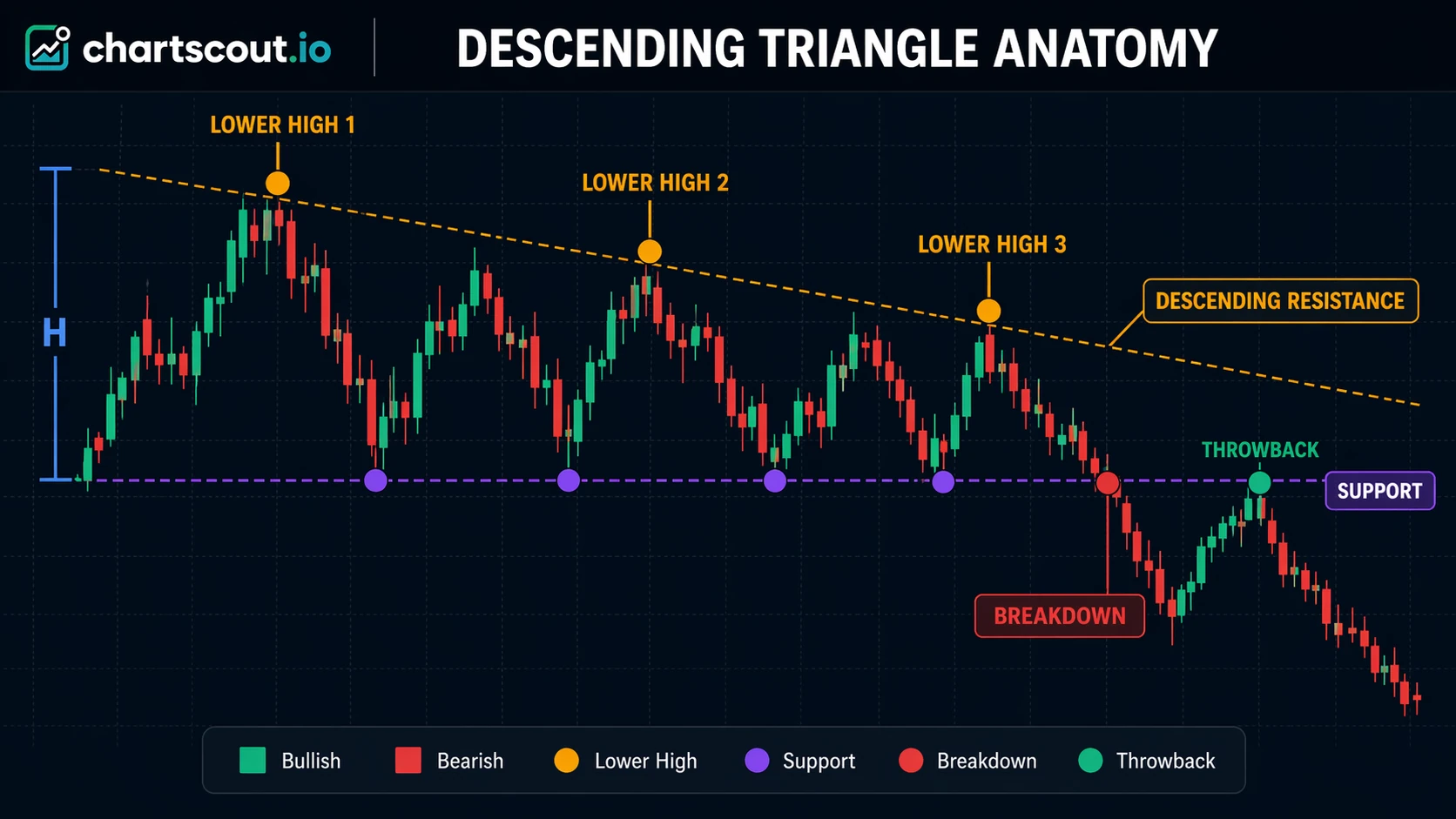
Descending triangle: flat support + descending lower highs converging toward the apex, with breakout typically occurring ~61-65% of the way to the apex
Key components of a descending triangle
The pattern can appear in any prior trend -uptrend, downtrend, or sideways market. This is important because the prior trend context helps determine the probability of breakout direction, which we'll cover in the statistics section.
How to identify a descending triangle
Identifying a valid descending triangle requires more than drawing two lines on a chart. Bulkowski outlines specific criteria that separate genuine patterns from noise. Here are the identification guidelines, ranked by importance:

Descending triangle - HIVE/USDT 1h
Binance98.9 ConfidenceThis chart shows a descending triangle on HIVE/USDT at the 1-hour timeframe on Binance, detected August 7, 2026. The flat support and descending resistance form lower highs while volume contracts.
1Minimum touch requirements
Price must touch one trendline at least three times and the other at least twice as distinct peaks or valleys. More touches strengthen the pattern. If you only have two points on either line, you're drawing a line between two dots -that's not a confirmed pattern, it's a guess.
2Price must fill the pattern
This is a commonly missed requirement. Price should cross from one trendline to the other, nearly filling the available space inside the triangle. Avoid descending triangles with abundant white space in the middle -where price hugs one trendline without ever reaching the other. That's a sign the pattern may be poorly formed or misidentified.
3Declining volume (78% of the time)
In the majority of valid descending triangles, volume recedes as the pattern develops and often reaches very low levels just before the breakout. This volume contraction represents diminishing interest -traders are waiting for the resolution. A breakout on strong volume is much more reliable than one on weak volume.
4Breakout confirmation
The pattern is only confirmed as valid when price closes outside one of the trendlines. A wick or intrabar spike through a trendline doesn't count -you need a candle close. The median breakout occurs 61-65% of the way from the start of the pattern to the apex (where the trendlines would theoretically meet).
Pro Tip: Use the rule of "thirds" for timing. Breakouts that occur in the first two-thirds of the pattern (before reaching the apex) tend to produce stronger moves. Breakouts near the apex, where the triangle narrows to almost nothing, often lack momentum and produce weak, unreliable moves.

Descending triangle - SANTOS/USDT 15min
Binance98.2 ConfidenceThis chart shows a descending triangle on SANTOS/USDT at the 15-minute timeframe on Binance, detected August 6, 2026. Each rally peak is lower than the last while price compresses toward the flat support.
Market psychology behind the pattern
Every chart pattern tells a story about human behavior. The descending triangle captures a very specific battle between two groups of market participants, and understanding this dynamic is what separates traders who blindly follow lines from those who understand why patterns work.
The buyers' perspective: A group of buyers has identified a price level they consider fair value. Every time price drops to this level, they step in and buy. This creates the flat support line. These might be institutional accumulators, limit-order traders, or algorithms programmed to buy at a specific price. Their conviction is consistent -they keep defending the same level.
The sellers' perspective: Sellers are becoming increasingly aggressive. After each bounce off support, they sell earlier -at lower prices than the previous rally peak. This creates the descending resistance line. Each lower high shows that sellers are willing to accept less profit to exit their positions, or that new short sellers are entering at progressively lower levels.
The resolution: As the range narrows, the tension builds. Eventually, one side capitulates. If buyers finally exhaust their demand at the support level, price crashes through it -often sharply, because every buyer who accumulated at that level is now sitting on a loss and may panic-sell. Alternatively, if sellers run out of supply, the buying pressure at support overwhelms them, and price surges above the declining resistance. This is why Bulkowski found that upward breakouts (53% of the time) tend to produce larger moves (38% vs 15%) -short sellers getting squeezed amplifies the buying pressure.
The psychological cycle inside a descending triangle
Bulkowski's statistics: what the data actually says
Thomas Bulkowski analyzed over 1,300 descending triangle trades in traditional markets and publishes the updated figures on thepatternsite.com (last refreshed 8/26/2020). These numbers form the statistical foundation for trading this pattern. Let's break down the key findings:
Descending triangle: bull market performance
Based on 1,300+ trades -Bulkowski, ThePatternSite.com
| Metric | Upward Breakout | Downward Breakout |
|---|---|---|
| Overall Performance Rank | 33 out of 39 | 15 out of 36 |
| Break-Even Failure Rate | 22% | 23% |
| Average Rise / Decline | +38% | -15% |
| Throwback / Pullback Rate | 60% | 58% |
| Meets Price Target | 64% | 50% |
| Breakout Direction | 53% upward | 47% downward |
Key takeaways from the data
The pattern is NOT inherently bearish. Upward breakouts occur 53% of the time -a slight majority. This directly contradicts the popular belief that descending triangles are bearish patterns.
Upward breakouts produce much larger moves. An average rise of 38% vs an average decline of 15% makes the risk-reward significantly better for bullish trades.
Throwbacks/pullbacks are extremely common. About 60% of breakouts retrace back to the breakout level before continuing in the breakout direction. This means you'll often get a second chance to enter.
Performance has declined over the decades. Bulkowski notes that descending triangle performance has dropped almost in half since the 1990s. This is likely due to more traders recognizing and front-running the pattern.
One crucial nuance: when price rises into the pattern (meaning the prior trend was bullish), it breaks out upward 63% of the time. This makes descending triangles in uptrends significantly more likely to be continuation patterns, not reversals. Context matters enormously.
Bullish vs bearish descending triangles
A descending triangle is neither inherently bullish nor bearish. Its character depends entirely on two factors: the prior trend context and the breakout direction. Here's how to classify the pattern:
Bullish descending triangle
Context: Forms during an uptrend as a consolidation/pullback phase. The declining highs represent profit-taking, not a trend reversal.
Breakout: Price breaks above the descending resistance line with strong volume.
Probability: 63% chance of upward breakout when price rises into the pattern.
Average Move: +38% (Bulkowski, bull market)
Success Rate: 78% reach meaningful gains after upward breakout (22% break-even failure).
Bearish descending triangle
Context: Forms during a downtrend as a continuation pattern. Support represents a temporary pause before the next leg down.
Breakout: Price breaks below horizontal support with increasing volume.
Probability: 47% of all descending triangles break downward.
Average Move: -15% (Bulkowski, bull market)
Success Rate: 77% success rate (23% break-even failure, bull market data).
"I found descending triangles hard to trade. Those that I thought would work properly didn't, while others that I thought were destined to fail, worked."
Thomas Bulkowski, ThePatternSite.comThis honest admission from the world's leading chart pattern researcher should tell you something: never assume a descending triangle will break in a specific direction. Wait for the confirmed breakout, then trade accordingly.
Volume analysis for descending triangles
Volume is the single most important confirmation tool for descending triangle breakouts. Without volume analysis, you're essentially guessing. Here's what to look for at each stage of the pattern:
During pattern formation
Volume should generally decline as the pattern develops. This declining volume represents traders stepping to the sidelines, waiting to see which direction price will resolve. If volume remains high throughout the formation, the pattern may be less reliable -it suggests active disagreement rather than consolidation.
At the breakout
A valid breakout should show a significant increase in volume -ideally 2x or more the average volume during the pattern. In crypto markets, look for at least a 1.5x spike above the 20-period volume average. This volume surge confirms that new money is driving the breakout, not just a temporary wick. If the breakout happens on thin, quiet volume, approach with extreme caution.
Volume trend direction matters
Bulkowski found that when the overall volume trend slopes upward during the pattern (against the typical decline), the median performance improves dramatically. Rising volume within a descending triangle often signals accumulation -smart money is quietly building positions at support, preparing for an upward breakout.
Volume confirmation checklist
Volume declining during pattern formation (78% of valid patterns)
Volume spike on breakout day (minimum 1.5-2x average)
Volume stays elevated for 2-3 candles post-breakout
OBV (On-Balance Volume) divergence can signal breakout direction
⚠️ Low-volume breakout = potential fakeout -reduce position size or wait for retest
For a deeper exploration of how volume interacts with all major chart patterns, read our comprehensive volume analysis guide.
3 entry strategies for trading descending triangles
There is no single "best" entry method. Each strategy below suits a different risk tolerance and trading style. The right choice depends on how aggressively you want to trade and how much confirmation you need.
Breakout entry (most common)
Enter a position when price closes outside the triangle boundary with above-average volume. For upward breakouts, buy when the candle closes above the descending resistance line. For downward breakouts, sell/short when the candle closes below horizontal support.
Pros: Confirmed direction, strong momentum often follows
Cons: You may enter at a higher price, potential for a throwback to shake you out
Best for: Traders who want confirmation before committing capital
Throwback/pullback entry (best risk-reward)
Since Bulkowski found that approximately 60% of breakouts retrace back to the breakout level, you can wait for this retest and enter at a more favorable price. After the breakout, wait for price to pull back toward the former resistance (now support) or former support (now resistance), then enter when it bounces.
Pros: Better entry price, smaller stop-loss distance, confirmed support/resistance flip
Cons: The throwback doesn't always happen (40% of the time it doesn't -you miss the trade entirely)
Best for: Patient traders who prioritize risk-reward over win rate
Anticipation entry (aggressive)
For traders who want to get ahead of the breakout: enter a long position at the horizontal support level when you see the pattern forming and volume declining. You're betting that buyers will continue defending support and that an upward breakout is coming. This requires a tight stop-loss just below support. Anticipation works only if you can spot compression early - see our guide on how to find crypto breakouts before they happen.
Pros: Best possible entry price if the trade works, excellent risk-reward
Cons: No breakout confirmation, higher failure rate
Best for: Experienced traders who understand support/resistance dynamics and manage risk strictly
Stop-loss placement & price targets
The measure rule (price target calculation)
The measure rule provides a mathematical method for calculating a minimum price target after a breakout. Here's how to apply it:
Step-by-step measure rule
Step 1: Measure the height of the triangle. Take the price at the highest peak in the pattern (point A) and subtract the horizontal support level (point B). This gives you the pattern height.
Step 2: Multiply by the success percentage. For upward breakouts, multiply the height by 64% (the percentage that meets the full target). For downward breakouts, multiply by 50%.
Step 3: Apply to the breakout price. For upward breakouts, add the adjusted height to the breakout price. For downward breakouts, subtract it from the breakout price.
Example (Upward Breakout):
Highest peak = $50,000 | Support = $45,000 | Height = $5,000
Conservative target = $5,000 × 64% = $3,200
Breakout at $48,000 → Target = $48,000 + $3,200 = $51,200
Stop-loss placement
For upward breakouts (long)
Conservative: Stop-loss below the horizontal support line (bottom of the triangle)
Aggressive: Stop-loss below the most recent swing low inside the triangle
Tight: Stop-loss just below the breakout candle's low
For downward breakouts (short)
Conservative: Stop-loss above the highest peak in the triangle
Aggressive: Stop-loss above the most recent lower high
Tight: Stop-loss just above the breakout candle's high
Critical Warning: Throwbacks and pullbacks hurt performance. When price retraces to the breakout level, it often shakes out traders with tight stops. Account for this by either (a) using a wider stop that can survive a throwback, or (b) accepting the throwback entry strategy instead of the breakout entry. Never place your stop-loss at the exact breakout level - give it room to breathe. For a deep dive into stop-loss strategies for every pattern, read our stop-loss placement guide.
Real crypto chart examples
Theory is useful, but real chart examples are where descending triangle skills actually develop. Below are descending triangles from ChartScout's backtest engine on real crypto pairs, produced by the same scripts that power the live scanner.
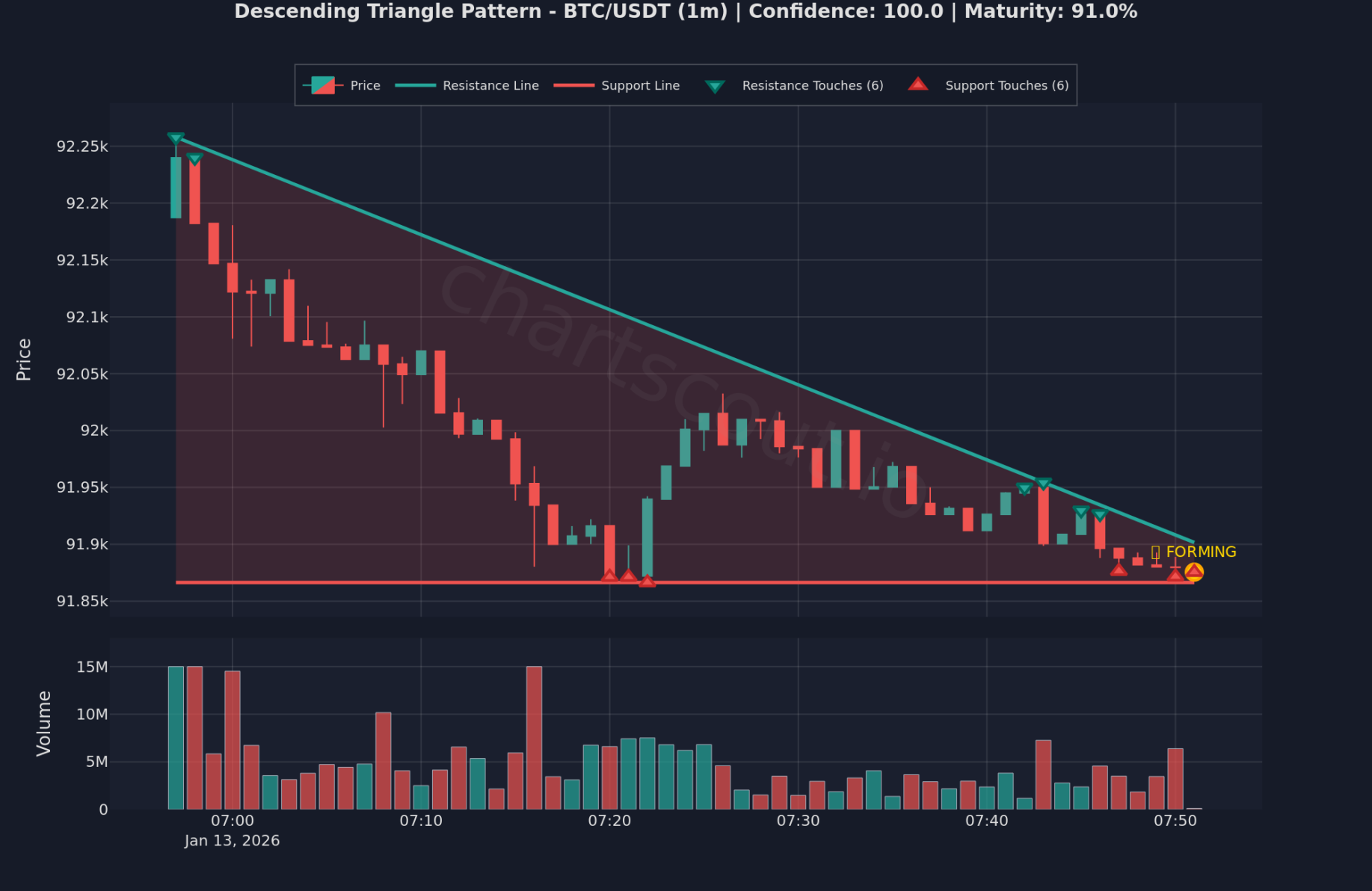
Descending triangle - BTC/USDT 1min
KuCoinBearish BiasThis ChartScout backtest engine detection shows a textbook descending triangle. Notice the flat support level along the bottom and the sequence of lower highs forming the descending resistance. Each rally fails at a progressively lower level, showing sellers gaining control. The key question is always the same: will support hold, or will it break?
How to trade this setup:
Bearish Entry: On break below flat support with volume confirmation
Bullish Entry: On break above descending resistance with volume spike
Stop-loss: Inside the triangle (above resistance for shorts, below support for longs)
Target: Height of the triangle projected from breakout point

Descending triangle - AIA/USDT 15min
BinanceHigher TimeframeThis chart shows a descending triangle on AIA/USDT at the 15-minute timeframe on Binance, detected August 5, 2026. The contracting range, lower highs, and flat support are visible before any breakout confirmation.
Why the 15-minute context matters:
More context: 15-minute candles include more trading activity than 1-minute candles, making the structure easier to validate
Less noise: Fewer false breakouts and wicks than the lowest intraday intervals
Actionable timing: There is time to confirm a close and manage the setup without chasing every tick
Expand your descending-triangle coverage
ChartScout scans 1,000+ crypto pairs across Binance, Bybit, KuCoin, MEXC, and Hyperliquid around the clock and routes descending-triangle detections for your review. That is alert-driven coverage without inspecting every chart manually.
Start 7-day trial→Descending triangle vs other patterns
Descending triangles are frequently confused with other chart patterns that look visually similar. Understanding the differences prevents costly misidentification.
| Feature | Descending Triangle | Ascending Triangle | Falling Wedge |
|---|---|---|---|
| Shape | Flat bottom, declining top | Flat top, rising bottom | Both lines slope downward |
| Typical Bias | Slightly bullish (53% up) | Bullish (63% up) | Bullish reversal |
| Horizontal Line | Support (bottom) | Resistance (top) | No horizontal line |
| Avg Rise (Upward BO) | 38% | 43% | 38% |
| Failure Rate | 22-23% | 17% | 26% |
The most common mistake is confusing a descending triangle with a falling wedge. The critical difference is simple: in a descending triangle, the bottom trendline is horizontal (flat support). In a falling wedge, both trendlines slope downward. If both lines are angled down, it's a wedge, not a triangle.
For a detailed comparison of ascending triangles, read our ascending triangle pattern guide. For the bilateral version, see our symmetrical triangle trading guide. For wedge patterns, see our rising wedge vs falling wedge guide. And for the most reliable bearish reversal of all (often confused with descending triangles when forming at a top), our head and shoulders pattern guide.
Busted descending triangles: trading failures
A "busted" pattern occurs when price breaks out in one direction, moves less than 10%, reverses, and breaks out in the opposite direction. Busted descending triangles are actually some of the most profitable setups -if you know how to trade them.
When a descending triangle breaks downward (as most traders expect), but then reverses and breaks above the top of the pattern, the resulting rally averages 40% according to Bulkowski. Why? Because every trader who shorted the initial downward breakout is now trapped. Their stop-losses get triggered above the triangle, fueling the rally with forced buying.
Types of busted descending triangles
Price breaks out, moves less than 10%, reverses, and breaks past the opposite side of the triangle. The new direction holds and produces a strong move.
After the single bust, the new breakout also fails (moves less than 10%) and reverses again. The third breakout direction is the same as the original first one.
The pattern reverses a third time. These are rare and extremely frustrating -the pattern whipsaws traders in both directions. Best avoided entirely.
The key lesson: when a pattern fails, consider trading the failure. A busted downward breakout from a descending triangle that reverses upward is one of the highest-probability, highest-reward setups in all of chart pattern trading. For more on detecting and avoiding false breakouts, read our guide to spotting fake breakouts in crypto. To compare busted-pattern dynamics across all 23 detectors ChartScout tracks, see our crypto chart patterns cheat sheet.
Crypto-specific considerations
Bulkowski's rules are written for daily stock charts, but chart patterns are defined by candle count, not calendar time. The translation below maps the same descending triangle structure across every ChartScout interval.
Crypto timeframe translation: same candles, compressed wall-clock
| Timeframe | 15-candle pattern duration | Practical ChartScout use |
|---|---|---|
| 1m | ~15 minutes | Scalping, highest noise, confirm against higher TF |
| 5m | ~1-1.5 hours | Intraday scalping / day trading |
| 15m | ~4 hours | Day trading sweet spot |
| 1h | ~15 hours (~0.5-1 day) | Intraday / overnight swing |
| 4h | ~2-3 days | Multi-day swing |
| 1d | ~3 weeks | Swing / position trading |
| 1w | ~3-4 months | Position trading (rare on alts, highest reliability) |
The Bulkowski-vs-crypto comparison
Cryptocurrency markets behave differently in several key ways that affect how descending triangles play out:
| Factor | Bulkowski baseline (stocks) | Crypto expectation |
|---|---|---|
| Pattern pace | Days to weeks on daily | Same candle count, compressed wall-clock time. Hours on 5m-15m, days on 1h-4h |
| Breakout direction | 53% upward, 47% downward | Likely similar direction split, but more sensitive to BTC trend than stock equivalents |
| Average decline | 15% (downward breakouts) | Likely amplified on volatile alts (long-liquidation cascades), comparable on BTC/ETH |
| Break-even failure rate | 22-23% | Likely higher on 1m-15m due to liquidity-driven fakeouts, comparable on 4h-1d |
| Volume confirmation | Single-exchange tape | Fragmented across 4+ exchanges, with wash-trading on low-volume alts |
| Throwback / pullback rate | ~60% | Likely similar, but leveraged perps create deeper liquidation-driven retests |
| Gap risk | Overnight / weekend gaps | 24/7 trading eliminates gaps, but weekend liquidity drops cause clean-looking fakeouts |
| Participant mix | Institutional-dominated | Retail-dominated alts, sharper and more emotional moves on news catalysts |
Honest framing: the crypto column above is qualitative, not quantitative. No published crypto-wide descending triangle study exists with a sample size comparable to Bulkowski's. Treat his stock-market figures as a relative reliability ranking, not exact crypto predictions. ChartScout has a proprietary crypto backtest in progress and will publish the numbers when the study is complete. Until then, the rule is: same structural logic, qualitatively amplified moves on alts, qualitatively higher noise on the lowest timeframes.
Beyond the comparison table, four crypto-specific considerations deserve their own callout:
24/7 trading - no gaps
Unlike stocks that gap up or down at the open, crypto trades continuously. This means breakouts happen at any hour and patterns form faster. Low-liquidity periods (weekends, late-night sessions) can produce false breakouts when there aren't enough participants to sustain the move.
Higher volatility means wider stops
Crypto's inherent volatility means price can wick through support or resistance and immediately reverse. Use candle closes rather than wicks to confirm breakouts. Consider placing stop-losses 1-2% beyond the trendline rather than right at it.
Leverage amplifies busted patterns
Crypto markets have significant leverage participation. When a pattern breaks one direction, leveraged traders pile in. If it reverses, their liquidations create cascading forced closures that amplify the move -making busted patterns even more profitable in crypto than in stocks.
Use multiple timeframes
A descending triangle on the 15-minute chart means very little if the 4-hour chart shows a strong bullish trend. Always check the higher timeframe context. Patterns that align with the higher timeframe trend have significantly better success rates. ChartScout lets you monitor multiple timeframes simultaneously.
Common mistakes to avoid
Assuming it's always bearish
The biggest mistake traders make. The data clearly shows upward breakouts occur 53% of the time. Never pre-determine the breakout direction based on the pattern shape alone. Wait for confirmation.
Trading without volume confirmation
A breakout on weak volume is a fakeout waiting to happen. If the breakout candle has below-average volume, either skip the trade or wait for the throwback/pullback for a second entry opportunity. Our guide to spotting fake breakouts in crypto walks through the specific volume thresholds and order-book signals that distinguish a real breakout from a trap.
Placing stops too tight
With a 60% throwback/pullback rate, tight stops will get triggered constantly. Your stop needs to survive the expected retest. Place it beyond the opposite trendline, not at the breakout level.
Confusing descending triangles with falling wedges
Check the bottom trendline. Flat = descending triangle. Sloping downward = falling wedge. They have completely different statistical profiles and breakout expectations. Misidentification leads to wrong trade decisions.
Ignoring the broader trend context
A descending triangle forming near the bottom of a long downtrend is very different from one forming as a pullback during an uptrend. The prior trend context significantly shifts the probability of breakout direction. Patterns near the yearly low or at the start of a trend tend to perform better.
Complete descending triangle trading checklist
Before entering any descending triangle trade, run through this checklist. Check each item that applies to your setup:
Pattern validation
Breakout confirmation
Risk management
Need help deciding where to place your stop-loss? Our complete stop-loss placement guide for crypto covers every strategy in detail, from conservative to aggressive approaches across all chart patterns.
Frequently asked questions
Is a descending triangle bullish or bearish?
A descending triangle is neither inherently bullish nor bearish. According to Bulkowski's research on 1,300+ trades, it breaks upward 53% of the time and downward 47%. The breakout direction determines whether the pattern is bullish or bearish, not the shape itself. When price rises into the pattern (bullish prior trend), it breaks upward 63% of the time.
What is the success rate of a descending triangle?
In a bull market, descending triangles with upward breakouts have a 78% success rate (22% break-even failure) with an average rise of 38%. Downward breakouts have a 77% success rate (23% break-even failure) with an average decline of 15%. These statistics are from Bulkowski's research on traditional markets; crypto markets may vary.
What is the descending triangle price target?
Use the measure rule: measure the height from the highest peak in the triangle to the horizontal support line. For upward breakouts, add this height to the breakout price (64% of cases reach this target). For downward breakouts, subtract the height from the breakout price (50% reach target). Use a conservative multiplier for crypto due to higher volatility.
How is a descending triangle different from a falling wedge?
The key difference is the bottom trendline. In a descending triangle, the bottom trendline is horizontal (flat support). In a falling wedge, both trendlines slope downward but converge. Falling wedges are typically bullish reversal patterns, while descending triangles can break in either direction.
What timeframe works best for descending triangles in crypto?
Longer timeframes (4-hour and daily charts) produce more reliable patterns with better success rates. Shorter timeframes (1-minute, 5-minute) form descending triangles more frequently but are noisier and more prone to false breakouts. For swing traders, the 4H-Daily range is ideal. For day traders, the 15-minute to 1-hour range provides a good balance of frequency and reliability.
How long does a descending triangle take to form?
Formation time varies by timeframe and chart interval. On lower timeframes commonly used in crypto (1-minute to 4-hour), patterns typically form over several hours to a couple of weeks. The median breakout point occurs 61-65% of the way to the apex. Patterns that take too long to resolve tend to lose their effectiveness as momentum fades.
Can I use ChartScout to detect descending triangles automatically?
Yes. Descending Triangle is included on Basic ($19 per month) across Binance, Bybit, and Hyperliquid. The full Pro trial and Pro or higher add KuCoin and MEXC. Every paid plan and the trial include platform, email, Discord, and Telegram delivery. See our pricing page for plan details.
Sources & references
Data source note: All break-even rates, average rises and declines, throwback and pullback rates, target-hit percentages, and Bulkowski rankings in this guide come from Thomas Bulkowski's most recent published statistics at thepatternsite.com (data updated 8/26/2020, based on 1,300+ perfect bull-market trades). The descending triangle ranks 33 out of 39 bullish patterns on upward breakouts and 15 out of 36 bearish patterns on downward breakouts in the current dataset. Earlier editions of Bulkowski's printed Encyclopedia (2nd Edition, 2005) reported a 16% average decline and a 64% downward breakout rate; we cite the updated figures of 15% and 47% throughout.
- Bulkowski, Thomas N. ThePatternSite.com - Descending Triangles. Updated 8/26/2020. thepatternsite.com/dtri.html.
Primary statistical source. Current figures used throughout this guide: 53% upward / 47% downward breakout split, 22% break-even failure on upward breakouts (78% success rate) with 38% average rise, 23% break-even failure on downward breakouts (77% success rate) with 15% average decline, 60% throwback rate, 58% pullback rate, 64% upward target-hit rate, 50% downward target-hit rate. Based on 1,300+ perfect bull-market trades. - Bulkowski, Thomas N. Encyclopedia of Chart Patterns, 3rd Edition. John Wiley & Sons, 2021. ISBN: 978-1119739685.
Companion print reference. Used for the descending triangle chapter discussion of identification guidelines, busted-pattern subtypes, prior-trend context (63% upward breakout when price rises into the pattern), and the volume-trend-direction nuance. - Murphy, John J. Technical Analysis of the Financial Markets. New York Institute of Finance, 1999. ISBN: 978-0735200661.
Foundational text covering triangle patterns, trend analysis, and volume interpretation in traditional markets. - Edwards, Robert D. & Magee, John. Technical Analysis of Stock Trends, 11th Edition. CRC Press, 2018. ISBN: 978-1138069411.
Classic technical analysis reference covering triangle formations, support/resistance concepts, and volume analysis. - Pring, Martin J. Technical Analysis Explained. McGraw-Hill, 2014. ISBN: 978-0071825177.
Comprehensive coverage of price patterns, trend identification, and technical indicators.
Related guides
Ascending triangle pattern guide
The bullish counterpart with a 63% upward breakout rate and 43% average gain from 1,400+ trades.
Symmetrical triangle pattern guide
Learn the bilateral triangle pattern with ~70% success rate and how it differs from descending triangles.
Rising wedge vs falling wedge
Understand the key differences between wedges and triangles for better pattern identification.
Chart patterns & volume analysis
Deep dive into volume confirmation techniques essential for validating descending triangle breakouts.

Stjepan Ivanović
Founder of ChartScout · Crypto Trader Since 2013
Trading crypto since 2013 with his first Bitcoin bought at ~$200. Four complete bull/bear market cycles, traded on early exchanges like Mt.Gox and BTC-e, on-chain trading on IDEX and EtherDelta, and ~70 crypto project investments. Built ChartScout after 2+ years of development to automate what no trader can do manually. Watch hundreds of charts 24/7.