Symmetrical triangle: the data-driven crypto guide
A symmetrical triangle is a neutral chart pattern formed by converging trendlines - a descending upper line and an ascending lower line - that can break in either direction. Bulkowski ranks it 36 out of 39 bullish patterns and calls its raw performance “awful,” but his busted-pattern rule (price moves less than 5% then reverses out the opposite side) often produces a larger, more reliable move than the original breakout would have - making pattern failure the better trade.
Statistical Note: The success rates and performance data cited in this guide come from Thomas Bulkowski's most recent published statistics at thepatternsite.com (data updated 8/26/2020, based on 3,000+ perfect bull-market trades) - the most comprehensive public dataset for chart pattern performance. Cryptocurrency markets exhibit higher volatility than traditional markets, which impacts pattern reliability.
Most symmetrical triangle content still quotes a “70% success rate” without context. That number does not exist in Bulkowski's current data. The updated thepatternsite.com figures (3,000+ trades, refreshed 8/26/2020) show a 25% break-even failure rate on upward breakouts (so 75% “clear 5%” rate, not 70%) and only a 58% measured-move hit rate. More importantly, Bulkowski ranks the pattern 36 of 39 bullish chart patterns and describes its raw performance as “awful.” The recycled 70% number is not wrong by accident, it is confusion between a break-even rate and a directional win rate. The two are not the same. (For context against every other pattern Bulkowski tracks, see our crypto chart patterns cheat sheet.)
The symmetrical triangle is one of the most commonly identified chart patterns in crypto, yet it is also one of the most misunderstood. The widely cited “70% success rate” masks a more complicated statistical reality. Bulkowski's research ranks symmetrical triangles near the bottom of all chart patterns for post-breakout performance. Understanding this gap between perception and statistical reality is what separates profitable triangle traders from the rest.
This guide breaks down everything you need to know about trading symmetrical triangles in crypto: what makes them valid, what the data actually says, how they behave differently in crypto versus traditional markets, and how to build high-probability setups that account for the pattern's known weaknesses. (If you're new to chart reading, start with our How to Read Crypto Charts guide first.)
Perhaps most importantly, we'll reveal why pattern failure often creates a better trade than pattern success - a counterintuitive finding from Bulkowski's data that most guides never mention.
What is a symmetrical triangle?
A symmetrical triangle forms when price creates a series of lower highs and higher lows, producing two converging trendlines that slope toward each other at roughly equal and opposite angles. The upper trendline descends, connecting at least two lower highs. The lower trendline ascends, connecting at least two higher lows. Together, they create a triangular shape that narrows over time, compressing price into an increasingly tight range.
The pattern reflects genuine market equilibrium. Neither buyers nor sellers can gain the upper hand. Each rally fails at a lower point than the last, and each selloff finds support at a higher level than the previous one. This compression of range builds potential energy - like a coiled spring - until one side capitulates and price breaks out.
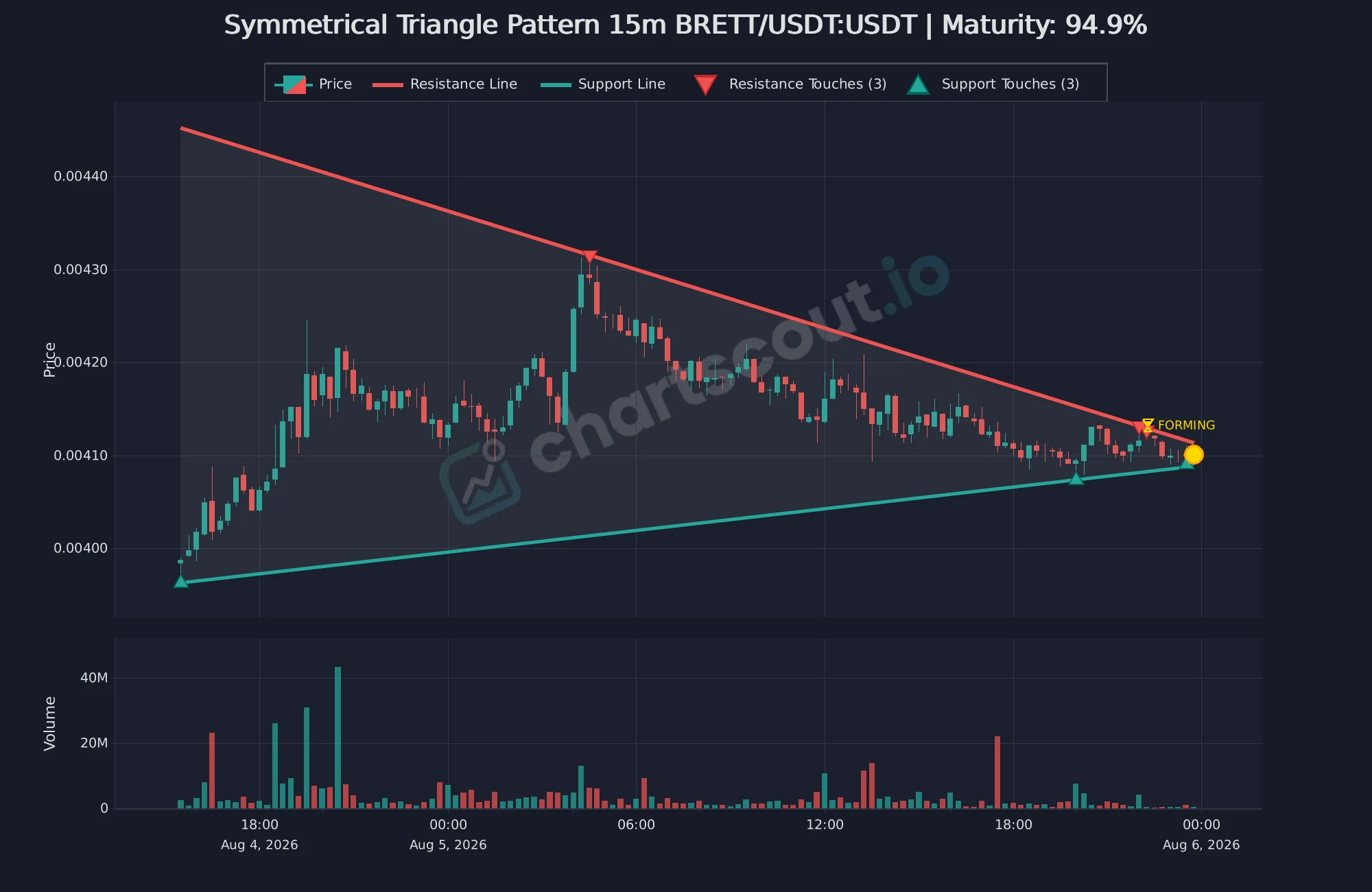
BRETT/USDT 15m - Binance
Symmetrical triangle on BRETT/USDT at the 15-minute timeframe on Binance, detected August 6, 2026, with converging trendlines and volume context
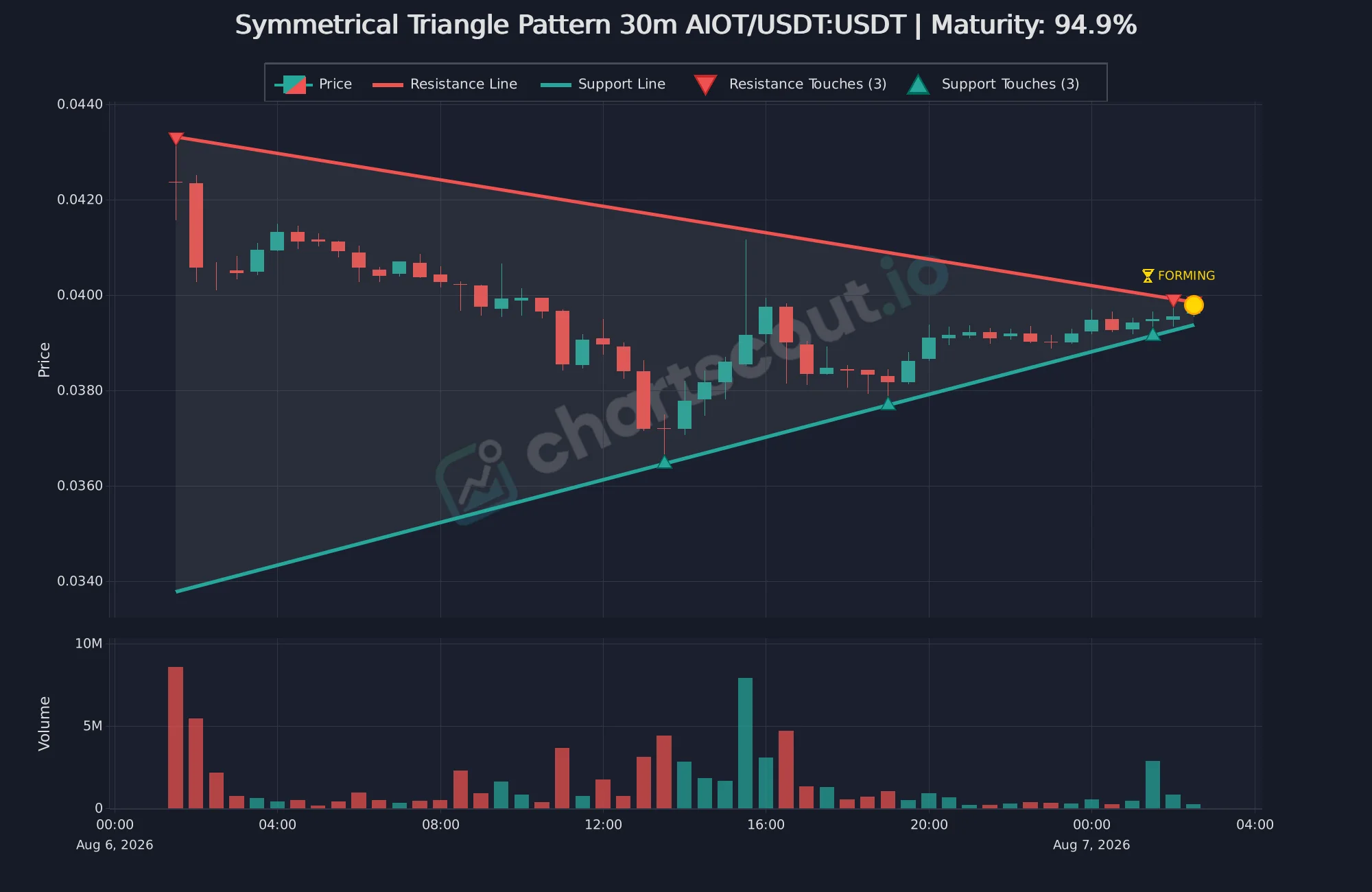
AIOT/USDT 30m - Binance
Symmetrical triangle on AIOT/USDT at the 30-minute timeframe on Binance, detected August 7, 2026, with a contracting range and volume context
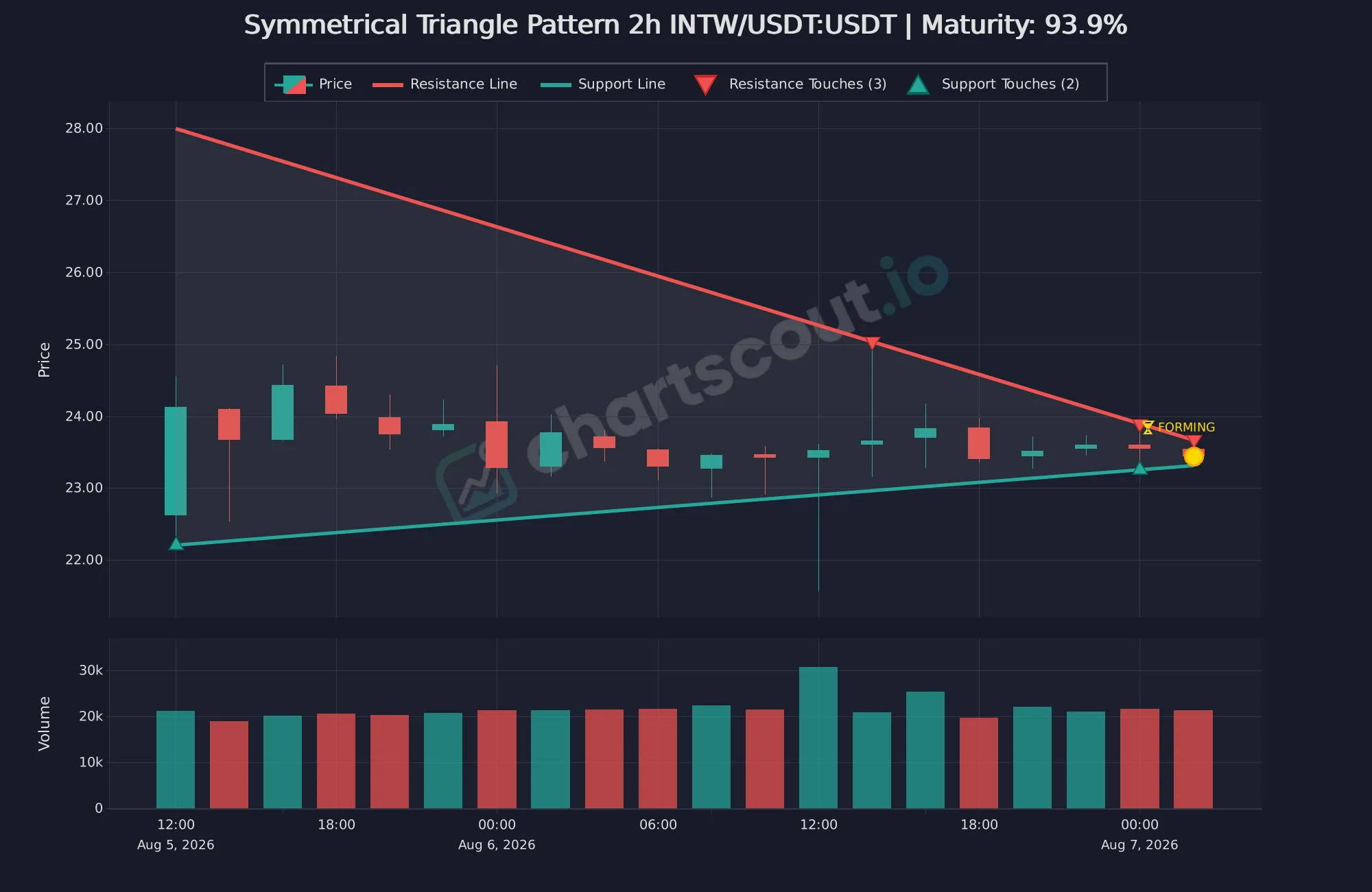
INTW/USDT 2h - KuCoin
Symmetrical triangle on INTW/USDT at the 2-hour timeframe on KuCoin, detected August 7, 2026, with converging trendlines before resolution
Symmetrical triangle detections from ChartScout's backtest engine, produced by the same scripts that power the live scanner. All intervals from 1m to daily across Binance, Bybit, KuCoin & MEXC.
For a symmetrical triangle to be valid, it needs specific structural requirements. Price must touch one trendline at least three times and the other at least twice, producing a minimum of five distinct contact points. The formation typically takes three weeks to three months to develop on daily charts. Anything shorter than three weeks is technically classified as a pennant - an important distinction since pennants carry a different statistical profile.
The apex - the theoretical point where the two trendlines would converge - serves as both a timing mechanism and a future price level of significance. Bulkowski found that price reaches a minor turning point within days of the apex approximately 75% of the time, making the apex a useful reference for post-breakout support/resistance levels.
How it differs from other triangle patterns
The symmetrical triangle's defining characteristic is its bilateral or neutral nature. It gives no inherent directional signal on its own. This fundamentally separates it from the other triangle types.
| Pattern | Upper Line | Lower Line | Bias | Breakout % |
|---|---|---|---|---|
| Ascending Triangle | Flat (horizontal) | Rising | Bullish | ~83% upward |
| Descending Triangle | Declining | Flat (horizontal) | Bearish | ~87% downward |
| Symmetrical Triangle | Declining | Rising | Neutral | ~60% upward (bull mkt) |
Source: Bulkowski, thepatternsite.com (updated 8/26/2020); Edwards & Magee, Technical Analysis of Stock Trends
The critical distinction from wedges is trendline direction. Wedges have both trendlines sloping the same way - either both rising (rising wedge) or both falling (falling wedge). Symmetrical triangles always have lines converging from opposite directions, one ascending and one descending.
Key characteristics at a glance
| Characteristic | Detail |
|---|---|
| Pattern Type | Neutral (continuation ~60% of the time) |
| Upper Boundary | Descending trendline connecting lower highs |
| Lower Boundary | Ascending trendline connecting higher lows |
| Minimum Touches | 5 total (3 on one line, 2 on the other) |
| Formation Time | 3 weeks to 3 months on daily; hours on intraday intervals (1m-15m) |
| Volume Behavior | Declines 84-86% of the time during formation |
| Breakout Position | ~74% of the distance from base to apex |
| Throwback Rate | 62% (upward), 65% (downward) - above average |
What Bulkowski's data actually says about performance
Thomas Bulkowski's thepatternsite.com symmetrical triangle page (data updated 8/26/2020) provides the most comprehensive public statistical analysis of symmetrical triangles available, drawn from over 3,000 “perfect trades” in U.S. equity markets. The numbers tell a story that's significantly less rosy than most trading guides suggest - Bulkowski himself describes the pattern's performance as “awful.”
Overall ranking and success rates
Performance ranking
In bull markets, symmetrical triangles rank 36th out of 39 chart patterns for upward breakout performance and 34th out of 36 for downward breakout performance. Bulkowski himself describes the performance as “awful.”
The break-even failure rate - defined as the percentage of patterns that fail to produce even a 5% move in the breakout direction - is 25% for upward breakouts and 37% for downward breakouts. More than one in three downside breakouts from symmetrical triangles don't even manage a 5% decline.
When breakouts do succeed, the asymmetry between directions is stark. Upward breakouts produce an average rise of 34%. Downward breakouts produce an average decline of just 12%. This disparity matters enormously for position sizing.
| Metric | Upward Breakout | Downward Breakout |
|---|---|---|
| Average Move | 34% rise | 12% decline |
| Break-Even Failure Rate | 25% | 37% |
| Measured Move Hit Rate | 58% | 36% |
| Throwback/Pullback Rate | 62% | 65% |
| Overall Rank | 36 of 39 | 34 of 36 |
Source: Bulkowski, thepatternsite.com (data updated 8/26/2020, 3,000+ perfect trades)
Breakout timing and location
Breakouts typically occur at approximately 74% of the distance from the triangle's base to its apex. Breakouts occurring too early - before the halfway mark - tend to be premature and lack follow-through. Breakouts near or beyond the apex often emerge into a congestion zone where the pattern's energy has already dissipated.
What makes some triangles perform better
Not all symmetrical triangles are created equal. Several measurable characteristics dramatically separate winners from losers:
- Tall triangles outperform short ones: On monthly charts, tall symmetrical triangles averaged a 154% rise versus 93% for shorter patterns. Tall and narrow triangles averaged an extraordinary 262% rise.
- Position relative to yearly range matters: Triangles near the yearly low averaged 182% gains versus 105% for mid-range formations.
- Short preceding trends produce better results: Trends under 3 months leading into the triangle yielded 167% average gains versus 91% for trends over 6 months. Fresh momentum outperforms exhausted momentum.
Critical warning: shorting breakdowns
The 36% measured move achievement rate for downside targets, combined with the 37% break-even failure rate and the 12% average decline, makes shorting symmetrical triangle breakdowns the statistically weakest application of this pattern. Consider using breakdowns as bust-reversal setups instead - per Bulkowski's busted-pattern rule, breakouts that move less than 5% before reversing tend to produce a larger, more reliable move in the opposite direction.
Busted symmetrical triangles: when failure becomes opportunity
Perhaps the single most actionable finding in Bulkowski's entire symmetrical triangle research is his busted-pattern rule. Given that the pattern's raw performance is “awful” (his own word), failed breakouts that reverse out the opposite side often turn into the better trade.
Bulkowski's busted-pattern rule
If price moves less than 5% in the breakout direction and then reverses to close on the opposite side of the triangle, the resulting busted move is typically larger and more reliable than the original breakout would have been. This rule applies in both directions - busted upward breakouts that flip into downside moves, and busted downward breakouts that flip into upside moves.
Pattern failure can literally produce a better trade than pattern success. The mechanism is simple: traders who entered on the initial breakout get trapped, and their forced exits add fuel to the move in the opposite direction.
“When a symmetrical triangle's breakout fails to move 5% and then reverses out the opposite side, the busted move is usually a better trade than the original would have been. Symmetrical triangles are notorious for double busting, so use stops.”
- Bulkowski, paraphrased from thepatternsite.com (busted pattern rule)How to trade the bust
- Wait for the initial breakout (or breakdown): Price closes outside the triangle in one direction
- Confirm it stalls within 5%: The follow-through fails to meet the 5% threshold
- Watch for the reversal: Price comes back through the triangle and closes outside the opposite trendline
- Enter on the bust confirmation candle: With volume confirmation
- Place your stop: Below the swing low (for bust longs) or above the swing high (for bust shorts) of the failed initial move
- Manage with trailing stops: Bulkowski's rule says the busted move tends to be larger, but he gives no fixed target percentage - use a trailing stop or measured-move projection from the bust point
Double bust warning
Bulkowski specifically warns that symmetrical triangles are “notorious for double busting” - meaning the reversal trade itself can fail and reverse a second time. Always use a stop-loss on bust trades. Never assume the bust is the “final” move.
How symmetrical triangles behave differently in crypto
Crypto markets introduce several structural factors that alter how symmetrical triangles form and resolve compared to traditional equities.
The 24/7 trading factor
The continuous trading cycle eliminates opening gaps, which in equities sometimes provide immediate breakout confirmation. In crypto, breakouts tend to unfold more gradually, and the absence of session boundaries means breakouts can occur during thin weekend liquidity when false signals are most common. A Saturday morning breakout on low volume deserves much more skepticism than a Tuesday afternoon breakout during peak trading hours.
Elevated false breakout rates
Multiple crypto-specific analyses place pattern reliability at roughly 62-65% for symmetrical triangles - below the stock market baseline. Higher leverage amplifies moves and triggers cascading liquidations that can temporarily push price through trendlines before snapping back. Long candle wicks that pierce trendlines without conviction are endemic to crypto triangles. The mitigation is straightforward: use candle close confirmation rather than intra-candle price action. (See our guide on How to Spot Fake Breakouts for more.)
Faster formation times across all intervals
Patterns that take weeks on stock charts compress into days on crypto daily charts due to 24/7 activity and higher volatility. A three-week stock market triangle may form in 7-10 days on a crypto daily chart. On lower timeframes, formation is even faster: a symmetrical triangle on a 15-minute chart can complete in a few hours, while a 5-minute triangle may form and break out within a single trading session. This compression doesn't invalidate the pattern - the same structural rules apply (converging trendlines, 5+ touch points, declining volume). It simply means traders across every interval from 1m to daily can find actionable symmetrical triangle setups throughout the day.
Recent crypto case studies
Bitcoin $84K-$94K (late 2025)
BTC formed a well-documented symmetrical triangle on the 4-hour chart in December 2025, with support at $86,740-$87,000 and resistance at ~$90,975. Aroon Up at 100% versus Aroon Down at 7.14% signaled strong buyer dominance. The bullish breakout target pointed to $94,200. Notably, this formed during $782M in weekly ETF outflows - a divergence between institutional flow data and the chart's bullish signal.
XRP multi-year megapattern (2018-2024)
XRP formed one of the most dramatic symmetrical triangles in crypto history, spanning from its $3.31 high in January 2018 through nearly eight years of consolidation. The breakout came in November 2024, driving price from ~$0.50 to a new all-time high of $3.66. The subsequent 61% pullback served as a textbook backtest of the original upper trendline.
Ethereum two-month formation (2025)
ETH developed a symmetrical triangle between $2,159 and $3,300 on the daily chart, accompanied by whale accumulation of 260,000 ETH in a 24-hour period. A separate Q3 2025 formation on the 4-hour chart targeted $4,711.
The Bulkowski-vs-crypto comparison
Bulkowski's 3,000-trade dataset is drawn from U.S. equities, not crypto. The structural rules translate directly (candle counts, trendline logic, volume contraction). The performance numbers translate qualitatively. Here is how the stock-market baseline maps to crypto expectations.
| Factor | Bulkowski baseline (stocks) | Crypto expectation |
|---|---|---|
| Pattern pace | 3 weeks to 3 months on daily | Same candle count, compressed wall-clock time. 7-10 days on crypto daily, hours on 5m-15m |
| Average move (upward) | 34% rise | Likely amplified on volatile alts (short-squeeze cascades), comparable on BTC/ETH |
| Break-even failure rate | 25% (up), 37% (down) | Likely higher on 1m-15m due to liquidity-driven fakeouts, comparable on 4h-1d |
| Volume confirmation | Single-exchange tape | Fragmented across 4+ exchanges, with wash-trading on low-volume alts |
| Throwback / pullback rate | 62% (up), 65% (down) | Likely similar, but leveraged perps create deeper liquidation-driven retests |
| Gap risk | Overnight / weekend gaps | 24/7 trading eliminates gaps, but weekend liquidity drops cause clean-looking fakeouts |
| Participant mix | Institutional-dominated | Retail-dominated alts, sharper and more emotional moves on news catalysts |
Honest framing: the crypto column above is qualitative, not quantitative. No published crypto-wide symmetrical triangle study exists with a sample size comparable to Bulkowski's. Treat his stock-market figures as a relative reliability ranking, not exact crypto predictions. ChartScout has a proprietary crypto backtest in progress and will publish the numbers when the study is complete. Until then, the rule is: same structural logic, qualitatively amplified moves on alts, qualitatively higher noise on the lowest timeframes.
Volume: the leading indicator inside every triangle
Volume behavior during symmetrical triangle formation is one of the most reliable confirming signals in all of technical analysis. Bulkowski's data shows volume trends downward during formation 84% to 86% of the time. This makes declining volume nearly a prerequisite for pattern validity. (For a deep dive, see our Chart Patterns & Volume Analysis guide.)
Breakout volume confirmation
The breakout candle's volume is the single most important confirmation signal. Heavy volume on the breakout - above the 30-day moving average - consistently produces better post-breakout performance. For high-confidence setups, require a volume increase of 50%+ above the recent average, with ideal breakouts showing 150-200% spikes. Volume confirmation is more critical for upside breakouts, as upward moves require active buying interest to sustain themselves.
Using OBV as a directional predictor
On-Balance Volume (OBV) provides perhaps the most valuable leading indicator for predicting breakout direction before price confirms it. Rising OBV during formation signals accumulation - smart money building positions before the breakout. Falling OBV signals distribution. The divergence between OBV direction and price direction within the triangle is one of the strongest predictive signals available.
Bullish OBV signal
OBV making higher highs while price makes lower highs inside the triangle.
- Accumulation is occurring
- Upside breakout probability increases
- Bias toward long entries
Bearish OBV signal
OBV declining while price makes higher lows inside the triangle.
- Distribution is occurring
- Downside breakout probability increases
- Watch for bust opportunity if breakdown occurs
Premature breakouts: the volume trap
Bulkowski found that premature breakdowns - false moves downward before the real breakout - occur 16% of the time, while premature upward breakouts happen only 3% of the time. The volume on these premature breakdowns averages 116% of the 25-day moving average, making them difficult to distinguish from real breakdowns using volume alone. This is precisely why multi-factor confirmation (volume with candle closes, time filters, and momentum indicators) is essential. For the full filter playbook, see our guide on how to spot fake breakouts in crypto.
Three entry strategies: breakout, retest, and anticipation
Strategy 1: the breakout entry
The most commonly traded approach. Enter when price closes beyond the upper trendline (for longs) or below the lower trendline (for shorts), confirmed by a volume spike of at least 50% above the recent average. Many traders add a price filter (1-3% close beyond the trendline) or a time filter (two consecutive candle closes outside the formation on your chosen timeframe). Stop-loss goes below the most recent swing low inside the triangle for longs. The measured move technique sets the profit target. This strategy works across all intervals - whether you're trading a 5-minute breakout or a daily one.
Strategy 2: the retest entry
This approach exploits the pattern's high throwback rate. Since throwbacks occur 62% of the time after upward breakouts, the strategy is: wait for the breakout, then wait for price to retrace back to the broken trendline, confirm the test holds via a reversal candlestick (hammer, engulfing, pin bar), and enter on the confirmation candle. This delivers a significantly tighter stop-loss and superior risk-reward ratio, often 3:1 or better. For crypto specifically, the retest entry is arguably the highest-probability approach due to elevated false breakout rates.
Strategy 3: the anticipation entry
The most aggressive approach. Enter inside the triangle before the breakout occurs, typically buying near the lower trendline in an uptrending context. This leverages Edwards and Magee's 75% continuation rate. The advantage is the best possible entry price and tightest stop. The disadvantage is the highest chance of being wrong. This is reserved for experienced traders with strong directional conviction from OBV, RSI, and MACD confluence. For a deeper framework on early-entry signals, read our guide on how to find crypto breakouts before they happen.
| Strategy | Risk:Reward | Hit Rate | Best For |
|---|---|---|---|
| Breakout | 2:1 - 3:1 | Moderate | Beginners, clear confirmation |
| Retest | 3:1+ | Highest (when it triggers) | Crypto traders, patient entries |
| Anticipation | 3:1 - 3.7:1 | Lowest | Advanced traders with confluence |
Profit target calculation
Measure the triangle's height at its widest point (highest high minus lowest low), then project that distance from the breakout point. Given Bulkowski's data showing the measured move is hit only 58% of the time (upward) and 36% (downward), a tiered exit strategy performs better than a single target: take 50% off at 50-60% of the measured move distance, and trail the remainder with a 20 or 50-period moving average.
Building high-probability setups with confluence
No symmetrical triangle should be traded in isolation. The highest-probability setups stack multiple confirming signals to overcome the pattern's inherently middling success rate.
RSI
RSI between 45 and 70 and rising at the moment of an upward breakout confirms bullish momentum without dangerous overextension. RSI divergence within the triangle - price making a lower high while RSI makes a higher high - is one of the most powerful directional predictors available inside the pattern.
MACD
A bullish MACD crossover (signal line cross above zero) coinciding with the upward breakout, accompanied by expanding histogram bars, significantly increases reliability. MACD divergence with price provides early directional clues - the two indicators used together create a strong momentum filter.
Moving averages as trend filters
The 200-day moving average serves as the most effective trend filter. Price above the 200 MA biases toward long entries. Below it biases toward shorts. Backtesting across thousands of triangle trades has shown that applying a moving average trend filter improves win rates by approximately 4 percentage points and reduces drawdown by roughly 25%.
Bollinger Band squeezes
Bollinger Band squeezes visually confirm the volatility compression that defines every symmetrical triangle. Combining a Bollinger squeeze with rising OBV while price is in a symmetrical triangle produces a particularly strong bullish breakout signal.
High-probability bullish checklist
Not every setup will check every box. The more confluent factors present, the more you can trust the signal and size accordingly.
Timeframe selection
Symmetrical triangles form on every timeframe - from 1-minute scalping charts to monthly macro views. Each interval serves a different trading style, and the pattern mechanics remain the same regardless of timeframe. What changes is the noise-to-signal ratio and the typical holding period. ChartScout scans all standard crypto intervals (1m, 3m, 5m, 15m, 1h, 4h, daily) to surface symmetrical triangles as they form - so you can trade the timeframe that matches your strategy.
Crypto timeframe translation: same candles, compressed wall-clock
Bulkowski's rules are written for daily stock charts (his “3 weeks to 3 months” classic duration), but chart patterns are defined by candle count, not calendar time. A 30-candle symmetrical triangle is the same pattern whether the candles are 1-minute or daily. The translation below maps the same Bulkowski rules across every ChartScout interval so a 5m scalper and a daily swing trader can both apply them.
| Timeframe | 15-candle pattern duration | Practical ChartScout use |
|---|---|---|
| 1m | ~15 minutes | Scalping, highest noise, confirm against higher TF |
| 5m | ~1-1.5 hours | Intraday scalping / day trading |
| 15m | ~4 hours | Day trading sweet spot |
| 1h | ~15 hours (~0.5-1 day) | Intraday / overnight swing |
| 4h | ~2-3 days | Multi-day swing |
| 1d | ~3 weeks | Swing / position trading - Bulkowski's “3 weeks to 3 months” baseline |
| 1w | ~3-4 months | Position trading (rare on alts, highest reliability) |
Reliability and trading style by timeframe
| Timeframe | Trading Style | Notes |
|---|---|---|
| 1m / 3m | Scalping | Fast setups, tight stops, high volume required for confirmation. Best during peak liquidity hours. |
| 5m / 15m | Day Trading | Popular for intraday setups. Patterns form within hours, ideal for active session traders. |
| 1-hour | Intraday Swing | Good balance of speed and reliability. Patterns form over 1-3 days in crypto. |
| 4-hour | Swing Trading | Filters most noise while producing actionable setups. Multi-day holding periods. |
| Daily | Position Trading | Strongest signals in Bulkowski's data. Holds for weeks. Wider stops, larger moves. |
| Weekly / Monthly | Macro | Highest reliability. Monthly triangles averaged 121% rise (Bulkowski). Rare but powerful. |
Bulkowski's research was conducted on daily and weekly charts, so the statistical benchmarks (34% average rise, 25% break-even failure rate, rank 36 of 39 bullish patterns) apply most directly to those intervals. On lower timeframes like 5m or 15m, expect slightly higher false breakout rates - compensate with stricter volume confirmation and tighter risk management. The pattern structure itself (converging trendlines, declining volume, 5+ touch points) is the same on a 5-minute chart as it is on a daily chart.
Multi-timeframe alignment
The strongest approach uses multi-timeframe alignment: a higher timeframe shows the trend direction, your trading timeframe shows the symmetrical triangle with bullish confluence, and a lower timeframe confirms the breakout entry with volume. For example: daily uptrend → 4h triangle → 1h breakout confirmation. Or for scalpers: 1h trend → 5m triangle → 1m entry timing. This layered confirmation substantially increases success probability over single-timeframe analysis.
Pattern degradation over time
Bulkowski's research shows that chart pattern failure rates have been increasing over the decades. Trading has become roughly “30% harder to make money” from chart patterns compared to the 1990s. The 2026 crypto market demands stricter confirmation criteria - volume spikes, candle close filters, and multi-indicator confluence are no longer optional enhancements, they're baseline requirements.
Risk management framework
Given the pattern's statistical reality - elevated break-even failure rates (25% up, 37% down), high throwback frequency (62% up, 65% down), and a rank near the bottom of all bullish patterns - risk management is not supplementary to triangle trading. It is the trade.
Position sizing
Never risk more than 1-2% of total account equity on any single symmetrical triangle trade. The pattern's middling success rate means a string of 3-4 consecutive losers is statistically normal. At 1% risk per trade, four consecutive losses cost 4% of equity. At 5% risk, the same string costs 20% - a drawdown that impairs decision-making and recovery speed.
Stop-loss placement
- Breakout entries: Below the last swing low inside the triangle (for longs) with a 0.5-1% buffer for wicking
- Retest entries: Just below the retested trendline
- Anticipation entries: Below the lower trendline
For pattern-by-pattern stop placement rules across every chart pattern ChartScout detects, see our stop-loss in crypto trading guide.
Invalidation criteria
Close the trade immediately - regardless of stop placement - if any of the following occur:
- A candle close back inside the triangle after a breakout on your trading timeframe (pattern invalidation)
- Volume dries up completely within two candles of the breakout (no follow-through)
- A higher timeframe signal directly contradicts your trade direction
The asymmetric approach: longs vs. shorts
Upward breakouts (favor these)
- 34% average gain
- 25% failure rate
- 58% measured move hit rate
- Larger position sizes appropriate
Downward breakouts (extreme caution)
- 12% average decline only
- 37% failure rate
- 36% measured move hit rate
- Rank 34 of 36 bearish patterns - consider busted reversal instead
How to scan for symmetrical triangles automatically
Symmetrical triangles form across hundreds of crypto pairs simultaneously, on every interval from 1-minute to daily. Manual scanning is impractical when the highest-probability setups require monitoring multiple timeframes, volume patterns, and confluence indicators across a large universe of assets.
Symmetrical Triangle is included on Basic across Binance, Bybit, and Hyperliquid at 15-minute and higher timeframes. The full Pro trial and Pro or higher expand it to all five exchanges and faster coverage, with platform, email, Discord, and Telegram delivery.
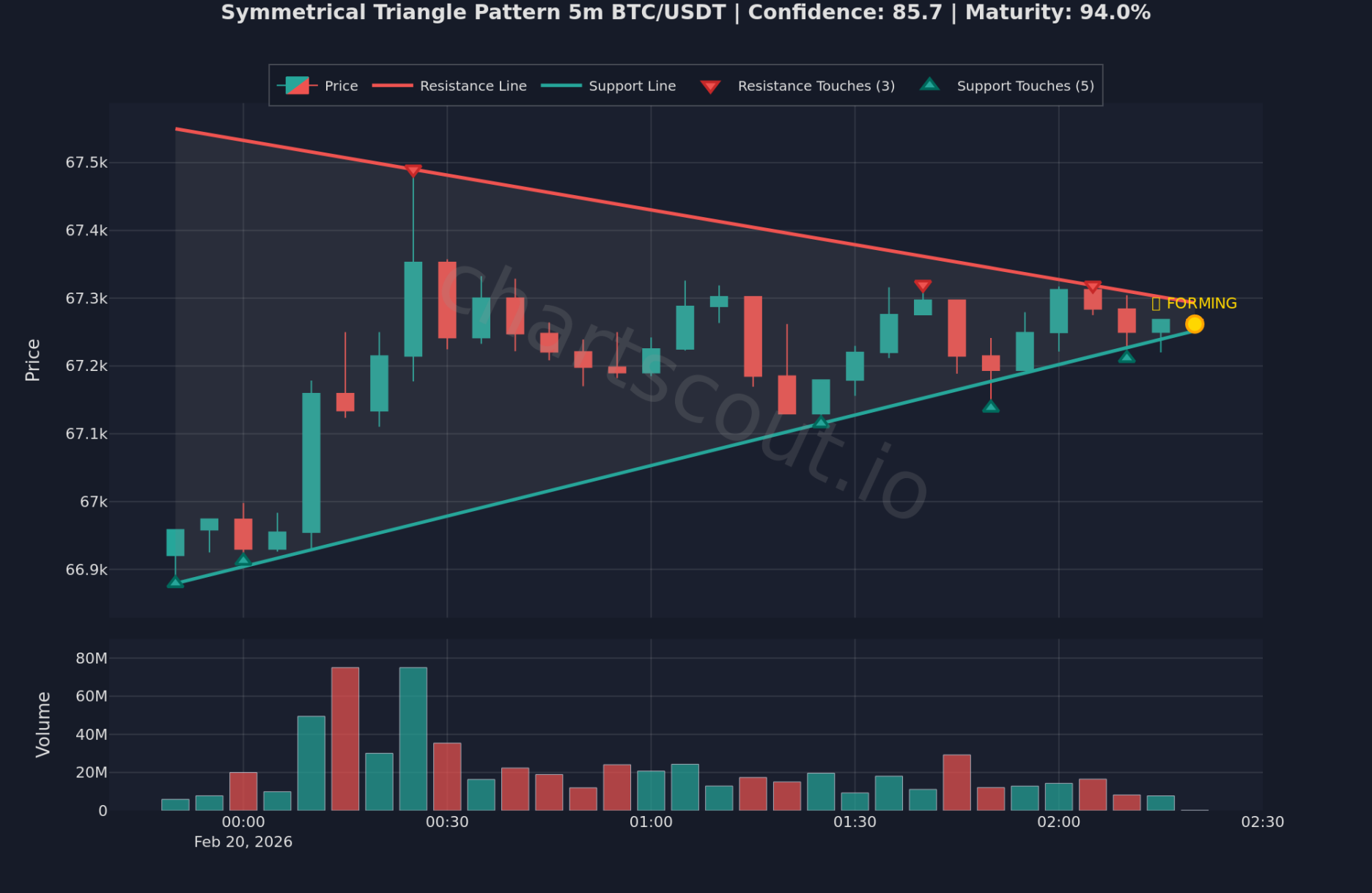
BTC/USDT 5m - Bybit
85.7% confidence, 94% maturity, 8 touch points
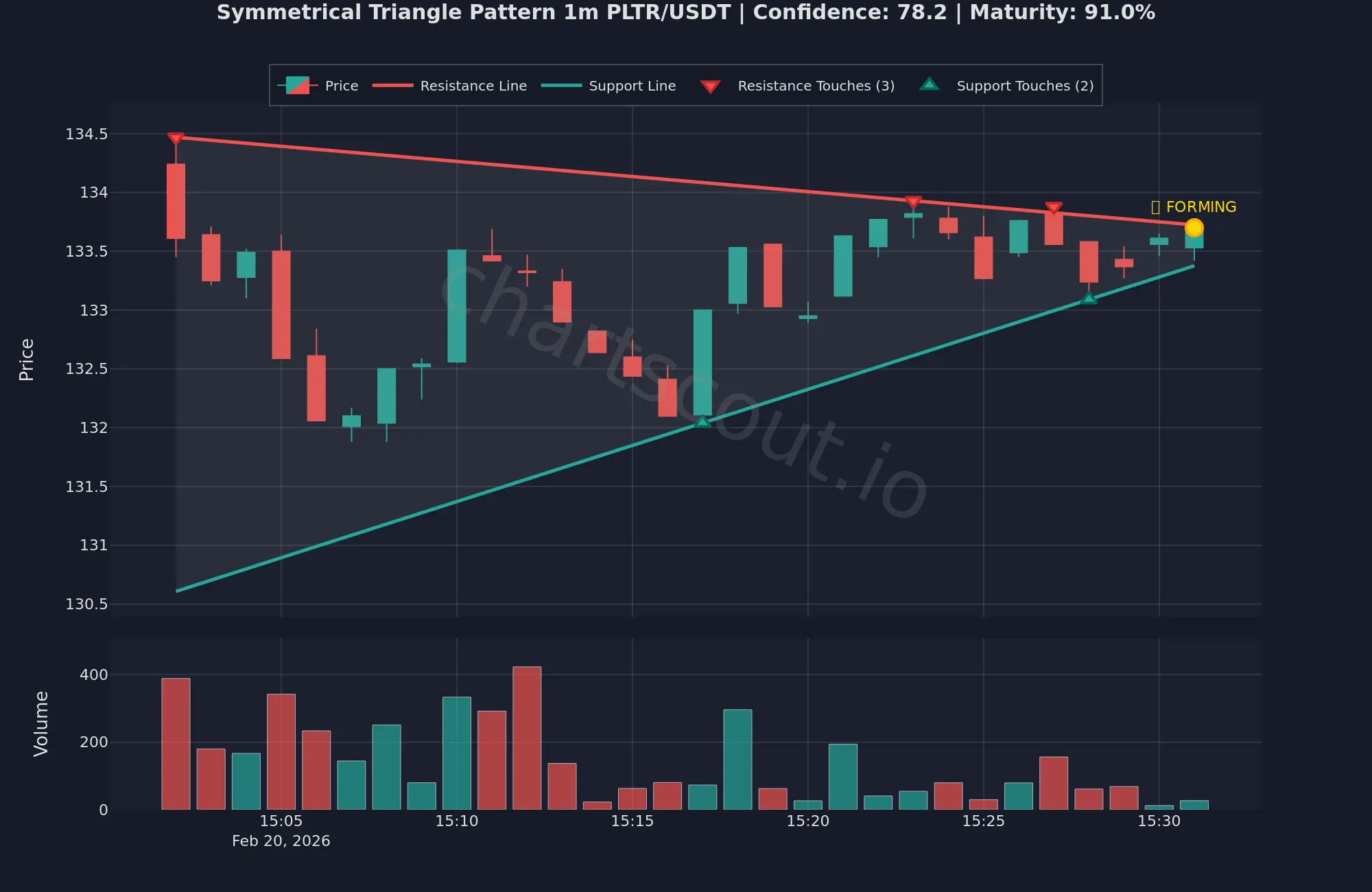
PLTR (Palantir) 1m - Binance
78.2% confidence, 91% maturity - stock tokenized pair
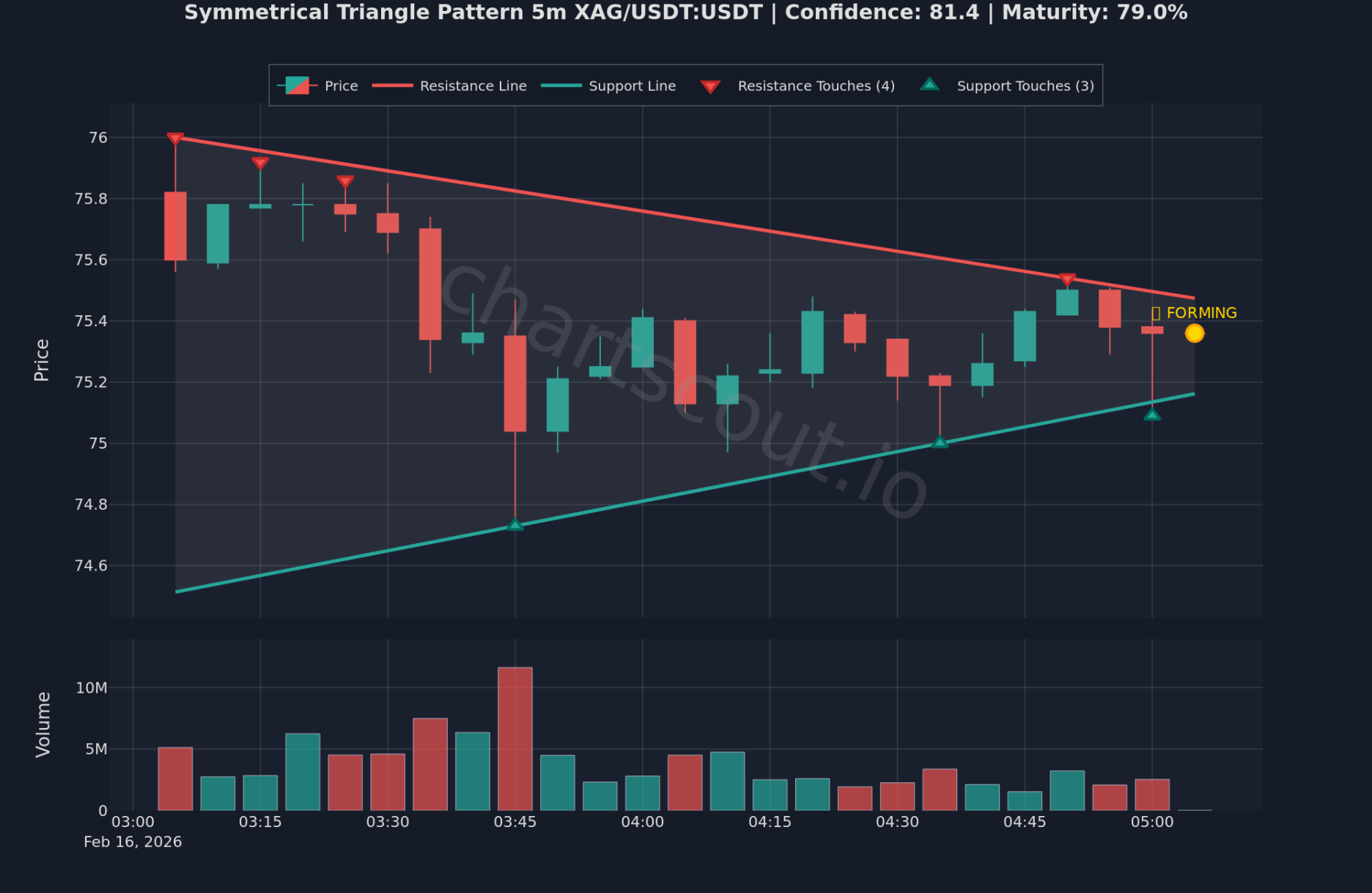
XAG/USDT (Silver) 5m - Binance
81.4% confidence, 79% maturity - commodities pair
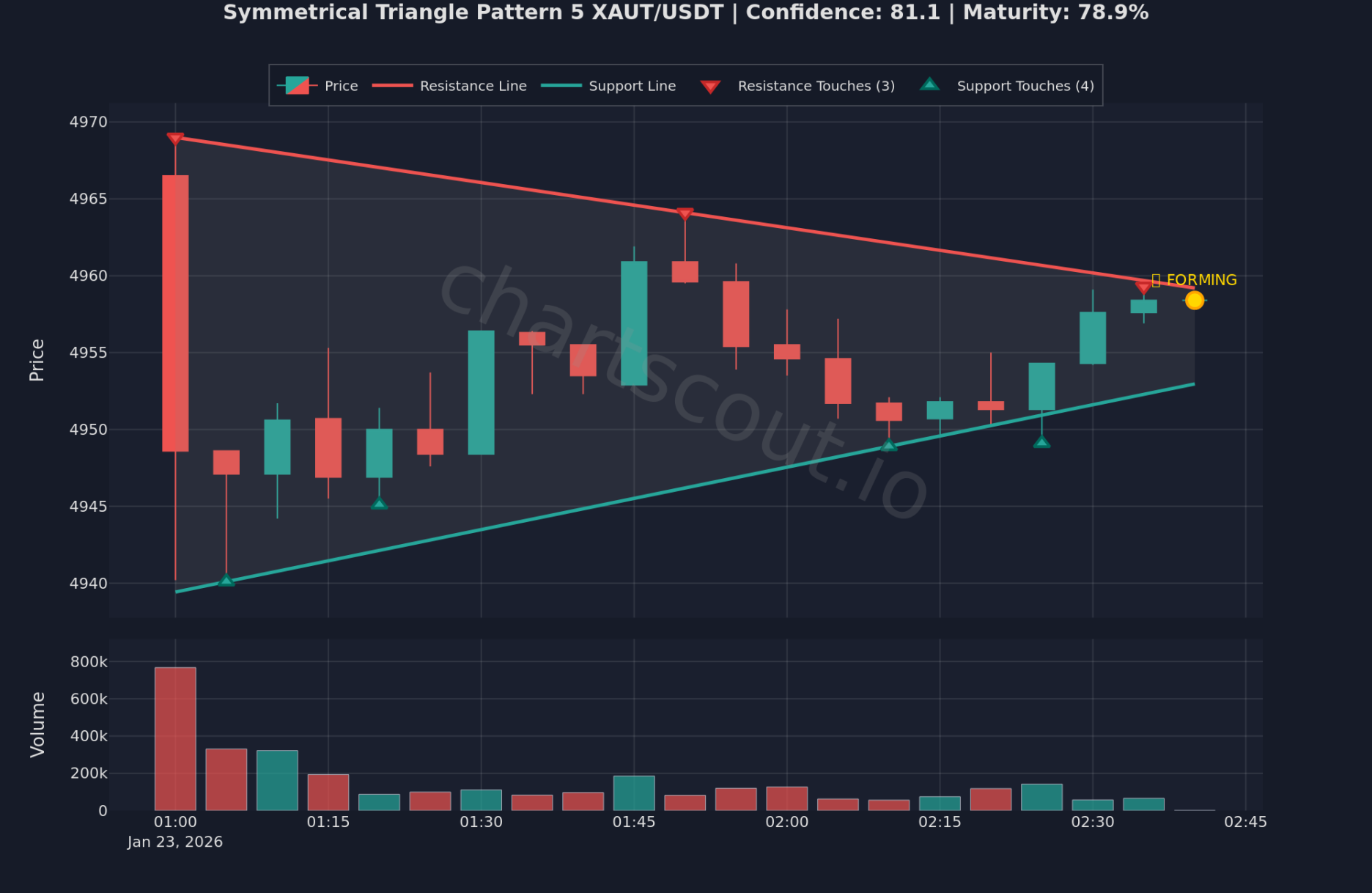
XAUT/USDT (Gold) 5m - Bybit
81.1% confidence, 78.9% maturity - commodities pair
ChartScout detects symmetrical triangles across crypto, tokenized stocks, and commodities - not just major pairs
Expand your symmetrical-triangle coverage
ChartScout detects symmetrical triangles on every interval (1m, 3m, 5m, 15m, 1h, 4h, daily) across Binance, Bybit, KuCoin, MEXC, and Hyperliquid, alerting you within seconds of formation.
Triangle patterns in crypto: ascending vs descending vs symmetrical
Crypto traders run into all three triangle variants on the same charts, often within a single trading session. They look superficially similar - converging trendlines, contracting volume, a clean breakout - but their statistical profiles, breakout direction probabilities, and crypto-specific quirks differ substantially. Picking the wrong variant means picking the wrong direction, the wrong stop, and often the wrong target.
The table below side-by-sides every metric Bulkowski publishes for the three triangles, anchored to his current 8/26/2020 dataset. Each row is a directly comparable number across all three patterns. The crypto column adjustments are qualitative (per the “Honest framing” rule earlier in this guide). For full deep dives into each variant, see our ascending triangle guide and descending triangle guide.
| Metric | Ascending | Descending | Symmetrical |
|---|---|---|---|
| Bulkowski rank (bull, upward) | 16 of 39 | 33 of 39 | 36 of 39 |
| Bulkowski rank (bear, downward) | 30 of 36 | 15 of 36 | 34 of 36 |
| Breakout direction (upward share) | 63% | 53% | ~60% |
| Avg move on upward breakout | 43% | 38% | 34% |
| Avg move on downward breakout | 13% | 15% | 12% |
| Break-even failure (upward) | 17% | 22% | 25% |
| Break-even failure (downward) | 38% | 23% | 37% |
| Throwback / pullback rate | 64% / 63% | 60% / 58% | 62% / 65% |
| Cleanest crypto timeframes | 15m, 1h, 4h, 1d | 1h, 4h, 1d | 15m, 1h, 4h, 1d |
| Bias / classification | Bullish continuation | Slight bullish bias (myth-busted “always bearish”) | Neutral / bilateral |
Source: Bulkowski, thepatternsite.com (data updated 8/26/2020). Crypto timeframe column reflects ChartScout's detection experience across 5 exchanges.
Choosing the right variant: a decision rule
The first thing to check on any triangle is which boundary is flat. Flat top, rising bottom = ascending (bullish bias, best statistical profile of the three). Flat bottom, declining top = descending (close to coin-flip on direction, do not assume bearish). Both boundaries sloping toward each other = symmetrical (truly neutral, lowest standalone reliability, but has the most actionable busted-pattern setup of the three). On a single chart you may move through all three: a symmetrical compression that resolves into a flat-topped ascending triangle on the next leg up is one of the cleanest continuation sequences in crypto.
Failure-mode comparison: where each one breaks
- Ascending triangles fail when the flat resistance turns out to be a multi-month distribution zone. Look for declining OBV during formation and unusually large rejection wicks at the top - they signal the rising-lows trap.
- Descending triangles fail most often by busting upward (46% of downward breakouts reverse). The classic crypto-trader trap is shorting the “obvious” breakdown into a thin weekend tape.
- Symmetrical triangles fail by double-busting (Bulkowski's explicit warning). The first breakout fails, the bust trade triggers, then the bust itself reverses. Always use a stop on bust trades.
Real BTC/ETH context for each
- Ascending - BTC accumulation phase: BTC repeatedly tests a horizontal supply zone (e.g. a prior all-time-high) while putting in higher lows on a 4h chart. Bulkowski's 49% “intermediate-term prior rise” bonus shows up disproportionately in BTC bull-cycle continuations.
- Descending - ETH against BTC: ETH/USDT often forms descending triangles into round-number support during BTC-led drawdowns. The 53% upward-breakout statistic translates well: most of these resolve as relief rallies once BTC stabilizes, not as breakdowns.
- Symmetrical - mid-trend BTC compression: The classic $84K-$94K 4-hour BTC formation in late 2025 is a textbook crypto symmetrical, including the “divergence with institutional flow data” that Bulkowski's rule does not capture - a reminder that the pattern is one input, not the trade thesis.
Frequently asked questions
Is a symmetrical triangle bullish or bearish?
A symmetrical triangle is neutral - it can break in either direction. Edwards and Magee estimated roughly 75% act as continuation patterns (resolving in the prior trend direction). Bulkowski's more recent data shows approximately 60% upward and 40% downward breakouts in bull markets. Use OBV direction, RSI divergence, and the prior trend to predict which way the breakout will go.
What is the success rate of symmetrical triangles?
Symmetrical triangles rank 36th out of 39 patterns for upward breakout performance in Bulkowski's research. The break-even failure rate is 25% for upward breakouts and 37% for downward breakouts. However, tall triangles near yearly lows with declining volume and rising OBV produce results materially better than the baseline averages.
What happens when a symmetrical triangle breakdown fails?
Bulkowski's busted-pattern rule applies: if price moves less than 5% after the breakdown and then reverses to close above the upper trendline, the resulting busted move is typically larger and more reliable than the original breakdown would have been. Bulkowski warns that symmetrical triangles are “notorious for double busting,” so always use a stop on bust trades. This makes busted breakdowns one of the more compelling contrarian setups - but never assume the bust is final.
How long does a symmetrical triangle take to form?
On daily charts, typically 3 weeks to 3 months (anything shorter is classified as a pennant). In crypto, the 24/7 cycle compresses this to 7-10 days. On lower timeframes the pattern forms much faster: a 15-minute symmetrical triangle can complete in a few hours, a 5-minute triangle in under an hour, and a 1-minute triangle in minutes. The structural requirements (5+ touch points, converging trendlines, declining volume) remain the same regardless of interval. ChartScout detects these formations across all intervals from 1m through daily.
Where should the breakout occur?
Breakouts typically occur at approximately 74% of the distance from the triangle's base to its apex. Breakouts before the halfway mark tend to be premature. Breakouts near or beyond the apex often emerge into a congestion zone where the pattern's energy has already dissipated.
How do I calculate the price target?
Use the measured move technique: measure the triangle's height at its widest point, then project that distance from the breakout point. The target is hit 58% of the time for upward breakouts and only 36% for downward breakouts. Consider tiered exits - taking 50% off at 50-60% of the target and trailing the remainder.
What volume pattern should I look for?
Declining volume during formation (occurs 84-86% of the time) followed by a volume spike on the breakout candle - ideally 50%+ above the 30-day average. Rising OBV during formation predicts upside breakouts. Falling OBV predicts downside. A breakout on below-average volume should be treated with immediate skepticism.
Should I short symmetrical triangle breakdowns?
Shorting breakdowns is statistically the weakest application of this pattern: 37% break-even failure rate, only 12% average decline, and a 36% measured-move achievement rate (Bulkowski/thepatternsite.com, updated 8/26/2020). Many traders use breakdowns exclusively as signals to watch for the busted reversal per Bulkowski's 5% rule rather than trading the breakdown itself.
Conclusion: the pattern everyone knows but few trade correctly
The symmetrical triangle occupies a unique position in crypto technical analysis. It is the only major triangle pattern that is genuinely bilateral - it can break either way with roughly equal legitimacy. This makes it both more flexible and more dangerous than its ascending and descending cousins.
The data paints a clear picture: the pattern's raw success rate is lower than most traders realize, its ranking among all chart patterns is near the bottom (36 of 39 bullish, 34 of 36 bearish), and Bulkowski himself calls its performance “awful.” But within those statistics lie specific, exploitable edges.
Key takeaways
- Symmetrical triangles are neutral - use OBV, RSI divergence, MACD, and the prior trend to establish directional conviction before trading.
- Apply Bulkowski's 5% busted-pattern rule - if the initial breakout moves less than 5% and reverses out the opposite side, the busted move is typically larger and more reliable.
- Favor upward breakouts over downward - 34% avg gain vs 12% avg decline, with far better measured move achievement rates.
- Volume is non-negotiable - declining during formation (84-86% of the time), spiking 50%+ on breakout. No volume = no trade.
- Tall triangles near yearly lows outperform dramatically - 182% avg gains vs 105% for mid-range formations.
- Use tiered exits - the measured move target is hit only 58% (up) and 36% (down). Take partial profits early.
- Risk 1-2% per trade maximum - the pattern's middling success rate means consecutive losers are statistically normal.
Monitor more symmetrical triangles
ChartScout scans 1,000+ pairs across Binance, Bybit, KuCoin, MEXC, and Hyperliquid for symmetrical triangles and the rest of its 23-detector library, then routes observations for your review without requiring constant manual scanning.
Start 7-day trial→Set up your first symmetrical triangle watcher in under 2 minutes.
About our statistics
The performance data cited in this guide come from Thomas Bulkowski's thepatternsite.com (data updated 8/26/2020, 3,000+ perfect bull-market trades) - the most comprehensive public dataset for chart pattern performance.
- Ranking: 36 of 39 patterns (upward), 34 of 36 (downward). Bulkowski calls the performance “awful.”
- Average Moves: 34% rise (upward), 12% decline (downward). Crypto may see larger moves in both directions.
- Break-Even Failure: 25% (upward), 37% (downward).
- Busted-Pattern Rule: Breakouts that move less than 5% then reverse out the opposite side typically produce a larger, more reliable move.
How crypto may differ
While symmetrical triangle psychology is universal, cryptocurrency markets introduce unique variables:
- Higher Volatility: Crypto breakouts often overshoot targets but also have higher false breakout rates (62-65% reliability vs higher in equities).
- 24/7 Markets: Breakouts during thin weekend liquidity increase fakeout risk significantly.
- Leverage Effects: Cascading liquidations can create false trendline breaks that snap back quickly.
- Faster Formation: Patterns compress by ~50% compared to traditional market timelines.
Sources & references
Data source note: All break-even rates, average rises, throwback rates, target-hit percentages, and Bulkowski rankings in this guide come from Thomas Bulkowski's most recent published statistics at thepatternsite.com (data updated 8/26/2020, based on 3,000+ perfect bull-market trades). The symmetrical triangle ranks 36 of 39 bullish patterns and 34 of 36 bearish patterns in the current dataset - Bulkowski himself describes the performance as “awful.” Earlier editions of Bulkowski's printed Encyclopedia of Chart Patterns (2005, 2nd Edition) used a smaller historical sample; we cite the updated thepatternsite.com figures throughout.
Pattern analysis & statistics
Primary sources for symmetrical triangle pattern analysis, statistics, and trading strategies:
- Bulkowski, Thomas N. ThePatternSite.com - Symmetrical Triangle. Updated 8/26/2020. thepatternsite.com/symt.html.
Primary statistical source. Current figures (bull market, upward breakouts): rank 36 of 39, 25% break-even failure rate, 34% average rise, 62% throwback rate, 58% target-hit rate. Downward breakouts: rank 34 of 36, 37% break-even failure rate, 12% average decline, 65% pullback rate, 36% target-hit rate. Breakout direction: 60% upward / 40% downward. Breakouts occur about 74% of the way to the apex. Includes Bulkowski's busted-pattern rule (5% threshold). - Bulkowski, Thomas N. Encyclopedia of Chart Patterns, 2nd Edition. John Wiley & Sons, 2005. ISBN: 978-0471668268. pp. 772–786.
Historical baseline using the older sample. Used for the detailed performance-by-characteristic tables (tall vs short, near yearly low, preceding trend length) not republished on thepatternsite.com. All headline figures in this guide use the updated thepatternsite.com numbers, not the 2005 print figures. - Bulkowski, Thomas N. Trading Classic Chart Patterns. John Wiley & Sons, 2002. ISBN: 978-0471435754. pp. 364–386.
Chapter 17 "Triangles, Symmetrical" - identification, HCRs, scoring system, yearly price range, breakout volume, throwbacks/pullbacks, gaps, market cap effects, and case studies. - Edwards, Robert D. & Magee, John. Technical Analysis of Stock Trends. AMACOM, 2018. ISBN: 978-1439898185. pp. 146–162, 497–504, 527–548.
Foundational symmetrical triangle classification, the 75% continuation rate estimate, original triangle taxonomy, volume patterns, false moves, and tactical trading strategies. - Schabacker, Richard. Technical Analysis and Stock Market Profits. Harriman House, 2005. ISBN: 978-1614271536. pp. 97–113, 197–208, 343–348, 374–378.
Original foundation for chart pattern theory. Symmetrical triangle formation rules, break-away moves, volume, continuation vs reversal logic, support/resistance at apex, and false move analysis. - Murphy, John J. Technical Analysis of the Financial Markets. New York Institute of Finance, 1999. ISBN: 978-0735200661. Ch. 6 "Continuation Patterns."
Volume analysis for triangle patterns, upside vs downside volume asymmetry, and moving average trend filter methodology.
Price patterns & recognition
- Pring, Martin J. Martin Pring on Price Patterns. McGraw-Hill, 2005. ISBN: 978-0071440387. pp. 79–84, 88, 99–100.
Symmetrical triangle definition, formation rules, volume behavior, consolidation vs reversal, measuring objectives, and real chart examples including Analog Devices weekly. - Pring, Martin J. Technical Analysis Explained. McGraw-Hill, 2014. ISBN: 978-0071825177.
RSI and MACD confluence indicators, multi-timeframe analysis methodology, and momentum divergence for breakout prediction. - Pesavento, Larry & Jouflas, Leslie. Trade What You See. John Wiley & Sons, 2007. ISBN: 978-0470106761. pp. 30, 33.
Symmetrical triangle shapes forming AB=CD patterns, visual pattern recognition techniques, and objective entry/exit criteria. - Duddella, Suri. Trade Chart Patterns Like the Pros. 2008. ISBN: 978-0977938315. p. 129.
Asymmetric vs symmetrical triangle comparison, falling wedge patterns, and practical trade setups. - Grimes, Adam. The Art and Science of Technical Analysis. John Wiley & Sons, 2012. ISBN: 978-1118115121. p. 136.
Converging ranges classification (symmetrical triangles, ascending/descending triangles, wedges, pennants) and quantitative approach to pattern edge.
Indicators & risk management
- Nison, Steve. Japanese Candlestick Charting Techniques. Prentice Hall, 2001. ISBN: 978-0735201811. p. 127.
Triangle classification (symmetrical, ascending, descending) as continuation patterns, and candlestick confirmation at pattern boundaries. - Bollinger, John. Bollinger on Bollinger Bands. McGraw-Hill, 2001. ISBN: 978-0071373685. pp. 106, 124, 244.
Bollinger Band squeeze theory for identifying compression before breakouts, bandwidth contraction signals, and volatility cycle analysis for triangle patterns. - Elder, Alexander. Trading for a Living. John Wiley & Sons, 1993. ISBN: 978-0471592242.
Risk management frameworks, position sizing, and trading psychology for pattern-based strategies.
Related guides
Ascending triangle pattern guide
Master this bullish continuation pattern with 63% breakout rate stats and crypto-specific insights.
Rising wedge vs falling wedge
Learn the critical distinction between wedges and triangles - both trendlines slope the same way in wedges.
Chart patterns & volume analysis
Deep dive into volume confirmation techniques and crypto-specific thresholds for all pattern types.
How to spot fake breakouts
Essential for symmetrical triangle trading - learn the 7-point fakeout detection checklist.

Stjepan Ivanović
Founder of ChartScout · Crypto Trader Since 2013
Trading crypto since 2013 with his first Bitcoin bought at ~$200. Four complete bull/bear market cycles, traded on early exchanges like Mt.Gox and BTC-e, on-chain trading on IDEX and EtherDelta, and ~70 crypto project investments. Built ChartScout after 2+ years of development to automate what no trader can do manually. Watch hundreds of charts 24/7.