Ascending triangle pattern in crypto: 43% average rise (2026)
An ascending triangle is a bullish continuation pattern formed by a flat horizontal resistance line and a rising support line (higher lows). It signals increasing buying pressure as buyers push price higher with each pullback, eventually overwhelming sellers at resistance. Trade it by entering on the breakout above resistance with volume confirmation, placing your stop-loss below the last higher low, and targeting a move equal to the triangle's height.
Statistical Note: The success rates and performance data cited in this guide come from Thomas Bulkowski's most recent published statistics at thepatternsite.com (data updated 8/26/2020, based on 1,400+ perfect trades), with the printed Encyclopedia of Chart Patterns used as a secondary reference. While these patterns reflect repeating human psychology, cryptocurrency markets often exhibit higher volatility and lower liquidity than traditional markets, which can impact pattern reliability.
You're watching a crypto chart and notice something interesting: price keeps bouncing off the same ceiling, but each bounce is starting from a higher point. The lows are rising. The range is tightening. Something is building. (If you're new to technical analysis, start with our guide on How to Read Crypto Charts).
What you're looking at is an ascending triangle - one of the most actionable patterns in cryptocurrency trading. Unlike many chart patterns that require interpretation, ascending triangles are visually clear and they give you a concrete trading plan with defined entry, stop-loss, and target levels. (For the broader picture across every pattern Bulkowski tracks, see our crypto chart patterns cheat sheet; for invalidation placement, see the crypto stop-loss guide.)
This guide covers everything you need to know: how to identify ascending triangles correctly, why they work, exactly how to trade them step-by-step, real crypto examples from live markets, and the mistakes that trip up most traders. Whether you're a beginner learning your first patterns or an experienced trader refining your edge, this is the definitive resource for trading ascending triangles in crypto.
What is an ascending triangle in crypto?
An ascending triangle is a chart pattern characterized by two converging trendlines: a flat horizontal resistance line at the top and a rising support line (higher lows) at the bottom. As price bounces between these two boundaries, the range narrows until one side breaks.
The pattern gets its name from the triangle shape formed on the chart - with the flat top and angled bottom creating a right triangle that points upward. It's classified as a bullish continuation pattern, meaning it typically forms during an uptrend and signals that price will continue higher after the consolidation phase ends.
The directional bias is bullish, but the widely cited “70-83% success rate” is the break-even rate, not the directional win rate. Per Bulkowski's updated thepatternsite.com data (1,400+ trades, refreshed 8/26/2020), the pattern breaks upward only 63% of the time, and 17% of those upward breakouts fail to move even 5% past the breakout. The pattern ranks 16 of 39 bullish chart patterns: solid, not the “most reliable bullish setup ever” some guides claim.
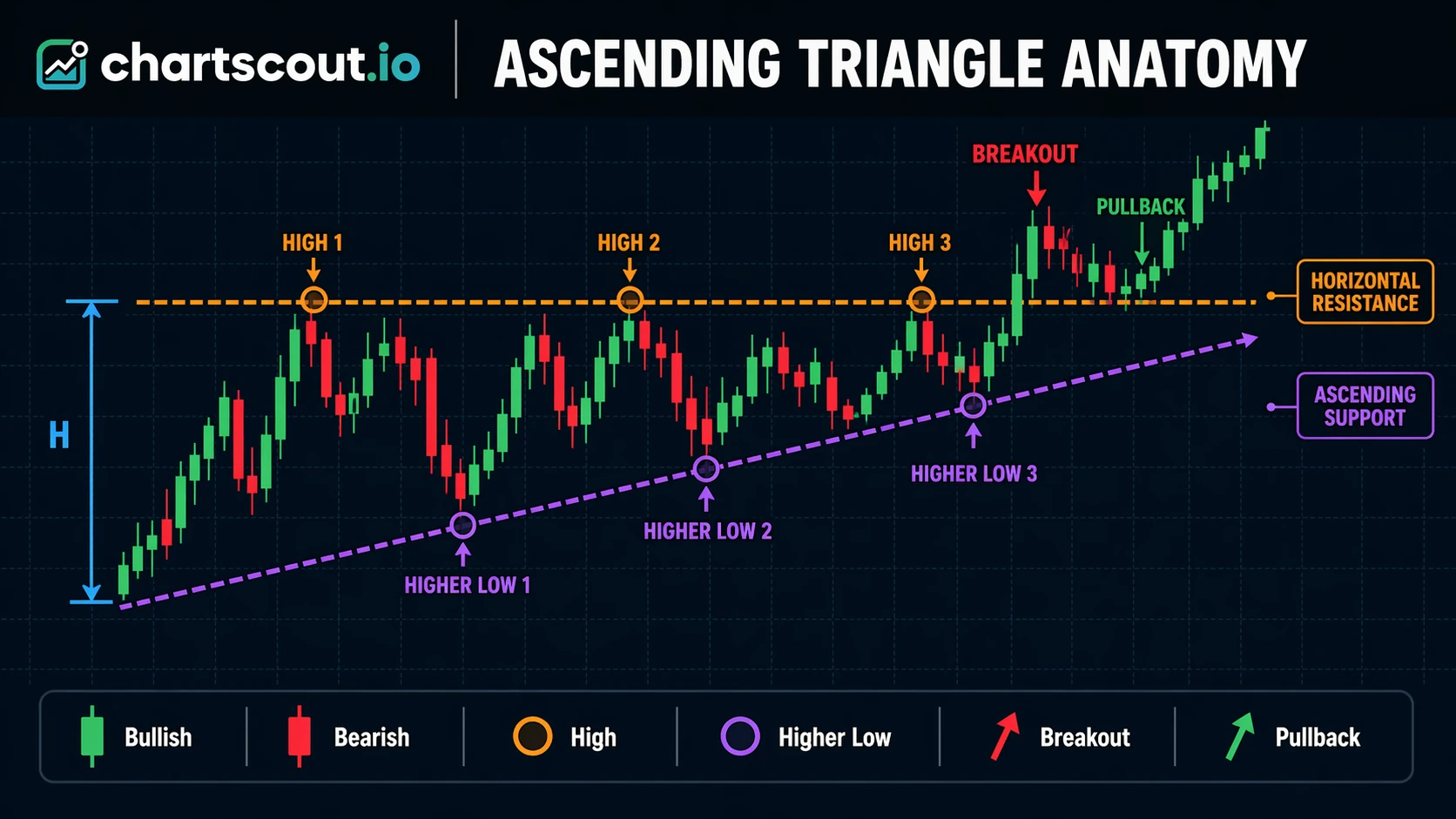
Ascending triangle: flat resistance + rising higher lows converging toward the apex, with breakout typically occurring ~64% of the way to the apex
However, “bullish continuation” doesn't mean the pattern only appears in uptrends. Ascending triangles can also form as reversal patterns at the bottom of downtrends, where the rising support line indicates accumulation and a potential trend change. The bullish bias holds in both scenarios - what matters most is the breakout direction and volume confirmation. John Murphy notes in Technical Analysis of the Financial Markets that ascending triangles typically form as continuation patterns in uptrends, but can appear as reversal patterns at the end of downtrends.
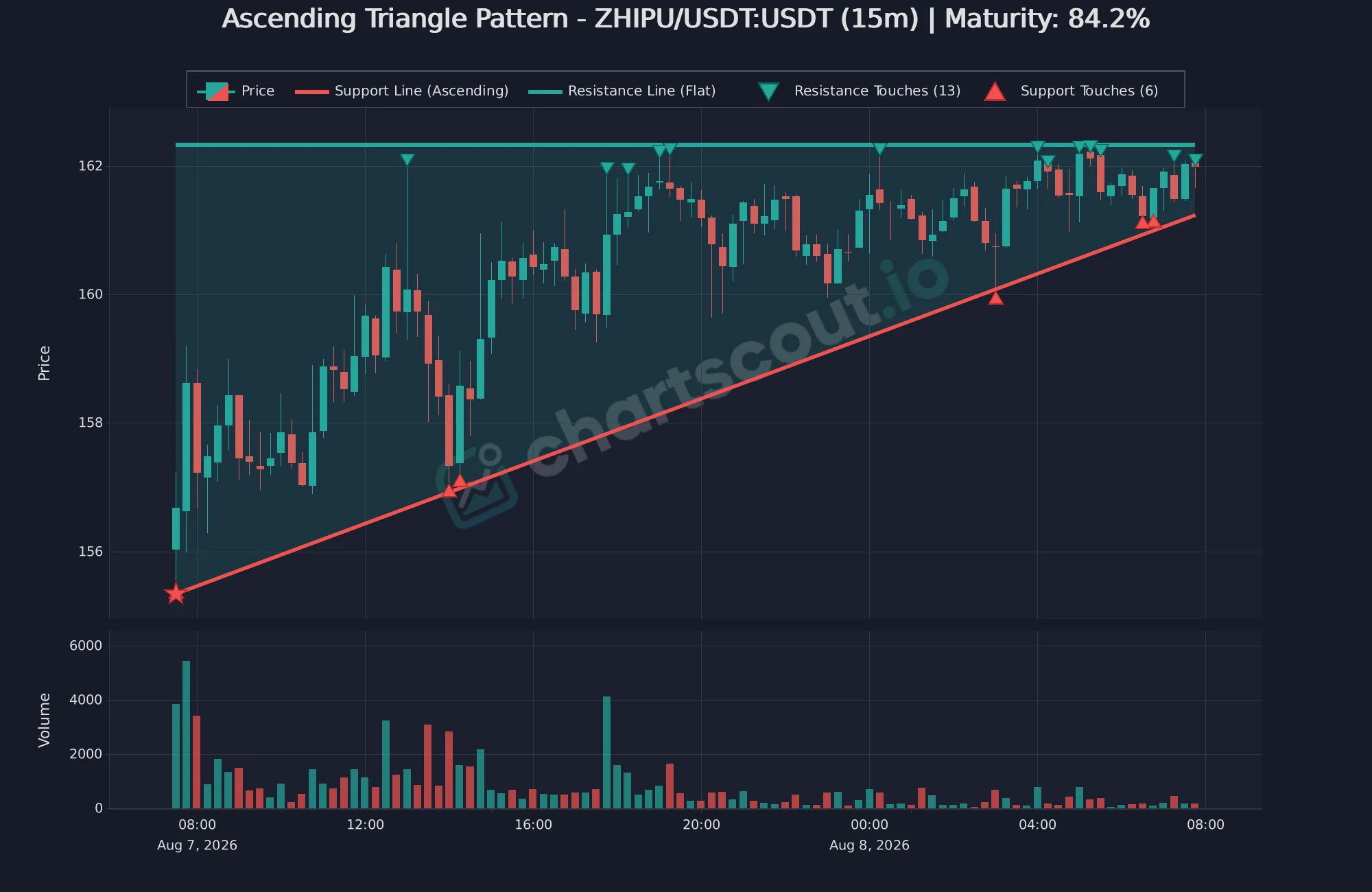
Ascending triangle - ZHIPU/USDT 15min
BinanceBullishThis chart shows an ascending triangle on ZHIPU/USDT at the 15-minute timeframe on Binance, detected August 8, 2026. Notice the flat resistance and rising support that form the converging structure.
Key characteristics at a glance
| Characteristic | Detail |
|---|---|
| Pattern Type | Bullish continuation (can also appear as reversal) |
| Upper Boundary | Flat horizontal resistance line |
| Lower Boundary | Rising trendline connecting higher lows |
| Minimum Touches | At least 3 touches on one trendline and 2 on the other, forming distinct peaks and valleys |
| Volume Behavior | Trends downward a majority of the time; spikes on breakout |
| Breakout Direction | Upward 63% of the time |
| Breakout Position | 64% of the way to the triangle apex (both directions) |
| Price Target | Height of triangle at widest point, projected from breakout |
How to identify an ascending triangle
Correctly identifying an ascending triangle is the first and most critical step. Many traders mistake ordinary price consolidation or other patterns for ascending triangles, which leads to poor entries and unnecessary losses. Here's what to look for, step by step.
Step 1: find the flat resistance line
The defining feature of an ascending triangle is a horizontal resistance level where price is repeatedly rejected. Bulkowski requires price to touch one trendline at least three times and the other at least twice - so look for at least two, ideally three or more, peaks that terminate at approximately the same price level. The key word is “approximately” - the highs don't need to be exact to the penny. In crypto, a tolerance of 0.5-1% is reasonable given the volatility.
These repeated rejections tell you that there is consistent selling pressure at that level - perhaps a large limit sell order, institutional distribution, or a psychologically important round number.
Step 2: identify the rising support line
The second trendline connects the swing lows, which should be progressively higher. Each time price pulls back from resistance, it finds support at a higher level than the previous pullback. This is the critical element that distinguishes an ascending triangle from a simple range.
You need a minimum of two higher lows to draw this trendline, but three or more touches make it significantly more reliable. Additionally, Bulkowski specifies that price must cross the pattern from side to side, filling the triangle with price movement rather than white space. The steeper the angle of the rising support, the more aggressive the buying pressure - though extremely steep angles can sometimes indicate that the pattern will resolve too quickly for a clean trade.
Step 3: confirm the converging structure
When you connect both lines, you should see a clear triangular shape with the two boundaries converging toward a point (the apex). Price should be compressing within this narrowing range, bouncing between resistance and the rising support. Bulkowski notes that the breakout tends to occur approximately 64% of the way to the triangle apex - patterns that drift all the way to the tip before breaking out tend to be less reliable.
Step 4: check volume behavior
During a valid ascending triangle, volume typically decreases as the pattern develops. This contraction reflects decreasing liquidity and tightening interest as the range narrows. Think of it like a coiled spring - energy is building, not dissipating. We'll cover volume analysis in detail in a dedicated section below.
Step 5: assess the prior trend context
While ascending triangles have a bullish bias regardless of context, they're most reliable when they appear within an existing uptrend (continuation). Bulkowski's data specifically shows that patterns preceded by an intermediate-term rise (3-6 months) produce an average post-breakout gain of 49% - significantly above the overall 43% average. When they form after a prolonged downtrend, they can act as reversal patterns, but the breakout statistics are slightly less favorable. Always note the broader trend context before planning your trade.
Ascending triangle identification checklist
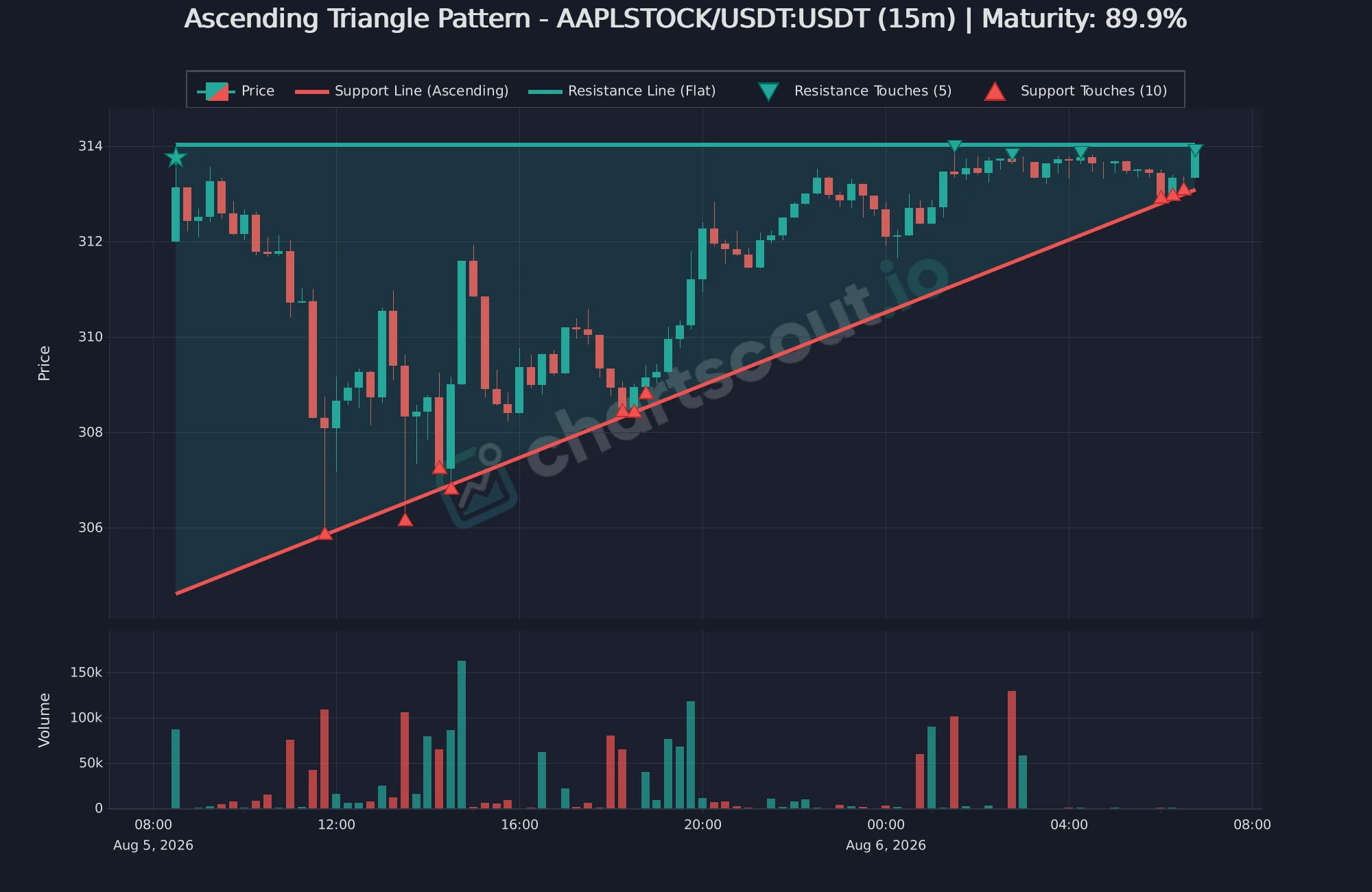
Identification example: AAPLSTOCK/USDT 15m
MEXCBullishThis AAPLSTOCK/USDT chart shows an ascending triangle on the 15-minute timeframe at MEXC. Flat resistance near 314 meets a rising support line as price compresses toward the apex, with resistance and support touches marked directly on the chart. The visible chart window runs from August 5 through August 6, 2026, and ChartScout published the detection on August 6, 2026.
What it is NOT
Don't confuse ascending triangles with rising wedges. In a rising wedge, both trendlines slope upward. In an ascending triangle, the upper line is flat and the lower line rises. This distinction matters enormously because a rising wedge is bearish while an ascending triangle is bullish. If the resistance line is angled upward even slightly, you may be looking at a wedge, not a triangle. Learn more in our Rising Wedge vs. Falling Wedge guide.
Why ascending triangles are bullish
The ascending triangle's bullish bias isn't arbitrary - it's rooted in the underlying supply and demand dynamics that the pattern reveals. Understanding why this pattern is bullish will help you trade it with more confidence and recognize when the setup is most reliable.
The supply and demand story
Imagine a seller who has placed a massive limit sell order at $100. Every time price reaches $100, this order absorbs buying pressure and pushes price back down. That's the flat resistance line.
Now look at the buyers. The first pullback goes to $85. The second pullback only reaches $90. The third stops at $94. Each time, buyers step in earlier and at higher prices. They're increasingly willing to pay more, showing growing demand and urgency.
Meanwhile, that sell wall at $100 isn't getting bigger - it's getting absorbed. Each test of resistance chews through more of the available supply. Eventually, the sell orders are exhausted, the last of the supply is absorbed, and price breaks through with conviction. As Martin Pring explains in Technical Analysis Explained, the higher lows demonstrate that buyers are gaining strength relative to sellers - they're willing to pay increasingly higher prices, eroding resistance from below.
The psychology behind the pattern
There's a fascinating psychological dynamic at play within every ascending triangle:
- Sellers at resistance become anxious: They see price returning to their level again and again. Some start lowering their asks. Others remove orders entirely, fearing they're fighting a losing battle.
- Buyers gain confidence: Each successful bounce from rising support reinforces the belief that the pattern will break upward. More traders position long, creating a self-reinforcing cycle.
- Breakout traders accumulate: Experienced traders recognize the ascending triangle and place buy-stop orders just above resistance, ensuring a burst of momentum when the level breaks.
- Short sellers add fuel: Traders who shorted at resistance are forced to cover (buy back) when the breakout occurs, adding buying pressure to an already bullish move.
Pattern statistics (thepatternsite.com, updated 8/26/2020)
According to Bulkowski's updated research based on over 1,400 perfect trades, ascending triangles show a clear bullish bias:
- Overall rank (bull market, upward breakouts): 16 out of 39 bullish patterns
- Breakout direction: 63% upward, 37% downward
- Break-even failure rate (upward breakouts): 17% (so 83% of patterns move at least 5% after breakout)
- Average rise after upward breakout: 43%
- Throwback rate (price retests breakout level): 64%
- Percentage meeting the measured move price target: 70%
- Average decline after downward breakout: 13% (downward breakouts rank 30 of 36 bearish patterns; 38% break-even fail rate; 63% pullback rate; 44% meet target)
- With intermediate-term prior rise (3-6 months): 49% avg rise
- Busted downward breakouts (reverse upward): 46%, avg rise of 36%
Source: Thomas N. Bulkowski, thepatternsite.com/at.html (updated 8/26/2020). Statistics based on stock market data. Crypto markets can experience both larger moves and more frequent failures due to higher volatility and thinner liquidity. Always use appropriate risk management.
Can ascending triangles break downward?
Yes. While the bullish bias is strong, ascending triangles break downward roughly 37% of the time according to Bulkowski's updated data (thepatternsite.com). A downward break means buyers failed to absorb all the selling pressure, and the pattern acts as a distribution zone instead. This is why waiting for the confirmed breakout before entering is essential - never assume the direction before price proves it.
How to trade ascending triangles step-by-step
Identifying the pattern is only half the battle. Executing a proper trade requires a plan with defined entry, stop-loss, target, and position sizing before you click the buy button. Here's the complete framework.
Entry strategy
Method 1: breakout entry (recommended)
Enter when a candle closes above the flat resistance line with a volume spike. The candle close is critical - a wick above resistance that closes back below is not a valid breakout.
- Wait for a full candle close above resistance
- Confirm volume is above the 20-period average
- Enter on the close or on a pullback to the breakout level
Pros: Highest probability, clearest signal
Cons: Slightly worse entry price than anticipation
Method 2: anticipation entry (advanced)
Enter near the rising support line as price bounces, anticipating the eventual upward breakout. This gives a better risk-reward ratio but is riskier since the breakout hasn't been confirmed.
- Buy near the rising trendline on the third or later touch
- Use tight stop-loss just below the trendline
- Only suitable for experienced traders
Pros: Better entry price, tighter stop-loss
Cons: Pattern may fail before breaking out
Stop-loss placement
Every trade needs a defined invalidation point. Alexander Elder emphasizes in Trading for a Living that the stop-loss should represent the point where your trade thesis is clearly wrong - not an arbitrary percentage. For ascending triangles, there are two common stop-loss approaches:
- Conservative stop (recommended): Place your stop-loss below the most recent higher low inside the triangle. This gives the trade room to breathe while invalidating if the pattern structure breaks down. Bulkowski suggests placing a stop a penny below the bottom of the triangle for upward breakouts.
- Aggressive stop: Place your stop-loss just below the breakout candle's low. This is tighter and results in better risk-reward but can get stopped out by normal post-breakout volatility.
- Pattern invalidation stop: Place your stop-loss below the rising support trendline. If price breaks back into the triangle AND below the trendline, the entire pattern thesis is invalidated.
Price target calculation
The standard price target for an ascending triangle breakout uses the measured move technique:
- Measure the height of the triangle at its widest point (distance from the flat resistance to the lowest low of the pattern)
- Add that distance to the breakout level (the flat resistance line)
- The result is your minimum price target
Example calculation
Flat resistance: $50,000
Lowest low in triangle: $45,000
Pattern height: $50,000 - $45,000 = $5,000
Price target (standard): $50,000 + $5,000 = $55,000
Note: Bulkowski recommends a more conservative approach - multiply the height by the “percentage meeting price target” (70% for upward breakouts) before adding to the breakout price. In this example: $50,000 + ($5,000 × 0.70) = $53,500. This gives a more realistic target since only 70% of ascending triangles reach the full measured move. In crypto, strong breakouts often exceed the full target, so consider using the standard method as a minimum and Bulkowski's method as a high-probability target.
Position sizing
Never risk more than 1-2% of your trading account on any single pattern trade. Calculate your position size based on the distance between your entry and stop-loss:
Position Size Formula:
Position Size = (Account Risk $) / (Entry Price - Stop-Loss Price)
Example: $10,000 account × 2% risk = $200 risk. Entry at $50,000, stop at $48,500 = $1,500 per unit. Position size = $200 / $1,500 = 0.133 BTC.
Complete ascending triangle trade plan
1. Identify: Flat resistance + 2-3 higher lows + decreasing volume
2. Wait: Candle close above resistance with volume spike
3. Enter: On breakout close or pullback to broken resistance
4. Stop-loss: Below the last higher low inside the triangle
5. Target: Pattern height added to breakout level
6. Risk: 1-2% of account maximum per trade
Volume analysis in ascending triangles
Volume is the single most important confirmation tool for ascending triangle breakouts. Without volume analysis, you're essentially trading blind. Here's exactly what to look for at each stage of the pattern.
Bulkowski on volume in ascending triangles
According to Bulkowski (thepatternsite.com), volume trends downward during ascending triangle formation a majority of the time. This declining volume is a key identifying characteristic - it signals that the pattern is maturing and building toward a breakout. Volume should then noticeably increase on the breakout to validate the move.
Volume during pattern formation
As the triangle develops and the price range compresses, volume should gradually decrease. Bulkowski's updated data (thepatternsite.com) confirms that volume trends downward in the majority of ascending triangles. This declining volume reflects the market “coiling” - fewer participants are trading within the narrowing range as both sides wait for a resolution. Think of it like a compressed spring - energy is building, not dissipating. If volume remains high during the formation, the pattern may be less reliable because it suggests active disagreement rather than building consensus.
Volume on the breakout
The breakout candle should show a significant spike in volume - ideally 25-50% or more above the average volume of the preceding candles within the triangle. This volume expansion confirms that genuine buying interest is driving the breakout, not just thin liquidity causing an accidental wick above resistance.
Volume after the breakout
The healthiest breakouts show sustained above-average volume for several candles following the initial break. Volume that immediately drops back to low levels after the breakout candle suggests weak follow-through and increases the probability of a false breakout (fakeout).
| Stage | Expected Volume | What It Tells You |
|---|---|---|
| Formation (early) | Moderate, mixed | Pattern establishing, buyers and sellers both active |
| Formation (late) | Declining | Market coiling, range compressing - breakout imminent |
| Breakout candle | Sharp spike (25-50%+ above avg) | Confirmation - real buying interest driving the move |
| Post-breakout | Sustained above average | Strong follow-through, trend likely to continue |
| Pullback to resistance | Low, declining | Healthy retest - old resistance becoming new support |
Low volume breakout = red flag
If price breaks above resistance but volume is equal to or below average, be very cautious. This is a common setup for a fakeout - price briefly breaks resistance then reverses back into the triangle. In crypto specifically, thin weekend or holiday liquidity causes many false breakouts. Consider waiting for a second candle to confirm, or reduce your position size.
Real-world crypto examples
Theory matters, but seeing ascending triangles on actual crypto charts is where understanding becomes practical. Below are real pattern detections from ChartScout, showing exactly how ascending triangles appear in live market conditions.
About these detections
Every image below is an actual ChartScout alert sent to users in real-time. These patterns were detected automatically by our AI while traders slept, worked, or focused on other tasks - no manual chart scanning required.
All our detections are set to detect ascending triangles with a minimum of 79% maturity. This means all detections arrive before the apex point, which is the only way traders can actually position themselves on time before the move happens,though this approach carries a higher fail rate than waiting for the final breakout.
ChartScout detects ascending triangles on all timeframes from 5-minute scalping setups to daily swing trade opportunities. Higher timeframes generally offer larger moves and more time to react.
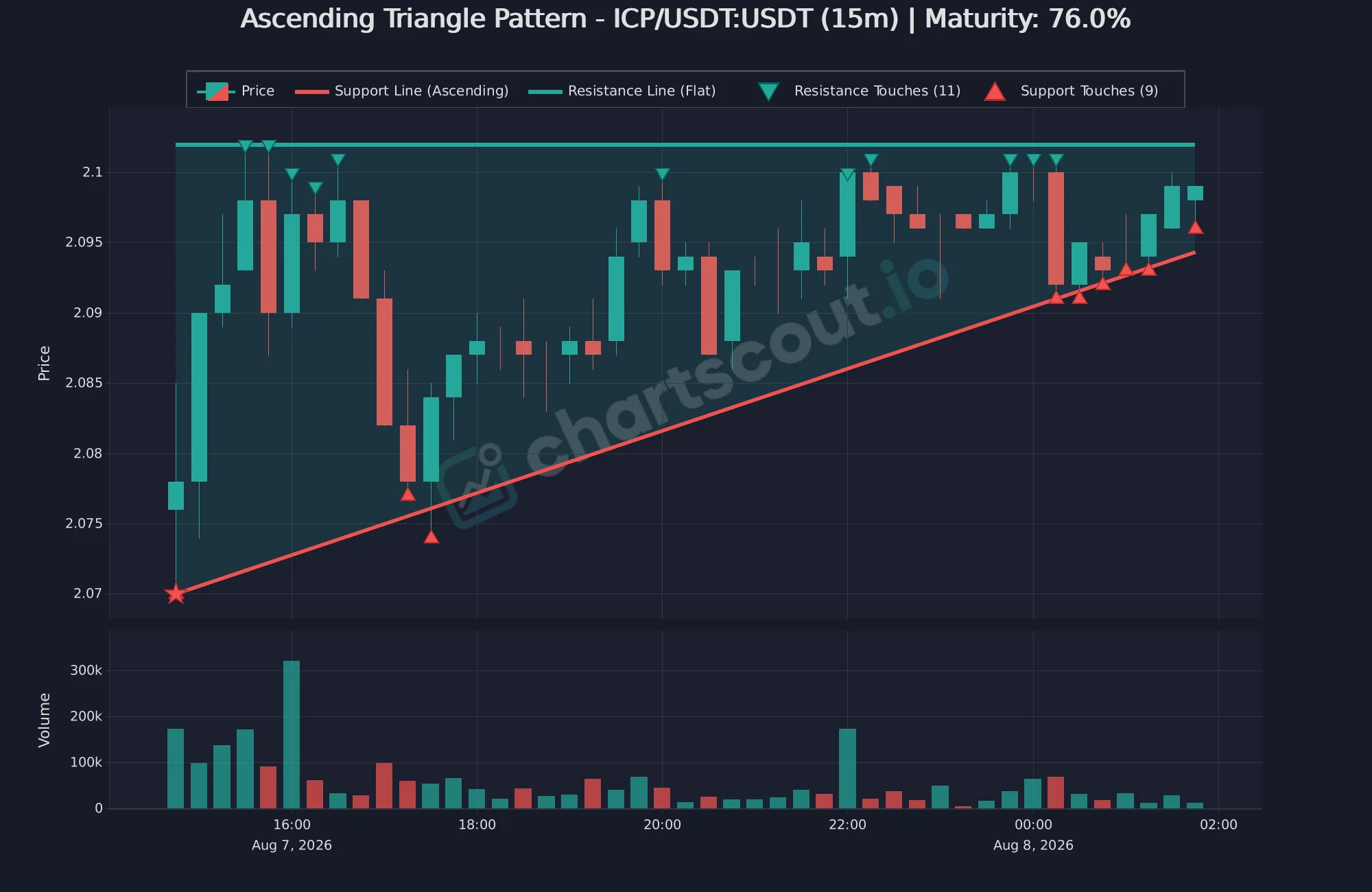
Ascending triangle - ICP/USDT 15min
BinanceBullishThis chart shows an ascending triangle on ICP/USDT at the 15-minute timeframe on Binance, detected August 8, 2026. The flat resistance and rising support converge as the range contracts.
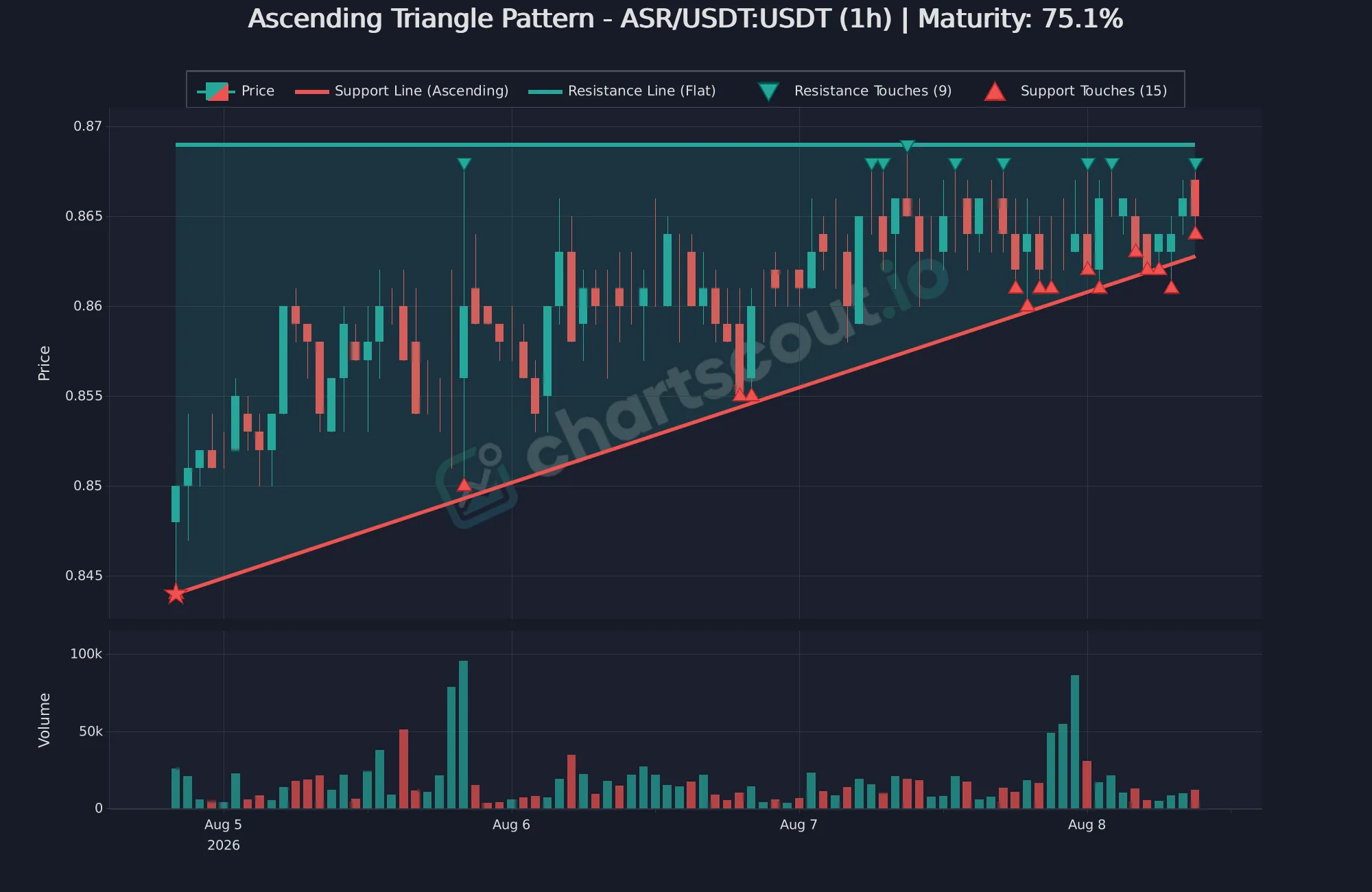
Ascending triangle - ASR/USDT 1h
BinanceBullishThis chart shows an ascending triangle on ASR/USDT at the 1-hour timeframe on Binance. The visible chart window runs from August 5 through August 8, 2026, and the detection was published August 8, 2026. Flat resistance and rising support remain visible on this higher-timeframe view.
Ascending triangles are forming right now
Ascending Triangle is included on Basic across Binance, Bybit, and Hyperliquid. The full Pro trial and Pro or higher add KuCoin and MEXC. Every paid plan and the trial include platform, email, Discord, and Telegram delivery.
Ascending triangle vs other triangle patterns
Triangle patterns come in three varieties, each with different directional biases. Understanding the differences prevents costly misidentification.
| Feature | Ascending Triangle | Descending Triangle | Symmetrical Triangle |
|---|---|---|---|
| Upper Line | Flat (horizontal) | Declining (lower highs) | Declining (lower highs) |
| Lower Line | Rising (higher lows) | Flat (horizontal) | Rising (higher lows) |
| Bias | Bullish | Bearish | Neutral (trend dependent) |
| Typical Context | Forms in uptrends | Forms in downtrends | Forms in either direction |
| What It Shows | Buyers gaining strength | Sellers gaining strength | Equal buyer/seller pressure |
Ascending triangle vs rising wedge
This is the most commonly confused pair. The critical distinction: in an ascending triangle, the upper boundary is flat. In a rising wedge, the upper boundary slopes upward. The trading implications are opposite - ascending triangles are bullish while rising wedges are bearish. If the “resistance” line has any upward slope, you're likely looking at a wedge.
→ Read our detailed Rising Wedge vs Falling Wedge guideAscending triangles on different timeframes
Ascending triangles form on every timeframe, from the 1-minute chart to the monthly chart. However, the reliability and trading implications differ significantly depending on which timeframe you're watching. Bulkowski's rules are written for daily charts, but chart patterns are defined by candle count, not calendar time. A 15-candle ascending triangle is the same pattern whether those candles are 1-minute or daily. The translation below maps stock-market durations to crypto timeframes so a scalper on 5m and a swing trader on 4h can both use the same Bulkowski rules.
Crypto timeframe translation: same candles, compressed wall-clock
| Timeframe | 15-candle pattern duration | Practical ChartScout use |
|---|---|---|
| 1m | ~15 minutes | Scalping, highest noise, confirm against higher TF |
| 5m | ~1-1.5 hours | Intraday scalping / day trading |
| 15m | ~4 hours | Day trading sweet spot |
| 1h | ~15 hours (~0.5-1 day) | Intraday / overnight swing |
| 4h | ~2-3 days | Multi-day swing |
| 1d | ~3 weeks | Swing / position trading |
| 1w | ~3-4 months | Position trading (rare on alts, highest reliability) |
Reliability and typical move size by timeframe
The candle-count framework above tells you when a pattern completes. The table below maps that to expected reliability and move size for ascending triangles in crypto specifically.
| Timeframe | Formation Time | Typical Move | Reliability | Best For |
|---|---|---|---|---|
| 1m - 5m | Minutes to hours | 0.5-2% | Lower | Scalping |
| 15m - 1h | Hours to 1-2 days | 2-5% | Medium | Day trading |
| 4h | Days to 1-2 weeks | 5-15% | High | Swing trading |
| Daily | 1-8 weeks | 10-35%+ | Very High | Position trading |
| Weekly | Months | 20-50%+ | Highest | Long-term investing |
Best timeframe for beginners: daily or 4-hour
If you're learning to trade ascending triangles, start with the daily or 4-hour chart. These timeframes provide the highest reliability, largest potential moves, and most time to analyze before making a decision. Lower timeframes are noisier and more prone to false breakouts, while the weekly chart requires more patience than most beginners can sustain.
Multi-timeframe confirmation
The most powerful ascending triangle setups occur when you can see alignment across multiple timeframes. For example, an ascending triangle on the 4-hour chart while the daily chart shows a strong uptrend provides significantly higher confidence than a triangle on the 4-hour chart against a daily downtrend.
A practical approach: identify the pattern on your trading timeframe, then check one timeframe higher for trend confirmation. If the higher timeframe supports a bullish bias, the ascending triangle is more likely to break upward.
The Bulkowski-vs-crypto comparison
Bulkowski's 1,400-trade dataset is drawn from U.S. equities, not crypto. The structural rules translate directly (candle counts, trendline logic, volume contraction). The performance numbers translate qualitatively. Here is how the stock-market baseline maps to crypto expectations.
| Factor | Bulkowski baseline (stocks) | Crypto expectation |
|---|---|---|
| Pattern pace | Days to weeks on daily | Same candle count, compressed wall-clock time. Hours on 5m-15m, days on 1h-4h |
| Average rise | 43% | Likely amplified on volatile alts (short-squeeze cascades), comparable on BTC/ETH |
| Break-even failure rate | 17% (upward breakouts) | Likely higher on 1m-15m due to liquidity-driven fakeouts, comparable on 4h-1d |
| Volume confirmation | Single-exchange tape | Fragmented across 4+ exchanges, with wash-trading on low-volume alts |
| Throwback rate | 64% | Likely similar, but leveraged perps create deeper liquidation-driven throwbacks before continuation |
| Gap risk | Overnight / weekend gaps | 24/7 trading eliminates gaps, but weekend liquidity drops cause clean-looking fakeouts |
| Participant mix | Institutional-dominated | Retail-dominated alts, sharper and more emotional moves on news catalysts |
Honest framing: the crypto column above is qualitative, not quantitative. No published crypto-wide ascending triangle study exists with a sample size comparable to Bulkowski's. Treat his stock-market figures as a relative reliability ranking, not exact crypto predictions. ChartScout has a proprietary crypto backtest in progress and will publish the numbers when the study is complete. Until then, the rule is: same structural logic, qualitatively amplified moves on alts, qualitatively higher noise on the lowest timeframes.
Common mistakes to avoid
Even with perfect pattern identification, these mistakes can turn a winning setup into a losing trade. Learning from them now will save you real money later.
1. Entering before the breakout
The most common and costly mistake. You spot a beautiful ascending triangle, get excited about the potential move, and buy before price actually breaks resistance. Then the pattern fails, price drops below the rising support line, and you're stuck in a losing position. Patience pays. Wait for the candle close above resistance and volume confirmation. The slightly worse entry price is more than offset by dramatically higher probability of success.
2. Ignoring volume on the breakout
A breakout without volume is not a breakout - it's a wick. Many traders see price poke above resistance and immediately jump in, only to watch it reverse back into the triangle. This is especially common in crypto during low-liquidity periods like weekends, where thin order books can cause temporary spikes above resistance that mean nothing.
3. Setting stop-loss too tight
Price often retests the broken resistance level as new support before continuing higher. If your stop is placed right at the breakout level, this perfectly normal retest will stop you out. Give the trade room by placing your stop below the last higher low, not at the breakout price.
4. Trading against the higher timeframe trend
An ascending triangle on the 15-minute chart is significantly less meaningful if the daily chart shows a strong downtrend. The pattern may break upward temporarily but the dominant bearish pressure from the higher timeframe often reasserts itself. Always check at least one timeframe higher for trend context.
5. Confusing the pattern with a rising wedge
As mentioned earlier, this misidentification is extremely common and the consequences are severe. A rising wedge is bearish; an ascending triangle is bullish. If the resistance line has any upward slope, reassess whether you're actually looking at a triangle. When in doubt, sit it out.
6. Over-sizing the position
Ascending triangles have strong statistics, but “strong” still means 37% break downward and 17% of upward breakouts fail to produce any profit. If you bet 10% of your account on a pattern trade, a few failures in a row can devastate your account. Keep risk per trade at 1-2% of total capital.
Throwback rate: 64%
According to Bulkowski, 64% of ascending triangle upward breakouts experience a throwback (price returns to the breakout level before continuing higher). Importantly, Bulkowski notes that throwbacks hurt post-breakout performance - patterns that throw back tend to show smaller overall gains than those that break cleanly. This means the majority of breakouts will retest the resistance-turned-support level. Setting your stop at the breakout price will get you stopped out on these normal throwbacks - place it below the last higher low instead.
Advanced ascending triangle strategies
Once you've mastered the basic breakout trade, these advanced techniques can improve your win rate and maximize returns.
Look for an intermediate-term rise before the pattern
Bulkowski's data reveals that ascending triangles preceded by an intermediate-term rise (3-6 months) show price rising an average of 49% after an upward breakout - significantly higher than the overall 43% average. This makes sense: a sustained uptrend leading into the triangle provides stronger momentum, and the triangle acts as a consolidation before the next leg higher. When scanning for setups, prioritize ascending triangles that form within established multi-month uptrends.
The breakout-retest entry
After a valid breakout, price frequently pulls back to test the broken resistance as new support. This retest offers a second, often superior entry point with a clearly defined stop-loss (just below the retest level). The trade-off is that not every breakout retests - sometimes price accelerates immediately and you miss the move entirely. A practical compromise is to enter with 50% of your position on the breakout and add the remaining 50% on the retest.
RSI divergence confirmation
If the RSI makes higher lows while price makes higher lows within the ascending triangle, this bullish RSI alignment adds conviction to the setup. Conversely, if RSI makes lower lows while the ascending triangle appears valid visually, it could signal hidden weakness - the pattern may be less reliable.
Fibonacci extensions for targets
Beyond the standard measured move target, you can use Fibonacci extensions for secondary targets. Measure the height of the triangle and apply Fibonacci ratios: the 1.0 extension equals the standard measured move target, while the 1.618 extension provides an ambitious target for strong trending markets. In crypto bull markets, the 1.618 and even 2.0 extensions are reached more often than in traditional markets due to momentum-driven price action.
Trading the failed breakout
Not all ascending triangles break upward. When a pattern fails and price breaks below the rising support line, it often results in a sharp sell-off as trapped longs exit their positions. This can be traded as a short opportunity with the entry below the broken support line, stop above the last resistance touch, and a target equal to the triangle height projected downward.
Failed patterns often move faster and further than successful ones because of the cascading stop-losses from trapped traders. This is sometimes called a “bull trap” and experienced traders specifically watch for these setups.
→ Learn how to identify and trade fake breakoutsComplete ascending triangle trading checklist
Before entering any ascending triangle trade, run through this checklist. Check each item that applies to your setup:
Pattern validation
Breakout confirmation
Risk management
Need help deciding where to place your stop-loss? Our complete stop-loss placement guide for crypto covers every strategy in detail, from conservative to aggressive approaches across all chart patterns.
How to scan for ascending triangles automatically
Here's the practical reality: manually scanning for ascending triangles across hundreds of crypto pairs and multiple timeframes is essentially impossible. By the time you find a pattern on one chart, dozens have formed and completed on others while you weren't looking. This is exactly why most crypto alerts arrive late - and why finding breakouts before they happen requires automation.
With crypto markets operating 24/7 across multiple exchanges, the math simply doesn't work for manual scanning:
- 1,000+ pairs across Binance, Bybit, KuCoin, MEXC, and Hyperliquid
- Multiple timeframes to monitor (5m, 15m, 1h, 4h, daily)
- 24 hours a day, 7 days a week - patterns don't pause while you sleep
- At just 30 seconds per chart, checking 1,000 pairs takes over 8 hours - and by the time you're done, the patterns have changed
ChartScout: automated ascending triangle detection
ChartScout was built specifically to solve this problem. Our AI continuously scans all supported exchanges and detects ascending triangles (along with 18+ other patterns) within seconds of formation. Instead of spending hours scanning charts, you receive an alert the moment a pattern appears - complete with a chart image showing the exact formation.
Frequently asked questions
Is an ascending triangle bullish or bearish?
Ascending triangles are predominantly bullish. The flat resistance combined with rising higher lows indicates that buyers are gaining strength while selling pressure at resistance remains static. Statistically, ascending triangles break upward approximately 63% of the time according to Bulkowski's updated research on over 1,400 perfect trades (thepatternsite.com, updated 8/26/2020). However, about 37% do break downward, which is why you should always wait for breakout confirmation before entering.
How long does an ascending triangle take to form?
Formation time depends entirely on the timeframe. On a 5-minute chart, an ascending triangle might form in a few hours. On a daily chart, it typically takes 2-8 weeks. On a weekly chart, formation can span several months. The pattern needs a minimum of 4-5 bounces between the two trendlines to be considered valid, which naturally requires time. Generally, patterns that take longer to form result in larger breakout moves.
What is the price target for an ascending triangle?
The standard price target uses the measured move technique: measure the height of the triangle at its widest point (from the flat resistance to the first/lowest low), then add that distance to the breakout level. For example, if resistance is at $50,000 and the initial low is $45,000, the target would be $55,000 ($50,000 + $5,000). In strong crypto trends, price often exceeds this minimum target.
How many touches of resistance are needed?
According to Bulkowski, price must touch one trendline at least three times and the other at least twice, forming distinct peaks and valleys. So at minimum you need 3 touches on resistance and 2 higher lows (or vice versa). More touches make the pattern more reliable - each additional touch confirms the significance of the level and increases breakout probability.
What's the difference between an ascending triangle and a rising wedge?
The critical difference is the upper trendline. In an ascending triangle, the upper line is flat (horizontal resistance). In a rising wedge, the upper line slopes upward along with the lower line - both boundaries rise. This distinction is crucial because ascending triangles are bullish while rising wedges are bearish. If your “resistance” line has any upward angle, you're likely looking at a rising wedge instead.
Can ascending triangles fail?
Yes. About 37% of ascending triangles break downward instead of upward, and the break-even failure rate for upward breakouts is 17% (meaning the breakout doesn't produce a profitable move). This is why risk management is non-negotiable: always use a stop-loss, never risk more than 1-2% of your account, and wait for volume confirmation on the breakout. Failed ascending triangles often lead to sharp downside moves as trapped buyers exit.
What volume pattern should I look for?
Look for declining volume during the triangle formation (the range is compressing, fewer traders are active) followed by a significant volume spike on the breakout candle - ideally 25-50% or more above the average volume during the pattern. Post-breakout, sustained above-average volume confirms the move is genuine. If the breakout occurs on low or average volume, be cautious as it may be a false breakout.
How do I scan for ascending triangles automatically?
Manual scanning across thousands of crypto pairs is impractical. ChartScout includes ascending-triangle coverage on Basic across three exchanges, while the full Pro trial and Pro or higher expand that to all five exchanges. Every paid plan and the trial include platform, email, Discord, and Telegram delivery.
What is the best timeframe to trade ascending triangles?
For beginners, the daily and 4-hour timeframes offer the best balance of reliability and move size. Daily ascending triangles have the highest success rates and produce the largest moves. Experienced day traders can find success on 15-minute to 1-hour charts, but these require faster decision-making and are more prone to false breakouts. Avoid 1-minute charts unless you're an experienced scalper.
Should I buy before the breakout to get a better price?
This is an advanced technique called “anticipation entry” where you buy near the rising support line. While it offers a better entry price and tighter stop-loss, it carries more risk because the pattern may fail before breaking out. For beginners, the recommended approach is to wait for a confirmed breakout (candle close above resistance with volume). The slightly worse entry is more than compensated by the higher probability of success.
Conclusion: mastering the ascending triangle
The ascending triangle is one of the most actionable patterns in crypto trading because it gives you everything you need for a complete trade plan: a clear visual structure, defined entry point (the breakout), logical stop-loss placement (below the last higher low), and a measurable price target (the triangle height).
Key takeaways
- Flat resistance + higher lows = ascending triangle. If resistance is angled upward, it's a wedge, not a triangle.
- Wait for the breakout confirmation - a candle close above resistance with above-average volume.
- Volume is non-negotiable - declining during formation, spiking on breakout. No volume = no trade.
- Place stops below the last higher low, not at the breakout level.
- Target = triangle height added to the breakout level as a minimum.
- Risk 1-2% per trade maximum - even the best patterns fail sometimes.
- Check the higher timeframe trend - ascending triangles work best when aligned with the broader trend.
The ascending triangle works because it captures a fundamental market dynamic: increasing demand meeting fixed supply. This dynamic plays out the same way whether it's 2006 or 2026, whether it's stocks or crypto. Master this pattern and you'll have a reliable, repeatable edge that compounds over time.
Bonus stat: busted downward breakouts
According to Bulkowski, nearly half (46%) of ascending triangles that break downward will “bust” and reverse upward, rising an average of 36% to the ultimate high. Most of these busts (67%) are single busts - meaning price drops, reverses once, and then continues higher without additional cycles. This means even failed ascending triangles often confirm their bullish nature.
Expand your ascending-triangle coverage
ChartScout scans 1,000+ crypto pairs around the clock for ascending triangles and other chart patterns, then routes detections for your review. This is alert-driven coverage without inspecting every chart manually.
Start 7-day trial→Set up your first ascending triangle watcher in under 2 minutes.
About our statistics
The success rates cited in this guide are derived from Thomas Bulkowski's updated statistics at thepatternsite.com (data updated 8/26/2020), which represent the most current published study of chart pattern performance.
- Overall Rank: 16 out of 39 bullish patterns in the current dataset.
- Breakout Direction: 63% upward breakouts based on over 1,400 perfect trades in stock market data. Crypto rates may differ due to market conditions.
- Average Moves: 43% average rise after upward breakout; 13% average decline after downward breakout. Crypto markets may see larger moves in both directions.
- Failure Rate: 17% break-even failure rate for upward breakouts (so 83% of patterns move at least 5% after breakout). This means 17% of upward breakouts fail to produce any meaningful profit.
- Market Conditions: Performance varies between bull and bear markets. Ascending triangles perform best in existing uptrends with an intermediate-term rise (3-6 months) preceding the pattern.
How crypto may differ
While ascending triangle psychology is universal, the cryptocurrency market introduces unique variables:
- Higher Volatility: Crypto breakouts often overshoot targets significantly but also have higher false breakout rates.
- 24/7 Markets: Breakouts can occur during low-liquidity periods (weekends, holidays), increasing fakeout risk.
- BTC Correlation: Altcoin ascending triangles can break down if Bitcoin makes a sudden move, regardless of the pattern's quality.
- Fragmented Liquidity: Volume is spread across exchanges, so always check volume on the exchange you're trading on.
Sources & references
Data source note: All break-even rates, average rises, throwback rates, target-hit percentages, and Bulkowski rankings in this guide come from Thomas Bulkowski's most recent published statistics at thepatternsite.com (data updated 8/26/2020, based on 1,400+ perfect trades). The ascending triangle ranks 16 out of 39 bullish chart patterns in the current dataset. Earlier editions of Bulkowski's printed Encyclopedia (2005) reported a 35% average rise and an 11% break-even failure rate; we cite the updated figures of 43% average rise and 17% break-even failure rate.
- Bulkowski, Thomas N. ThePatternSite.com - Ascending Triangles. Updated 8/26/2020. thepatternsite.com/at.html.
Primary statistical source. Current figures (bull market, upward breakouts): rank 16 of 39 bullish patterns, 17% break-even failure rate, 43% average rise, 64% throwback rate, 70% target-hit rate, 63% upward breakout direction. Downward breakouts: rank 30 of 36 bearish patterns, 38% break-even failure rate, 13% average decline, 63% pullback rate, 44% target-hit rate. Based on 1,400+ perfect trades. - Bulkowski, Thomas N. Encyclopedia of Chart Patterns, 2nd Edition. John Wiley & Sons, 2005. ISBN: 978-0471668268.
Historical baseline reference for ascending triangle structural rules, identification guidelines, and the supporting psychology discussion. The 2005 print figures (35% average rise, 11% break-even failure rate) have been superseded by the updated thepatternsite.com dataset above and are cited only as historical context. - Murphy, John J. Technical Analysis of the Financial Markets. New York Institute of Finance, 1999. ISBN: 978-0735200661.
Definitive reference on triangle patterns, volume analysis, and continuation pattern classification. - Elder, Alexander. Trading for a Living. John Wiley & Sons, 1993. ISBN: 978-0471592242.
Trading psychology, stop-loss placement strategies, and risk management for pattern-based trading. - Pring, Martin J. Technical Analysis Explained. McGraw-Hill, 2014. ISBN: 978-0071825177.
Trendline validation, supply and demand analysis within triangle patterns. - Nison, Steve. Japanese Candlestick Charting Techniques, Second Edition. New York Institute of Finance, 2001. ISBN: 978-0735201811.
Candlestick interpretation within chart patterns and breakout confirmation techniques.
Related guides
Head and shoulders pattern guide
Master this classic reversal pattern with 81% success rate stats and crypto-specific insights.
Golden cross vs death cross
Combine moving-average crossovers with chart patterns for higher-probability crypto trades.
Stop loss placement guide
ATR-based pattern-by-pattern stop placement with Bulkowski's 14,000-trade data set.
Double bottom (W pattern)
Bullish reversal companion: 39% average rise, 16% failure rate on confirmed breakouts.
Cup and handle pattern
Bulkowski rank 3 of 39 bullish patterns. 54% average rise on 913 trades.
How to spot fake breakouts
Critical reading before any triangle breakout entry: 3-step fakeout detection checklist.
Descending triangle pattern
The bearish counterpart with 78% upward breakout rate and 38% average rise.
Symmetrical triangle pattern
The neutral triangle. 48% bust rate creates a 52% average gain reversal opportunity.

Stjepan Ivanović
Founder of ChartScout · Crypto Trader Since 2013
Trading crypto since 2013 with his first Bitcoin bought at ~$200. Four complete bull/bear market cycles, traded on early exchanges like Mt.Gox and BTC-e, on-chain trading on IDEX and EtherDelta, and ~70 crypto project investments. Built ChartScout after 2+ years of development to automate what no trader can do manually. Watch hundreds of charts 24/7.