Hyperliquid chart pattern scanner: perp DEX alerts (2026)
Hyperliquid became the most active perp DEX in crypto and the alert tooling never caught up. The order book runs on-chain, the listings include assets no CEX offers (TradFi perps on stocks and commodities, builder-code sub-DEX markets), and the trader base moves fast enough that a 5m flag can complete in under 20 minutes. None of that helps if you are still flipping between charts hunting the setup. ChartScout watches every Hyperliquid perp 24/7, native markets and sub-DEX (xyz) listings alike, and pings you in under 20 seconds when any of 23 detectors triggers. No wallet connection. No API keys.
Hyperliquid is the venue serious perp traders moved to once it became clear the rest of the market was not catching up any time soon. Sub-second on-chain settlement. A fully transparent order book with no privileged market makers. A two-track listings lineup: native crypto perps for BTC, ETH, SOL, HYPE and the long tail of alts, plus a sub-DEX (xyz prefix) covering stocks, ETFs, indices, metals, and commodities that trade as crypto perpetuals 24/7. A trader base that came from CEX perps for a reason and expects every tool around it to keep pace. The piece that has been missing on Hyperliquid is the piece that has been missing on every venue at first: a scanner that watches every listing so you do not have to.
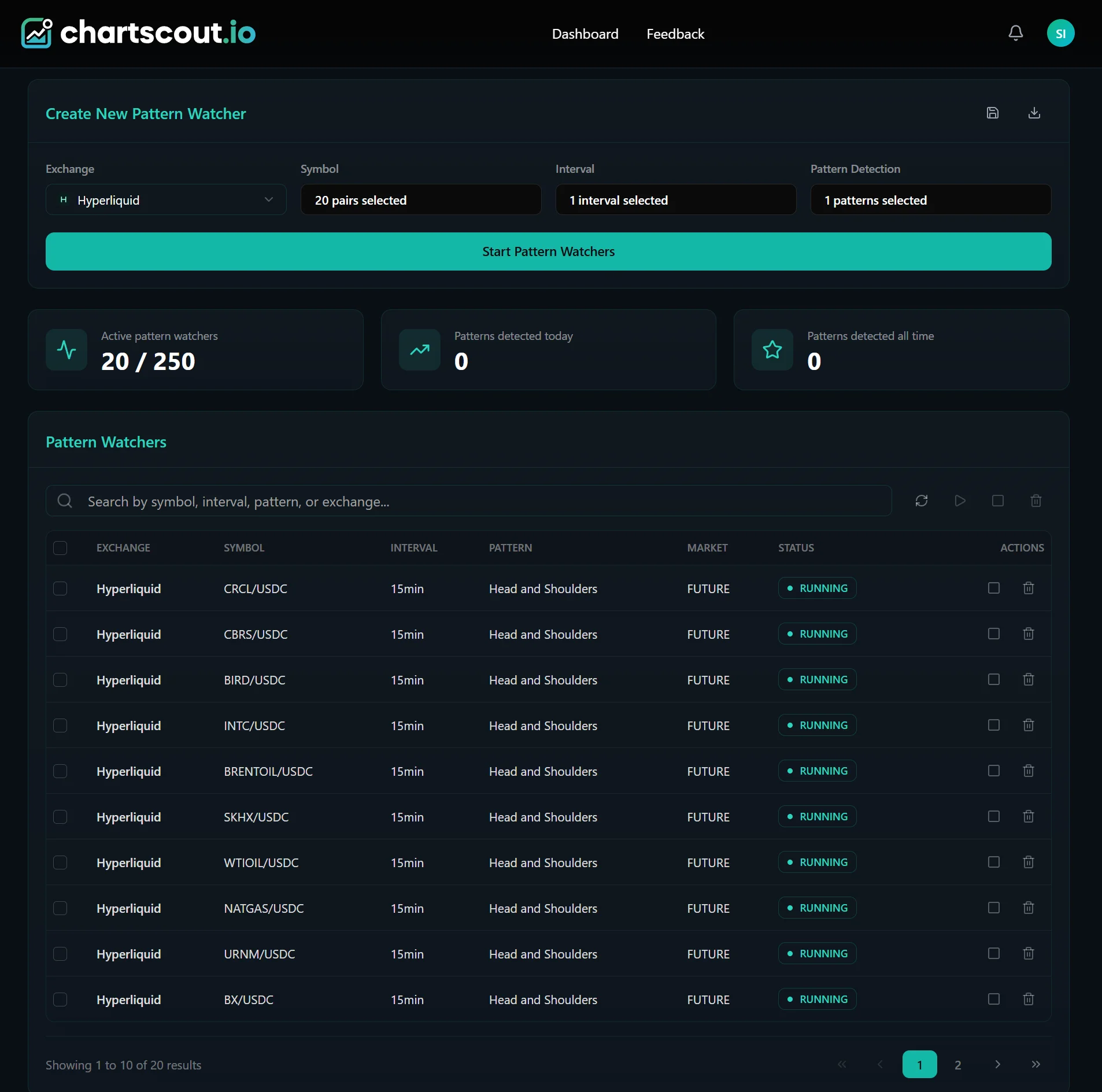
The math is simple and unfriendly. Roughly 100 active perp markets. Seven timeframes that matter for short-term setups. Twenty supported patterns. That is 14,000 possible pair-timeframe-pattern combinations on Hyperliquid alone, every one of them needing a fresh check on every candle close. No human gets through that list, and you should not have to. ChartScout flips the model: you decide which pair, which timeframe, and which pattern matter to you, then save that as a watcher. The scanner runs your watchers continuously and dispatches an alert the moment one of yours matches.
ChartScout on Hyperliquid at a glance
Who should use this Hyperliquid scanner
This is for traders who already understand how Hyperliquid works: the order book, leverage tiers, funding, the leaderboard, the visible liquidation feed, and the difference between a native perp and a sub-DEX (xyz) listing. You pick the pairs, the timeframes, and the patterns you actually care about. ChartScout takes the one part no human can do well, which is sitting on those configurations around the clock and only interrupting you when a defined structure resolves. The trade decision is still yours.
Good fit
- Active Hyperliquid perp traders running multiple pairs at once.
- Day traders who care about 5m, 15m, and 1h setup timing on perp DEX markets.
- Traders who use Hyperliquid as their primary venue but want pattern coverage at the same speed they get on CEX setups.
- Anyone watching new sub-DEX (xyz) listings, where setups can form before broader CEX listings even happen.
Not a good fit
- Anyone looking for guaranteed signals, financial advice, or guaranteed PnL.
- Traders who want automated order placement on Hyperliquid (ChartScout never executes).
- Beginners who plan to trade alerts blind without checking the chart, the funding rate, the open interest, or the liquidation map.
- Users looking for a Hyperliquid wallet-connected trading bot.
The workflow is simple. The alert lands, you open the Hyperliquid interface, you check funding, OI, and the order book context, and you accept or reject the setup. Detection runs in the background. The trade decision stays with you.
How the Hyperliquid pattern scanner works
ChartScout reads Hyperliquid public market data: candles, symbols, volume. That is the entire connection. No wallet signature, no API key, no read access to your account, no permission of any kind. The scanner cannot see your positions, your margin, your subaccounts, or your address on the leaderboard. On a venue where the address IS the account, this matters more than it does on a CEX: there is literally no surface for a third-party tool to compromise, because the tool never touches the wallet in the first place.
You build the configuration. Each watcher binds one Hyperliquid pair, one timeframe, and one pattern. The scanner then runs that watcher continuously, evaluating each closed candle against the pattern definition using trendline fitting, peak validation, and maturity rules. Triangles and wedges are tuned to fire while the structure is still actionable, around 75 to 80 percent maturity, so you have time to load the chart and assess context before price has already left the level. Reversal patterns such as head and shoulders, double tops, double bottoms, triple tops, and triple bottoms wait until the structure is more complete, because early reversal calls are too noisy to be useful. Your plan determines how many watchers you can run and how low you can go on timeframe.
“The chartist can easily follow as many markets as desired, which is generally not true of his or her fundamental counterpart.”
John J. Murphy, Technical Analysis of the Financial Markets
Murphy was writing about manual chart work in 1999. The principle still applies. The number of “markets a chartist can follow” has just changed shape. On a 24/7 perp DEX with on-chain settlement and a constantly expanding list of native and sub-DEX markets, the only way to follow them all is to let a scanner do the watching and only interrupt you when a defined setup appears.
How to verify alerts before you pay
Do not judge a scanner by its landing page. Judge it by real alerts on real charts. Private watcher detections stay inside your account once you sign up, but ChartScout publishes a sample of scanner activity on X. Use that feed as a public audit trail: pick a few timestamped posts on Hyperliquid pairs, open the same market on Hyperliquid's chart, and see whether the pattern was actually there at the candle the alert references.
60-second verification workflow
- Open the public @ChartScout_bot on X feed.
- Pick a recent post showing the pair, timeframe, exchange, and pattern.
- Open the same market on Hyperliquid's interface or on TradingView using Hyperliquid data where available.
- Compare the post timestamp with the candle where the pattern was detected.
- Decide whether the pattern quality and timing match how you trade.
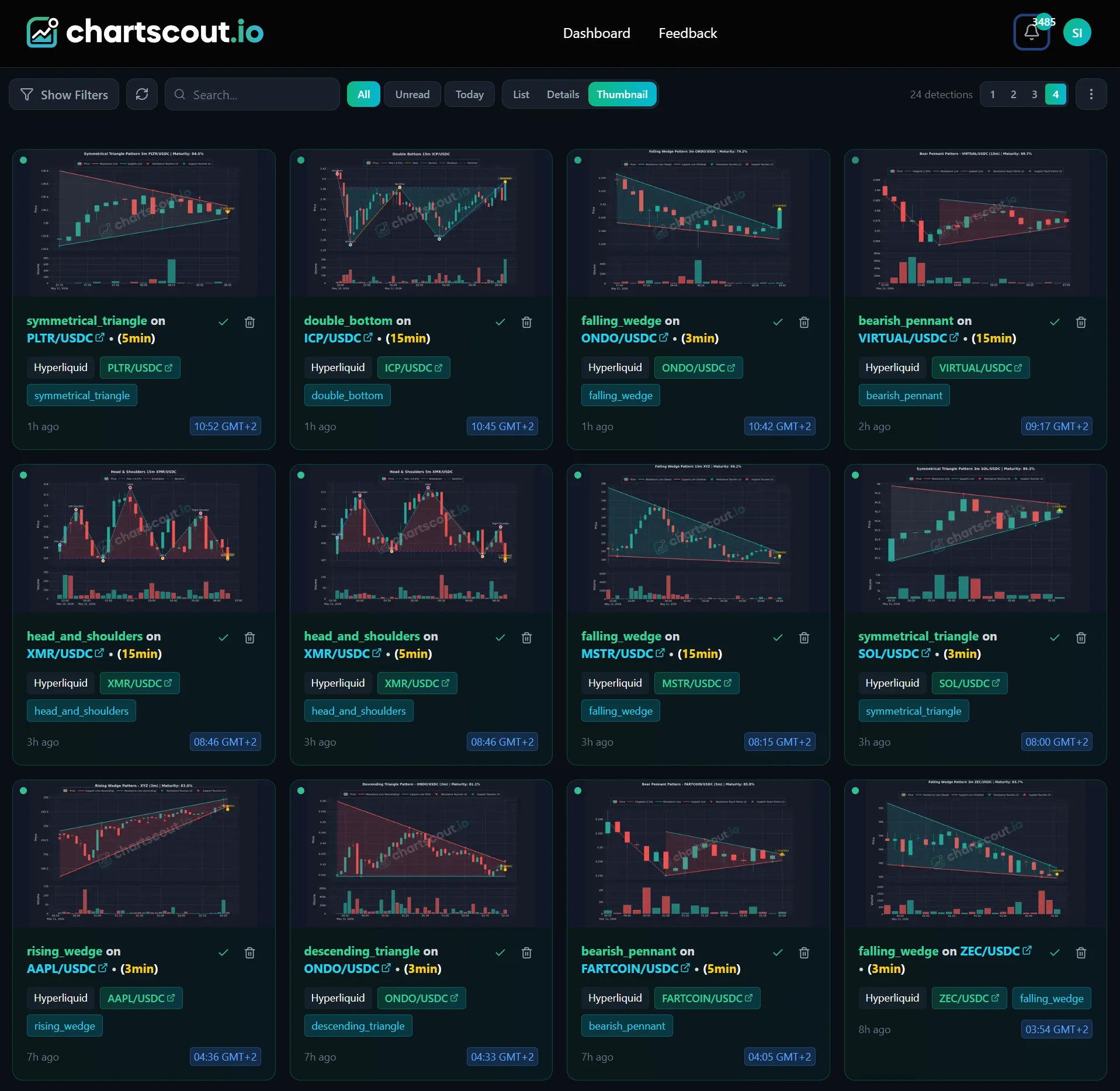
That is the honest expectation for a paid plan too. The scanner gets you to candidates faster. It does not read order book depth, check funding, glance at the liquidation map, or judge whether a setup makes sense given what HYPE just did or where the leaderboard is positioned. Many alerts will not become trades. The useful ones are useful because you see them early enough to act.
23 detectors detected on Hyperliquid
ChartScout supports the same 23 detectors on Hyperliquid that it runs on Binance, Bybit, KuCoin, and MEXC. The success-rate notes below come from Thomas Bulkowski's stock-market research, not crypto-native perp DEX data. Use them as a relative reliability ranking, not a promised hit rate on any specific Hyperliquid pair.
Reversal patterns
| Pattern | Bias | Bulkowski success rate |
|---|---|---|
| Head and shoulders | Bearish | 81% |
| Inverse head and shoulders | Bullish | 89% |
| Double top | Bearish | 83% |
| Double bottom | Bullish | 88% |
| Triple top | Bearish | Rarer |
| Triple bottom | Bullish | Rarer |
Continuation patterns
| Pattern | Bias | Bulkowski success rate |
|---|---|---|
| Bull flag | Bullish | 85% (tight) |
| Bear flag | Bearish | 55% break-even |
| Bullish pennant | Bullish | Continuation |
| Bearish pennant | Bearish | 43% downside |
| Ascending triangle | Bullish | 83% |
| Descending triangle | Bearish | 77% |
| Symmetrical triangle | Bilateral | ~75% |
Wedges, channels, and crossovers
| Pattern | Bias | Notes |
|---|---|---|
| Rising wedge | Bearish | Ranked 36/36 (worst) bearish in Bulkowski's data. Size small. |
| Falling wedge | Bullish | 74% |
| Broadening wedge | Bilateral | Volatility expansion |
| Ascending channel | Trend | Parallel upward trendlines |
| Descending channel | Trend | Parallel downward trendlines |
| Golden cross | Bullish | 50 SMA crosses above 200 SMA |
| Death cross | Bearish | 50 SMA crosses below 200 SMA |
Data notice
These figures come from Bulkowski's stock-market research, not crypto perp DEX data. Hyperliquid has its own microstructure: on-chain order book, visible liquidations, and a sophisticated trader mix that can change how the same pattern resolves. Treat the numbers as a relative ranking, not a probability on any specific Hyperliquid market.
Native Hyperliquid markets vs sub-DEX (xyz) coverage
Hyperliquid's perp listings split cleanly into two groups, and they trade differently enough that the same alert pattern needs different judgment depending on which side it fires on.
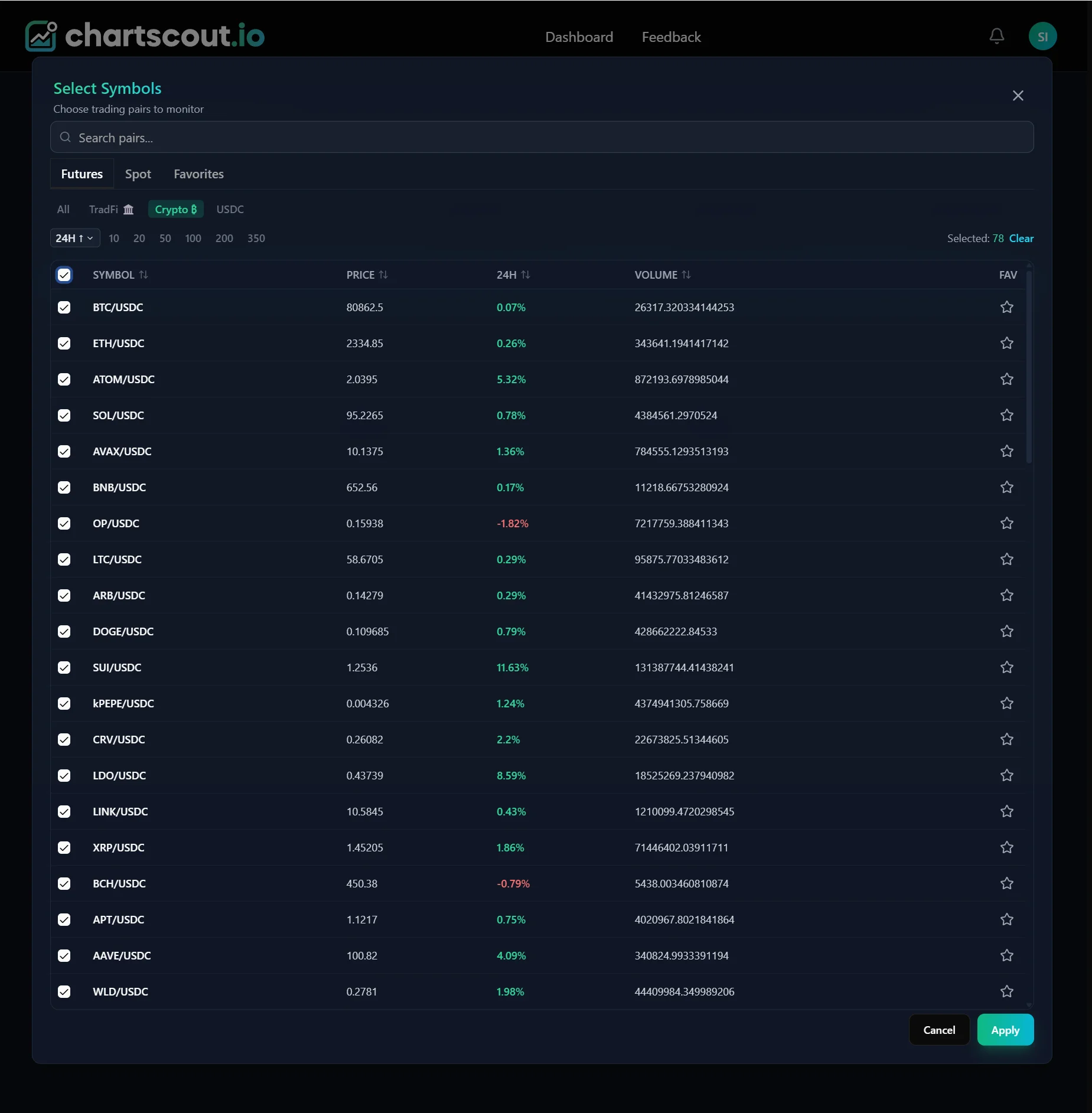
Native Hyperliquid perps are the venue's directly listed crypto perpetuals: BTC, ETH, SOL, HYPE, and the long tail of mid- and small-cap alts (ICP, ONDO, VIRTUAL, FARTCOIN, ZEC, MOVE, and similar). The deep majors behave closer to a major CEX perp than to anything else in DeFi: cleaner structure, more reliable retests, faster follow-through on breakouts. Standard ChartScout confirmation rules apply directly here: volume on breakout, higher-timeframe alignment, and a stop that respects the visible book and the nearest liquidation cluster. The low-cap natives are still real perps but trade closer to MEXC microcap behaviour: thinner books, higher fakeout rates, sharper sensitivity to a single large order. On those, tighten the confirmation: prefer 1h and 4h over 5m and 15m, demand stronger volume on the breakout candle, and size noticeably smaller than you would on BTC or ETH.
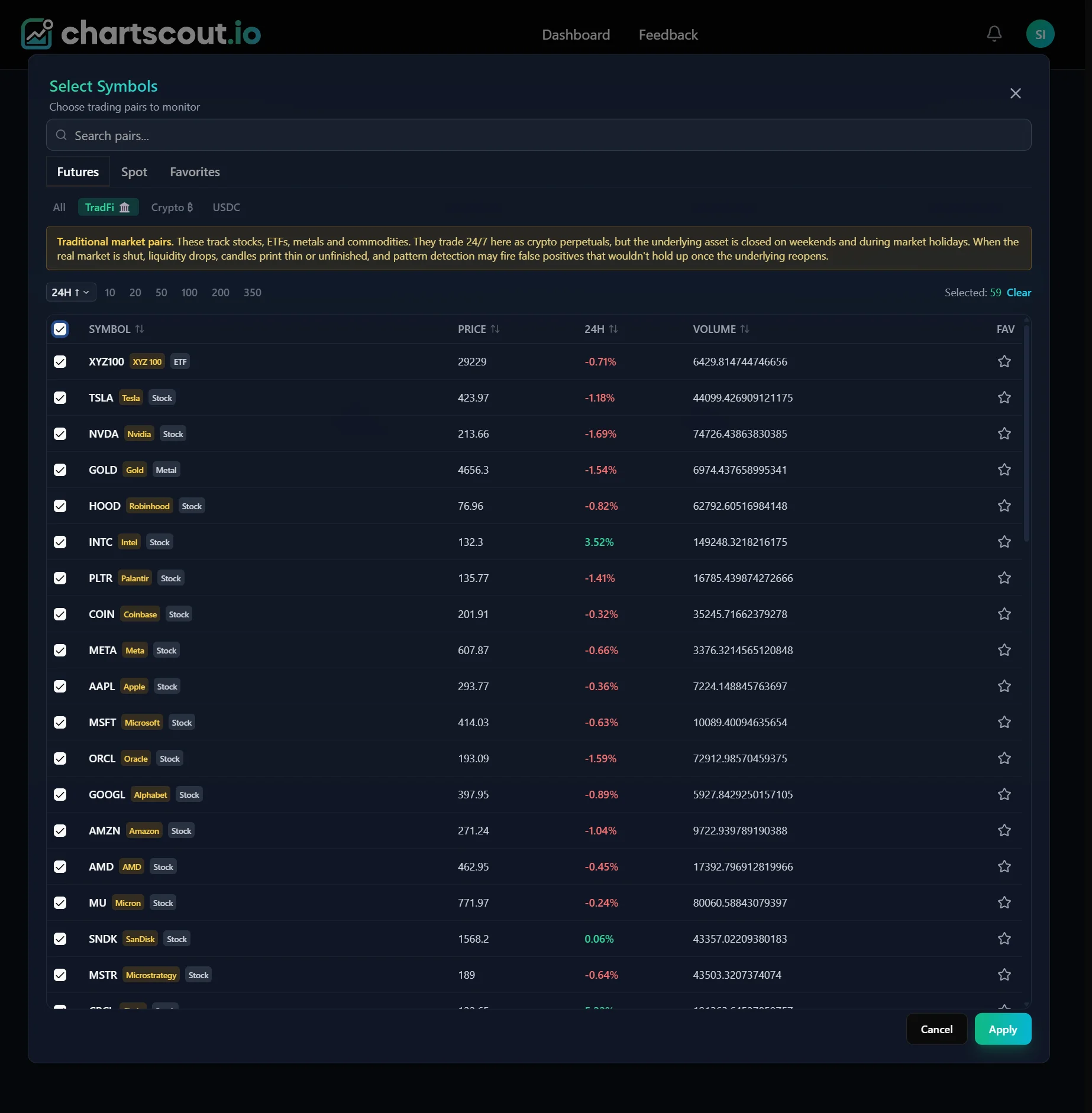
Sub-DEX (xyz) perps are the TradFi side. The Hyperliquid app exposes them under a separate “TradFi” tab in the symbol picker, and on-chain symbols carry an xyz prefix (XYZ:CL for crude light, for example). The lineup covers stocks (TSLA, NVDA, AAPL, MSFT, MSTR, INTC, BX, and more), ETFs (URNM and others), indices, precious metals (GOLD), and commodities (BRENTOIL, WTIOIL, NATGAS). All of them trade 24/7 as crypto perpetuals, even when the underlying NYSE, NASDAQ, or commodity exchange is closed.
ChartScout monitors xyz pairs with the same 23 detectors. The catch on this side is session-context: during US market hours TSLA-on-Hyperliquid reads like a real TSLA chart because the underlying is also trading. On weekends and after the closing bell the underlying does not trade, so the Hyperliquid perp drifts on lower volume, candles can print thin or unfinished, and pattern detection can produce signals that would not survive the next session open. Match the timeframe to the underlying market hours, or stick to native crypto perps when the TradFi book is closed.
Why does this distinction matter for a pattern scanner? Because the alert criteria are mechanical. ChartScout fires when the structure resolves, regardless of whether the underlying market is a deep BTC native perp, a low-cap native that did $40k in the last hour, or a TSLA xyz perp at 3am ET while the actual stock has not traded for nine hours. The judgment about whether the book is deep enough and the session context is appropriate stays with you. On deep natives, that judgment is usually quick. On low-cap natives and xyz pairs, it is the single most important step in the workflow.
How fast are Hyperliquid alerts?
Alerts arrive in under 20 seconds, detection to inbox, in the vast majority of cases. Per-channel dispatch is a few seconds. The rest of the budget covers candle close, structure validation, maturity check, and queueing.
Speed matters more on Hyperliquid than almost anywhere else. The trader base is fast, the leverage is real, and a 5m flag on an active perp can complete its full measured move in under 20 minutes. A 20-second alert versus a two-minute delay is the difference between a planned entry with a defined stop and chasing a green candle without one. This is the practical reason ChartScout exists, and it is the reason Hyperliquid coverage is included on the Basic plan rather than gated behind Pro: speed only matters if you can actually act on it, and pricing the venue out of the entry tier would defeat the whole point.
Every paid plan and the full Pro trial include platform, email, Discord, and Telegram delivery. A single watcher can notify multiple included channels.
How to set up your first Hyperliquid watcher
Setup takes a couple of minutes. There is no wallet connection step. There is no API key step. ChartScout reads public Hyperliquid market data and that is the entire connection.
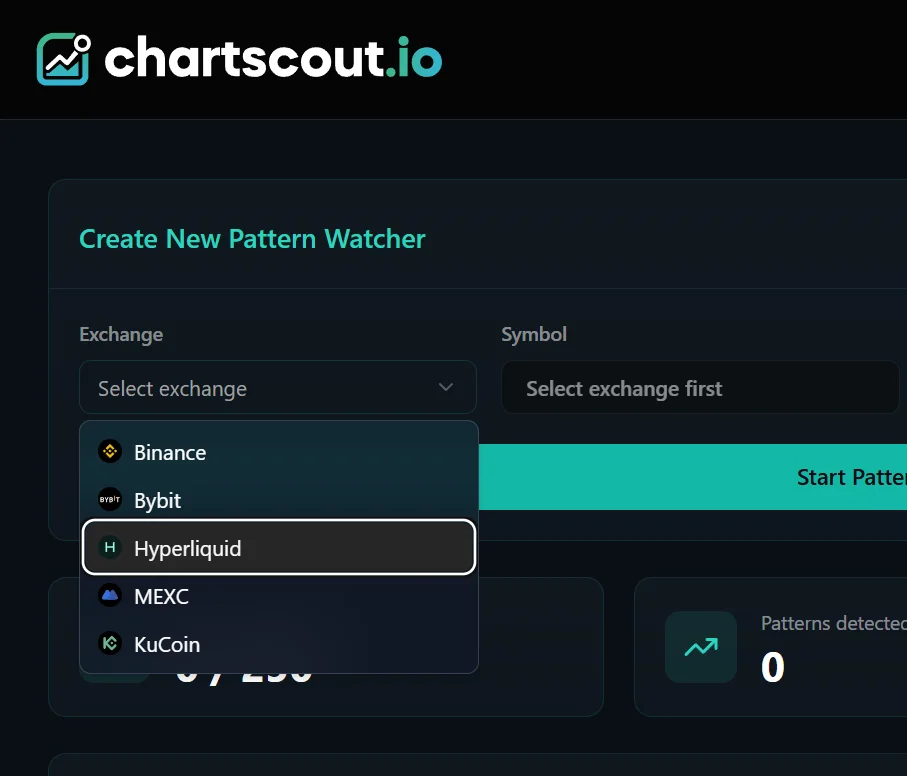
- Start the 7-day Pro trial. Sign up at chartscout.io/subscription. A card is required to start, but no charge is made until day 8. The trial unlocks every exchange, every pattern, and 5m timeframes across the board.
- Connect an alert channel. Every paid plan and the full Pro trial can link Telegram and Discord and use in-app and email delivery.
- Create a watcher. Choose exchange (Hyperliquid), pair, timeframe, and pattern. One watcher = one pair + one timeframe + one pattern.
- Walk away. The scanner runs continuously. When your conditions match, the alert fires. You still decide whether the setup deserves your capital. That is the core idea behind alert-driven trading: set the criteria once, live your life, act only when an alert actually matches.
Hyperliquid coverage starts on Basic, which is the lowest paid tier ChartScout offers. That is intentional. A scanner that excludes the venue you actually trade is not useful, and Hyperliquid is now too active to gate behind Pro.
The public detection feed on X
ChartScout publishes a sample of detections on @ChartScout_bot on X. Private watcher alerts stay private and only appear inside your account or connected channels.
The feed exists for verification, not engagement. Open a recent Hyperliquid post, load the same market and timeframe in the Hyperliquid interface, and check whether the pattern was actually there at the candle the alert references. If timing and quality match how you actually trade, the only remaining decisions are plan tier and watcher count.
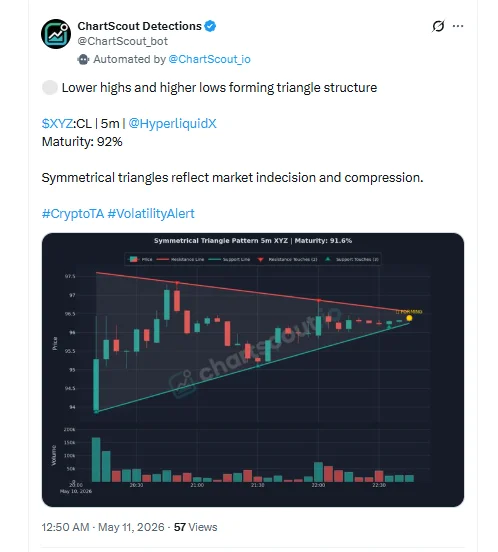
Follower counts and impressions do not prove scanner quality. A few timestamped detections checked against real candles tells you everything a landing page never will.
Scanner vs Hyperliquid's own charts and TradingView
The Hyperliquid interface gives you everything you need to execute: order book depth, funding rate, open interest, liquidation map, position management, and a built-in TradingView chart with a full indicator and drawing toolkit. What it does not give you is automated pattern recognition across every listing. There is no native setting for “alert me when a 1h bull flag forms on any Hyperliquid market.”
| Capability | ChartScout | Hyperliquid interface |
|---|---|---|
| Chart pattern alerts | 23 detectors, automated | None |
| Multi-pair scanning | Native + sub-DEX (xyz) | One chart at a time |
| Push to Discord/Telegram | < 20 seconds, native | Not supported |
| Price level alerts | Not the focus | Yes |
| Funding rate display | Not in alerts | Yes |
| Liquidation map | Not in alerts | Yes |
| Drawing tools | None | Full TradingView toolkit |
| 24/7 autonomous coverage | Yes, runs in the background | Requires you to open the chart |
| Order execution | Never | Native, on-chain |
TradingView itself, whether you use it through Hyperliquid's embedded chart or in a separate tab, is excellent for charting, indicators, drawings, and single-chart Pine Script alerts. It gets awkward fast when the job is broad coverage across an entire perp DEX. A Pine Script alert on one chart is a fundamentally different problem from continuous detection across the full Hyperliquid pair universe.
A working trader stack looks like this: Hyperliquid open for execution, funding context, liquidation map, and chart confirmation; ChartScout running as the discovery layer in the background; the alert lands and you use it as a prompt to check for fake breakout risk, plan the stop, read volume around the structure, and glance at HYPE for correlated risk before sizing in. The tools are complementary.
Honest limitations on Hyperliquid pairs
A detected pattern is not an entry signal. Pattern failure is real on every venue, and Hyperliquid has its own microstructure quirks that show up in clean technical setups going sideways for non-technical reasons.
“A professional futures trader surprised me early in my career when he told me he spent a third of his time on risk management. Beginners jump into trades without giving them much thought. Intermediate-level traders focus on market analysis. Professionals dedicate a massive proportion of their time to risk control, and take money away from beginners and amateurs.”
Alexander Elder, The New Trading for a Living, chapter on risk management
Funding, OI, and the leaderboard live outside the alert. The alert payload covers pattern, symbol, timeframe, direction, and chart preview. It does not include current funding rate, open-interest changes, or what the top wallets on the public leaderboard are positioned for. On a leverage-heavy venue where the largest accounts are visible by design, those inputs are not optional. Check them on the Hyperliquid interface before sizing.
Liquidation cascades override structure. Hyperliquid's on-chain liquidations are fully transparent, which is excellent for after-the-fact analysis and brutal for clean pattern resolution in the moment. A textbook ascending triangle can be invalidated in seconds by a forced unwind that has nothing to do with the chart. Liquidation clusters are also visible in advance on the public liquidation map, so the trader who checks before sizing has an information edge over the one who does not.
HYPE-correlated regimes. Hyperliquid's native token has its own news flow (assistance fund buybacks, ecosystem announcements, builder code launches) and that flow tends to drag correlated alts with it. A clean breakout on a mid-cap sub-DEX listing can fail purely because HYPE wicked down 4 percent in the same minute. The scanner cannot see this. You have to.
Sub-DEX (xyz) thinness. Newer sub-DEX markets produce more false structure than the native perps. Pattern detection still runs, but the same caveats that apply to MEXC microcap pairs apply here: stricter volume confirmation, higher timeframes, and smaller size. The cost of skipping a real setup is much smaller than the cost of taking a fake one with leverage.
No execution. ChartScout does not connect to your Hyperliquid wallet and cannot place, modify, or close trades. It is detection and dispatch only. The trade decision, the size, the stop, and the target stay with you.
Which plan covers Hyperliquid?
Hyperliquid is included on Basic, the same tier as Binance and Bybit. There is no premium-tier surcharge for the venue, and there will not be one. Hyperliquid is now part of how serious crypto traders operate; pricing it out of the entry plan would defeat the purpose of the scanner.
| Plan | Price | Exchanges | Timeframes | Watchers |
|---|---|---|---|---|
| Basic | $19/mo | Binance, Bybit, Hyperliquid | 15m+ | 100 |
| Pro | $39/mo | All 5 | 5m+ | 250 |
| Enterprise | $69/mo | All 5 | 1m+ | 500 |
| Enterprise+ | $99/mo | All 5 | 1m+ | 1,000 |
The 7-day Pro trial includes 250 watchers, all five exchanges, all 23 detectors, and platform, email, Discord, and Telegram delivery at 5m+ timeframes. A card is required; it renews at $39/month on day 8 unless canceled first. Yearly billing is available at a discount on every tier.
Stop hunting Hyperliquid setups one chart at a time.
Scan Hyperliquid's native perp markets and sub-DEX (xyz) listings for 23 detectors. Alerts in under 20 seconds. No API keys. No wallet connection.
Start 7-day trial→Card required to start. No charge until day 8.
FAQ
Does Hyperliquid have a built-in chart pattern scanner?
No. The Hyperliquid interface embeds a TradingView chart with drawing tools, indicators, and price-level alerts, but it does not automatically scan every listing for chart patterns. ChartScout scans Hyperliquid's native and sub-DEX markets for 23 detectors and sends alerts when a watcher matches.
Is ChartScout affiliated with Hyperliquid?
No. ChartScout is independent from Hyperliquid. The scanner reads public Hyperliquid market data and does not require any wallet connection, signature, or account access.
Do I need to connect my wallet or share API keys to use ChartScout on Hyperliquid?
No. ChartScout does not connect to your Hyperliquid wallet, does not request signatures, and does not require API keys. Your funds, positions, and on-chain account stay fully separate.
Which chart patterns does ChartScout detect on Hyperliquid?
ChartScout detects 23 detectors on Hyperliquid: Ascending Triangle, Falling Wedge, Channel Up, Double Bottom, Bull Flag, Bull Pennant, Double Top, Descending Triangle, Channel Down, Rising Wedge, Bear Flag, Bear Pennant, Head and Shoulders, Inverse Head and Shoulders, Triple Bottom, Triple Top, Symmetrical Triangle, Cup and Handle, Inverse Cup and Handle, Crossover, TD Setup, TD Countdown, Falling Knife Reversal.
Does ChartScout cover sub-DEX (xyz) markets on Hyperliquid?
Yes. ChartScout monitors native Hyperliquid perps and sub-DEX listings using the xyz prefix. Sub-DEX markets typically have thinner liquidity than native perps, so stricter confirmation (higher timeframes, stronger volume) applies.
How many Hyperliquid pairs does ChartScout cover?
Roughly 100+ perp markets across native Hyperliquid and sub-DEX (xyz) coverage at the time of writing. Coverage updates as Hyperliquid's listings expand.
How fast are Hyperliquid pattern alerts delivered?
In most cases, observations arrive in under 20 seconds from detection to your platform inbox, email, Discord, or Telegram. Triangles and wedges can fire before completion; reversal patterns wait until the structure is more complete.
What timeframes can I scan on Hyperliquid?
Basic supports 15m and higher. Pro supports 5m and higher. Enterprise and Enterprise+ support 1m and higher. Lower timeframes create more alerts, so match the timeframe to how actively you trade.
Is the Hyperliquid scanner included in the free trial?
Yes. The card-backed 7-day Pro trial includes Hyperliquid and the other four supported exchanges at 5m+ timeframes, all 23 detectors, and platform, email, Discord, and Telegram delivery. It renews at $39/month unless canceled or changed before the trial ends.
Does ChartScout place trades on Hyperliquid?
No. ChartScout is an alert and discovery tool. It does not connect to your wallet and cannot place, modify, or close trades.
Are chart patterns reliable on Hyperliquid perps?
On native Hyperliquid perps with deep order books, pattern setups tend to be closer in character to major CEX perps: cleaner structure, more reliable retests, faster follow-through. On thinner sub-DEX (xyz) markets, expect higher fakeout rates and require stronger volume confirmation before entering.
Can I scan Hyperliquid alongside Binance, Bybit, KuCoin, or MEXC?
Yes. Watchers are configured per exchange. You can run a 1h ascending triangle on a Hyperliquid perp and a 15m bull flag on a Binance pair at the same time, sharing your plan's watcher allocation across both venues.
Which ChartScout plan includes Hyperliquid?
Basic ($19/month), Pro, Enterprise, and Enterprise+. Basic combines Hyperliquid with Binance and Bybit; the full Pro trial and Pro or higher add KuCoin and MEXC.
Sources & references
Data source note: All pattern success rates in this guide come from Thomas Bulkowski's stock-market research at thepatternsite.com (updated 2020, 40,000+ perfect trades). Hyperliquid perp DEX markets may behave differently. ChartScout's crypto-specific study is pending publication.
- Bulkowski, Thomas N. ThePatternSite.com - Chart Pattern Statistics. Updated 8/26/2020. thepatternsite.com.
Primary statistical source for every pattern success rate, failure rate, and ranking referenced in this guide. - Bulkowski, Thomas N. Encyclopedia of Chart Patterns, 3rd Edition. John Wiley & Sons, 2021. ISBN: 978-1119739685.
Canonical print reference. Performance rankings for reversal, continuation, wedge, and channel patterns. - Murphy, John J. Technical Analysis of the Financial Markets. New York Institute of Finance, 1999. ISBN: 978-0735200661.
Source for the quote on chart-based market coverage in “How the Hyperliquid pattern scanner works.” - Elder, Alexander. The New Trading for a Living. John Wiley & Sons, 2014. ISBN: 978-1118443927.
Source for the verbatim quote on professional futures trader risk control allocation, used in “Honest limitations on Hyperliquid pairs.” Chapter on risk management. - Hyperliquid. Official Documentation and API Reference. hyperliquid.gitbook.io.
Reference for Hyperliquid perp DEX market structure, native vs sub-DEX listings, and public market data endpoints.
Related guides
Binance chart pattern scanner
The same workflow on Binance Spot and USD-M futures, with Binance Square public proof.
Bybit chart pattern scanner
Spot and Perpetual coverage on Bybit, on the same Basic tier as Hyperliquid.
MEXC chart pattern scanner
The largest pair list of any supported CEX, built for early-listing traders.
How to scan crypto for chart patterns
Manual scanning, TradingView, Pine Script, and automated scanners compared.
Alert-driven trading
Build a workflow around alerts instead of constant screen-watching.
How to spot fake breakouts
Use volume, retests, and context before acting on any Hyperliquid alert.

Stjepan Ivanović
Founder of ChartScout · Crypto Trader Since 2013
Trading crypto since 2013 with his first Bitcoin bought at ~$200. Four complete bull/bear market cycles, traded on early exchanges like Mt.Gox and BTC-e, on-chain trading on IDEX and EtherDelta, and ~70 crypto project investments. Built ChartScout after 23+ months of development to automate what no trader can do manually. Watch hundreds of charts 24/7.