Cup and handle pattern in crypto: 54% average rise (2026 guide)
The cup and handle is a bullish continuation pattern and one of the best-performing setups in all of technical analysis. Bulkowski's updated research (thepatternsite.com, 913 perfect trades) ranks it #3 out of 39 bullish chart patterns, with a 5% break-even failure rate and an average rise of 54%. It forms when a U-shaped cup is followed by a small handle consolidation before breaking out to new highs.
On a crypto chart, a cup and handle looks like a rounded teacup with a small handle on the right: price drops in a smooth U-shape, recovers back toward its old high, then pauses in a short pullback before breaking out higher. Crypto traders watch for the cup and handle in crypto because it marks a pause inside an uptrend, which gives a clean entry trigger (the handle breakout), a logical stop (below the handle), and a measured price target. It is one of the most reliable bullish continuation patterns, and 24/7 trading, higher volatility, and thinner order books make it especially relevant in crypto. Cups that take months in stocks can form in weeks on a Bitcoin daily chart, and breakouts that play out gradually in equities can explode in crypto.
This guide covers how to identify valid setups, confirm them with volume, trade them using three entry strategies, and manage risk, using Bulkowski's actual numbers, O'Neil's original rules, a decade of crypto-specific context, and real crypto backtest results visualized from ChartScout's own detection engine. Use the volume analysis guide to validate breakout participation and the stop-loss placement guide to plan invalidation.
Thomas Bulkowski classifies the cup with handle as a bullish continuation pattern. His updated statistics at thepatternsite.com (913 perfect bull-market trades) show a 5% break-even failure rate - meaning 95% of patterns move at least 5% past the breakout - and an average rise of 54%. Bulkowski ranks it 3 out of 39 bullish chart patterns, making it one of the best-performing setups in his entire catalog. Only 61% reach the full measured-move target, so aggressive partial profit-taking is essential.
William O'Neil popularized the pattern in the first edition of How to Make Money in Stocks (1988). Writing in the 2nd edition (1995, p. 162), O'Neil describes it this way: “One of the most fundamental chart-base price patterns looks like a cup with a handle when the outline of a cup is viewed from the side.” He studied thousands of the biggest stock market winners and found many formed a cup-shaped base before their largest advances. The structural rules he laid down - a 7 to 65 week base, a 12-33% typical correction, a handle in the upper half of the cup - still hold up in crypto with some adjustments.
A note on data sources and what the numbers actually mean
All statistics in this guide come from Thomas Bulkowski's most recent published figures at thepatternsite.com (data updated 8/26/2020, based on 913 perfect trades in bull markets). The structural trading rules come from William O'Neil's original definition in How to Make Money in Stocks. Every chart example is a real crypto detection from ChartScout's backtest engine. The widely quoted “95% success rate” is actually Bulkowski's break-even rate: 5% of bull-market patterns fail to rise even 5% past the breakout, so 95% move at least 5%. That is not the same as 95% reaching the measured-move target - only 61% do that.
Bulkowski rank: 3 out of 39 bullish patterns.
Data notice: All statistics are derived from stock market data. Bulkowski has not published a crypto-specific study, and no equivalent crypto-wide dataset exists. Crypto's 24/7 trading and higher volatility can shift both success rates and average moves, so treat these figures as a relative ranking of pattern reliability rather than exact crypto predictions. Note that earlier editions of Bulkowski's Encyclopedia of Chart Patterns (2005, based on 412 trades) reported a 34% average rise; the updated 2020 sample of 913 trades raised it to 54%. We use the latest data.
What is a cup and handle pattern in crypto?
The cup and handle is a bullish continuation chart pattern that signals a pause in an uptrend before the next leg higher. Visually, it looks like a rounded teacup with a small handle on the right side.
The pattern unfolds in two phases. First, the cup: an asset that has been rising hits a peak (the left lip), pulls back gradually, forms a rounded bottom, and recovers back toward that original peak (the right lip). The bottom must be rounded, not V-shaped. A V-shape indicates a panic-driven bounce rather than the methodical accumulation a true cup and handle requires.
Second, the handle: once price approaches the prior high, it pulls back slightly or drifts sideways in a small consolidation. This pause represents the final shakeout of weak hands who bought at the top and are selling to break even. When price breaks above the handle's resistance on strong volume, the pattern is complete and the uptrend is expected to continue.
| Component | Description | Key characteristic |
|---|---|---|
| Prior uptrend | Rally leading into the pattern | Required - confirms continuation context |
| Left lip | Peak before the cup forms | Sets resistance level (cup rim) |
| Cup bottom | Lowest point of U-shape | Rounded, not V-shaped |
| Right lip | Recovery to prior high | Within 5% of left lip |
| Handle | Small pullback after lip | Stays in upper half of cup (O'Neil rule) |
| Breakout | Price closes above handle | Must be confirmed with volume |
The critical distinction: the cup and handle is a continuation pattern. It appears within an existing uptrend, not at market bottoms. If you see a similar shape after a prolonged downtrend, you are probably looking at a rounding bottom, which has different trading implications. For a broader overview of pattern types and how they interact with volume, see our chart patterns and volume analysis guide.
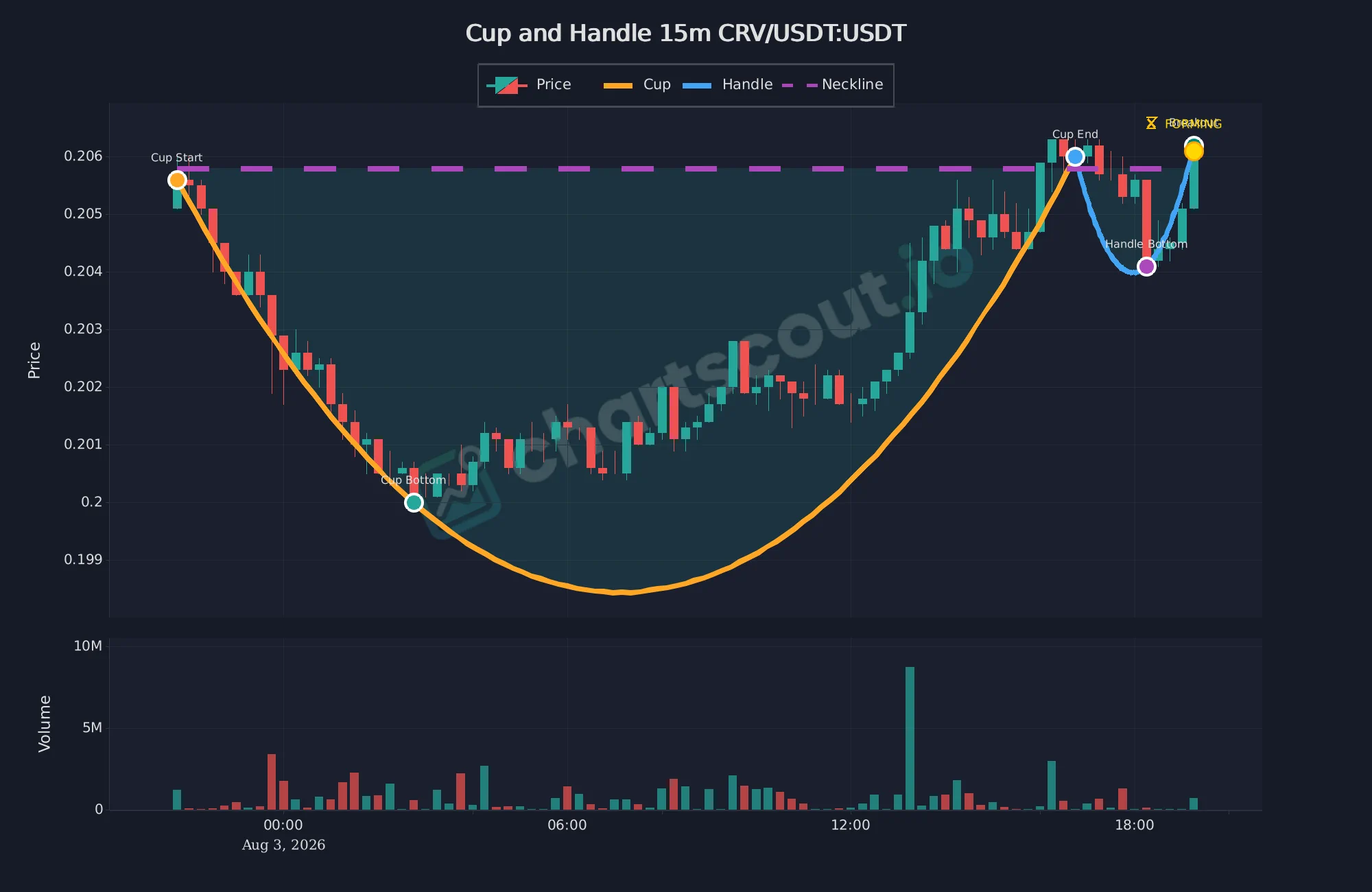
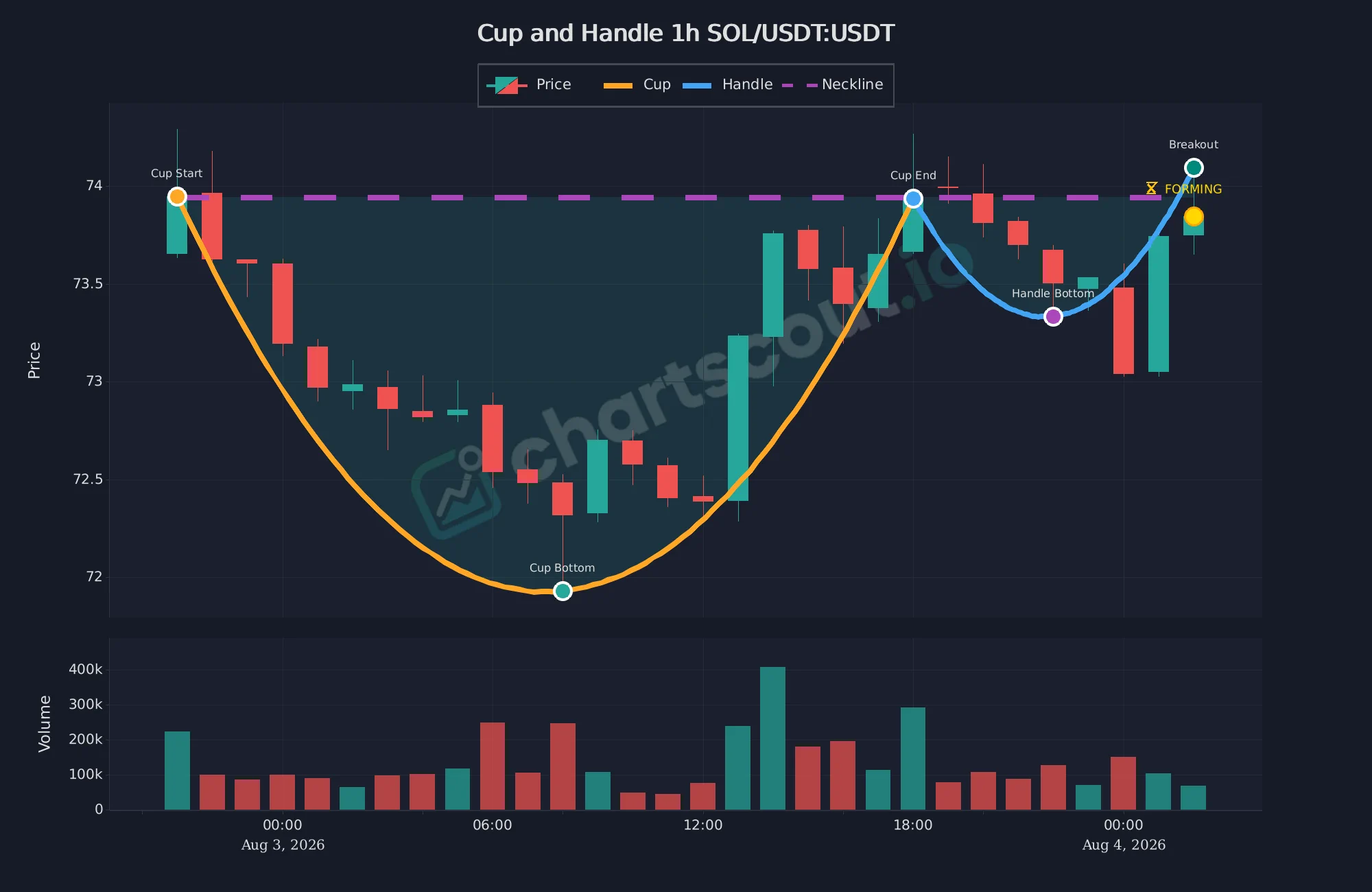
Both fresh detections above were produced by the same backtest scripts that power ChartScout's live scanner - no hand-picked examples.
The psychology behind the cup and handle
Understanding the psychology behind each phase makes you a better trader than simply memorizing the shape. The cup and handle tracks the transfer of assets from weak hands (impatient retail traders) to strong hands (patient accumulators).
Phase 1: the left side of the cup (profit-taking)
The pattern begins after a sustained rally. Price reaches a new high and early buyers start taking profits. This selling is rational and methodical, not panic. Price declines gradually, forming the left wall of the cup. Volume is moderate to high as positions unwind.
Phase 2: the cup bottom (exhaustion and accumulation)
As price continues to decline, selling pressure exhausts itself. Meanwhile, patient accumulators begin quietly buying at lower prices. The bottom is rounded because this transition from selling to buying happens gradually, not all at once. A V-shape would indicate panic and a reactive reversal with less conviction. The smooth U-shape tells you sentiment shifted methodically from bearish to cautiously bullish.
Phase 3: the right side of the cup (recovery)
As accumulation completes, buying pressure outweighs selling. Price climbs back toward the prior high. Volume picks up as more traders recognize the opportunity. But there is still a key test ahead: the prior high (the rim) where original selling began. Traders who bought at the bottom are sitting on gains, and traders who bought at the original high are finally back to breakeven.
Phase 4: the handle (final shakeout)
When price approaches the rim, two things happen: buyers from the bottom take profits, and stuck traders from the original high sell to break even. This shakeout clears out weak hands. Volume dries up because there are not many aggressive sellers left. The people still holding are conviction buyers who accumulated at the bottom and are not interested in selling for a small profit.
Phase 5: the breakout (buyers take control)
With weak hands cleared and sellers exhausted, there is almost no one left to sell. When price pushes above the handle's resistance, it triggers stop-buy orders, short covering, and momentum traders piling in. Volume spikes. In Bulkowski's updated data (thepatternsite.com, 913 trades), the average move from breakout to the ultimate high is 54% in bull markets - a top-3 result out of 39 bullish chart patterns.
“One of the most fundamental chart-base price patterns looks like a cup with a handle when the outline of a cup is viewed from the side. Cup patterns last, in time duration, from 7 to as many as 65 weeks (most are usually three to six months).”
- William O'Neil, How to Make Money in Stocks, 2nd ed., p. 162
Key insight: Do not enter during the handle. The handle is designed to shake out weak hands. Wait for the breakout above handle resistance with volume confirmation before committing capital.
Why the pattern works differently in crypto
Most educational content about the cup and handle was written for stock traders. Crypto markets have characteristics that change how this pattern forms, how quickly it develops, and how violently it breaks out.
24/7 markets mean faster formation
Stock markets are open 6.5 hours per day, five days per week. Crypto never closes. A pattern that takes three months in stocks might complete in three to four weeks in crypto. Continuous price discovery compresses the accumulation cycle because there are no overnight gaps or weekend pauses.
Higher volatility creates deeper cups
In traditional markets, O'Neil's usual range was a 12% to 33% correction, with leaders sometimes dropping 40-50% in bull markets and 50-60% or more in bear markets (How to Make Money in Stocks, 2nd ed., p. 162-163). In crypto, cups routinely retrace deeper still. Bitcoin's cup from its November 2021 high to its 2022 low retraced over 75% and still led to new all-time highs - the rounded-base structure matters more than the exact depth.
Retail-dominated order flow
Crypto has a higher proportion of retail traders compared to equities, which amplifies the psychological phases. Retail traders tend to be more emotional, creating sharper selloffs on the left side and more explosive FOMO breakouts when momentum shifts.
Lower liquidity and exchange fragmentation
Thinner order books on altcoins lead to larger moves but higher false breakout risks. Unlike stocks where volume is centralized, crypto volume is spread across dozens of platforms. Large players can move price with smaller orders, creating fakeouts that would not happen in larger markets.
| Factor | Stocks (traditional) | Crypto |
|---|---|---|
| Cup duration | 1-6 months | Scales with timeframe: minutes on 1m/5m, hours on 15m/1H, days on 4H, weeks on daily, months on weekly (rare) |
| Cup depth | 12-33% retracement | 20-60% retracement |
| Handle duration | 1-4 weeks | Proportional to cup: roughly 10-30% of cup length on any timeframe |
| Handle rule | Upper half of cup (O'Neil); halfway rule (Bulkowski) | Same rule; looser in practice (see below) |
| Volume data | Centralized | Fragmented / aggregate |
| Detectable timeframes | Weekly / daily (classic approach) | 1m through weekly - lower TFs fire more often, higher TFs are rarer and more reliable |
| Breakout speed | Gradual | Often explosive |
| False breakout risk | Moderate | Higher (whale manipulation) |
Crypto caveat: whale manipulation
Low liquidity on altcoins can lead to patterns created by whales. Large holders may dump enough coins to form what looks like a handle, triggering stop losses before the actual breakout. Use wider stops and wait for confirmed closes above resistance rather than reacting to intraday wicks.
How to identify: step-by-step
Follow this 7-step process to distinguish high-probability setups from noise. If you are new to reading charts, our how to read crypto charts guide covers the fundamentals.
- Confirm the prior uptrend: O'Neil's rule (How to Make Money in Stocks, 2nd ed., p. 165) is a minimum 30% increase in the prior uptrend before the base begins. The cup and handle is a continuation pattern and only works within a bullish trend. If the broader trend is sideways or bearish, any cup-like shape is more likely a rounding bottom.
- Look for the U-shape: The cup must have a rounded bottom. A smooth, gradual curve indicates selling pressure faded over time and accumulation happened patiently. V-shaped bottoms suggest panic and carry less conviction.
- Check cup depth: Measure how far price dropped from the left lip to the bottom. O'Neil's usual range for stocks was 12-33% (with leaders occasionally dropping 40-50%). In crypto, depths of 20-40% are common and 40-60% cups still work often enough to be tradeable if the bottom is rounded and volume confirms accumulation. Depths over 70% are not disqualifying in crypto (Bitcoin's 2022-2024 base retraced ~76%), but they demand extra volume and structural confirmation.
- Measure cup duration: O'Neil specifies cup patterns last from 7 to 65 weeks, with most between 3 and 6 months (How to Make Money in Stocks, 2nd ed., p. 162). Crypto daily charts compress this - 4-8 weeks is a common range, and 2 weeks is a reasonable floor. Intraday detections on 5-minute and 15-minute charts can play out in hours, though they carry higher noise.
- Identify the handle: Once the right side recovers to near the prior high, watch for a small pullback or sideways drift. It should slope slightly downward or move horizontally and look small relative to the cup.
- Verify handle depth and position: O'Neil's rule (How to Make Money in Stocks, 2nd ed., p. 164) is that the handle must form in the upper half of the overall base - not the lower half. Bulkowski applies a similar halfway rule in the Encyclopedia (p. 152), excluding cups where handle lows drift below the midpoint. A high handle forming close to the rim is the most bullish variation.
- Watch the volume pattern: Volume should decrease during the left side, hit its lowest near the bottom, then gradually increase during recovery. During the handle, volume should taper off again. The breakout requires a 40%+ spike above the 20-period average.
Validation checklist
Score each criteria. 10/10 = high-confidence setup. 7-9 = valid pattern, proceed with standard risk. Below 7 = skip.
- Prior uptrend of 30%+ exists (Required for continuation)
- Cup is U-shaped (Rounded bottom, not V-shaped)
- Cup depth is 20-60% of prior rally (Retains structure)
- Cup has enough bars to form a genuine U-shape (20+ candles on any timeframe)
- Right lip approaches left lip (Within 5% of original high)
- Handle stays in upper half of cup (O'Neil's rule, p. 164)
- Handle low stays above cup midpoint (halfway rule)
- Handle duration < cup duration (Avoids deterioration)
- Volume declines during cup bottom and handle formation
- Higher timeframe trend is bullish (Weekly/Daily alignment)
Running through this checklist manually across hundreds of pairs is impractical. ChartScout automates this validation across 1,000+ crypto pairs 24/7, alerting you only when a pattern scores high enough to act on.
Volume analysis: the critical edge
Volume is the single most important tool for confirming pattern reliability. A perfectly shaped cup and handle with wrong volume behavior is far more likely to fail than a slightly imperfect pattern with textbook volume. Volume tells you what price alone cannot: whether the moves are backed by genuine conviction.
“Volume should increase or expand in the direction of the existing price trend. In an uptrend, volume should be heavier as the price moves higher, and should decrease or contract on price dips. As long as this pattern continues, volume is said to be confirming the price trend.”
- John J. Murphy, Technical Analysis of the Financial Markets, p. 162
| Phase | Expected volume | What it means | Red flag |
|---|---|---|---|
| Left side (decline) | Moderate to high | Selling pressure is active | Extreme panic volume |
| Cup bottom | Low, declining | Sellers are exhausted | Spike at bottom |
| Right side (recovery) | Gradually increasing | Buyers returning | Flat volume on recovery |
| Handle | Low, tapering | Weak hands exiting | High volume in handle |
| Breakout candle | 40%+ spike | Buyers overwhelmed sellers | Low volume breakout |
| Post-breakout | Above average | Trend continuation | Volume dies immediately |
Pro tip: volume profile & OBV
During a valid cup and handle, On-Balance Volume (OBV) should trend upward during the right side of the cup even while price is still below the left lip. This signals accumulation. If OBV makes a new high before price does, that is a strong leading indicator of the coming breakout. Also, a breakout into a low-volume zone on the Volume Profile can result in explosive moves.
Complete trading strategy
Identifying a cup and handle is only half the battle. The real edge comes from knowing exactly when to enter, where to place your stop loss, and how to set targets. There are three entry strategies depending on your risk tolerance.
1. Aggressive entry (inside the handle)
Enter while the handle is still forming, betting on the bounce from handle support. Identify the handle's support level and enter on a bullish reaction (e.g., a hammer candle or bounce on increasing volume). This maximizes risk-to-reward but has a lower win rate as the pattern isn't confirmed. Best used when the higher timeframe (weekly) is extremely bullish, providing an environmental tailwind for the trade.
R:R: highest (3:1+) | Best for: experienced traders | Stop loss: just below handle low
2. Conservative entry (the breakout)
Wait for a candle close above the handle resistance. This is the statistically validated method, eliminating the risk of a handle that never completes. Place a buy stop order slightly above the resistance level to filter noise. This is the method O'Neil himself recommended. To increase accuracy, wait for a 4-hour candle close above the handle rather than just a price touch.
Win rate: high | Best for: most traders | Stop loss: below handle low or cup midpoint
3. Very conservative (the retest)
Wait for the breakout, then enter when price pulls back to retest the broken resistance as new support. Offers double confirmation. You might miss some trades that moon without looking back, but you'll avoid many false breakouts. Bulkowski's updated data (thepatternsite.com) shows throwbacks occur 62% of the time in bull markets - waiting for a retest is viable more often than not, though not guaranteed. Best for trading large position sizes where slippage is a concern.
Win rate: highest | Best for: risk-averse traders | Stop loss: just below retest level
| Strategy | Entry point | Stop loss | Win rate |
|---|---|---|---|
| Aggressive | Handle bounce | Below handle low | Lowest |
| Conservative | Breakout close | Below handle / midcup | Moderate |
| Very conservative | Breakout retest | Below retest level | Highest |
Setting price targets
The standard method for setting a profit target is straightforward: calculate the vertical depth of the cup and project it upward from the breakout point. In crypto, where trends can be explosive, use a multi-stage exit strategy to capture the full move. Never cap your upside on a generational trend.
- Target 1: Breakout point + 1.0x Cup Depth (The minimum statistically expected target where the R:R typically hits 2:1)
- Target 2: Breakout point + 1.5x Cup Depth (Captures extended momentum moves and “blow-off top” potential)
- Target 3: Breakout point + 2.0x Cup Depth (Ideal for “moonshot” trades on altcoins during the mania phase)
Multi-stage exit strategy
Don't close everything at once. Professional traders scale out to capture extended moves while locking in profits. After taking profit on the first 50%, move your stop loss to breakeven. This allows you to trade with “house money” for the remainder of the move.
- 50% at Target 1 - Move SL to breakeven immediately; lock in the gain.
- 25% at Target 2 - Lock more gains to protect the winner from volatility.
- 25% with trailing stop - Ride the trend for as long as it lasts; use ATR-based trailing stops.
The inverse cup and handle
The inverse cup and handle is a bearish continuation pattern that signals a pause in a downtrend before the next leg lower. It is the mirror image of the classic pattern. If you trade both long and short positions, this pattern doubles your opportunity set during bearish phases or when individual coins are losing momentum. Bear markets in crypto are often faster and more violent than bull markets, making the inverse cup and handle a high-impact tool for short-sellers.
What it looks like
Instead of a U-shaped bottom, you get an inverted U (dome or rounded top). The handle drifts slightly upward. It completes when price breaks below the handle's support. Bulkowski's data (Encyclopedia of Chart Patterns, 2nd ed., p. 164) shows this pattern is at its strongest in bear markets: a 2% break-even failure rate and 26% average decline, ranking it 1 out of 21 bearish patterns with downward breakouts. In bull markets the numbers are less impressive - 11% break-even failure, 16% average decline, rank 8 out of 21. In crypto, breakdowns often happen faster than breakouts due to cascading liquidations.
The psychology (in reverse)
A downtrending asset bounces temporarily, forming the left side of the dome. Buyers lose conviction, creating the rounded top as selling pressure returns gradually. The handle is the last gasp of buying before sellers take full control. When price breaks below the handle's support, it confirms the breakdown. Trapped buyers at the top of the dome are forced to sell, fueling the move lower.
| Component | Standard (bullish) | Inverse (bearish) |
|---|---|---|
| Cup shape | U-shaped (rounded bottom) | Inverted U (rounded top / dome) |
| Handle drift | Slight downward slope | Slight upward slope |
| Breakout direction | Upward (above resistance) | Downward (below support) |
| Break-even failure | 5% bull / 7% bear | 11% bull / 2% bear |
| Average move | +54% (bull market) | -16% bull / -26% bear |
| Bulkowski rank | 3 / 39 bullish patterns | 8/21 bull, 1/21 bear |
Cup and handle variations
Not every pattern looks like a textbook illustration. Recognizing these variations prevents you from missing valid setups or trading weak ones that merely resemble the pattern.
| Variation | Cup depth | Reliability | Notes |
|---|---|---|---|
| Classic | 20-33% | ★★★★★ | Standard teacup setup |
| Cup and saucer | 10-20% | ★★★★★ | Wide, shallow curve; high conviction |
| Deep cup | 40-60% | ★★★ | Common in crypto; requires strong volume |
| High handle | Near rim | ★★★★ | Extremely bullish; tight consolidation |
| Multi-handle | 20-40% | ★★★ | Exhausts all remaining sellers over time |
| Intraday | Varies | ★★ | 15m - 1H charts; use with other indicators |
Cup & handle vs. other patterns
Confusing the cup and handle with other patterns leads to incorrect targets and timing. Here is how to tell them apart.
| Feature | Cup and handle | Rounding bottom | Ascending triangle | Bull flag |
|---|---|---|---|---|
| Type | Continuation | Reversal | Continuation | Continuation |
| Duration | Weeks to months | Months to years | Weeks to months | Days to weeks |
| Handle required | Yes | No | No | No |
| Key structural signal | Handle after U-shape | Rounded recovery alone | Flat top + rising lows | Sharp rally + tight flag |
Decision framework
- U-shape + consolidation at rim? → cup and handle (best for swing trading)
- U-shape + no consolidation? → rounding bottom (best for position trading)
- Flat top + rising lows? → ascending triangle (breakout trading)
- Vertical rally + tight brief flag? → bull flag (momentum trading)
Technical indicator confirmation
Pick two or three complementary indicators: one for momentum, one for volume, and one for trend strength. The goal is not to stack every indicator. Use indicators to veto a trade, not blindly confirm one.
John Murphy's rule (Technical Analysis of the Financial Markets, p. 165) is that “volume precedes price” - the loss of upside pressure in an uptrend shows up in volume figures before the actual price reversal. In practice, that means watching for declining volume on the right side of the cup as an early warning: if price is climbing but buyers are fading, the handle break may not have the fuel to follow through.
| Indicator | What to look for | Strength |
|---|---|---|
| OBV | New high before price does during right side | Very strong |
| RSI (14) | Rising through 50; stays > 40 in handle; 55-65 at breakout | Strong |
| MACD | Bullish crossover during handle; positive histogram | Strong |
| Bollinger Bands | Squeeze during handle; expansion at breakout | Moderate |
| Moving averages | Price above 50 EMA; golden cross zone | Strong |
| ADX | Rising above 20 at breakout confirms trend strength | Moderate |
Ideal indicator scenario
The most effective combination is OBV + RSI + MACD. OBV should be trending up (accumulation), RSI between 55-65 at breakout (momentum without being overbought), and MACD turning positive. Watch for RSI divergence: if price makes a new high but RSI makes a lower high, the move lacks fuel and may fail.
Real crypto case studies
Theory becomes actionable only when you see it applied to real charts. Here are three case studies demonstrating how the pattern plays out in live crypto markets. These examples showcase the pattern across different timeframes and asset classes.
Bitcoin: the extended weekly (2021-2024)
This is perhaps the most dramatic cup and handle in crypto history. Bitcoin reached $69,000 in Nov 2021, followed by a brutal bear market to below $16,000 - a cup depth of over 75%. Through 2022 and 2023, Bitcoin formed a massive, rounded bottom on the weekly chart as institutional accumulation picked up. By early 2024, price consolidated in the $60k-$69k range (forming the handle) before an explosive breakout to $100,000+. Key lesson: in crypto's extreme volatility, the rounded bottom produced a textbook breakout even with a “too deep” retracement. Structure beats textbook ratios in the digital asset space.
Institutional accumulation
The weekly BTC cup was driven by “smart money” accumulating at the cycle lows. The handle formed exactly where you'd expect - at the prior ATH resistance - and the breakout volume was unmistakable. This was a classic macro base that signaled the start of a multi-year bull cycle.
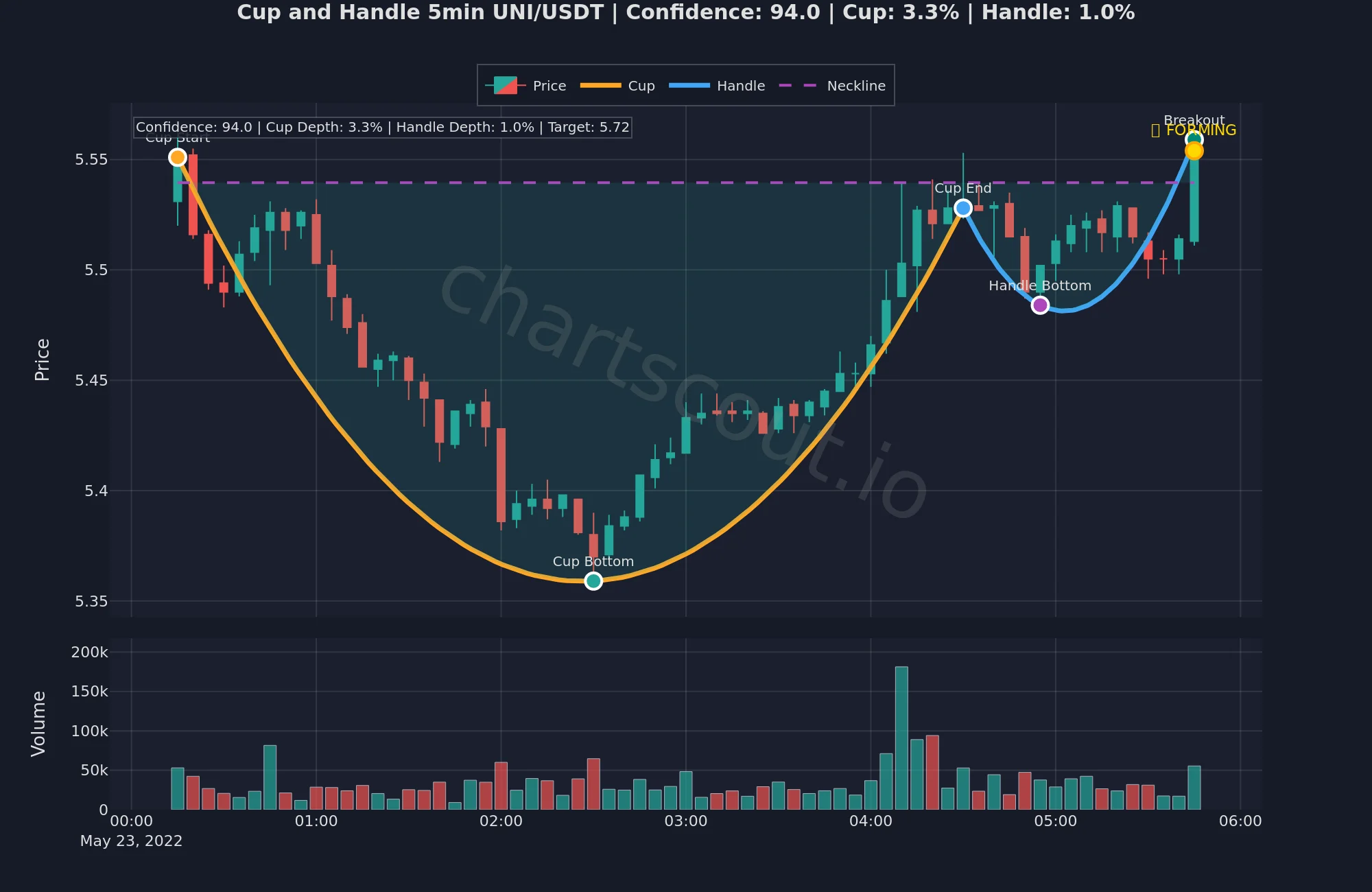
UNI/USDT 5m - a textbook intraday setup
The cup formed with a rounded bottom and a handle drift that stayed in the upper half of the base - exactly what O'Neil's rule calls for. The crypto twist: on the 5-minute timeframe, the entire structure plays out in a few hours instead of the 7-to-65-week window O'Neil described for stocks. The structural rules still hold; only the clock is different.
Crypto pattern variety across pairs and timeframes
Pattern shape varies more in crypto than in stocks. Below are three more backtest detections across different pairs and timeframes, showing how the same structural rules fit very different market conditions. CRV/USDT on the 15-minute is a deeper, longer base - the kind of structure Bulkowski has in mind when he writes that the handle must not drift lower than halfway down the cup (p. 152). SUSHI/USDT 5m shows a wider, shallower cup closer to a saucer. DASH/USDT 5m has a tighter, faster base with clean volume contraction through the cup bottom.
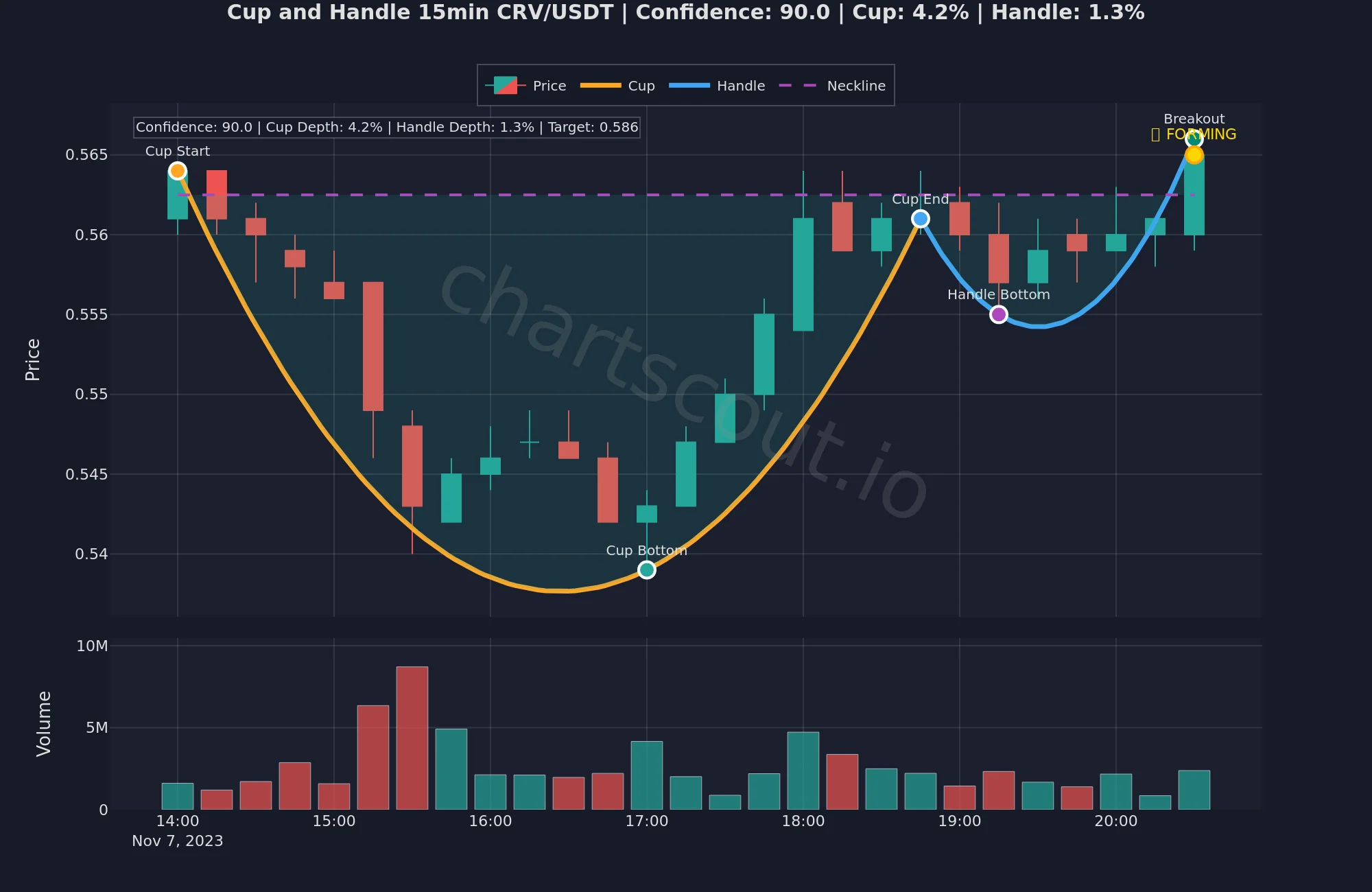
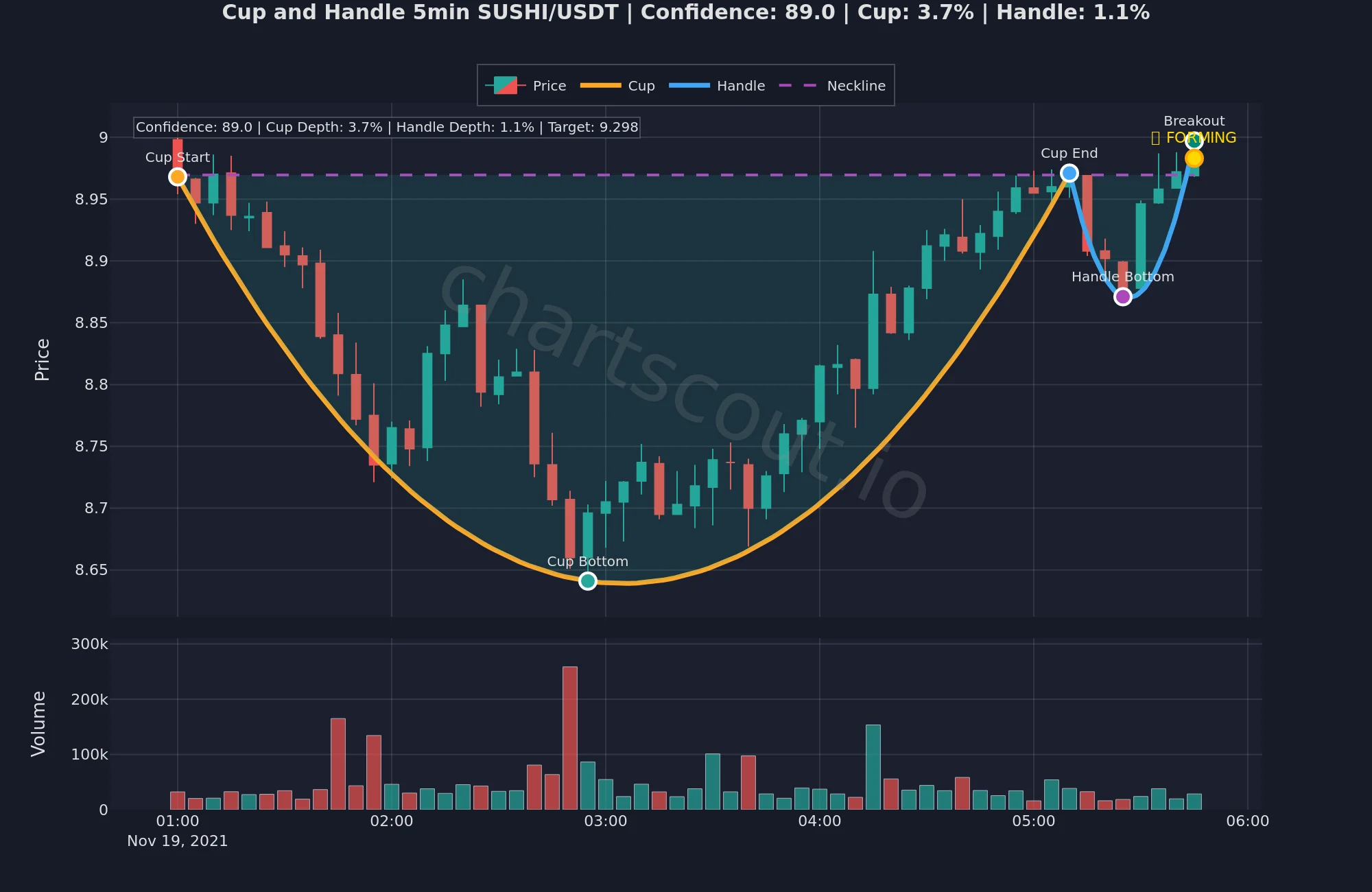
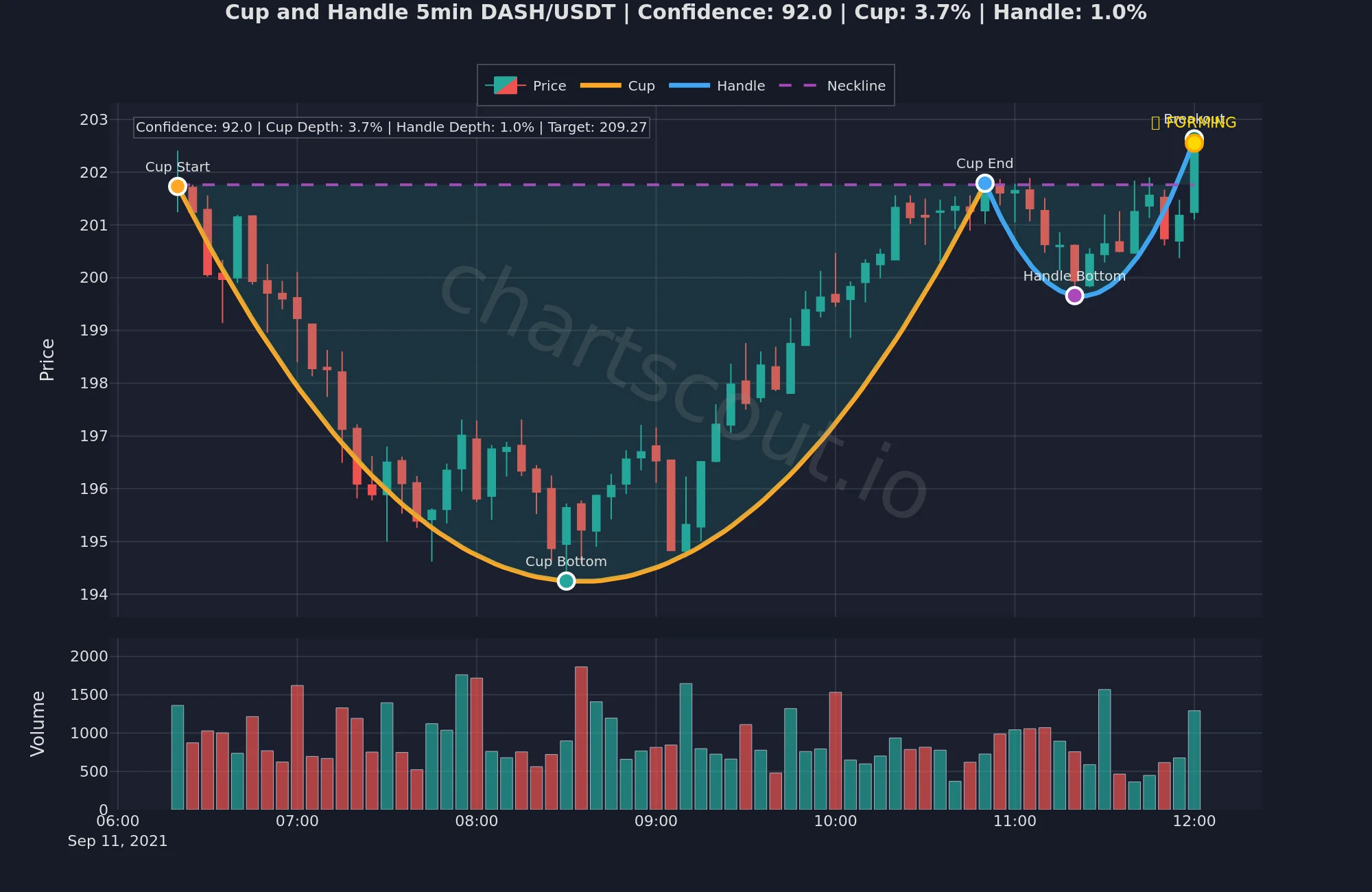
All three of these patterns were detected by the same scripts ChartScout runs against live data - the backtest and production pipelines share the exact same detector logic. The critical question for each is whether the handle stayed in the upper half of the base, whether volume confirmed the breakout, and whether the prior trend justifies a continuation bet.
BEAT/USDT 1m - a noisy live detection
Not every valid detection looks like a textbook drawing. Here's a live 1-minute detection on BEAT/USDT, picked up by the production scanner in March 2026. The shape is noticeably rougher than the backtest examples above - the cup wall on the left side has a deep wick, the right side recovers in a choppy stair-step, and the handle is shallow and messy. It still qualifies: the confidence score came in at 87, the handle stayed in the upper half of the base, and the structural rules held. This is what the lower timeframes actually look like in the wild - and exactly why the detector has to do structural math instead of pattern-matching a picture.
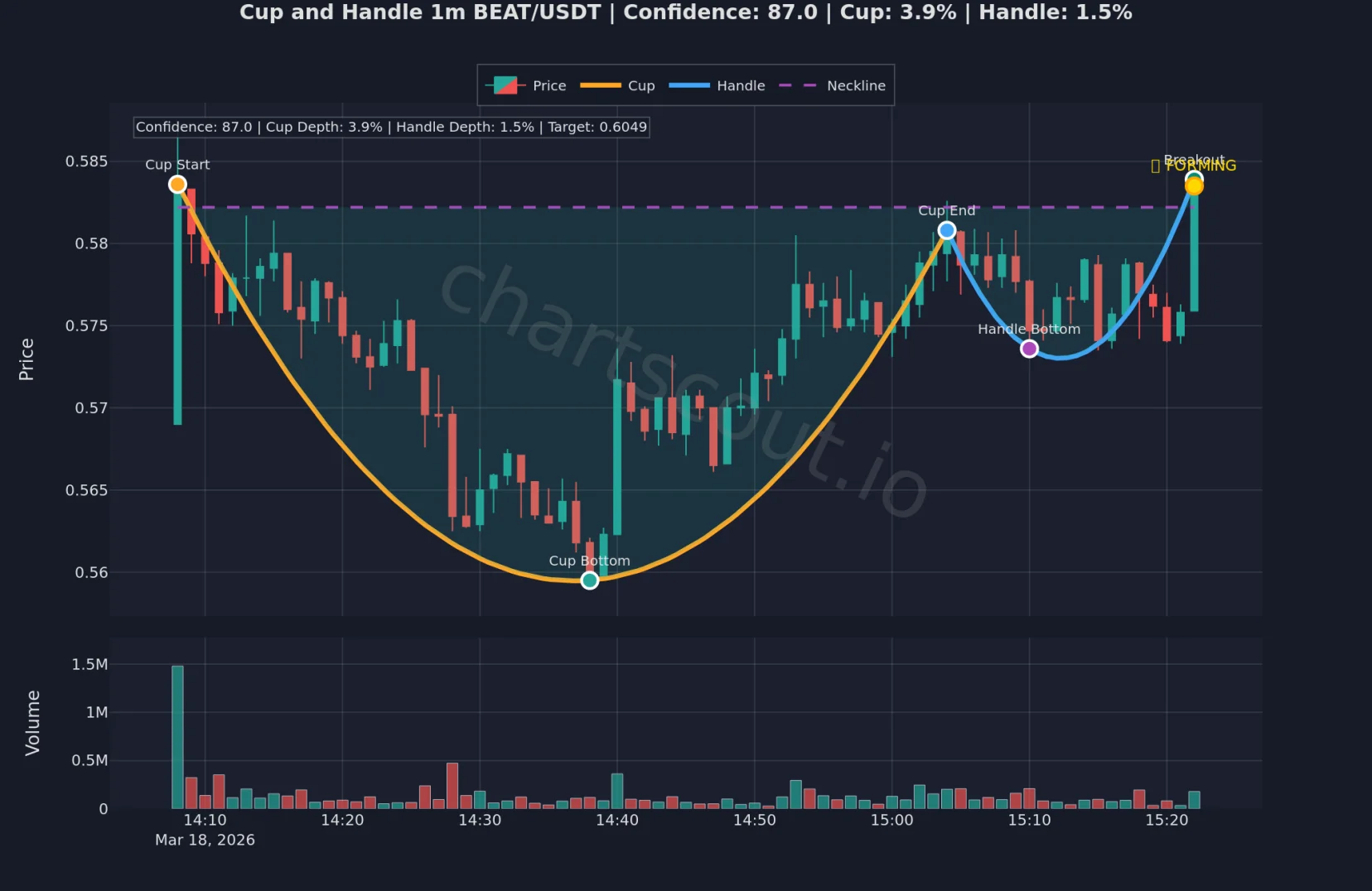
Why this matters: if you only train your eye on clean textbook diagrams, you will miss the majority of valid crypto detections on sub-hourly timeframes. Noise is the default state. What matters is whether the underlying structure - rounded accumulation, upper-half handle, confirming volume - is still intact. The chart does not need to be pretty.
Common trading mistakes
Even experienced traders make errors with this pattern. Here are the eight most common mistakes and how to avoid each one.
| Mistake | Why it's wrong | Solution |
|---|---|---|
| Confusing V-bottoms | Indicates panic, not accumulation | Trade only smooth U-shapes |
| Early entry | Pattern not confirmed yet | Wait for candle close above breakout |
| Ignoring volume | Breakout lacks fuel/conviction | Require 40%+ volume spike |
| Handle too deep | Sellers still in control | Skip if handle drifts below cup midpoint |
| Fighting trend | Ignoring higher timeframe direction | Check weekly trend first |
| No stop loss | Controlled trade becomes disaster | Place stop below handle low |
| Single timeframe | Narrow view of market structure | Use multi-timeframe analysis |
| Chasing breakout | Poor risk/reward entry point | Wait for retest or skip |
What to do when a cup and handle fails
No pattern works 100% of the time. Bulkowski's updated data at thepatternsite.com shows throwbacks occur 62% of the time in bull markets - and when a pattern throws back, its subsequent performance is often weaker than the non-throwback average. Only 61% of cup and handle patterns reach the full measured-move target even though 95% move at least 5%. The key is distinguishing a normal throwback from a true reversal.
Failure warning signs
- Quick Reversal: Price drops back below handle immediately after breakout (rejection). If the breakout candle is a “shooting star,” be extremely cautious. Learn to recognize these in our fake breakouts guide.
- Evaporating Volume: Breakout candle has no follow-through volume in the next 2-3 candles. A “low volume” climb is prone to collapse.
- Bearish Divergence: RSI makes lower highs while price makes higher highs at the breakout. This shows the move is “exhausted.”
Recovery framework
If your stop loss is hit, accept the loss immediately. Do not average down or hope for a recovery. A failed pattern often becomes a double top or a distribution zone. The loss was quantified before entry. Honor your plan and look for the next valid setup.
Timeframe considerations for crypto
Cup and handle formations appear on every timeframe ChartScout scans - from 1-minute all the way up to weekly. The tradeoff is reliability vs. frequency: higher timeframes are rarer but significantly more trustworthy, lower timeframes fire constantly but carry more noise. This is a direct function of volatility - intraday price action has a much higher noise-to-signal ratio, so random wicks and short-term liquidity grabs are more likely to form structures that look like a valid cup but aren't backed by genuine accumulation. Higher timeframes smooth this out: each weekly candle aggregates roughly 2,000 one-minute candles, filtering out the noise and leaving only the price action backed by real positioning. That's why the same detector rules produce higher precision on the daily and weekly than on the 1m or 5m. For most swing traders, daily is the sweet spot. Scalpers working 1m-15m should always confirm direction with a higher timeframe.
| Timeframe | Typical cup duration | Reliability | Best for |
|---|---|---|---|
| Weekly | 2-12 months | ★★★★★ | Position trading; cycle-defining setups (rare) |
| Daily | 2-8 weeks | ★★★★ | Swing trading (recommended default) |
| 4-hour | 1-3 weeks | ★★★ | Active swing trading; timing entries |
| 1-hour | 1-3 days | ★★★ | Day trading; momentum setups |
| 15-min | 6-24 hours | ★★ | Intraday; fires frequently, confirm with higher TF |
| 5-min | 2-6 hours | ★★ | Scalping; high signal frequency, more noise |
| 1-min | 20-90 minutes | ★ | Scalping only; noisiest, use strict confluence |
The multi-timeframe framework
- Weekly: Confirm the broader market trend is bullish. Trade only in the direction of the macro cycle.
- Daily: Identify and validate the specific pattern structure. This is where you draw your “rim” and “target.”
- 4-Hour: Time your entry precisely at the handle breakout or retest. Watch for “micro-confirmations” like bull-div on RSI.
For the full framework with the 1:4 ratio rule, HTF/MTF/LTF roles, and alignment-tier sizing, see multi-timeframe analysis for crypto.
Cup and handle on the 4-hour crypto timeframe
The 4-hour chart is the single most reliable timeframe to scan for cup and handle setups in crypto, and it's where most active swing traders should focus. The reasoning is structural: 4h is long enough to filter out the wick-driven noise that ruins detection on 1m through 15m, but short enough that you can scan a hundred or more pairs in a single sitting and still catch fresh setups several times per week. Daily charts are more reliable per signal but you'll see a valid cup and handle on a single pair maybe once every 2-3 months, which is too sparse if you trade more than a handful of assets.
Candle math for the 4h. Bulkowski's stock-market baseline puts cup duration at 7-65 weeks (typically 3-6 months). Translated to candles, that's roughly 60-120 trading candles for a typical formation. On a 4-hour crypto chart, 60-120 candles equals about 10-20 days of price action. So a textbook cup and handle on 4h typically takes 1.5 to 3 weeks to fully develop, with the cup itself eating the bulk of that time and the handle resolving in the final 5-15 candles. Anything shorter and you are likely looking at a rounding bottom on a smaller scale; anything substantially longer and the structure tends to lose its identity and reclassify as a rectangle or channel.
Why 4h beats 1h and 15m for this specific pattern. The cup and handle requires a smooth, rounded U-shape with no V-bottom. Lower timeframes are dominated by liquidity sweeps, funding-rate flushes, and short-term wick events that produce angular bottoms instead of methodical accumulation. The 4-hour candle aggregates 240 minutes of trading, which mutes most of those single-event distortions. Meanwhile the daily and weekly charts produce too few candles to draw a clean U on most alts inside any given month, so the structure is harder to spot in real time. 4h is the sweet spot.
Scanning 100+ pairs on 4h efficiently. Manually reviewing 100 charts on 4h takes hours, and by the time you finish the early ones have moved. Three filters narrow the list before you ever look at a chart: (1) require a confirmed prior uptrend (the asset is up at least 30% from its swing low before the pattern starts); (2) require the right lip to be within 5% of the left lip; (3) require the handle to sit in the upper half of the cup (O'Neil's rule). These three filters eliminate the bulk of false positives that look cup-shaped but lack the continuation context. ChartScout's engine applies these filters automatically across 1,000+ pairs and only alerts on patterns that pass all three. See the how to scan crypto for chart patterns guide for the manual workflow alternative, and the alert-driven trading framework for the philosophy behind only acting when an alert fires.
Professional risk management
A great pattern identification means nothing without proper risk management. The cup and handle gives you natural levels for stop placement. Use them. For a deeper dive, see our stop-loss crypto trading guide.
The 1% rule
Never risk more than 1-2% of your total portfolio on any single trade. Use the following formula to calculate your position size before clicking “buy”:
Position Size = (Portfolio × Risk %) / (Entry - Stop Loss)Example: $10,000 portfolio, 2% risk, $50 entry, $45 stop = 40 units ($2,000 position). Always risk dollar amounts, not just percentages. Factor in slippage and exchange fees when calculating your “net risk.”
Stop loss options
- Below handle low: Standard approach; tightest risk/best R:R. If this hits, the handle thesis is dead. Use this for aggressive breakouts.
- Below cup midpoint: Moderate breathing room; allows for deeper crypto volatility. Best for large-cap assets like BTC or ETH.
- Below cup bottom: Wide stop for long-term position trades; requires much smaller position size. This is a “set it and forget it” stop.
Crypto adjustments
Factor in exchange risk by splitting large positions across platforms. Also, check funding rates - extreme positive rates on perpetual futures create a tax on your long position. Use limit orders to avoid slippage on breakout candles. High funding rates can often lead to long squeezes that target handle stops.
Frequently asked questions
What is the cup and handle pattern success rate?
The widely quoted “95% success rate” is actually Bulkowski's break-even rate: 95% of bull-market patterns move at least 5% past the breakout, and only 5% fail to do so. That is not the same as 95% reaching the full measured-move target - only 61% do that. Bulkowski's updated statistics at thepatternsite.com (913 bull-market trades) show an average rise of 54% and a rank of 3 out of 39 bullish patterns - making it one of the best-performing setups in his entire catalog.
How long does it take to form in crypto?
Duration scales directly with the timeframe you're scanning. On 1-minute charts a cup can complete in 20-90 minutes; on 5-minute charts in 2-6 hours; on 15-minute charts in 6-24 hours; on 1-hour in 1-3 days; on 4-hour in 1-3 weeks; on daily in 2-8 weeks; and on weekly in 2-12 months. The classic 1-6 month stock-market range only applies to higher-timeframe patterns, which are rare in crypto. ChartScout detects cup and handle formations across all these timeframes.
Can a cup and handle pattern be bearish?
Yes. Bulkowski's inverted cup with handle is a bearish reversal pattern featuring an inverted U-shape and an upward-drifting handle. It's strongest in bear markets, where Bulkowski reports a 2% break-even failure rate and 26% average decline, ranking it 1 out of 21 bearish patterns (Encyclopedia of Chart Patterns, 2nd ed., p. 164). In bull markets the pattern is less reliable - 11% failure, 16% decline, rank 8 of 21.
What is the difference between a cup and handle and a rounding bottom?
The key difference is the handle and the context. A cup and handle requires a small consolidation (the handle) after the cup's right lip recovers. A rounding bottom is a U-shaped reversal pattern that lacks the handle consolidation and occurs at market bottoms. The cup and handle is a “continuation” pattern occurring within an existing trend.
What volume should I look for on a cup and handle breakout?
The breakout candle should show at least a 40% increase in volume compared to the 20-period average. Low-volume breakouts have a significantly higher failure rate and often lead to bull traps. In crypto, check aggregate “Real Volume” to filter out bot-driven wash trading on smaller exchanges.
What is the best timeframe for cup and handle in crypto?
For swing trading, daily charts offer the best balance of reliability and signal frequency. Weekly charts are the most reliable but patterns are rare. The 4-hour is strong for timing entries. Intraday timeframes (1m, 5m, 15m, 1H) fire much more often but carry higher noise - treat them as scalping setups and always confirm direction against a higher timeframe.
Where should I place my stop loss on a cup and handle trade?
The standard stop loss placement is just below the handle's lowest point. For a wider stop, use the cup's midpoint. Regardless, ensure your total risk doesn't exceed 1-2% of your portfolio. Use a hard stop in the system rather than a mental stop to protect against flash crashes.
Conclusion
The cup and handle is one of the best-performing bullish chart patterns Bulkowski has ever studied. His updated data at thepatternsite.com (913 bull-market trades) shows a 5% break-even failure rate, a 54% average rise, a 62% throwback rate, and a 61% target-hit rate - earning it rank 3 out of 39 bullish patterns in his entire catalog. Its real edge is both statistical and structural: high break-even reliability, a measurable target using cup depth, clearly defined risk below the handle, and an easily recognizable shape. For crypto traders, that means it pairs well with strict volume confirmation, honest position sizing, and patience. Use O'Neil's original rules (base of 7-65 weeks, 12-33% typical correction, handle in the upper half) as your structural filter.
Key takeaways
- Wait for the handle - Never trade the cup alone; the handle is the shakeout that clears the path and provides the launchpad.
- Volume is fuel - Confirm every breakout with a significant volume spike to avoid bull traps and “phantom” breakouts.
- Follow the trend - The cup and handle is a continuation tool; use it to ride existing momentum during the strongest phases of the cycle.
Detect cup and handles in real time
Don't spend hours scanning 1,000+ pairs. ChartScout's engine detects valid patterns as they form and alerts you instantly.
Start 7-day trial→Set up your first cup-and-handle watcher in under 2 minutes.
Sources & references
Data source note: All break-even rates, average rises, throwback rates, target-hit percentages, and Bulkowski rankings in this guide come from Thomas Bulkowski's most recent published statistics at thepatternsite.com (data updated 8/26/2020, based on 913 perfect bull-market trades). The cup and handle ranks 3 out of 39 bullish chart patterns in the current dataset. Earlier editions of Bulkowski's printed Encyclopedia (2005, 412 trades) reported a 34% average rise; we cite the updated 913-trade figure of 54%.
- Bulkowski, Thomas N. ThePatternSite.com - Cup with Handle. Updated 8/26/2020. thepatternsite.com/cup.html.
Primary statistical source. Current figures: 5% break-even failure rate, 54% average rise, 62% throwback rate, 61% target-hit rate, rank 3 out of 39 bullish patterns. Based on 913 perfect bull-market trades. - Bulkowski, Thomas N. Encyclopedia of Chart Patterns, 2nd Edition. John Wiley & Sons, 2005. ISBN: 978-0471668268.
Chapter 9 (“Cup with Handle”, pp. 149-163) and Chapter 10 (“Cup with Handle, Inverted”, pp. 164-180). Historical baseline using the older 412-trade sample. Used for the inverted cup with handle statistics (Chapter 10) and for the detailed failure-rate-by-target-level tables not published on thepatternsite.com. - O'Neil, William J. How to Make Money in Stocks: A Winning System in Good Times or Bad. McGraw-Hill. First edition 1988; Second edition 1995 used for page citations.
Chapter 15 (“How to Read Charts like an Expert”), pp. 160-169. Source for O'Neil's cup-with-handle structural rules: 7-65 week duration, 12-33% typical correction, handle in the upper half of the base, 30% prior uptrend requirement, and the pivot point buy signal originally attributed to Jesse Livermore. - Murphy, John J. Technical Analysis of the Financial Markets. New York Institute of Finance, 1999. ISBN: 978-0735200661.
Chapter 7 (“Volume and Open Interest”), pp. 162-165. Source for volume-confirmation principles and the “volume precedes price” rule.
Related guides
Head and shoulders pattern
The bearish counterpart at market tops. 81% success rate with full Bulkowski breakdown.
Stop loss placement guide
Pattern-by-pattern stop placement framework with 14,000 trade data, including cup and handle.
Double bottom (W pattern)
The other major bullish reversal: 39% average rise, 16% failure rate (1,154 Bulkowski trades).
Double top (M pattern)
The bearish reversal complement. Recognize it early to avoid failed cup-and-handle longs.

Stjepan Ivanović
Founder of ChartScout · Crypto Trader Since 2013
Trading crypto since 2013 with his first Bitcoin bought at ~$200. Four complete bull/bear market cycles, traded on early exchanges like Mt.Gox and BTC-e, on-chain trading on IDEX and EtherDelta, and ~70 crypto project investments. Built ChartScout after 23+ months of development to automate what no trader can do manually. Watch hundreds of charts 24/7.