Double top pattern crypto: the definitive 2026 trading guide
The double top is a bearish reversal pattern forming an “M” shape, with two peaks at approximately equal highs. Bulkowski's updated thepatternsite.com data shows the Adam & Adam variant has a 25% break-even failure rate when confirmed by a neckline close (Eve & Eve: 20%) - but twin peaks fail 65% of the time without that confirmation. The neckline break is everything.
Most blogs quote a flat “75% reliability” for the double top. That figure is the break-even rate - 75% of confirmed Adam & Adam patterns move at least 5% past the neckline. Only 64% reach the full measured-move target, and the pattern ranks 19 out of 36 bearish patterns in Bulkowski's thepatternsite.com data. That is mid-tier, not great. Confirmed double tops are tradeable, but they are not the elite reversal pattern most articles imply, and the “75%” number quietly hides the failure modes that actually take traders out.
Understanding the difference between a genuine reversal signal and a mere two-peak shape on a chart is the dividing line between profitable and losing trades. This guide is built for crypto traders who want to spot reversals before they break down instead of reacting after the fact.
Data at a glance
Source: Thomas N. Bulkowski, thepatternsite.com - Adam & Adam Double Top, 1,114 perfect trades, updated 8/26/2020. Eve & Eve variant performs slightly better (20% failure, 16% decline).
This guide covers everything from the pattern's market psychology to exact entry rules, stop-loss placement, volume confirmation, and crypto-specific failure modes - using statistics from over 1,000 trades analyzed by Bulkowski and the foundational definitions from Edwards & Magee and Schabacker.
What is the double top pattern in crypto?
“A Double Top is formed when a stock advances to a certain level with, usually, high volume at and approaching the Top figure, then retreats with diminishing activity, then comes up again to the same (or practically the same) top price as before with some pickup in turnover, but not as much as on the first peak, and then finally turns down a second time for a Major or Consequential Intermediate Decline.”
- Robert D. Edwards & John Magee, Technical Analysis of Stock TrendsThe double top prints an “M” shape on the price chart - hence its alternative names: M formation or twin peaks pattern. Price rallies to a high, pulls back to a support level called the neckline, rallies again to approximately the same high, and then reverses downward. John J. Murphy defines it simply: “double tops and bottoms (also called M's and W's because of their shape) show two prominent peaks or troughs instead of three. The inability of the second peak to move above the first peak is the first sign of weakness.”
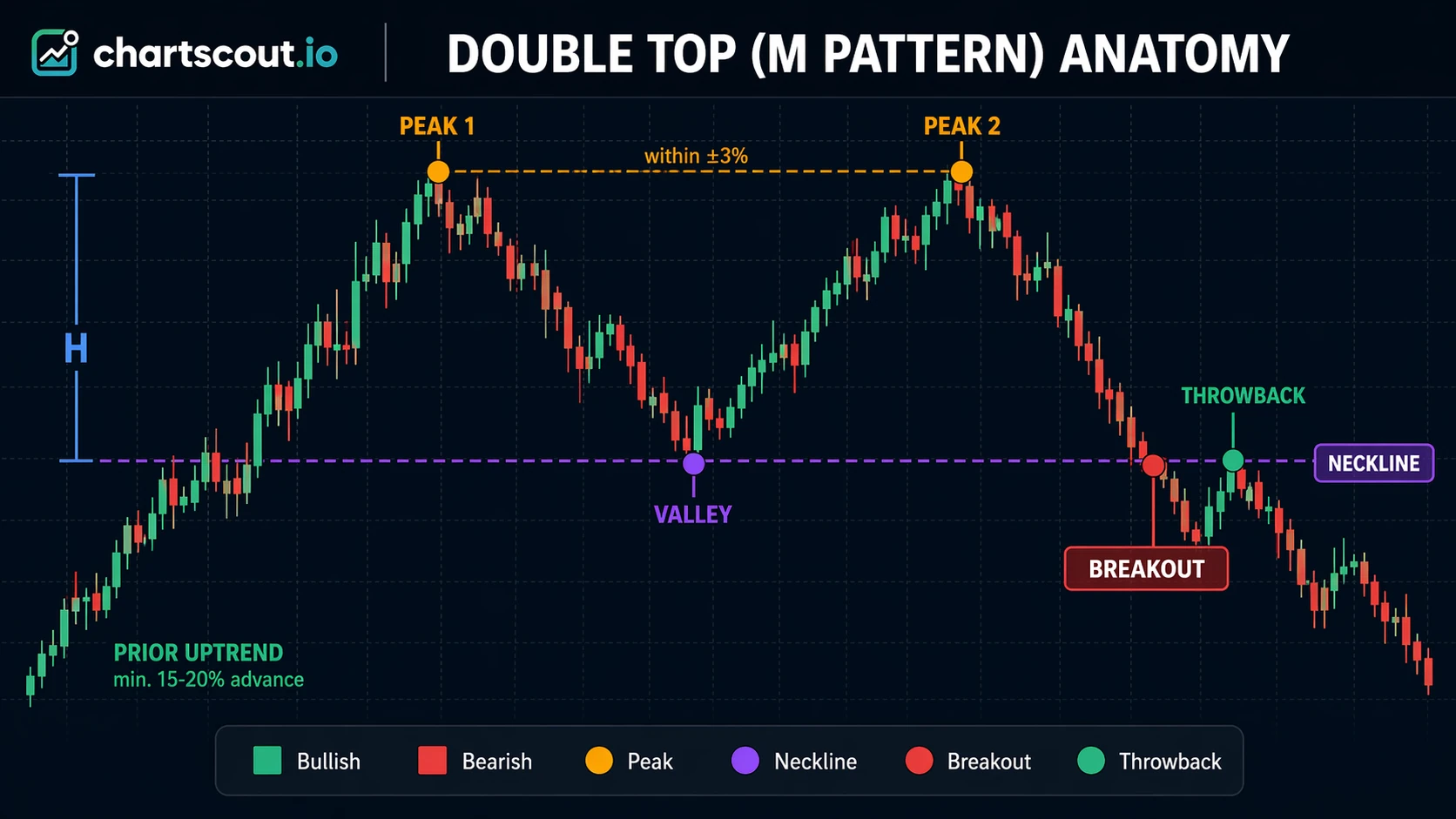
The double top (M pattern) anatomy: prior uptrend, two peaks within ±3%, valley forming the neckline, breakout confirmation, throwback, and measured-move decline
The five anatomy components
1. Prior uptrend
A double top is a reversal pattern - it must have something to reverse. A minimum 15–20% prior advance is required for the pattern to carry meaningful weight.
2. First peak (left top)
Price rallies to a new high on strong volume, then pulls back. This creates the left side of the “M.”
3. The valley (neckline)
The trough between the two peaks forms the neckline. According to Edwards & Magee's formal definition, this level must be at least 15% below the peaks on diminishing activity. Schabacker suggested approximately 20% as an ideal depth.
4. Second peak (right top)
Price rallies again but fails to exceed the first peak. Edwards & Magee specify ±3% tolerance. Volume is characteristically lower than the first peak - buyers are running out of conviction.
5. Neckline break (confirmation)
A close below the valley level confirms the pattern and signals a trend reversal. This is the critical step - without it, you do not have a confirmed double top.
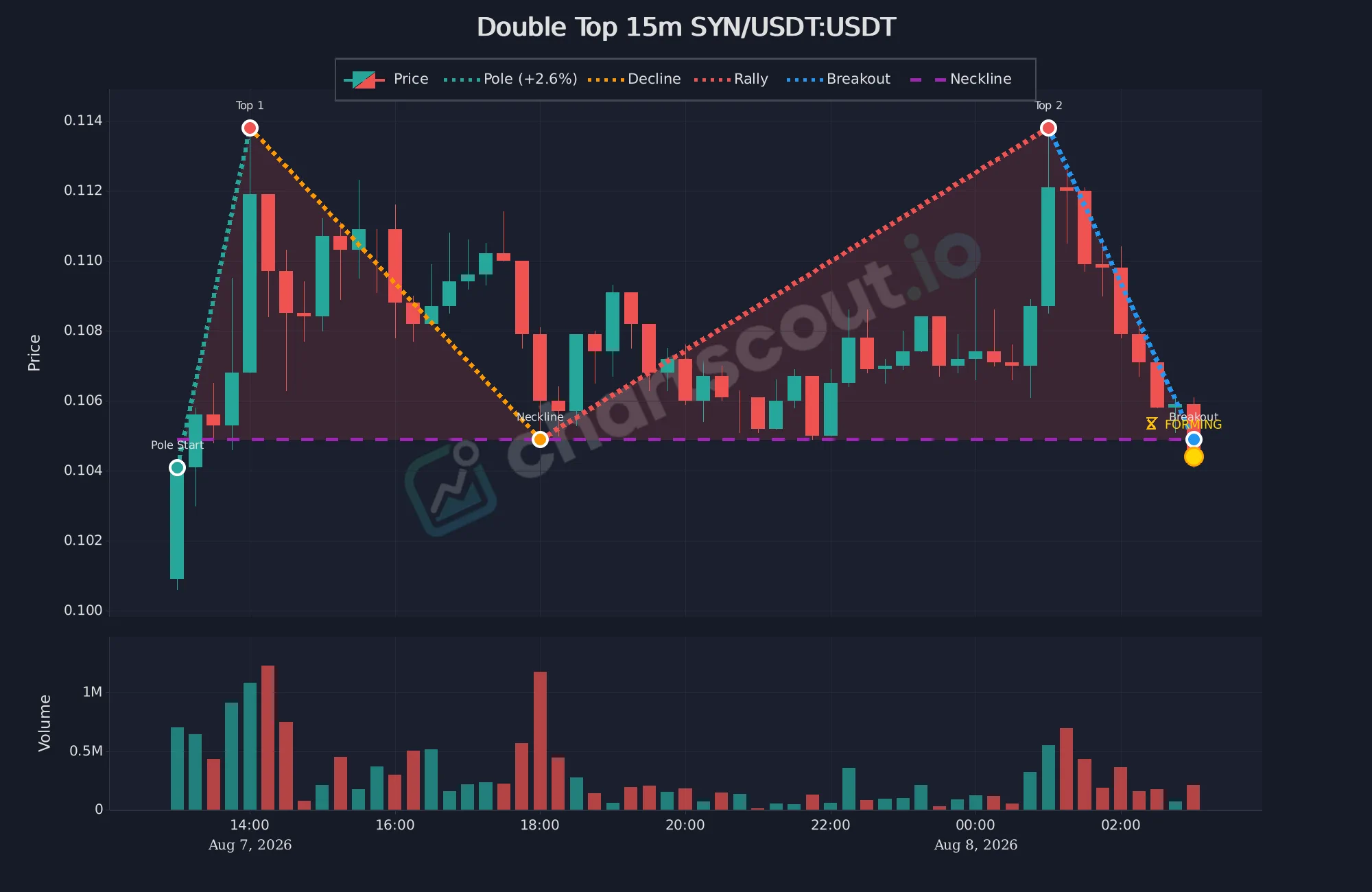
SYN/USDT 15-minute chart on MEXC - forming double top M pattern with two peaks, neckline, and breakdown marker. Detection date: August 8, 2026.
The psychology behind double tops
“The Double Top formation may be compared to successive assaults made by an army on a strongly defended enemy line. The first attack is made in force but is stopped short and quickly repulsed. The attackers drop back to a safe position, consolidate their forces, rest and gather strength for another assault on the enemy trenches. Again the charge is made; the first line of enemy trenches may be slightly penetrated or the attack may be stopped before it quite attains that objective; in any event the attack is repulsed and, this time, the beaten army has spent its strength and retreats in defeat. The tide of battle has turned.”
- Richard W. Schabacker, Technical Analysis and Stock Market ProfitsSchabacker's military analogy is remarkably precise. The double top is not a random shape - it is the visible footprint of a specific battle between buyers and sellers playing out in two acts.
Act one: the first peak
Price rallies strongly to a new high on heavy volume. Momentum traders and late bulls pile in, driving prices to a level where significant selling interest exists - often a previous high, a round number, or a major resistance zone. When the selling pressure absorbs the buying, price reverses. Early buyers take profits. The market pulls back.
Act two: the failed assault
Traders who missed the first rally now buy the dip, driving price back toward the prior high. But this rally is different: volume is lower, momentum indicators diverge, and institutional sellers who absorbed demand at the first peak are waiting at the same price level again. The second assault fails at the same resistance ceiling - and this time, buyers have fewer reserves left.
The neckline break: capitulation
When price falls through the neckline - the low between the two peaks - it invalidates the pattern of higher lows that defined the uptrend. Stop-loss orders cluster just below this level, and their execution accelerates the decline. In crypto, this dynamic is amplified by leveraged positions and liquidation cascades. Bulkowski observed the mechanism directly: “Many unfortunate investors bought near the left top hoping prices would continue rising... Those investors that bought at the top swore they would sell just as soon as they got their money back. When price started rising again, many of them pulled the trigger and sold their shares.” The second peak was their exit, flooding the market with supply and setting up the breakdown.
Double top statistics: what the data actually shows
No other analyst has studied chart pattern performance with the rigor of Thomas Bulkowski. His work across two books - Encyclopedia of Chart Patterns and Trading Classic Chart Patterns - provides the most reliable statistical baseline available.
“The twin peak pattern becomes a true AADT when price closes below the confirmation line. That qualification is important as an earlier study I did found that price continues rising 65% of the time without confirming the twin-peak pattern. Thus, always wait for confirmation unless you have valid reasons for trading earlier.”
- Thomas N. Bulkowski, Encyclopedia of Chart Patterns, 2nd EditionThe confirmation effect
Without confirmation
Entering before neckline close = flipping a biased coin against you
After confirmed break (Adam & Adam)
Eve & Eve variant: 20% failure / 80% break-even (thepatternsite.com)
Performance statistics (Bulkowski thepatternsite.com, Adam & Adam variant)
Source: thepatternsite.com, 1,114 perfect Adam & Adam trades, updated 8/26/2020. Adam & Adam ranks 19 out of 36 bearish patterns. Eve & Eve variant (the better performer) ranks 12/36 with 16% decline, 65% pullback rate, and 80% break-even rate. As Bulkowski states in Trading Classic Chart Patterns: “Simply put, double tops are light on performance.” Manage expectations accordingly. Compare with head-and-shoulders.
Stop-loss placement is critical
A meaningful share of confirmed double tops still reverse back above the neckline after the initial breakdown. This is why the stop-loss must always be placed above the second peak - not at the neckline. A close above the second peak definitively invalidates the pattern regardless of prior confirmation.
How to identify a valid double top in crypto
Edwards & Magee were blunt: “True Double Tops and Double Bottoms are exceedingly rare... The true patterns can seldom be positively detected until prices have gone quite a long way away from them.” Most patterns that “look like” double tops do not qualify. The following checklist separates genuine signals from noise.
The 5 qualification criteria
Criterion 1: prior uptrend of 15%+
The pattern must emerge from a clear uptrend. A double top with no prior uptrend is just price consolidation, not a reversal.
Criterion 2: peaks within ±3% of each other
Per Edwards & Magee: “Another rally back to the previous high (plus or minus 3%) is made.” A second peak significantly above the first is a bull trap, not a double top.
Criterion 3: valley depth of 10–20%
The trough between peaks should represent a 10–20% decline from the top (Schabacker suggested ~20%). Shallower pullbacks - under 7–10% - disqualify the pattern. A deep valley indicates genuine supply/demand imbalance.
Criterion 4: adequate time separation
Edwards & Magee: “The two highs should be more than a month apart.” Schabacker: “The longer the time interval between the two tops, the more important the pattern becomes.” In crypto on lower timeframes (4h, 1h), scale this proportionally - peaks 20–40+ candles apart carry more weight.
Criterion 5: lower volume at the second peak
Volume should be high at the first peak and noticeably lower at the second. Edwards & Magee: “some pickup in turnover, but not as much as on the first peak.” Rising volume at the second peak is a disqualifier - it signals renewed buying pressure, not exhaustion.
Real Bitcoin examples
The most cited crypto double top is Bitcoin's 2021 formation - two peaks at approximately $64,800 (April) and $64,000 (June), with the neckline around $47,000. The pattern confirmed when BTC closed below $47,000, initiating a decline to the mid-$20,000s. More recently, BTC formed another potential double top structure near the $108,000 level in late 2024/early 2025, with the neckline around the $92,000–$95,000 zone. These are the formations ChartScout's detector identifies in real time across all pairs.
ChartScout automates this checklist
Manually scanning 200+ crypto pairs for valid double top setups across multiple timeframes is impractical. ChartScout's automated detector validates all five criteria in real time, including dual-peak proximity and neckline confirmation, and alerts you the moment a pattern passes. See live double top alerts →
Volume confirmation rules for double tops
Volume is the single most important confirmation tool for the double top pattern. Every authoritative source - Schabacker, Edwards & Magee, and Bulkowski - emphasizes the volume signature. (For a broader look at how volume interacts with all chart patterns, see our volume analysis guide.) Here is the four-stage pattern to look for:
First peak: high volume
Strong buying pressure drives price to the first high. Volume should be above the 20-period average - this represents genuine demand.
Valley: declining volume
Volume decreases as price pulls back to the neckline. Low-volume pullbacks suggest the downtrend is merely a pause, not a full reversal - yet.
Second peak: lower volume
This is the key divergence. The second rally produces noticeably less volume than the first - 15–20% lower is the target threshold. Fewer buyers are willing to pay those prices.
Neckline break: volume spike
A valid breakdown should be accompanied by above-average volume - at least 25–30% above the 20-period average. A breakdown on low volume is suspicious and may not hold.
Bulkowski on pullback and volume
“When everyone sells their shares soon after a breakout, what is left is an unbalance of buying demand (since the sellers have all sold), so the price rises and pulls back to the confirmation point.” High-volume breakouts are paradoxically more likely to produce pullbacks to the neckline, creating your second entry opportunity. For broader confirmation logic that pairs well with double-top breakdowns, the death cross trading guide walks through the moving-average filters most useful in bear regimes.
Complete double top trading strategy (6 steps)
“The conclusive definition of a Double Top is given by a negative answer to that last question. If prices, on their recession from the second peak, drop through the Bottom level of the valley, a Reversal of Trend from up to down is signaled. And it is usually a signal of major importance. Fully confirmed Double Tops seldom appear at turns in the Intermediate Trend; they are characteristically a Primary Reversal phenomenon. Hence, when you are sure you have one, do not scorn it.”
- Edwards & Magee, Technical Analysis of Stock Trends6-step trading framework
Key takeaway: minimum R:R rule
Before entering any double top trade, verify the setup offers at least 2:1 reward-to-risk. Calculate: (entry to measured-move target) / (entry to stop). If the result is below 2.0, skip the trade - the pattern is real but the trade math doesn't support participation.
Best timeframes for double top patterns in crypto
No competitor guide addresses this question for crypto - and it matters. The 24/7 nature of crypto markets means patterns form across weekends, during low-liquidity periods, and with different noise profiles than equity markets. (New to reading crypto charts? Start with our beginner chart reading guide.) Here is a practical breakdown:
| Timeframe | Reliability | Noise Level | Best Use |
|---|---|---|---|
| 15m | Low | Very High | Scalping only; require RSI divergence filter |
| 1h | Medium | Medium | Short-term swing; confirm with 4h trend |
| 4h | High | Low | Sweet spot for crypto swing traders |
| Daily | Highest | Lowest | Macro reversals; position trading |
Crypto timeframe translation: candles, not calendar
Bulkowski's data is anchored to daily stock charts where his “peaks more than a month apart” rule equates to roughly 20 to 40 trading candles. Chart patterns scale by candle count, not wall-clock time. A 30-candle double top with peaks 20 to 40 candles apart is the same pattern on 5m as on daily, the calendar duration just collapses.
| Timeframe | Peaks 20 to 40 candles apart | ChartScout use |
|---|---|---|
| 1m | ~20 to 40 minutes | Scalping only, very high noise |
| 5m | ~1.5 to 3.5 hours | Intraday scalping, day trading |
| 15m | ~5 to 10 hours | Day trading sweet spot |
| 1h | ~20 to 40 hours | Intraday to overnight swing |
| 4h | ~3.5 to 7 days | Multi-day swing, cleanest signal |
| 1d | ~3 to 6 weeks | Macro reversal, position trading |
| 1w | ~5 to 10 months | Cycle reversal, very rare |
Bulkowski's “peaks should be more than a month apart” rule scales to the candle column. On 1m, 20 minutes between peaks is enough. On daily, three weeks plus is the equivalent. The pattern's structural validity does not change, only the number of clock minutes a candle covers.
Practical rules by trader type
Why double tops fail: crypto-specific risks
“We come now to a formation which is one of the most loosely and glibly discussed of all reversal patterns - the Double Top... Probably not more than a third of them signaled reversal; and most of the patterns which are popularly alluded to as ‘looking like a Double Top’, carry no such suggestion to the informed student.”
- Richard W. Schabacker, Technical Analysis and Stock Market ProfitsSchabacker wrote this in 1932. The warning is more relevant in crypto than anywhere else. Here are the five most common failure modes specific to crypto markets:
Failure 1: news-driven invalidation
A single positive catalyst - ETF approval, institutional buying announcement, regulatory clarity - can erase a forming double top in minutes. This is the primary crypto failure driver and has no equivalent in equity or forex markets. Filter: avoid entering double tops immediately before major scheduled catalysts (FOMC, ETF decisions, token unlocks).
Failure 2: second peak exceeds first (bull trap)
When the second peak clears the first by more than 3%, the pattern is invalidated - but traders who already shorted are trapped. This is a calculated stop-hunt by larger players who know where stops cluster (just above the first peak). Filter: place stop-loss above the second peak, not the first.
Failure 3: low-liquidity fake neckline break
On low-cap altcoins, thin order books mean a single large sell order can spike price below the neckline momentarily without representing genuine selling pressure. The candle closes back above the neckline within one or two bars - a classic fake breakout. Filter: require above-average volume on the neckline break candle and confirmation over 2–3 bars.
Failure 4: rising neckline pattern
A significantly rising neckline - where each trough is higher than the last - often resolves as a continuation pattern rather than a reversal. The rising lows indicate persistent buying pressure. Filter: treat rising-neckline double tops with skepticism; only trade them if the second peak is notably weaker in volume and momentum indicators diverge sharply.
Failure 5: pattern busts after confirmation
Even fully confirmed double tops can reverse - price recovers above the neckline after the initial breakdown. This is not prevented by any filter; it is managed by the stop-loss above the second peak. Rule: always size positions conservatively, and treat a close above the second peak as a definitive exit signal regardless of how well the trade looked at entry.
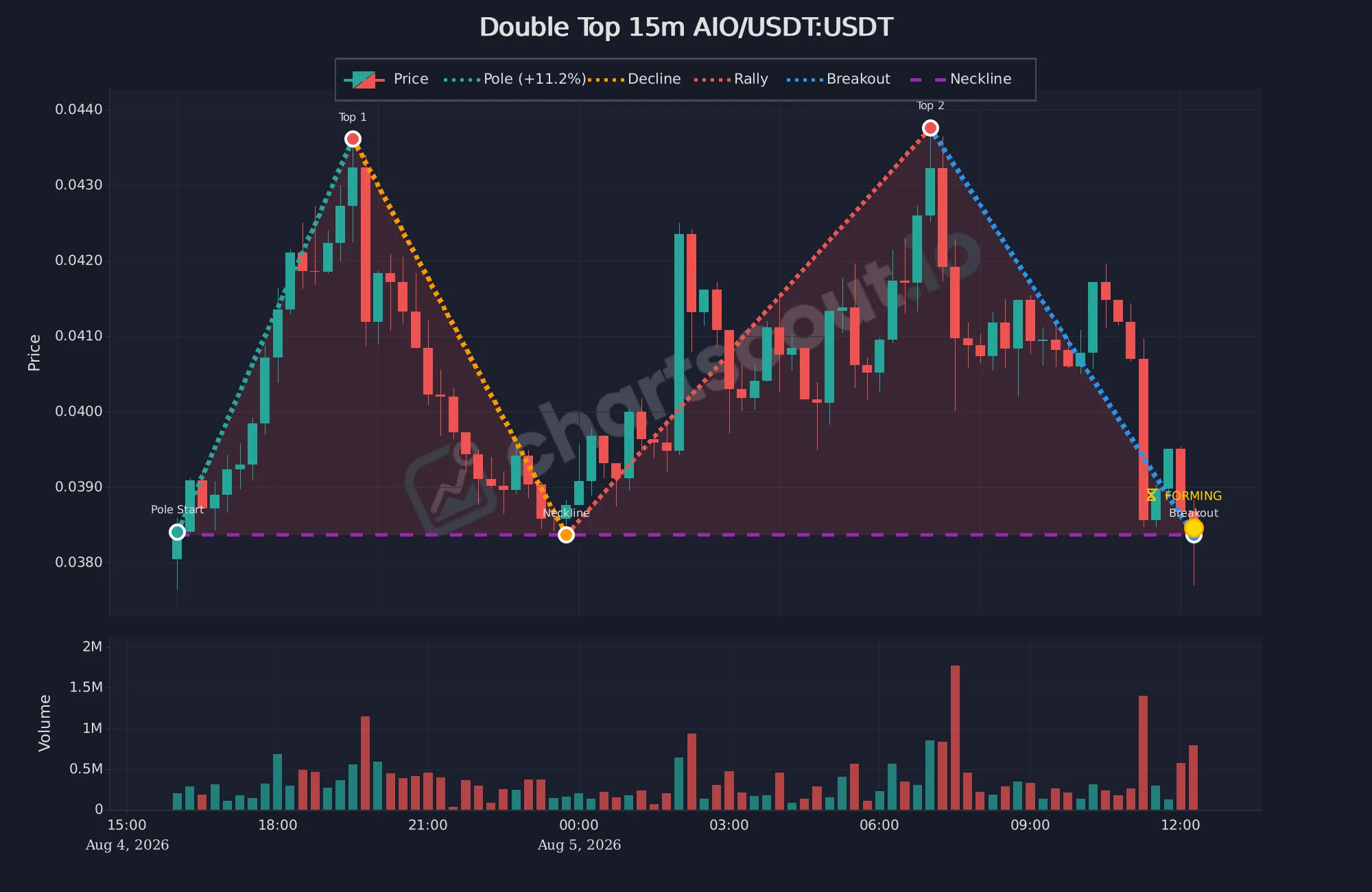
AIO/USDT 15-minute chart on Bybit - forming double top with two peaks, neckline, and breakdown marker. Detection date: August 5, 2026.
Double top in bull vs. bear markets: what the data shows
Market regime is the single largest modifier of double top reliability. Bulkowski's updated thepatternsite.com data - a 25% break-even failure rate and 15% average decline for Adam & Adam - comes from bear market conditions where the pattern performs best. In bull markets, even confirmed double tops are more likely to be absorbed by the prevailing uptrend, producing shallower declines or outright failures.
Bear market context (best performance)
- 25% break-even failure rate (Adam & Adam, 20% for Eve & Eve)
- Average decline 15% (16% for Eve & Eve) from neckline breakout
- 64% reach full measured-move target
- Macro trend aligns with the pattern's direction
Bull market context (reduced edge)
- 65% of twin peaks never confirm (price keeps rising)
- Confirmed patterns produce shallower declines
- Higher throwback rate as buyers re-enter on dips
- Require stronger volume confirmation before entering
Crypto-specific regime filter
In crypto, Bitcoin's weekly trend functions as the regime indicator for the entire market. Before shorting a double top on any altcoin, check the BTC weekly chart: if BTC is in a confirmed weekly uptrend (price above the 20-week EMA, rising weekly closes), treat all lower-timeframe double tops as lower-probability setups requiring extra confirmation. In crypto's 2024-2025 bull market, many textbook double tops were absorbed by the prevailing uptrend and never reached their targets.
An additional crypto-specific factor is perpetual futures funding rates. A heavily positive funding environment during the formation of the second peak is a bearish signal: the market is paying longs to hold, and when funding normalizes or flips negative, long liquidations accelerate the breakdown. A positive-to-negative funding flip at the neckline break is a high-conviction confirmation signal unique to crypto.
Bulkowski stock baseline vs crypto: what shifts
All Bulkowski statistics cited above are stock-market data. Crypto has structural differences that modify how double tops form and how they resolve. The psychology and structural rules carry across cleanly. What changes is the pace, the amplitude, and the noise floor.
| Factor | Bulkowski baseline (stocks) | Crypto expectation |
|---|---|---|
| Pattern pace | Days to weeks per pattern | Minutes to days on low timeframes, same candle count, compressed wall-clock time |
| Average decline | 15% (Adam & Adam), 16% (Eve & Eve) | Likely amplified on volatile alts, tighter on BTC/ETH. No crypto-wide study yet |
| Failure rate | 25% break-even failure (Adam & Adam) | Likely higher on 1m to 15m due to fakeouts and thin liquidity, comparable on 4h to 1d |
| Volume confirmation | Single-exchange tape, reliable | Fragmented across 4+ exchanges, wash-trading on low-volume alts. Cross-check aggregate volume |
| Pullback rate | 64% return to neckline | Likely similar, but leveraged perp liquidations create deeper pullbacks |
| Gap risk | Overnight and weekend gaps common | 24/7 trading - no gaps, but weekend liquidity drops cause fakeouts |
| Participant mix | Mostly institutional, smoother tape | Retail-dominated on alts, sharper, more emotional moves |
Honest framing: No comprehensive crypto-wide pattern study exists with a sample size comparable to Bulkowski's 1,114 Adam & Adam dataset. ChartScout is running proprietary backtests to publish crypto-specific figures. Until then, treat Bulkowski's numbers as a relative reliability ranking of chart patterns, not exact crypto predictions. A pattern that ranks 19/36 in stocks is very likely to rank in the same neighbourhood in crypto. Magnitude and speed will differ. Underlying structural edges carry over.
Double top vs. triple top vs. head and shoulders
| Pattern | Structure | Success Rate | Avg. Decline | Trade-off |
|---|---|---|---|---|
| Double Top (Adam & Adam) | 2 peaks, 1 neckline | 75% (25% fail) | 15% | Faster confirmation; moderate decline |
| Triple Top | 3 peaks, 1 neckline | ~85% | ~20% | Extra confirmation; more of the move consumed |
| Head & Shoulders | 3 peaks (middle highest) | 81% | 16% | Longer formation; clearer mid-formation signal |
Key distinguishing criteria
Double Top vs. Triple Top: A triple top requires a third test of the resistance zone before confirming. This extra confirmation sounds like an advantage, but by the time the triple top neckline breaks, more of the measured-move has been consumed and entry-to-target distance is shorter. In fast-moving crypto markets, the double top is typically preferable because it confirms sooner with nearly identical statistical performance.
Double Top vs. Head and Shoulders: The head and shoulders has an asymmetric structure - the middle peak (head) is the highest. This gives traders more information mid-formation (they can anticipate the pattern from the head), while the double top only reveals itself after the second peak. The H&S produces a similar average decline (16%) with a comparable failure rate (19%). Choose based on what the price structure actually shows - never force one interpretation over another.
Double Top vs. Resistance Rejection: A resistance rejection at a prior high is not automatically a double top. The critical difference is the prior uptrend requirement and the meaningful valley between peaks (neckline formation). If price has been ranging sideways for weeks and tests the same high twice, that is range resistance - not a reversal pattern with the statistical edge Bulkowski documented.
Real crypto examples: double top detections
Double top in crypto (BTC and ETH examples)
The most cited double top in crypto is Bitcoin's 2021 cycle top on the weekly chart. The first peak printed in April 2021 around the $64,800 area before BTC sold off into the $30k zone over the following two months. The neckline sat around $30,000 to $32,000. Price then rallied to a second peak in November 2021 near $69,000, just barely exceeding the first high before reversing. The pattern was technically not a clean Adam & Adam double top because the second peak printed slightly higher than the first, but the structure resolved as a textbook reversal anyway: BTC closed below the $30k neckline through Q1/Q2 2022 and continued falling to roughly $15,500 by November 2022, a decline of about 78% from the second peak. ChartScout's backtest engine flags this exact structure on the daily and weekly timeframes as a high-confidence bearish reversal.
Ethereum produced a tighter double top across the same window. ETH topped at roughly $4,360 in early November 2021, pulled back to the $3,900 area, then printed a second peak near $4,860 in early December 2021. Both peaks formed on declining volume relative to the May 2021 climax. The neckline broke around $3,900 in January 2022 and ETH continued falling to roughly $880 by mid-2022, a measured-move overshoot of more than 2x the textbook target.
On lower timeframes, the same structure plays out in hours. A mid-cap altcoin that prints two peaks within 1 to 3% on the 15m or 1h timeframe, on declining volume, with a confirmed neckline close below the valley, behaves identically to BTC's weekly cycle top. The candle count is the same, the wall-clock time is compressed. ChartScout fires alerts on these structures across 1,000+ pairs the moment the neckline closes through.
Detection example: DOLO/USDT - 1-hour Binance
This fresh double top was flagged by ChartScout on the 1-hour DOLO/USDT chart on Binance. The forming structure shows two peaks, the neckline, and a breakdown marker, giving traders a clear confirmation level to monitor before treating the reversal as confirmed.
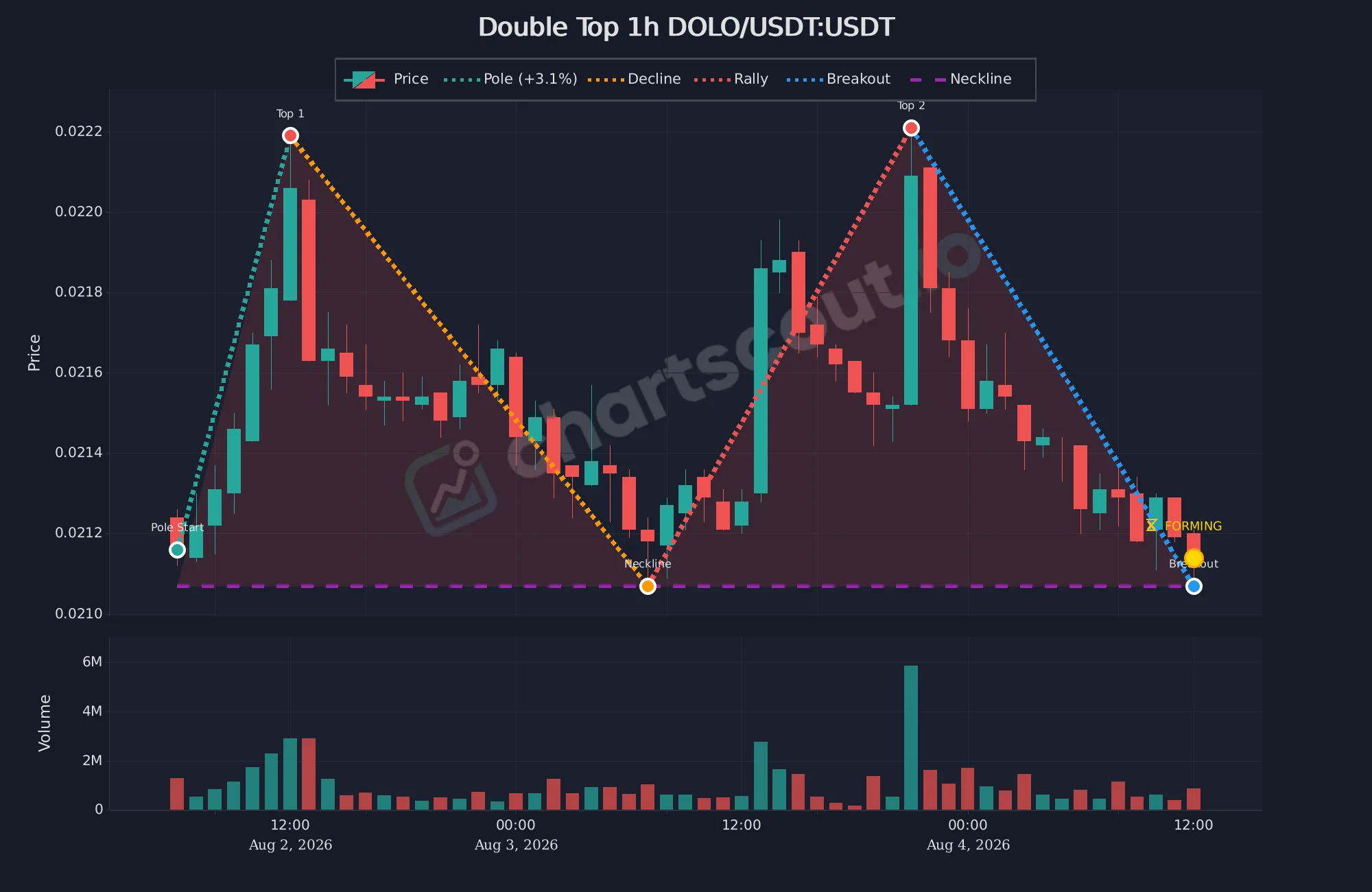
DOLO/USDT 1-hour chart on Binance - forming double top with two peaks, neckline, and breakdown marker. Detection date: August 4, 2026.
Backtesting results: historical double top detections
The following double top patterns were identified by ChartScout's backtesting engine on historical data. These results validate the detection model against known market conditions across major and mid-cap coins from 2021-2025.
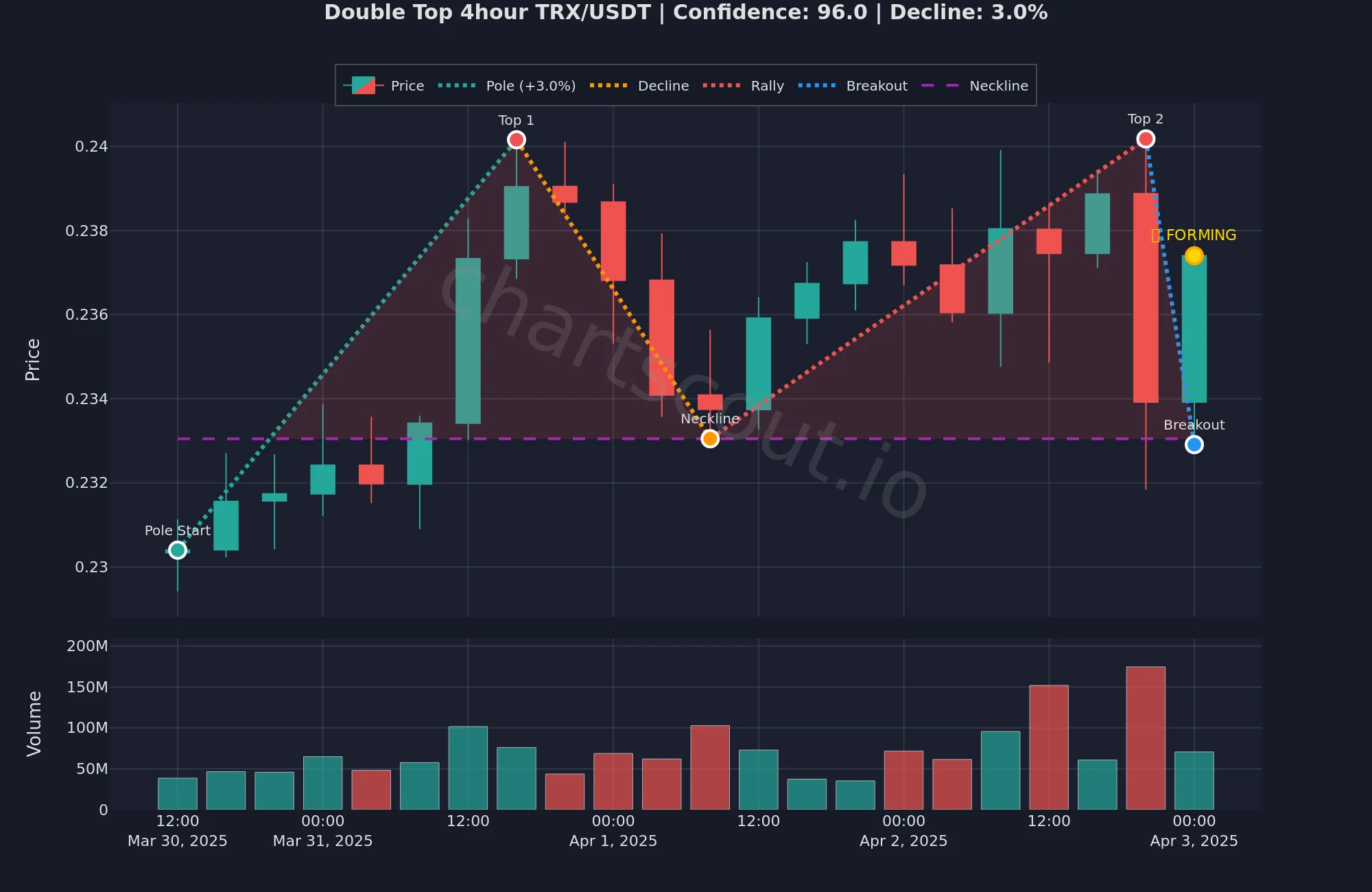
TRX/USDT 4h, March 2025 - ChartScout backtest engine detection: double top (96% confidence, 3.0% decline) with textbook M formation and strong volume confirmation
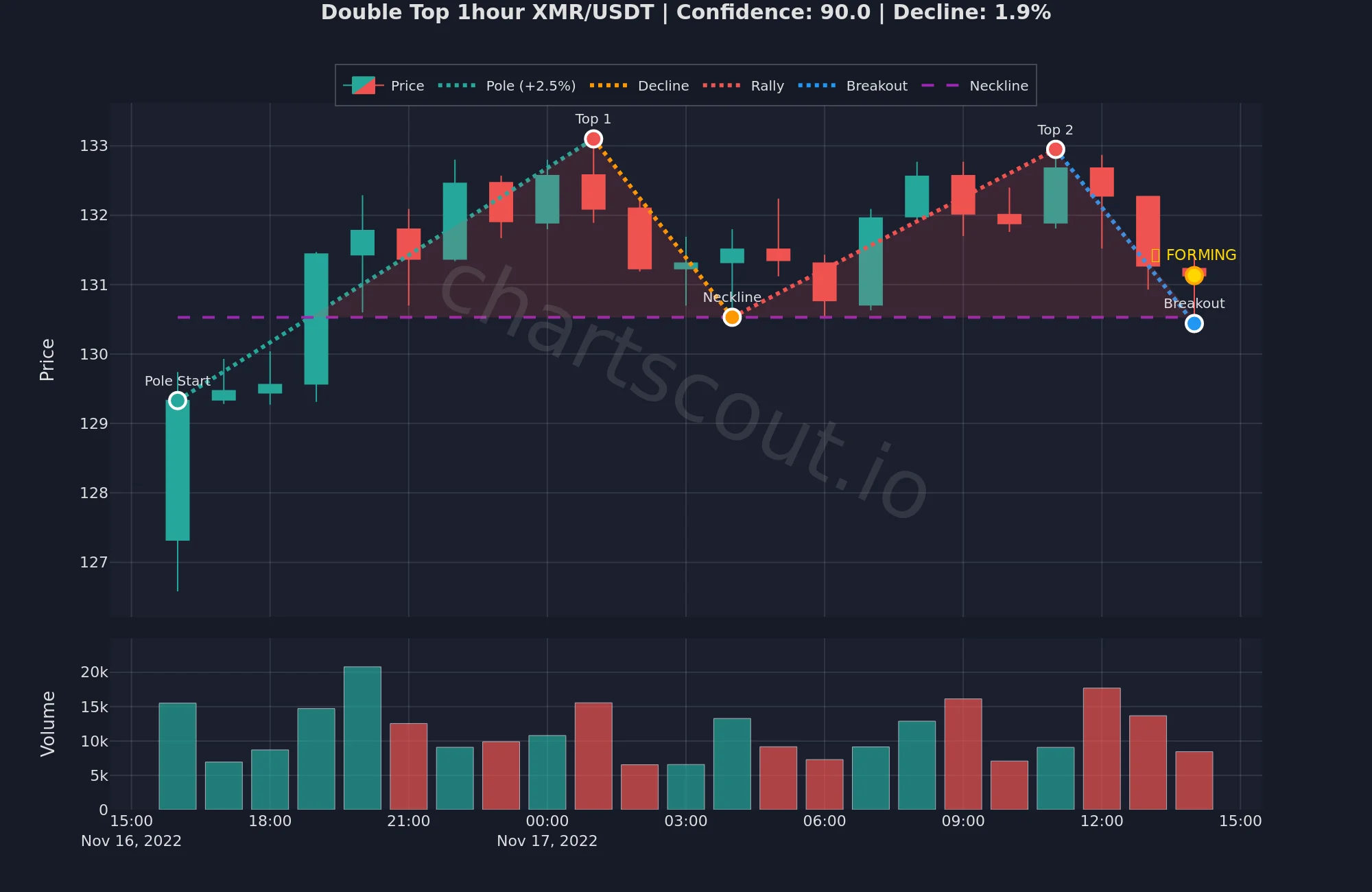
XMR/USDT 1h, November 2022 - ChartScout backtest engine detection: double top (90% confidence, 1.9% decline) with two equal peaks at $133 and confirmed neckline break
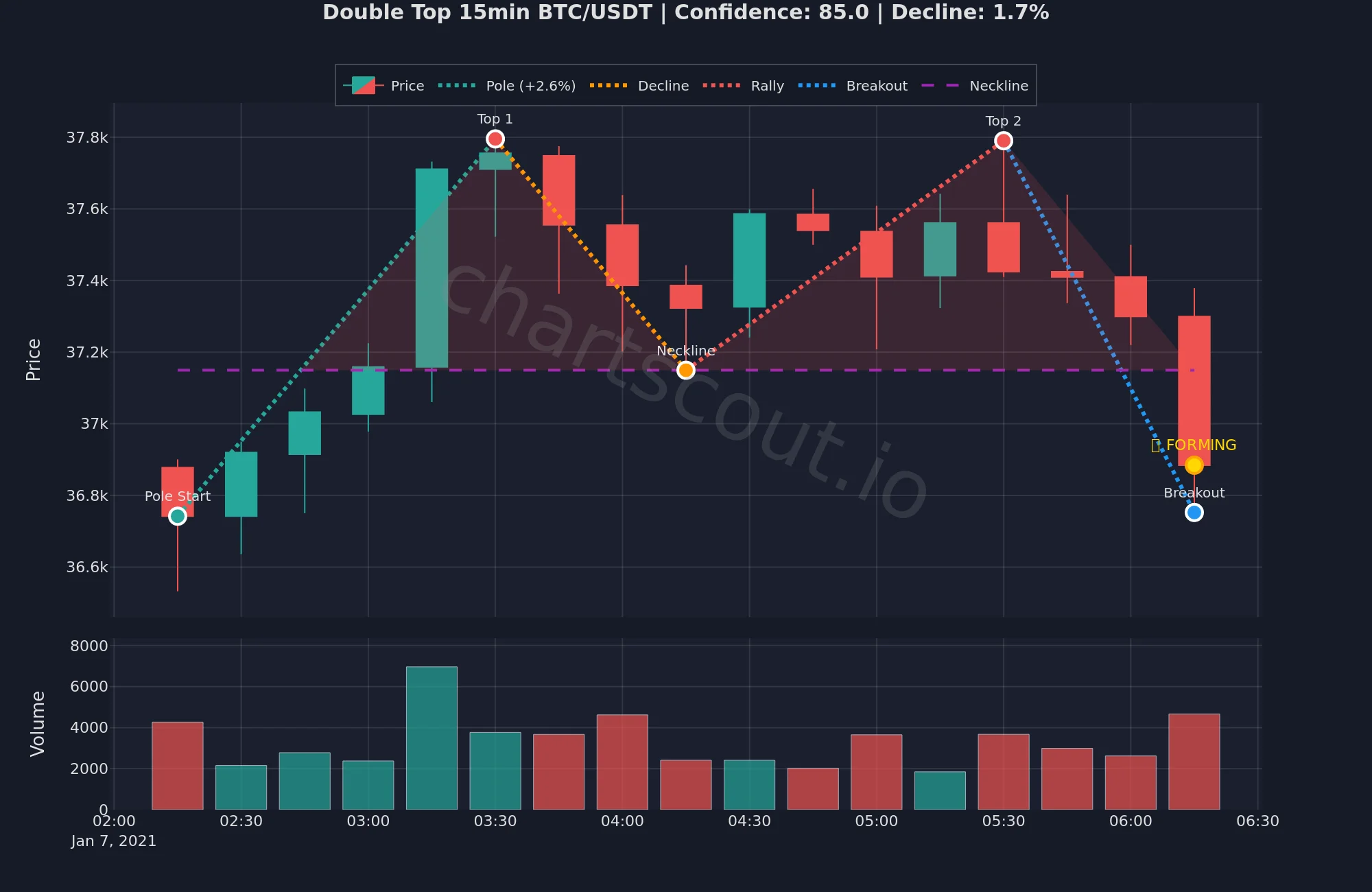
BTC/USDT 15m, January 2021 - ChartScout backtest engine detection: double top (85% confidence, 1.7% decline) with two peaks at $37,800 and neckline break
Get real-time double top alerts
ChartScout monitors 1,000+ trading pairs across all major timeframes. The moment a confirmed double top is detected, you receive an instant alert, no chart-watching required.
Start 7-day trial→Set up your first double top watcher in under 2 minutes.
Frequently asked questions
What is the success rate of the double top pattern?
According to Thomas Bulkowski's updated thepatternsite.com data (1,114 Adam & Adam trades), the confirmed double top pattern has a 25% break-even failure rate - meaning 75% of patterns that close below the neckline move at least 5% lower. The Eve & Eve variant performs slightly better at 80%. Without neckline confirmation, twin-peak formations fail 65% of the time as price continues rising. Waiting for the confirmed close is the single most important factor.
How reliable is the double top pattern in crypto?
It is reasonably reliable on 4h and daily timeframes. Confirmed Adam & Adam patterns produce an average decline of 15% (16% for Eve & Eve) and approximately 64% reach the full measured-move target per Bulkowski's updated thepatternsite.com data. Crypto-specific risks - leverage, sudden news, and thin altcoin liquidity - make volume confirmation essential.
What is the double top pattern failure rate?
Confirmed Adam & Adam double tops carry a 25% break-even failure rate per Bulkowski's updated thepatternsite.com data (the Eve & Eve variant is slightly better at 20%). Unconfirmed twin peaks fail 65% of the time. Additionally, a meaningful share of confirmed patterns later reverse back above the neckline - which is why the stop-loss must always be placed above the second peak, not at the neckline.
What causes a double top to fail in crypto?
The most common failure causes: unexpected positive news reversing selling pressure (the primary crypto driver), the second peak slightly exceeding the first (a bull trap), low liquidity creating a fake neckline break, and a rising neckline resolving as a continuation. Always require above-average volume on the neckline break to filter false signals.
Where do you place a stop-loss on a double top trade?
Place the stop-loss 1–3% above the second peak - above the maximum resistance ceiling. A close above this level definitively invalidates the pattern. On a retest entry - entering when price returns to the neckline after breaking below it - a tighter stop 1–2% above the neckline is acceptable and improves risk/reward significantly.
How do you calculate the price target for a double top?
Measure the vertical distance (H) from the peaks to the neckline, then subtract H from the neckline breakout price. If peaks are at $100 and neckline at $88, the target is $76. According to Bulkowski, approximately 64% of confirmed Adam & Adam double tops reach this full measured-move target.
Should you enter on the neckline break or wait for a retest?
Both are valid. A breakout entry captures the full move but risks fakeouts. A retest entry waits for the 64% of confirmed Adam & Adam patterns (65% for Eve & Eve) that pull back to the neckline as resistance - offering a tighter stop and better risk/reward, at the cost of missing the ~35% of patterns that do not pull back.
On which timeframe is the double top pattern most reliable in crypto?
The 4-hour and daily timeframes produce the most reliable double top signals in crypto, with significantly less noise than 1h or 15m charts. On the 15-minute timeframe, require RSI divergence - RSI making a lower high at the second peak while price makes an equal high - as an additional confirmation filter.
Key takeaways
- • 65% of twin peaks do not confirm - never enter before the neckline close
- • Confirmed Adam & Adam double tops have a 25% break-even failure rate (75% success), with 15% average declines (Eve & Eve: 20% / 16%)
- • 64% of confirmed patterns pull back to the neckline - use that for a lower-risk entry
- • Stop-loss always above the second peak - never at the neckline
- • 64% of confirmed Adam & Adam double tops reach the full measured-move target (thepatternsite.com)
- • 4h and daily timeframes provide the best signal quality in crypto
Sources & references
Data source note: All break-even failure rates, average declines, pullback rates, target-hit percentages, and Bulkowski rankings in this guide come from Thomas Bulkowski's most recent published statistics at thepatternsite.com (data updated 8/26/2020). The Adam & Adam double top is based on 1,114 perfect trades and ranks 19 out of 36 bearish chart patterns; the Eve & Eve variant (942 trades) ranks 12/36. Earlier print editions of Bulkowski's Encyclopedia (2005) reported a 17% failure rate using a different methodology; we cite the updated 25% break-even figure throughout.
- Bulkowski, Thomas N. ThePatternSite.com - Double Tops, Adam & Adam. Updated 8/26/2020. thepatternsite.com/DTAA.html.
Primary statistical source. Current Adam & Adam figures: 25% break-even failure rate, 15% average decline, 64% pullback rate, 64% target-hit rate, rank 19 out of 36 bearish patterns. Based on 1,114 perfect trades. Eve & Eve variant (DTEE.html) is the better-performing double top: 20% failure, 16% decline, 65% pullback, rank 12/36. - Edwards, Robert D., John Magee & W.H.C. Bassetti. Technical Analysis of Stock Trends, 9th Edition. CRC Press, 2007. ISBN: 978-0849337222.
Primary source for the formal double top definition (p. 138), the “exceedingly rare” warning about true double tops (p. 136), the conclusive confirmation rule and measuring formula (p. 144), and the glossary criteria: ±3% peak tolerance, minimum 15% valley depth, and peaks more than a month apart (p. 751). - Schabacker, Richard W. Technical Analysis and Stock Market Profits. 1932 (reprinted by Harriman House, 2005). ISBN: 1897597568.
Original documentation of the double top as “one of the most loosely and glibly discussed of all reversal patterns,” the military-analogy explanation of market psychology, and the time-separation rule: “the longer the time interval between the two tops, the more important the pattern becomes.” - Bulkowski, Thomas N. Encyclopedia of Chart Patterns, 2nd Edition. John Wiley & Sons, 2005. ISBN: 978-0471668268.
Historical baseline. Cited for the 65% non-confirmation rate for twin-peak patterns (p. 277), the four-variant taxonomy (Adam & Adam, Adam & Eve, Eve & Adam, Eve & Eve), and the psychology behind why investors sell at the second peak (pp. 296-297). Statistical figures from this edition have been superseded by the 2020 thepatternsite.com update. - Bulkowski, Thomas N. Trading Classic Chart Patterns. John Wiley & Sons, 2002. ISBN: 978-0471435754.
Source for the qualitative assessment that “double tops are light on performance” relative to other bearish patterns (p. 172) and for the four double-top variant comparisons. - Murphy, John J. Charting Made Easy. Marketplace Books, 2004.
Concise definition of double tops as “M” patterns and the first-sign-of-weakness rule: “the inability of the second peak to move above the first peak is the first sign of weakness” (p. 15).
Related guides
Double bottom (W pattern) guide
The bullish mirror of the double top - 39% average rise and 84% break-even rate on confirmed Adam & Adam breakouts.
Head and shoulders pattern
Another major bearish reversal with 81% success rate - compare its structure and stats to the double top.
Stop loss placement guide
Pattern-by-pattern stop placement with Bulkowski data, ATR-based stops, and the 1% position sizing rule.
How to spot fake breakouts
7-point checklist to avoid fakeouts - essential for filtering false neckline breaks on double tops.
Chart patterns & volume analysis
Volume confirmation rules for 16 chart patterns including double tops and bottoms.
How to read crypto charts
Candlestick basics, chart types, and 8 essential patterns every crypto trader must know.
Crypto chart patterns cheat sheet
all 23 ChartScout detectors with Bulkowski break-even rates, volume rules, and 5m to 4h playbooks.
Bear flag pattern
The bearish continuation that often follows a confirmed double top, 8% average decline on confirmed breaks.
Bear pennant pattern
Bear pennants and double tops are bearish cousins, only 43% break down and 32% hit target.
Rising wedge vs falling wedge
Rising wedge ranks 36/36 dead last among bearish patterns, often confused with double tops.

Stjepan Ivanović
Founder of ChartScout · Crypto Trader Since 2013
Trading crypto since 2013 with his first Bitcoin bought at ~$200. Four complete bull/bear market cycles, traded on early exchanges like Mt.Gox and BTC-e, on-chain trading on IDEX and EtherDelta, and ~70 crypto project investments. Built ChartScout after 23+ months of development to automate what no trader can do manually. Watch hundreds of charts 24/7.