Double bottom pattern crypto: 39% average rise W pattern guide
The double bottom (W pattern) is a bullish reversal with a 16% break-even failure rate and a 39% average rise on confirmed breakouts, per Thomas Bulkowski's research on 1,154 Adam & Adam double bottoms. Two roughly equal price lows form a W shape; a close above the neckline is the only valid entry signal.
A double bottom in crypto is the W-shaped price structure you see on a chart when an asset falls to a support level, bounces, falls back to roughly the same level, and then turns higher. Crypto traders use it to time the end of a downtrend: two equal lows show that sellers tried to push price down twice and failed, and a close above the neckline between those lows is the signal that buyers have taken control. Without that neckline close the pattern fails roughly two-thirds of the time (Bulkowski's pre-confirmation failure rate is 64%); once price closes above the neckline, that failure rate collapses dramatically.
Double bottom pattern: key statistics
Source: Thomas Bulkowski, thepatternsite.com, Adam & Adam Double Bottom, 1,154 perfect trades. Break-even failure rate = patterns failing to rise 5% above the breakout price.
This guide covers every layer of the double bottom: its anatomy, the psychology behind it, how to confirm it correctly, specific entry and exit rules, what failure looks like before it happens, and how ChartScout's scanner detects it across hundreds of crypto pairs without requiring you to inspect every chart manually.
Once the neckline confirms, plan invalidation and target distance before entering. The crypto stop-loss placement guide covers structural stops, while the pattern-specific risk-reward guide shows how to test whether the measured move is worth the risk.
What is the double bottom pattern in crypto?
The double bottom is a bullish reversal chart pattern that forms after a sustained downtrend. Price falls to a support level and produces a first trough, bounces up to an intermediate peak called the neckline, then falls a second time to approximately the same level to form a second trough. When price subsequently rallies above the neckline on expanding volume, the reversal is confirmed - producing the distinctive W shape that gives the pattern its popular alias.
“We come now to a formation which is one of the most loosely and glibly discussed of all reversal patterns - the Double Top (or, in its opposite manifestation, the Double Bottom). The layman who has followed the financial columns in the daily papers or listened to board room gossip has undoubtedly heard it mentioned frequently. It is referred to so often by superficial writers that the beginner is likely to believe it a common and reliable indication of technical reversal, requiring little study. Unfortunately, this is not the case.”
- Richard W. Schabacker, Technical Analysis and Stock Market Profits, Study IV“When a Double Bottom, meeting all the specifications we have analyzed above, appears on our charts we are warranted in predicting an advance of goodly proportions to follow. The 'W' formation is simply the 'M' turned upside down, and is a similar variant of the Double Bottom. Generally speaking, the same requirements as to volume action, extent of price movement and timing apply, and the interpretation is the same.”
- Richard W. Schabacker, Technical Analysis and Stock Market Profits, Study IVMost articles call the double bottom “the most reliable bullish reversal.” That claim is only true for one variant. Bulkowski's thepatternsite.com data ranks the Eve & Eve double bottom 5 out of 39 bullish patterns (excellent), while the Adam & Adam variant ranks 26/39 (mediocre). Most generic mentions don't separate them, which means readers expect Eve & Eve performance from any W shape they spot. The shape alone is not enough. Variant identification, neckline confirmation, and volume profile decide whether the trade has a real edge.
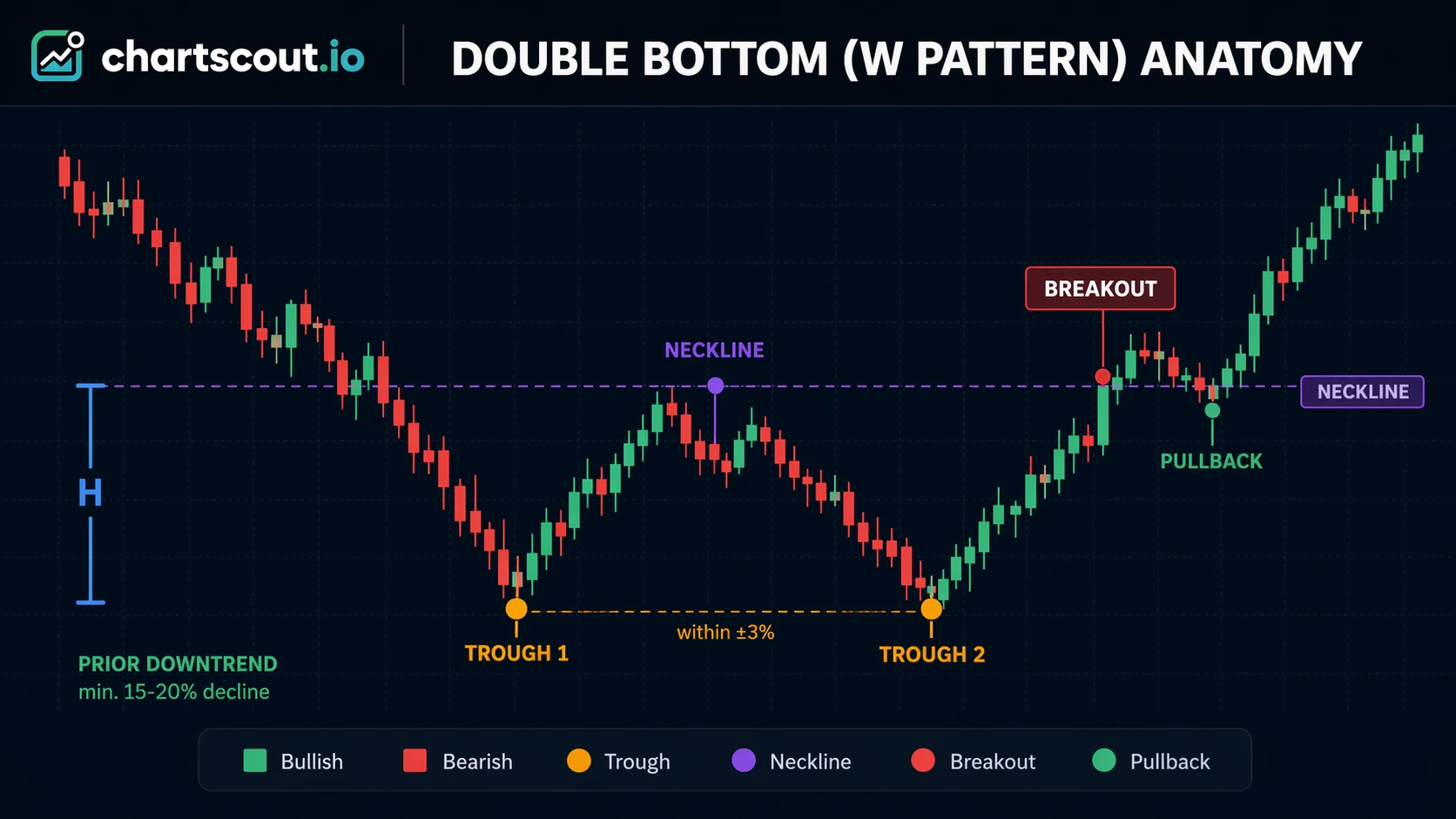
The double bottom (W pattern) anatomy: prior downtrend, two troughs within ±3%, neckline, breakout confirmation, throwback, and measured-move rally
The four components of every valid double bottom
1. Prior downtrend
A meaningful decline must precede the pattern - typically at least 10-15% with a majority of bearish bars. Without a prior downtrend there is nothing to reverse.
2. Two equal troughs
Two price lows within 1-3% of each other, separated by a meaningful time interval and an intermediate rally. The second trough typically forms on lower volume than the first.
3. Neckline
A horizontal resistance level drawn at the highest close reached during the rally between the two troughs. This is the pattern's critical confirmation level.
4. Neckline breakout
A candle close above the neckline on expanding volume. This is the only valid confirmation signal - intraday pierces do not count.
In crypto, the double bottom works across all major pairs and timeframes but is most reliable on 4H and daily charts where market noise is reduced. The 24/7 nature of crypto means the pattern can complete on any day of the week - unlike stocks, where Friday closes often stall developing patterns.
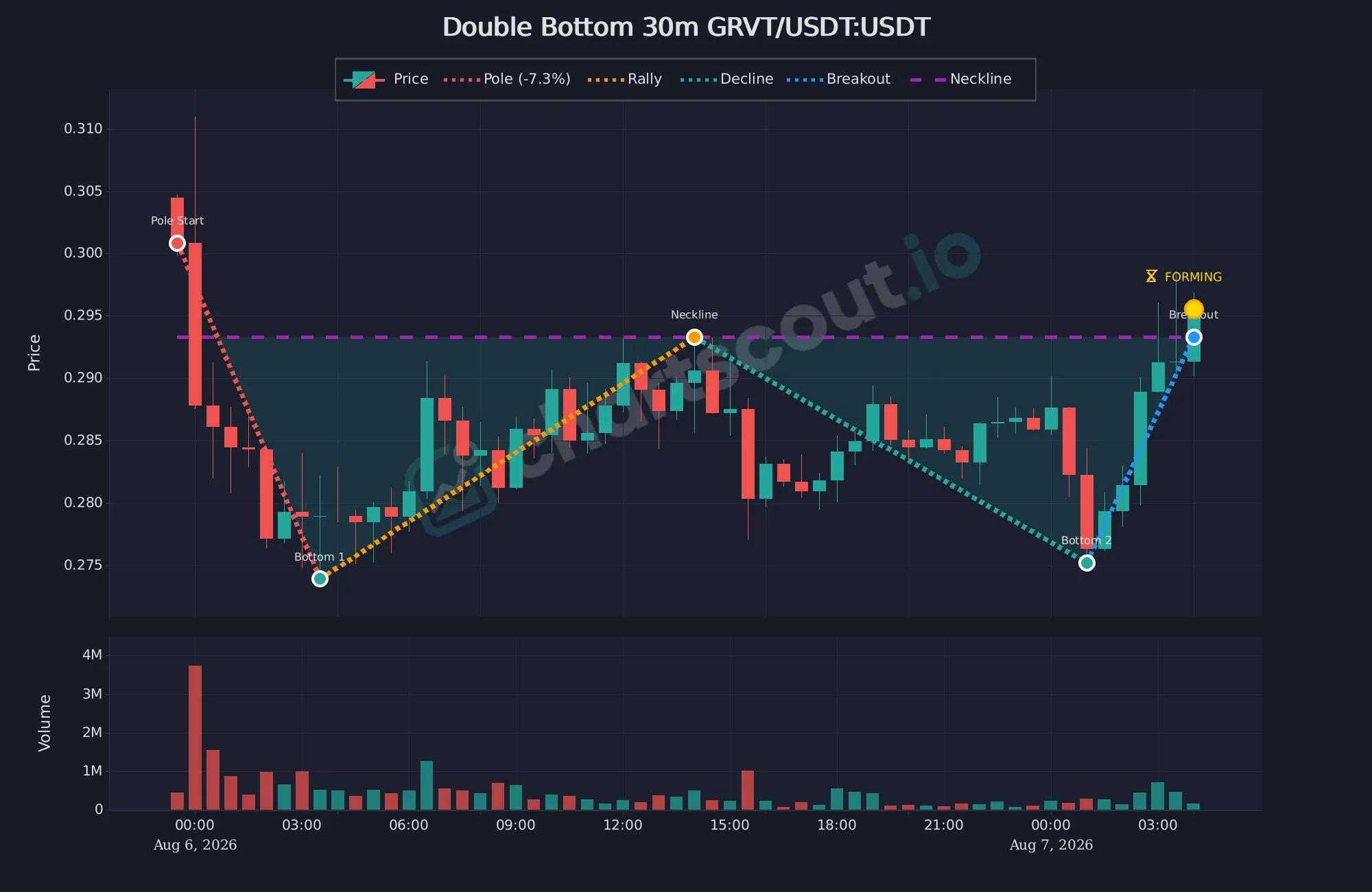
GRVT/USDT 30-minute chart on Bybit - forming double bottom W pattern with two troughs, neckline, and breakout marker. Detection date: August 7, 2026.
How to identify a double bottom in crypto
Most traders misidentify double bottoms by calling any two nearby lows a W pattern. Valid double bottoms require five checkpoints that filter noise from genuine reversals.
Prior downtrend is measurable
Require at least a 10% decline from the most recent swing high to the first trough, with a majority of candles closing lower. Patterns forming in a sideways range have no reversal context and should be ignored.
Two troughs within 1-3% of each other
The two lows must be close in price to demonstrate that sellers hit the same support twice. William O'Neil notes the second bottom often undercuts the first by one or two percent - shaking out weak holders before the reversal accelerates.
Troughs separated by meaningful time
Schabacker emphasized that the interval between troughs must be “of some consequence” - at minimum several days, ideally weeks. On a daily chart, Bulkowski's data shows the best-performing patterns have bottoms roughly 3 months apart. On 4H, aim for at least 8 bars between the two lows.
Rally between troughs of at least 10%
The intermediate bounce must be meaningful enough to establish a clear neckline. A 2-3% rebound is not a neckline candidate - it is a minor consolidation within the downtrend. The Recognia/Bulkowski minimum is 10%; Schabacker and Edwards & Magee preferred 20%.
Volume declines into the second trough
Edwards & Magee note the second bottom is “usually conspicuously dull (little trading volume) and is apt to be quite rounded.” Declining volume at the second trough signals that sellers are exhausted - they cannot muster the same force as the first decline.
ChartScout automates this checklist
Manually scanning dozens of pairs for all five criteria simultaneously is impractical. ChartScout's double bottom detector validates prior downtrend, trough symmetry, volume profile, and neckline breakout automatically across 200+ crypto pairs, alerting you the moment a setup passes the full checklist.
See double bottom alerts on ChartScout →How to confirm a double bottom: neckline and volume rules
The most important stat in this guide
Pre-confirmation failure rate: 64%. Post-confirmation failure rate: 3%. The difference between these two numbers is the neckline close. Never enter before it.
“The success of that test is not proved, however - and this is a point to remember - until prices have demonstrated their ability to rise on increasing volume above the preceding high (the height of the rally between the two Bottoms).”
- Robert D. Edwards & John Magee, Technical Analysis of Stock Trends, Chapter 9The three-part confirmation checklist
Candle close above the neckline
An intraday pierce does not count. The closing price of a full candle must be above the neckline. On a 4H chart, wait for the 4H candle to close. On daily, the daily close.
Volume expansion on breakout candle
The breakout candle's volume should be noticeably above recent averages - at minimum 5-10% above the 20-period average, ideally 1.5-2x average. Schabacker insisted “the volume rule must be applied quite strictly in the case of a double bottom.”
RSI divergence or 50-level break (secondary)
If RSI(14) at the second trough is higher than at the first trough while price is at approximately the same level, that is bullish divergence - sellers are losing momentum. Combine with RSI breaking above 50 on the breakout candle for maximum confidence.
The throwback: a re-entry opportunity, not a failure
After the neckline breakout, 67% of double bottoms pull back to retest the neckline from above - a move Bulkowski measured as averaging 11 days to complete. This throwback is not a failure signal; it is a re-entry opportunity that offers a tighter stop and superior risk/reward compared to the initial breakout entry.
“A pullback after the breakout is usual for a double bottom. Bulkowski estimates that in 68% of double bottom patterns, price will throwback to the breakout price. Bulkowski estimates that the average time for prices to return to the breakout price is 11 days. Throwbacks that occur 30 days after the breakout are not throwbacks at all, but simply normal price fluctuations.”
- Recognia Inc., Understanding Classic Chart Patterns, citing Thomas BulkowskiChartScout's multi-factor confirmation logic
ChartScout's confirmation logic mirrors what experienced traders do manually. The neckline breakout requires a minimum 0.5% clearance above the neckline close, and the breakout candle's volume must reach at least 105% of the recent average. Only setups that score 75 out of 100 on the internal confidence model - which weights trough symmetry, volume profile, breakout clearance, and trend context - trigger an alert. This means every alert you receive has already passed the same multi-factor filter you'd apply by hand, without requiring you to watch the chart.
How to trade the double bottom: entry, stop, and target
“If one insists on buying a double bottom, several important observations must be made before acting to improve the chances of profit. First, never buy until the breakout has occurred. Second, look for flat bases either at the same level as the twin bottoms or slightly higher and earlier. Third, look for an absence of a consolidation area above the formation. Fourth, look for what is called an 'Eve & Eve' variety, where each bottom is rounded rather than sharp, as in a spike, or for an 'Adam & Eve' variety, where the first bottom is spike-like and the second is rounded.”
- Charles D. Kirkpatrick II & Julie R. Dahlquist, Technical Analysis: The Complete Resource for Financial Market Technicians, Box 15.36-step trading framework
Key takeaway: minimum R:R rule
Before entering any double bottom trade, verify the setup offers at least 2:1 reward-to-risk. Calculate: (neckline to measured-move target) ÷ (entry to stop). If the result is below 2.0, skip the trade - the pattern is real but the trade math doesn't support participation.
When double bottoms fail - and how to spot it early
“True Double Tops and Double Bottoms are exceedingly rare; Triple Forms are even rarer. And the true patterns (as distinguished from chart pictures which might mistakenly be called such, but are really assignable to some one of our other Reversal Formations) can seldom be positively detected until prices have gone quite a long way away from them.”
- Robert D. Edwards & John Magee, Technical Analysis of Stock Trends, Chapter 9Understanding how double bottoms fail is as important as understanding how they succeed. There are three primary failure modes, each with a distinct fingerprint.
Failure mode 1: the low-volume bull trap
Price closes above the neckline but volume is flat or below average. Within 1-3 candles, price reverses and closes back below the neckline. This is the most common failure and the easiest to avoid: simply enforce the volume rule at entry. A breakout on below-average volume is a warning that institutional participation is absent.
Failure mode 2: macro trend override
In a primary bear market, double bottoms on lower timeframes frequently form and fail because the broader selling pressure eventually overwhelms the local support zone. Bulkowski's favorable statistics apply specifically to patterns forming during bull market conditions - “a retrace within an uptrend.” In a downtrend, that rate deteriorates significantly. The filter: always check the weekly chart trend before trading a 4H or 1H double bottom.
Failure mode 3: chop pattern - no prior downtrend
Two roughly equal lows in a sideways range are not a double bottom - they are support in a range. Without a meaningful downtrend preceding the first trough, there is nothing for the pattern to reverse. Murphy warned the term double bottom “is greatly overused in the markets” - most apparent double bottoms are range support, not reversal setups.
The busted double bottom: a short setup
When a confirmed double bottom (neckline close + volume) subsequently reverses and breaks back below the pattern lows, Bulkowski calls this a “busted” pattern. Busted double bottoms decline an average of ~15% after busting (Bulkowski). The long trade is stopped out below the second trough; the short entry is the close below the second trough's low.
Four pre-entry filters that eliminate most false signals
Prior downtrend of at least 10% with majority bearish bars
Volume on breakout candle ≥ 105% of 20-period average
Higher timeframe (4H for 1H trades, daily for 4H trades) in uptrend or neutral
RSI at second trough equal to or higher than RSI at first trough (bullish divergence)
Double bottom in bull vs. bear markets: what the data shows
Market regime is the single largest modifier of double bottom reliability. Bulkowski's data - a 16% break-even failure rate and 39% average rise for Adam & Adam double bottoms - comes from bull market conditions. In bear markets, the same pattern produces substantially worse outcomes because macro selling pressure repeatedly overwhelms local support.
Bull market context
- 16% break-even failure rate (Bulkowski, 1,154 trades)
- Average gain 37% (39% for Adam & Adam variant)
- 73% reach the measured-move target
- Best when “a retrace within an uptrend”
Bear market context
- Success rate deteriorates significantly
- Local double bottoms frequently busted
- BTC 2022: multiple double bottom attempts failed
- Reduce position size; require stronger confirmation
Crypto-specific regime filter
In crypto, Bitcoin's weekly trend functions as the regime indicator for the entire market. Before trading a double bottom on any altcoin, check the BTC weekly chart: if BTC is in a confirmed weekly downtrend (price below the 20-week EMA, declining weekly closes), treat all lower-timeframe double bottoms as lower-probability setups requiring extra confirmation. In crypto's 2023-2024 bull market recovery, the same setups that were traps in 2022 became powerful launching pads.
An additional crypto-specific factor is perpetual futures funding rates. A heavily negative funding environment during the formation of the second trough is actually a bullish signal: the market is paying shorts to hold, and when funding normalizes or flips positive, short covering accelerates the breakout. A negative-to-positive funding flip at the neckline breakout is a high-conviction confirmation signal unique to crypto.
Bulkowski stock baseline vs crypto: what shifts
All Bulkowski statistics cited above are stock-market data. Crypto has structural differences that modify how double bottoms form and how they resolve. The psychology and structural rules carry across cleanly. What changes is the pace, the amplitude, and the noise floor.
| Factor | Bulkowski baseline (stocks) | Crypto expectation |
|---|---|---|
| Pattern pace | ~70 days average on daily charts | Minutes to days on low timeframes, same candle count, compressed wall-clock time |
| Average rise | 39% (Adam & Adam), 50% (Eve & Eve) | Likely amplified on volatile alts, tighter on BTC/ETH. No crypto-wide study yet |
| Failure rate | 16% break-even failure (Adam & Adam) | Likely higher on 1m to 15m due to fakeouts and thin liquidity, comparable on 4h to 1d |
| Volume confirmation | Single-exchange tape, reliable | Fragmented across 4+ exchanges, wash-trading on low-volume alts. Cross-check aggregate volume |
| Throwback rate | 67% return to neckline within 11 days | Likely similar, but leveraged perp liquidations create deeper throwbacks |
| Gap risk | Overnight and weekend gaps common | 24/7 trading - no gaps, but weekend liquidity drops cause fakeouts |
| Participant mix | Mostly institutional, smoother tape | Retail-dominated on alts, sharper, more emotional moves |
Honest framing: No comprehensive crypto-wide pattern study exists with a sample size comparable to Bulkowski's 1,154 Adam & Adam dataset. ChartScout is running proprietary backtests to publish crypto-specific figures. Until then, treat Bulkowski's numbers as a relative reliability ranking of chart patterns, not exact crypto predictions. Eve & Eve ranking 5/39 in stocks suggests it ranks well in crypto too. Magnitude and speed will differ. Underlying structural edges carry over.
Double bottom reliability by timeframe: 15m, 1H, 4H, daily
Reliability degrades as timeframe compresses. This is not unique to double bottoms - all chart patterns have higher signal-to-noise ratios on higher timeframes because each candle represents more aggregated price discovery. Schabacker noted that double bottoms “also appear, and apparently with greater frequency” on weekly and monthly charts compared to daily.
| Timeframe | Reliability | Typical Duration | Notes |
|---|---|---|---|
| Daily | Highest | 2-4 months | Best match for Bulkowski's statistics; use for position trades |
| 4H | Good | 1.5-3 weeks | Best balance for swing traders; volume data reliable |
| 1H | Acceptable | 3-10 days | Enforce strict volume filter; require 4H trend confirmation |
| 15m | Reduced | 6-48 hours | High false-signal rate; only trade with 4H uptrend context |
| Sub-5m | Avoid | <1 hour | Noise dominates; W shapes are market microstructure artifacts |
Crypto timeframe translation: candles, not calendar
Bulkowski's “3 months between bottoms” ideal is anchored to daily stock charts and equates to roughly 60 trading candles. Chart patterns scale by candle count, not wall-clock time. A 30 to 60 candle double bottom behaves the same on 5m as on daily, the calendar duration just collapses.
| Timeframe | Troughs 30 to 60 candles apart | ChartScout use |
|---|---|---|
| 1m | ~30 to 60 minutes | Scalping only, very high noise |
| 5m | ~2.5 to 5 hours | Intraday scalping, day trading |
| 15m | ~7.5 to 15 hours | Day trading sweet spot |
| 1h | ~30 to 60 hours | Intraday to overnight swing |
| 4h | ~5 to 10 days | Multi-day swing, cleanest signal |
| 1d | ~1 to 2 months | Macro reversal, position trading |
| 1w | ~7 to 14 months | Cycle bottom, very rare |
Bulkowski's 70-day average duration scales the same way. A pattern with under 8 candles between troughs lacks structural validity on any timeframe. The candle count is what matters, not the clock minutes those candles cover.
Multi-timeframe scanning without the manual work
ChartScout scans double bottom setups continuously across all supported timeframes. Setups are screened for prior downtrend, trough symmetry, volume profile, and breakout clearance across Bitcoin, Ethereum, and 200+ altcoins - so your attention goes to trade evaluation, not pattern hunting.
Set up double bottom alerts on ChartScout →Real crypto examples: Bitcoin double bottoms
Double bottom in crypto (BTC and ETH examples)
The most cited double bottom in crypto is Bitcoin's 2022 bear-market low. The first trough printed in mid-June 2022 around the $17,500 to $18,000 area as the LUNA/3AC cascade washed out. Price rallied through July and August into the $25,000 zone, establishing a clear neckline around the $24,000 to $25,000 region. BTC then sold off again into November 2022 with the FTX collapse, printing a second trough near $15,500, technically slightly undercutting the first low (a classic Adam & Eve setup with a sharp first bottom and a more rounded second). Volume into the second trough was lower than into June, matching the textbook pattern. The neckline cleared decisively in early 2023, and BTC went on to rally above $70,000 by 2024, a 350%+ rise from the second trough that wildly overshot the textbook measured-move target. ChartScout's backtest engine flags this exact structure on the daily and weekly timeframes as a high-confidence bullish reversal.
Ethereum produced a parallel double bottom across the same window. ETH printed a first trough around $880 in mid-June 2022, rallied to roughly $2,000 by mid-August, then fell to a second trough near $1,080 in November 2022. The neckline broke around $1,650 in January 2023. ETH rallied to over $4,000 by Q4 2024, again massively overshooting the textbook measured-move from the pattern height.
The same structure plays out in hours on lower timeframes. A mid-cap altcoin that prints two troughs within 1 to 3% on the 15m or 1h timeframe, on declining volume, with a confirmed neckline close above the rally peak, behaves identically to BTC's weekly cycle bottom. The candle count is the same, the wall-clock time is compressed.
Fresh detection: EIGEN/USDT - 2-hour Bybit
This fresh EIGEN/USDT detection on Bybit uses a 2-hour timeframe and shows the classic W structure in formation. Two troughs sit below a visible neckline while the breakout marker identifies the level traders should watch for confirmation.
Because the setup is still forming, the chart is useful for planning rather than hindsight: wait for a decisive close above the neckline, then apply the measured-move rule and risk controls described earlier in this guide.
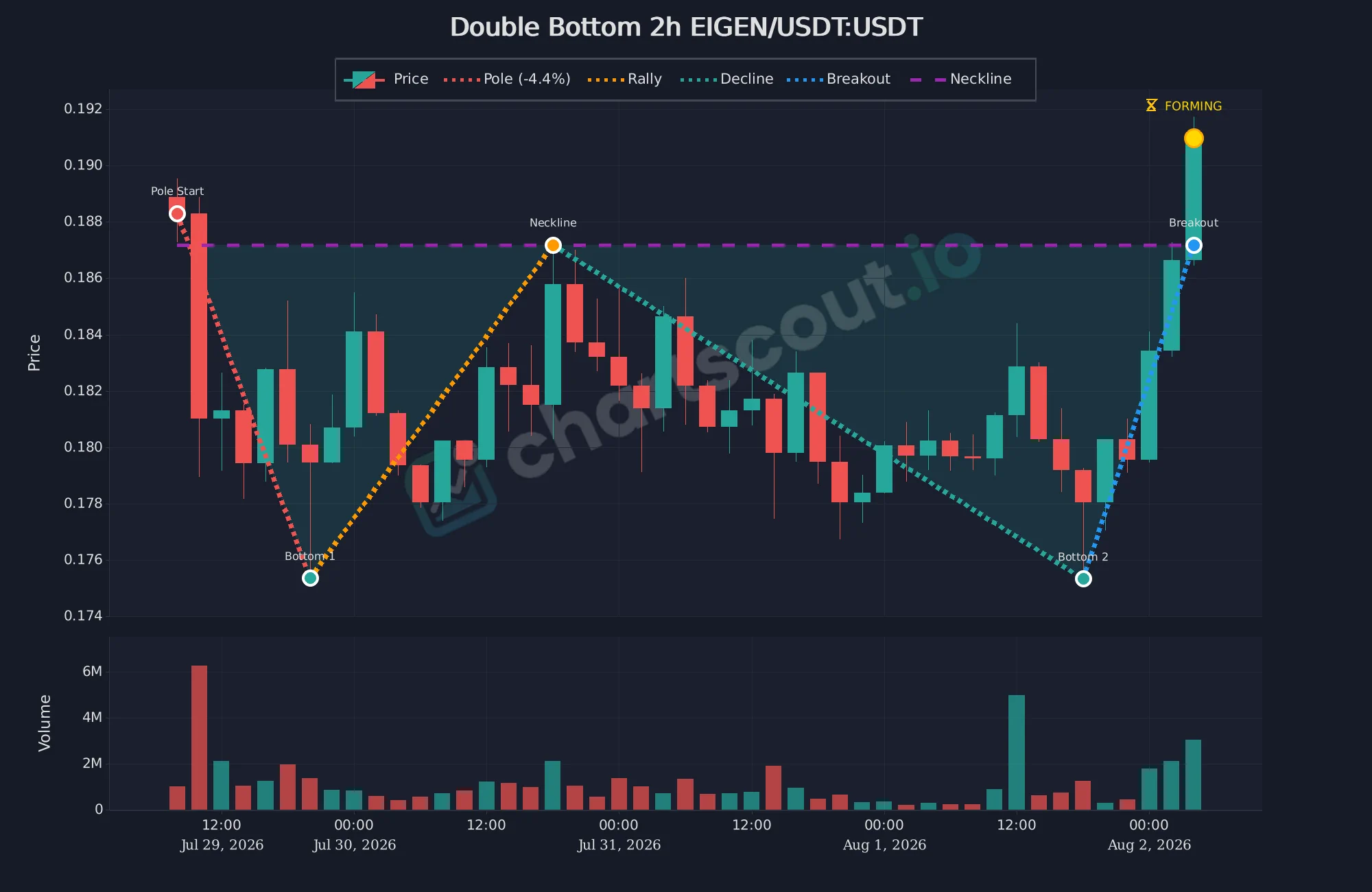
EIGEN/USDT 2-hour chart on Bybit - forming double bottom with a clear downtrend pole, two troughs, neckline, and breakout marker. Detection date: August 2, 2026.
More double bottom examples detected by ChartScout
Below are additional live double bottom detections from ChartScout's real-time scanner, showing how the pattern appears across different altcoins. Each example was flagged automatically using the same multi-factor confidence model.
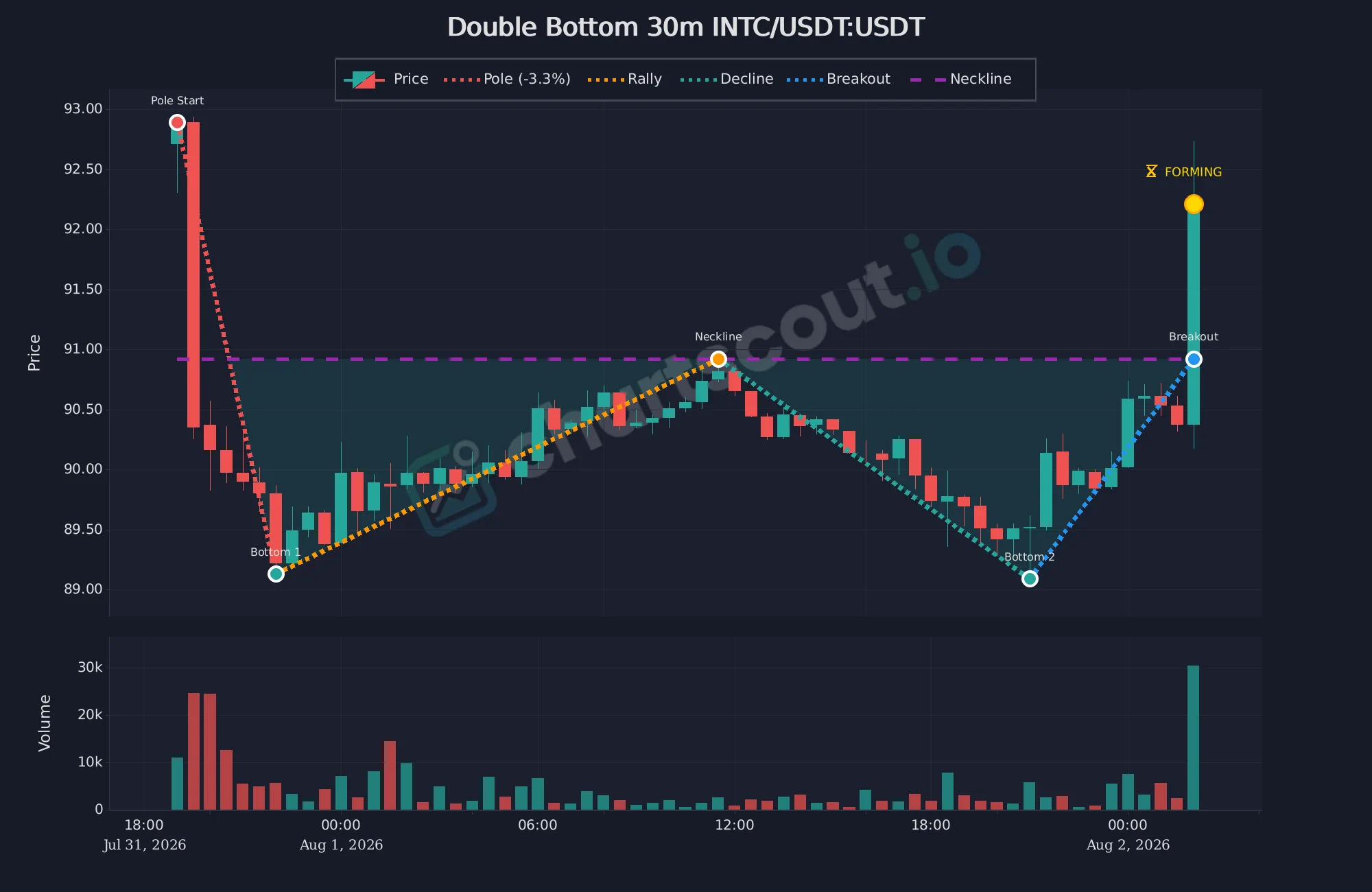
INTC/USDT 30-minute chart on Binance - forming double bottom W pattern with two troughs, neckline, volume, and breakout marker. Detection date: August 2, 2026.
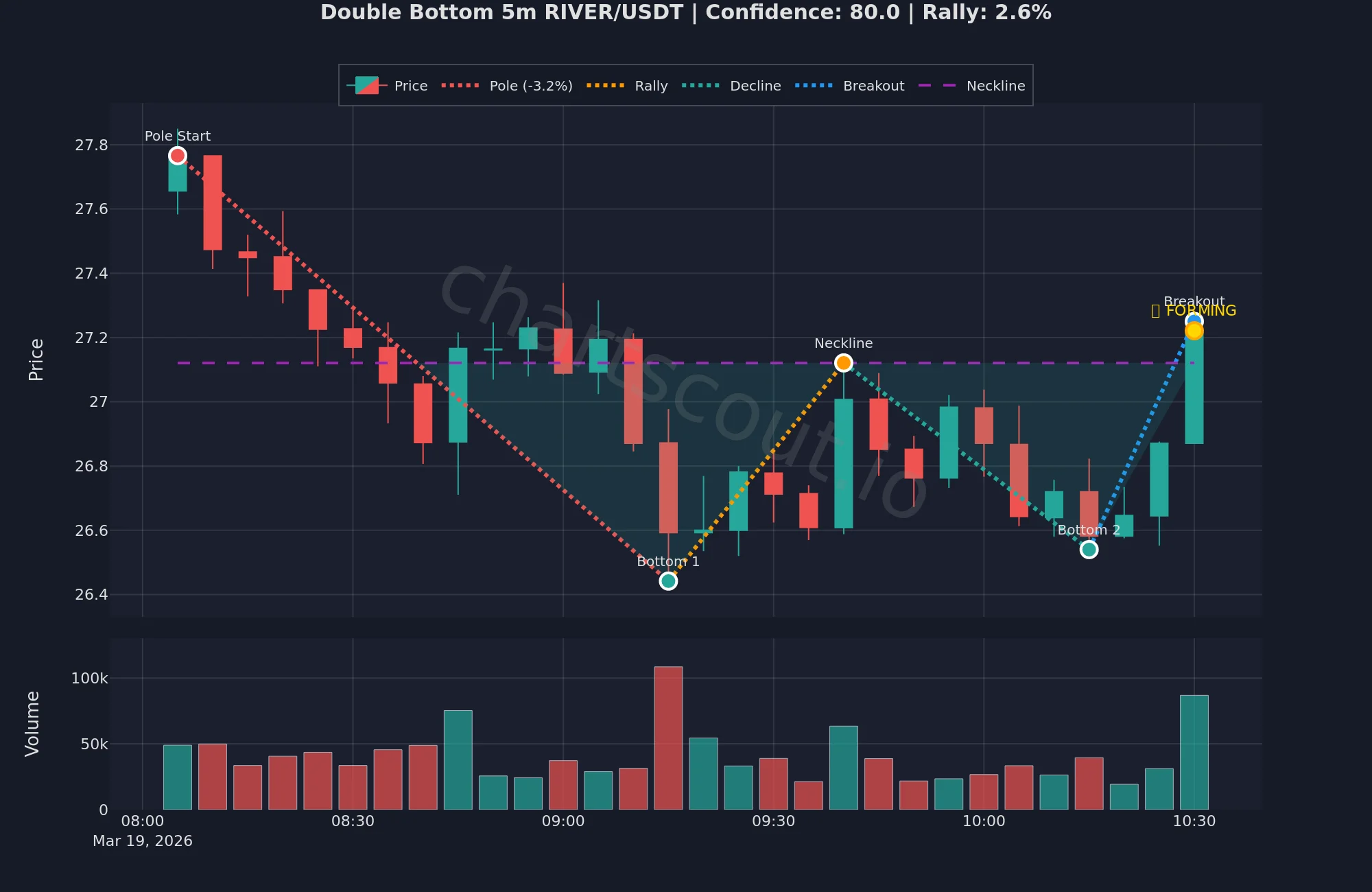
RIVER/USDT 5-minute chart - double bottom ChartScout backtest engine detection (80% confidence, 2.6% rally), prior downtrend pole and two symmetric troughs
Backtesting results: historical double bottom detections
The following double bottom patterns were identified by ChartScout's backtesting engine on historical data. These results validate the detection model against known market conditions across major and mid-cap coins from 2021-2022.
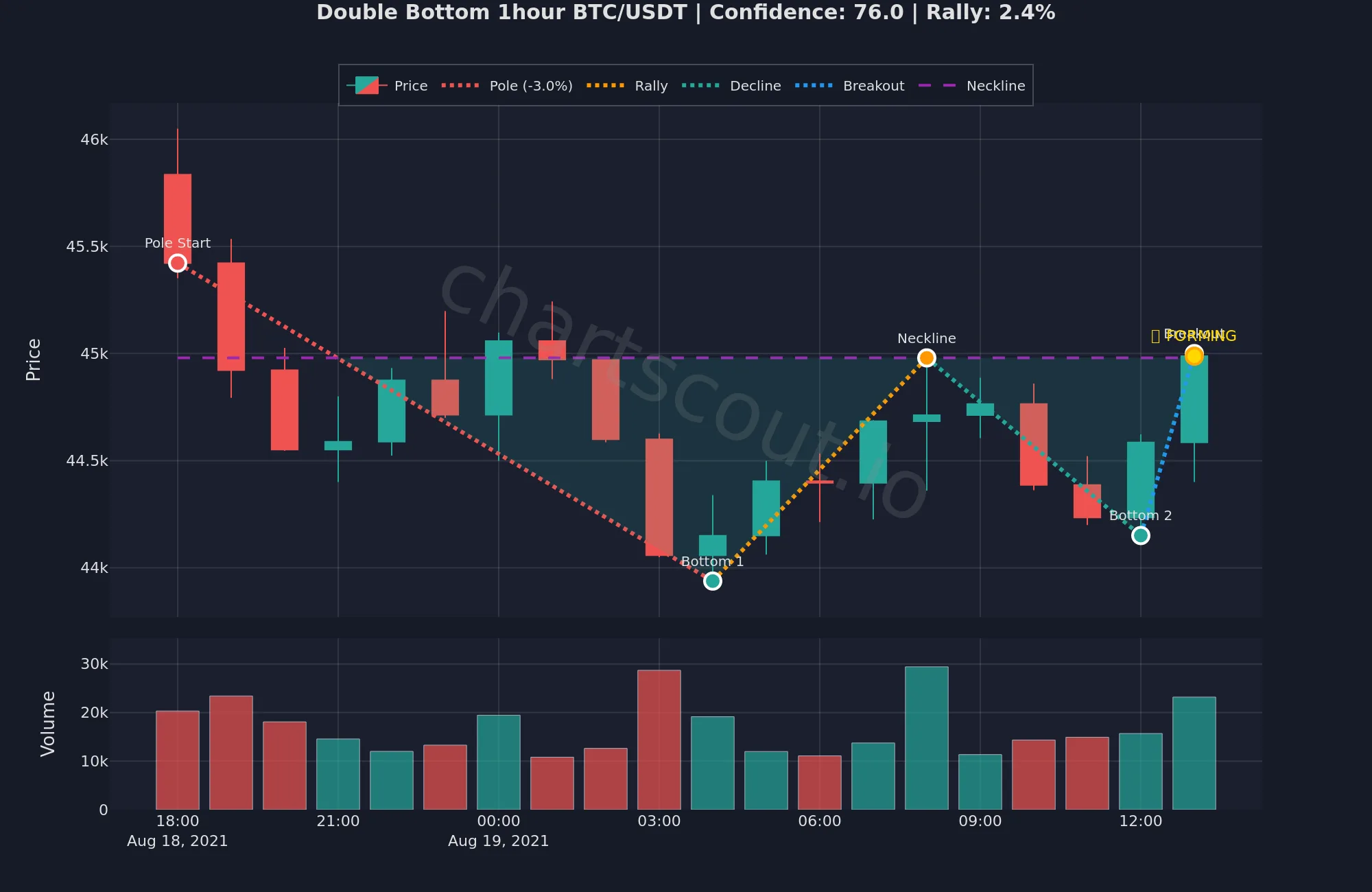
BTC/USDT 1-hour chart, August 2021 - ChartScout backtest engine detection: double bottom W pattern (76% confidence, 2.4% rally) with two symmetric troughs and confirmed neckline breakout
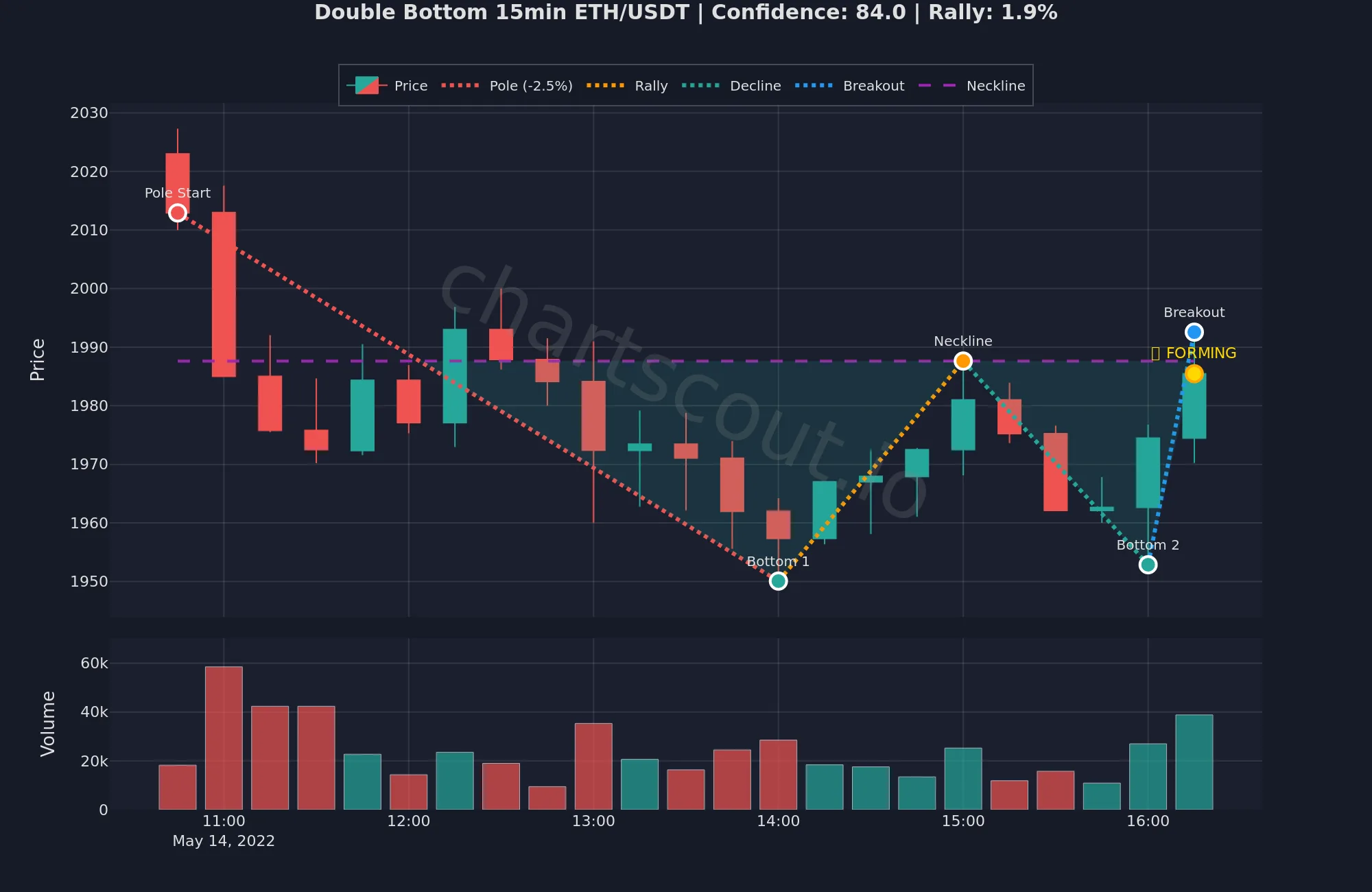
ETH/USDT 15-minute chart, May 2022 - ChartScout backtest engine detection: double bottom (84% confidence, 1.9% rally) with two equal lows and bullish reversal confirmation
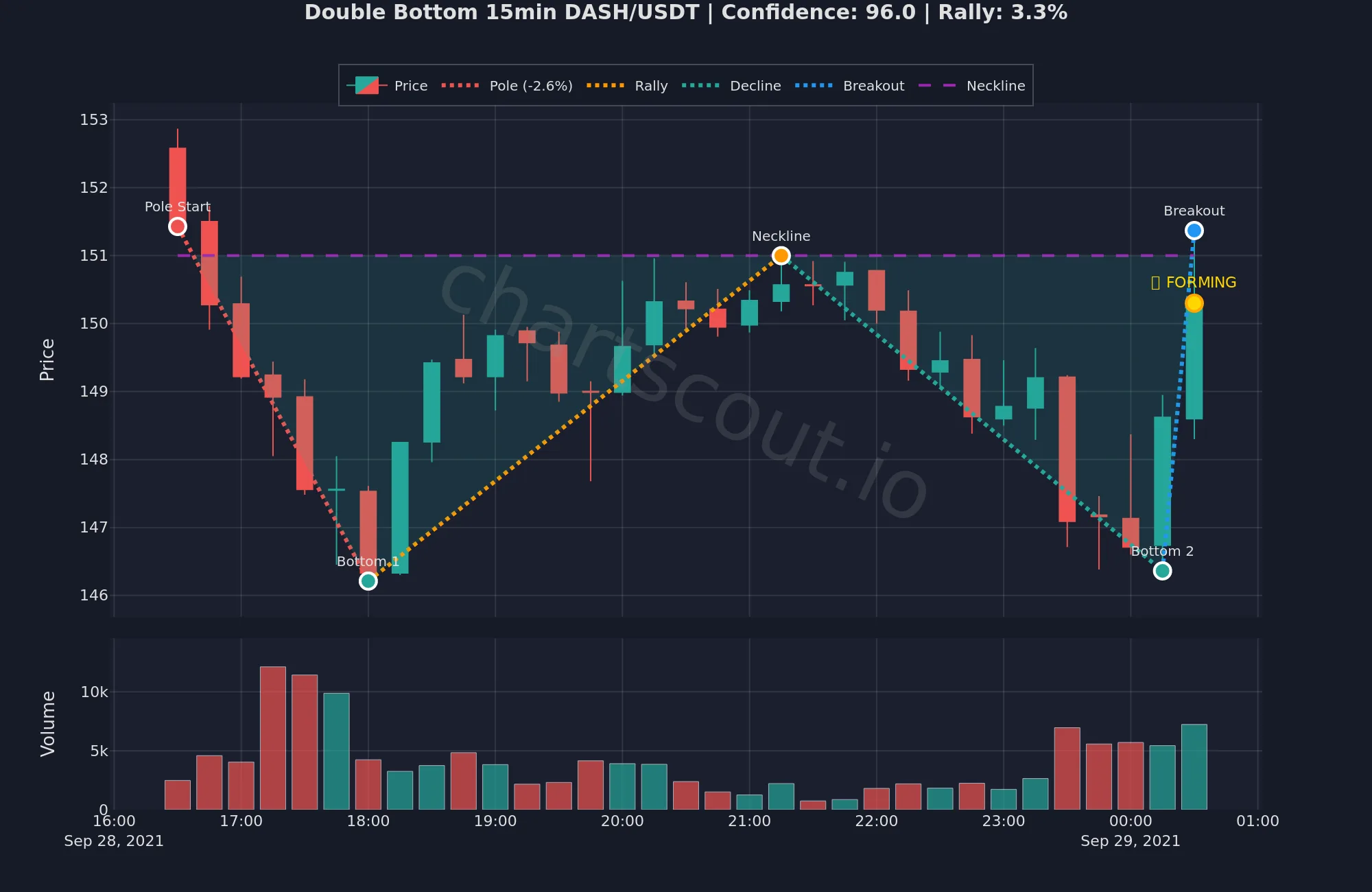
DASH/USDT 15-minute chart, September 2021 - ChartScout backtest engine detection: double bottom (96% confidence, 3.3% rally) with classic W reversal structure and neckline break
What a failed double bottom looks like: BTC 2022
Bitcoin's 2022 bear market provided multiple examples of double bottom attempts that failed due to macro regime override. Double bottom structures formed repeatedly in the $17,500-$19,000 zone - and each appeared technically valid in isolation. But the weekly BTC trend was in confirmed decline, and each neckline breakout ultimately failed as broader macro conditions overwhelmed local support. These failures reinforce the regime filter: when BTC's weekly trend is down, treat every double bottom as lower-probability and require volume confirmation two to three times above the standard threshold.
Double bottom vs. triple bottom vs. inverse head and shoulders
| Pattern | Structure | Success Rate | Avg. Gain | Trade-off |
|---|---|---|---|---|
| Double Bottom | 2 troughs, 1 neckline | 84% (16% fail) | 37-39% | Faster confirmation; smaller pattern height |
| Triple Bottom | 3 troughs, 1 neckline | 87% | ~45% | More confirmation needed; more move already consumed |
| Inv. Head & Shoulders | 3 troughs (middle deepest) | ~85% | 37-39% | Longer formation; clearer mid-formation signal |
Key distinguishing criteria
Double Bottom vs. Triple Bottom: A triple bottom requires a third test of the support zone before confirming. This extra confirmation sounds like an advantage, but by the time the triple bottom neckline breaks, more of the measured-move has been consumed and entry-to-target distance is shorter. In fast-moving crypto markets, the double bottom is typically preferable because it confirms sooner with nearly identical statistical performance.
Double Bottom vs. Inverse Head and Shoulders: The inverse head and shoulders has an asymmetric structure - the middle trough (head) is the deepest. This gives traders more information mid-formation (they can anticipate the pattern from the head), while the double bottom only reveals itself after the second trough. The double bottom confirms faster; the inverse H&S has a longer, more clearly telegraphed setup. Both are valid - choose based on what the price structure actually shows.
Double Bottom vs. Support Bounce: A support bounce at a prior low is not automatically a double bottom. The critical difference is the prior downtrend requirement and the meaningful rally between troughs (neckline formation). If price has been ranging sideways for weeks and tests the same low twice, that is range support - not a reversal pattern with the statistical edge Bulkowski documented.
Get real-time double bottom alerts
ChartScout monitors 1,000+ trading pairs across all major timeframes. The moment a confirmed double bottom is detected, you receive an instant alert, no chart-watching required.
Start 7-day trial→Set up your first double bottom watcher in under 2 minutes.
Frequently asked questions
What is the double bottom pattern in crypto?
The double bottom is a bullish reversal chart pattern forming after a downtrend. Price falls to support (first trough), bounces to a neckline peak, falls back to the same level (second trough), then rallies above the neckline to confirm the reversal. Its W shape gives it the common alias "W pattern." Confirmation requires a candle close above the neckline - not just an intraday pierce.
Is the double bottom pattern bullish or bearish?
The double bottom is a bullish reversal pattern. It signals that sellers pushed price to new lows twice, failed both times, and buyers have established a support floor. The bullish signal only activates after a confirmed close above the neckline - before that, the pattern carries no directional edge and price can continue lower.
What is the success rate of the double bottom pattern?
Thomas Bulkowski's research on 1,154 Adam & Adam double bottoms shows a 16% break-even failure rate and a 39% average rise on confirmed breakouts, with 73% reaching the measured-move price target. The pre-breakout failure rate is far higher - waiting for a neckline close is the single most important filter.
How do you confirm a double bottom on the chart?
Three criteria confirm the pattern: (1) a candle close above the neckline, not an intraday pierce; (2) breakout volume at least 5-10% above the 20-period average; (3) RSI breaking above 50 or showing bullish divergence at the second trough. The candle close above the neckline is the minimum required threshold.
When does a double bottom fail?
The most common failure is a low-volume bull trap: price closes above the neckline then reverses within 1-3 candles. A second failure is macro override - in a bear market, local double bottoms frequently bust. A third is the pattern forming in sideways chop with no prior meaningful downtrend.
What is the W pattern in crypto trading?
The W pattern is another name for the double bottom, named for its visual shape. Richard Schabacker documented this in 1932, calling it "the W formation - simply the M turned upside down." W pattern is the colloquial crypto community term; double bottom is the classical technical analysis name. They are fully interchangeable.
Where do you place a stop-loss on a double bottom trade?
Place a hard stop just below the lower of the two troughs, with a 0.3-0.5% buffer below the wick. If this level breaks, the downtrend has resumed and the pattern is invalid. For a retest entry after the neckline breakout, the stop can sit just below the neckline, tightening risk significantly.
How long does a double bottom take to form in crypto?
On a daily chart, Bulkowski's average is approximately 70 days, with best performance when bottoms are about 3 months apart. On a 4H chart, the same structure takes roughly 1.5-3 weeks. Patterns forming in under 8 bars between troughs are statistically less reliable - the second trough hasn't had time to genuinely test support.
Sources & references
Data source note: All break-even failure rates, average rises, throwback rates, target-hit percentages, and Bulkowski rankings in this guide come from Thomas Bulkowski's most recent published statistics at thepatternsite.com (data updated 8/26/2020). The Adam & Adam double bottom is based on 1,154 perfect trades and ranks 26 out of 39 bullish chart patterns. The Eve & Eve variant (952 trades) is the standout performer, ranking 5 out of 39 bullish patterns with 50% average rise and 12% break-even failure rate.
- Bulkowski, Thomas N. ThePatternSite.com - Double Bottoms, Adam & Adam. Updated 8/26/2020. thepatternsite.com/DBAA.html.
Primary statistical source. Current Adam & Adam figures: 16% break-even failure rate, 39% average rise, 67% throwback rate, 73% target-hit rate, rank 26 out of 39 bullish patterns. Based on 1,154 perfect trades. The Eve & Eve variant (DBEE.html) is one of the top-5 bullish patterns in Bulkowski's catalog: 12% failure, 50% average rise, 65% throwback, rank 5/39. - Bulkowski, Thomas N. Encyclopedia of Chart Patterns, 3rd Edition. John Wiley & Sons, 2021. ISBN: 978-1119739685.
Print companion to the thepatternsite.com data. Cited for the four-variant taxonomy (Adam & Adam, Adam & Eve, Eve & Adam, Eve & Eve), throwback timing analysis (~11 day average), and the “busted” pattern definition. - Schabacker, Richard W. Technical Analysis and Stock Market Profits. 1932 (reprinted by Harriman House, 2005).
Original documentation of the W formation and warnings about double bottom misidentification. - Edwards, Robert D., John Magee & W.H.C. Bassetti. Technical Analysis of Stock Trends, 9th Edition. CRC Press, 2007. ISBN: 978-0849337222.
Neckline confirmation rules, volume requirements, and the “conspicuously dull” second trough observation. - Recognia Inc. Understanding Classic Chart Patterns.
Throwback statistics and minimum rally requirements between troughs, citing Bulkowski. - Kirkpatrick II, Charles D. & Julie R. Dahlquist. Technical Analysis: The Complete Resource for Financial Market Technicians. FT Press, 2010. ISBN: 978-0137059447.
Adam/Eve variant guidance and pre-entry filter recommendations. - Brooks, Al. Trading Price Action Trends. John Wiley & Sons, 2012. ISBN: 978-1118066515.
Price action context for double bottom entries and stop placement.
Related guides
Double top (M pattern) guide
The bearish mirror of the double bottom - 75% break-even rate with 15% average decline on confirmed Adam & Adam patterns.
Head and shoulders pattern
The most reliable bearish reversal pattern with 81% success rate - compare to your double bottom setups.
Stop loss placement guide
Pattern-by-pattern stop placement including double bottom specific rules with Bulkowski data.
How to spot fake breakouts
7-point checklist to avoid fakeouts - essential for filtering false neckline breaks on double bottoms.
Chart patterns & volume analysis
Volume confirmation rules for 16 chart patterns including double bottoms and tops.
How to read crypto charts
Candlestick basics, chart types, and 8 essential patterns every crypto trader must know.
Crypto chart patterns cheat sheet
all 23 ChartScout detectors with Bulkowski break-even rates, volume rules, and 5m to 4h playbooks.
Bull flag pattern
The bullish continuation that often follows a confirmed double bottom, 56% break-even rate on 1,028 trades.
Cup and handle pattern
Ranked 3rd of 39 bullish patterns by Bulkowski, 54% average rise across 913 trades.

Stjepan Ivanović
Founder of ChartScout · Crypto Trader Since 2013
Trading crypto since 2013 with his first Bitcoin bought at ~$200. Four complete bull/bear market cycles, traded on early exchanges like Mt.Gox and BTC-e, on-chain trading on IDEX and EtherDelta, and ~70 crypto project investments. Built ChartScout after 23+ months of development to automate what no trader can do manually. Watch hundreds of charts 24/7.