Bull flag pattern in crypto: statistics and trading guide
A bull flag is a short consolidation inside an uptrend that can resolve with another leg higher: a steep flagpole, a tight pullback channel against the trend, then a breakout above the upper trendline. Bulkowski's stock-market reference reports 56% reaching a 5% break-even threshold, a 9% average short swing, and 46% reaching the full measured-move target. In ChartScout's crypto corpus, 20.09% of 6,013 eligible upward families moved at least 5%; the rate was 25.13% at 5m and above and 35.68% at 15m and above. The definitions and markets differ, so the figures are shown side by side rather than blended into one universal “success rate.”
The bull flag is one of the most popular and most misquoted chart patterns on the internet. The common story goes: sharp rally, brief consolidation, explosive continuation, with a success rate people casually round up to “70-80%”. Bulkowski's stock results tell a different story. Standard bull flags fail 44% of the time at the 5% break-even threshold, and 46% reach the measured-move target. Those descriptive outcomes do not establish a profitable trading edge after execution costs.
This matters because a near-guaranteed continuation assumption is inconsistent with the published evidence. Pattern quality, entry, exit, fees, slippage, and risk limits all affect trading results, and none can be replaced by a chart-pattern headline rate.
There is also a more demanding stock-market variant, the high-and-tight flag. Bulkowski reports a 39% average rise, 15% break-even failure, and 82% half-height target rate across 1,028 perfect trades. Most ordinary flags do not meet that definition, and those stock results should not be treated as crypto probabilities.
This guide separates ChartScout's crypto evidence from Bulkowski's published stock references. Martin Pring's framework is used for qualitative pattern context. Every empirical claim is labelled by market and linked to its source.
A note on data sources and what the numbers actually mean
Crypto outcome statistics come from ChartScout's study of 6,250 pattern families. Stock-market comparisons come from Bulkowski's flags.html, htf.html, and HTFStudy.html publications. These sources use different markets and outcome designs, so their percentages are not merged into one universal success rate. Martin Pring's volume framework provides qualitative context rather than a crypto performance estimate.
Bulkowski does not rank standard flags because their performance is measured on the short-term price swing, not breakout-to-ultimate-high.
Data notice: Standard flag statistics measure the short-term price swing (trend start to trend end), not the breakout-to-ultimate-high metric used for most chart patterns. Direct comparisons between the 9% stock average and other pattern averages can therefore be misleading. Bulkowski's figures are stock-market references. ChartScout's crypto study covers 6,250 distinct bull flag pattern families across a combined sample of 59 Binance markets and prints its own denominators for every endpoint.
What is a bull flag pattern?
The bull flag is a continuation pattern that forms during an uptrend. It signals a temporary pause in buying pressure before the trend resumes higher. The name comes from its visual resemblance to a flag on a pole: a near-vertical price surge creates the pole, and the brief consolidation that follows creates the flag.
Bulkowski classifies flags as short-term patterns. Per his identification guidelines in the Encyclopedia of Chart Patterns, 2nd edition, the flag portion must last under ~15 trading candles - the “3 weeks” figure in the book is anchored to daily stock charts. On a crypto 15m chart that is roughly 3-4 hours. On 1h it is about half a day. On 4h it is a couple of days. Anything longer and the pattern is reclassified as a rectangle or channel, which have their own statistics and trading rules.
The pattern has four components: a steep flagpole, a small rectangular consolidation bounded by parallel or near-parallel trendlines, a declining volume profile during the consolidation, and a volume-confirmed breakout above the flag's upper boundary.
| Component | Description | Key characteristic |
|---|---|---|
| Flagpole | Steep rally into the pattern | Unusually steep, multi-day, straight-line run |
| Flag | Small rectangular consolidation | Parallel trendlines, slight downward tilt |
| Flag tilt | Against the prior trend | Slight downward slope performs best |
| Duration | Length of flag formation | ~5-15 candles on any timeframe (minutes on 1m, hours on 15m-1h, days on 4h, weeks on daily) |
| Retracement depth | How much of the flagpole is given back | 10-34% produces the best post-breakout rise |
| Volume | Activity during the flag | Downward trend in 74% of Bulkowski's upward-breakout stock cases |
| Breakout | Exit from the consolidation | Candle close above highest peak in the flag |
“The flagpole, the price run-up or -down leading to the flag or pennant, should be unusually steep and quick.”
- Thomas Bulkowski, Getting Started in Chart Patterns, p. 167
A gradual drift upward followed by consolidation is not a bull flag. Without an aggressive, near-vertical move into the pattern, the continuation psychology simply is not there. For a wider survey of how all 23 detectors relate to each other, see our crypto chart patterns cheat sheet.
The psychology behind the bull flag
The bull flag captures a simple rhythm: impulse, rest, impulse. Price does not move in a single straight line even in strong trends. Periods of aggressive buying give way to brief pauses where early buyers book gains and new buyers step in at slightly lower prices. The pattern is that pause made visible.
Phase 1: flagpole (momentum and FOMO)
A catalyst triggers aggressive buying. In equities it might be an earnings surprise or a sector rotation. In crypto it is typically a protocol upgrade, a major listing, or a macro shift that pulls capital into the asset. Early participants drive price sharply higher, FOMO amplifies the move, and volume surges.
Phase 2: flag (consolidation and profit-taking)
After the initial surge, some early buyers take profits. Price drifts lower on declining volume. The key word is drift - selling is rational, not panicked. Traders waiting for a pullback start accumulating at lower prices. The pattern represents a temporary equilibrium between profit-takers and new accumulators, which is why it looks tight and contained rather than wide and emotional.
Phase 3: breakout (continuation)
As selling pressure exhausts itself, buyers regain control. Price closes above the flag boundary on renewed volume. The half-staff phenomenon - where the flag appears roughly midway in the total price trend - is one of the most consistent observations in Bulkowski's data. Measure the flagpole, project that height above the flag low, and you have a reasonable maximum expectation.
“On average, flags act as half-staff patterns (the price/time run after the flag is about as long as the one preceding it).”
- Thomas Bulkowski, Encyclopedia of Chart Patterns, 2nd ed., p. 336 (Chapter 21, Flags)
Key insight: The half-staff principle is a statistical tendency, not a guarantee. Bulkowski's stock data shows 46% of standard flags reaching the full measured-move target. The statistic describes target attainment and does not specify an exit rule.
Standard bull flag statistics
Bulkowski updated his flag statistics in August 2020 based on hundreds of perfect stock trades. A 44% break-even failure rate means that 44% failed to produce a 5% short-swing move under his definition. It is a descriptive stock result, not a crypto strategy return.
| Metric | Upward breakout | Downward breakout |
|---|---|---|
| Break-even failure rate | 44% | 45% |
| Average move | +9% | -8% |
| % meeting price target | 46% | 46% |
| Volume trend downward | 74% | 77% |
| Breakout direction | 60% | 40% |
Source: thepatternsite.com/flags.html, updated 8/27/2020. Hundreds of perfect trades.
Why flags are not ranked
Bulkowski does not assign a performance rank to standard flags or pennants. The reason: flag performance is measured against the short-term price swing (from the start of the trend to the end of the trend), not from the breakout to the ultimate high used for most other chart patterns. That is why the average 9% rise looks so modest compared to the 39% averages reported for head-and-shoulders reversals or inverse head-and-shoulders patterns.
Apples vs oranges: Do not compare the 9% flag average directly against the 38% average for inverse head-and-shoulders. They are measuring different move definitions. The high-and-tight flag variant, covered next, is measured on the breakout-to-ultimate-high basis, which is why its 39% figure is directly comparable to other patterns.
Flags vs pennants
| Metric (up breakouts) | Flags | Pennants |
|---|---|---|
| Break-even failure rate | 44% | 54% |
| Average rise | 9% | 7% |
| % meeting price target | 46% | 35% |
| Volume trend downward | 74% | 86% |
| Sample size | Hundreds of trades | 1,600+ trades |
Source: thepatternsite.com/flags.html and thepatternsite.com/pennants.html, updated 8/27/2020.
In Bulkowski's stock tables, flags have a lower break-even failure rate (44% vs 54%), a larger average rise (9% vs 7%), and a higher target rate (46% vs 35%) than pennants. Pennants show a downward volume trend more often (86% vs 74%). These comparisons describe those stock samples and do not establish profitability in crypto.
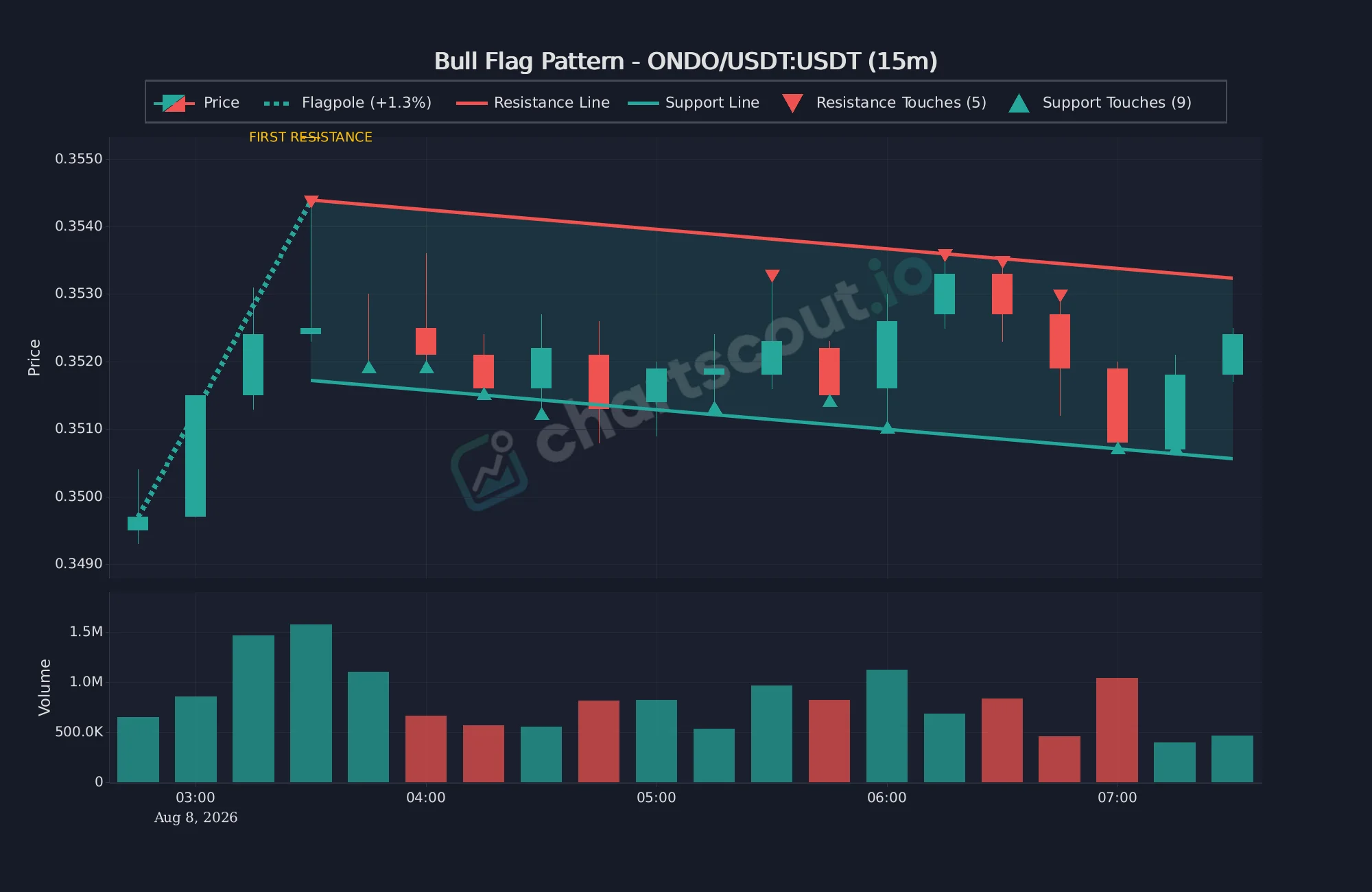
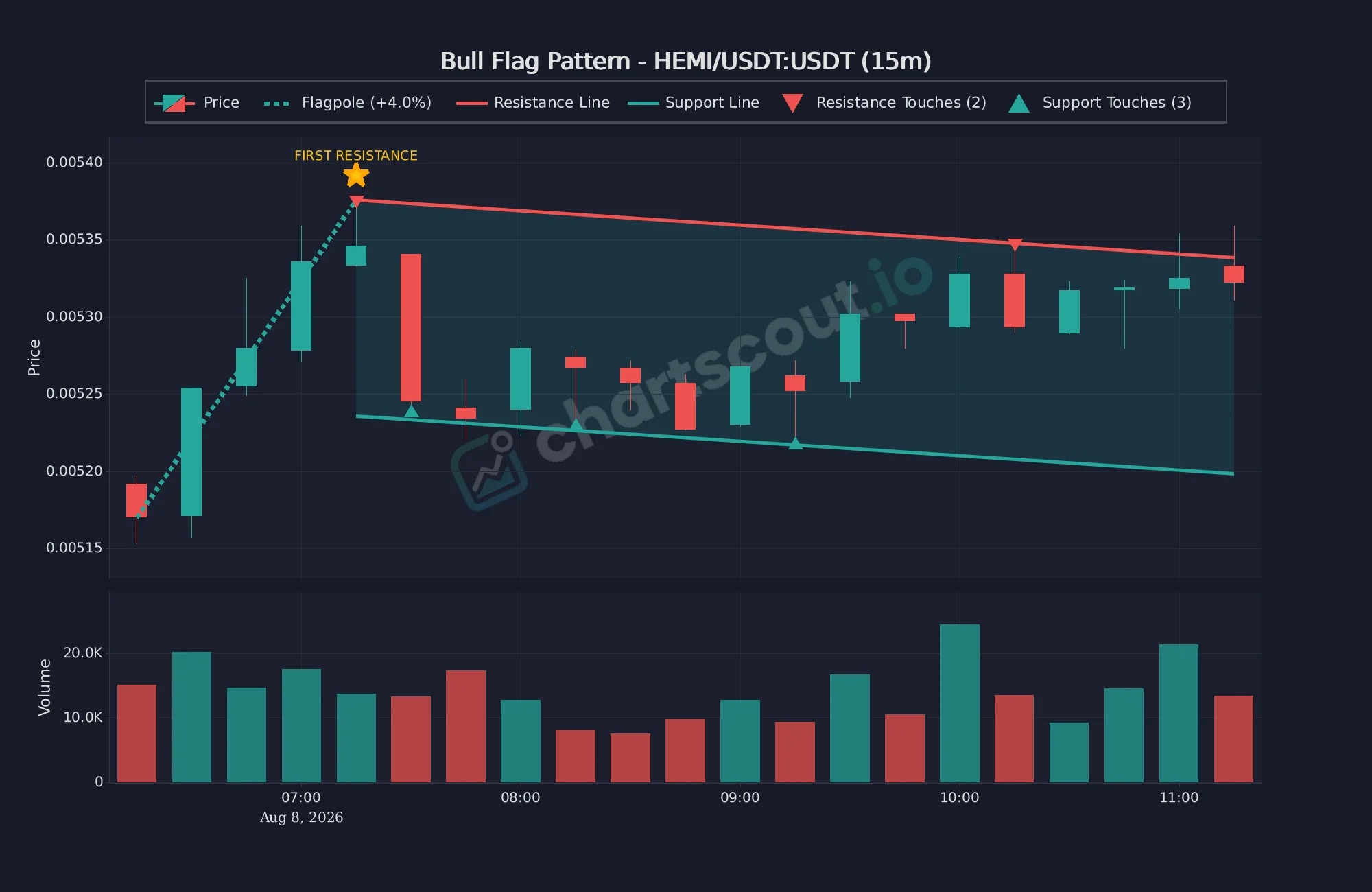
Same pattern structure, different pairs, 1-minute timeframe - scalping-grade bull flags detected by the same scripts that power ChartScout's live scanner.
The high-and-tight flag: the elite variant
The high-and-tight flag (HTF) is a separate, stricter stock-pattern definition. Bulkowski requires a rise of at least 90% in fewer than 42 daily price bars before the consolidation. His 1,028-trade stock reference reports a 15% break-even failure rate and a 39% average rise. Applying the same candle count to intraday crypto would be an untested extrapolation, so this guide does not present the HTF stock rates as crypto estimates.
Data notice: Bulkowski's original HTF study (253 manually-qualified patterns) showed a 69% average rise and 0% failure rate. His updated, larger study (1,028 trades) shows significantly lower performance: 39% average rise and 15% failure rate. The updated numbers are more reliable and are what we cite throughout this guide. The older 69% figure still circulates in older educational material - it is out of date.
HTF headline statistics
| Metric | Value |
|---|---|
| Break-even failure rate | 15% |
| Average rise after breakout | 39% |
| Throwback rate | 67% |
| % meeting half-height target | 82% |
| Performance rank (bull, up breakout) | 30 out of 39 (htf.html); 43 out of 56 in the extended study |
| Sample size | 1,028 perfect trades |
Source: thepatternsite.com/htf.html, updated 8/26/2020.
The vertical-flagpole trap
One of Bulkowski's stock-market HTF findings is that nearly vertical flagpoles had a lower average post-breakout rise than moderate 45-degree flagpoles. This is a sample comparison, not proof that a particular crypto formation will fail.
“Avoid HTFs with nearly vertical rises leading to the pattern... Patterns with moderate rises (typically 45 degrees) climb an average of 70% after the breakout versus 64% for the vertical moon shots.”
- Thomas Bulkowski, Getting Started in Chart Patterns, p. 91
The comparison can motivate a crypto hypothesis, but the cited stock study does not validate that filter for Bitcoin or altcoins. Crypto-specific performance would need to be tested under its own HTF definition.
What the extended HTF study shows
Bulkowski's expanded HTF study analyzed 1,018 stocks total, of which 552 produced 2,588 non-overlapping HTF patterns between January 1995 and May 2009. Unlike the htf.html sample (1,028 manually-qualified perfect trades), this larger dataset captures every algorithmically detected HTF - warts and all. The numbers are more sobering and more useful for setting expectations.
“Waiting for a breakout cuts your chances of having a failure in half.”
- Thomas Bulkowski, thepatternsite.com/HTFStudy.html
| Metric | Value |
|---|---|
| Average flagpole rise | 111% (median 102%) |
| Average time to climb 90% (flagpole) | ~25 trading candles (“36 calendar days” on daily stock charts) |
| Average rise after upward breakout | 27% |
| Total failure rate (down breakout + rise under 5%) | 33% |
| Patterns closing below flag low | 18% |
| Average flag height (stop-loss risk) | 26% of breakout price |
| Patterns doubling after breakout | 6% |
| Patterns with over 45% gains | 22% |
Source: thepatternsite.com/HTFStudy.html. 2,588 patterns from 552 stocks, 1995-2009.
Inbound trend slope matters
In the extended stock study, average post-breakout rise varied with the slope of the trend leading into the flagpole. Shallow bases had higher sample averages than steep inbound trends, as shown below.
| Inbound slope (before flagpole) | Average rise after breakout |
|---|---|
| Shallow upward 2-month slope | 36% (best) |
| Shallow downward 1-month slope | 35% |
| Flat / shallow base overall | 33% |
| Steep upward slope (1-2 month) | 26-28% |
| Steep down 2-month (V-shaped into flagpole) | 22% (worst) |
Source: thepatternsite.com/HTFStudy.html.
Optimal flag characteristics
Flag retracement depth. In Bulkowski's extended stock sample, the 10-34% retracement bins had average rises around 30%, compared with 17% for the 0-5% bin and 21% for the 40-45% bin. These are descriptive subgroup results and can be sensitive to binning.
Flag duration. In the extended daily-stock sample, the 10-15 day bin had the highest reported average rise at 37%, while very short flags averaged 18%. Converting those daily-stock bins directly into intraday crypto candle counts is an untested extrapolation, so they are not presented as an intraday performance rule.
Price distribution. The average starting stock price was $12.13 and the median was $6.11. Share price is not market capitalization, and the stock distribution does not establish an altcoin frequency or performance effect. No crypto inference is made from this statistic.
How to identify a bull flag
Pattern identification requires a definition that separates short flags from rectangles, channels, and other consolidations. Bulkowski's qualitative stock guidelines emphasize compact structure and a clear preceding impulse:
“When selecting a flag to trade, the most important guideline is the rapid, steep price trend. If prices are meandering up or down and form a flag, then [look elsewhere].”
- Thomas Bulkowski, Encyclopedia of Chart Patterns, 2nd ed., p. 338 (Chapter 21)
The identification checklist
| Characteristic | What to look for |
|---|---|
| Prior trend | Strong, near-vertical upward price run (the flagpole) |
| Flag shape | Small rectangle with parallel or near-parallel trendlines |
| Flag tilt | Slight downward slope against the uptrend (best performance) |
| Duration | Under ~15 candles; optimal 10-15 candles |
| Depth | Ideally 10-34% retracement of flagpole (not over 50%) |
| Volume | Declining during flag formation (74% of the time) |
Tight vs loose: the critical distinction
Bulkowski emphasizes that tight flags dramatically outperform loose flags. A tight flag has lots of price overlap and horizontal, compact price action. A loose flag sees price meander, poke outside trendline boundaries, contain white space, and look jagged. If the flag looks messy, skip it. This is probably the single most underused filter in the entire pattern.


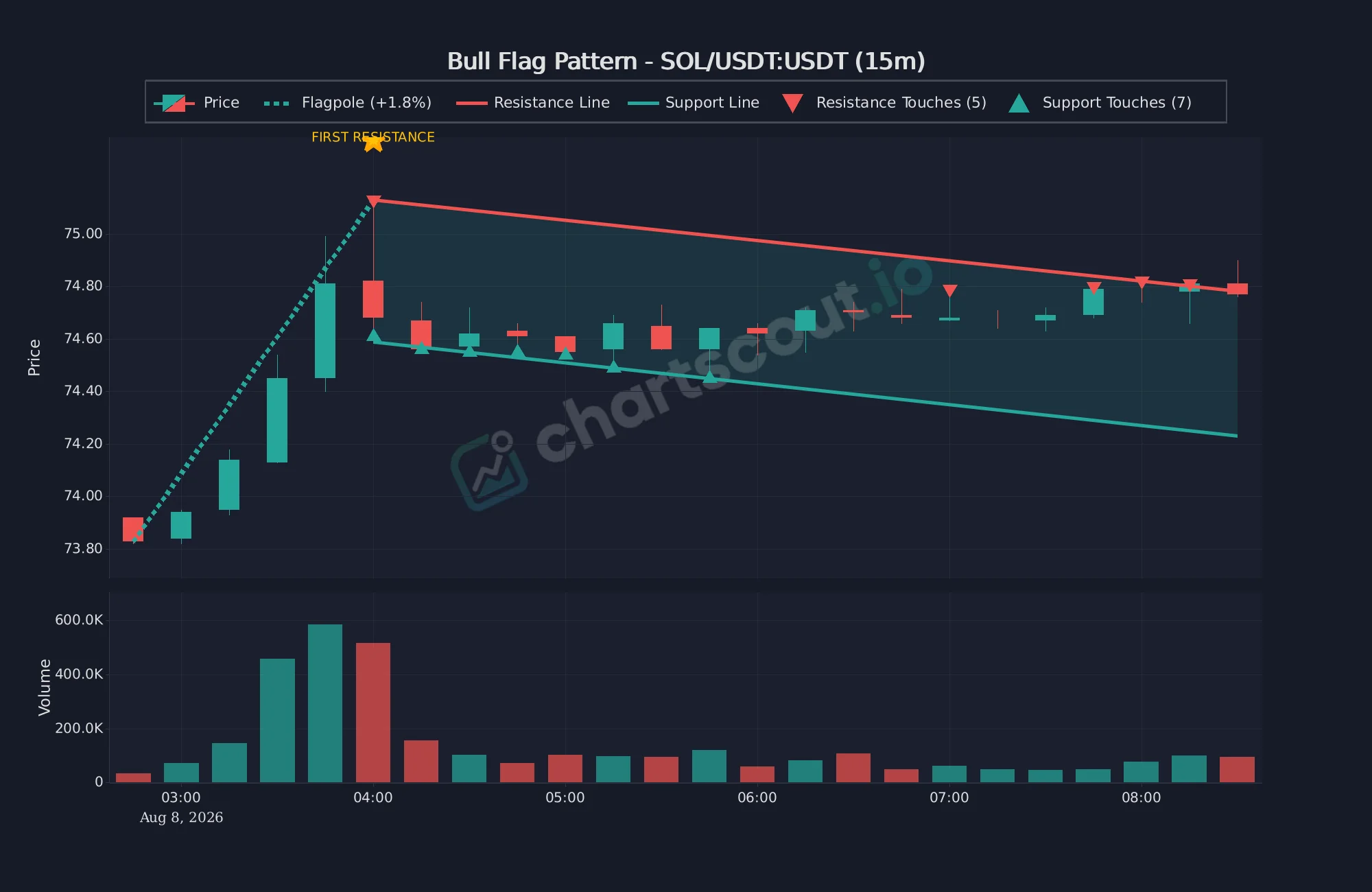
Two ChartScout detections at different timeframes, shown as visual examples rather than evidence of a profitable trading edge.
What to avoid: (1) Flags without a real flagpole - a gradual uptrend that flattens into a rectangle is not a flag, it is a rectangle. (2) Flags lasting more than ~15 candles on your scanning timeframe - reclassified as rectangles or channels. (3) Flags retracing over 50% of the flagpole - too deep to retain continuation psychology. (4) Loose, messy consolidations - price overlapping and drifting rather than tightening.
Volume: Pring's framework
Of every confirmation signal available to a pattern trader, volume behavior during a flag is the most reliable. Martin Pring's Pring on Price Patterns gives the canonical description of what a valid flag looks like under volume, and it is worth quoting in full:
“A flag is a quiet parallel trading range accompanied by a trend of declining volume. Such formations usually interrupt a sharp, almost vertical price rise or decline.”
- Martin Pring, Pring on Price Patterns, p. 211 (Ch. 12, Smaller Patterns and Gaps)
“Volume is normally extremely heavy just before the point at which the flag formation begins. As the formation develops, activity gradually contracts to almost nothing. It then explodes as the price works its way out of the completed formation.”
- Martin Pring, Pring on Price Patterns, p. 213
That is the classic bull flag volume signature: heavy flagpole, contracting consolidation, explosive breakout. If you do not see this three-phase volume profile, you do not have a high-probability flag.
Bulkowski's volume statistics
| Volume characteristic | Upward breakouts |
|---|---|
| Volume trends downward during flag | 74% of the time |
| Downward volume trend and better performance | Positive correlation |
| For HTFs: volume should recede for best performance | Best performance subset |
Source: thepatternsite.com/flags.html and thepatternsite.com/htf.html, updated 2020.
The validity test
Pring also gives a sharp warning about flags where volume does not contract. This is the filter most traders skip, and it is the filter that most often separates a real bull flag from a stalling uptrend about to reverse:
“It is important to make sure that the price and volume characteristics agree. For example, in a bull trend, the price may consolidate following a sharp rise, in what appears to be a flag formation, but volume may fail to contract appreciably. In such cases, great care should be taken before coming to a bullish conclusion, since the price may well react on the downside.”
- Martin Pring, Pring on Price Patterns, p. 213
Rising or flat volume during the flag signals that sellers are matching buyers - not that the consolidation is healthy. For a full breakdown of how volume confirms or breaks every major pattern, see our chart patterns and volume analysis guide.
Complete trading strategy
Common entry frameworks
Framework 1: confirmed breakout
Bulkowski's stock HTF framework confirms the pattern only after price closes above the highest peak in the formation. That is stricter than a trendline break. The crypto study measures post-breakout outcomes and does not compare entry rules.
Framework 2: post-breakout pullback
A pullback entry waits for price to test the broken boundary after breakout. Not every breakout produces this path. Bulkowski reports a 67% throwback rate for his stock HTF sample, but that rate is not a directly comparable estimate for standard crypto Bull Flags.
Framework 3: pre-breakout entry
A pre-breakout entry assumes the pattern will confirm before that outcome is known. It can shorten the distance to a structural invalidation level, but it also introduces confirmation risk. The present research does not estimate its win rate or reward-to-risk distribution.
Price target: the measured move
The standard target is calculated by measuring the flagpole height (from the start of the steep run to the top) and projecting that distance upward from the flag low or the breakout point.
| Pattern | Target basis | % meeting target |
|---|---|---|
| Standard bull flag | Full flagpole height | 46% |
| High-and-tight flag | Half the flagpole height | 82% |
For his stock HTF sample, Bulkowski reports 82% attainment of a half-height target. That figure describes a different pattern definition and does not prescribe an exit rule for this crypto cohort.
Stop-loss placement
| Approach | Stop level | Use case |
|---|---|---|
| Standard | Just below flag low + 0.5-1% buffer | Most trades |
| Aggressive | Below 50% retracement of flagpole | Tight-flag high-conviction setups |
| Conservative | Below the start of the flagpole | Only for large HTFs |
Sizing reality check: The average flag height in Bulkowski's extended stock HTF study was 26% of breakout price. A stop near the flag low would therefore imply a wide price-risk distance in that sample. Position risk depends on the actual entry, stop, size, fees, and slippage; the study does not supply a universal portfolio-risk percentage.
Failure rates and risk management
Bulkowski's 44% break-even failure rate is a useful warning against treating standard stock flags as near-certain continuations. ChartScout's crypto study found a different 5% success rate under a different design. Neither percentage alone determines whether a strategy is profitable after entries, exits, costs, and risk controls. Clean-looking patterns can still produce fake breakouts.
What causes failures
- Weak flagpole. Without a strong, steep prior move, the continuation psychology is absent. A gradual drift followed by consolidation is not a flag.
- Loose flag formation. Price that meanders, gaps, or pokes outside the flag boundaries signals uncertainty, not controlled consolidation.
- Rising volume during the flag. Pring's validity test: if volume fails to contract during consolidation, do not come to a bullish conclusion.
- Counter-trend conditions. A conflicting higher-timeframe trend changes the context, but this guide does not publish a causal success-rate estimate for that filter.
- Major resistance overhead. Flags forming directly below a multi-week or multi-month resistance level face an uphill battle even after the breakout.
- Vertical flagpole. On HTFs, nearly vertical rises produce a 64% average rise vs 70% for moderate 45-degree flagpoles. Parabolic moves are the worst inbound slope.
Failure by rise threshold (HTF extended study)
| Rise threshold after breakout | % failing to reach |
|---|---|
| 5% | 19% |
| 45% | 78% |
| 100% (doubling) | 94% |
Source: thepatternsite.com/HTFStudy.html, 2,588 patterns, 1995-2009.
Only 22% of HTFs produce a post-breakout rise of over 45%. Only 6% double. That is why Bulkowski consistently recommends the half-height target over the full flagpole measurement - the half target is hit 82% of the time and lets you book gains before the pattern distribution catches up with you.
“Flags are for swing traders, ones who want to ride the quick price move and sell when price turns.”
- Thomas Bulkowski, Encyclopedia of Chart Patterns, 2nd ed., p. 345
Position flags as swing-trading setups, not position-trading setups. Take profits aggressively. Do not hold a flag trade expecting the cup-and-handle-sized move - the math is not on your side.
Crypto-specific considerations
The Bulkowski references above use stock-market data. ChartScout's separate crypto evidence uses Binance perpetual-futures markets and a different outcome method. The two evidence bases are labelled separately. If you are new to reading crypto charts specifically, start with our beginner's guide to reading crypto charts.
ChartScout original research
ChartScout analyzed 6,250 distinct bull flag pattern families across a combined sample of 59 Binance markets from 1m through 1d, then compared the outcomes with Bulkowski's stock baseline. Across all timeframes 20.09% of eligible upward endpoints moved at least 5%; the rate was 25.13% at 5m and above and 35.68% at 15m and above. The full methodology, per-timeframe results, threshold sensitivity, and Bulkowski comparison are in our bull flag win rate study.
Bulkowski's stock baseline vs crypto: what shifts
Crypto and equities can display similar visual formations, but that does not guarantee equal outcome rates. Market structure and timeframe exposure differ. Wall-clock duration changes mechanically with candle interval, while the claim that a daily-stock duration rule retains the same performance intraday would require separate evidence. The estimates below are descriptive comparisons rather than interchangeable probabilities.
| Factor | Bulkowski baseline (stocks) | Crypto (measured where studied) |
|---|---|---|
| Pattern pace | Days to weeks per pattern | Minutes to days on low timeframes; same candle count, compressed wall-clock time |
| Average flagpole size | Stocks rarely double in 2 months | Not estimated in the ChartScout outcome study |
| Average post-breakout move | 9% for standard, 39% for HTF | Measured at 3.80% across all eligible upward families and 9.52% at 15m and above; these use ChartScout's causal finite-horizon endpoint (our study) |
| Failure rate | 44% break-even failure (standard flag) | 79.91% failed to move 5% across all eligible upward families; 64.32% failed at 15m and above. The stock and crypto designs differ, so this is descriptive rather than causal. |
| Volume confirmation | Single-exchange tape; reliable | Fragmented across 4+ exchanges; wash-trading on low-volume alts. Cross-check aggregate volume |
| Throwback rate | 67% for HTFs | Not estimated on a definition directly comparable with Bulkowski's throwback convention |
| Gap risk | Overnight and weekend gaps common | No scheduled overnight closure, though liquidity and operational discontinuities can still occur |
| Participant mix | Varies by market and period | Varies by market and period; participant composition was not measured in this study |
Interpretation boundary: Our crypto bull flag win rate study measured 6,250 distinct pattern families across a combined sample of 59 Binance markets. It provides crypto-specific evidence for this detector and cohort, but it does not prove that stock-market rankings transfer to crypto or that the measured chart outcomes produce net trading profits.
24/7 markets
Crypto venues generally trade continuously without a scheduled overnight close, although operational interruptions and liquidity gaps can still occur. Patterns can form at any hour, and liquidity conditions can vary materially by venue and time.
Which timeframes bull flags work on
ChartScout detects bull flags across its supported timeframe range, but the research sample is represented from 1m through 1d. Lower timeframes contribute more observations, while evidence becomes sparse above 2h. The measured rates should be read with their denominators rather than as a simple ranking from worst to best timeframe.
| Timeframe | Typical flag duration | Use case |
|---|---|---|
| 1m | 5-15 minutes | Secondary study stratum; 896 families |
| 5m | 25-75 minutes | Intraday; included in the 5m+ aggregate |
| 15m | 1-4 hours | Intraday; 283 pattern families |
| 1h | 5-15 hours | Intraday to multi-session; 384 families |
| 4h | 20-60 hours | Sparse study cell; 42 families |
| 1d | 1-3 weeks | Very sparse study cell; 2 families |
| 1w | 1-4 months | Not represented in this analytical sample |
For many traders, 15m and 1h offer a practical balance between frequency and chart clarity. That is a workflow judgment, not a proven profitability ranking. In the measured corpus, the pooled 15m+ group moved at least 5% in 35.68% of 810 eligible upward families, while individual cells above 2h were too sparse for stable ranking. Use higher-timeframe context as confirmation, not as a guarantee.
Volatility amplification
Volatility changes the percentage width of formations and the distance to structural invalidation. Stops and position sizes therefore need to be derived from the observed market and timeframe rather than copied from an equity example. This guide does not claim a universal crypto-to-equity volatility ratio.
Liquidity tiers
Liquidity, spread, market depth, and venue quality can affect execution and apparent breakout behavior. Bulkowski's lower-priced stock distribution cannot be mapped directly to crypto market-cap tiers, and the ChartScout study does not publish a causal reliability ranking by market capitalization.
Volume confirmation across exchanges
Crypto volume data is fragmented and partially inflated by wash trading. For flag confirmation, verify declining flag volume and explosive breakout volume across multiple major exchanges, not a single source. When exchange-specific volume is unreliable, fall back on aggregated data or pure price-action confirmation - the breakout candle closing decisively above the highest peak in the flag.
Crypto entry rule: Require a full candle close above the flag boundary, not a wick. Fakeouts are more common in crypto than in equities. A wick above the boundary that closes back inside is a failure signal, not a buy signal. Combining flag detection with confluence signals like a golden cross can further filter the noise.
Bull flag vs pennant, wedge, channel
Four patterns often get confused because they all involve a consolidation after a trend. The differences matter - they have different trading rules and different statistics.
Chart patterns are defined by number of candles, not calendar time. A 15-candle flag is the same pattern whether those candles are 1-minute or 1-day. The duration column below is expressed in candles so it maps to any ChartScout timeframe.
| Pattern | Trendlines | Duration (candles) | Flagpole |
|---|---|---|---|
| Bull flag | Parallel, slight down-tilt | ~5-15 candles | Yes |
| Bullish pennant | Converging (small triangle) | ~5-15 candles | Yes |
| Falling wedge | Converging, both sloping down | ~60-120 candles | No |
| Ascending channel | Parallel, both sloping up | 30-200+ candles (open-ended) | No |
Translating candles to ChartScout timeframes
| Timeframe | Bull flag (~5-15 candles) | Falling wedge (~60-120 candles) |
|---|---|---|
| 1m | 5-15 minutes | 1-2 hours |
| 5m | 25-75 minutes | 5-10 hours |
| 15m | 1-4 hours | 15-30 hours |
| 1h | 5-15 hours | 2.5-5 days |
| 4h | 20-60 hours | 10-20 days |
| 1d | ~1-3 weeks | ~2-4 months |
| 1w | ~1-4 months (rare) | ~1-2 years (rare) |
The cleanest way to distinguish: a flag is a short, parallel, slightly-down-tilted consolidation that requires a prior steep impulse. A pennant is the same idea with converging trendlines. Wedges and channels last many more candles and do not require a flagpole. For a full comparison of wedge behavior, see our rising wedge vs falling wedge guide.
Frequently asked questions
What is the success rate of the bull flag pattern?
There is no universal Bull Flag success rate. Bulkowski's stock reference reports 56% reaching a 5% short-swing threshold for standard flags, while ChartScout's crypto study found 20.09% across all eligible upward families, 25.13% at 5m and above, and 35.68% at 15m and above. Different markets and outcome rules produce different estimates. None of these rates is a net strategy return.
How do you calculate the bull flag price target?
The classical measure rule projects the flagpole height from the flag or breakout reference. Bulkowski reports 46% full-target attainment for standard stock flags and 82% attainment of a half-height target for stock HTFs. ChartScout's crypto cohort reached its full-pole target in 23.85% of evaluable upward families (1,430/5,997). These are descriptive target statistics, not exit instructions.
How long should a bull flag last?
Bulkowski defines stock flags as short formations, generally no longer than three weeks on daily charts. His extended daily-stock HTF study reports its strongest average in a 10-15 day bin. Treating that as a universal 10-15 candle rule on every intraday crypto timeframe would be an extrapolation, not a result of this study.
What is the best timeframe for bull flags in crypto?
15m and 1h are practical day-trading timeframes because they balance observation frequency with readable structure. This is not a profitability ranking: the study's cells above 2h are sparse, with only one eligible daily family and no retained weekly observation. Use multiple timeframes for context and let a higher timeframe confirm, not guarantee, a lower-timeframe setup.
Should I enter a bull flag before the breakout?
Bulkowski explicitly warns against using a trendline break of the flag as a buy signal because too many patterns fail after trendline breaks alone. The safer approach is to wait for a candle close above the highest peak in the flag. In-flag entries on the lower boundary offer better risk-reward but much higher failure risk.
How do bull flags differ from pennants?
Flags have parallel trendlines forming a small rectangle. Pennants have converging trendlines forming a small triangle. In Bulkowski's upward-breakout stock tables, flags average 9% versus 7% for pennants, and their reported target rates are 46% versus 35%.
What is a high-and-tight flag?
Bulkowski's stock HTF definition requires price to rise at least 90% in fewer than 42 daily price bars before consolidating. His 1,028-trade stock reference reports 15% break-even failure, a 39% average rise, and 82% attainment of a half-height target. Those values are not crypto estimates.
Do bull flags work in crypto?
Bull Flags occur in crypto, but “work” depends on the endpoint. Our study of 6,250 distinct bull flag pattern families across a combined sample of 59 Binance markets found that 20.09% of eligible upward endpoints moved at least 5% across all timeframes, compared with 25.13% at 5m and above and 35.68% at 15m and above. These are conditional chart outcomes, not net strategy returns.
Conclusion
Bull Flag outcomes depend on the market, timeframe, pattern definition, and endpoint. Bulkowski's stock reference and ChartScout's crypto study should therefore be read as separate descriptive samples. ChartScout found a 20.09% 5% move rate across all eligible upward families, 25.13% at 5m and above, and 35.68% at 15m and above. These results do not by themselves establish a profitable trading edge.
Key takeaways
- Bulkowski's 44% failure rate is stock-specific. It uses a 5% short-swing threshold and is not interchangeable with the crypto estimates.
- High-and-tight flags are a separate stock pattern. Their 15%, 39%, and 82% reference values come from 1,028 perfect stock trades.
- Pattern definition matters. A short parallel consolidation following a clear impulse is distinct from a rectangle, channel, or pennant.
- Volume is contextual evidence. Bulkowski reports a downward volume trend in 74% of upward-breakout stock flags, not a crypto success guarantee.
- Subgroup findings remain sample-specific. Bulkowski's extended stock HTF study reports different averages by inbound slope and retracement bin.
- Daily-stock duration bins do not automatically transfer to intraday crypto. Timeframe-specific claims require timeframe-specific evidence.
- Confirmation rules change the sample. Bulkowski's stock HTF framework confirms above the highest pattern peak; the crypto study does not compare entry rules.
Detect bull flags in real time
ChartScout continuously scans supported markets and timeframes and can alert you when its classifier identifies a Bull Flag candidate. Learn more about alert-driven trading.
Start 7-day trial→Set up your first bull flag watcher in under 2 minutes.
Sources & references
Data source note: Crypto statistics come from ChartScout's study of 6,250 pattern families across a combined sample of 59 Binance markets. Stock references come from Bulkowski's flags.html, htf.html, pennants.html, and HTFStudy.html publications. The markets and outcome methods differ, so the figures are labelled separately and should not be interpreted as interchangeable probabilities.
- ChartScout Research. Bull Flag Win Rate in Crypto: A Study of 6,250 Pattern Families. 2026. Read the complete study.
Primary source for the crypto cohort, per-timeframe outcomes, 5m+ and 15m+ aggregates, threshold sensitivity, and study limitations. - Bulkowski, Thomas N. ThePatternSite.com - Flags. Updated 8/27/2020. thepatternsite.com/flags.html.
Primary statistical source for standard flag performance: 44% break-even failure rate (56% success), 9% average rise, 60% upward breakout rate, 46% meeting target, 74% volume trend downward. Based on hundreds of perfect trades. - Bulkowski, Thomas N. ThePatternSite.com - High and Tight Flags. Updated 8/26/2020. thepatternsite.com/htf.html.
Primary statistical source for HTF performance: 15% failure rate, 39% average rise, 67% throwback rate, 82% half-height target-hit rate, rank 30/39 bullish. Based on 1,028 perfect trades. - Bulkowski, Thomas N. ThePatternSite.com - HTF Study. thepatternsite.com/HTFStudy.html.
Extended study of 2,588 non-overlapping HTF patterns from 552 stocks, January 1995 - May 2009. Source for inbound trend slope analysis, retracement-depth findings, duration optimization, failure thresholds (19% fail 5%, 78% fail over 45%, 94% fail to double), and flag-height stop-loss risk (26% of breakout price). - Bulkowski, Thomas N. Encyclopedia of Chart Patterns, 2nd Edition. John Wiley & Sons, 2005. ISBN: 978-0471668268.
Chapter 21 (Flags, pp. 335-350) and Chapter 22 (Flags, High and Tight, pp. 351-372). Source for pattern identification guidelines, the half-staff principle (p. 336), flagpole selection criterion (p. 338), the “flags are for swing traders” characterization (p. 345), and HTF volume/shape filter (p. 361). - Bulkowski, Thomas N. Getting Started in Chart Patterns. John Wiley & Sons, 2006. ISBN: 978-0471727668.
Page 91 (HTF vertical-flagpole warning: 45-degree slopes climb 70% on average vs 64% for vertical moon shots) and page 167 (flagpole identification: “unusually steep and quick”). - Pring, Martin J. Pring on Price Patterns: The Definitive Guide to Price Pattern Analysis and Interpretation. McGraw-Hill, 2005. ISBN: 978-0071440387.
Chapter 12 (Smaller Patterns and Gaps), Flags section, pp. 211-216. Source for the canonical flag volume signature (p. 213), the flag-as-declining-volume definition (p. 211), and the price-volume validity test (p. 213) used to filter failing flags.

Stjepan Ivanović
Founder of ChartScout · Crypto Trader Since 2013
Trading crypto since 2013 with his first Bitcoin bought at ~$200. Four complete bull/bear market cycles, traded on early exchanges like Mt.Gox and BTC-e, on-chain trading on IDEX and EtherDelta, and ~70 crypto project investments. Built ChartScout after 2+ years of development to automate what no trader can do manually. Watch hundreds of charts 24/7.