Bear flag pattern in crypto: statistics and trading guide (2026)
A bear flag is a short consolidation inside a downtrend that can resolve with another leg lower: a steep flagpole down, a tight pullback channel against the trend, then a breakdown below the lower trendline. Bulkowski's stock-market reference reports 55% reaching a 5% short-swing threshold, an 8% average decline, and 46% reaching the full measured-move target after a downward breakout. In ChartScout's crypto corpus, 16.59% of 17,572 eligible downward families declined at least 5%; the rate was 27.18% at 5m and above and 44.49% at 15m and above. The definitions and markets differ, so the figures are shown side by side rather than blended into one universal “success rate.”
The bear flag is the mirror image of the bull flag: a sharp decline (the flagpole), a brief consolidation that typically tilts upward (the flag), and a confirmed move lower. Bulkowski's updated stock reference reports a 45% break-even failure rate and an 8% average decline after downward breakouts. ChartScout's separate crypto study uses a finite causal observation window and reports its own eligible denominators, so its results are not interchangeable with the stock figures.
Bulkowski's stock sample also reports that 40% of completed flag formations break downward and 60% break upward. That base-rate result applies to his stock definitions and sample. ChartScout's crypto cohort begins at a confirmed downward endpoint, so it does not estimate how often an unfinished candidate will eventually break down. Keeping those denominators separate is essential: one study starts before direction is known, while the other measures outcomes after direction is confirmed.
This distinction matters because a chart-outcome rate is not automatically a tradable win rate. Neither source includes a complete crypto strategy with fills, fees, slippage, position sizing, and drawdown. Use the numbers to calibrate expectations and to define what must be tested, not as permission to oversize a short. Every chart example in this guide comes from ChartScout's study detections.
A note on data sources and what the numbers actually mean
Crypto outcome statistics come from ChartScout's study of 17,581 canonical Bear Flag families. Stock-market comparisons come from Bulkowski's flags.html, studystudy.html, pennants.html, and BestPatterns.html publications. These sources use different markets and outcome designs, so their percentages are not merged into one universal success rate. Martin Pring's volume framework provides qualitative context rather than a crypto performance estimate.
Source: thepatternsite.com/flags.html, updated 8/27/2020, hundreds of perfect trades. Bulkowski does not publish a performance rank for standard flags because the move is measured on the short-term swing.
Data notice: Standard stock flag statistics measure the short-term price swing, while ChartScout uses a fixed post-breakdown outcome definition. Direct comparison therefore requires both the endpoint and denominator. Our crypto Bear Flag study covers 17,581 canonical families across 59 Binance markets and all 15 configured timeframes and prints the eligible denominator for every result.
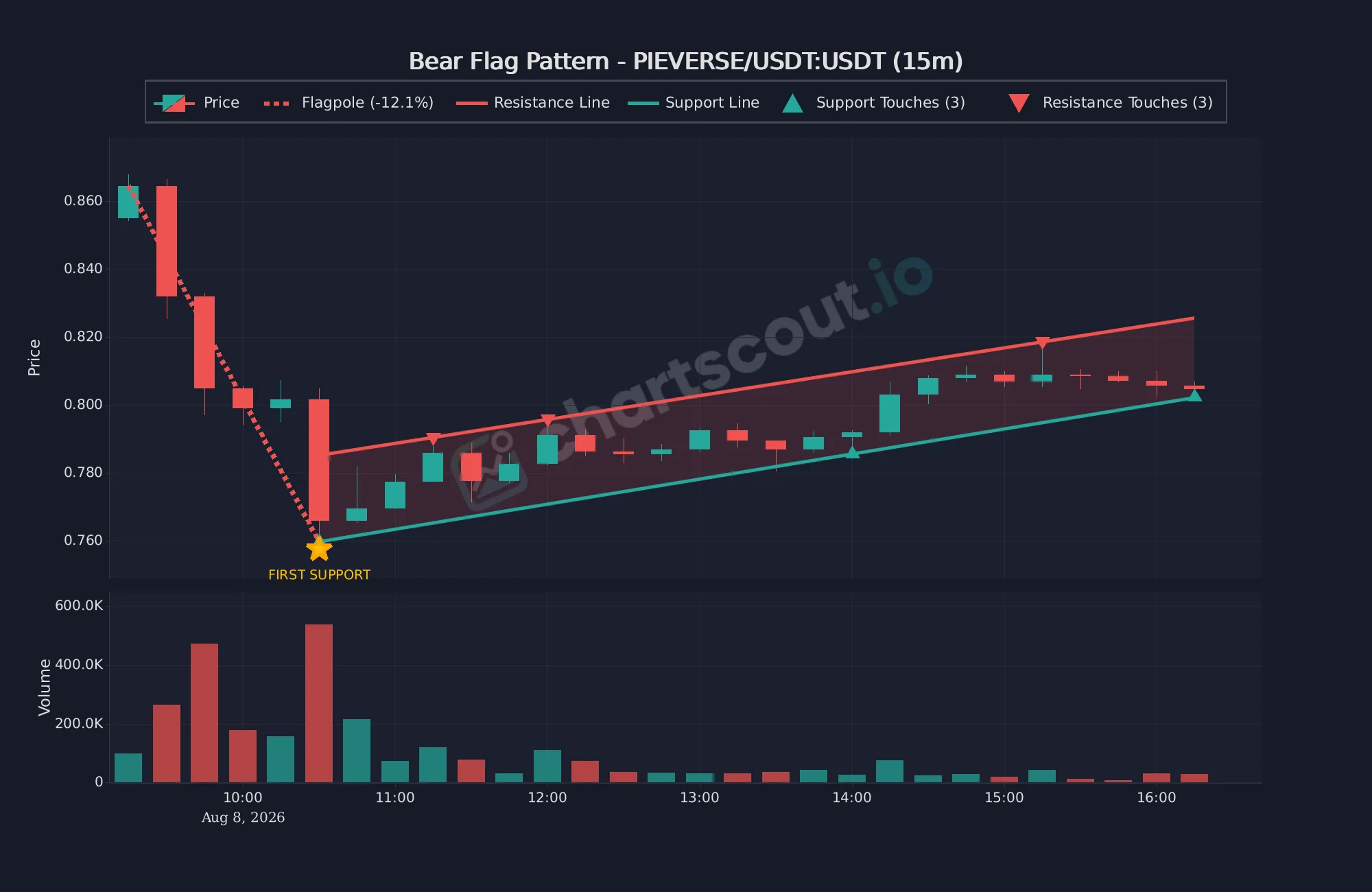
What is a bear flag pattern?
A bear flag is a short-term continuation pattern that forms during a downtrend. It signals a temporary pause in selling pressure before the decline resumes lower. The structure has four components: a steep, near-vertical decline (the flagpole), a brief upward-tilted consolidation bounded by parallel or near-parallel trendlines (the flag), declining volume through the consolidation, and a volume-confirmed breakdown below the lower flag boundary.
“In an uptrend, therefore, the bull flag has a downward slope; in a downtrend, the bear flag slopes upward. Both patterns are said to ‘fly at half mast,’ meaning that they often occur near the middle of the trend, marking the halfway point in the market move.”
- John J. Murphy, Charting Made Easy, pp. 20-21 (Chapter 5, Flags and Pennants)
Bulkowski classifies flags as short-term patterns. Per the identification guidelines in Encyclopedia of Chart Patterns, 2nd edition, the flag portion should last under ~15 trading candles - the “3 weeks” figure in the book is anchored to daily stock charts. On a crypto 15m chart that is roughly 3-4 hours. On 1h it is about half a day. On 4h it is a couple of days. On 1m that is 15 minutes. Anything longer and the pattern is reclassified as a rectangle or channel - which have their own statistics and trading rules.
| Component | Description | Key characteristic |
|---|---|---|
| Flagpole | Steep decline into the pattern | Unusually steep, multi-candle, near-vertical drop |
| Flag | Small rectangular consolidation | Parallel trendlines, slight upward tilt |
| Flag tilt | Against the prior trend | Slight upward slope (counter to downtrend) |
| Duration | Length of flag formation | ~5-15 candles on any timeframe |
| Volume | Activity during the flag | Declining 77% of the time for valid downward breakouts |
| Breakdown | Exit from the consolidation | Candle close below the lowest point of the flag |
Source: Bulkowski, Encyclopedia of Chart Patterns, 2nd ed., Chapter 21, and thepatternsite.com/flags.html.
“These formations usually form near the midpoint of a steep, quick price trend. If you do not have a strong advance or decline leading to the chart pattern, ignore the flag.”
- Thomas Bulkowski, Encyclopedia of Chart Patterns, 2nd ed., p. 337 (Chapter 21, Table 21.1 Identification Characteristics)
A gradual drift down followed by a sideways range is not a bear flag. Without a sharp, near-vertical inbound decline, the continuation psychology is absent and the statistics break down. This is the single most common identification error traders make. For a wider survey of how all 23 ChartScout detectors relate to each other, see our crypto chart patterns cheat sheet.
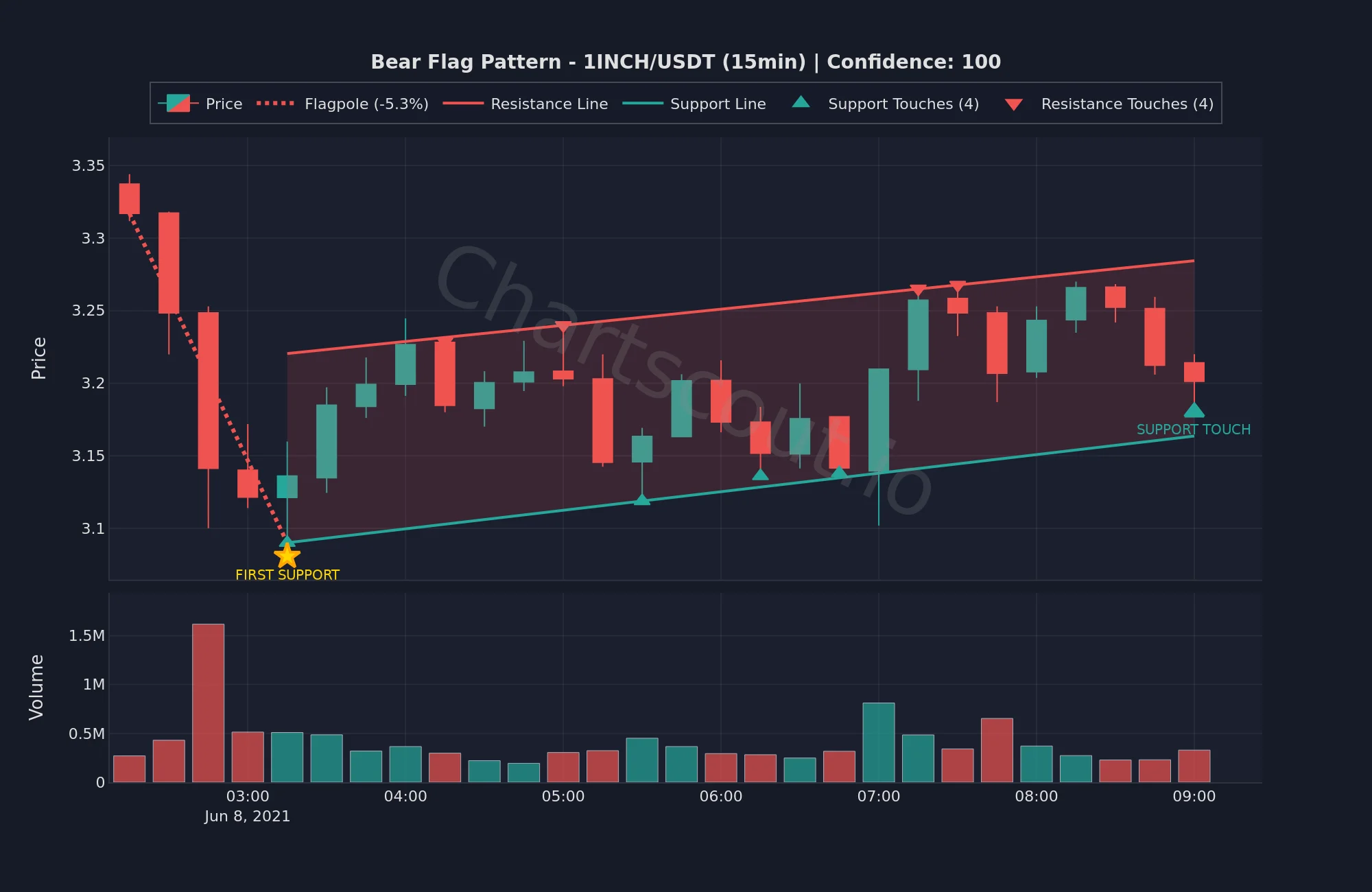
The psychology behind the bear flag
The bear flag captures a recognizable rhythm of a declining market: panic, reflex bounce, resumption. Price rarely moves in a single straight line even during sharp declines. Aggressive selling gives way to a pause where short-sellers book gains and bottom-fishers attempt to catch the low. The flag is that pause made visible.
Phase 1: flagpole (panic selling)
A catalyst triggers aggressive selling. In equities it might be an earnings miss or a downgrade. In crypto it is typically a hack, a listing cancellation, a regulatory scare, or a macro risk-off event dragging the whole market lower. Early holders rush for the exit, leveraged longs get liquidated, and volume surges. The sharp decline creates the flagpole.
Phase 2: flag (reflex bounce and profit-taking)
After the initial plunge, some short-sellers cover and bottom-fishers buy the dip. Price drifts higher on declining volume. That detail is critical - if the bounce had conviction, volume would expand. A flag bounce on falling volume represents weak buying, not a trend change. Bulkowski's data on flags with downward breakouts shows volume trends downward during the consolidation 77% of the time.
Phase 3: breakdown (continuation)
As buyers exhaust themselves, sellers regain control. Price closes below the lower flag boundary on renewed volume. Buyers who purchased inside the flag are now underwater and their stops trigger more selling. In crypto, where leveraged longs can liquidate in cascades, this phase can play out faster and more violently than in stocks.
“On average, flags act as half-staff patterns (the price/time run after the flag is about as long as the one preceding it).”
- Thomas Bulkowski, Encyclopedia of Chart Patterns, 2nd ed., p. 335 (Chapter 21, Flags)
Key insight: The half-staff principle is a statistical tendency, not a guarantee. Bulkowski's data shows only 46% of bear flags reach the full measured-move target, and his explicit guidance is to “set price targets conservatively since the price move after the breakout will usually be shorter than the price move leading to the flag.” Use the target to plan partial profits, not as a destination you expect to hit.
Bulkowski's bear flag statistics
Bulkowski updated his flag statistics in August 2020 based on hundreds of perfect trades. The results may surprise traders who assume bear flags are high-probability short setups. A 45% break-even failure rate means nearly half of all bear flag breakdowns fail to produce even a 5% move beyond the breakout. Combined with the 40% downward-breakout rate, the pattern carries a serious base-rate disadvantage.
| Metric (bear flag = downward breakout) | Value |
|---|---|
| Break-even failure rate | 45% |
| Average decline after breakdown | -8% (short-term swing) |
| % meeting measured-move target | 46% |
| Downward breakout rate | 40% |
| Volume trend downward during flag | 77% |
| Performance rank (bearish) | Not in top 10 bearish patterns |
Source: thepatternsite.com/flags.html, updated 8/27/2020. Hundreds of perfect trades.
Why the 8% number is deceptive
Flag performance is measured on the short-term price swing (trend start to trend end), not the breakout-to-ultimate-low metric used for most chart patterns. That is why the 8% average looks small next to the 16% average decline for head and shoulders tops. The two numbers are not measuring the same thing. This also explains why Bulkowski does not assign a performance rank to standard flags.
Apples vs oranges: Do not compare the 8% bear flag average directly to the 16% head and shoulders top or 38% inverse head and shoulders. They measure different move definitions. What the 8% figure does tell you is that bear flag swings are modest even when they work - size for modest outcomes, not home runs.
The 60/40 base-rate problem
The single most important number in this entire guide: only 40% of flag patterns break downward. The other 60% break upward. When you look at a chart and identify what appears to be a bear flag, you are already betting against the base rate. Combined with the 55% odds of a valid breakdown given it breaks down, roughly 22% of identified bear flag setups produce a useful short-side move (0.40 multiplied by 0.55, approximately 0.22). The pattern still has edge when filtered carefully - but the edge is narrower than most educational content suggests.
“Set price targets conservatively since the price move after the breakout will usually be shorter than the price move leading to the flag.”
- Thomas Bulkowski, Encyclopedia of Chart Patterns, 2nd ed., p. 346 (Chapter 21, Flags, Statistics)
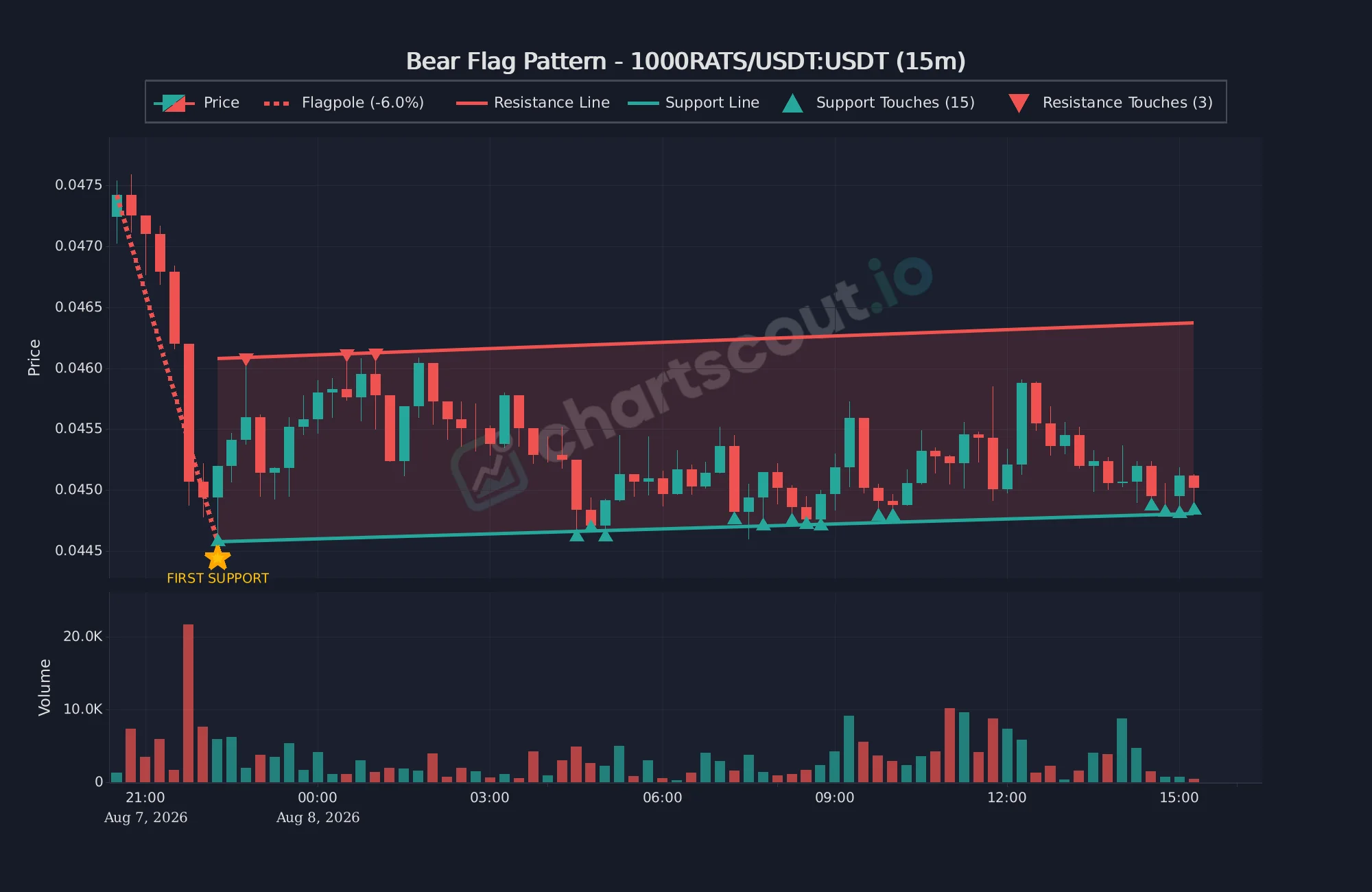
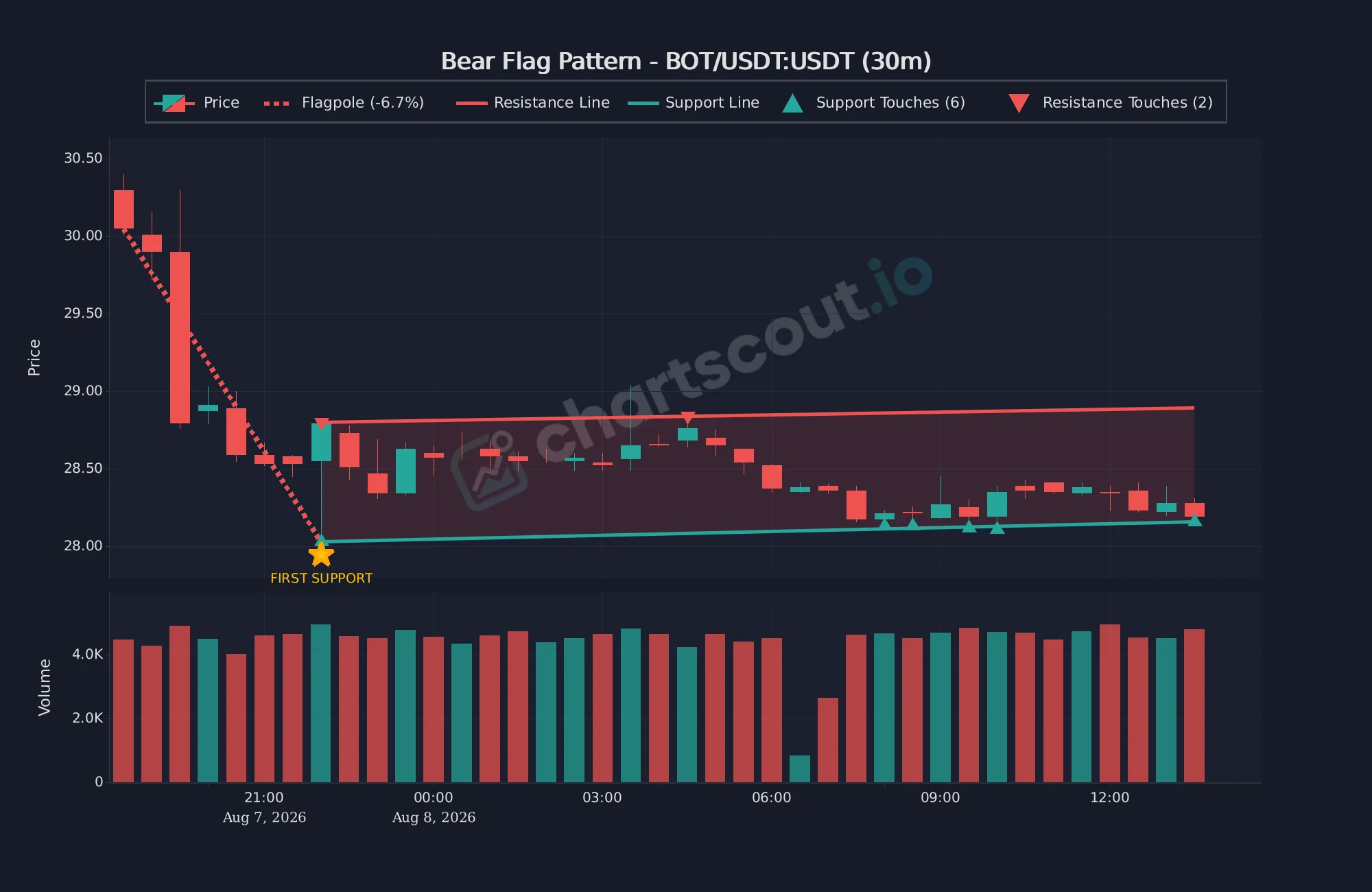
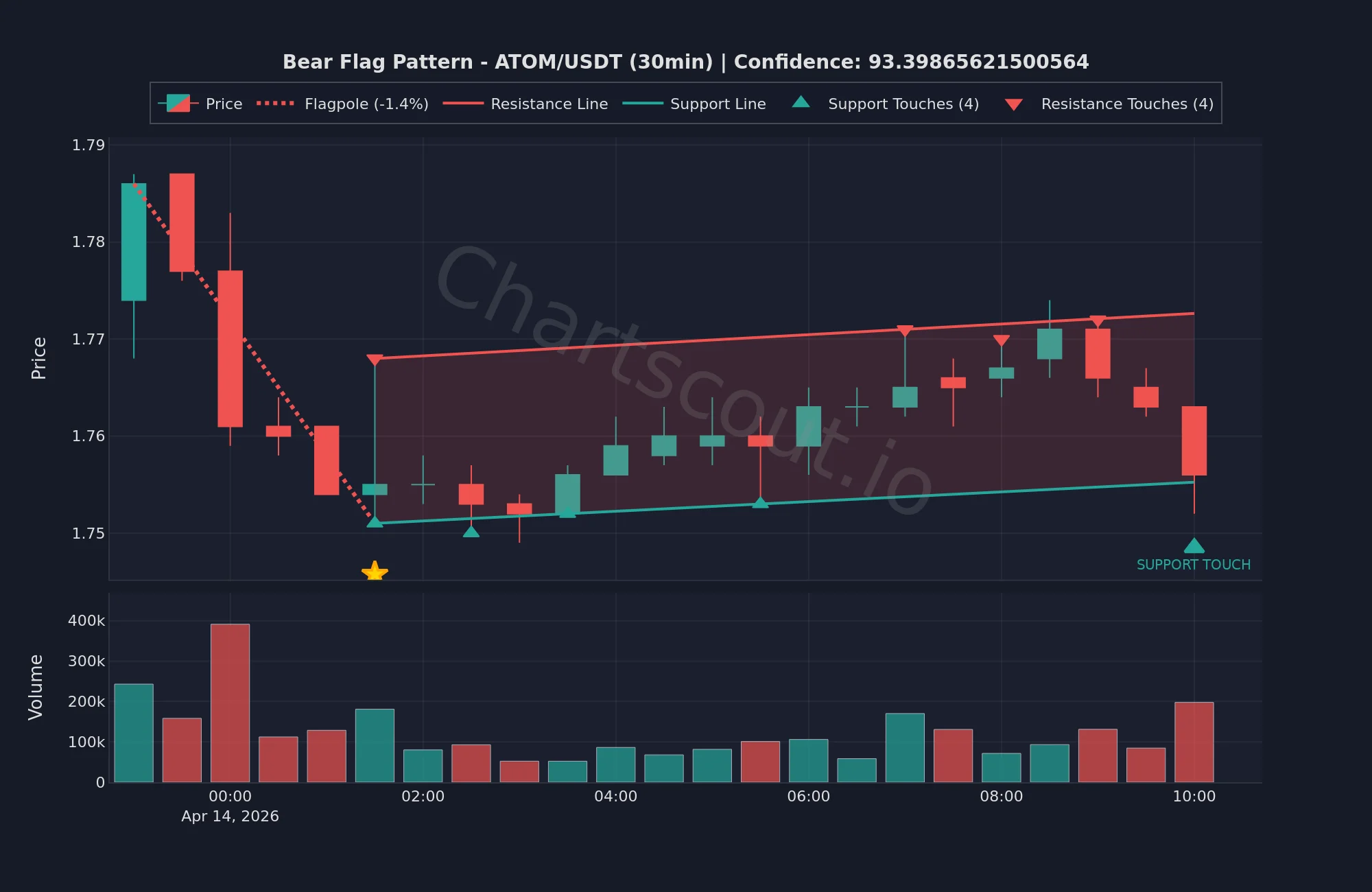
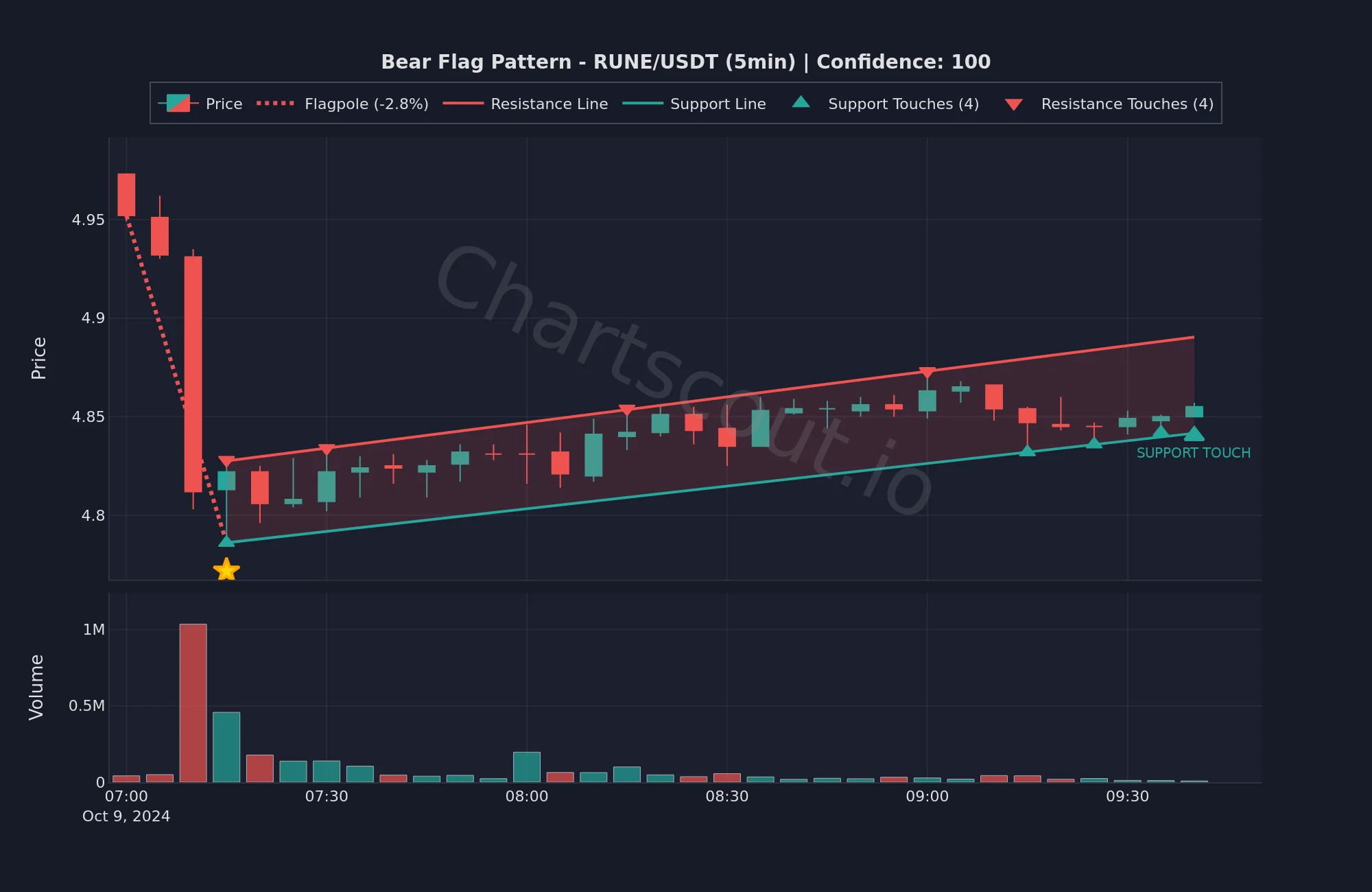
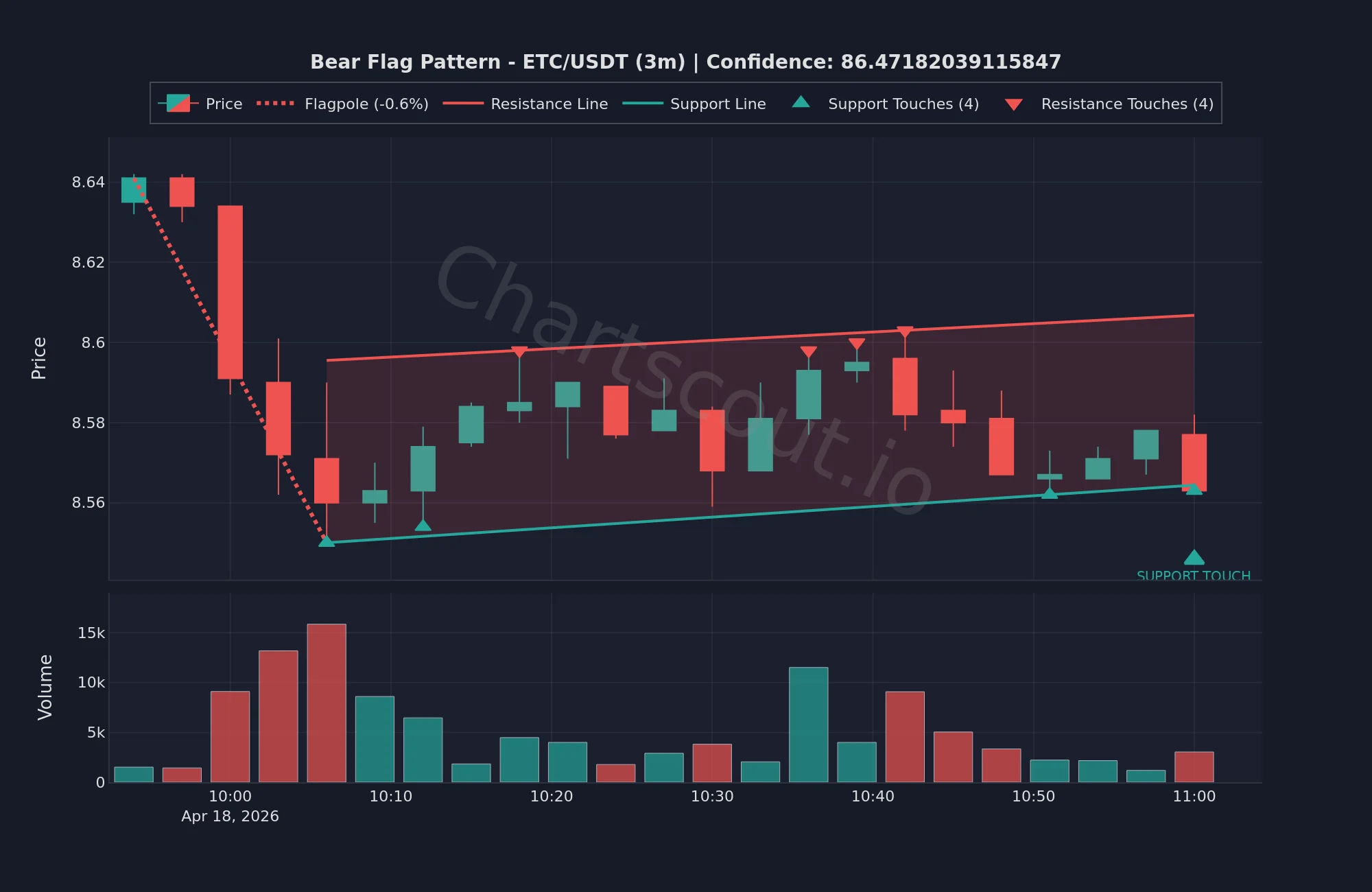
Same pattern structure, different pairs, 30-minute timeframe - produced by the same scripts that power ChartScout's live scanner.
How to identify a bear flag
Given the unfavorable base rate, identification discipline matters more for bear flags than for almost any other pattern. The checklist below combines Bulkowski's guidelines with the volume filter Pring emphasizes and the half-mast structure Murphy describes.
| Characteristic | What to look for |
|---|---|
| Prior trend | Sharp, near-vertical multi-candle decline (the flagpole) |
| Flag shape | Small rectangle bounded by parallel or near-parallel trendlines |
| Flag tilt | Slight upward slope, against the downtrend |
| Duration | Under ~15 candles on any timeframe; <3 weeks on daily per Bulkowski |
| Depth | Bounce should not retrace more than ~50% of the flagpole |
| Volume | Must decline during the flag (77% of valid setups show this) |
| Higher-timeframe alignment | Broader trend on 4h/1d should also be bearish |
| No major support below | Price should not be consolidating directly above prior lows or psychological levels |
Sources: Bulkowski, Encyclopedia of Chart Patterns, 2nd ed., Chapter 21 (Table 21.1, pp. 337-338); Pring, Pring on Price Patterns, Chapter 12, pp. 211-216.
Pattern confusion to avoid
A bear flag is often confused with three other patterns. The differences matter because they have different statistics and different trading rules.
- Bear flag vs descending channel: A descending channel has both boundaries sloping down and can last hundreds of candles. A bear flag has an upward-tilted consolidation with parallel boundaries and must complete in under ~15 candles after a steep inbound decline.
- Bear flag vs descending triangle: A descending triangle has a flat lower boundary and a descending upper boundary. A bear flag has two parallel boundaries that slope gently up. See our descending triangle guide for the separate rules.
- Bear flag vs bear pennant: Bear pennants have converging trendlines forming a small triangle. Bear flags have parallel trendlines forming a rectangle. Flags outperform pennants on every key metric - see the bear pennant guide.
Volume: the expert's edge
Volume analysis is the single most useful filter for separating valid bear flags from setups that break upward. Martin Pring devotes the cleanest framing to this in Pring on Price Patterns, and his volume-agreement rule is what most traders skip.
“A flag is a quiet parallel trading range accompanied by a trend of declining volume. Such formations usually interrupt a sharp, almost vertical price rise or decline. As the name implies, this formation looks like a flag on the chart. Since they are continuation patterns, flag completions involve a breakout in the same direction as the previous trend.”
- Martin Pring, Pring on Price Patterns, p. 211 (Chapter 12, Smaller Patterns and Gaps)
“Volume is normally extremely heavy just before the point at which the flag formation begins. As the formation develops, activity gradually contracts to almost nothing. It then explodes as the price works its way out of the completed formation.”
- Martin Pring, Pring on Price Patterns, p. 211 (Chapter 12, Flags)
This is the signature of a valid bear flag: heavy volume on the flagpole, volume contracting through the bounce, and explosive volume on the breakdown. Edwards, Magee & Bassetti describe the same behavior explicitly for the bearish case.
“Flags form on steep down moves in much the same manner and with precisely the same implications as they do in uptrends. Down Flags, of course, tend to slope up; i.e., they simply invert the picture presented by an up Flag. Trading volume diminishes during their formation and increases again as prices break down away from them.”
- Edwards, Magee & Bassetti, Technical Analysis of Stock Trends, p. 194 (Chapter 11, Consolidation Formations)
Volume statistics for bear flags
| Volume characteristic | Impact |
|---|---|
| Volume trends downward during flag | 77% of flags with valid downward breakouts |
| Falling volume trend improves performance | 56% of the time (all downward-breakout patterns) |
| Heavy breakout-day volume improves performance | 67% of the time |
| Breakout-day gap improves performance | 85% of the time |
Source: thepatternsite.com/flags.html and thepatternsite.com/studystudy.html, updated 2020.
Pring's validity test: If you see what looks like a bear flag but volume is flat or rising during the bounce, the buyers stepping in are real. Flags that lack volume contraction fail more often than they break down. This is the filter that separates real bear flags from failed breakdowns waiting to happen. For a full breakdown of volume confirmation across every major pattern, see our chart patterns and volume analysis guide.
Complete trading strategy
Entry strategies
Strategy 1: breakdown entry (conservative)
Enter when price closes below the lowest point in the flag, not just outside a trendline. Breakout-day volume should exceed the flag's average volume. This is the highest-confirmation entry and reduces exposure to fakeouts. Cost: you miss the initial portion of the move.
“After a series of ‘higher high’ tops and ‘higher low’ bottoms, prices will breakout of the lower-trend line. Wait for confirmation of breakdown with a long range bar. One of the best confirmations occur when prices ‘close’ below a previous ‘swing low’ (of bear flag). Enter a ‘short’ trade one tick below the ‘swing low’ or previous bars' low.”
- Suri Duddella, Trade Chart Patterns Like the Pros, p. 123 (Bear Flag)
Strategy 2: pullback entry (better risk-reward)
Wait for the breakdown, then enter when price retests the broken flag boundary as new resistance. Better entry price, tighter stop. Trade-off: pullbacks occur in only 56% of downward breakouts, and when they do occur, performance is worse 91% of the time per Bulkowski's aggregate data.
Strategy 3: anticipation entry (aggressive - not recommended)
Some traders short on a rejection at the upper flag boundary during consolidation. This offers the best possible entry but fails dramatically more often because there is no breakdown confirmation and no volume signal. Given the 60/40 upward-breakout tendency, anticipation entries fight the base rate twice over. Skip this approach unless you have specific higher-timeframe bearish confluence.
Price target: the measured move
The standard target is calculated by measuring the flagpole height (from the start of the steep decline to the bottom) and projecting that distance downward from the top of the flag or from the breakout point.
| Target approach | Basis | % meeting target |
|---|---|---|
| Full measured move | Full flagpole height projected down from top of flag | 46% |
| Conservative partial | Half the flagpole height | Higher hit rate - Bulkowski recommends conservative targets |
| Prior swing low | First major structural low below the breakdown | Context-dependent |
Source: Bulkowski, thepatternsite.com/flags.html, and Encyclopedia of Chart Patterns, 2nd ed., p. 346 (conservative-target guidance).
Only 46% of bear flags reach the full measured-move target. Take partial profits well before the full projection - Bulkowski is explicit that the post-breakout move is typically shorter than the flagpole.
Stop-loss placement
| Approach | Stop level | Use case |
|---|---|---|
| Standard | Just above flag high + 0.5-1% buffer | Most trades |
| Aggressive | Above 50% retracement of flagpole | Tight-flag high-conviction setups |
| Conservative | Above the start of the flagpole | Only for very deep-conviction swing trades |
Short-selling position sizing: Short trades carry theoretically unlimited upside risk. Cap portfolio risk per short at 1% of account rather than the 2% often used for longs. Require a minimum 2:1 reward-to-risk - a bear flag with an 8% average move and a stop above the flag high needs a clean setup to clear that threshold. If the math does not work, pass on the trade.
Failure rates and risk management
The 45% break-even failure rate for bear flags is the single most important number in this guide. Nearly half of all valid setups fail to produce a meaningful move. Even clean patterns produce fake breakouts that trap traders who ignore volume confirmation.
Aggregate downward-breakout statistics
Bulkowski's “Study of Studies” aggregates all chart patterns with downward breakouts, giving useful context for what can go wrong with any bearish setup - bear flags included.
| Metric (all downward-breakout patterns) | Value |
|---|---|
| Pullback rate | 56% |
| Patterns performing better without pullback | 91% |
| Heavy breakout volume helps performance | 67% |
| Falling volume trend helps performance | 56% |
| Tall patterns outperform short ones | 100% |
| Wide patterns outperform narrow ones | 85% |
| Breakout-day gaps help performance | 85% |
| Patterns leading to >20% decline | 28% |
Source: thepatternsite.com/studystudy.html. Aggregate of all chart patterns with downward breakouts.
The asymmetry: Only 28% of bearish chart patterns lead to declines exceeding 20%, versus 55% of bullish patterns that lead to 20%+ rises. Markets fall faster but recover more reliably. Short-selling bear flags requires higher conviction, faster execution, and tighter risk management than the equivalent bull setup.
What causes bear flag failures
- No valid flagpole. A gradual drift down is not a flagpole. Without a sharp, steep prior decline, the continuation psychology is absent.
- Loose flag formation. Price that meanders, wicks beyond the channel, or pokes outside the boundaries signals uncertainty and usually resolves upward.
- Rising volume during the flag. Pring's validity test: if volume fails to contract, buyers are real and the bearish thesis is weak.
- Bullish higher-timeframe context. A bear flag that forms against a clearly bullish 4h or daily trend is fighting the tape.
- Major support below. If price is consolidating directly above prior lows, a major moving average, or a round-number level, the breakdown attempt is more likely to be absorbed.
- The 60/40 base rate. Remember: 60% of flags break up. Even clean-looking bear flags fight unfavorable odds.
“It is important to make sure that the price and volume characteristics agree... A flag that takes more than four weeks to develop should also be treated with caution. This is because these formations are, by definition, temporary interruptions of a sharp uptrend. A period in excess of four weeks represents an unduly long time for profit taking, and therefore has a lower probability of being a true flag.”
- Martin Pring, Pring on Price Patterns, pp. 213-214 (Chapter 12, Flags)
When a bear flag fails
When a bear flag fails and price closes decisively above the upper boundary, the move can be powerful. Trapped short-sellers cover, stops above the flag trigger, and the combined pressure fuels a strong rally. Treat a failed bear flag as a potential long signal if it is confirmed by volume - but only if higher-timeframe structure agrees. Do not hold a losing short past a full candle close above the flag high.
“Flags are for swing traders, ones who want to ride the quick price move and sell when price turns.”
- Thomas Bulkowski, Encyclopedia of Chart Patterns, 2nd ed., p. 345
Treat bear flags as swing-trade setups, not position-trade setups. Take profits aggressively. The math does not support holding for large moves.
Bear flag vs other bearish patterns
Bear flags rank poorly compared to most other bearish patterns Bulkowski covers. Understanding where they sit in the ranking helps allocate capital to higher-probability setups instead of defaulting to the most-cited pattern.
| Pattern | Average decline | Break-even failure | Rank (bearish) |
|---|---|---|---|
| Head and shoulders top | -16% | 19% | 9 of 36 |
| Descending triangle (down breakout) | -15% | 23% | Top 10 |
| Double top (Adam & Adam) | -19% | Variant-dependent | Top 20 |
| Bear flag (down breakout) | -8% (short-term swing) | 45% | Not ranked top 10 |
| Bear pennant (down breakout) | -6% (short-term swing) | 54% | Not ranked top 10 |
Sources: thepatternsite.com/flags.html, thepatternsite.com/pennants.html, thepatternsite.com/BestPatterns.html, Encyclopedia of Chart Patterns, 2nd ed. Short-term swing vs breakout-to-ultimate-low metrics are not directly comparable.
For high-conviction short trades, head and shoulders tops offer a meaningfully better statistical edge. Use bear flags as complementary signals inside a broader bearish thesis, not standalone entries.
Bear flag vs bear pennant
| Metric (down breakouts) | Bear flag | Bear pennant |
|---|---|---|
| Break-even failure rate | 45% | 54% |
| Average decline (short-term swing) | -8% | -6% |
| % meeting price target | 46% | 32% |
| Volume trend downward during flag | 77% | 86% |
Source: thepatternsite.com/flags.html and thepatternsite.com/pennants.html, updated 8/27/2020.
Bear flags outperform bear pennants on every headline metric. If you are choosing between a flag setup and a pennant setup on the same pair, the flag is the better bet - though neither is particularly strong on an absolute basis.
Crypto-specific considerations
The Bulkowski references above use stock-market data. ChartScout's separate crypto evidence uses Binance markets, a distinct detection cohort, and a different outcome method. The two evidence bases are labelled separately. If you are new to reading crypto charts specifically, start with our beginner's guide to reading crypto charts.
ChartScout original research
ChartScout analyzed 17,581 canonical Bear Flag pattern families from a dedicated study run across 59 Binance markets and all 15 configured timeframes from 1m through 1M. Across all timeframes, 16.59% of 17,572 eligible downward endpoints declined at least 5%; the rate was 27.18% at 5m and above and 44.49% at 15m and above. The full methodology, per-timeframe results, threshold sensitivity, market-regime splits, sample atlas, and Bulkowski comparison are in our Bear Flag win rate study.
Bulkowski's stock baseline vs crypto: what shifts
Crypto and equities can display similar formations, but that does not guarantee equal outcome rates. Market structure, timeframe exposure, and measurement horizons differ. The comparisons below are descriptive, not interchangeable probabilities.
| Factor | Bulkowski baseline (stocks) | Crypto (measured where studied) |
|---|---|---|
| Pattern pace | Days to weeks per pattern | Minutes to days on low TFs; same candle count, compressed wall-clock time |
| Full measure-rule target | 46% | 25.25% across all evaluable families and 32.28% at 15m and above |
| Average post-breakdown move | -8% short-term swing | 2.77% across all eligible families and 8.12% at 15m and above, using ChartScout's causal finite-horizon endpoint (our study) |
| Failure rate | 45% break-even failure | 83.41% failed to decline 5% across all eligible families; 55.51% failed at 15m and above. The stock and crypto designs differ. |
| Volume confirmation | Single-exchange tape; reliable | The study used Binance data only and did not test cross-exchange volume confirmation |
| Pullback rate | 56% (all down breakouts) | 98.59% returned near the boundary under ChartScout's boundary-proximity definition, which is not directly comparable with Bulkowski's pullback convention |
| Gap risk | Overnight/weekend gaps common | No scheduled overnight closure, though liquidity and operational discontinuities can still occur |
| Participant mix | Varies by market and period | Varies by market and period; participant composition was not measured in this study |
Interpretation boundary: Our crypto Bear Flag win rate study measured 17,581 canonical pattern families across 59 Binance markets. It provides crypto-specific evidence for this detector and cohort, but it does not prove that stock-market rankings transfer to crypto or that the measured chart outcomes produce net trading profits.
24/7 markets
Crypto venues generally trade continuously without a scheduled overnight close, although operational interruptions and liquidity gaps can still occur. Patterns can form at any hour, and liquidity conditions can vary materially by venue and time. The study did not test funding, open interest, or liquidation data as explanatory variables.
Which timeframes bear flags work on
The detector ran on all 15 configured timeframes from 1m through 1M. Canonical families were represented from 1m through 3d, with no retained 1w or 1M families. The lower timeframes contribute most observations, so rates must be read with their denominators rather than as a simple ranking from worst to best timeframe.
| Timeframe | Typical flag duration | Use case |
|---|---|---|
| 1m | 5-15 minutes | Largest study stratum; 6,959 families |
| 5m | 25-75 minutes | Intraday; 4,004 families and included in 5m+ |
| 15m | 1-4 hours | Intraday; 464 families |
| 1h | 5-15 hours | Intraday to multi-session; 324 families |
| 4h | 20-60 hours | Sparse study cell; 86 families |
| 1d | 1-3 weeks | Very sparse study cell; 17 families |
| 1w | 1-4 months | No canonical families in this analytical sample |
For many traders, 15m and 1h offer a practical balance between frequency and chart clarity. That is a workflow judgment, not a proven profitability ranking. In the measured corpus, the pooled 15m+ group declined at least 5% in 44.49% of 1,416 eligible downward families, while individual cells above 2h were too sparse for stable ranking. Use higher-timeframe context as confirmation, not as a guarantee.
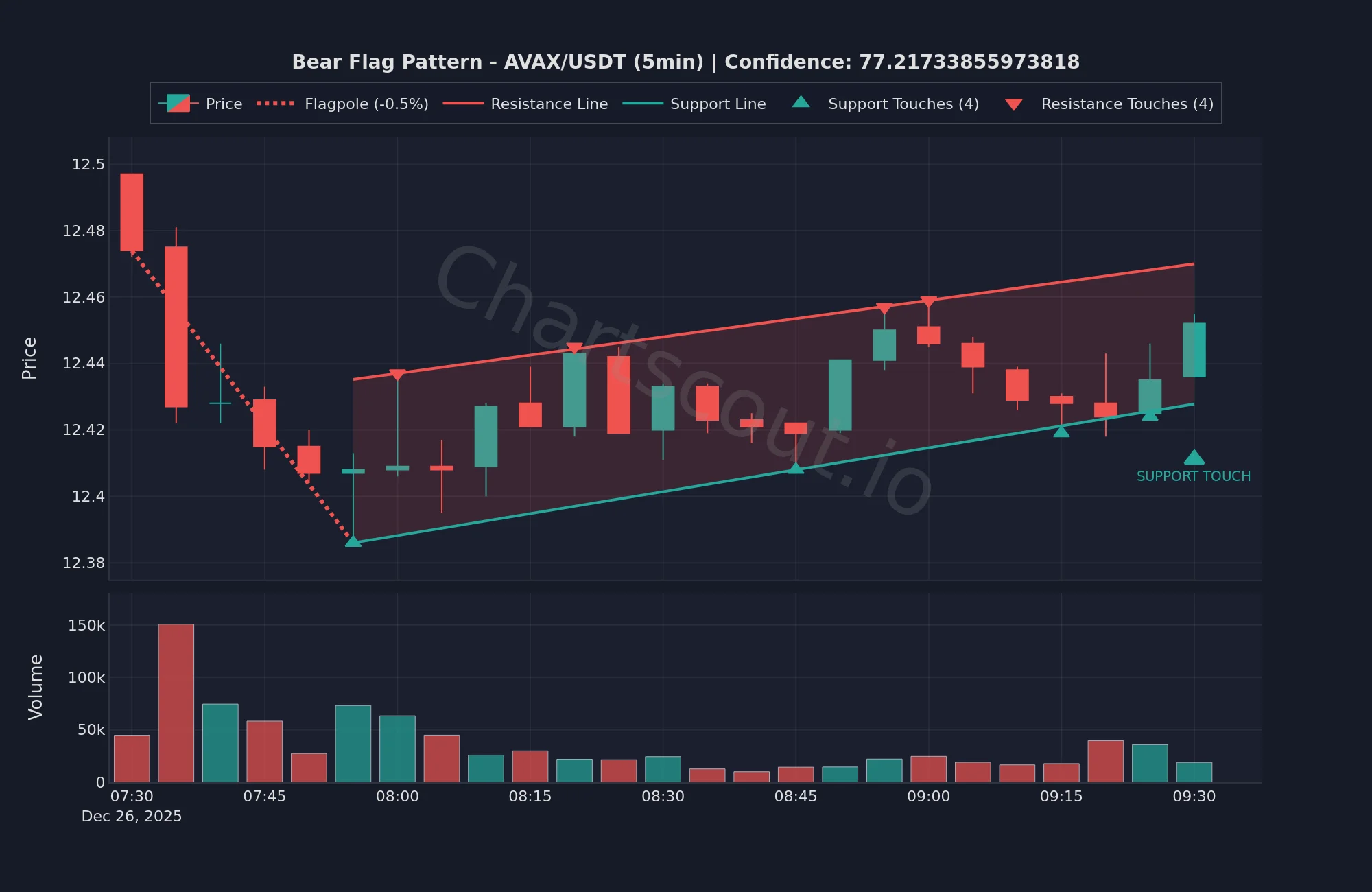
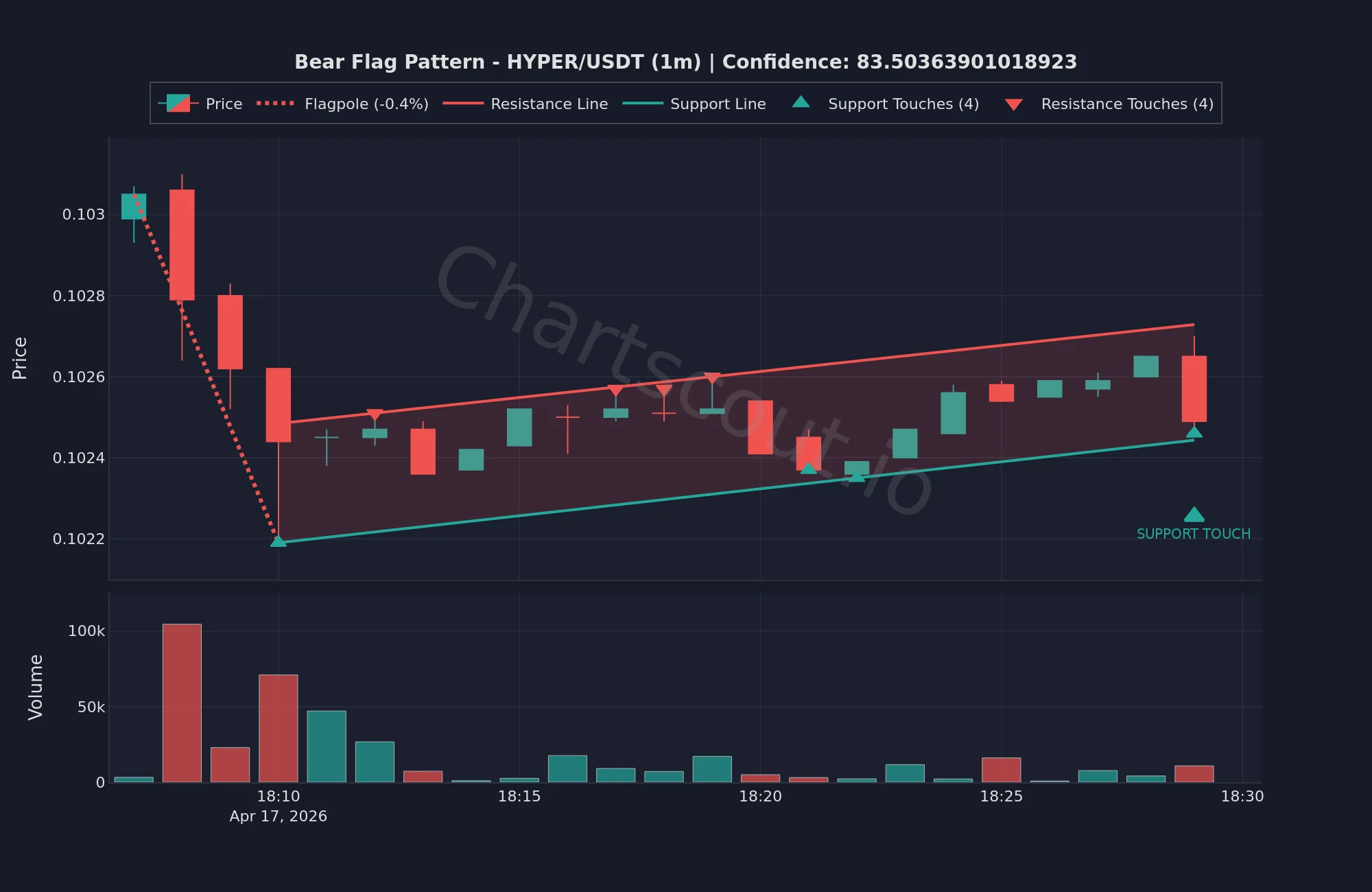
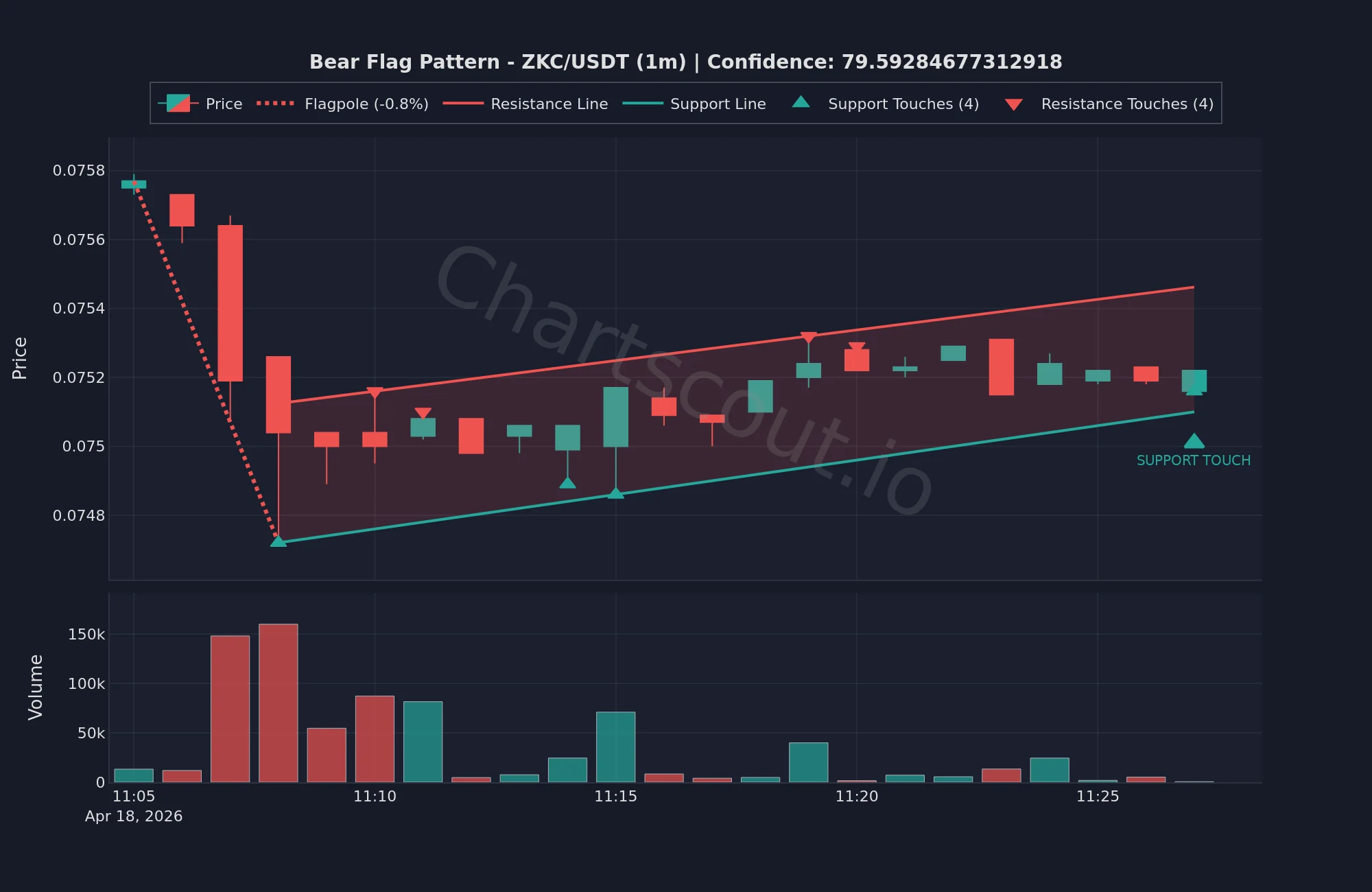
Three crypto bear flags across 5m and 1m - same pattern structure, same detection script, compressed to minutes. AVAX is a backtest screenshot, HYPER and ZKC are live alerts from the past 24 hours.
Volatility amplification
Volatility changes the percentage width of formations and the distance to structural invalidation. Stops and position sizes therefore need to be derived from the observed market and timeframe rather than copied from an equity example. The study reports percentage and ATR-normalized thresholds, but it does not claim a universal crypto-to-equity volatility ratio.
Volume confirmation across exchanges
ChartScout's research cohort uses Binance data only. It does not test whether cross-exchange volume confirmation improves outcomes, so Pring's declining-volume framework should be treated as contextual evidence rather than a measured crypto success filter.
Execution boundary: Waiting for a completed candle below the flag low is a conservative confirmation rule; entering on an intrabar wick is a different strategy with a different sample. The crypto study measures post-breakdown chart outcomes and does not compare entry rules, fees, slippage, or confluence filters such as a higher-timeframe death cross.
Frequently asked questions
What is the success rate of the bear flag pattern?
There is no universal Bear Flag success rate. Bulkowski's stock reference reports 55% reaching a 5% short-swing threshold after a downward breakout, while ChartScout's crypto study found 16.59% across all eligible downward families, 27.18% at 5m and above, and 44.49% at 15m and above. Different markets and outcome rules produce different estimates. None of these rates is a net strategy return.
How do you calculate the bear flag price target?
The classical measure rule projects the flagpole height downward from the flag or breakdown reference. Bulkowski reports 46% full-target attainment for downward stock flags. ChartScout's crypto cohort reached the full-pole target in 25.25% of 17,550 evaluable families and 32.28% of 1,422 evaluable 15m+ families. These are descriptive target statistics, not exit instructions.
How long should a bear flag last?
Classical references describe flags as short formations and caution against unusually long daily-stock consolidations. Treating a daily-stock duration rule as one universal candle-count threshold on every intraday crypto timeframe would be an extrapolation, not a result of ChartScout's study.
Why do most flags break upward instead of downward?
Per Bulkowski, only 40% of all flag patterns break downward; 60% break upward. Markets have a structural upward bias over time and Bulkowski's aggregate data shows only 28% of bearish chart patterns lead to declines exceeding 20%, compared to 55% of bullish patterns producing 20%+ rises. Short-selling bear flags requires higher conviction than trading bull flags.
How often do pullbacks occur after bear flag breakdowns?
Bulkowski's aggregate data for all chart patterns with downward breakouts shows pullbacks occur 56% of the time. When pullbacks occur, performance is worse 91% of the time. The most profitable bear flag trades do not pull back - they break down and run.
What is the best timeframe for bear flags in crypto?
15m and 1h are practical day-trading timeframes because they balance observation frequency with readable structure. This is not a profitability ranking: the pooled 15m+ group declined at least 5% in 44.49% of 1,416 eligible families, while individual cells above 2h were sparse. The study found 17 daily families and no canonical weekly or monthly families.
How do bear flags compare to head and shoulders tops?
Head and shoulders tops significantly outperform bear flags. Per Bulkowski, head and shoulders tops produce a 16% average decline and rank 9 out of 36 bearish patterns; bear flags produce an 8% average decline and do not rank in the top 10. For high-conviction short trades, head and shoulders offers a much stronger statistical edge.
Are bear flags worth trading?
The studies describe chart outcomes, not a net trading strategy. Any decision to trade Bear Flags still requires causal entry and exit rules, fees, slippage, position sizing, drawdown analysis, and forward validation. Treat the pattern as one input rather than standalone proof of an edge.
Do bear flags work in crypto?
Bear Flags occur in crypto, but “work” depends on the endpoint. Our study of 17,581 canonical Bear Flag families across 59 Binance markets found that 16.59% of eligible downward endpoints declined at least 5% across all timeframes, compared with 27.18% at 5m and above and 44.49% at 15m and above. These are conditional chart outcomes, not net strategy returns.
Conclusion
Bear Flag outcomes depend on the market, timeframe, pattern definition, and endpoint. Bulkowski's stock reference and ChartScout's crypto study should therefore be read as separate descriptive samples. ChartScout found a 16.59% 5% decline rate across all eligible downward families, 27.18% at 5m and above, and 44.49% at 15m and above. The full-pole target was reached in 25.25% of evaluable crypto families. These results do not by themselves establish a profitable trading edge.
Key takeaways
- Bulkowski's 45% failure rate is stock-specific. It uses a 5% short-swing threshold after a downward breakout and is not interchangeable with the crypto estimates.
- The crypto result depends strongly on timeframe mix. The 5% decline rate was 16.59% overall, 27.18% at 5m+, and 44.49% at 15m+.
- The typical move is smaller than the mean. At 15m+, the mean favorable decline was 8.12% while the median was 3.70%, showing that large downside tails lift the average.
- Volume is contextual evidence. Classical references describe declining volume during the flag, but the crypto study did not test volume as a performance filter.
- Target rates also differ by sample. Bulkowski reports 46% for downward stock flags; ChartScout measured 25.25% overall and 32.28% at 15m+.
- Higher-timeframe cells are sparse. The detector found only 86 families at 4h, 17 at 1d, seven at 3d, and none at 1w or 1M.
- Chart outcomes are not strategy returns. Entry rules, fees, slippage, sizing, drawdown, and forward validation remain outside this study.
Detect bear flags in real time
Scanning 1,000+ pairs for valid bear flags with tight consolidation and declining volume is not something a human can do manually across seven timeframes. ChartScout's engine runs the same detection logic around the clock and alerts you when a setup qualifies. Learn more about alert-driven trading.
Start 7-day trial→Set up your first bear flag watcher in under 2 minutes.
Sources & references
Data source note: Crypto statistics come from ChartScout's study of 17,581 canonical pattern families across 59 Binance markets. Stock references come from Bulkowski's flags.html, studystudy.html, BestPatterns.html, and pennants.html publications. The markets and outcome methods differ, so the figures are labelled separately and should not be interpreted as interchangeable probabilities.
- ChartScout Research. Bear Flag Win Rate in Crypto: A Study of 17,581 Pattern Families. 2026. Read the complete study.
Primary source for the crypto cohort, per-timeframe outcomes, 5m+ and 15m+ aggregates, threshold sensitivity, regime splits, detector sample atlas, and study limitations. - Bulkowski, Thomas N. ThePatternSite.com - Flags. Updated 8/27/2020. thepatternsite.com/flags.html.
Primary statistical source. Bear flag figures (downward-breakout column): 45% break-even failure, 8% average decline, 40% downward breakout rate, 46% meeting target, 77% volume trend downward. Hundreds of perfect trades. - Bulkowski, Thomas N. ThePatternSite.com - Study of Studies. thepatternsite.com/studystudy.html.
Aggregate statistics for all chart patterns with downward breakouts. Source for pullback rate (56%), performance-hurt-by-pullback (91%), heavy-volume-helps (67%), breakout-gap-helps (85%), and the 28% share of bearish patterns producing >20% declines. - Bulkowski, Thomas N. ThePatternSite.com - Best Patterns. thepatternsite.com/BestPatterns.html.
Performance ranking across all chart patterns. Confirms bear flags do not rank among the top 10 bearish patterns; head and shoulders tops rank 9 of 36 bearish. - Bulkowski, Thomas N. ThePatternSite.com - Pennants. thepatternsite.com/pennants.html.
Source for bear pennant comparison statistics: 54% break-even failure, 6% average decline, 32% target hit, 86% volume down during formation. - Bulkowski, Thomas N. Encyclopedia of Chart Patterns, 2nd Edition. John Wiley & Sons, 2005. ISBN: 978-0471668268.
Chapter 21 (Flags), pp. 335-350. Source for the half-staff principle (p. 335), the flagpole-required identification rule (p. 337, Table 21.1), the “set targets conservatively” guidance (p. 346), and the “flags are for swing traders” characterization (p. 345). - Bulkowski, Thomas N. Getting Started in Chart Patterns. John Wiley & Sons, 2006. ISBN: 978-0471727668.
Chapter 7, Flags and Pennants, p. 153. Source for the flagpole identification standard: “The flagpole, the price run-up or -down leading to the flag or pennant, should be unusually steep and quick.” - Pring, Martin J. Pring on Price Patterns: The Definitive Guide to Price Pattern Analysis and Interpretation. McGraw-Hill, 2005. ISBN: 978-0071440387.
Chapter 12 (Smaller Patterns and Gaps), Flags section, pp. 211-216. Source for the flag definition and volume signature (p. 211), the volume-agreement validity test (pp. 213-214), and the 4-week duration caution. - Duddella, Suri. Trade Chart Patterns Like the Pros. 2008. ISBN: 978-1439230862.
Bear Flag section, p. 123. Source for breakdown entry rules, confirmation via close below previous swing low, and short-trade entry at one tick below swing-low. - Edwards, Robert D.; Magee, John; Bassetti, W. H. C. Technical Analysis of Stock Trends.
Chapter 11 (Consolidation Formations), Flags and Pennants section, p. 194. Source for down-flag behavior: upward slope, diminishing volume through the formation, and volume increase on breakdown. - Murphy, John J. Charting Made Easy. Marketplace Books.
Chapter 5 (Reversal and Continuation Price Patterns), Flags and Pennants, pp. 20-21. Source for the half-mast principle and bear flag upward-slope definition.

Stjepan Ivanović
Founder of ChartScout · Crypto Trader Since 2013
Trading crypto since 2013 with his first Bitcoin bought at ~$200. Four complete bull/bear market cycles, traded on early exchanges like Mt.Gox and BTC-e, on-chain trading on IDEX and EtherDelta, and ~70 crypto project investments. Built ChartScout after 2+ years of development to automate what no trader can do manually. Watch hundreds of charts 24/7.