KuCoin chart pattern scanner: spot & futures alerts (2026)
The pair that just ran 30% on KuCoin? You had it on your watchlist three weeks ago. You stopped checking it. That is how most KuCoin trading days end. Not because the analysis was wrong, but because nobody can watch the full KuCoin pair list by hand, and the move always lands on the one you stopped opening. ChartScout fixes the watching problem. It scans KuCoin Spot and Futures, 24/7, for 23 detectors, and fires the alert in under 20 seconds, before the breakout candle rather than after. We drop the dead pairs before detection runs (more on that below), so the alerts that reach your phone come from markets you can actually trade. No KuCoin login. No API keys. No funds at risk.
KuCoin sits in a specific spot in the unofficial exchange tier system traders use. Binance, Upbit, and Bithumb are at the top. Bybit and Bitget in the middle. MEXC, Gate, and KuCoin at the bottom of the majors. That is not an insult. It is the reason KuCoin is on the list at all.
Tokens hit KuCoin earlier than Binance or Coinbase because the listing bar is lower. The chart history you can scan on KuCoin often does not exist anywhere else yet. The exchange has been operating since September 2017, so many of the small and mid-cap charts have years of price action: long enough for triangles, wedges, and cup-and-handle structures to actually form.
That is the coverage opportunity. The problem is volume. A meaningful share of KuCoin's pair list is too thin to produce useful pattern observations, so ChartScout filters those pairs before detection runs. This guide covers what ChartScout does on KuCoin, why the liquidity filter exists, how Spot and Futures behave differently, where timely delivery matters most, and what additional risks apply to small-cap markets.
ChartScout on KuCoin at a glance
Why KuCoin needs a scanner more than most exchanges
KuCoin's own blog posts on chart patterns are educational primers that point readers back to the native charts to draw trendlines by hand. One pair, one timeframe, one chart at a time is not coverage for an exchange that lists thousands of pairs and is the first major venue to list a meaningful share of new altcoins. Even after we strip out the dead tail nobody trades, what is left is still too much to watch by hand.
That is the gap. Most of the highest-reward setups on KuCoin (small caps forming clean structures before broader market attention arrives) are forming in pairs nobody is watching. By the time the move shows up on a watchlist somewhere, the candle that mattered already closed.
“The chartist can easily follow as many markets as desired, which is generally not true of his or her fundamental counterpart.”
John J. Murphy, Technical Analysis of the Financial Markets
Murphy wrote that about manual chartists decades ago. The compliment does not survive contact with the KuCoin pair list across every supported timeframe, and that is after we have already dropped the pairs nobody is actually trading. Automation is the only sane way to cover what remains, and that is the argument for a dedicated KuCoin scanner.
How the KuCoin pattern scanner works
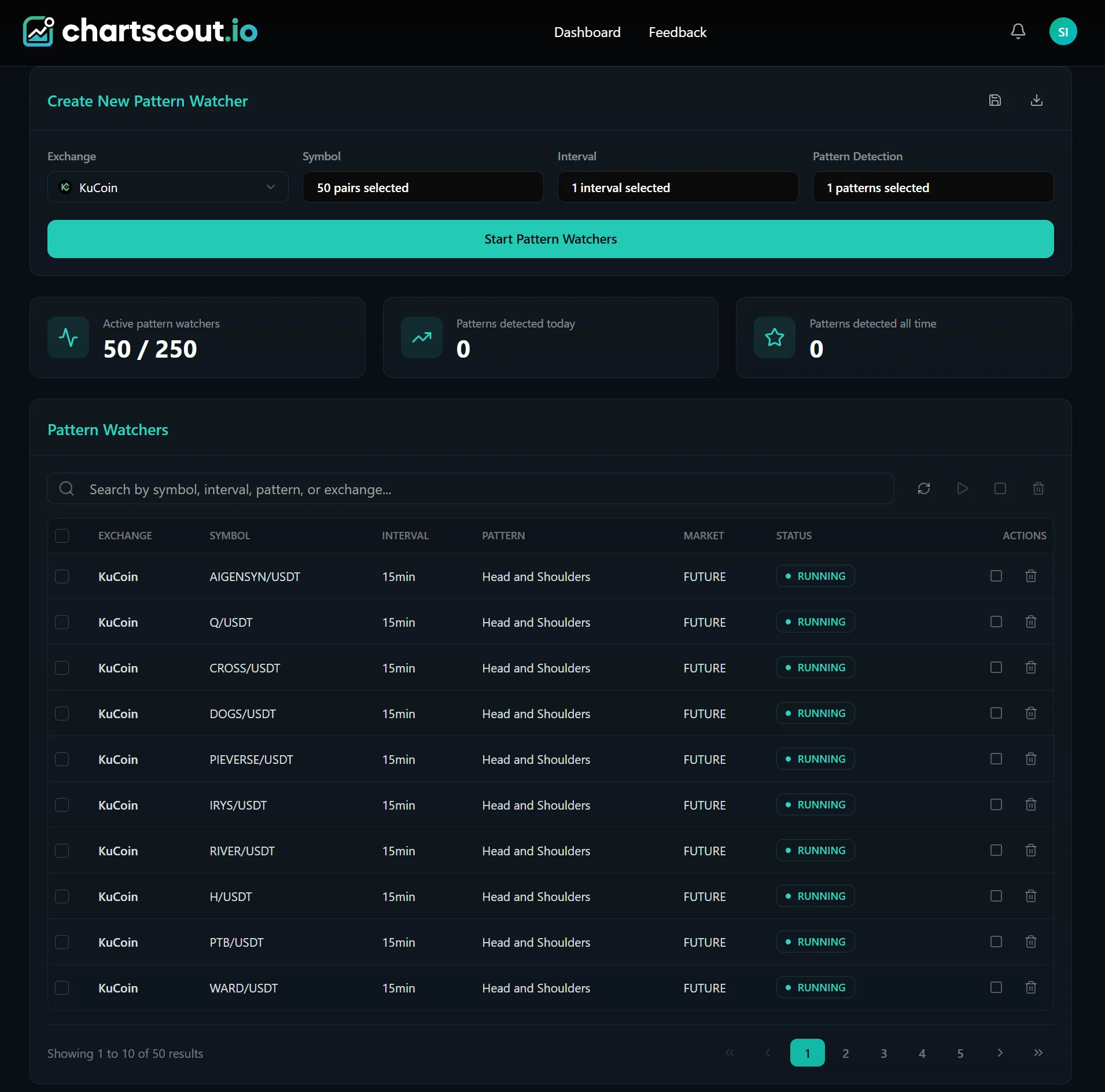
ChartScout is not a market-wide screener. You build a watcher list and the scanner runs detection on exactly that list. One watcher = one pair, one timeframe, one pattern, on one exchange. Set 50 KuCoin watchers and we evaluate 50 detector jobs on every candle close against KuCoin's public market data. Set 5 and we evaluate 5. Alerts only fire on the combinations you specifically configured. We do not push you a stream of every pattern on every pair, because most of that stream would not be a signal you would actually act on.
Tuned for noisy alt charts. KuCoin's small-cap charts are noisier than BTC or ETH charts. The detectors that handle diagonal structure (flags, triangles, wedges, channels) are tuned for that wider candle range so false trendlines drawn through single spikes do not produce alerts.
Pre-breakout firing. Triangles and wedges fire while the pattern is still actionable, before the breakout candle. The thinking is simple: an alert that arrives after the breakout is a notification, not a signal. Firing pre-breakout gives you time to open the chart, validate context, and place a limit order at a level you choose rather than chase.
No sensitivity sliders. You pick the pattern, the pair, the timeframe, the exchange. The detection logic itself is fixed. This is deliberate: parameter tinkering is the fastest way to curve-fit a scanner to past data and then watch it underperform on future data.
No API keys. ChartScout reads public market data only. Your KuCoin account, balances, and keys never touch the scanner. There is nothing to compromise.
Why KuCoin needs an extra liquidity filter
Pattern detection on a perfectly clean chart is one thing. Pattern detection across an exchange where most listed pairs trade thinly enough to leave dead minutes on the tape is another. KuCoin is the second one. Liquidity matters here more than on any other exchange we cover, and we strip out the dead pairs before detection runs.
Before scanning a pair, we check whether it has enough 24-hour volume to be worth scanning at all. The long tail of KuCoin's listings does not, so it never reaches the detection stage. The book is not there, the stop is not there, and the exit is not there. There is no upside to running pattern detection on a pair where the geometry might be perfect and the market still cannot absorb your order. The scanned list is dynamic, too: pairs that fade drop out, pairs that gain traction cross back in. The list rotates as the market moves.
Inside the scanned list, we still have to deal with empty candles. When a pair stops trading for a candle period, the exchange still emits a candle with zero volume and flat OHLC to keep the chart continuous. Those flat prints look like price action to a detector when they are not. Patterns built on too much dead air get discarded on every exchange ChartScout covers, no matter how clean the geometry looks.
KuCoin has the highest empty-candle rate of any of the five exchanges we cover, even after the volume filter. That is not a defect in KuCoin's API. It is a direct consequence of the listings model: an exchange that lists tokens early and broadly carries a long tail of pairs that go quiet for stretches. To compensate, we apply a stricter liquidity check on KuCoin than on Binance, Bybit, MEXC, or Hyperliquid. Some KuCoin patterns that survive the geometric check still get discarded because the volume around them does not support an honest trade. That is a deliberate tradeoff. We would rather skip a pattern that looks perfect on the chart than fire an alert that puts you into a market where your stop is the only volume the candle sees.
Where this hits hardest
Low timeframes on alts. Even inside the filtered list, 1m and 5m are noisy, with empty stretches on anything outside the top of the volume table. It can happen on 15m too. 1h, 4h, and 1d are clean on virtually every KuCoin pair we look at.
How to work with the filter rather than fight it:
- Run 5m and 15m watchers only on top-volume KuCoin pairs (the same names that dominate the daily turnover ranking). Those have the trader density to produce honest candles every period.
- Skip low-liquidity pairs entirely on 1m and 5m. If a pair is hovering just above the floor, do not stack your fastest watchers on it. The signal-to-noise ratio is bad enough that even when a pattern gets through every filter, the entry conditions on the book are usually wrong.
- If you want pattern detection on small-cap KuCoin pairs that barely clear the floor, move the watcher to 1h or 4h. At that bar size, even thin pairs accumulate enough volume per candle to leave a tradeable footprint. Patterns there are slower to form, but they are real when they fire.
This is why the same watcher count does more work on KuCoin than on Binance: you are not just covering more pairs, you are covering pairs that already passed a stricter liquidity gate and still need higher-timeframe coverage to produce trustable signal.
How to verify alerts before you pay
Do not judge a scanner from a landing page. Judge it from real alerts. Your private watcher detections stay inside your account once you sign up, but ChartScout publishes a sample of scanner activity on X. Use that feed as an audit trail: pick a few posts, open the same KuCoin chart, and check the timestamp against the candle.
60-second verification workflow
- Open the public @ChartScout_bot on X feed.
- Pick a recent post showing the pair, timeframe, exchange, and pattern.
- Open the same KuCoin market and timeframe on KuCoin's chart or on TradingView using KuCoin market data.
- Compare the post timestamp with the candle where the pattern was detected.
- Decide whether the pattern quality and timing match how you trade.
This is also the right expectation for a paid plan. The scanner gets you to candidates faster. It does not confirm volume, read the wick, check the news, or evaluate liquidity for you. Many alerts will not become trades. The useful ones are useful because you see them early enough to act.
The 23 detectors detected on KuCoin
KuCoin gets the same 23 detectors ChartScout runs on every supported exchange. The success-rate notes below come from Thomas Bulkowski's stock-market research, not crypto-native KuCoin data. Use them as a relative reliability ranking, not a promised hit rate on any specific KuCoin pair.
Reversal patterns
| Pattern | Bias | Bulkowski success rate |
|---|---|---|
| Head and shoulders | Bearish | 81% |
| Inverse head and shoulders | Bullish | 89% |
| Double top | Bearish | 83% |
| Double bottom | Bullish | 88% |
| Triple top | Bearish | Rarer |
| Triple bottom | Bullish | Rarer |
| Cup and handle | Bullish | 95% break-even |
Continuation patterns
| Pattern | Bias | Bulkowski success rate |
|---|---|---|
| Bull flag | Bullish | 85% (tight) |
| Bear flag | Bearish | 55% break-even |
| Bullish pennant | Bullish | Continuation |
| Bearish pennant | Bearish | 43% downside |
| Ascending triangle | Bullish | 83% |
| Descending triangle | Bearish | 77% |
| Symmetrical triangle | Bilateral | ~75% |
Wedges, channels, and crossovers
| Pattern | Bias | Notes |
|---|---|---|
| Rising wedge | Bearish | Ranked 36/36 (worst) bearish in Bulkowski's data. Size small. |
| Falling wedge | Bullish | 74% |
| Broadening wedge | Bilateral | Volatility expansion |
| Ascending channel | Trend | Parallel upward trendlines |
| Descending channel | Trend | Parallel downward trendlines |
| Golden cross | Bullish | 50 SMA crosses above 200 SMA |
| Death cross | Bearish | 50 SMA crosses below 200 SMA |
Honest framing
These are stock-market numbers. Crypto can amplify the moves and worsen the failure rate on low timeframes. No crypto-wide study with comparable sample size exists yet (ChartScout's proprietary study is in progress). Treat the table as a relative reliability ranking, not an exact crypto prediction. Rising wedge in particular ranks 36/36 (worst) for bearish patterns in Bulkowski's data: expect higher false signal rates there.
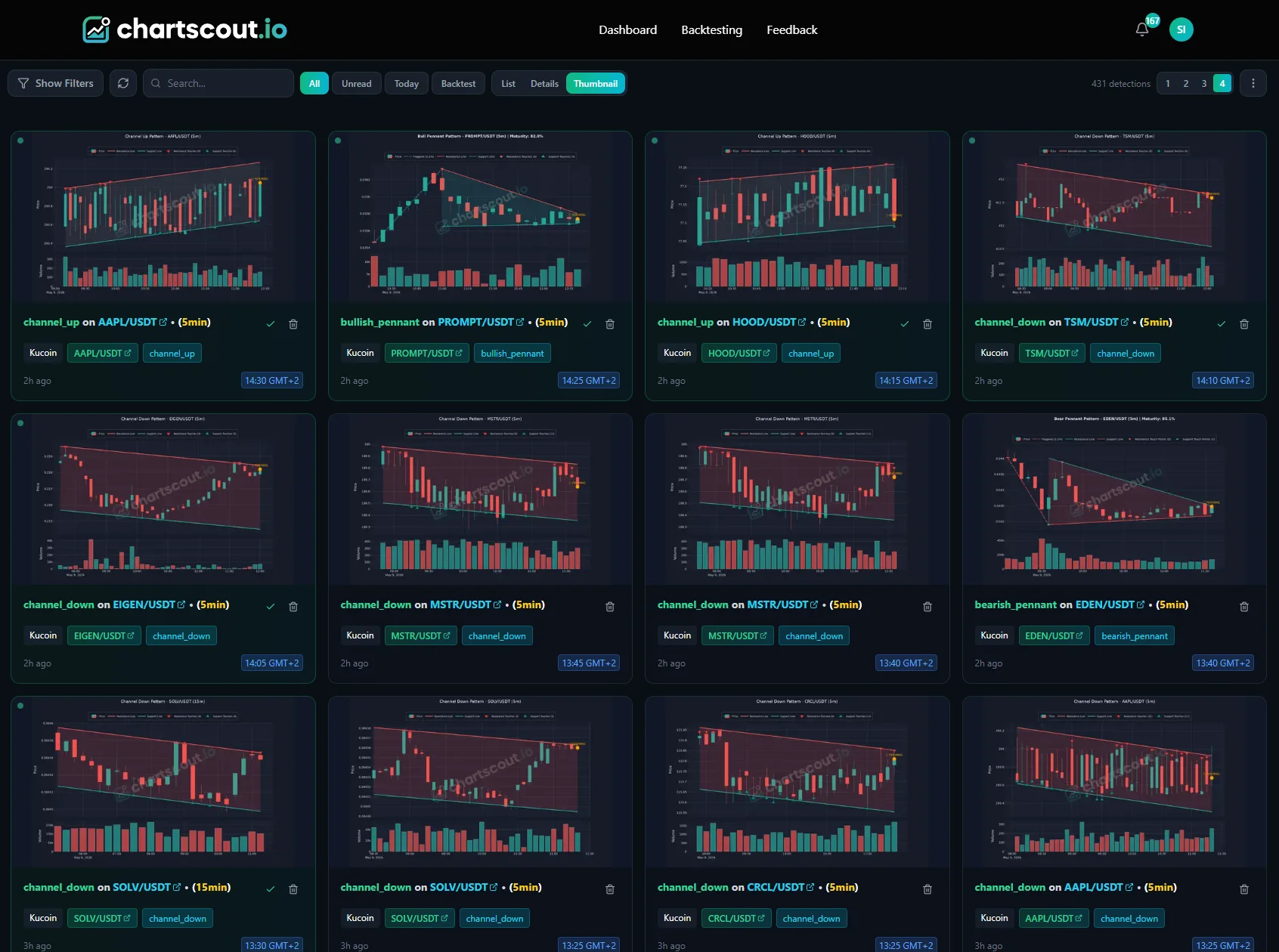
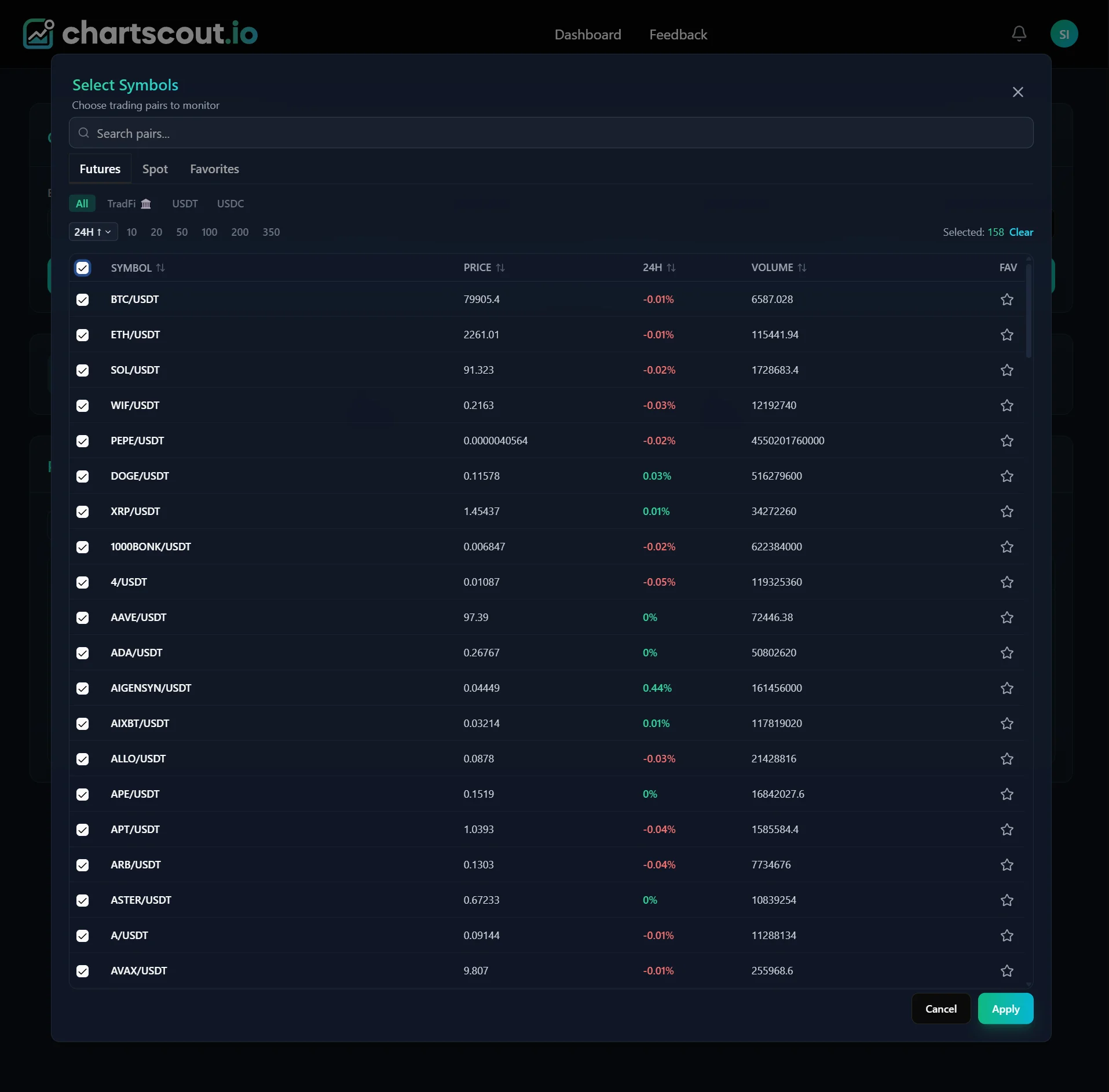
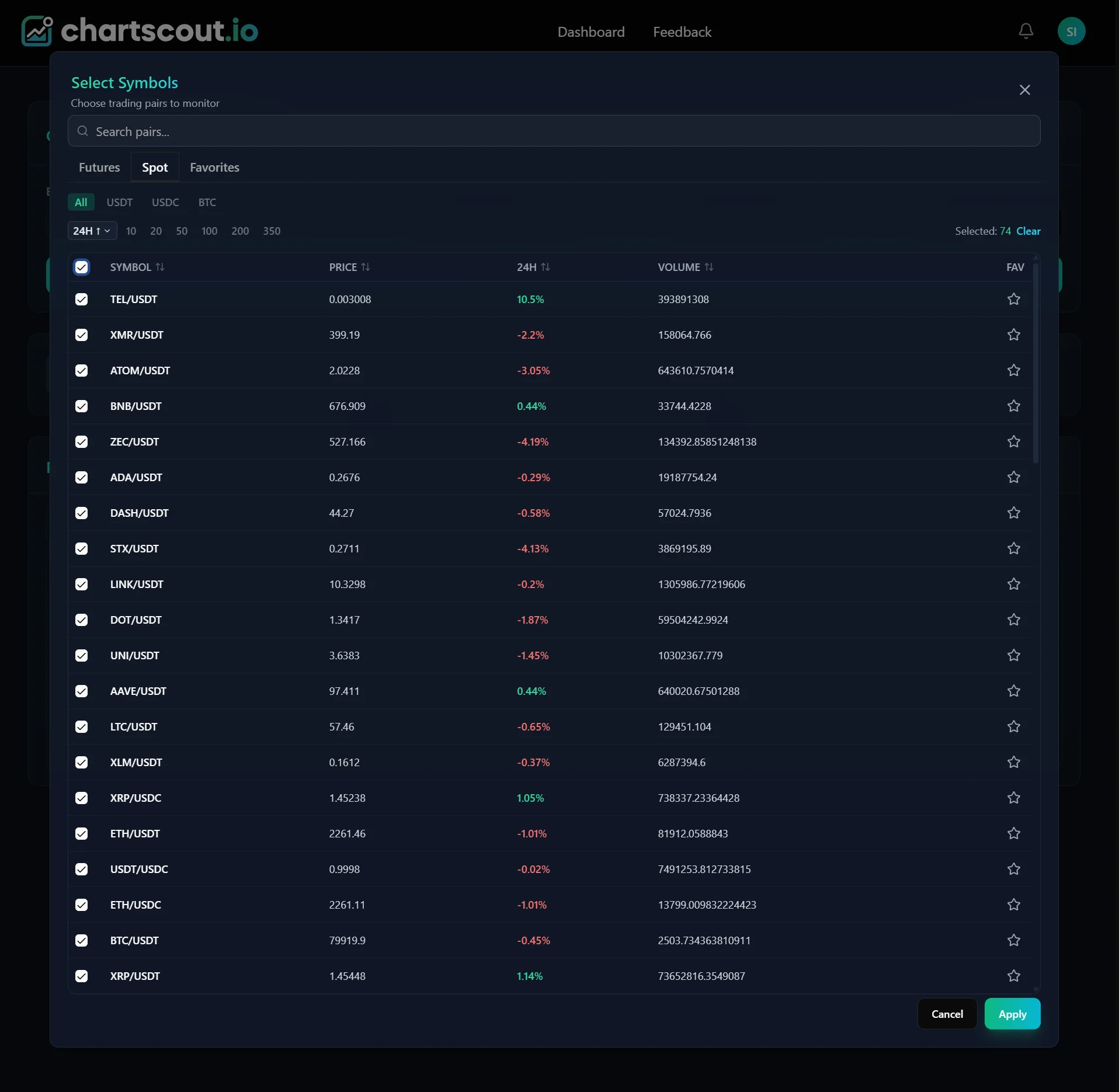
KuCoin Spot vs Futures coverage
Spot. This is where KuCoin's edge lives. Many of the liquid Spot pairs ChartScout scans trade on KuCoin weeks or months before they list on Binance or Coinbase, and a meaningful share never makes it to those exchanges at all. Pattern detection on KuCoin Spot is most valuable for finding setups on small and mid caps before broader market attention arrives.
Volume confirmation still matters inside the filtered list. A bull flag on a KuCoin Spot pair with deep volume is a normal setup. The same bull flag on a pair sitting just above the volume floor is a setup with a meaningfully higher false-breakout rate. Rule of thumb: require RVOL >=2x on Spot pairs that are thin within the filtered list, and RVOL >=2.5x on the ones near the floor. The volume floor gets you out of the worst dead-air tier; RVOL gets you out of the thinly-traded-but-technically-tradeable tier above it.
Futures. KuCoin Futures runs leveraged perpetual contracts on more established tokens, with funding rates that behave more predictably than MEXC's listing-day perps. The perps that make it through the liquidity filter read closer to Bybit perps in character: deeper books, faster price discovery, cleaner geometric structure. These are the contracts where you can take Tier A textbook patterns at sensible size.
Watcher allocation that actually works. A reasonable starting split on Pro's 250 watchers: 60 to 70 percent on Spot (1h and 4h, reversal and continuation patterns, focused on small caps where you have a thesis), and 30 to 40 percent on Futures (1h and 4h, major-token perps with consistent volume).
Alert speed and channels
Detection to delivery is under 20 seconds in normal conditions, including during high-volatility periods. The number is not marketing: it is the worst-case end-to-end latency budget the scanner is built around. If you are receiving alerts noticeably later than that, it is almost always an end-side delivery delay (Discord rate limits, Telegram bot configuration), not detection.
| Channel | Free | Basic | Pro | Enterprise |
|---|---|---|---|---|
| Platform (in-app) | Yes | Yes | Yes | Yes |
| Discord | Yes | Yes | Yes | Yes |
| No | Yes | Yes | Yes | |
| Telegram | No | Yes | Yes | Yes |
KuCoin is included during the full Pro trial and on Pro or higher. Every paid plan includes platform, email, Discord, and Telegram delivery; Basic keeps those channels for its supported Binance, Bybit, and Hyperliquid coverage but does not include KuCoin.
A single KuCoin watcher can dispatch the same alert to Platform, Discord, Email, and Telegram in parallel.
Setting up your first KuCoin watcher
The whole flow takes under two minutes once you are signed in. There is no KuCoin API-key step because ChartScout does not connect to your KuCoin account.
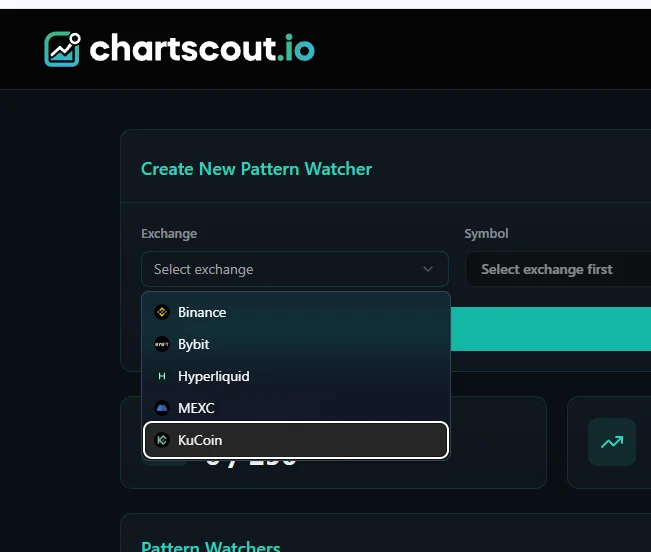
- Start the 7-day Pro trial. Sign up at chartscout.io/subscription. A card is required to start, but no charge is made until day 8. One click cancels before that.
- Connect your delivery channels. KuCoin coverage requires the full Pro trial or Pro or higher, so platform, email, Discord, and Telegram are all available.
- Create a watcher. Choose market type (Spot or Futures), pair, exchange (KuCoin), timeframe (5m through 1d on Pro), and pattern (any of the 20).
- Walk away. The scanner runs continuously. When a pattern matches your criteria, the alert fires. You decide whether the setup deserves your capital. That is the core idea behind alert-driven trading: set the criteria once, live your life, act only when an alert actually matches.
One watcher = one combination of pair + timeframe + pattern + exchange. Stacking three patterns on the same KuCoin pair on the same timeframe consumes three watchers. Running the same pair on KuCoin and MEXC consumes two more. If your phone does not ring, no setup matched, and that is a feature, not a bug.
Trading small-cap KuCoin altcoins without getting wrecked
The reason small-cap pattern trading on KuCoin can produce outsized gains is the same reason it can produce outsized losses: thin books. A clean ascending triangle on a small KuCoin token can run 5x to 10x what the same pattern produces on BTC. It can also stop you out twice in an hour on a single whale wallet repositioning. ChartScout's liquidity filter strips out the worst of the tail before alerts even fire, but the pairs sitting just above that floor still need extra care.
Four rules that survive contact with KuCoin small caps:
- Check order book depth before entering. Daily volume tells you the pair is alive; book depth tells you whether your size fits. If there is only $10,000 in bids within 2% of the current price, your exit at the target price will move the market against you by more than your edge. Size accordingly, or pass.
- Use limit orders, never market orders. Entry slippage on thin tokens can put you 1 to 3 percent worse than the breakout level. That single percentage point destroys the risk-reward calculation on most setups. The 30 seconds you save by using a market order is not worth it.
- Apply a tier downgrade for the liquidity environment. A Tier A textbook pattern on a KuCoin token barely clearing the liquidity floor is a Tier B setup at best in practice. The chart geometry does not change; the slippage and fakeout risk do. Size as you would for Tier B regardless of how clean the pattern looks.
- Volume confirmation is the highest-EV filter. A pattern with RVOL >=2x on a small-cap KuCoin pair is meaningfully more reliable than the same pattern with average volume. On the thinner survivors inside the filtered list, lift the bar to RVOL >=2.5x. On the ones sitting just above the liquidity floor, require RVOL >=3x or skip.
The strongest patterns on KuCoin small caps tend to be ascending triangles, bull flags, and cup and handle. All three benefit disproportionately from volume confirmation, which is also the easiest filter to add manually after the alert fires. Read more on this in our chart patterns and volume analysis guide.
ChartScout vs KuCoin's native charts
KuCoin's native charting is built on a competent TradingView-style interface. It is excellent for validating individual setups, drawing manual trendlines, and adding indicators. It is not a scanner.
| Capability | ChartScout | KuCoin native charts |
|---|---|---|
| Automatic pattern detection | 23 detectors, no drawing | Manual trendline drawing |
| Pair universe scanned | Your watcher list, Spot + Futures | One chart at a time |
| Alert speed | Under 20 seconds | Per-pair manual alert setup |
| 24/7 monitoring | Yes | Only while you watch |
| Multi-channel alerts | Discord, Telegram, email, in-app | Platform-only |
| Funding rate overlay | Not in alerts | Yes |
| Order placement | No (read-only by design) | Native |
The pairing that actually works for KuCoin traders: ChartScout flags which pairs have actionable patterns forming, you open KuCoin's native chart to validate, then place the entry on KuCoin. Discovery on ChartScout, execution on KuCoin. Two tools, one workflow. Before sizing in, use the alert as a prompt to check for fake breakout risk on the timeframe you are trading.
Honest limitations
Detection is not prediction. Even perfectly formed patterns have 60 to 75 percent historical success rates, not 100 percent. A meaningful share of KuCoin alerts will fail. Volume confirmation, higher-timeframe context, and a hard stop are required on every entry, every time.
Small-cap fakeouts are higher. On thin KuCoin tokens, false breakouts are more frequent than Bulkowski's stock-market data would suggest. Apply stricter volume filters and smaller position sizes on micro-caps. This is not optional. It is what separates traders who survive small-cap trading from traders who fund the ones who do.
Detection is geometric, not fundamental. ChartScout does not know if a KuCoin token has a major unlock event tomorrow, a team wallet moving to exchanges, or a pending exchange listing that will override the chart. Combine pattern alerts with basic due diligence on every token you are considering.
KuCoin regional access. KuCoin entered into a US$297.4M settlement with the US Attorney's Office for the Southern District of New York in January 2025 and committed to exiting the US market for at least two years, and was assessed a C$19.55M FINTRAC penalty in Canada in July 2025. ChartScout will still detect patterns on KuCoin markets if you set a watcher there. Whether you can act on those alerts depends on your jurisdiction. If you are restricted, run KuCoin watchers as informational signal and route the trade to an exchange you can access.
New listings need history before they fire. Detection requires enough closed candles to fit a trendline and validate a peak. On a brand-new KuCoin listing, expect a delay before pattern coverage starts: a 1d watcher needs months of history, a 1h watcher needs roughly a week, a 5m watcher needs about 17 hours. Coverage starts the moment the candle count is met.
No execution. ChartScout does not connect to your KuCoin account and cannot place, modify, or close trades. It is detection and dispatch only. KuCoin is included during the full Pro trial and on Pro, Enterprise, and Enterprise+.
Which plan covers KuCoin?
KuCoin coverage starts with the full Pro trial and paid Pro. Basic covers Binance, Bybit, and Hyperliquid instead. Higher tiers increase watcher capacity and minimum-timeframe speed.
| Plan | Price | Exchanges | Timeframes | Watchers |
|---|---|---|---|---|
| Basic | $19/mo | Binance, Bybit, Hyperliquid | 15m+ | 100 |
| Pro | $39/mo | All 5 | 5m+ | 250 |
| Enterprise | $69/mo | All 5 | 1m+ | 500 |
| Enterprise+ | $99/mo | All 5 | 1m+ | 1,000 |
The 7-day Pro trial includes all five exchanges at 5m+ timeframes, all 23 detectors, and platform, Discord, Telegram, and email alerts. A card is required to start; Pro is $39/month after day 7 unless you cancel or select another tier. Yearly billing is available at a discount on every tier.
Stop hunting KuCoin setups one chart at a time.
Scan KuCoin Spot and Futures for 23 detectors. Liquid pairs only. Private alerts to Discord, Telegram, email, or in-app. No KuCoin API keys.
Start 7-day trial→Card required to start. No charge until day 8.
FAQ
Does KuCoin have a built-in chart pattern scanner?
No. KuCoin's native charts are excellent for manual analysis of individual pairs, but they do not automatically detect or alert on geometric chart patterns across the full pair universe. KuCoin's own blog content on patterns is educational, not algorithmic.
Is there a chart pattern scanner for KuCoin?
Yes. ChartScout scans KuCoin Spot and Futures for all 23 detectors during the full Pro trial and on Pro ($39/month), Enterprise, and Enterprise+. Basic does not include KuCoin.
Can ChartScout detect patterns on KuCoin's small-cap altcoins?
Yes, but only on pairs that clear ChartScout's liquidity floor. Pairs below the threshold are filtered out before detection runs, because thin books cannot support honest pattern signal. Inside the filtered list, apply stricter volume confirmation on the thinnest survivors (RVOL >=2.5x is a reasonable starting bar on the lower end).
Which KuCoin pairs does ChartScout actually scan?
The liquid portion of KuCoin Spot and Futures, both markets. Pairs that fall below a minimum 24-hour volume threshold are filtered out before detection runs, because thin order books and frequent empty candles produce more noise than signal. Membership in the scanned list is dynamic: pairs that fade below the floor drop out, pairs that gain traction cross back in.
Do I need to give ChartScout my KuCoin API keys?
No. ChartScout reads public market data only. It never accesses your KuCoin account, balances, or funds. No keys, no permissions, no execution.
Which patterns work best on small-cap KuCoin altcoins?
Ascending triangles, bull flags, and cup and handle tend to perform best on early-listing altcoins, particularly with strong volume confirmation (RVOL >=2x). The lower-ranked patterns in Bulkowski's data, especially rising wedges, have higher false-signal rates and should be sized smaller.
Can I scan KuCoin Spot and Futures simultaneously?
Yes. You can run KuCoin Spot and Futures watchers side by side. The two market types are independent in the watcher form, and a single watcher can fire alerts to multiple channels in parallel.
How fast are KuCoin pattern alerts?
Under 20 seconds from detection to your Discord, Telegram, email, or in-app inbox in normal conditions. Triangles and wedges fire pre-breakout while the pattern is still actionable. Reversal patterns wait until the structure is fully formed.
Why does ChartScout discard some KuCoin patterns even when they look perfect?
KuCoin has the highest empty-candle rate of any exchange we cover (candles with zero trades print as flat OHLC and can fool pure geometric detection). We discard patterns built on too much dead air, and we run a stricter liquidity check on KuCoin than on Binance, Bybit, MEXC, or Hyperliquid. Some patterns that look clean get discarded because the volume around them cannot support an honest trade. This is most common on 1m, 5m, and sometimes 15m alt charts.
What is the best timeframe for KuCoin pattern scanning?
1h and 4h are the highest-EV timeframes for most KuCoin traders. They produce enough signal volume to find opportunities without the noise of 1m to 15m, and the patterns that complete on those timeframes tend to play out cleanly. Day traders run 5m and 15m; swing traders run 4h and 1d.
Which subscription plan covers KuCoin?
The full Pro trial, Pro ($39/month), Enterprise, and Enterprise+. The trial includes KuCoin at 5m+ timeframes, all 23 detectors, and all four delivery channels. Basic does not include KuCoin.
Can I still use ChartScout on KuCoin if I am in a restricted jurisdiction?
ChartScout will still detect patterns on KuCoin markets if you set a watcher there. Whether you can act on those alerts depends on your jurisdiction. If KuCoin is restricted where you live, run KuCoin watchers as informational signal and route the trade to an exchange you can access.
Does ChartScout place trades on KuCoin?
No. ChartScout is an alert and discovery tool. It does not connect to your KuCoin account and cannot place, modify, or close trades. The trade decision, the size, the stop, and the target stay with you.
Sources & references
Data source note: Pattern success rates and average moves in this guide are sourced from Bulkowski's published research at thepatternsite.com (2020 update, 40,000+ perfect trades). The data is stock-market based; crypto behavior may differ in absolute terms while preserving the relative ranking of pattern reliability.
- Bulkowski, Thomas N. ThePatternSite.com - Chart Pattern Statistics. Updated 8/26/2020. thepatternsite.com.
Primary statistical source. Success rates, average moves, throwback rates, and performance ranks for every pattern in this guide. - Bulkowski, Thomas N. Encyclopedia of Chart Patterns, 3rd Edition. John Wiley & Sons, 2021. ISBN: 978-1119739685.
Canonical print reference for every pattern detected by ChartScout. - Murphy, John J. Technical Analysis of the Financial Markets. New York Institute of Finance, 1999. ISBN: 978-0735200661.
Source of the chartist-coverage quote in “Why KuCoin needs a scanner”. - CoinGecko. KuCoin Exchange Statistics. coingecko.com/en/exchanges/kucoin.
Source for current KuCoin Spot and Futures pair counts cited throughout the guide. - US Attorney's Office, Southern District of New York. Press release: Cryptocurrency Exchange KuCoin Pleads Guilty to Unlicensed Money Transmission. January 27, 2025.
Source for the US$297.4M settlement and US-market exit cited in the Honest limitations section. - FINTRAC (Financial Transactions and Reports Analysis Centre of Canada). Public notice on administrative monetary penalty against Peken Global Limited. September 25, 2025.
Source for the C$19.55M Canadian penalty cited in the Honest limitations section.
Related guides
Binance chart pattern scanner
The same workflow on Binance Spot and USD-M futures.
Bybit chart pattern scanner
Spot and Perpetual coverage on Bybit.
MEXC chart pattern scanner
The largest pair universe of any supported exchange, built for early-listing traders.
Hyperliquid chart pattern scanner
Native perp DEX and sub-DEX (xyz) listings on the same scanner.
How to scan crypto for chart patterns
Manual scanning, TradingView, Pine Script, and automated scanners compared.
Alert-driven trading
Build a workflow around alerts instead of constant screen-watching.

Stjepan Ivanović
Founder of ChartScout · Crypto Trader Since 2013
Trading crypto since 2013 with his first Bitcoin bought at ~$200. Four complete bull/bear market cycles, traded on early exchanges like Mt.Gox and BTC-e, on-chain trading on IDEX and EtherDelta, and ~70 crypto project investments. Built ChartScout after 23+ months of development to automate what no trader can do manually. Watch hundreds of charts 24/7.