Risk reward ratio in crypto trading: real numbers per chart pattern (2026)
“Always aim for a 1:3 risk-reward ratio.” Almost every crypto trading guide says it. Almost none of them check whether the pattern being traded can actually deliver 1:3. A bull flag has an average post-breakout move of roughly 9% (Bulkowski, thepatternsite.com, updated 8/26/2020). A cup and handle averages around 54%. The same 1:3 target works on one and is laughably wrong on the other. This guide replaces the 1:3 cliché with pattern-specific math. Use the calculator below to test your own entry, stop, and target.
Data notice: Average moves and target hit rates are from Thomas Bulkowski's published research (thepatternsite.com, updated 2020) and the Encyclopedia of Chart Patterns, 3rd Edition. Equity-market data; crypto behavior may differ on lower timeframes (see crypto adjustment section).
The 1:3 rule originates from a real piece of math: at 1:3, you only need a 33% win rate to break even. Anything above that produces profit. As a floor for traders with unknown edge, it is sensible. The problem starts when the floor becomes a target, and traders place take-profits at 3x their stop regardless of where the pattern's measured-move target actually sits.
What you actually need is pattern-specific R:R, anchored to two independent calculations: an ATR-based stop derived from pattern invalidation, and a measured-move target derived from the pattern itself. The R:R is the result of those two numbers, not the starting point. For a fast lookup of every pattern with break-even rates, see the crypto chart patterns cheat sheet.
If the pattern you are trading is new to you, start with how to read crypto charts first, then come back here once you can identify pattern invalidation by eye.
The 1:3 rule is marketing, not math
The legitimate origin of the 1:3 rule is the breakeven win rate: at 1:3, a 33% hit rate breaks even, anything above produces profit. As a survival floor for traders with no measured edge, it makes sense. The problem is what happens next: traders set their stop based on personal risk tolerance, then extend the take-profit to 3x that distance, with no reference to the pattern's measured move.
In practice this produces three failure modes. The TP gets placed at an arbitrary price with no technical anchor. The trade runs to the natural target but not the inflated one and reverses, returning all the open profit. Or the TP is so far away that the trade has to fight noise for hours and stops out repeatedly while the trader waits for a fictional “1:3 setup” that the pattern was never going to deliver.
The better question is not does this setup give me 1:3? The better question is: what R:R does the pattern's geometry actually support, and what is the probability of hitting that target? That is pattern-specific work, not a universal ratio.
The clearest example
Bull flag average move: ~9%. Cup and handle average move: ~54%. With a 3% stop, “1:3” means a 9% target on both. That is essentially the maximum historical average move for a flag, applied as the default expectation, while simultaneously being a 1/6th-target for a cup and handle. Same ratio, completely different bet.
The three inputs you actually need
Forget the 1:3 rule. Every valid trade is built from three independent numbers, calculated in this order:
1. Entry price
The exact price you take the position after breakout confirmation. Defined before entry, not “somewhere around the breakout level.” Limit orders at the breakout level beat market orders into a fast candle, especially on alts.
2. Stop price
The pattern invalidation level, not an arbitrary percentage and not a round number. The stop sits where the pattern's premise is proven wrong: typically 1 to 1.5x ATR below the breakout point for longs, or above for shorts. The full pattern-by-pattern placement rules live in the stop-loss placement guide.
3. Target price
The pattern's measured-move projection from the breakout point. Geometric, not arbitrary. Flagpole height for flags. Cup depth for cups. Bottom-to-resistance distance for double bottoms. Head-to-neckline distance for H&S top. Pattern height projected from the apex for triangles.
Common error: starting from the stop and multiplying by 3 to derive the target. That inverts the logic. The target is set by the pattern. The stop is set by invalidation. The R:R is the result of those two independent calculations, never the starting point.
Expectancy and breakeven win rate
Expectancy is the average dollar amount you make or lose per dollar risked across all trades. It is the only number that matters at the system level.
Expectancy = (Win Rate x Average Win) - (Loss Rate x Average Loss)
In R:R terms: Expectancy = (W x R) - (1 - W), where W is win rate and R is the reward multiple.
Three worked examples
- 1:1 at 55% win rate: (0.55 x 1) - (0.45 x 1) = +0.10 per dollar risked.
- 1:2 at 45% win rate: (0.45 x 2) - (0.55 x 1) = +0.35 per dollar risked.
- 1:3 at 35% win rate: (0.35 x 3) - (0.65 x 1) = +0.40 per dollar risked.
The key insight: a 1:1 system at 55% wins is profitable. A 1:2 at 45% is more profitable. The interaction between win rate and R:R determines whether a strategy is profitable, not the absolute R:R alone. This is why a bull flag at 1:1.5 with an 82% half-target hit rate is a real strategy, while a symmetrical triangle at 1:3 with a 30% hit rate may not be.
Van Tharp formalized this idea as the R-multiple framework. Treat every closed trade as a multiple of its initial risk and the system's edge is the average R-multiple across all trades.
“I refer to a trade's reward-to-risk ratio as an ‘R multiple’, R simply being a symbol for the initial risk. To calculate a trade's R multiple, simply take the number of points captured at the exit of the position and divide by the initial risk. You can just as easily use dollar values per contract or per 100-share lot. For example, if you risked $500 and made $1,500, you would have an R multiple of 3.”
Van K. Tharp, Trade Your Way to Financial Freedom, 2nd Edition, Ch. 6
Breakeven win rate by R:R
Formula: Breakeven Win Rate = 1 / (1 + R). Memorize this table; it is the single most useful filter in trading math.
| R:R | Breakeven win rate |
|---|---|
| 1:1 | 50.0% |
| 1:1.5 | 40.0% |
| 1:2 | 33.3% |
| 1:2.5 | 28.6% |
| 1:3 | 25.0% |
| 1:4 | 20.0% |
| 1:5 | 16.7% |
How to use this: look up the pattern's realistic full-target hit rate (Bulkowski data, master table below). Compare it to the breakeven win rate at your computed R:R. If the historical hit rate exceeds the breakeven, the strategy has positive expectancy. If not, the trade is negative-expectancy by design, no matter how good the chart looks.
Worked example: Head and shoulders top, full measured-move hit rate ~51%. At 1:2 R:R, breakeven is 33%. 51% > 33%, so the trade has positive expectancy. But the margin is thin, and crypto's higher fakeout rate on lower timeframes may narrow it further.
Crypto risk-reward calculator
Most R:R calculators handle a stock setup with three inputs: entry, stop, target. Crypto trades have at least three more variables that change the answer: leverage (and the liquidation price it implies), funding (which silently consumes the reward side over multi-day perp holds), and pattern hit rate (which determines whether the R:R you computed is actually profitable in expectation).
The calculator below handles all of that. Pick your pattern, plug in entry/stop/target, and it returns gross R:R, net R:R after fees and funding, position size, rough liquidation price, and a green/red verdict on whether the historical hit rate clears the breakeven win rate at your computed ratio.
Crypto risk-reward calculator
Pre-loaded with a real ascending triangle setup on BTC 4h. Adjust any field to test your own trade. Outputs include funding-adjusted net R:R, liquidation price, position size, and pattern-specific expectancy verdict.
Liquidation price is a rough estimate (entry x (1 - 1/leverage) for longs, entry x (1 + 1/leverage) for shorts) and does not include maintenance margin. Fees are calculated at the actual target/stop exit price. Funding follows perp convention: positive funding means longs pay shorts. Pattern hit rates are full-target measured-move rates from Bulkowski (thepatternsite.com, equity data). Half-target rates apply only to flag patterns. This calculator is for educational use, not investment advice.
How to use the verdict: a green “positive expectancy” box means the pattern's historical full-target hit rate exceeds the breakeven win rate at your computed R:R. A red box means the trade is negative-expectancy by design at this stop/target combination, even if the chart looks clean. The fix is usually one of three things: tighten the stop, use the half-target rule (if the pattern is a flag), or skip the trade.
Master table: realistic R:R per pattern
Data note: Average moves and target hit rates from Thomas Bulkowski, thepatternsite.com (updated 8/26/2020) and the Encyclopedia of Chart Patterns, 3rd Edition. R:R ranges below assume 2-3% stop distance. Recalculate from the actual ATR-based stop on every trade. Crypto behavior on 1m-15m may compress hit rates further (see crypto adjustment section).
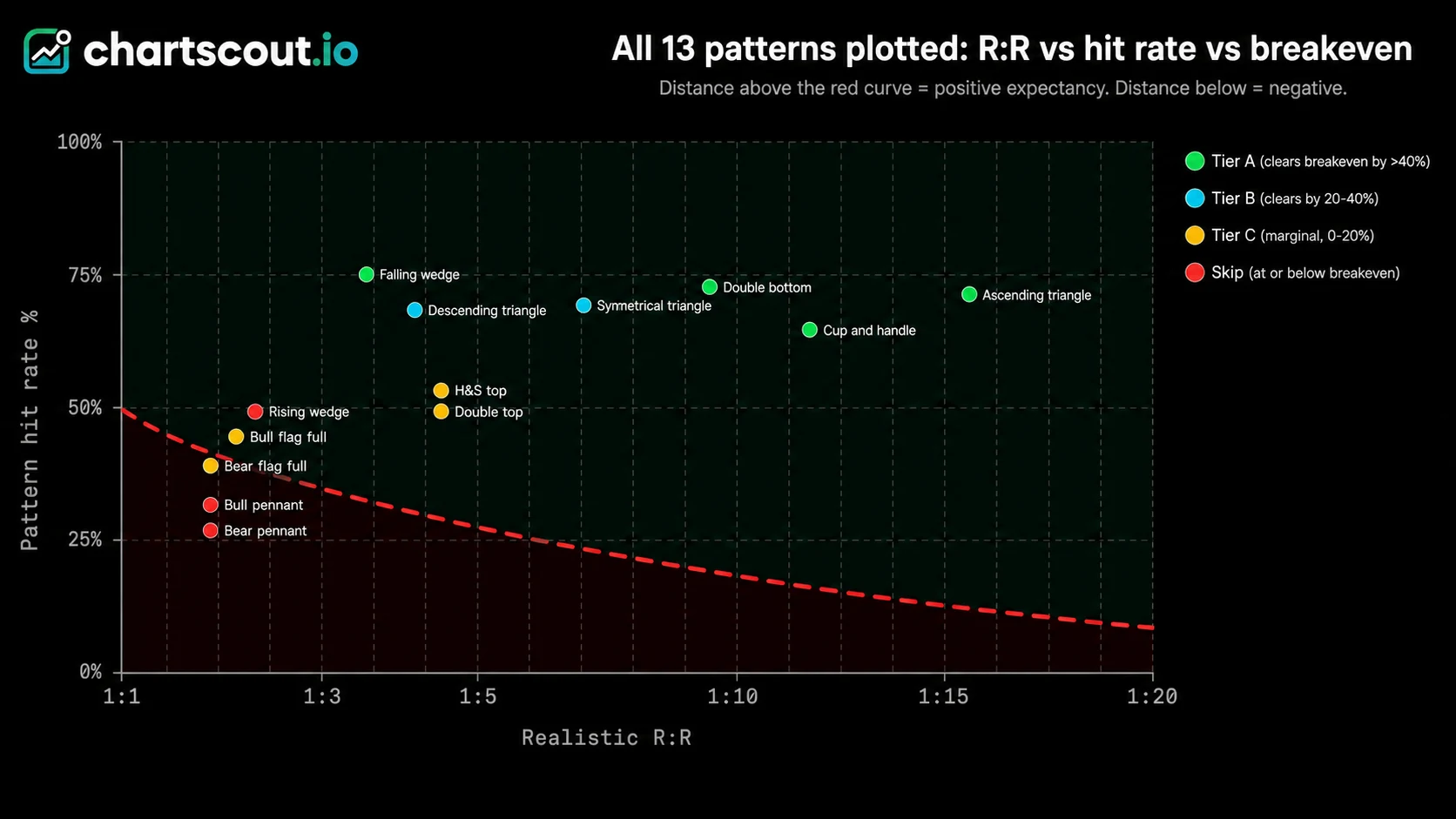
Distance above the red breakeven curve = positive expectancy. Distance below = negative. Tier A patterns clear breakeven by 40%+; pennants barely clear or sit underneath.
| Pattern | Avg move | Full-target hit | Realistic R:R | BE win rate | Verdict |
|---|---|---|---|---|---|
| Double bottom | +37% | ~71% | 1:10 to 1:12 | 8% | Strong |
| Ascending triangle | +43% | ~70% | 1:12 to 1:20 | 5-8% | Strong |
| Cup & handle | +54% | ~61% | 1:8 to 1:18 | 5-11% | Strong |
| Falling wedge | +18% | ~74% | 1:4 to 1:6 | 14-20% | Good |
| Descending triangle | -16% | ~68% | 1:4 to 1:8 | 11-20% | Good |
| H&S top | -22% | ~51% | 1:5 to 1:7 | 13-17% | Moderate |
| Double top | -20% | ~50% | 1:5 to 1:7 | 13-17% | Moderate |
| Symmetrical triangle | +34% | ~70% | 1:8 to 1:11 | 8-11% | Good (high fakeout risk) |
| Bull flag | +9% avg | ~46% / ~82% half | 1:1.5 to 1:2.5 | 28-40% | Use half-target |
| Bear flag | -9% avg | ~42% / ~78% half | 1:1.5 to 1:2 | 33-40% | Use half-target |
| Rising wedge | -9% | ~49% | 1:2 to 1:3 | 25-33% | Marginal |
R:R ranges are wide because they depend on actual stop placement, not a fixed formula. “Strong” designations combine both realistic R:R and a target hit rate that comfortably clears the breakeven win rate. A high R:R with a sub-breakeven hit rate is not strong, it is a setup that loses money slowly.
Why bull flags don't deserve 1:3 targets
Bull flags are the most over-traded, under-analyzed pattern in crypto. They produce textbook continuation signals and reliable alerts, but the underlying numbers are harder than most traders assume:
- Average flagpole move: ~9%
- Full measured-move hit rate: ~46% (less than half)
- Half measured-move hit rate: ~82%
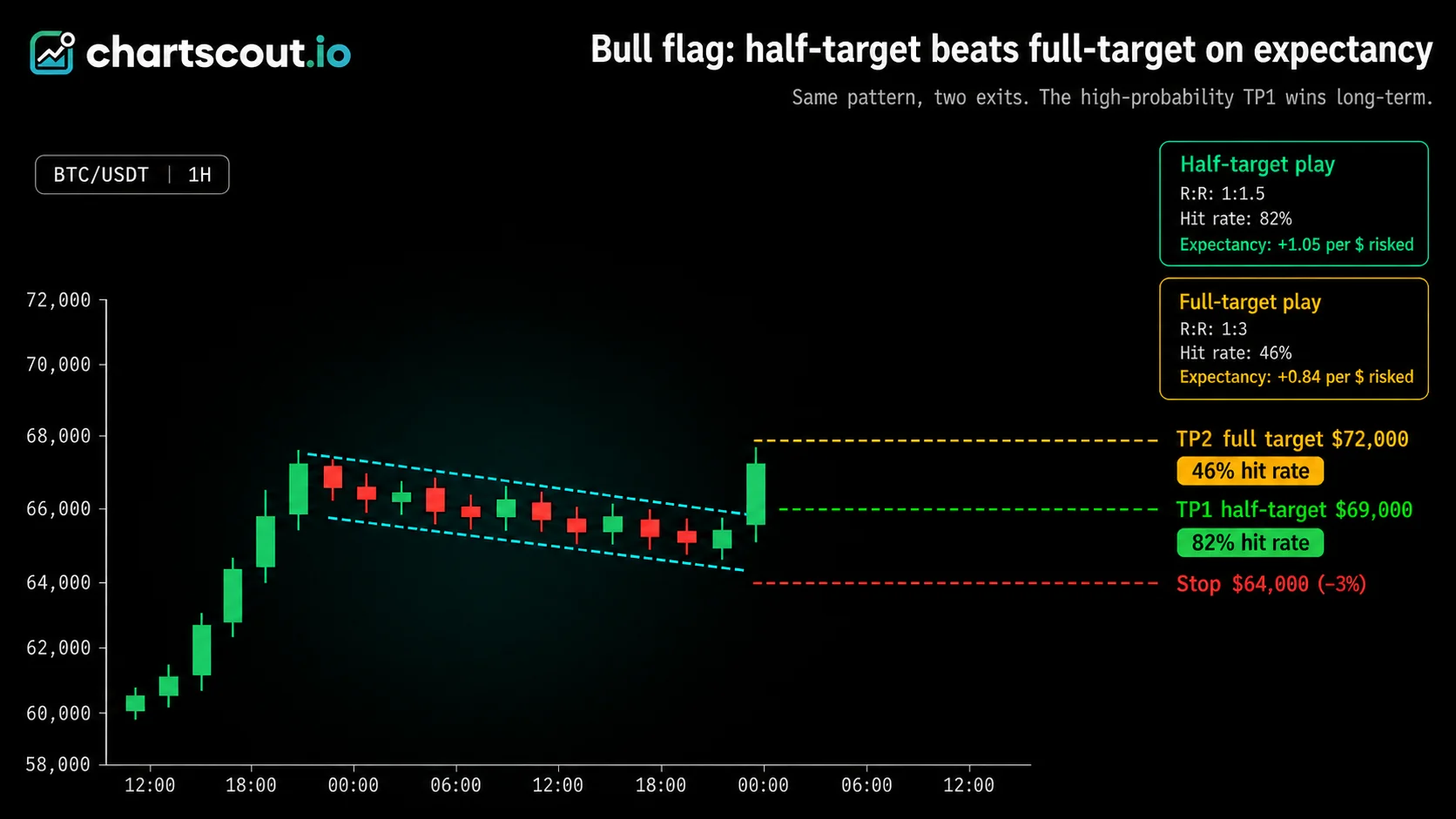
Same flag, two exits. The half-target hits 82% of the time and produces ~1.25x more expected profit per dollar risked than the full-target version, despite a smaller R:R.
If the stop is 2% and the “1:3 target” is 6%, that is roughly two-thirds of the average flagpole height being demanded as the default outcome, on a pattern that hits its full target less than half the time. Expectancy at 1:3 is positive on paper:
(0.46 x 3) - (0.54 x 1) = +0.84 per dollar risked
But the half-target alternative crushes it on expectancy:
Bull flag half-target math
- Stop: 2%
- Target: ~4.5% (half of typical 9% flagpole)
- Hit rate: ~82%
- R:R: 1:2.25
- Expectancy: (0.82 x 2.25) - (0.18 x 1) = +1.665 per dollar risked
Roughly 2x the expectancy of the same setup taken to the full 1:3 target. This is one of the most underused data points in Bulkowski's entire dataset.
The full pattern teardown, including volume rules and crypto-specific entry timing, is in the bull flag pattern guide.
Why cup & handle and double bottom earn 1:3+ honestly
Not every pattern struggles with ambitious targets. Two in particular justify aggressive R:R: the cup and handle and the double bottom.
Cup & handle: +54% average move, ~61% hit rate
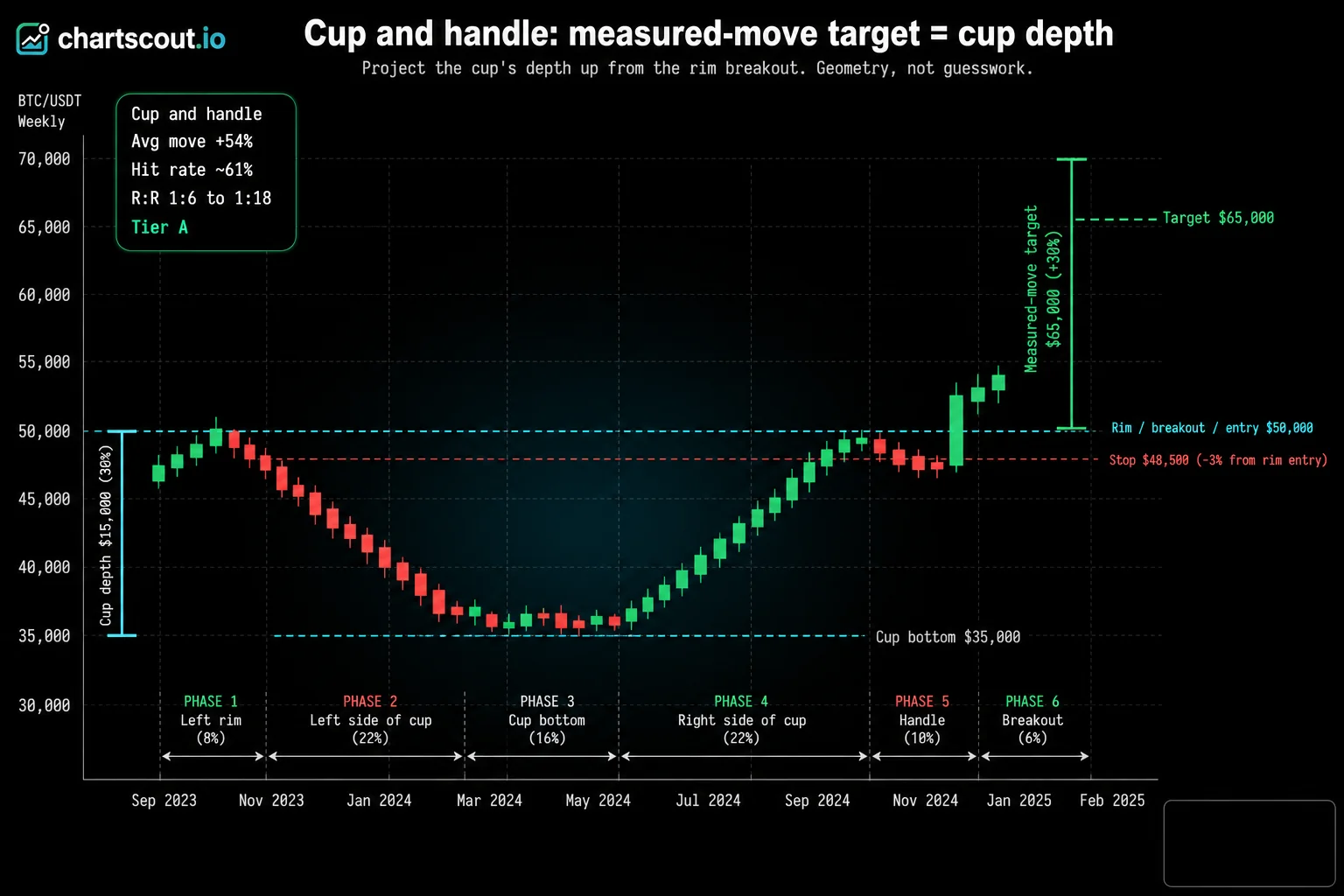
Cup depth becomes the target. With a 3% stop just below the handle low, the geometry produces a 1:10 R:R automatically. The pattern does the work.
With a 3-5% ATR-based stop, the full measured-move target is roughly 10x to 18x the stop distance on large cups in trending markets. Even modest 20%-depth cups produce 20% measured moves from rim breakout, which is over 6x a 3% stop.
At 1:3 R:R (3% stop, 9% target), 9% is well below the 54% average. At 1:5 (3% stop, 15% target), still a fraction of average. Hit rate of 61% sits comfortably above the 25% breakeven for 1:3 and the 17% breakeven for 1:5. The pattern's geometry produces the large targets; you do not have to manufacture them.
Double bottom: +37% average move, ~71% hit rate
The measured-move target is the distance from the lowest bottom to the resistance peak between the two bottoms, projected up from the breakout point. On a typical 15-25% pattern height, R:R with a 3% stop lands between 1:5 and 1:8. At 71% historical hit rate, the breakeven for 1:7 is 12.5%. There is structural margin-of-safety baked into the setup: you can lose nearly a third of trades and still produce some of the best expectancy in technical analysis.
The crypto adjustment: volatility and funding
Bulkowski's data is daily equity charts. Three adjustments are required before the framework above maps cleanly to crypto on lower timeframes.
1. ATR-based stop, not fixed percentage
Crypto ATR fluctuates dramatically. During a high-volatility regime, 1h ATR on ETH might be 1.5%. On a quiet weekend, 0.3%. A fixed 1% stop is loose in the first regime and tight in the second. Anchoring the stop at 1.5x current ATR calibrates it to the conditions actually present, not historical norms.
2. Funding rate impact on perps
Funding silently consumes the reward side of every multi-day perp position. Funding settles every 8 hours, three times per day, so a long held 15 days at 0.1% per period pays roughly 4.5% in funding alone (15 days x 3 periods x 0.1%). On a planned 1:3 setup with a 9% target, that funding cost halves the net profit:
Funding-adjusted R:R (15-day swing example)
- Planned: 3% stop, 9% target, R:R 1:3
- Funding cost on a 15-day hold at 0.1%/8h: -4.5%
- Effective net target: 4.5%
- Effective R:R: 1:1.5
Even shorter holds bleed: 5 days at 0.1%/8h costs 1.5%, which on a tight 1:2 setup with a 4% target erodes net R:R to 1:0.83 (negative expectancy at most realistic hit rates). Calculate funding explicitly for any swing trade held overnight. During sustained high-funding regimes (e.g. 0.3% per period during euphoric or capitulation moves), even a 5-day hold accumulates 4.5%.
3. Lower-timeframe hit rate adjustment
Fakeout rates on 1h and 15m crypto charts are higher than on Bulkowski's daily equities. As a practical adjustment, expect to subtract 10-15% from Bulkowski's hit rates on 1h crypto, 15-20% on 15m. On 4h add 5%. On 1d add 10%. These are heuristics, not measured numbers; use them as a margin of safety, not as exact replacements.
The high-level point: as the timeframe drops, both the noise and the opportunity rise, and the breakeven win rate on any given R:R tightens. Filtering fake breakouts matters more on 15m than on 4h, because the cushion between hit rate and breakeven is thinner.
4. Why I stopped chasing late breakouts
Most of my worst R:R trades were not bad setups. They were good setups I entered late. When I chased a breakout 2 to 3% above the proper trigger, the stop had to widen to keep the same invalidation level, the target stayed where the pattern's geometry put it, and a setup that read 1:5 on the alert would silently turn into 1:1 by the time I was filled.
The bigger cost was not the chased trade itself. It was the habit. Each chase trained me to override my own entry rules, and that cost me far more on later trades than the chased trade ever paid. Once I stopped chasing, my realized R:R came much closer to my planned R:R across the journal, even when individual win rates barely moved.
The setups always come back. BTC, ETH, large alts: there is another bull flag tomorrow, another ascending triangle next week. The only real cost of skipping a missed entry is psychological, and that cost shrinks fast once you watch the next clean alert fire two days later.
Position sizing tied to R:R
R:R is meaningless until it is connected to a position size. The connection is the 1% rule, applied through stop distance:
- Calculate stop distance: 1.5x ATR from pattern invalidation.
- Calculate target: pattern measured-move projection.
- R:R = target % / stop %.
- Compare pattern hit rate to breakeven win rate at that R:R. If below, skip.
- Account risk on this trade = 1% (or less, by tier).
- Position size in dollars = (Account x Risk%) / Stop%.
Worked example: ascending triangle on BTC 4h
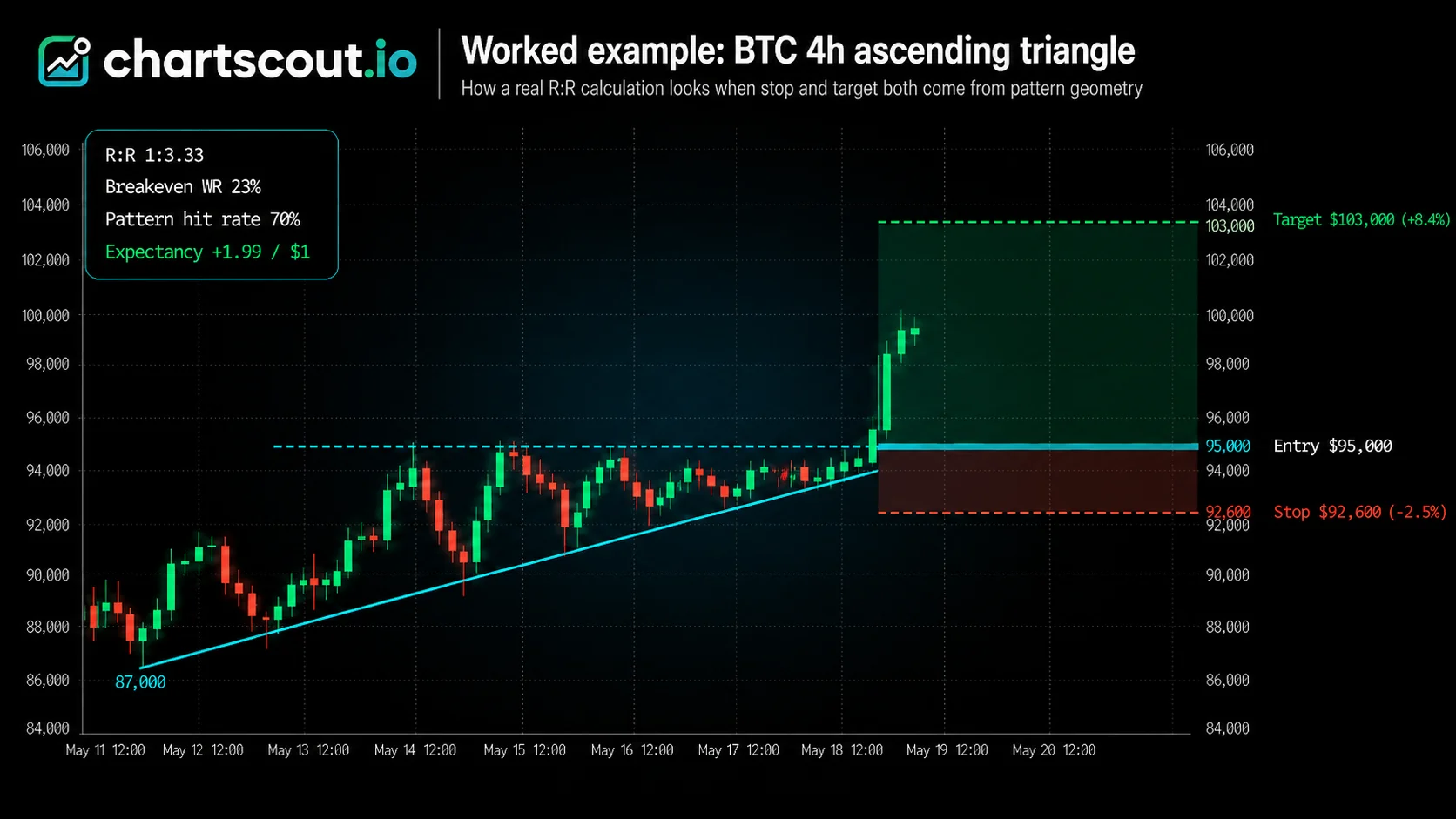
Same setup as the calculator's pre-loaded values. Stop comes from pattern invalidation, target comes from triangle height projected from the breakout. R:R is the result, not the input.
- Entry: $95,000 (flat resistance breakout)
- Stop: $92,600 (1.5x ATR below breakout, 2.5% risk)
- Pattern height: $8,000 (resistance minus lowest swing low at $87,000)
- Full target: $103,000 (+8.4%)
- R:R: 8.4% / 2.5% = 1:3.4
- Hit rate ~70% vs breakeven 23% at 1:3.4: strongly positive expectancy
- Account risk: 1% on a $10,000 account = $100
- Position size: $100 / 0.025 = $4,000 notional
Alexander Elder formalized the discipline of risk-driven sizing in The New Trading for a Living. The point is the same as Tharp's R-multiple framework, but the language is different. Elder's rule about not widening a stop is the operational consequence of having sized the trade correctly in the first place:
“As a trade moves in your favor, your remaining potential gain begins to shrink, while your risk, the distance to the stop, keeps increasing. To trade is to manage risk. As the reward-to-risk ratio for your winning trades slowly deteriorates, you need to begin reducing your risk. Protecting a portion of your paper profits will keep your reward-to-risk ratio on a more even keel.”
“Giving a trade ‘more room’ is wishful thinking, pure and simple. It doesn't belong in the toolkit of a serious trader.”
Alexander Elder, The New Trading for a Living (2014), Ch. 54 (How to Set Stops), pp. 224-225
Multi-target R:R: the 50/50 split
Single-exit trades either exit too early (giving up upside) or too late (returning open profit). The 50/50 split solves this on patterns with large measured moves:
- Exit 50% at TP1 (half measured move): high hit rate, locks profit.
- Exit 50% at TP2 (full measured move): lower hit rate, runs for the full move.
- Once TP1 hits, move stop on the remainder to breakeven.
Best for cup & handle, ascending triangle, double bottom. Not suited to flags, where the half-target hit rate is so much higher than the full that an 80/20 split (80% out at TP1, trail the remainder) usually beats 50/50. On high-failure patterns like H&S top and rising wedge, lean even further toward TP1: 70-75% out at the half target locks in profit on a setup whose full-target hit rate is below 55%.
What I've learned about R:R that the math alone won't tell you
The pattern stats and the expectancy formulas above are the easy part. They are public, they are countable, and a good calculator does the work for you. The harder lessons came from years of running real money against this framework and watching where I lost it. The five sections below are what I keep coming back to.
1. Controlling my risk side mattered far more than chasing reward
I spent my early years hunting 1:5 setups, cherry-picking patterns that “looked” asymmetric, and skipping anything that did not promise an enormous payoff. The accounts that survived were not the ones with the highest-R trades. They were the ones where I was religious about the risk side and let the reward come from whatever the pattern actually delivered.
That is why the framework above ranks patterns by hit rate first and treats R:R as the result of geometry, not a target. If I control how much I lose on the bad ones, expectancy on a portfolio of clean setups takes care of itself.
2. My drawdown depth is downstream of position size, not luck
The single most useful number I have logged from years of journaling: my worst rolling drawdown lands at roughly 6 to 10x my per-trade risk. Sized at 1% per trade, my deepest equity drawdowns came in at 6 to 10%. During one stretch where I tested 3% per trade on the same setups, I hit a 28% drawdown inside a few months. Same strategy, same patterns, same edge. Just larger sizing.
This is the real reason I run 1% per trade. Not because losing 1% on any single trade matters; it does not. But because I know the bad streak that is coming will compound, and 1% gives me a survivable floor. The recovery math makes this concrete:
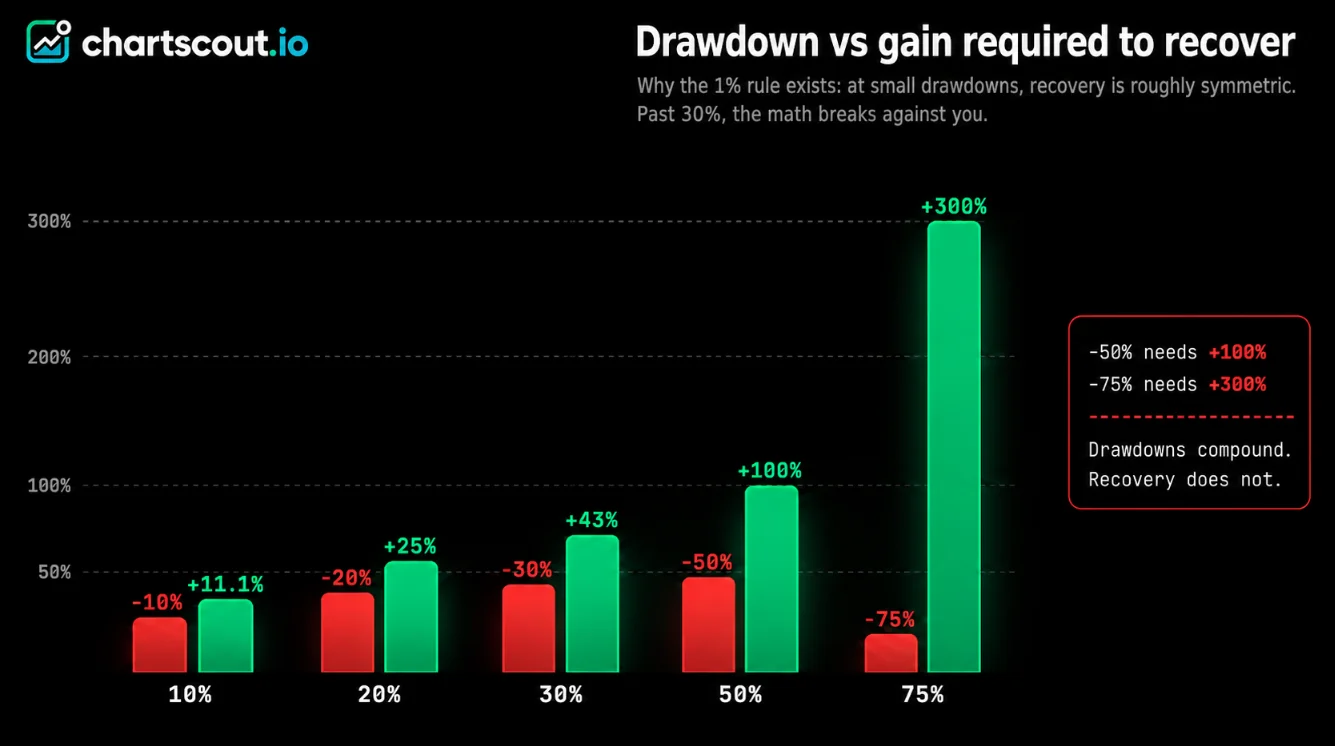
The 1% rule exists because of this curve. Up to roughly 30% drawdown, recovery is manageable. Past 30%, the math turns sharply against you.
Drawdown vs gain required to recover
| Drawdown | Gain required to recover |
|---|---|
| -10% | +11.1% |
| -20% | +25.0% |
| -30% | +42.9% |
| -50% | +100% |
| -75% | +300% |
Risk 1% per trade and the worst stretch typically bottoms at -6 to -10%, which needs +6 to +11% to recover. Risk 5% per trade and the same edge bottoms at -30 to -50%, which needs +43 to +100% to recover. The edge did not change. Only the time and emotional cost of getting back to a high-water mark.
3. The worst drawdown I have ever had was, until it happened, larger than I thought possible
Every time I recalibrated “the worst that can happen” to whatever I had just lived through, the market eventually showed me a deeper version. The crypto cycles I have traded keep producing once-in-a-decade tail events on a roughly annual schedule. My current sizing assumes the next bad stretch is bigger than anything I have yet logged, and I size accordingly.
Practical translation: if your sizing is calibrated to “my biggest losing streak so far was X”, you are under-sized for risk. The honest assumption is that the next streak will be larger.
4. A small minority of trades produces most of my P&L
When I tag every closed trade in my journal at year-end, roughly 10 to 20% of trades drive the bulk of the year's profit. The remaining 80 to 90% are noise: small wins, scratches, small losses that net close to zero. The job of risk management is not to make average trades better. It is to keep the noise from killing the rare big winners.
That is why I am ruthless about skipping marginal-R:R setups. Every forced trade I take is a chance for noise to chew through a winner I have not yet found. The alert filter further down this guide is the operational version of that lesson: pre-defined, hard math, no “maybe just this once.”
5. When I am in drawdown, the worst thing I can do is trade harder
The reflex is always the same: I am down, so I want to “trade my way back.” Every time I have done that, the drawdown deepened. Forcing trades, widening criteria, experimenting with new tactics: each one made it worse. What works for me, every time, is the opposite. Halve per-trade risk, tighten setup quality, take fewer trades, and wait for the rare A-tier patterns.
The mechanism is simple. Smaller risk equals smaller emotional load equals better decision quality on the few good setups that show up. The market does the work; I just have to be patient enough to let it.
The rule I live by: down 15% or more from high-water mark, cut size to 0.5% per trade until I am within 5% of the high again. I never recover by experimenting. I recover by undersizing on better setups.
The five-line summary
- 1. Control the risk side religiously. Reward sorts itself out.
- 2. Drawdown depth = 6 to 10x per-trade risk, near enough.
- 3. Size for a worse drawdown than you have ever had.
- 4. 10 to 20% of trades produce most of the P&L. Do not let noise kill them.
- 5. In drawdown: halve size, raise quality bar, do not trade your way out.
The alert-driven R:R filter
ChartScout fires alerts when a pattern reaches roughly 75-80% maturity, before the breakout candle. That pre-breakout window is when R:R is calculated, not after entry. The alert tells you a pattern is forming. The R:R math tells you whether to trade it.
The minimum-R:R rule: only enter trades where TP1 (the higher-probability first exit) produces at least 1:1. That is a low bar. It cuts the worst setups, the ones where the pattern's geometry simply cannot deliver enough room to make the trade worthwhile.
Recommended minimum R:R by tier
- Tier A (double bottom, ascending triangle, cup & handle, falling wedge): TP1 ≥ 1:1, TP2 ≥ 1:2
- Tier B (falling wedge, descending triangle, sym triangle, H&S top, double top): TP1 ≥ 1:1.5
- Tier C (bull/bear flags, rising wedge): TP1 ≥ 1:2 or skip
The filter in practice: alert fires, calculate ATR-based stop, calculate measured-move target, compute TP1 R:R. Below threshold, pass. This is one of the highest-leverage uses of automated pattern detection: not just finding patterns, but filtering them with hard math before any emotion gets near the decision.
Common R:R mistakes
Widening stops after entry
“Just a little more room” voids the original R:R calculation and adds unplanned risk. Elder's rule (above) applies: never widen a stop, only tighten.
Ignoring fees and funding
Entry fee + exit fee + funding can consume 0.5-2% of a multi-day perp trade. On a 1:2 setup, that is meaningful. Net R:R is the only number that matters; gross R:R is for screenshots.
Slippage on breakout entries
Market orders into a breakout candle can fill 0.5-1.5% above the intended entry on volatile alts. That slippage shifts the stop relative to entry and reduces net R:R. Limit orders at the breakout level fix this; if the breakout runs without filling you, the trade was wrong-sized anyway.
Not tracking realized vs planned R:R
Document every trade: planned R:R, realized R:R, reason for divergence. If you consistently exit at 40% of the planned target out of fear, your real strategy is 1:0.8 regardless of what the plan said.
Applying 1:3 to all patterns
The whole point of this guide. Bull flags, rising wedges, cup & handles, double bottoms: same ratio, completely different geometries and hit rates. Pattern-specific targets beat universal ratios every time.
Skipping the breakeven win rate check
Before any trade: does this pattern's historical hit rate exceed the breakeven win rate at my R:R? If not, the trade is negative-expectancy by design, no matter how clean the chart looks.
Pattern alerts with the math already done
ChartScout scans 1,000+ pairs across Binance, Bybit, KuCoin, MEXC, and Hyperliquid for 23 detectors and fires alerts before the breakout. You compute the R:R, apply the filter, take the trade or skip it.
Card required to start the trial. No charge if cancelled before day 8.
FAQ
What is a good risk-reward ratio for crypto trading?
It depends on the pattern. Bull flags realistically support 1:1.5 to 1:2 at the half-target level. Cup and handles, double bottoms, and ascending triangles can support 1:3 to 1:10+ because their measured-move targets are large. There is no universal good R:R; the answer is always pattern-specific.
Is 2:1 risk-reward enough in crypto?
At 2:1 you need a 33% win rate to break even. Most chart patterns produce hit rates well above that, so 2:1 is sufficient for the weakest setups. For Tier-A patterns (70%+ hit rates) 2:1 actually understates the potential; let pattern geometry, not a fixed ratio, set the target.
How do you calculate risk-reward ratio in crypto?
R:R = (Target Price - Entry Price) / (Entry Price - Stop Price). The target should come from the pattern's measured-move formula. The stop should come from ATR x 1.5 below or above the pattern invalidation level. Both are independent calculations; the R:R is the result.
Can you be profitable with a 1:1 risk-reward ratio?
Yes, if your win rate is above 50%. At 1:1 with a 55% win rate, expectancy is +0.10 per dollar risked. The bull flag half-target strategy is essentially 1:1.5 to 1:2 at roughly 82% win rate, which produces strongly positive expectancy despite the modest ratio.
What win rate do I need at 1:3 risk-reward?
Breakeven win rate at 1:3 is 25%. Above that, expectancy is positive. Tier-A patterns like double bottoms (71% hit rate) or ascending triangles (70%) are well above breakeven, making 1:3 comfortable, provided the geometric target actually sits at the 3x stop level.
How does leverage affect the risk-reward ratio?
Leverage amplifies dollar gain and dollar loss equally. A 1:3 trade at 5x leverage is still 1:3 in ratio terms; only the dollar magnitudes scale. What leverage does change is funding costs on perps, which silently reduces the net profit side of the ratio over multi-day holds.
What is the 1% rule in crypto trading?
Risk no more than 1% of account capital on any single trade. Combined with stop-loss placement it determines maximum position size: Position Size = (Account x 1%) / Stop Distance. The 1% level is preferred over 2% in crypto because of the high correlation between assets during liquidation cascades.
Does risk-reward ratio actually work?
It works as a planning and filter tool, not a guarantee. Positive-expectancy trades can lose; negative-expectancy setups can win. The edge from disciplined R:R only materializes over many trades (50 to 100+). Short-term, randomness dominates. Long-term, expectancy wins.
How big a drawdown should I expect at my position size?
A useful rule of thumb from years of journaling: your worst rolling drawdown tends to land at roughly 6 to 10x your per-trade risk. Risk 1% per trade and expect 6 to 10% drawdowns over a long enough sample. Risk 3% and expect 18 to 30%. Risk 5% and expect 30 to 50%. The strategy edge does not change with sizing; only the depth of the bad streak does. Recovery math compounds against you: -10% needs +11.1%, -20% needs +25%, -30% needs +43%, -50% needs +100%.
What should I do during a trading drawdown?
Do not trade your way out. The reflex to force more trades, widen criteria, or experiment with new tactics deepens the drawdown nearly every time. The opposite works: halve per-trade risk, raise the setup quality bar, take fewer trades, and wait for A-tier patterns. A practical rule: down 15% or more from high-water mark, cut size to 0.5% per trade until within 5% of the high again. Most traders are in some form of drawdown most of the time, so being underwater is normal, not a signal to act.
Sources & references
Data source note: Pattern statistics in this guide come from Thomas Bulkowski's published research at thepatternsite.com (updated 8/26/2020) and the Encyclopedia of Chart Patterns, 3rd Edition. Equity-market data; crypto behavior on lower timeframes likely differs (see crypto adjustment section).
- Bulkowski, Thomas N. ThePatternSite.com - Chart Pattern Statistics. Updated 8/26/2020. thepatternsite.com.
Primary statistical source: average moves, full-target hit rates, throwback rates, and performance ranks for every pattern in the master table. - Bulkowski, Thomas N. Encyclopedia of Chart Patterns, 3rd Edition. John Wiley & Sons, 2021. ISBN: 978-1119739685.
Canonical print reference for measured-move geometry, half-target rules on flags, and pattern-specific failure modes. - Tharp, Van K. Trade Your Way to Financial Freedom, 2nd Edition. McGraw-Hill, 2007. ISBN: 978-0071478717. Chapter 6 (Understanding Expectancy and Other Keys to Trading Success).
R-multiple framework, expectancy formula, and the position-sizing-as-edge thesis. Quoted verbatim in the expectancy section. - Elder, Alexander. The New Trading for a Living: Psychology, Discipline, Trading Tools and Systems, Risk Control, Trade Management. John Wiley & Sons, 2014. ISBN: 978-1118443927. Chapters 51-54 (Risk Management, 2% Rule, 6% Rule, How to Set Stops), esp. pp. 209-225.
Risk management framework, the 2%/6% rules adapted here to 1% for crypto, and the “more room” rule. Quoted verbatim in the position-sizing section. - Murphy, John J. Technical Analysis of the Financial Markets. New York Institute of Finance, 1999. ISBN: 978-0735200661.
ATR methodology, volatility-adjusted stop placement, and measured-move projection rules used in the worked examples.
Related guides
Stop loss placement guide
Pattern-by-pattern ATR-based stops from Bulkowski's 14,000-trade database. The risk side of every R:R calculation.
Chart patterns & volume analysis
Volume confirmation cuts breakout failure rates by 31%. Filter trades before they get to the R:R math.
Bull flag pattern guide
The half-target rule explained in pattern context. Why 9% average moves can't support 1:3 targets.
Cup and handle pattern guide
54% average move and 61% hit rate. Why this pattern earns aggressive R:R targets honestly.

Stjepan Ivanović
Founder of ChartScout · Crypto Trader Since 2013
Trading crypto since 2013 with his first Bitcoin bought at ~$200. Four complete bull/bear market cycles, traded on early exchanges like Mt.Gox and BTC-e, on-chain trading on IDEX and EtherDelta, and ~70 crypto project investments. Built ChartScout after 23+ months of development to automate what no trader can do manually. Watch hundreds of charts 24/7.