Triple bottom pattern crypto: 46% average rise (2026 guide)
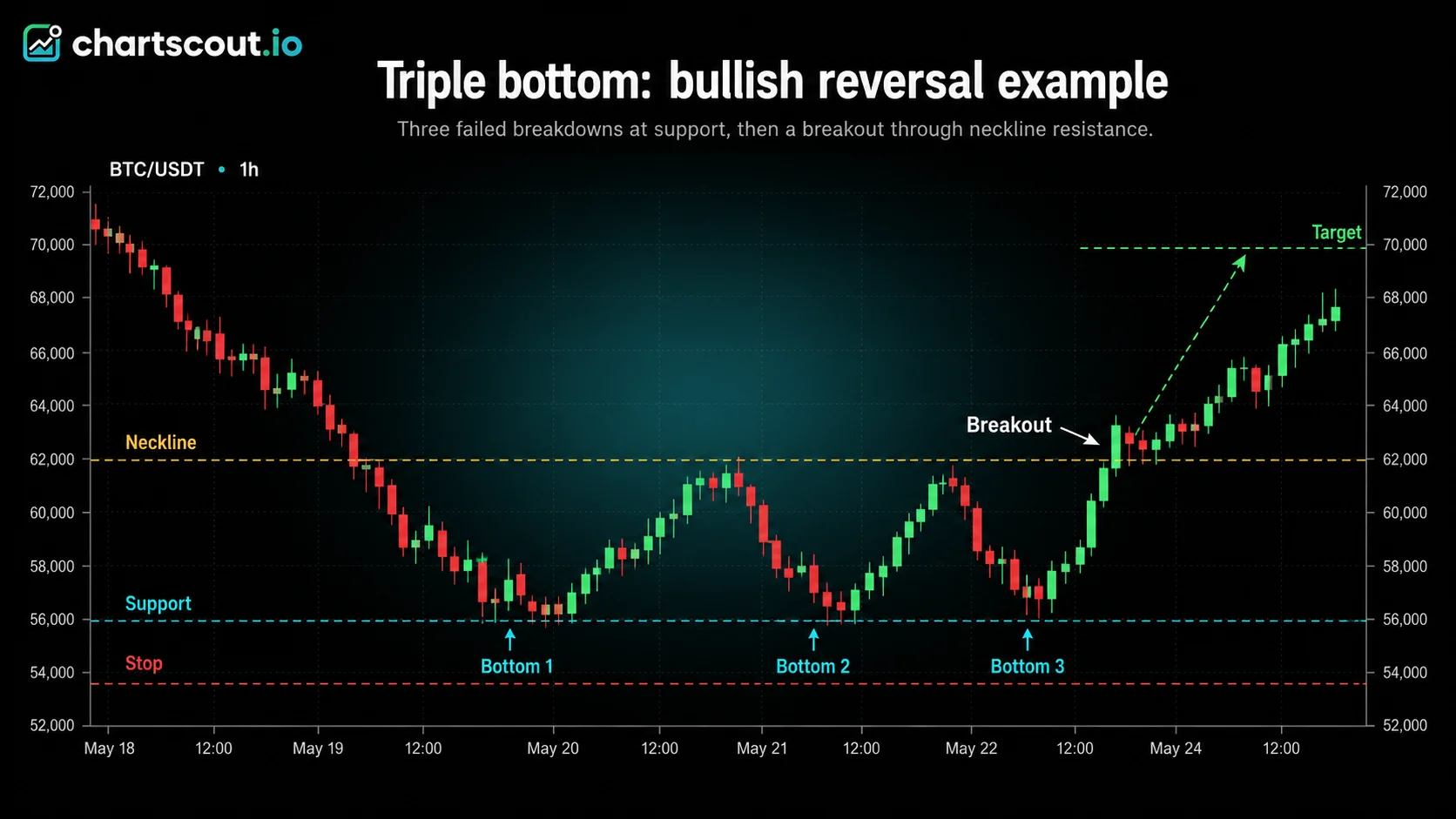
The triple bottom is a bullish reversal: three failed tests of the same support level, then a close above the highest peak between them, and the reversal is confirmed. Per Bulkowski's 2,500-trade dataset it ranks 12 out of 39 chart patterns for upward breakouts in bull markets, with a 13% break-even failure rate, a 46% average rise, and a 74% target-hit rate.
Most articles on the triple bottom quote an “87% success rate” with no source. That figure comes from inverting Bulkowski's 13% break-even failure rate and re-labeling it as a win rate. It is not. 13% break-even failure means 87% of confirmed triple bottoms move at least somewhat upward after the breakout, not 87% reach a profit target. The number that actually matters for trade planning is the 74% target-hit rate, and the average rise of 46% across all confirmed breakouts in Bulkowski's 2,500-trade dataset on thepatternsite.com.
The other widely repeated mistake is the measure rule. Almost every guide on the internet teaches a 100% measured-move target: pattern height projected straight up from the breakout. That target is hit only 74% of the time. Bulkowski's recommendation is to bake the probability into the target itself, multiply pattern height by 0.74, then add it to the breakout price. The difference matters for risk-reward sizing.
“The surprising thing about triple bottoms is their lack of surprises. More about that in a moment. In a bull market, triple bottoms have a low failure rate and a high average rise. In a bear market, the results are about what you would expect from a bullish pattern in a bear market. Almost two out of three triple bottoms will throw back, so consider that before you trade. If price continues down after the throwback, then your trade may well end up with a loss. If it rebounds, the numbers suggest that performance will suffer. In other words, the best performers are triple bottoms without throwbacks.”
- Thomas N. Bulkowski, Encyclopedia of Chart Patterns, 2nd Edition, Chapter 50, p. 765-766Triple bottom: key statistics (Bulkowski, bull market)
Source: Thomas Bulkowski, thepatternsite.com/tb.html, statistics updated 8/27/2020. “More than 2,500 perfect trades” in US equities. Crypto results may differ; the rank order and direction of effects are likely to hold across asset classes, the absolute percentages should be treated as an upper-bound benchmark.
This guide covers the full triple bottom: anatomy, the verified Bulkowski statistics, identification rules, the most common look-alike (inverse head and shoulders), the 74% measure rule, entry/stop/target placement, throwback management, and the specific filters that separate high-conviction setups from traps. Internal links go to the double bottom comparison and the head and shoulders guide where the look-alike risk is highest.
What is the triple bottom pattern?
A triple bottom is a bullish reversal pattern that forms after a sustained downtrend. Price attempts to break lower three times, each time finding support at approximately the same level and reversing. After the third failed breakdown, buyers overwhelm sellers and price closes above the highest peak between the three lows, the neckline, and the reversal is confirmed.
The shape resembles a wide, flat-bottomed letter W with three troughs instead of two. The three valleys do not need to be at exactly the same price. Bulkowski explicitly allows for variation, but they must appear to test the same support zone.
Anatomy
Three troughs (A, B, C)
Three minor lows at approximately the same price. Valley C forming slightly higher than B is a bullish tell, covered in the filters section.
Two intervening peaks
The rallies between the troughs. The higher of the two peaks is the confirmation line and the breakout level.
Confirmation line (neckline)
The highest point between the three valleys. Until price closes above this level, the pattern is unconfirmed.
Breakout
A close above the confirmation line on expanding volume. Bulkowski's default: if the breakout candle gaps above the confirmation line, use the opening price as the entry.
“I think most technical analysts will tell you that not any three bottoms will do for a triple bottom. The three bottoms are usually large and well separated with generally rounded rises in between. The lowest price in each bottom is at about the same level. If the center price is lower than the other two, then you might be looking at a head-and-shoulders bottom. When the bottoms are successively lower in price, it might be one of the broadening series of formations.”
- Thomas N. Bulkowski, Encyclopedia of Chart Patterns, 2nd Edition, Chapter 50, “Identification Guidelines”, p. 767-768The inbound trend matters. A genuine triple bottom requires a meaningful downtrend leading into the formation. A pattern forming after a 10-candle consolidation inside a broader uptrend is not a reversal, it is a continuation pause that resembles a triple bottom. Bulkowski's data comes from patterns with a clear downward price trend before the first trough.
Triple bottom statistics: what Bulkowski's 2,500-trade study shows
Most articles on triple bottoms either cite no statistics at all, or repeat a dubious “87% success rate” figure that circulates across trading blogs without a traceable source. The real numbers, drawn from thepatternsite.com's 2,500+ perfect-trade dataset (statistics last updated 8/27/2020), are below.
| Metric | Value | What it means for trading |
|---|---|---|
| Performance rank | 12 / 39 | Top third of all upward-breakout patterns |
| Break-even failure | 13% | 87% of confirmed breakouts move at least somewhat higher |
| Average rise | 46% | Mean gain across all confirmed breakouts, winners and losers |
| Throwback rate | 65% | Price retests the breakout level after most patterns |
| Target hit rate | 74% | Use 74% of pattern height, not 100%, for target placement |
| Volume trend during pattern | Down 61% of the time | Volume usually peaks beneath each valley, with the first valley highest |
The 87% figure is a misquote
The 13% break-even failure rate inverts to 87%, which third-party blogs then label “success rate.” That is technically the rate at which price moves at least somewhat upward after a confirmed breakout. It is not a target-hit rate, not a profit-target rate, not a win rate in the trader sense. The number to plan around is the 74% target hit and the 46% average rise. Use the verified Bulkowski figures, not the inverted-failure-rate label.
Throwback, not pullback
Several third-party sources cite a “70% pullback rate” for triple bottoms. That is a terminology error or a misquote of an older edition. On thepatternsite.com, “pullback” describes price returning up to the breakout after a downward breakout (used for triple tops), while “throwback” describes price returning down to the breakout after an upward breakout (used for triple bottoms). The current canonical figure is 65% throwback.
How the triple bottom forms in crypto markets
The market structure behind a triple bottom is always the same: sellers keep trying to push price to a new low and keep failing. Each attempt exhausts a fresh wave of sellers. Each recovery tests the patience of remaining bears. By the third failed breakdown, the short side is structurally depleted.
In crypto, this plays out with one added layer: liquidation clusters. On perp exchanges like Binance Futures and Bybit, concentrated long positions from previous failed rallies build up near the resistance peaks. When price breaks above the confirmation line, those resistance levels become magnets for short-covering and new long entries, which is part of why the post-breakout move can be sharp and fast when the setup is clean.
Typical formation timeline
Chart patterns are defined by candle count, not calendar time. A 30-candle triple bottom is the same pattern whether those candles are 1-minute or daily, the wall-clock duration just compresses. Bulkowski's daily-chart bull-market average is 78 days from the first valley to the last valley, plus another ~35 days from the last valley to the breakout, roughly 113 candles end-to-end on a daily chart (Encyclopedia 2nd ed., Tables 50.4 and 50.6). On crypto, most setups ChartScout users trade are far more compact, in the 25-50 candle range. The table below maps a typical 30-candle pattern across timeframes:
| Timeframe | ~30-candle compact pattern duration | Practical ChartScout use |
|---|---|---|
| 1m | ~30 minutes | Scalping, highest noise, lowest reliability |
| 5m | ~2.5 hours | Intraday scalping, only on liquid majors |
| 15m | ~7-8 hours | Day trading on majors, workable |
| 1h | ~1-1.5 days | Intraday and overnight swing, reliable on majors |
| 4h | ~5-6 days | Multi-day swing, sweet spot for triple bottoms |
| 1d | ~1 month | Position trading, highest reliability |
| 1w | ~7-8 months | Position, rare on alts but very high signal |
Triple bottoms are uncommon. Bulkowski notes that price often continues declining without completing the third trough, which means the pattern never confirms. That rarity is part of what makes a confirmed setup significant: it represents three separate tests of a support level, not random noise.
Volume signature
Volume trends downward across the formation 61% of the time, but typically peaks beneath each valley as sellers step in at each test. The first valley usually carries the highest volume of the three, the third the weakest. Breakout volume should be noticeably above the recent average, a breakout on below-average volume is a warning, not a confirmation.
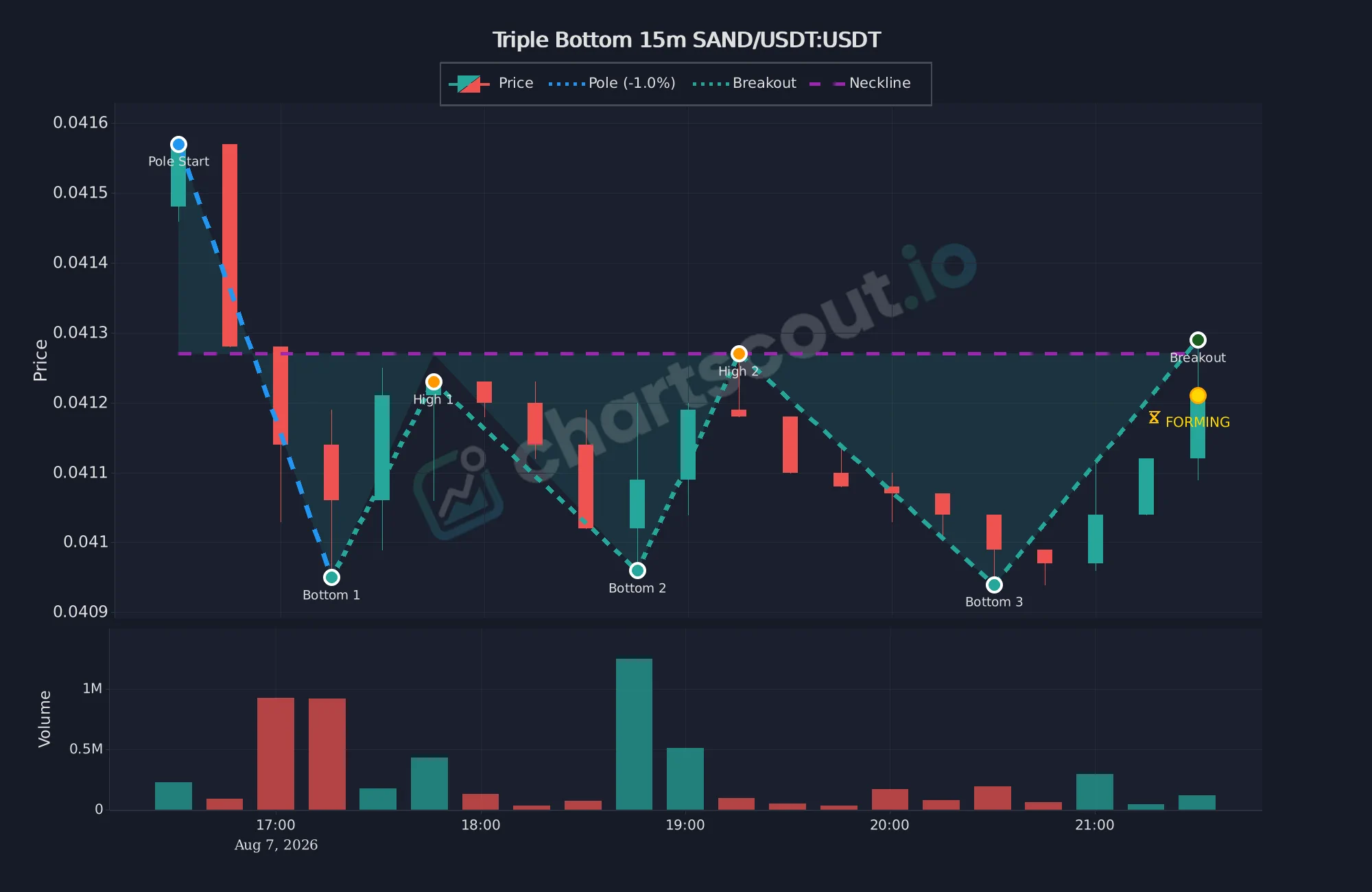
The example below is a fresh SAND/USDT 15-minute triple bottom on Bybit. Three bottoms and the intervening peaks are visible, with price testing the neckline; the “FORMING” label means the breakout has not yet confirmed. This is exactly the moment a scanner alert is most useful: the structure is identifiable before the breakout, giving the trader time to plan entry and stop levels rather than chasing a confirmed move.
How to identify a true triple bottom (and avoid look-alikes)
Misidentification is the biggest practical problem with triple bottoms. Three common patterns can be confused for one another, and the trading implications are different enough that the distinction matters.
Identification checklist
- Clear downward price trend leading into the first trough
- Three distinct valleys at approximately the same price level
- Middle valley (B) is not materially lower than valleys A and C
- Two intervening peaks, the higher of which is the confirmation line
- Pattern duration: at least several weeks of candles on the timeframe being traded
- Volume declining during formation, expanding on breakout
- Breakout confirmed by a close above the highest intervening peak
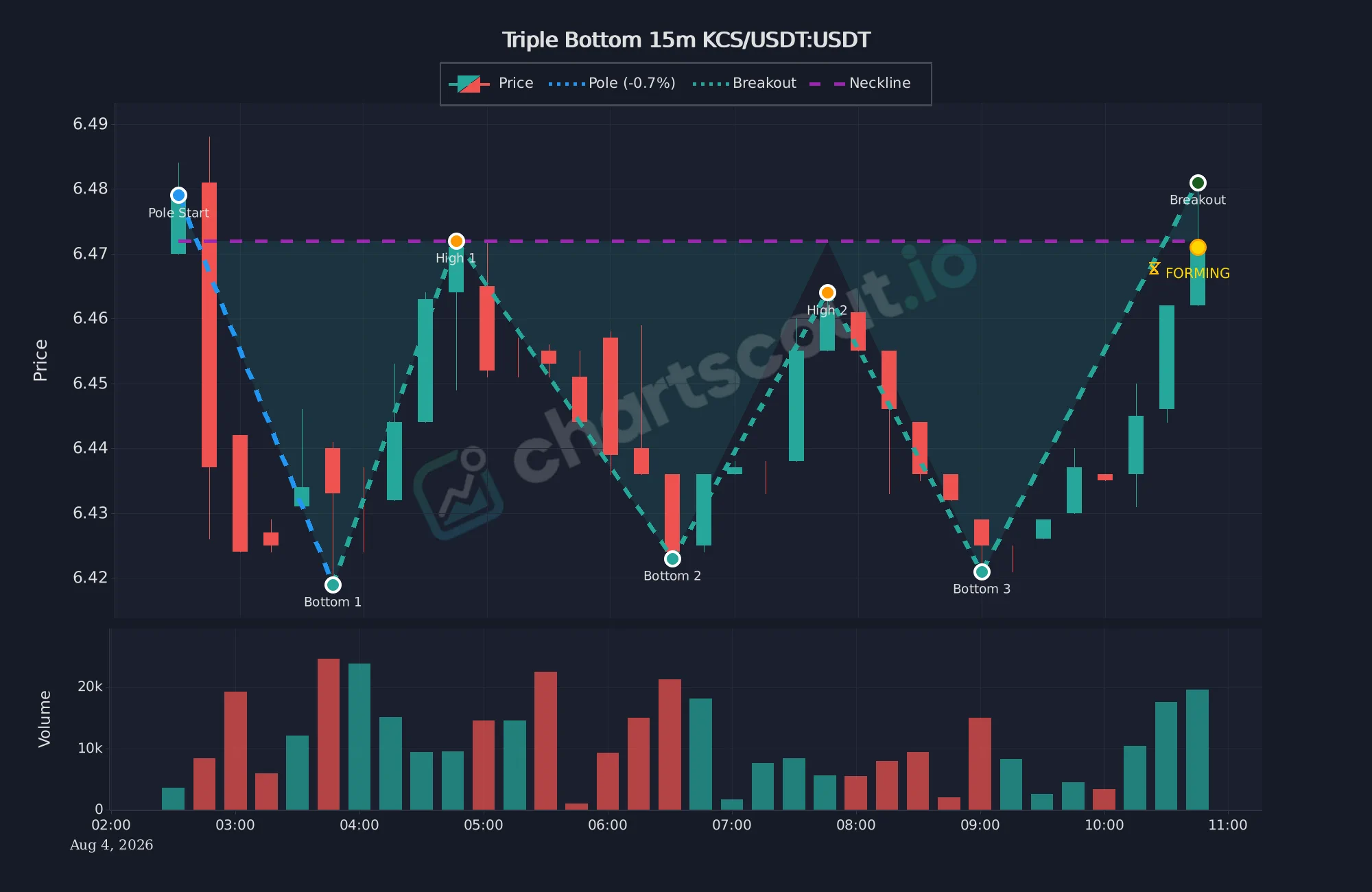
The KCS/USDT 15-minute detection below on KuCoin shows the pre-confirmation state: three bottoms, two intervening peaks, a neckline, and a “FORMING” label before breakout confirmation. This is the canonical state that makes triple bottoms tradable, because you can plan the entry, stop, and target before the move happens.
Look-alike 1: head and shoulders bottom (inverse H&S)
This is the most common misidentification. The structural difference is the depth of the middle trough. In a triple bottom, all three troughs form at approximately the same price. In an inverse head and shoulders, the middle trough (the head) is materially deeper than the two outer troughs (the shoulders). Bulkowski links to his head and shoulders bottom page from the triple bottom entry for exactly this reason.
The trading implications differ: the inverse head and shoulders measure rule projects from head depth, not from a flat trough level. Do not average the two patterns together. The full head and shoulders guide covers the inverse variant in detail.
“The true Triple Top (as distinct, that is, from other types of three-peak formations) carries a recognizable family resemblance to the Double Top. Its Tops are widely spaced and with quite deep and usually rounding reactions between them. Volume is characteristically less on the second advance than on the first, and still less on the third, which often peters out with no appreciable pickup in activity. The three highs need not be spaced quite so far apart as the two which constitute a Double Top, and they need not be equally spaced... Also, the intervening valleys need not bottom out at exactly the same level... And the three highs may not come at precisely the same price; our 3% tolerance rule is again useful here.”
- Robert D. Edwards & John Magee (revised by W.H.C. Bassetti), Technical Analysis of Stock Trends, 9th Edition, Chapter 9, “Triple Tops and Bottoms”, p. 146-147Edwards and Magee describe triple tops, but the structural rules mirror exactly for triple bottoms: widely spaced troughs, rounded reactions between them, declining volume on the second and third tests, the 3% tolerance rule for matching low prices. The 3% tolerance is a useful working number for crypto identification.
Look-alike 2: rectangle bottom
A rectangle forms when price bounces repeatedly between a flat support and a flat resistance over an extended period, more than three touches on each side. A triple bottom has three low touches only. If you are counting four, five, or six tests of the support level, it is a rectangle, not a triple bottom. The trading rules and targets are different.
Look-alike 3: multi-peak bear trap
Bulkowski specifically warns about this in his trading lessons section: after trending upward, price sometimes moves sideways forming multiple peaks and valleys without making a clear higher high or lower low. A pattern forming at the bottom of this sideways range can look like a triple bottom but behaves like a continuation pause rather than a reversal. The tell is the inbound trend. A true triple bottom requires a downtrend before the first trough, not a lateral drift.
The 74% measure rule: how to calculate a realistic target
Almost every guide on the internet teaches the triple bottom using a 100% measured move: take the height of the pattern (from the lowest valley to the highest peak between valleys) and project it upward from the breakout price. That target is hit only 74% of the time. Bulkowski's recommendation is to build the 74% probability directly into the target calculation.
The formula
Pattern height = Highest peak between valleys (A) - Lowest valley (B)
Target = Breakout price (A) + (Pattern height × 0.74)
Worked example
Lowest valley: $38,000
Highest intervening peak (confirmation/breakout level): $45,000
Pattern height: $45,000 - $38,000 = $7,000
74% of pattern height: $7,000 × 0.74 = $5,180
Target: $45,000 + $5,180 = $50,180
Compare to the naive 100% target: $45,000 + $7,000 = $52,000. The difference is $1,820, a target 3.5% higher that gets hit only 74% of the time instead of having a much higher fill probability. For stop-loss and risk-reward planning, the 74% target is the right anchor.
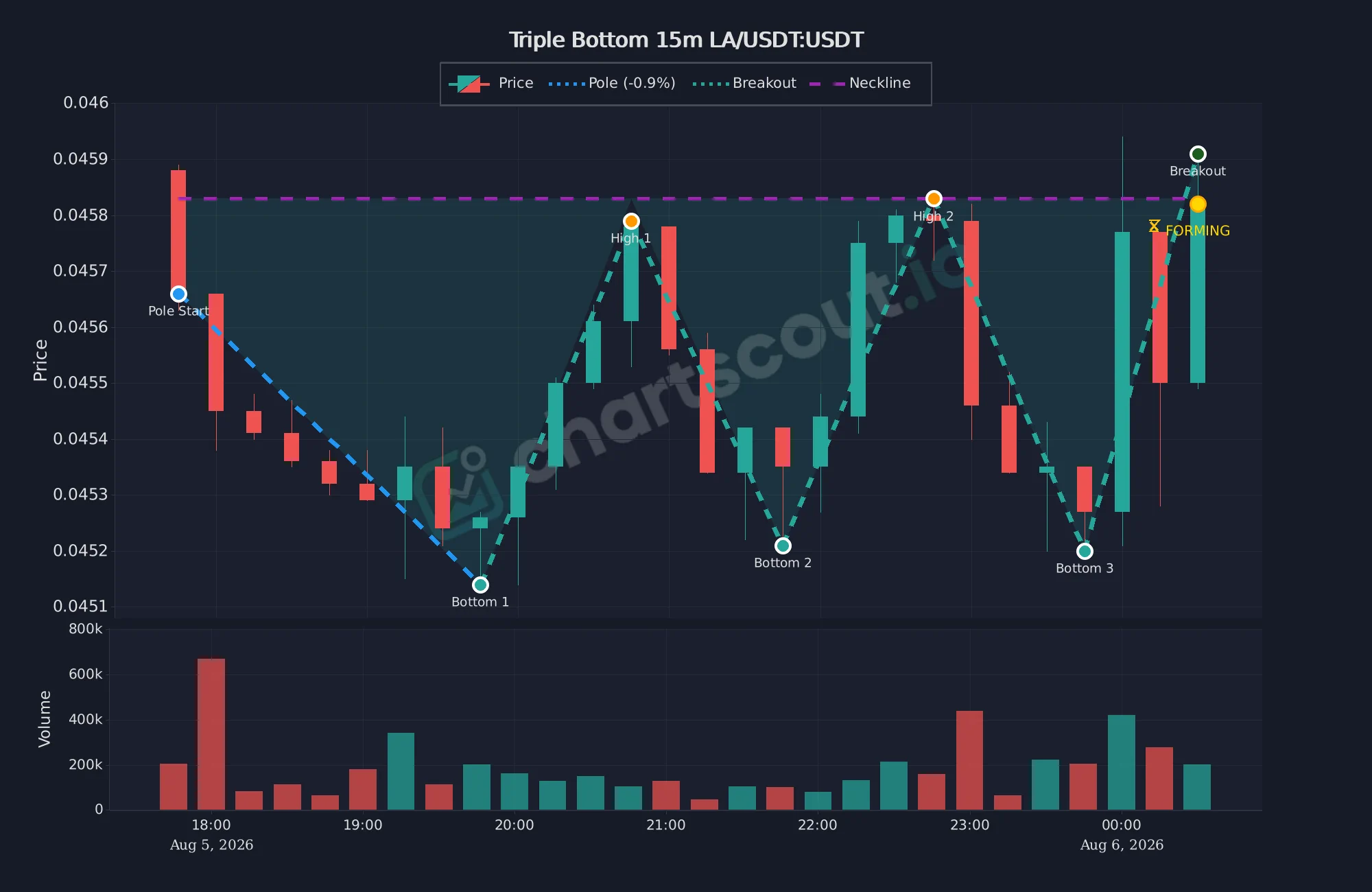
The LA/USDT 15-minute detection below on Bybit shows the measured-move setup on a compact base: three bottoms, two intervening peaks, a neckline, and a “FORMING” label awaiting confirmation. Once the neckline clears, the 74% target formula above gives a probability-aware projection instead of assuming the full pattern height will be reached.
Partial targets and laddering
If you want to ladder exits, take TP1 at 74% of pattern height (highest probability), TP2 at 100% for the portion of the position you let run. This structure locks in the high-probability exit while leaving exposure to the full measured move. Risk-reward should be calculated against TP1, not TP2, otherwise you over-state the expected payoff.
How to trade a triple bottom: entry, stop, and target
Entry
Primary entry, breakout buy stop: place a buy stop order one tick above the confirmation line (the highest peak between the valleys). When price closes above this level, the pattern is confirmed and you are filled. If the breakout candle gaps above the confirmation line, use the opening price of the gap candle as the entry. This is the cleanest, most data-backed method, you are buying confirmed strength, not anticipating it.
Pre-confirmation entry, internal trendline: if the first intervening peak is higher than the second (the two peaks form a declining sequence), draw a down-sloping trendline connecting them. A close above this trendline is an earlier entry signal that Bulkowski explicitly endorses. Use a tighter stop if entering early this way.
Throwback re-entry: after a breakout, price pulls back to the confirmation line 65% of the time. If this throwback holds at or above the confirmation level and price resumes higher, that is a valid lower-risk re-entry. The throwback entry only works if price does not drop back inside the pattern, a close back below the confirmation line after a breakout is a warning that the pattern may be failing.
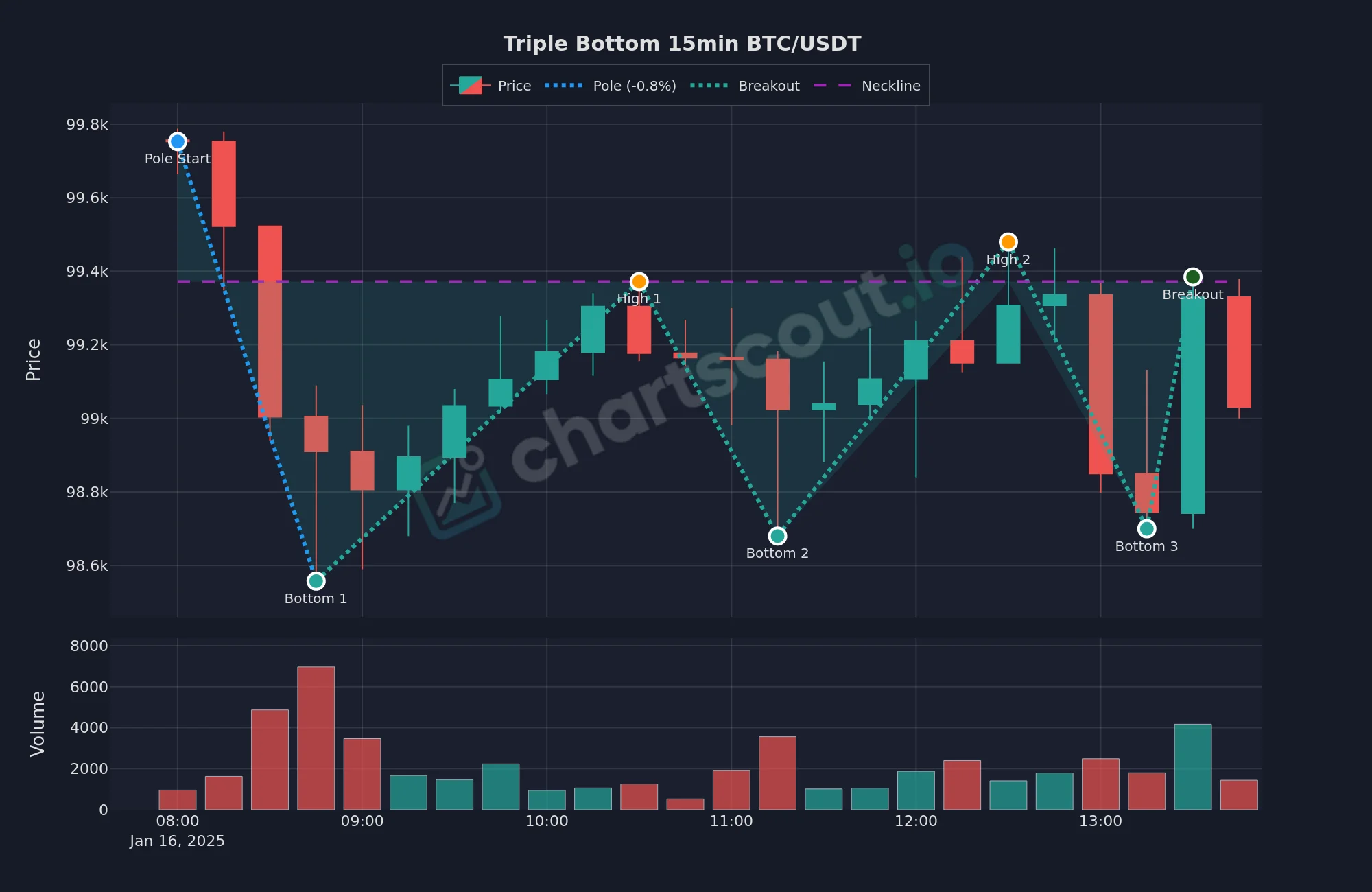
The BTC/USDT 15-minute detection from January 2025 below shows both entry types in one chart. Three bottoms cluster within $50 around $98,650, the neckline sits at $99,400, and price closes decisively above on the breakout candle, the primary buy-stop entry trigger. After the breakout, price drifts back toward the neckline in a textbook 65% throwback before resuming the rally toward the measured-move target. A trader who missed the initial breakout could have entered on the retest with a tighter stop just below the throwback low instead of below the lowest valley.
“When is a triple bottom not a triple bottom? When price fails to rise above the confirmation point. Always wait for confirmation. On average, it takes about a month to get there, but it is well worth the wait. The longest time it took to reach the confirmation point in the formations I looked at is 207 days, almost 7 months. Was the gain worth waiting for? Yes, prices rose by 54%!”
- Thomas N. Bulkowski, Encyclopedia of Chart Patterns, 2nd Edition, Chapter 50, “Trading Tactics”, p. 776Stop placement
Canonical stop: one tick below the lowest of the three valleys. This is Bulkowski's standard stop. It is the widest reasonable stop but the one with the clearest pattern-invalidation logic, if price closes below the lowest trough, the support zone has failed. Bulkowski's exact instruction: “Place a stop-loss order .10 below the lowest low. Raise your stop as prices rise; that way you will be cashed out at the first sign of trouble.”
ATR-based tighter stop: on liquid pairs with clean formations, some traders use the confirmation line minus 1 to 1.5 ATR(14) as a tighter stop. This works on BTC and ETH but risks premature exit on altcoins with wider spreads. Only use an ATR-based stop if you have verified that the expected throwback range (65% chance of a retest) will not trigger it.
Never place a stop at the exact valley low. Liquidity clusters at obvious support levels mean market makers and algorithms will probe those levels before a breakout. Give your stop at least one ATR of breathing room below the lowest valley. Pattern-specific stop placement is covered across all 23 ChartScout detectors in the stop loss crypto trading guide.
Risk-reward check before entry
Risk = Entry price - Stop price
Reward = Target price - Entry price
R:R ratio = Reward / Risk
A triple bottom with a deep pattern height relative to the stop distance will often yield a 2:1 to 3:1 R:R ratio. Patterns where the troughs are clustered tightly (small pattern height) relative to the stop width are lower quality, the expected payoff does not justify the risk. Risk-reward ratio per chart pattern covers the full math.
Throwbacks: the 65% complication
A throwback occurs when price breaks above the confirmation line, then pulls back down to retest it before resuming higher. It happens after 65% of triple bottom breakouts, more often than not. This is not a pattern failure, it is a normal part of the pattern's post-breakout behavior.
Bulkowski's data on triple bottoms shows the average rise when a throwback occurs is 34%, against 41% when no throwback occurs. The throwback itself is a small performance drag, it delays the move and shakes out weak hands. Patterns without a throwback statistically outperform those with one.
What it means in practice
- Do not panic-exit on a throwback. A return to the confirmation level is expected behavior, not evidence the trade is broken.
- Watch the throwback floor. If the throwback holds above the confirmation line and forms a higher low, the breakout is intact. If price closes back below the confirmation line and re-enters the pattern body, that is the warning.
- Throwbacks hurt performance. Bulkowski's research consistently shows that patterns which do not experience a throwback produce higher average rises than those that do.
- Use the throwback as an entry if you missed the breakout. A confirmed throwback that holds and reverses at the confirmation line is a second-chance, lower-risk entry, with the stop now placed just below the throwback low rather than below the full pattern.
On crypto specifically, throwbacks can be more volatile than in equities. A 24/7 market means weekend candles, thin order books, and funding-rate flips on perps can all produce sharper-than-expected retests. Size accordingly.
Bulkowski's high-conviction setup filters
These are the specific conditions Bulkowski identifies on thepatternsite.com as improving or degrading triple bottom performance. Apply them as filters before committing to a trade.
Green flags (add conviction)
- Last valley higher than the middle valley. If valley C is slightly higher than valley B, expect better post-breakout performance. This higher third low is evidence that selling pressure is weakening, bears cannot even reach the prior support level on the third attempt.
- Short-to-intermediate inbound decline. Patterns forming after a decline of up to roughly six months perform best. A downtrend that started six months ago and has been grinding lower has more pent-up reversal energy than one that has been going for years.
- Flat base on the higher timeframe. When a triple bottom appears as a small pothole in a long flat base on the weekly chart, expect a large post-breakout move. The sideways consolidation builds energy, the triple bottom resolves it.
- Big W structure. A triple bottom with a tall, steep left side, a sharp clean decline leading into the first trough with few consolidations, tends to see price return to where the downtrend began.
- Volume expanding at the breakout. Breakout volume significantly above the 20-period average confirms genuine buying interest, not a breakout driven by a few large orders in a thin market.
“If trading this pattern in a bull market, select triple bottoms with a higher third valley for the best performance.”
- Thomas N. Bulkowski, Encyclopedia of Chart Patterns, 2nd Edition, Chapter 50, “Statistics”, p. 775Red flags (reduce size or skip)
- Long uptrend before the pattern. If the downtrend leading to the triple bottom is actually a minor pullback inside a massive prior uptrend, the post-breakout move is likely to disappoint. The pattern is reversing a small correction, not a major downtrend.
- Overhead resistance. If the first pattern-confirming close sits just below a major prior peak or resistance zone, the post-breakout move will likely stall there. Map the prior price history above the neckline before entering.
- Bad news gap or spike. A gap-down event near the first trough, or a tall bearish candle closing near its open during the formation, raises the probability of failure. These represent fundamental event risk that overrides technical setups.
- Measured move up correction phase. A triple bottom forming as the corrective leg of a measured-move-up structure tends to resolve as a continuation rather than a major reversal.
Triple bottom vs. double bottom: the full data comparison
A double bottom appears roughly three to four times more often than a triple bottom, which is why most traders default to it. But frequency is not performance. The comparison table below tells a more nuanced story.
| Pattern | Rank (1 = best) | Break-even fail | Average rise | Throwback | Hit target |
|---|---|---|---|---|---|
| Eve & Eve double bottom | 5 / 39 | Lowest of DB | Highest of DB | ~55% | ~67% |
| Triple bottom | 12 / 39 | 13% | 46% | 65% | 74% |
| Adam & Eve double bottom | 17 / 39 | ~4-5% | Mid | 67% | - |
| Eve & Adam double bottom | 20 / 39 | 12% | 42% | 67% | 72% |
| Adam & Adam double bottom | 26 / 39 | 16% | 39% | 67% | 73% |
Sources: Bulkowski, Encyclopedia of Chart Patterns, 3rd ed. (variant rankings); Eve & Adam confirmed via thepatternsite.com/eadb.html (updated 8/4/25). Eve & Eve throwback and target percentages are approximate, drawn from Bulkowski's variant pages, not all variant pages display every metric in the live HTML.
The triple bottom's 74% target hit rate is the highest of any major bottom reversal variant tracked by Bulkowski. If the goal is maximizing the probability that the measured-move target is reached, the triple bottom is the best available setup among reversal bottoms.
However, the Eve & Eve double bottom ranks higher overall (5 vs. 12) with a higher average rise. The trade-off: Eve & Eve double bottoms are rarer than other double-bottom variants and harder to identify in real time. The triple bottom sits in the middle, rarer than any double bottom, but with the best target-hit probability. The full breakdown of the four double-bottom variants is in the double bottom guide.
The common claim that “three tests of support is more reliable than two” is only partially supported by the data. The triple bottom beats three of the four double-bottom variants on rank. It loses to Eve & Eve. The extra test adds reliability in target-hit rate, not in average magnitude of the move.
Triple bottom vs. inverse head and shoulders
Both patterns signal a bullish reversal after a downtrend. Both have three troughs. The structural difference is the depth of the middle trough, and that difference produces different statistics and different trade mechanics.
| Feature | Triple bottom | Inverse H&S |
|---|---|---|
| Middle trough | Same depth as outer troughs | Materially deeper (the head) |
| Performance rank | 12 / 39 | 7 / 39 |
| Breakout direction | Upward | Upward |
| Measure rule | Pattern height × 74% | Head depth projected upward |
| Confirmation | Close above highest inter-trough peak | Close above neckline |
| Frequency | Rare | Moderate |
The inverse H&S actually outperforms the triple bottom on rank (7 vs. 12), driven by a higher average rise that traces to projecting from the deeper head rather than a flat trough. The critical distinction is identification accuracy. If you call a pattern a triple bottom but the middle trough is deeper than the others, you are using the wrong measure rule and the wrong setup filters. Identify correctly first.
When a triple bottom becomes an inverse H&S: if you are watching a pattern form and valley C comes in near valley A and B, you have a triple bottom. If valley B is materially lower, reassign it to inverse H&S, recalculate the target from head depth, and adjust the stop accordingly.
Triple bottom in crypto: what changes, what doesn't
Bulkowski's 2,500-trade dataset is built from US equities, 1991-2021. Crypto markets carry higher volatility, 24/7 trading, fragmented liquidity, and a different participant mix. The rank order and qualitative direction of every filter (throwbacks hurt, higher third low is bullish, overhead resistance is a drag) are pattern-structure phenomena that transfer cleanly across asset classes. The absolute percentages need an honest crypto adjustment.
Bulkowski baseline vs. crypto expectation
| Factor | Bulkowski baseline (stocks) | Crypto expectation |
|---|---|---|
| Pattern pace | ~78 days first valley to breakout (daily) | Same candle count, compressed wall-clock time on lower TFs |
| Average rise | 46% | Likely amplified on volatile alts, comparable on BTC/ETH |
| Break-even failure | 13% | Likely higher on 1m-15m due to fakeouts, comparable on 4h-1d |
| Volume confirmation | Single-exchange equity tape | Fragmented across 4+ exchanges, wash-trading on low-volume alts |
| Throwback rate | 65% | Likely similar, but leveraged perps create deeper liquidation-driven retests |
| Gap risk | Overnight and weekend gaps in stocks | 24/7 trading, but weekend liquidity drops cause fakeouts |
| Participant mix | Institutional-dominated | Retail-dominated alts, sharper and more emotional moves |
Honest framing
No crypto-wide triple bottom study with comparable sample size to Bulkowski's 2,500 trades has been published. ChartScout maintains a backtest dataset and a forthcoming crypto-specific study, but until that publishes, treat the Bulkowski numbers as a relative reliability ranking, not as exact crypto predictions. Claims of “85% reliability in crypto” that circulate on third-party sites are unsourced extrapolations, not measured.
Timeframe reliability
Below the 1-hour chart, triple bottoms in crypto carry substantially higher false-breakout rates. On thin pairs with sub-$1M daily volume, even 1-hour patterns are noise-heavy. The 4-hour and daily timeframes produce the cleanest signals. On major pairs (BTC, ETH, SOL), the 1-hour chart is workable. How to spot fake breakouts in crypto covers volume, retest, and order-book filters that screen out false triple-bottom signals.
Funding rates on perpetuals
On perp contracts, a triple bottom breakout accompanied by a negative funding rate (shorts paying longs) is a higher-quality setup than one with a highly positive funding rate (longs paying shorts, indicating crowded long positioning). A crowded long at a breakout is a mechanical headwind, the funding mechanism works against the position every 8 hours.
Liquidity and slippage
On small-cap MEXC or KuCoin altcoin pairs, an entry order at the confirmation line moves the price. The exit order at the target also moves the price. Factor both into net expected profit before sizing. This is exactly where automation matters: scanning 1,000+ pairs by hand is the wrong job to do manually.
Same pattern, different assets
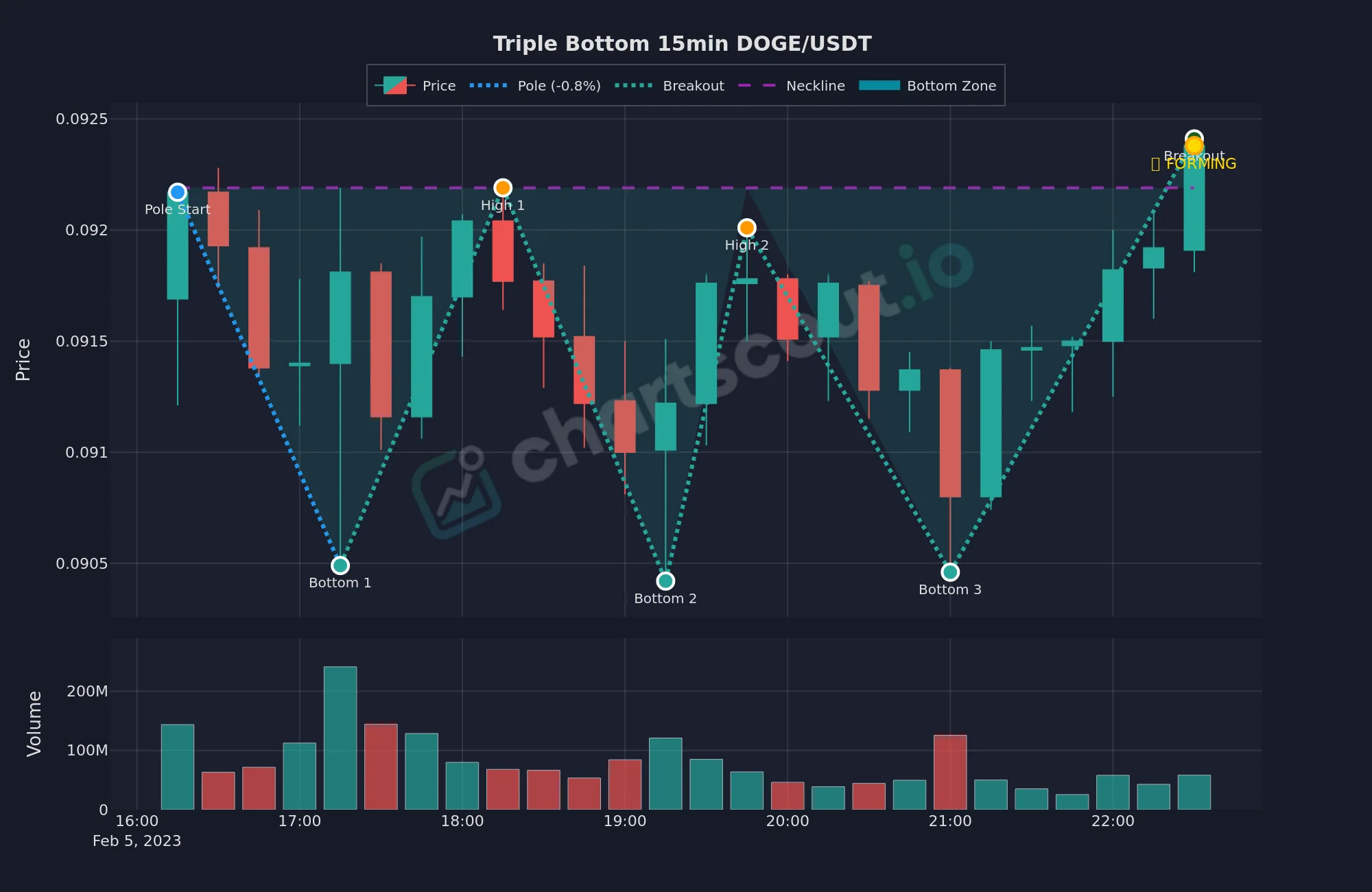
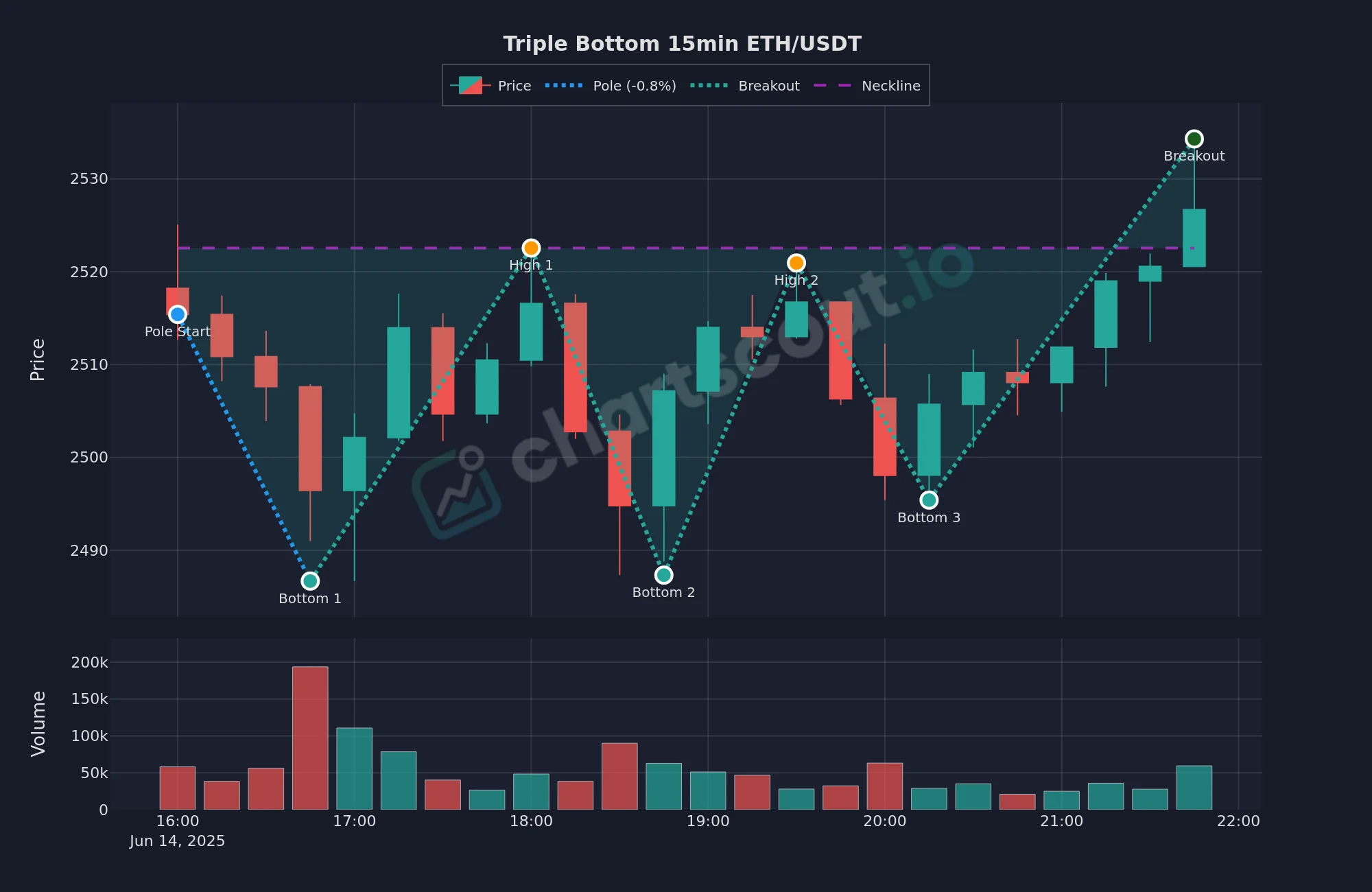
The two detections below show the same triple bottom structure on a high-volatility altcoin (DOGE, February 2023) and a major (ETH, June 2025), both on the 15-minute timeframe. Volume profile differs significantly: DOGE prints in tens of millions of base units per candle, ETH in hundreds of base units. The structural rules are identical. Both produce three valleys at approximately the same price, two intervening peaks, and a neckline test that confirms with a close.
Same pattern, higher timeframes
The 1-hour timeframe gives the pattern more room to develop and tends to filter out the noisier setups visible on 5m and 15m. Below are three 1-hour triple bottom detections from late 2025: ALGO/USDT (November 14-15), CRV/USDT (October 24-26), and EGLD/USDT (October 24-26). The CRV and EGLD detections fired in the same scan window, two different alts printing identical structure at the same time. All three are tagged “FORMING”: the third bottom is in place, the neckline test is happening live, and the breakout has not yet confirmed.
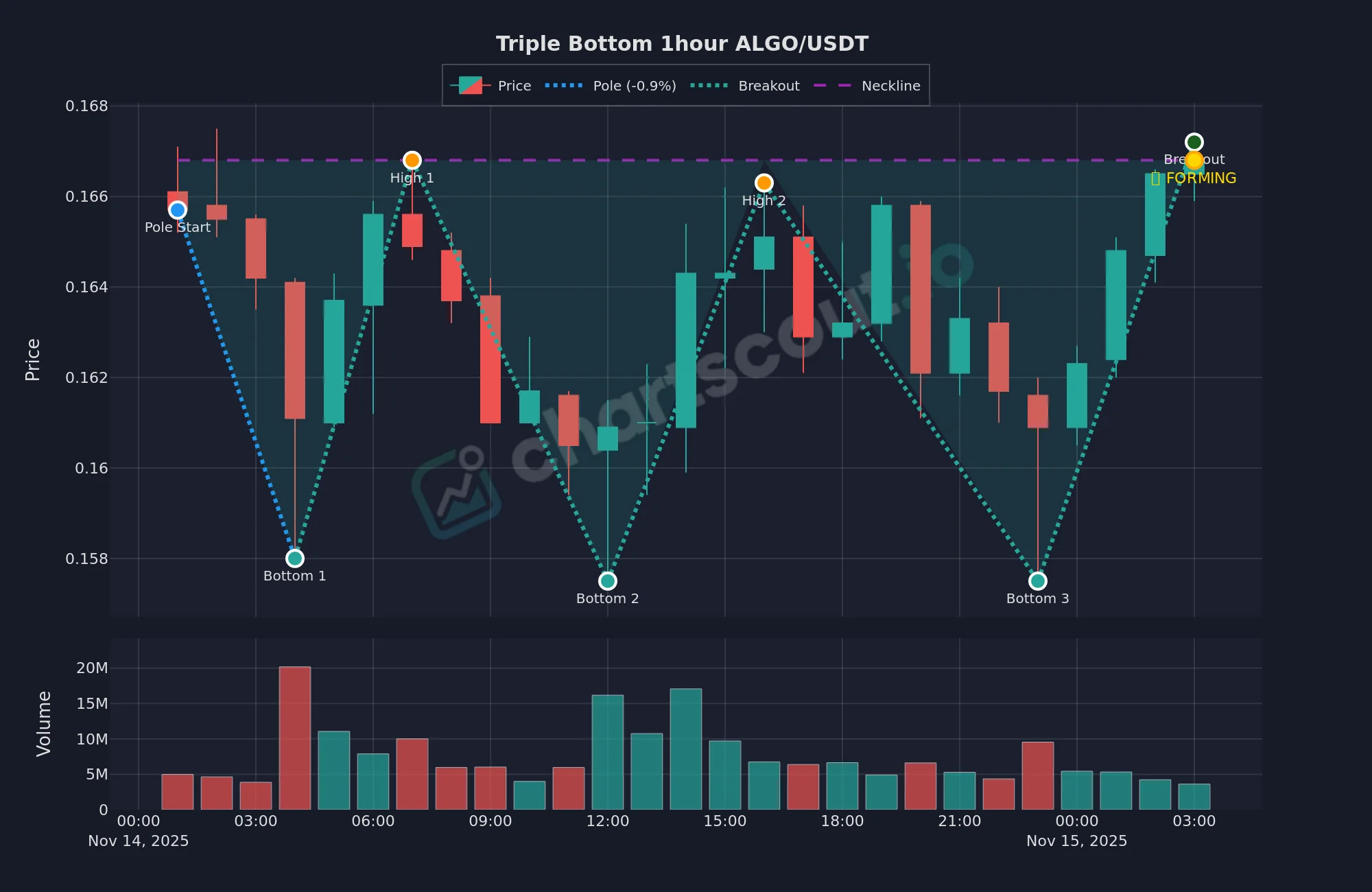
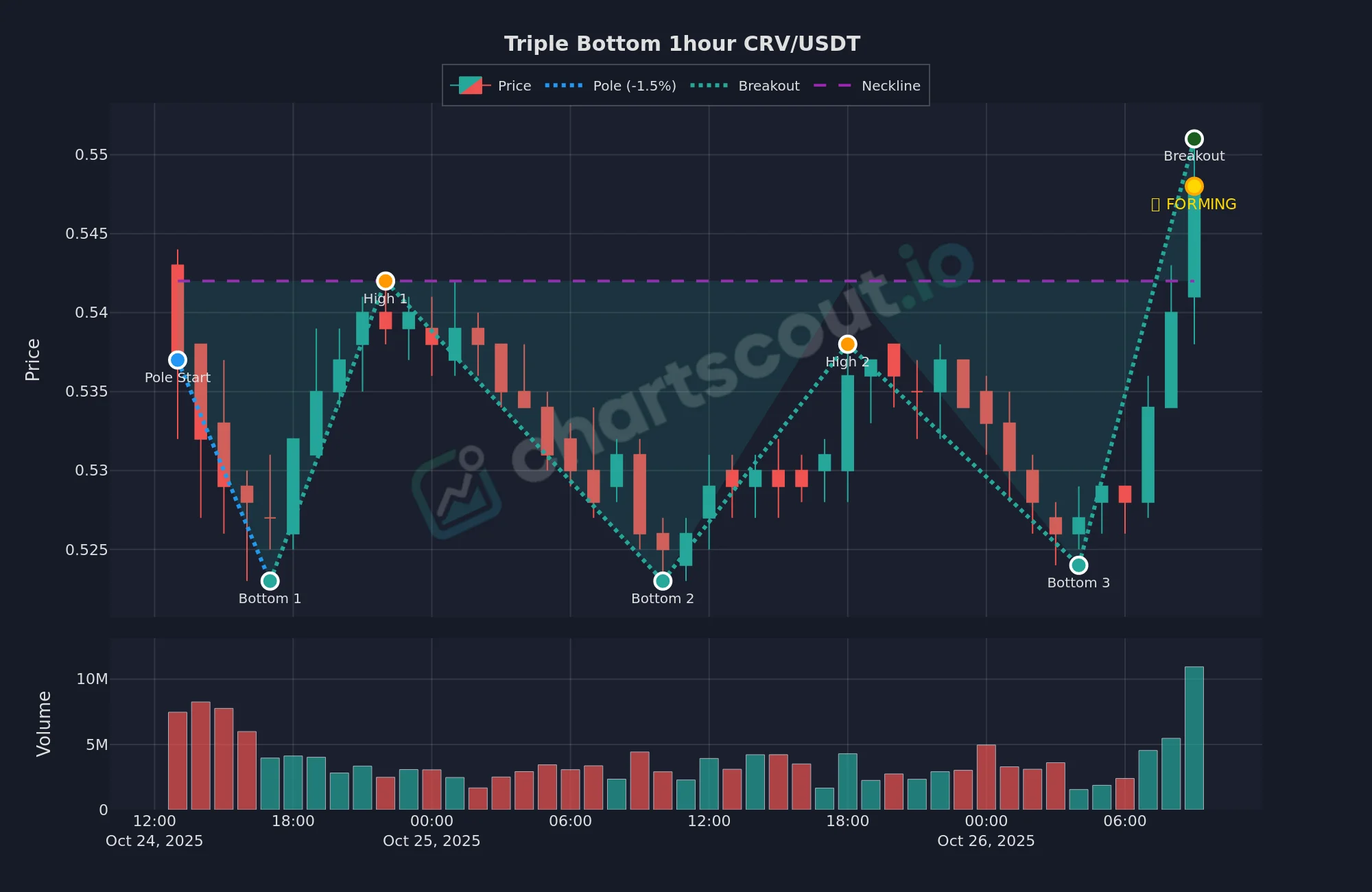
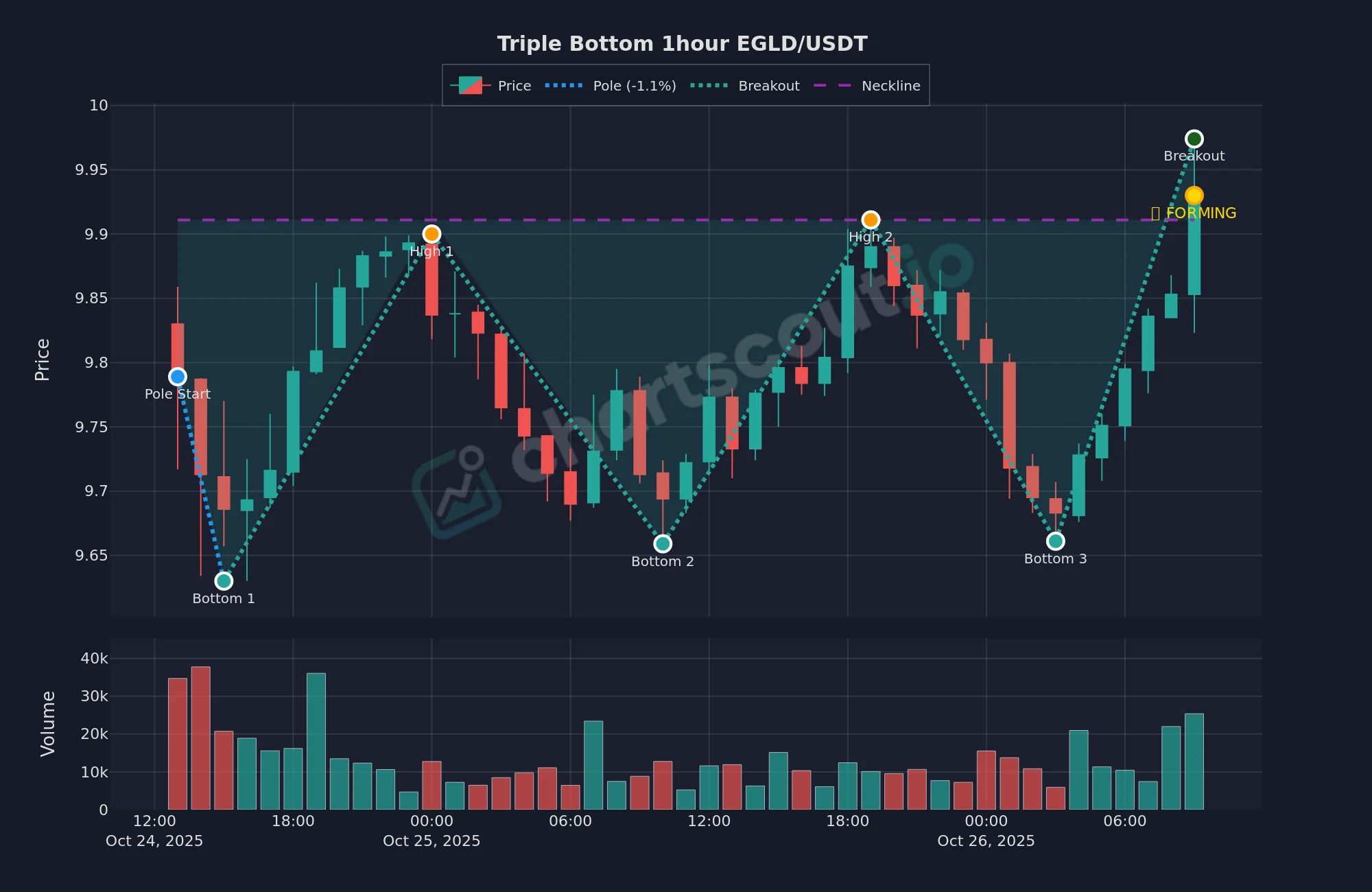
The CRV and EGLD detections firing in the same scan window is the practical case for an automated scanner: a trader watching either pair manually would have caught one. A scanner watching all 1,000+ pairs caught both, plus every other pattern that printed in that hour across the universe. The 1-hour timeframe is the day-trading swing sweet spot for triple bottoms, more reliable than 15m, faster than 4h, and the pattern duration on 1h scales to roughly half a day to a day of wall-clock time.
Common mistakes
Using the 100% measured-move target
The 100% projection reaches its level only 74% of the time. Build the probability into the target itself and take partial profits at the 74% level.
Entering before confirmation
The pattern is not confirmed until price closes above the highest peak between the three valleys. Entering during the third trough is buying a potential triple bottom, not a confirmed one. Bulkowski's statistics are for confirmed patterns only.
Ignoring the inbound trend
A pattern forming after a short, shallow dip in a raging bull market is a continuation pause that resembles a triple bottom, not a reversal setup. Check for a genuine downtrend preceding the formation.
Placing the stop at the exact valley low
Support levels are liquidity pools. The exact price of the lowest valley will be probed. Place the stop below the valley, not at it.
Treating a throwback as a failure
A 65% throwback rate means most successful triple bottoms pull back to the neckline after breaking out. A throwback that holds at the neckline is the pattern behaving normally, not failing.
Skipping the look-alike check
A middle trough that is materially lower than the others is an inverse H&S, not a triple bottom. The measure rule and setup filters are different. Identify correctly before trading.
Ignoring volume at the breakout
A triple bottom breakout on below-average volume in crypto is a yellow flag. Confirm volume is expanding before committing full size.
Not checking for overhead resistance
The measured-move target is a mathematical projection. If a major prior peak sits between the breakout price and the target, that level will act as a magnet and a barrier. Map the overhead structure before entering.
Get real-time triple bottom alerts
ChartScout scans 1,000+ pairs across Binance, Bybit, KuCoin, MEXC, and Hyperliquid continuously, 24/7. Triple bottom alerts fire at the formation maturity point, before the breakout, via Discord, Telegram, or email in under 20 seconds. No API keys required.
Start 7-day Pro trial→Set up your first triple bottom watcher in under 2 minutes.
Frequently asked questions
Is the triple bottom pattern bullish or bearish?
Bullish. The triple bottom is a reversal pattern that forms after a downtrend. When price closes above the confirmation line (the highest peak between the three troughs), it signals selling pressure has been exhausted and buyers have taken control.
What is the success rate of the triple bottom pattern?
Bulkowski's data on more than 2,500 perfect trades shows a 13% break-even failure rate, meaning 87% of confirmed triple bottoms produce at least a small upward move. The number that matters for trade planning is the 74% target hit rate. Average rise across all confirmed breakouts is 46%. Source: thepatternsite.com, statistics updated 2020.
What is the difference between a triple bottom and a double bottom?
A double bottom has two troughs, a triple bottom has three. Both are bullish reversals. The triple bottom's three tests of support produce a higher target-hit rate (74%) than most double bottom variants, but the best double-bottom variant (Eve & Eve) still ranks higher overall (5th vs. 12th of 39 patterns). The triple bottom is rarer and takes longer to form.
What is the difference between a triple bottom and an inverse head and shoulders?
Both have three troughs and a bullish breakout. In a triple bottom, all three troughs form at approximately the same price. In an inverse head and shoulders, the middle trough (the head) is materially deeper than the two outer troughs (the shoulders). The measure rules and setup filters differ, identify the correct pattern first.
How do you confirm a triple bottom?
The pattern is confirmed when price closes above the highest peak between the three valleys. That peak is the confirmation line and the breakout price. Volume should expand on the breakout candle. An upward gap that closes above the confirmation line also counts as confirmation.
Where do you place a stop-loss on a triple bottom?
One tick below the lowest of the three troughs. This is Bulkowski's canonical stop. If price closes below the deepest valley, the support zone has failed and the pattern is invalidated. On volatile crypto pairs, give it at least one ATR of additional room below the valley low.
How do you calculate the price target for a triple bottom?
Use Bulkowski's 74% measure rule: Target = Breakout price + ((Highest peak between troughs - Lowest valley) x 0.74). The 74% multiplier reflects the actual probability that the full measured move gets hit. Using 100% sets a target that is missed roughly one-quarter of the time.
What does a throwback mean on a triple bottom?
A throwback is when price breaks above the confirmation line and then pulls back to retest it. It happens after 65% of triple bottom breakouts. It is normal post-breakout behavior, not a failure signal. A throwback that holds at or above the confirmation line before resuming higher is intact. A close back below the line is a warning.
What timeframe works best for triple bottoms in crypto?
The 4-hour and daily timeframes produce the cleanest signals. On major pairs (BTC, ETH, SOL), the 1-hour chart is workable. Below 1-hour, false-breakout rates increase materially, especially on altcoins with lower liquidity.
How rare is the triple bottom pattern?
Bulkowski notes triple bottoms are uncommon. Price often continues declining without completing the third trough and confirming. That rarity is part of what makes a confirmed setup significant, it represents three documented tests of a support level across a sustained period, not noise.
Sources & references
Data source note: All break-even failure rates, average rises, throwback rates, target-hit percentages, and Bulkowski rankings come from Thomas Bulkowski's most recent published statistics at thepatternsite.com (data updated 8/27/2020). The triple bottom dataset is more than 2,500 perfect trades in US equities, 1991-2021. Crypto markets may differ in absolute magnitude, the rank order and qualitative direction of effects are likely to hold.
- Bulkowski, Thomas N. ThePatternSite.com - Triple Bottoms. Statistics updated 8/27/2020. thepatternsite.com/tb.html.
Primary statistical source. Triple bottom: rank 12/39, 13% break-even failure, 46% average rise, 65% throwback, 74% target hit, more than 2,500 perfect trades. Trading lessons added 6/25/24 cover bear-trap warnings, gap-down risk, and the higher-third-low filter. - Bulkowski, Thomas N. Encyclopedia of Chart Patterns, 2nd Edition. John Wiley & Sons, 2005. ISBN: 978-0471668268.
Chapter 50, “Triple Bottoms”, p. 765-778. Source for the verbatim quotes on identification guidelines, throwback performance penalty, confirmation logic, the higher-third-valley rule, and the canonical stop-loss instruction (“.10 below the lowest low”). - Bulkowski, Thomas N. Encyclopedia of Chart Patterns, 3rd Edition. John Wiley & Sons, 2021. ISBN: 978-1119739685.
Print companion to thepatternsite.com data. Cited for the four-variant double-bottom taxonomy (Adam & Adam, Adam & Eve, Eve & Adam, Eve & Eve) used in the comparison table. - Edwards, Robert D., John Magee & W.H.C. Bassetti. Technical Analysis of Stock Trends, 9th Edition. CRC Press, 2007. ISBN: 978-0849337222.
Chapter 9, “Important Reversal Patterns - Continued”, “Triple Tops and Bottoms”, p. 146-147. Source for the 3% tolerance rule, family-resemblance description, declining volume across successive tests, and the structural mirror between triple tops and triple bottoms. - Schabacker, Richard W. Technical Analysis and Stock Market Profits. 1932 (modern reprint, Harriman House).
Study IV, “Multiple Tops and Bottoms”. The original 1932 documentation of multiple-bottom reversal mechanics, including the volume signature requirement and the role of the rally above prior minor highs as confirmation.
Related guides
Double bottom (W pattern) guide
The two-trough variant. Four structural types with different performance ranks. Eve & Eve ranks 5/39 bullish.
Head and shoulders pattern
Includes the inverse H&S (head and shoulders bottom) that is most often confused with the triple bottom.
Double top (M pattern)
The bearish mirror. Two failed attempts at the same high with 75% break-even rate.
How to spot fake breakouts
Volume, retest, and order-book filters to manage the 13% triple bottom failure rate and 65% throwback.
Stop loss placement guide
Pattern-by-pattern stop placement rules for all 23 ChartScout detectors including the triple bottom canonical stop.
Risk reward ratio per chart pattern
Pattern-specific R:R math, expectancy, and the half-target rule applied to triple bottom 74% targets.
Chart patterns & volume analysis
Volume confirmation rules across 16 chart patterns including triple bottoms and inverse H&S.
Crypto chart patterns cheat sheet
all 23 ChartScout detectors with Bulkowski break-even rates, volume rules, and 5m to 4h playbooks.

Stjepan Ivanović
Founder of ChartScout · Crypto Trader Since 2013
Trading crypto since 2013 with his first Bitcoin bought at ~$200. Four complete bull/bear market cycles, traded on early exchanges like Mt.Gox and BTC-e, on-chain trading on IDEX and EtherDelta, and ~70 crypto project investments. Built ChartScout after 23+ months of development to automate what no trader can do manually. Watch hundreds of charts 24/7.