Triple top pattern crypto: 25% failure rate (2026 guide)
The triple top is a bearish reversal: three failed pushes at the same resistance, then a close below the lowest trough between them, and the reversal is confirmed. Per Bulkowski's 1,964-trade dataset it ranks 24 out of 36 patterns for downward breakouts, with a 25% break-even failure rate, a 14% average decline, and a measured-move target reached just 49% of the time. Tradable, but a below-average pattern, and most guides do not tell you that.
Most triple top guides still quote a 10% failure rate. That number is real, but it is from the 2005 second edition of Bulkowski's Encyclopedia of Chart Patterns. When Bulkowski reran the pattern across a larger dataset of 1,964 perfect trades and published the update on thepatternsite.com in 2020, the break-even failure rate more than doubled, from 10% to 25%, and on the updated data the pattern sits at a below-average rank of 24 out of 36 downward-breakout patterns. The triple top is not the “comfortably reliable” formation the older books describe.
The second widely repeated mistake is the target. Almost every guide teaches a 100% measured move: pattern height projected straight down from the breakdown. Bulkowski's data shows that target is hit only 49% of the time, less often than a coin flip. The fix is to bake the probability into the target itself, multiply pattern height by 0.49, then subtract it from the confirmation line. This guide uses the verified 2020 figures throughout, and tells you exactly where the old numbers came from.
“The failure rate of triple tops at 10% is comfortably below the 20% maximum that I consider reliable formations to maintain. I classify a failure of a triple top to be when price reaches the confirmation point and continues moving down by less than 5% before turning around and heading meaningfully higher.”
- Thomas N. Bulkowski, Encyclopedia of Chart Patterns, 2nd Edition, Chapter 51, “Focus on Failures”, p. 784That 10% figure is the one still circulating across trading blogs and YouTube. Bulkowski himself superseded it. The 2020 thepatternsite.com update is the dataset this guide treats as canonical, and the gap between the two numbers is the single most important thing to understand before trading this pattern.
Triple top: key statistics (Bulkowski, updated 2020)
Source: Thomas Bulkowski, thepatternsite.com/tt.html, statistics updated 8/27/2020. 1,964 perfect trades in US equities, downward breakouts. Crypto results may differ; the rank order and direction of effects are likely to hold across asset classes, the absolute percentages should be treated as a benchmark, not a guarantee.
This guide covers the full triple top: anatomy, the verified Bulkowski statistics, identification rules, the look-alikes that ruin trades (head and shoulders, double top, rectangle), the 49% measure rule, entry, stop and target placement, pullback management, the setup filters that separate quality from traps, and the asymmetry that makes the triple top notably weaker than its bullish mirror, the triple bottom.
What is the triple top pattern?
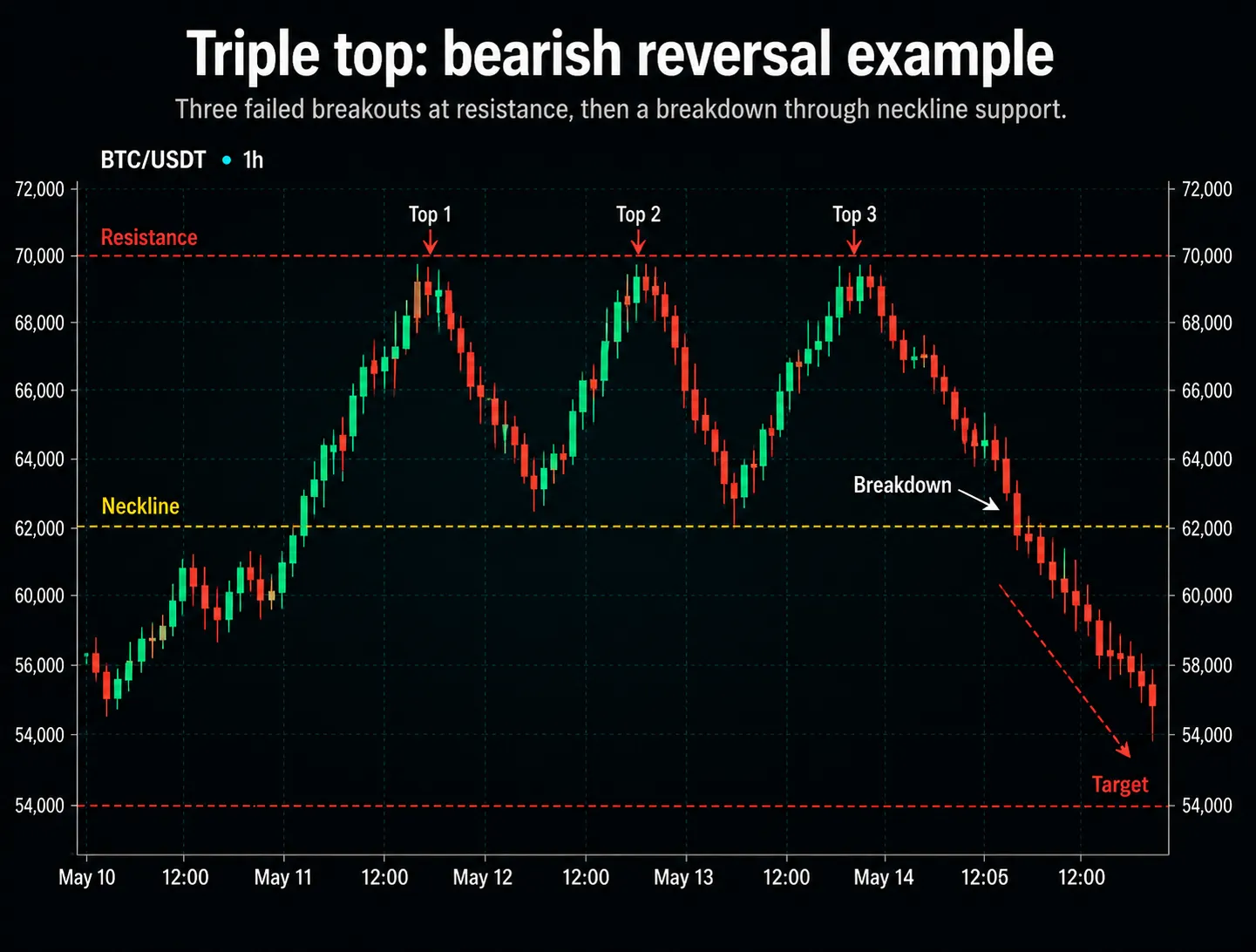
A triple top is a bearish reversal pattern that forms after a sustained uptrend. Price attempts to push to a new high three separate times, each time hitting resistance at approximately the same level and reversing. After the third failed attempt, sellers overwhelm buyers and price closes below the lowest trough between the three peaks, the confirmation line, and the uptrend is over.
The shape is a price ceiling tested three times. The market tries to break through, gets rejected, pulls back, tries again, gets rejected again, tries a third time, and fails again. Each rejection drains bullish conviction and adds to the evidence that supply is overwhelming demand at that level. The three peaks do not need to be at exactly the same price, but they must clearly test the same resistance zone.
Anatomy
Three peaks (A, B, C)
Three minor highs at approximately the same price. A third peak forming slightly lower than the second is a bearish tell, covered in the filters section.
Two intervening troughs
The reactions between the peaks. The lower of the two troughs is the confirmation line and the breakdown level.
Confirmation line
The lowest point between the three peaks. Until price closes below this level, the pattern is unconfirmed and price is likely to keep rising.
Breakdown
A close below the confirmation line on expanding volume. If the breakdown candle gaps below the line, Bulkowski's default is to use the opening price as the entry.
“The true Triple Top (as distinct, that is, from other types of three-peak formations) carries a recognizable family resemblance to the Double Top. Its Tops are widely spaced and with quite deep and usually rounding reactions between them. Volume is characteristically less on the second advance than on the first, and still less on the third, which often peters out with no appreciable pickup in activity.”
- Robert D. Edwards & John Magee (revised by W.H.C. Bassetti), Technical Analysis of Stock Trends, 9th Edition, Chapter 9, “Triple Tops and Bottoms”, p. 146The inbound trend matters. A genuine triple top requires a meaningful uptrend leading into the first peak. A three-bump pattern forming as a congestion area inside a broader downtrend is not a reversal, it is a pause. Bulkowski's statistics come from patterns with a clear upward price trend before the first peak, and his data shows most triple tops act as reversals of an uptrend.
Triple top statistics: what Bulkowski's 1,964-trade study shows
The triple top's headline numbers put it firmly in the lower half of bearish patterns. That is worth sitting with before trading it. Every figure below is from thepatternsite.com's 1,964 perfect-trade dataset, statistics last updated 8/27/2020.
| Metric | Value | What it means for trading |
|---|---|---|
| Performance rank | 24 / 36 | Below average among downward-breakout patterns |
| Break-even failure | 25% | 1 in 4 confirmed triple tops fails to produce a meaningful decline |
| Average decline | 14% | Mean drop across all breakdowns, winners and losers |
| Pullback rate | 66% | Price returns to the confirmation line after most breakdowns |
| Target hit rate | 49% | Use 49% of pattern height as the target, not 100% |
| Volume trend during pattern | Down 62% of the time | Volume usually peaks beneath each high, with the first peak highest |
The 25% failure rate is the number that demands respect
One in four confirmed triple tops, patterns where price has already closed below the confirmation line, fails to produce a material decline. That is nearly double the triple bottom's 13% failure rate. The practical implication: a triple top warrants a smaller position than an equivalent triple bottom or head and shoulders setup, all else equal.
Old numbers vs. updated numbers
Bulkowski's 2005 Encyclopedia (2nd edition) reported a 10% failure rate and a 19% average decline for triple tops in a bull market. The 2020 thepatternsite.com update, drawn from a larger 1,964-trade sample, revised those to a 25% failure rate and a 14% average decline. The target-hit rate moved the other way, from 40% to 49%. Where a third-party article quotes “10% failure,” it is quoting a figure the author himself has superseded.
The 49% target hit rate means the full measured move is reached less than half the time. If you project a 100% measured-move target on every triple top, you are using a level that, per Bulkowski's 1,964-trade dataset, is missed more often than it is hit. The correct multiplier is 0.49, and the math behind that is in the measure-rule section below.
Data notice: bull market vs. bear market
Bulkowski's dataset covers US equities, daily charts, collected predominantly in bull-market conditions. He notes triple tops are more common in bear markets, and his older edition found steeper declines (24% vs. 19%) in bear markets. In a crypto bear cycle, triple tops may be more frequent and resolve harder than the headline numbers suggest. Treat 14% decline and 49% target as a baseline, not a crypto-specific guarantee.
How the triple top forms in crypto markets
The psychology behind a triple top is the mirror of a triple bottom. Buyers keep attempting to push price to a new high and keep running into a wall of supply. Sellers who bought lower take profits into each rally. Traders who missed the first push set limit sells near the prior high. By the third failed test, the bulls are structurally exhausted and the pattern resolves downward.
In crypto there is an extra mechanical layer: leveraged long positions accumulate at and below each peak. When the pattern confirms with a close below the confirmation line, those positions begin liquidating, which can accelerate the decline sharply on perp exchanges. A confirmed triple top breakdown on Binance or Bybit perps often triggers a cascade of long liquidations that produces a faster, harder drop than the same pattern on a spot-only market.
Formation duration: count candles, not calendar
Chart patterns are defined by candle count, not calendar time. A 30-candle triple top is the same pattern whether those candles are 1-minute or daily, only the wall-clock duration changes. Bulkowski's daily-chart triple tops are large formations, his bull-market average runs roughly 95 days from the first peak to the last, plus about another month to the breakdown. On crypto, most setups ChartScout users trade are far more compact, in the 25 to 50 candle range. The table maps a typical 30-candle pattern across timeframes:
| Timeframe | ~30-candle compact pattern duration | Practical ChartScout use |
|---|---|---|
| 1m | ~30 minutes | Scalping, highest noise, lowest reliability |
| 5m | ~2.5 hours | Intraday scalping, only on liquid majors |
| 15m | ~7-8 hours | Day trading on majors, workable |
| 1h | ~1-1.5 days | Intraday and overnight swing, reliable on majors |
| 4h | ~5-6 days | Multi-day swing, sweet spot for triple tops |
| 1d | ~1 month | Position trading, highest reliability |
| 1w | ~7-8 months | Position, rare on alts but very high signal |
Triple tops are relatively rare. Bulkowski notes price often continues higher without completing the third peak and confirming. A formation that looks like a potential triple top on the right edge of the chart has not earned its statistics, only a confirmed close below the lowest trough does.
Volume signature
Volume trends downward across the formation 62% of the time, but typically peaks beneath each high as buyers push into resistance, with the first peak usually the heaviest. The confirmation breakdown should occur on expanding volume. A low-volume breakdown is a warning sign the move lacks conviction, a high-volume close below the confirmation line is the highest-quality signal.
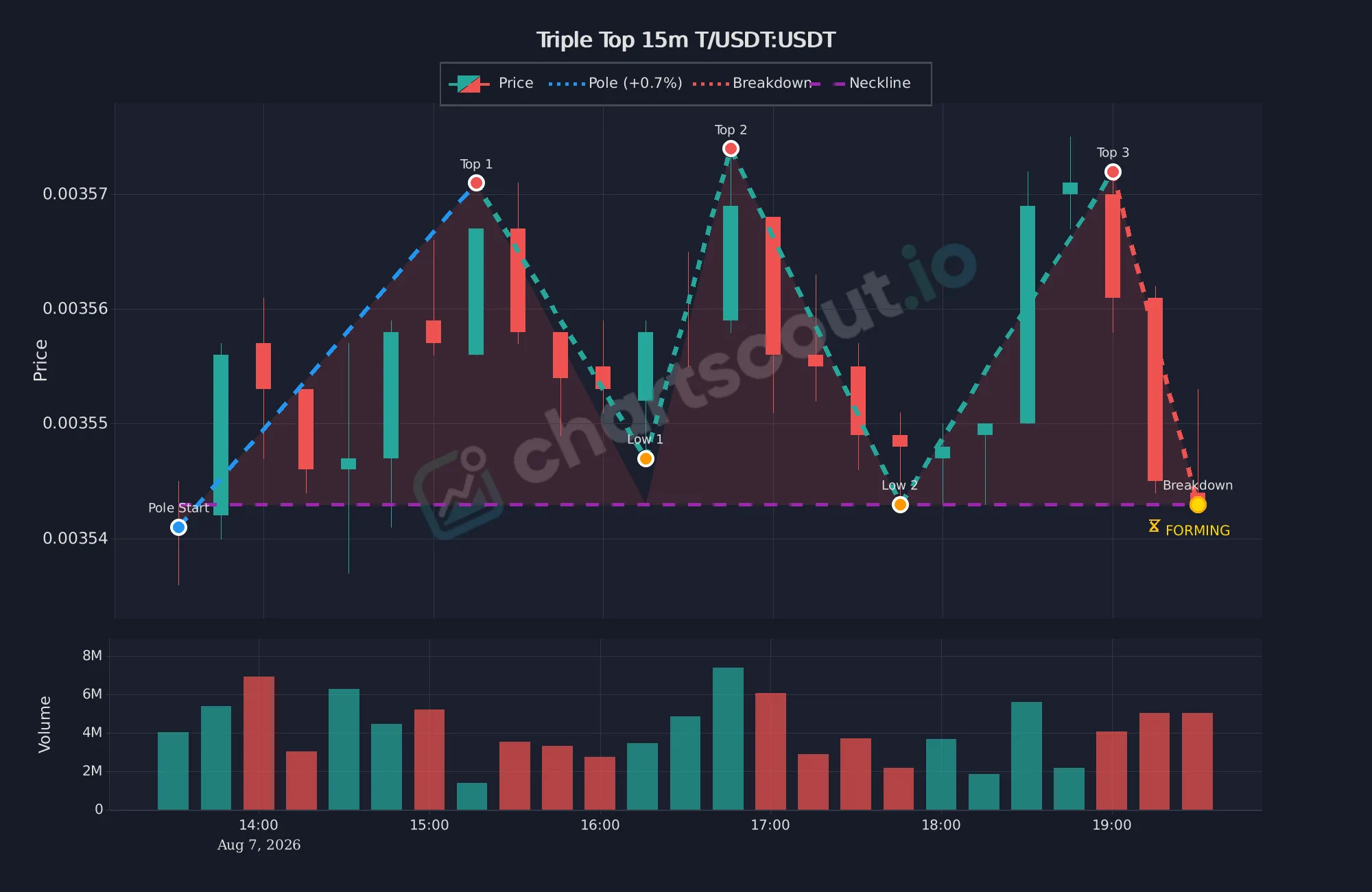
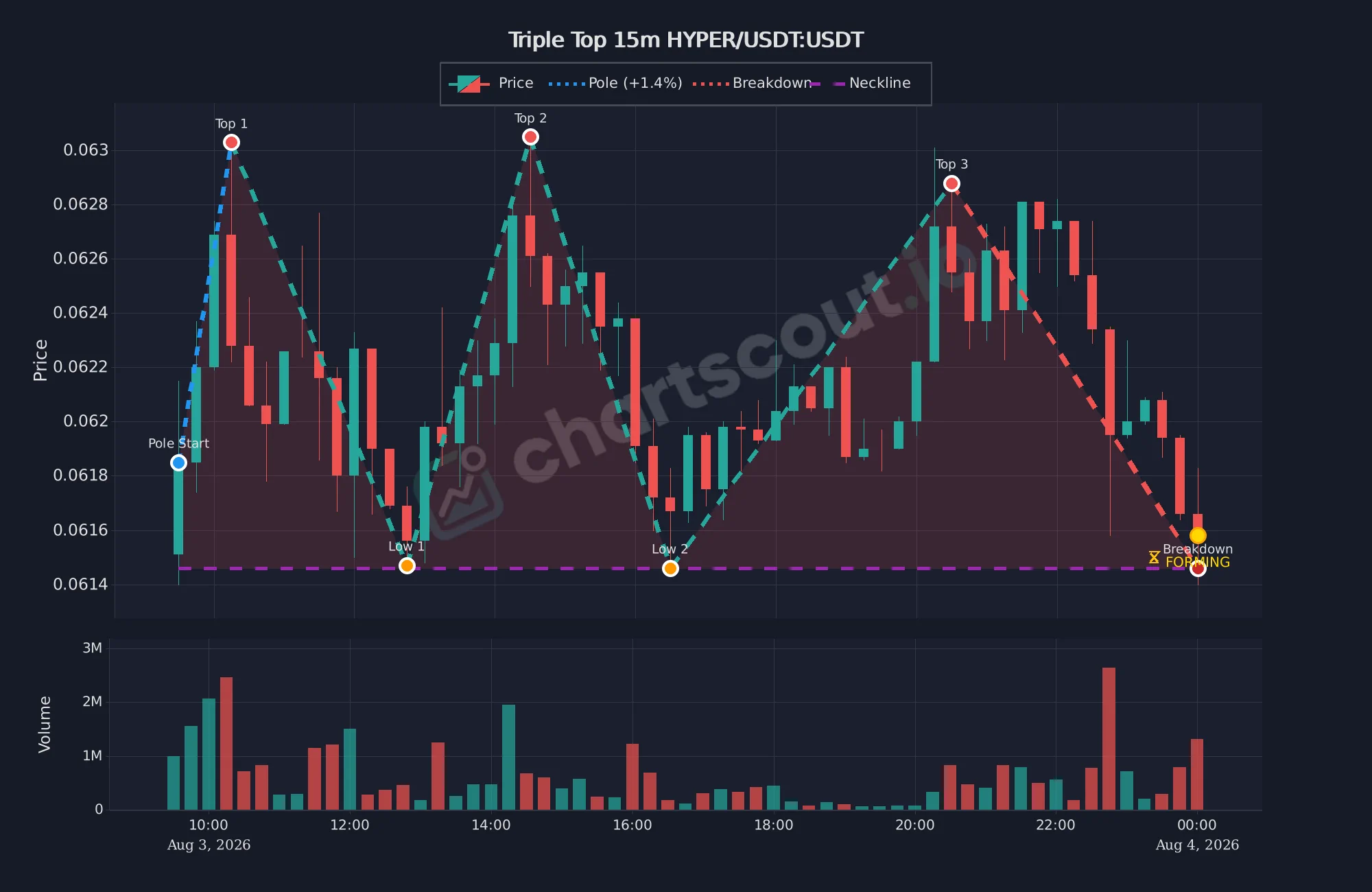
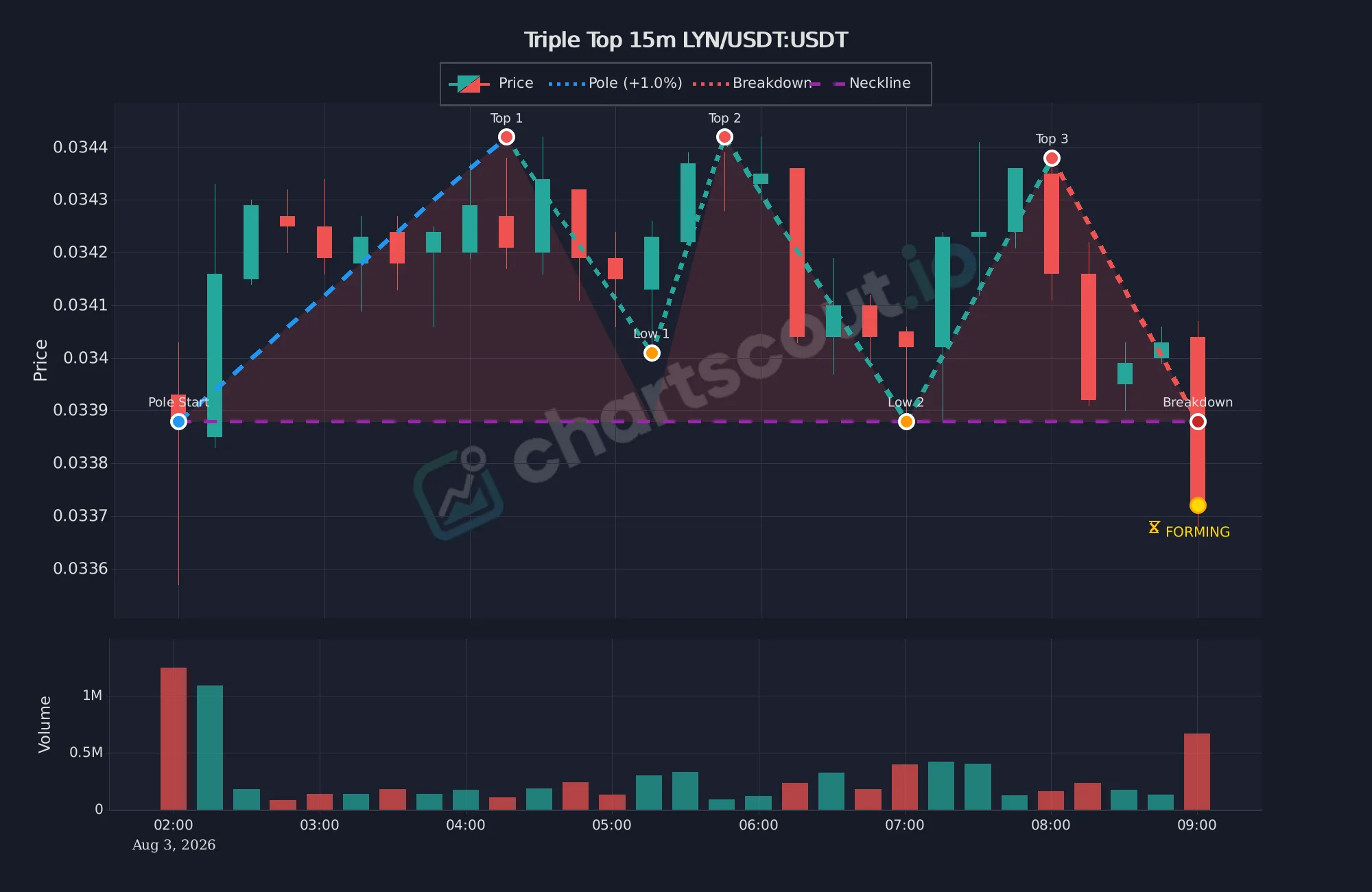
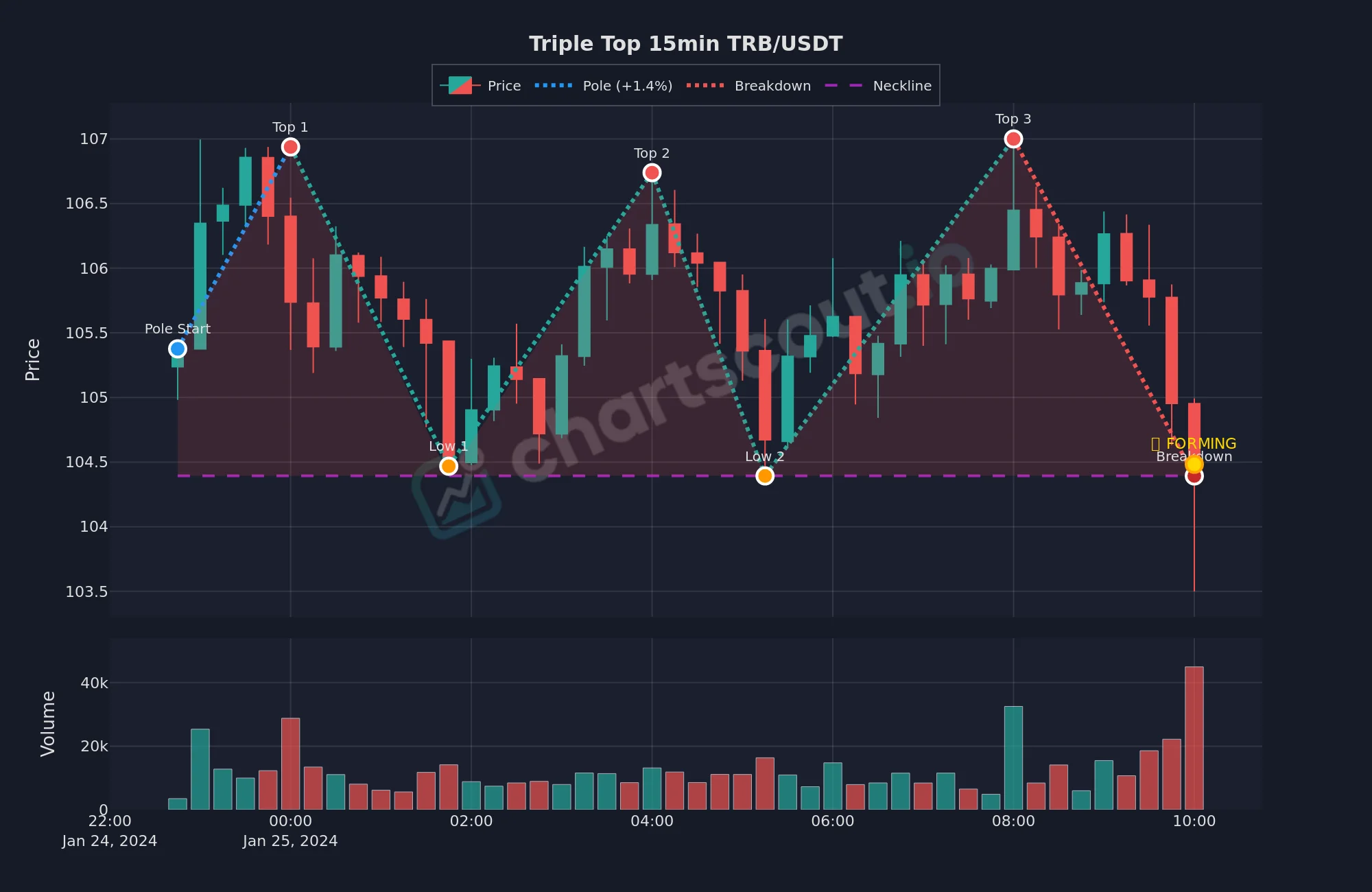
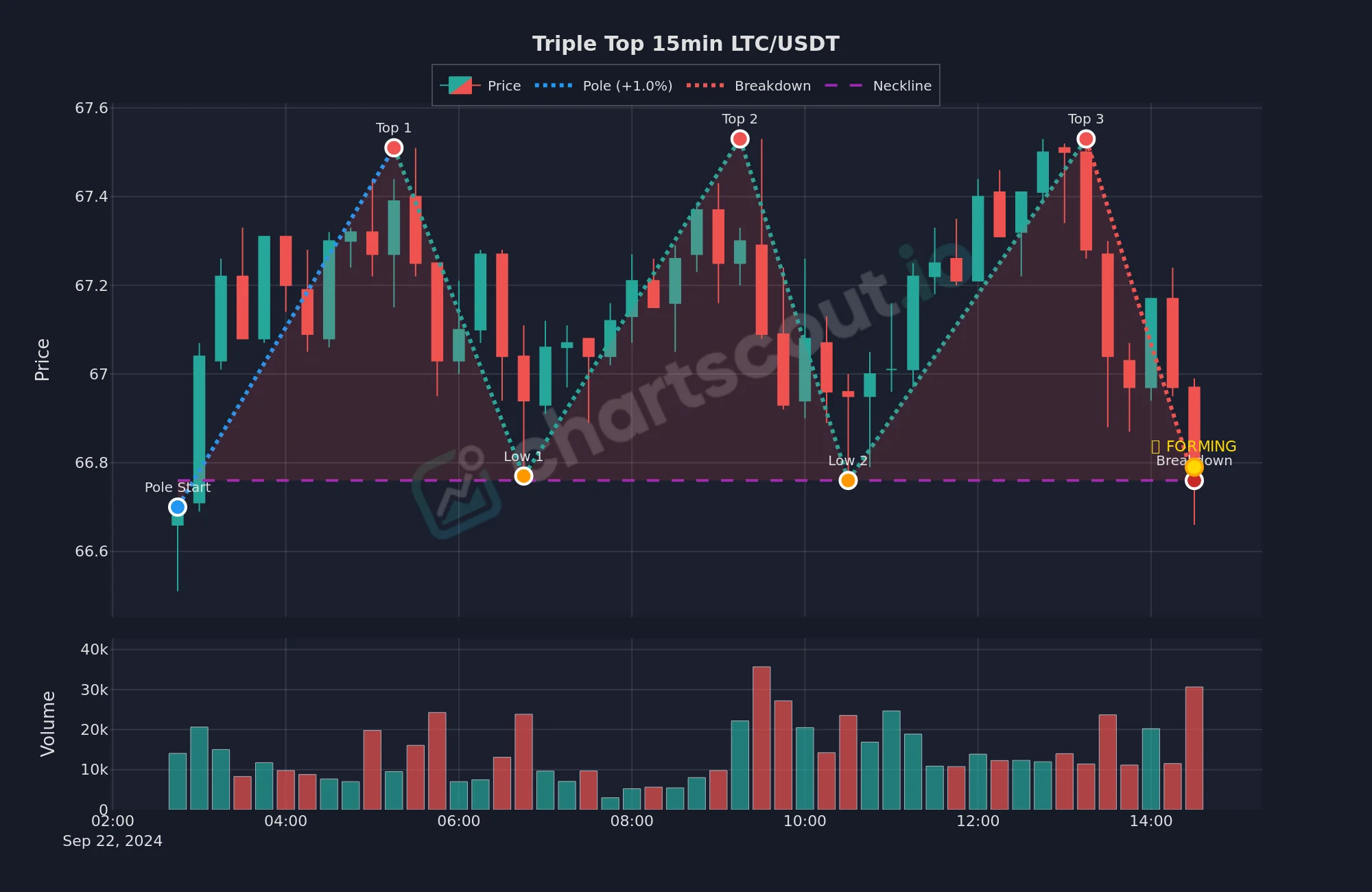
The three 15-minute examples below show the volume signature in practice. On all three, volume tapers across the peaks and then spikes hard on the breakdown candle, the expanding-volume confirmation Bulkowski calls for. Each chart is tagged “FORMING”: the three tops have printed and the confirmation breakdown is in progress, which is exactly the moment a scanner alert gives a trader time to plan levels.
How to identify a true triple top (and avoid look-alikes)
Misidentification is the biggest practical problem with triple tops. Three patterns are routinely confused for it, and each carries different statistics and a different measure rule, so the distinction directly changes the trade.
Identification checklist
- Clear upward price trend leading into the first peak
- Three distinct minor highs at approximately the same price level
- Center peak (B) does not tower above peaks A and C
- Two intervening troughs, the lower of which is the confirmation line
- Pattern duration: at least several weeks of candles on the timeframe being traded
- Volume declining during formation, expanding on the breakdown
- Breakdown confirmed by a close below the lowest intervening trough
“The three peaks in a triple top usually are sharp and pointed looking, with rounded-appearing valleys in between. There are wide variations in this pattern, so do not be too critical. Make sure the three well-separated peaks are not part of the same congestion pattern. Each top should be a part of its own minor high, a distinct peak that towers above the surrounding price landscape. The price difference between the three peaks is usually minor, with the center peak often below the other two. A large price variation should exclude the pattern from consideration.”
- Thomas N. Bulkowski, Encyclopedia of Chart Patterns, 2nd Edition, Chapter 51, “Identification Guidelines”, p. 782Look-alike 1: head and shoulders top
The most common misidentification, and the most consequential. In a triple top all three peaks form at approximately the same price. In a head and shoulders top the middle peak, the head, is materially higher than the two outer peaks, the shoulders. If the chart has a noticeably taller middle peak, it is a head and shoulders, not a triple top.
The trading implications differ. The head and shoulders measure rule projects from the height of the head above the neckline, while the triple top uses overall pattern height (highest peak minus lowest trough). Using the wrong measure rule gives the wrong target and the wrong risk-reward. As a working rule: if the middle peak is more than 3 to 5 percent higher than the outer peaks, default to head and shoulders; if all three are within 3 percent of each other, it is a triple top. The head and shoulders guide covers both the top and the inverse bottom in detail.
Look-alike 2: double top
A double top has two peaks; a triple top has three. A pattern where the third rally stalls well below the prior peaks is not a triple top, it may be a lower-high structure or a descending triangle. The three peaks of a triple top must genuinely test the same resistance. The distinction matters: every double top variant outperforms the triple top in Bulkowski's data, so if the chart could honestly be called either, the double top is the better statistical frame.
Look-alike 3: rectangle top
If price tests the same resistance four, five, or six times across a prolonged period, that is a rectangle top, not a triple top. The rectangle has different formation rules, tests on both ceiling and floor, and different trading mechanics. A triple top has three peak tests only. If you are counting more, reassign the pattern. Bulkowski also notes triple tops frequently overlap with the broadening family, so check the troughs too: if the troughs are stepping down while the peaks hold flat, you may be looking at a right-angled descending broadening top.
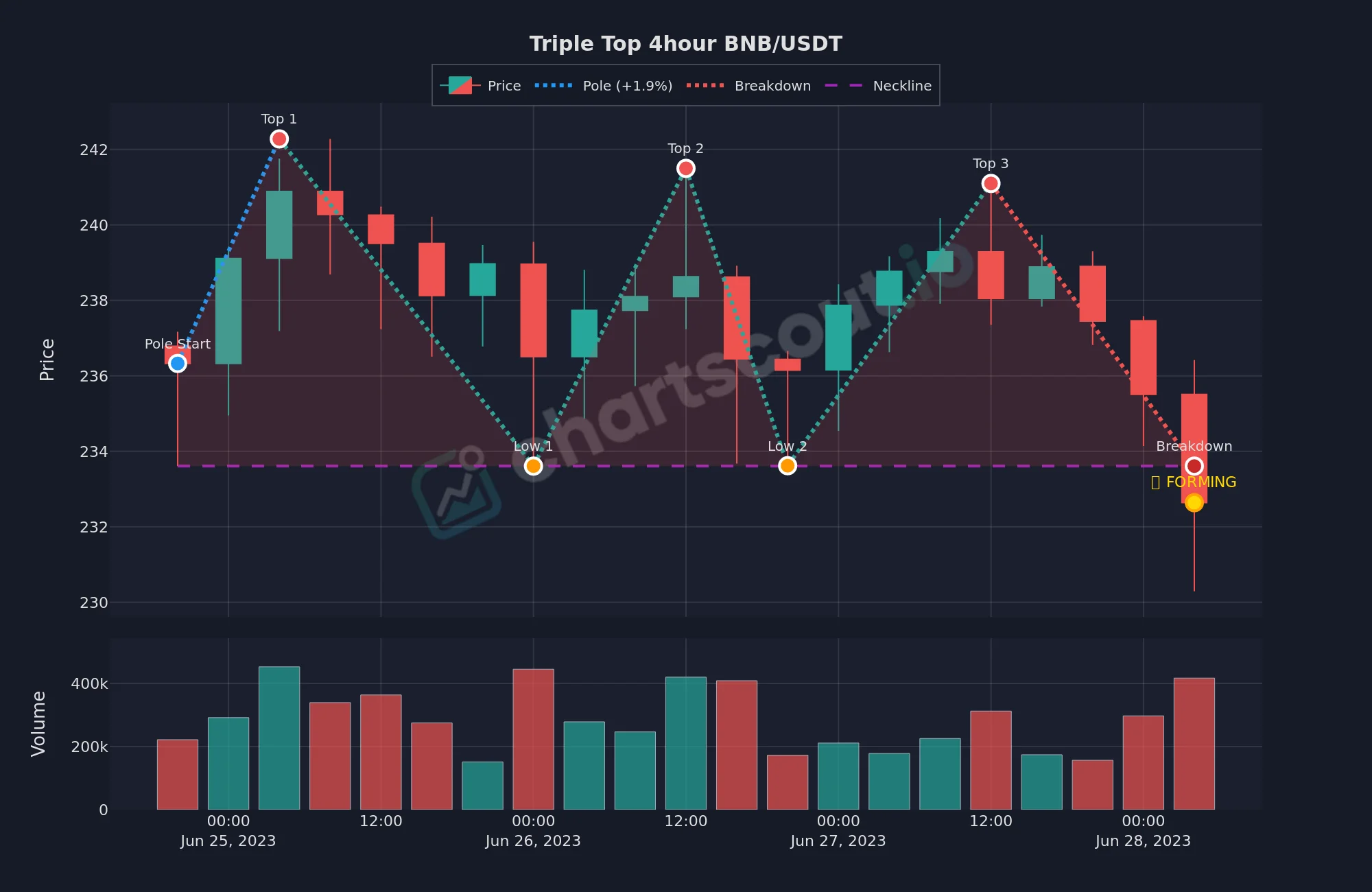
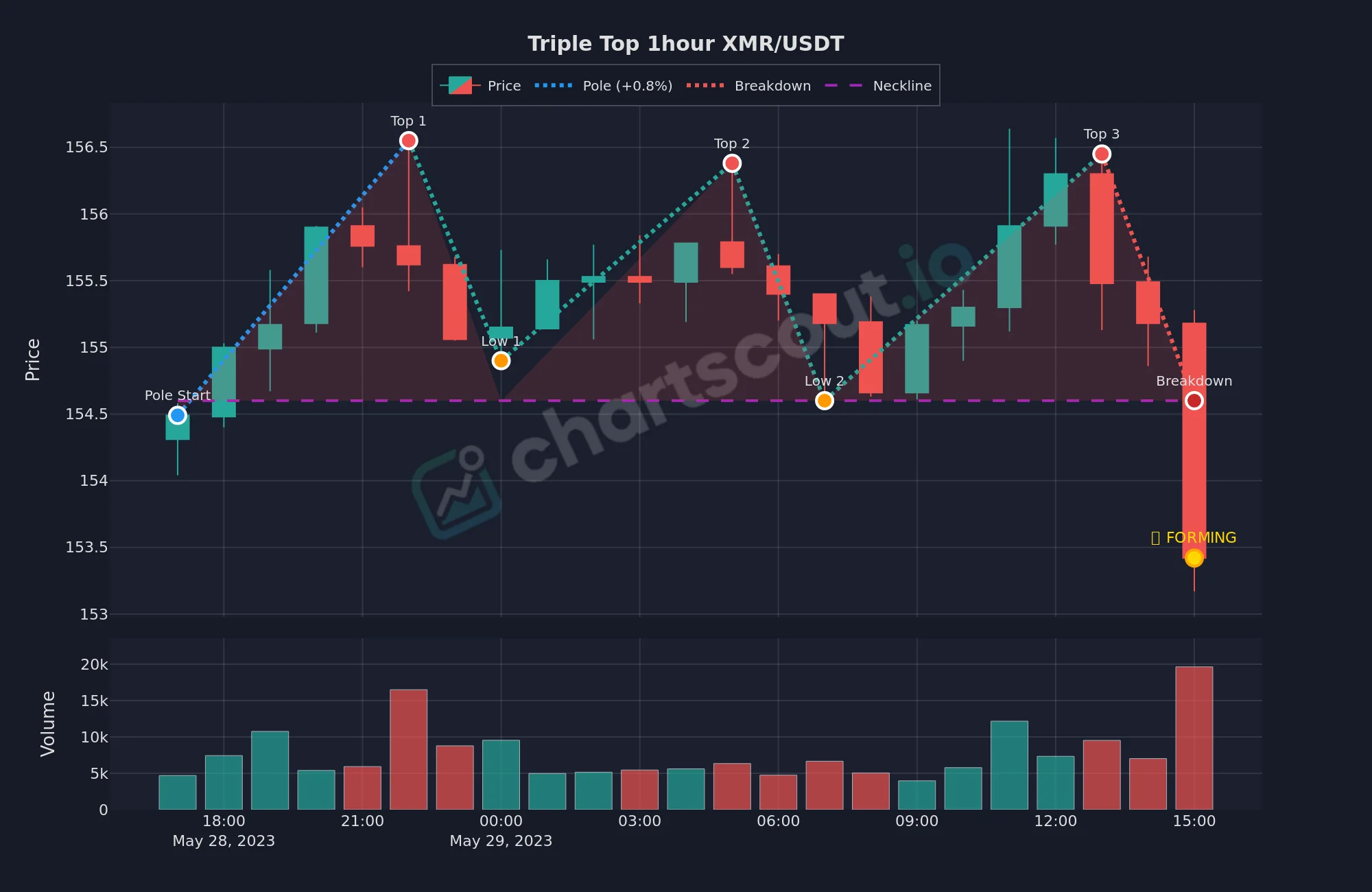
The two examples below both pass the identification checklist. On the BNB/USDT 4-hour chart the three tops cluster between $241 and $242, well within the 3% tolerance, with no towering center peak, so it is a triple top and not a head and shoulders. The XMR/USDT 1-hour chart shows the same flat-ceiling structure with the third peak coming in marginally below the first two, the bearish tell covered in the filters section.
The 49% measure rule: why your target is half what you think
The naive measured move for a triple top: take the pattern height (highest peak minus lowest trough between peaks) and project it downward from the confirmation line. That is what most guides teach, and it produces a target that Bulkowski's 1,964-trade dataset shows is reached only 49% of the time. His recommendation is to build the probability into the target.
The formula
Pattern height = Highest peak (A) - Lowest trough between peaks (B)
Target = Confirmation line (B) - (Pattern height × 0.49)
Worked example
Highest peak: $52,000
Lowest trough between peaks (confirmation line): $44,000
Pattern height: $52,000 - $44,000 = $8,000
49% of pattern height: $8,000 × 0.49 = $3,920
Target: $44,000 - $3,920 = $40,080
Compare to the naive 100% target: $44,000 - $8,000 = $36,000. The difference is $4,080, a target roughly 10% lower that gets hit only about half the time. For most setups, scaling out at or before the 49% level is the data-backed approach.
Partial targets and laddering
Given the 49% hit rate on the full target, tiered exits make more sense here than on higher-reliability patterns. TP1 at 49% of pattern height, the most defensible level. TP2 at 75% for a smaller remaining position. Trail the rest. Calculate risk-reward against TP1, not TP2, or you overstate the expected payoff.
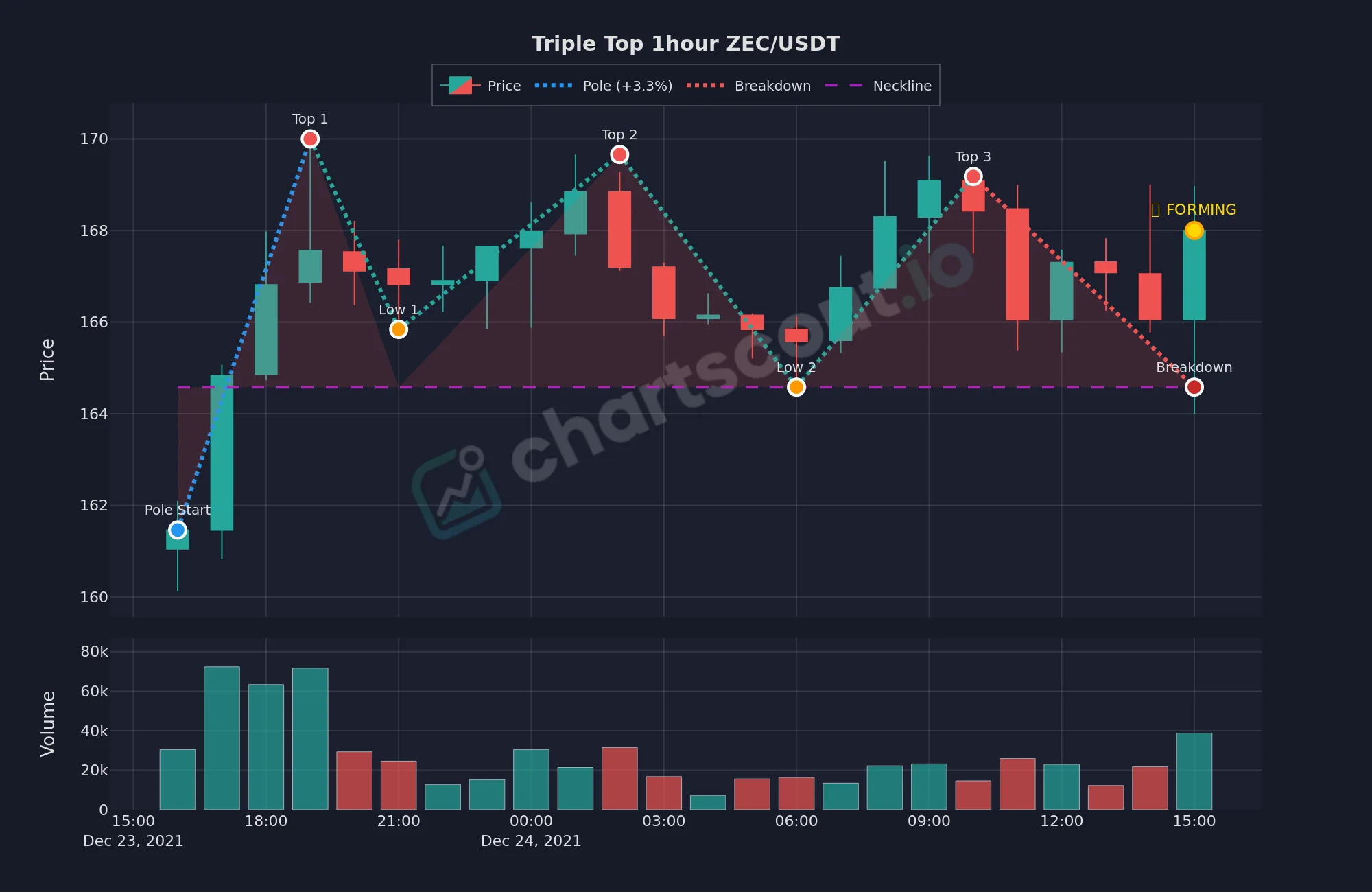
The ZEC/USDT 1-hour chart below is a clean worked example. The highest peak prints near $170 and the confirmation line, the lower of the two troughs, sits near $164.50, for a pattern height of roughly $5.50. The 49% measured-move target lands at $164.50 - ($5.50 × 0.49) = about $161.80, while the naive 100% target would sit near $159. The third peak coming in below the first is the bearish structural tell.
How to trade a triple top: entry, stop, and target
Entry
Primary entry, breakdown sell stop: place a sell stop one tick below the confirmation line, the lowest trough between the three peaks. When price closes below this level the pattern is confirmed and you are filled. If the breakdown candle gaps below the confirmation line, use the opening price of that gap candle as the entry.
Pre-confirmation entry, internal trendline: if the two intervening troughs form a rising sequence, draw an up-sloping trendline connecting them. A close below this trendline is an earlier entry signal that Bulkowski explicitly endorses, it often gets you in sooner than waiting for the close below the lowest low. Use tighter sizing if entering early, the pattern is not yet confirmed.
Pullback short entry: after confirmation, price retests the confirmation line 66% of the time. If the pullback stalls at the confirmation level and price resumes lower, that is a valid short entry, with the stop now placed just above the pullback high rather than above the full pattern. This is the lower-risk entry for traders who missed the initial breakdown.
“In a roaring bull market, triple tops are often deceiving. Three price bumps appear and price does not decline to the confirmation point before soaring. Thus, an important guideline in using triple tops is to wait for prices to close below the confirmation point.”
- Thomas N. Bulkowski, Encyclopedia of Chart Patterns, 2nd Edition, Chapter 51, “Trading Tactics”, p. 792Stop placement
Canonical stop: one tick above the highest of the three peaks (Bulkowski's equity-data instruction is $0.10 above the high). The three peaks form a resistance zone, so price will not reach the stop until that zone burns through. If price closes above the highest peak, the resistance has broken and the triple top is invalidated.
Tighter alternative: a stop above the third peak rather than the highest of all three is a reasonable compromise when the third peak is the lowest of the three, which is the highest-conviction setup filter. If C is the lowest peak, a stop above C is naturally tighter than above A or B.
Never set the stop at the exact peak high. Resistance levels are liquidity pools, and price will probe them. Give the stop at least one ATR of room above the highest peak on volatile pairs. Pattern-by-pattern stop placement is covered in the stop loss crypto trading guide.
Risk-reward check before entry
Risk = Stop price - Entry price
Reward = Entry price - Target price (49% measure rule)
R:R ratio = Reward / Risk
The triple top's statistics create a structural risk-reward challenge. With a 49% target hit rate and a 14% average decline, the canonical stop above the highest peak is often wide relative to the target. Many setups will not clear 2:1. Only trade setups where R:R is at least 1.5:1 after applying the 49% target; below that, skip or cut size hard. The triple top's below-average rank means it has to earn its place through quality filters, not be taken mechanically on every signal. The full math is in the risk-reward ratio guide.
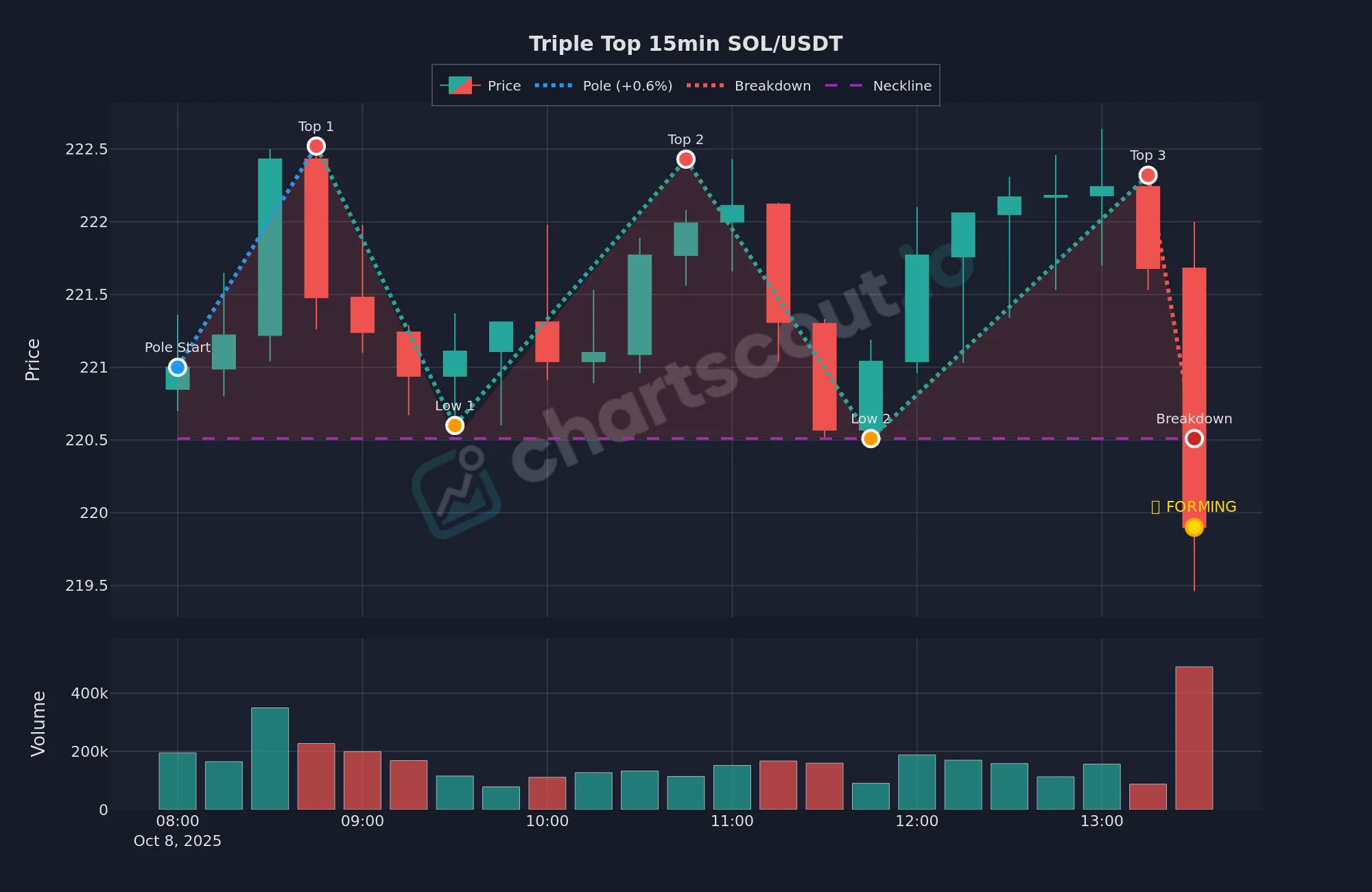
The SOL/USDT 15-minute chart below maps the trade. The three tops step down from $222.50 to $222.30, the bearish tell, and the confirmation line sits at $220.50. The sell stop goes one tick below $220.50; the protective stop goes one tick above the $222.50 high. With the breakdown candle closing on a clear volume spike, this is the high-conviction version of the setup.
Pullbacks: the 66% complication
A pullback occurs when price breaks below the confirmation line, then rallies back to retest it before resuming lower. It happens after 66% of triple top breakdowns, more often than not. This is normal post-breakout behavior, not a pattern failure. Note the terminology: on thepatternsite.com a “pullback” is the retest after a downward breakout (triple tops), while a “throwback” is the retest after an upward breakout (triple bottoms).
- Pullbacks hurt performance. Bulkowski's research shows triple tops with no pullback produce better average declines than those with one. The pullback signals a weaker breakdown, short-covering strong enough to push price back to the confirmation level before bears regain control.
- They are short-entry opportunities, not exit signals. A pullback that stalls at the confirmation line and reverses lower is a second short entry, with a tighter stop above the pullback high. Often a better entry than the initial breakdown, the risk is smaller and the signal has been tested twice.
- Watch the pullback ceiling. A close back above the confirmation line after a confirmed breakdown is a serious warning, not a “wait and see.” If price recaptures the confirmation level on a closing basis, the pattern may be failing. Treat that close as a stop-out signal.
On crypto perpetuals, pullbacks can be sharp. Short-covering by leveraged traders can push price back to the confirmation line quickly. Set the stop above the confirmation line plus a noise buffer rather than at the exact breakdown level, and size for the likelihood that two out of three breakdowns will retest before they run.
Bulkowski's setup filters for triple tops
These are the specific conditions Bulkowski identifies as improving or degrading triple top performance. Apply them as filters before committing to a trade.
Green flags (add conviction)
- Last peak lower than the middle peak. If peak C is lower than peak B, selling pressure is intensifying, bulls could not even reach the prior high on the third attempt. Bulkowski's data shows larger declines follow when the final peak is below the center peak. This is the strongest structural signal.
- Pattern in the lower third of the yearly price range. Bulkowski's updated data shows triple tops in the lowest third of the annual range perform best. A pattern at the low end of the range has less support below it, so the breakdown is more likely to extend.
- Steep, high-velocity inbound rally. Bulkowski notes high-velocity leading rises produce stronger post-breakdown declines. A sharp, fast run into the pattern carries less embedded profit-taking support beneath it than a slow grind.
- U-shaped or declining volume. Triple tops with U-shaped volume perform best, and a downward volume trend gives a minor performance edge. When volume around the last peak sits below the center peak, the pattern does better.
- Tall, narrow pattern with an expanding-volume breakdown. Tall and narrow triple tops outperform short and wide ones. A breakdown close on significantly above-average volume confirms genuine selling and reduces the chance of a failed breakdown.
Red flags (reduce size or skip)
- Short and wide formation. Short and wide triple tops are the worst-performing height-and-width combination in Bulkowski's data. A squat, sprawling three-bump shape lacks the energy of a tall, compact one.
- Pattern near yearly highs with strong momentum. The lower-third filter is the positive case; a triple top forming near yearly highs lacks that edge. The pattern is fighting an intact uptrend rather than reversing a tired one.
- Prior support just below the confirmation line. If a major support zone, a prior consolidation, or a high-volume node sits just below the confirmation line, the decline will likely stall there rather than extending to target. Map the structure below the pattern before entering.
- Low-volume breakdown. A breakdown on below-average volume is the single most important red flag. It suggests a thin, reversible move. Wait for a second, higher-volume confirmation candle before entering.
- Bear-market dead-cat bounce. Triple tops are more common in bear markets, but a pattern forming as part of a dead-cat bounce can resolve quickly without a clean, tradeable move. Check the macro context.
Triple top vs. double top: the full data comparison
The double top appears far more often than the triple top, and in every variant it outranks it. Bulkowski splits the double top into four types by the shape of the peaks, Adam (narrow, pointed) and Eve (wide, rounded). The table uses the verified thepatternsite.com figures for each.
| Pattern | Rank (1 = best) | Break-even fail | Avg decline | Pullback | Hit target |
|---|---|---|---|---|---|
| Adam & Eve double top | 10 / 36 | 21% | 16% | 64% | 54% |
| Eve & Eve double top | 12 / 36 | 20% | 16% | 65% | 43% |
| Eve & Adam double top | 16 / 36 | 21% | 15% | 64% | 55% |
| Adam & Adam double top | 19 / 36 | 25% | 15% | 64% | 64% |
| Triple top | 24 / 36 | 25% | 14% | 66% | 49% |
Source: Bulkowski, thepatternsite.com double top variant pages (aedt, eedt, eadt, aadt), statistics updated 8/26/2020, and tt.html updated 8/27/2020. Variant sample sizes: Adam & Eve 651, Eve & Eve 942, Eve & Adam 662, Adam & Adam 1,114.
Every double top variant outranks the triple top. The best, Adam & Eve at rank 10, sits 14 positions above the triple top at 24. Even Adam & Adam, the weakest double top and the one that shares the triple top's exact 25% failure rate, still ranks higher (19 vs. 24) and hits its target far more often (64% vs. 49%). If a chart could honestly be called either a double top or a triple top because the third peak is marginal, trading it as a double top is the statistically better frame.
The triple top is not a stronger version of the double top. More tests of resistance does not equal more reliability on the short side. This is the inverse of the triple bottom, where three tests of support do produce a higher target-hit rate than most double-bottom variants.
Triple top vs. head and shoulders
Both are bearish reversals with three peaks, and both are routinely confused, but the head and shoulders top (rank 9/36) substantially outperforms the triple top (rank 24/36). The structural difference is the one that decides the trade.
| Feature | Triple top | Head and shoulders top |
|---|---|---|
| Middle peak | Same height as outer peaks | Materially higher (the head) |
| Performance rank | 24 / 36 | 9 / 36 |
| Break-even failure | 25% | 19% |
| Average decline | 14% | 16% |
| Measure rule | Pattern height × 49% | Head height above the neckline |
| Frequency | Rare | More common |
A triple top with a slightly taller middle peak is not a “mini head and shoulders.” Once the middle peak is materially higher than the others, the pattern label changes, the measure rule changes, and the expected decline changes. Identify it correctly, then apply the right statistics. If the middle peak is more than 3 to 5 percent higher than the outer peaks, treat it as a head and shoulders; within 3 percent, it is a triple top.
Triple top vs. triple bottom: the asymmetry in the data
The gap between the triple top and the triple bottom is one of the clearest asymmetries in Bulkowski's pattern database. They look like mirror images. Their performance is not.
| Metric | Triple bottom | Triple top |
|---|---|---|
| Performance rank | 12 / 39 (upward) | 24 / 36 (downward) |
| Break-even failure | 13% | 25% |
| Average move | +46% rise | -14% decline |
| Throwback / pullback rate | 65% | 66% |
| Target hit rate | 74% | 49% |
| Sample size | 2,500+ | 1,964 |
The triple bottom is a top-third pattern with a 13% failure rate and a 74% target-hit rate. The triple top is a bottom-third pattern with a 25% failure rate and a 49% target-hit rate. They share an almost identical retest rate and a similar formation structure, but their outcomes are not mirrors.
The likely reasons are structural rather than mysterious. Bulkowski's dataset covers predominantly bull-market conditions, so bullish reversal patterns had macro wind at their back. Average declines (14%) run smaller than average rises (46%) across almost every chart pattern in a bull-market sample, this is a general property of the data, not specific to triples. The practical takeaway: when choosing between a triple top short and a triple bottom long of comparable visual quality, the data favors the long.
Triple top in crypto: what changes, what doesn't
Bulkowski's 1,964-trade dataset is built from US equities. Crypto carries higher volatility, 24/7 trading, fragmented liquidity, and a different participant mix. The rank order and the qualitative direction of every filter (declining peaks are bearish, lower-third setups perform better, pullbacks hurt, low-volume breakdowns are unreliable) are pattern-structure phenomena that transfer cleanly. The absolute percentages need an honest crypto adjustment.
Bulkowski baseline vs. crypto expectation
| Factor | Bulkowski baseline (stocks) | Crypto expectation |
|---|---|---|
| Pattern pace | Weeks to months on the daily chart | Same candle count, compressed wall-clock time on lower TFs |
| Average decline | 14% | Likely amplified on volatile alts, comparable on BTC/ETH |
| Break-even failure | 25% | Likely higher on 1m-15m due to fakeouts, comparable on 4h-1d |
| Volume confirmation | Single-exchange equity tape | Fragmented across 4+ exchanges, wash-trading on low-volume alts |
| Pullback rate | 66% | Likely similar, but leveraged perps create sharper short-covering retests |
| Gap risk | Overnight and weekend gaps in stocks | 24/7 trading, but weekend liquidity drops cause fakeouts |
| Participant mix | Institutional-dominated | Retail-dominated alts, sharper and more emotional moves |
Honest framing
No crypto-wide triple top study with a sample size comparable to Bulkowski's 1,964 trades has been published. ChartScout maintains its own crypto detection dataset and a forthcoming crypto-specific study, but until that publishes, treat the Bulkowski numbers as a relative reliability ranking, not exact crypto predictions. Specific crypto reliability percentages quoted on third-party sites are unsourced extrapolations, not measured results.
Leverage and liquidations
On Binance, Bybit, KuCoin, or Hyperliquid perps, a confirmed triple top breakdown can trigger cascading long liquidations that produce a sharper, faster drop than in equities. That accelerates the move, but it also raises the odds of a sharp short-covering pullback once the initial flush exhausts.
Funding rates as a confirmation filter
A triple top forming while perpetual funding rates are highly positive (longs paying shorts) is a higher-quality short setup than one with neutral or negative funding. Highly positive funding means the market is leaning long, and the unwind of those crowded positions amplifies the breakdown.
Timeframe and liquidity
Below the 1-hour chart, triple tops carry materially higher false-breakdown rates. The 4-hour and daily timeframes produce the cleanest signals; on majors like BTC, ETH, and SOL the 1-hour is workable. On thin pairs with sub-$2M daily volume on MEXC or KuCoin, a triple top can produce a sharp breakdown followed by immediate recovery when a single large buyer absorbs the sell side. Volume confirmation is non-negotiable on low-liquidity pairs. How to spot fake breakouts in crypto covers the volume, retest, and order-book filters that screen out false triple top signals.
Same pattern, two timeframes
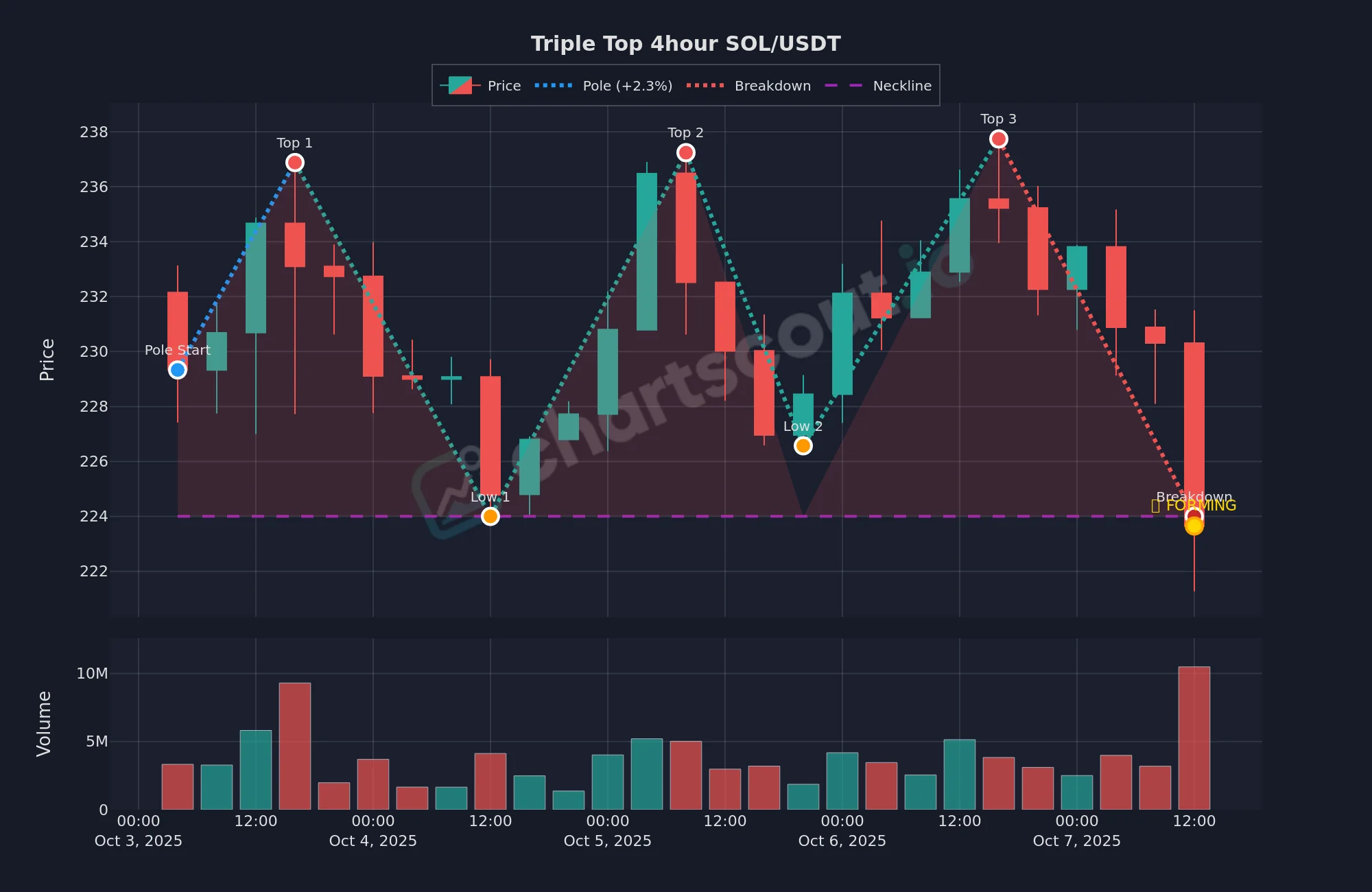
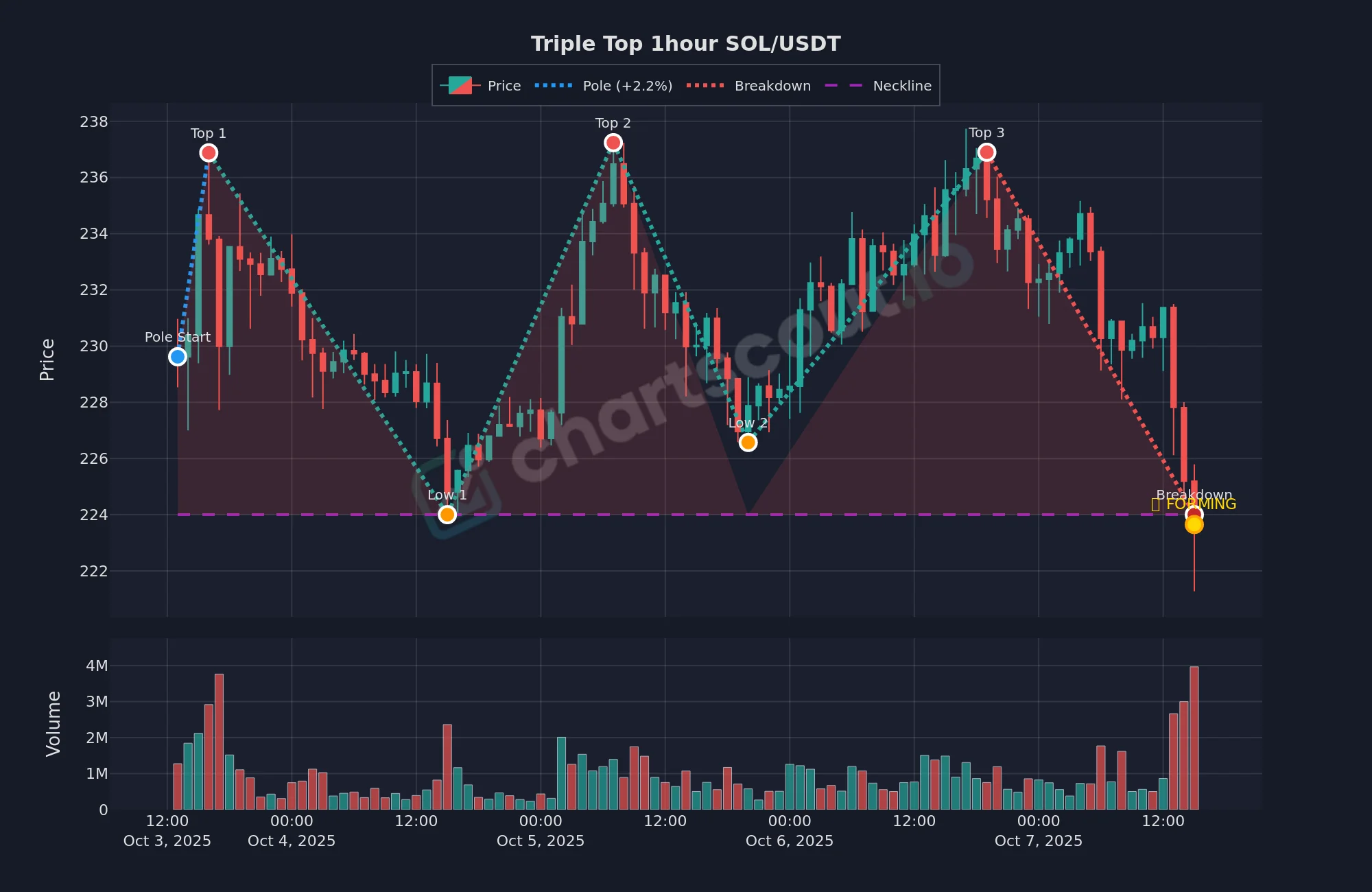
The two charts below are the same SOL/USDT triple top from early October 2025, viewed on the 4-hour and the 1-hour timeframe. The three tops near $236 and the confirmation line near $224 are identical, the 1-hour chart simply prints more candles for the same calendar window. The 4-hour read is the cleaner swing signal; the 1-hour gives an earlier, noisier look at the same structure.
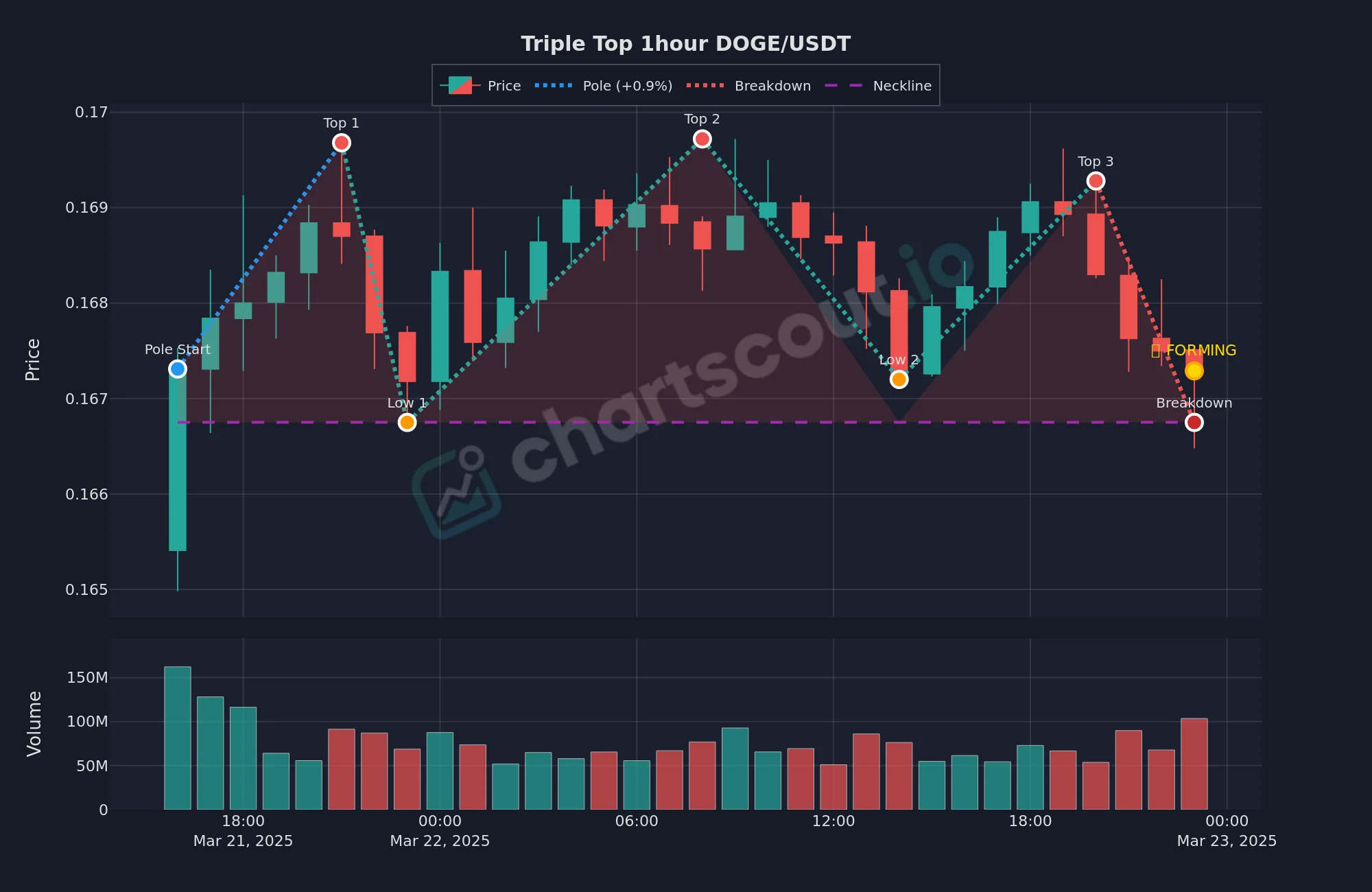
The triple top prints across the whole crypto universe, majors and alts, at every timeframe. The three detections below span TRB, LTC, and DOGE, from 15-minute scalp setups to 1-hour swings, each with the same flat-ceiling structure: three tops at a shared resistance, two troughs, and a confirmation breakdown.
Common mistakes
Using the 100% measured-move target
The full projected height is reached only 49% of the time. Use 49% of pattern height as the primary target, not 100%. Holding through a target that gets missed more than half the time is a systematic way to give back gains.
Quoting the old 10% failure rate
The 10% figure is from Bulkowski's 2005 Encyclopedia. His own 2020 update revised it to 25% on a larger sample. Size the triple top for the 25% reality, not the superseded number.
Confusing it with head and shoulders
If the middle peak is materially higher than the outer peaks, the pattern is a head and shoulders top (rank 9/36), not a triple top (rank 24/36). The measure rule, expected decline, and filters are all different.
Entering before confirmation
A potential triple top is not a confirmed triple top until price closes below the lowest trough. Shorting during the third peak is betting on a reversal that Bulkowski notes often does not happen.
Ignoring the failure rate
A 25% break-even failure rate means one in four confirmed triple tops produces no meaningful decline. Position size should reflect that, smaller than a head and shoulders or double top of equivalent visual quality.
Treating a pullback as a signal to cover
A 66% pullback to the confirmation line is normal post-breakdown behavior. Covering on the retest, before the move develops, is the most common way to leave money behind on a triple top that eventually works.
Not checking what is below
The measured-move target is a projection. If a major support zone or high-volume node sits between the confirmation line and the target, the decline will stall there. Map the structure below the pattern before entering.
Sizing it like a triple bottom
The triple bottom's 13% failure and 74% target hit justify larger positions. The triple top's 25% and 49% do not. They look like mirrors; the performance data is not symmetric.
Get real-time triple top alerts
ChartScout scans 1,000+ pairs across Binance, Bybit, KuCoin, MEXC, and Hyperliquid continuously, 24/7. Triple top alerts fire at the formation maturity point, before the breakdown confirms, via Discord, Telegram, or email in under 20 seconds. No API keys required, so you have time to calculate levels rather than react.
Start 7-day Pro trial→Set up your first triple top watcher in under 2 minutes.
Frequently asked questions
Is the triple top pattern bullish or bearish?
Bearish. The triple top is a reversal pattern that forms after an uptrend. When price closes below the confirmation line (the lowest trough between the three peaks), it signals that buying pressure has been exhausted and sellers have taken control.
What is the success rate of the triple top pattern?
Bulkowski's updated 1,964-trade study shows a 25% break-even failure rate, meaning 1 in 4 confirmed triple tops fails to produce a material decline. The measured-move target is hit only 49% of the time. Average decline across all breakdowns is 14%. Source: thepatternsite.com, updated 8/27/2020.
Is a triple top more reliable than a double top?
No. In Bulkowski's updated data every double top variant outranks the triple top. Adam & Eve ranks 10/36, Eve & Eve 12/36, Eve & Adam 16/36, Adam & Adam 19/36. The triple top ranks 24/36. More tests of resistance does not equal more reliability on the short side.
How is a triple top different from a head and shoulders?
Both are bearish reversals with three peaks. In a triple top all three peaks form at approximately the same price. In a head and shoulders top the middle peak (the head) is materially higher than the outer peaks (the shoulders). If the middle peak is more than 3 to 5 percent higher than the others, it is a head and shoulders.
How do you confirm a triple top?
The pattern is confirmed when price closes below the lowest trough between the three peaks. That trough is the confirmation line. Volume should expand on the breakdown candle. A downward gap that closes below the confirmation line also counts as confirmation.
Where do you place a stop-loss on a triple top?
Place the stop one tick above the highest of the three peaks. The three peaks form a resistance zone, so price will not reach the stop until that zone breaks. On volatile crypto pairs, add at least one ATR of buffer above the highest peak to avoid being stopped out by noise.
How do you calculate the price target for a triple top?
Use Bulkowski's 49% measure rule: Target = Confirmation line - ((Highest peak - Lowest trough between peaks) x 0.49). The 49% multiplier reflects the actual probability that the full measured move gets hit. The naive 100% target gets reached less than half the time.
What does a pullback mean on a triple top?
A pullback is when price breaks below the confirmation line and then rallies back to retest it before resuming lower. It happens after 66% of triple top breakdowns. A pullback that stalls at the confirmation line and resumes lower is a valid short re-entry. A close back above the line is a warning the pattern may be failing.
How does the triple top compare to the triple bottom?
They share a similar pullback rate (around 65 to 66%) and a similar structure, but the performance data is not symmetric. Triple bottom ranks 12/39 with a 13% failure rate, 46% average rise, and 74% target hit. Triple top ranks 24/36 with a 25% failure rate, 14% average decline, and 49% target hit.
Can I scan for triple tops automatically in crypto?
Yes. ChartScout scans 1,000+ pairs across Binance, Bybit, KuCoin, MEXC, and Hyperliquid for triple tops and the rest of its 23-detector library continuously, 24/7. Alerts fire at the formation maturity point, before the breakdown confirms, via Discord, Telegram, or email in under 20 seconds.
Sources & references
Data source note: Break-even failure rates, average declines, pullback rates, target-hit percentages, and rankings come from Thomas Bulkowski's most recent published statistics at thepatternsite.com (triple top data updated 8/27/2020, double top variant pages updated 8/26/2020). The triple top dataset is 1,964 perfect trades in US equities. The older 10% failure rate cited in this guide is from the 2005 2nd-edition Encyclopedia and has been superseded by the 2020 figures. Crypto markets may differ in absolute magnitude; the rank order and qualitative direction of effects are likely to hold.
- Bulkowski, Thomas N. ThePatternSite.com - Triple Tops. Statistics updated 8/27/2020. thepatternsite.com/tt.html.
Primary statistical source. Triple top: rank 24/36, 25% break-even failure, 14% average decline, 66% pullback, 49% target hit, 1,964 perfect trades. Also the measure rule, the volume trend, the lower-third yearly-range filter, and the declining-final-peak filter. - Bulkowski, Thomas N. ThePatternSite.com - Double Top variant pages. Statistics updated 8/26/2020. Adam & Eve (aedt.html), Eve & Eve (eedt.html), Eve & Adam (eadt.html), Adam & Adam (aadt.html).
Source for the four-variant double top comparison table: ranks 10, 12, 16, and 19 of 36, with failure rates, declines, pullbacks, and target-hit rates per variant. - Bulkowski, Thomas N. Encyclopedia of Chart Patterns, 2nd Edition. John Wiley & Sons, 2005. ISBN: 978-0471668268.
Chapter 51, “Triple Tops”, p. 779-794. Source for the verbatim quotes on the superseded 10% failure rate (“Focus on Failures”, p. 784), the identification guidelines (“Same price”, p. 782), and the wait-for-confirmation trading tactic (p. 792). - Bulkowski, Thomas N. Encyclopedia of Chart Patterns, 3rd Edition. John Wiley & Sons, 2021. ISBN: 978-1119739685.
Print companion to the updated thepatternsite.com data. Cited for the four-variant double top taxonomy (Adam & Adam, Adam & Eve, Eve & Adam, Eve & Eve) used in the comparison table. - Edwards, Robert D., John Magee & W.H.C. Bassetti. Technical Analysis of Stock Trends, 9th Edition. CRC Press, 2007. ISBN: 978-0849337222.
Chapter 9, “Triple Tops and Bottoms”, p. 146. Source for the verbatim “true Triple Top” family-resemblance passage and the declining-volume signature across the three successive peaks.
Related guides
Triple bottom pattern
The bullish mirror: rank 12/39, 13% failure, 46% average rise, 74% target hit. Significantly more reliable than the triple top.
Head and shoulders pattern
The higher-ranked bearish reversal (9/36) most often confused with the triple top. Covers the top and the inverse bottom.
Double top (M pattern)
Every double top variant outperforms the triple top. Know when you are actually looking at a double.
How to spot fake breakouts
Volume, retest, and order-book filters to manage the 25% failure rate and 66% pullback risk.
Stop loss placement guide
Pattern-by-pattern stop placement for all 23 ChartScout detectors, including the triple top canonical stop.
Risk reward ratio per chart pattern
Pattern-specific R:R math and the half-target rule applied to the triple top 49% target.
Chart patterns & volume analysis
Volume confirmation rules for breakdowns across the major chart patterns.
Crypto chart patterns cheat sheet
all 23 ChartScout detectors with Bulkowski break-even rates, volume rules, and 5m to 4h playbooks.

Stjepan Ivanović
Founder of ChartScout · Crypto Trader Since 2013
Trading crypto since 2013 with his first Bitcoin bought at ~$200. Four complete bull/bear market cycles, traded on early exchanges like Mt.Gox and BTC-e, on-chain trading on IDEX and EtherDelta, and ~70 crypto project investments. Built ChartScout after 23+ months of development to automate what no trader can do manually. Watch hundreds of charts 24/7.