Bull pennant pattern in crypto: 54% failure rate (2026)
A bull pennant is a brief converging-triangle consolidation inside an uptrend that resolves with another leg higher: a steep flagpole up, a tight pennant of converging lines, then a breakout above the upper trendline. Per Bulkowski's updated 1,600-trade sample, 57% break upward, 54% of those breakouts fail to clear 5%, and only 35% reach the full measured-move target. The continuation edge is real, but the “guaranteed continuation” framing on most YouTube charts overstates it by a factor of two. This guide uses the current Bulkowski numbers, candle-count durations that work on 5-minute crypto charts, and the volume rules that separate the 46% of pennants that pay from the 54% that do not.
Thomas Bulkowski classifies the pennant as a short-term continuation pattern. The bull pennant is its bullish variant: a market exhaling after a violent rally. Buyers take a breath, sellers take partial profits, and momentum is supposed to resume. At least, that is the theory. The numbers are more sober than the theory. Per Bulkowski's current data at thepatternsite.com (updated 8/27/2020, 1,600+ perfect trades), pennants break upward 57% of the time. Of those upward breakouts, 54% fail to clear the 5% break-even threshold. Only 35% reach the full flagpole-height target. That is the real statistical baseline.
What confuses most readers is the gap between Bulkowski's pennant data and the pennant lore that came before him. Richard Schabacker introduced flag and pennant terminology in 1932 and described both as “reliable” continuation patterns. Edwards and Magee echoed that framing across multiple editions of Technical Analysis of Stock Trends from 1948 onward. Their reputation as near-sure-thing continuations stuck, even after Bulkowski's sample-driven research showed the actual numbers are mediocre. Stack the 43% wrong-way breakout rate on top of the 54% break-even failure on the upside, and roughly one in four bull pennant longs produces a move worth trading. Selectivity is not optional - it is the entire edge.
What makes the pattern especially relevant for crypto is how 24/7 trading, perpetual-futures leverage, and short-squeeze cascades distort the stock-market baseline in the bull's favour. Flagpoles that take days in equities develop in hours in crypto. Breakouts that average 7% in Bulkowski's stock data can produce 15-25% moves on volatile altcoins when shorts get liquidated and a fresh wave of FOMO enters. This guide covers identification, psychology, the real statistics, entry and stop rules, the half-staff measure, and crypto-specific adjustments, using Bulkowski's actual numbers, Pring's volume framework, Murphy's duration rules, and live ChartScout detections from the past week across six different crypto pairs.
A note on data sources and what the numbers actually mean
All headline statistics come from Thomas Bulkowski's most recent published figures at thepatternsite.com (updated 8/27/2020, 1,600+ perfect trades). The volume framework comes from Martin Pring. The duration guideline comes from John Murphy. The historical context for flag and pennant patterns comes from Richard Schabacker (1932) and Edwards and Magee. Every chart example in this guide is a real ChartScout detection captured directly from the production scanner; the examples span April 19-25 and August 7-8, 2026. One nuance that trips up most readers: pennant performance is measured on the short-term price swing (trend start to trend end), not the breakout-to-ultimate-high metric used for most chart patterns. That is why the 7% average rise here looks tiny next to ascending triangle's 43%. The two figures measure different things.
Sample: 1,600+ perfect trades. Volume declines during formation in 86% of cases. Performance is measured on the short-term price swing (start of inbound trend to end of outbound trend), not breakout-to-ultimate-high.
Data notice: All statistics are derived from stock market data. No crypto-wide bull pennant study exists with a comparable sample size. Crypto's 24/7 trading, higher volatility, and short-squeeze follow-through can shift both success rates and average moves, so treat Bulkowski's figures as a relative reliability ranking rather than exact crypto predictions. ChartScout is running a proprietary crypto backtest and will publish crypto-specific figures when the study is complete. Where we reference Bulkowski's earlier book research (Encyclopedia of Chart Patterns, 2nd Edition, 2005), we note it clearly.

What is a bull pennant pattern?
Martin Pring characterizes pennants as very small triangles in which volume tends to contract even more during formation than it does inside a flag. That contracting-volume signature is the defining behavioural tell.
A bull pennant is a short-term continuation pattern that forms after a sharp price advance. It signals that aggressive buying is pausing, not reversing, before the uptrend resumes. Think of it as a brief equilibrium zone where profit-taking from early longs and dip-buying from new entrants compress price into an increasingly narrow range, until one side overwhelms the other and the prevailing trend resumes.
The four essential components
Every valid bull pennant contains these four elements. Miss one and you are probably looking at a different pattern.
- Flagpole (the rally). A steep, near-vertical price advance lasting several candles. This is the defining characteristic. Without a sharp aggressive rally preceding it, you do not have a bull pennant. The flagpole represents genuine momentum buying, short-covering, or a major positive catalyst (earnings, listing, partnership, macro news).
- Pennant body (the compression). After the sharp rally, price consolidates between two converging trendlines forming a small symmetrical triangle. The upper trendline slopes downward; the lower slopes upward. The range narrows as the battle between profit-takers and new buyers compresses into an increasingly tight zone.
- Duration. The standard guideline across the technical-analysis literature is that flags and pennants complete within 1 to 3 weeks on a daily chart, roughly 15 candles on any timeframe. Anything longer is reclassified as a rectangle, channel, or symmetrical triangle. In crypto, bull pennants often resolve in days or hours during sharp rallies.
- Volume profile. Volume declines during the pennant's formation. Bulkowski's data shows volume trends downward in 86% of pennant formations. During a bull pennant this decline is constructive: it means selling pressure is drying up, setting the stage for buyers to reassert control on a fresh volume spike at the breakout.


SPCX/USDC and AUCTION/USDT were pulled from the August 8 2026 detection set. These are market examples, not evidence of a profitable trading edge.
The psychology behind a bull pennant
The bull pennant captures a specific psychological sequence that repeats across every market and every timeframe. Understanding the sequence is what lets you read the pattern as a story rather than a shape.
Phase 1: Euphoria (the flagpole)
A catalyst triggers aggressive buying. Momentum traders, breakout traders, and FOMO buyers all enter simultaneously. Volume spikes and price moves almost vertically. In crypto, this phase is amplified by perpetual-futures leverage, short liquidations, and social-media reflexivity. The flagpole is the visible signature of that euphoria.
Phase 2: Profit-taking (the pennant body)
The initial wave of buying exhausts itself. Early buyers take profits. Short-term traders exit. Price pulls back, but it does not collapse - each wave of selling is met by buyers at incrementally higher lows, and each rally attempt is capped by sellers at incrementally lower highs. The range narrows. This is the battle zone. The tightening signals that selling pressure is drying up while patient buyers continue to absorb each dip.
Phase 3: Resolution (the breakout)
The compression resolves. In a bull pennant the resolution should be upward: buyers overwhelm the remaining sellers, and the trend resumes with a sharp volume spike on the breakout candle. In crypto, where leverage amplifies everything, a breakout above the upper trendline often triggers stop-losses on short positions, margin calls, and a fresh wave of FOMO entries. That is why the same pattern that produces a 5-7% move on stocks can produce 15-25% on a mid-cap altcoin.
“A pennant is in effect a very small triangle. If anything, volume tends to contract even more during the formation of a pennant than during that of a flag.”
- Martin J. Pring, Technical Analysis Explained, 5th Edition
The statistics: what 1,600+ trades reveal
Bulkowski's pennant page at thepatternsite.com is the most cited statistical study of the pattern, drawn from over 1,600 perfect trades. Read these numbers carefully because most published pennant content quotes the older, more flattering figures from the first edition of Encyclopedia of Chart Patterns (2000). The 2020 update is significantly less rosy.
| Metric | Value | What it means |
|---|---|---|
| Sample size | 1,600+ trades | Updated 8/27/2020 |
| Upward breakout rate | 57% | The other 43% break the wrong way |
| Break-even failure (up) | 54% | Of upward breakouts, 54% fail to clear 5% |
| Average rise (up) | 7% | Short-term swing measure, not breakout-to-ultimate-high |
| Price target met (up) | 35% | Full flagpole projection achieved |
| Volume trend down | 86% | Single most reliable diagnostic |
| Half-staff hit rate | ~30% | Trend after pennant equals or exceeds inbound trend in only 30% of cases |
Why the 7% average rise is misleading
That 7% number looks dismal next to the 43% average rise on ascending triangles or the 38% on inverse head and shoulders. The comparison is unfair. Pennant performance is measured on the short-term price swing only - from the start of the inbound trend to the end of the outbound trend. Most other patterns are measured from breakout to ultimate high, which can run for months or years. You are looking at two different measurement windows. A 7% short-term swing per pennant is not equivalent to a 7% multi-month run. The pennant is doing exactly what it is supposed to do: capturing a brief continuation move inside a larger trend.
The Bulkowski-vs-crypto comparison
| Factor | Bulkowski baseline (stocks) | Crypto expectation |
|---|---|---|
| Pattern pace | 1-3 weeks on daily | Same candle count, compressed wall-clock time. Hours on 5m-15m, days on 1h-4h |
| Average rise | 7% | Likely amplified on volatile alts (short-squeeze cascades), comparable on BTC/ETH |
| Failure rate | 54% break-even failure | Likely higher on 1m-15m due to liquidity-driven fakeouts, comparable on 4h-1d |
| Volume confirmation | Single-exchange tape | Fragmented across 4+ exchanges, with wash-trading on low-volume alts |
| Throwback rate | Comparable to flags | Likely similar, but leveraged perps create deeper liquidation-driven throwbacks before continuation |
| Gap risk | Overnight / weekend gaps | 24/7 trading eliminates gaps, but weekend liquidity drops cause clean-looking fakeouts |
| Participant mix | Institutional-dominated | Retail-dominated alts, sharper and more emotional moves on news catalysts |
Honest framing: the crypto column above is qualitative, not quantitative. No published crypto-wide pennant study exists with a sample size comparable to Bulkowski's. Treat his stock-market figures as a relative reliability ranking, not exact crypto predictions. ChartScout has a proprietary crypto backtest in progress and will publish the numbers when the study is complete. Until then, the rule is: same structural logic, qualitatively amplified moves, qualitatively higher noise on the lowest timeframes.
How to identify a bull pennant
Bulkowski provides clear identification guidelines that separate valid pennants from random consolidation. The rules are deceptively simple. Most failed pennant trades are not failures of the pattern - they are failures of pattern identification.
| Characteristic | What to look for |
|---|---|
| Prior trend | Steep, near-vertical price rise (the flagpole) |
| Shape | Small symmetrical triangle with converging trendlines |
| Trendlines | Lower highs and higher lows converging to a point |
| Duration | 3 weeks or less on daily, ~15 candles on any timeframe |
| Flagpole | Unusually steep, lasting several candles, on heavy volume |
| Volume | Declining during formation (86% of cases) |
| Breakout direction | Upward 57% of the time |
Candle-count duration on every ChartScout timeframe
The Bulkowski / Murphy duration rule (1-3 weeks on daily) is really a candle-count rule. A 15-candle pattern is a pennant whether those candles are 1-minute or 1-day. Use this table to translate:
| Timeframe | 15-candle pattern duration | Practical use |
|---|---|---|
| 1m | ~15 minutes | Scalping, highest noise |
| 5m | ~1-1.5 hours | Intraday scalping / day trading |
| 15m | ~4 hours | Day trading sweet spot |
| 1h | ~15 hours (~0.5-1 day) | Intraday / overnight swing |
| 4h | ~2-3 days | Multi-day swing |
| 1d | ~3 weeks | Swing / position |
| 1w | ~3-4 months | Position (rare on alts) |
Common identification mistakes
- No flagpole. The most common error. A consolidation without a preceding sharp rally is not a pennant - it is a symmetrical triangle. The flagpole is what distinguishes the pennant from every other converging-trendline pattern. If the prior advance is gradual, it is the wrong pattern.
- Too large. Pennants are small. If the pattern spans more than 3 weeks on daily (or more than ~15 candles on any timeframe), it is no longer a pennant by definition. Trade it as a symmetrical triangle instead.
- Confusing with wedges. In a pennant, both trendlines converge symmetrically. In a wedge, both lines slope in the same direction. A rising wedge has both lines sloping upward; a falling wedge has both sloping downward. Pennants have one of each.
- Counter-trend pennants. A bull pennant inside a confirmed downtrend (a bear-market relief rally) faces structural headwinds. The broader trend reasserts itself more often than the local pennant resolves upward. Filter for higher-timeframe alignment first.
Bull pennant vs bull flag: key differences
Pennants and flags are siblings. Both are short-term continuation patterns that form on flagpoles, both last 1-3 weeks, both depend on declining volume during formation. The shape is what differs - and the shape changes the statistics.
| Feature | Bull pennant | Bull flag |
|---|---|---|
| Shape | Converging trendlines (small triangle) | Parallel trendlines (small rectangle) |
| Trendline direction | One slopes up, one slopes down | Both slope against the prevailing trend |
| Break-even failure (up) | 54% | 44% |
| Average rise | 7% | 9% |
| Volume trend down | 86% | 74% |
| Upward breakout rate | 57% | 60% |
| Price target met (up) | 35% | 46% |
Flags statistically outperform pennants on every metric Bulkowski tracks: lower failure rate, higher average rise, more frequent target achievement, higher upward breakout rate. If you can choose between trading a pennant and a flag on the same flagpole, the data favours the flag every time. For a deeper look at flag mechanics, see our bull flag pattern guide and the corresponding bear flag and bear pennant writeups for full pattern coverage.
That said, pennants are still worth trading. They form more frequently than flags, often appear inside the same flagpole sequences, and produce sharper resolutions when they do work. The edge sits in selectivity, not in pattern choice.
Volume: the confirmation signal
Volume is the single most important confirmation tool for pennants. Bulkowski's 86% volume-decline base rate during formation is the highest among all flag/pennant variants - higher than the 74% on bull flags, higher than what most other continuation patterns produce. That makes volume both predictable and diagnostic. For a deeper dive into how volume confirms every major chart pattern, see our complete guide to chart patterns and volume analysis.
The ideal volume signature
- Flagpole: heavy volume. The initial rally should be accompanied by above-average volume, confirming genuine buying pressure rather than a thin-market push.
- Pennant formation: declining volume. 86% of pennants show this. Declining volume during the consolidation means selling pressure is drying up rather than building.
- Breakout: volume spike. When price breaks above the upper trendline, you want a sharp increase in volume. This confirms fresh buyers are entering rather than just shorts covering. A breakout without a volume spike is a warning sign and is one of the leading indicators of a fake breakout.
Volume red flags
- Rising volume during formation. If volume is increasing while price compresses, sellers may be quietly distributing. The probability of a downward break increases.
- No volume on breakout. A “quiet” breakout where price nudges above the trendline without volume is far more likely to fail.
- Volume spike before breakout. A large volume candle inside the pennant body, before the breakout, often signals distribution. Be alert.
The single best filter
If you only apply one filter to bull pennant trades, make it volume. Require declining volume through the pennant body and a clear volume spike on the breakout candle. This single filter eliminates more failed trades than any other rule. The remaining 46% of pennants that pay are disproportionately concentrated in the cohort that meets this volume signature.
Complete trading strategy
Three entry strategies
Strategy 1: Breakout entry (standard)
Enter when price closes above the upper trendline with above-average volume.
- Trigger: candle close above upper trendline + volume confirmation
- Pros: clear, objective signal with defined invalidation
- Cons: may miss part of the initial move; some breakouts will be false
Strategy 2: Retest entry (optimal risk-reward)
Wait for the breakout, then for price to pull back and retest the broken upper trendline as support. Enter on the bounce.
- Trigger: breakout, pullback to former resistance, bounce
- Pros: tighter stop, better reward-to-risk
- Cons: not every breakout retests; you may miss the trade
Strategy 3: Anticipatory entry (aggressive)
Enter inside the pennant on a bounce off the lower trendline, with a stop below the pennant low.
- Trigger: bounce off lower trendline + volume pickup
- Pros: best entry price, biggest profit potential
- Cons: 43% break the wrong way - higher failure rate
Price target calculation: half-staff measure
- Measure the flagpole height: from the start of the sharp rally (point A) to the pennant high (point B).
- Project that distance above the breakout point (point C) to get the target (point D).
- Bulkowski's data shows only 35% of upward breakouts hit the full projection. Take partial profits at 50% and 75% of the projection rather than holding for the full target.
Stop-loss placement
For deeper coverage of stop placement across every pattern type, see our crypto stop-loss guide. Pennant-specific options:
- Standard stop: below the lowest point of the pennant. Gives the pattern room to breathe.
- Tight stop: below the lower trendline at the breakout candle. Tighter risk, more vulnerable to noise.
- Conservative stop: below the midpoint of the flagpole. Only invalidated if the trend seriously reverses.
Bulkowski's trading tips
- Tight beats loose. Tight pennants show clean overlapping price action with minimal wicks outside the trendlines. Loose pennants are messy, with frequent pokes outside the boundaries and white-space gaps. Always favour tight patterns.
- Tilt matters. A bull pennant ideally tilts slightly downward (against the uptrend) or sits horizontal. An upward-tilting pennant inside an uptrend underperforms.
- Flat-base boost. If the pennant forms above a flat base (a horizontal support level established over weeks or months), expect a larger move on the breakout. The flat base provides additional structural support.
- Yearly-high context. Pennants near the yearly high - especially with no major resistance overhead - outperform pennants stuck under heavy supply.
Failure rates and risk management
A 54% break-even failure rate on upward breakouts means more than half of the “valid” bull pennant breakouts do not produce a meaningful follow-through move. Stack that on top of the 43% that break the wrong way and the unfiltered base rate is brutal. The edge has to come from filtering and trade management.
What causes bull pennant failures?
- Weak flagpole. A gradual rise mistaken for a flagpole produces weak pennants. The pattern needs genuine momentum to continue.
- Counter-trend formation. A bull pennant forming during a confirmed downtrend faces structural headwinds. Bear-market relief rallies eventually fail.
- No volume confirmation. Quiet breakouts lack conviction and disproportionately fail. The 86% volume-decline base rate is one of the strongest filters available.
- Overhead resistance. If the pennant forms just below a major resistance level (previous high, round number, key moving average), the breakout can stall on the first touch.
- Pattern too wide. Loose, sloppy pennants with wide ranges are more prone to failure than tight, clean formations.
- Upward tilt. A pennant that slopes up against gravity inside an uptrend is showing late-cycle exhaustion, not fresh accumulation.
Managing failures
When a bull pennant fails - price breaks below the lower trendline instead of above the upper - it often unwinds violently. The same traders who anticipated continuation become trapped longs, and their stops accelerate the decline. The same crypto leverage that amplifies winners amplifies losers. A failed bull pennant on a leveraged altcoin can erase the entire flagpole gain inside a few candles.
This is why stops are non-negotiable. A 54% break-even failure rate plus the asymmetric downside of a leveraged liquidation cascade means you cannot trade these without rigid stop-loss discipline. The edge of the pattern lives entirely on the right side of the distribution. You have to be there to collect it, not stuck inside a stopped-out short.
The selectivity stack
The unfiltered base rate is poor. The filtered base rate is tradable. Compounded filters:
- Tight pennant only (skip loose patterns)
- Volume declining through formation, spike on breakout
- Inside an established uptrend on the higher timeframe
- No major overhead resistance within 1.5x flagpole height
- Slight downward tilt or horizontal, never upward tilt
- Confluence with at least one other technical signal (moving-average support, ascending triangle inside the body, momentum divergence)
The half-staff measure: predicting the move
The pennant's claim to fame in the older literature - Schabacker, Edwards and Magee, Pring, Murphy - is its ability to mark the midpoint of a price move. The theory: the distance from trend start to pennant should roughly equal the distance from pennant to trend end. The pattern flies at half mast on the flagpole, hence the name.
How it works
- Measure from trend start (A), the low before the flagpole begins, to the pennant high (B).
- Project that same distance from the pennant low (C) upward to get the target (D).
- The theory: A-to-B should roughly equal C-to-D.
The reality
Bulkowski's data is clear: this only works about 30% of the time. The trend after the pennant equals or exceeds the inbound trend in just 30% of cases. The average post-pennant rise is roughly 14% versus 19% for the pre-pennant rise - so the move after is typically smaller, not equal. The half-staff is a useful framework for setting targets, but expecting a full measured move every time will lead to disappointment.
Three target tiers
- Aggressive: full flagpole projection (achieved ~35% of the time).
- Moderate: 75% of flagpole height (more realistic, partial profit).
- Conservative: 50% of flagpole height (high probability, exit at first sign of resistance).
The most consistent edge comes from combining moderate and conservative tiers: scale out 50% of the position at the conservative target, another 25-30% at the moderate, and trail the rest with the lower trendline of the developing post-breakout structure. You do not need every pennant to deliver a textbook full target. You need to harvest the brief continuation move that 46% of breakouts produce, then get out clean.
Real crypto case studies
Theory becomes actionable only when you see it on real charts. The hero image above is a ChartScout detection from August 8 2026 on ENS/USDT 30m, captured by the production scanner. Below are five more market detections from the prepared examples, with no hand-drawn lines or hindsight. Each shows how the same Bulkowski rules apply to very different crypto liquidity profiles.
RPL/USDT 15m, April 25 2026 - the failed-breakout case study
This is what a structurally clean bull pennant looks like on a higher timeframe. Steep 3.15% flagpole over 12 bars - three hours of wall-clock time on the 15m - from 1.844 to 1.902 into 02:00 UTC on April 25, then about five hours of compression between converging trendlines with four resistance touches and four support touches. Volume contracted from the flagpole peak through the entire pennant body, the 86% Bulkowski base rate playing out in real time. ChartScout flagged it at 82.8% maturity, which on the 15m corresponds to roughly the apex zone. Every structural rule held.
Then it broke the wrong way. RPL did not continue higher. Price broke below the lower trendline of the pennant and consolidated sideways for the rest of the session - no continuation rally, no measured move, no half-staff follow-through. This is exactly the 43% wrong-way breakout outcome Bulkowski's data warns about, captured in real time on a textbook-clean setup. We are including it deliberately. The point of this guide is not to show you a curated highlight reel where every pattern delivers. The point is the actual base rate: 43% of pennants break the wrong way and another 54% of upward breakouts fail to clear 5%. Stack those, and roughly one in four bull pennant longs produces a move worth trading. Selectivity and waiting for confirmation is the entire edge.
The lesson on this exact chart: a trader who entered long on the upper trendline before the breakout (Strategy 3, anticipatory entry) was stopped out on the breakdown. A trader who waited for a confirmed candle close above the upper trendline with volume (Strategy 1, the standard rule) never entered - because the breakout never came. The confirmation rule does not just filter out failed breakouts. On patterns like this, it saves you from taking the trade at all.
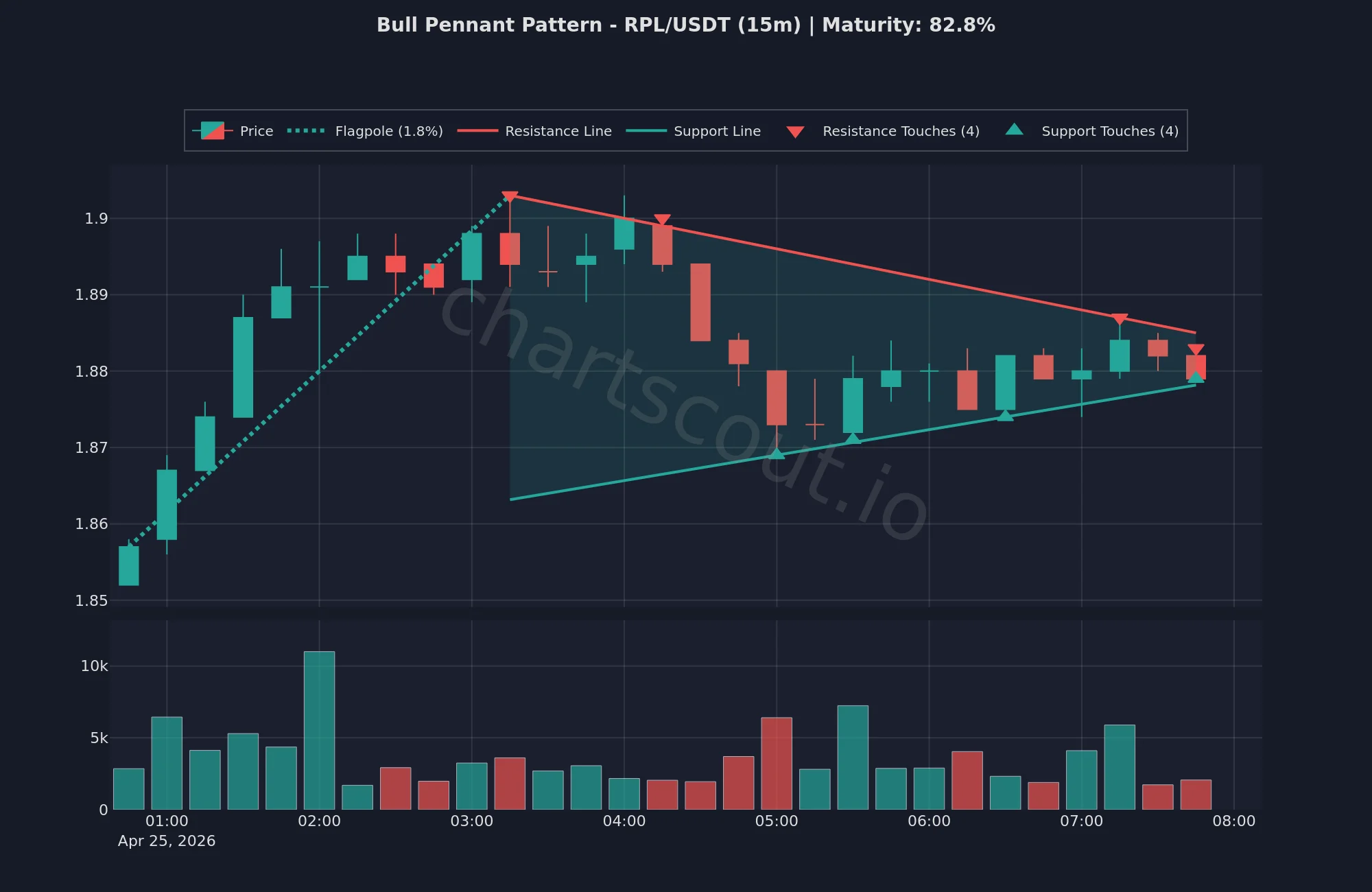
This detection was posted live on X at the time of formation - even though it failed
ChartScout's public detection feed at @ChartScout_bot on X publishes a curated, daily-diversified sample of patterns the production scanner picks up - the algorithm rotates pairs and pattern types so the feed is not just the same names repeating every hour. The RPL/USDT 15m detection above went out as a live tweet at the moment of formation, not a backfilled archive post - and that tweet stayed up even after the pattern broke the wrong way. We do not delete failed detections from the public feed. You can verify the timestamp and the chart against the original post:
x.com/ChartScout_bot/status/2047948827907203193
The full scanner fires Discord, Telegram, email, and in-app alerts on every detection across 1,000+ pairs in real time. The X feed is a curated public window into that pipeline, intentionally diversified so you can audit the timing yourself before paying.
Cross-timeframe crypto setups
The two support detections near the top - SPCX/USDC on 30m and AUCTION/USDT on 1h - show how the same structure scales across crypto venues and timeframes. SPCX has a +2.7% flagpole with four touches on each trendline; AUCTION has a +6.3% flagpole and a 69.3% mature pennant. The pattern recognition is identical; only the time horizon and market context shift.
Pattern variety: how shape changes across pairs
Bull pennant shape varies more in crypto than in stocks because liquidity profiles vary so much. Below are two more live detections from the same week. ETHW/USDT (a low-volume mid-cap fork) shows a slightly upward-tilting pennant - Bulkowski's data flags upward tilt as a performance drag in uptrends, so this is the kind of setup that needs extra-strict volume confirmation. CLANKER/USDT (a memecoin with thin order books) shows a wider, looser pennant body, exactly the “loose” pattern Bulkowski warns against without strong volume confirmation. Both fired live; both required different filtering thresholds before being tradable.
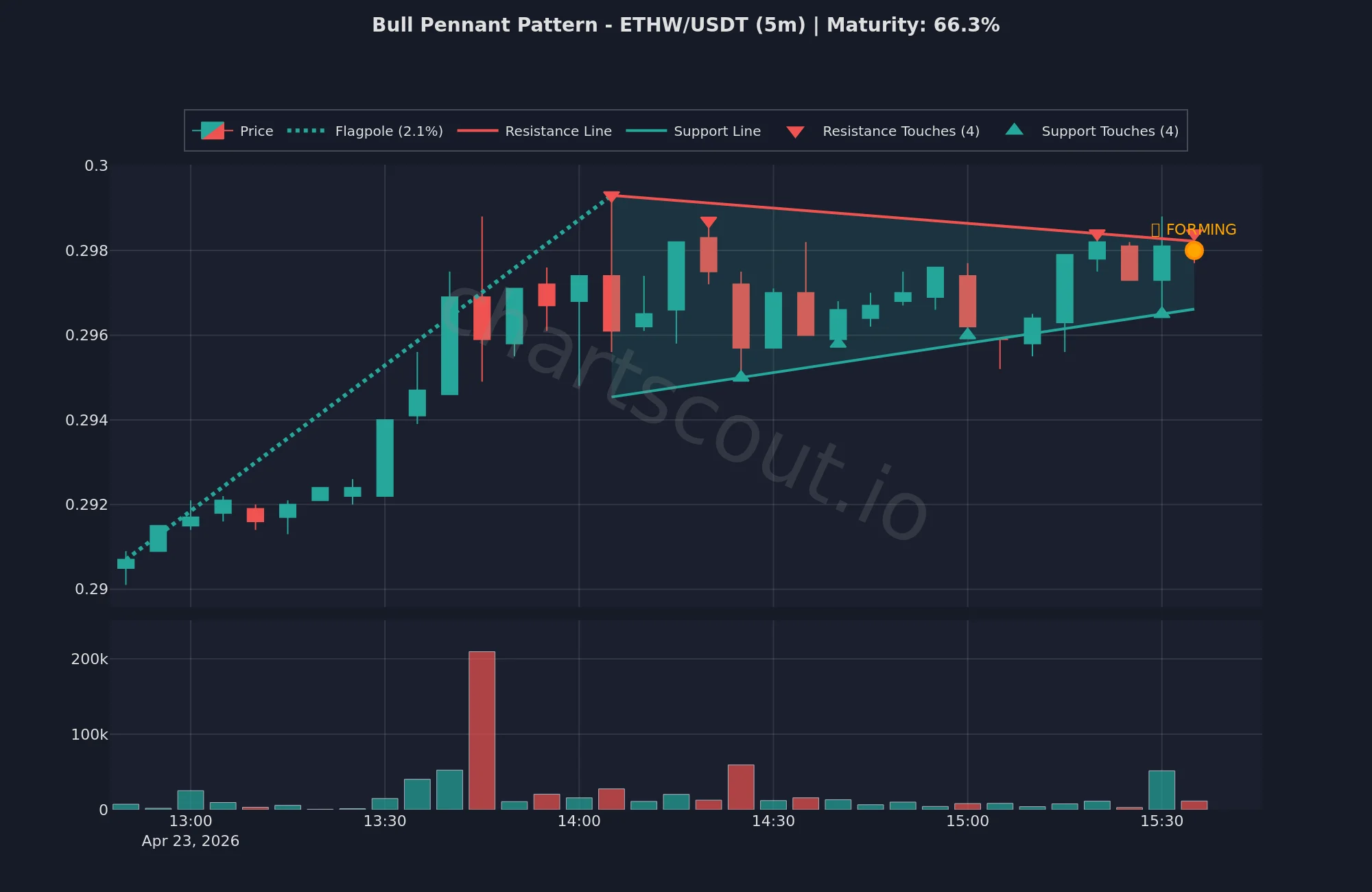
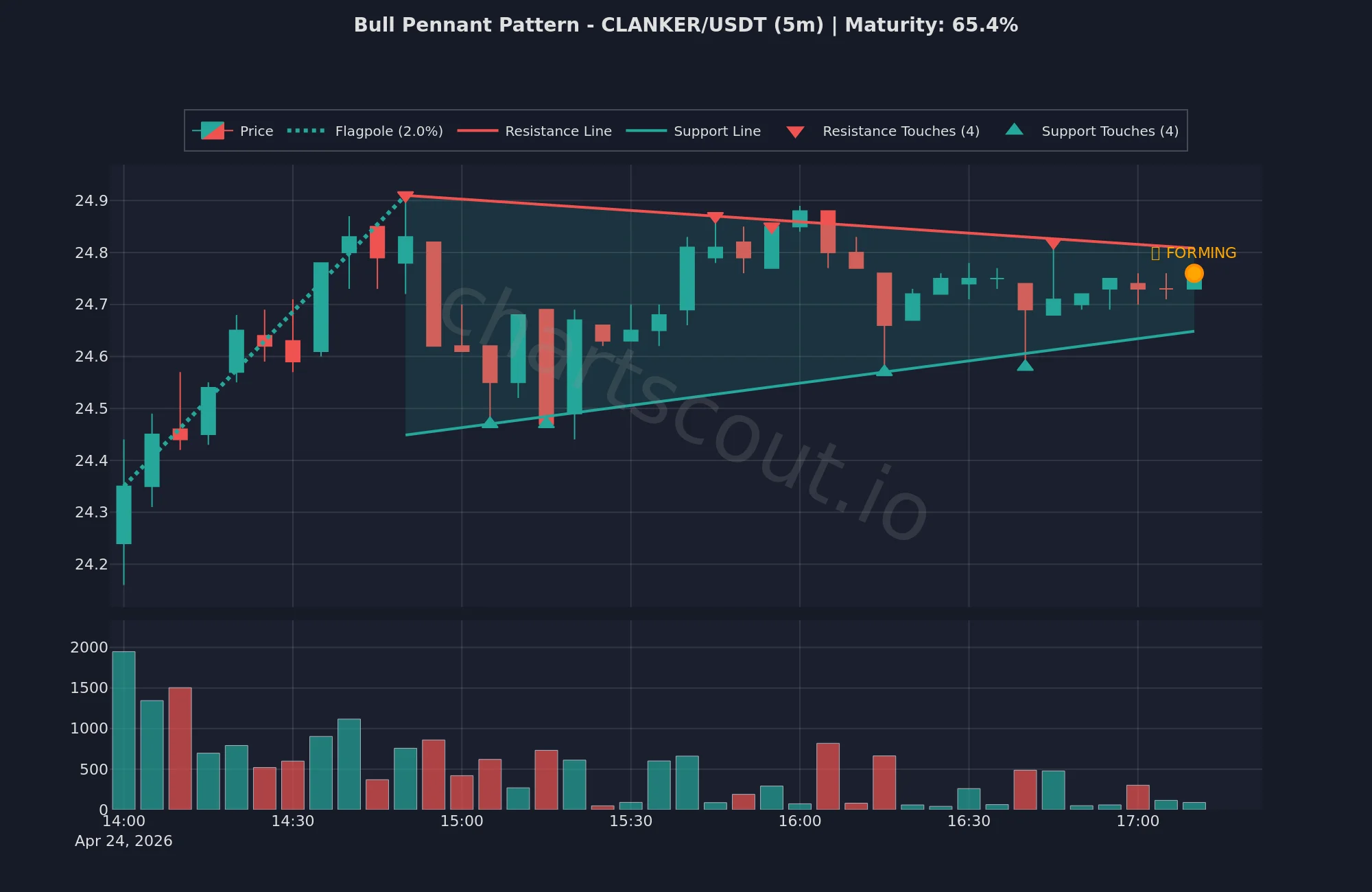
All six examples in this guide are live detections from a single week of April 2026. The shape does not need to be pretty. What matters is whether the flagpole was steep, whether the pennant compressed on declining volume, whether the structural rules held, and - critically - whether the breakout candle confirmed with a volume spike. Pattern matching the picture without checking volume is how the 54% break-even failure rate compounds against you.
Crypto-specific considerations
Best timeframes for bull pennants in crypto
- 1m / 5m: high noise, high false-breakout rate. Confirm against the 15m or 1h trend before entering.
- 15m / 1h: the day-trading sweet spot. Balance of frequency and reliability.
- 4h / 1d: the most reliable swing setups. Lower frequency but higher base success rate.
- 1w: rare on alts. When they form, they often coincide with macro continuation moves and produce the largest absolute returns.
Short-squeeze cascades amplify breakouts
This is where crypto bull pennants differ most from stocks. When price breaks above the upper trendline, short liquidations on perpetual futures can cascade:
- Breakout triggers stop-losses for short positions opened near the upper trendline.
- Stops trigger margin calls on leveraged shorts.
- Forced buy-to-cover liquidations push price higher.
- Higher price triggers more liquidations.
The cascade effect means crypto bull pennant breakouts can exceed measured targets significantly. A pattern projecting a 7% move can produce 15-25% on volatile mid-cap altcoins when the short-squeeze chains. This is the single biggest reason crypto pennants reward partial-profit-taking with a trailed remainder rather than fixed measured-move targets.
Altcoin reliability varies by market cap
- Large caps (BTC, ETH): moves are more measured. Bull pennants produce reliable but moderate continuations.
- Mid caps (Top 50): amplified moves. Short-squeeze cascades are common; targets often overshoot.
- Small / micro caps: extreme. Whale buy walls can manufacture clean-looking pennants that fail because the underlying liquidity is not there to support continuation. Treat low-volume pennants on small caps as untradable until volume confirms.
Combining with golden-cross signals
Bull pennants forming above the 200-period moving average, especially coinciding with a fresh golden cross, carry additional bullish weight. The moving average acts as dynamic support below the pennant, making downward breakouts statistically less likely. Trend-following confluence is one of the few filters that materially shifts the 46% base success rate.
24/7 trading and weekend liquidity
Crypto never sleeps. Pennants that take days to form on stocks can form in hours. The compression does not invalidate the pattern - it accelerates the entire cycle. The trade-off: weekend liquidity drops produce clean-looking fakeouts that get unwound on Monday. If a bull pennant breakout occurs late Saturday on thin volume, halve your size and wait for the Monday open to confirm.
Scanning bullish continuations across 1,000+ pairs
Bull pennants form fast and break fast. By the time you spot one manually on a single pair, dozens have already completed their breakouts elsewhere. ChartScout detects bull pennants across Binance, Bybit, KuCoin, MEXC, and Hyperliquid in real time, alerting you in under 20 seconds via Discord, Telegram, email, or in-app. Learn how alert-driven trading eliminates the scanning problem entirely, and read our breakdown of how to find breakouts before they happen.
Frequently asked questions
What is the success rate of a bull pennant pattern?
Per Bulkowski's 2020 data on 1,600+ trades, the break-even failure rate for upward breakouts is 54%, meaning 46% of breakouts produce moves exceeding 5%. Average rise is 7%. Pennant stats are measured on the short-term price swing, not breakout-to-ultimate-high. Direct comparison with patterns like ascending triangle (43% average rise) is misleading because they measure different metrics.
How do you calculate the price target for a bull pennant?
Measure the flagpole height (low before the rally to the pennant high) and project that distance above the breakout point. Only 35% of upward breakouts meet this full target. Target 50-75% of flagpole height for more realistic exits and trail your stop for any additional gains.
How long does a bull pennant take to form?
The standard guideline is 1 to 3 weeks on a daily chart, about 15 candles on any timeframe. Roughly 15 minutes on 1m, 4 hours on 15m, 15 hours on 1h, 2-3 days on 4h, under 3 weeks on daily. Anything longer is reclassified as a symmetrical triangle. In crypto, bull pennants frequently form and resolve within hours during sharp rallies.
What is the difference between a bull pennant and a bull flag?
Both are short-term bullish continuation patterns with flagpoles. A bull pennant has converging trendlines (small triangle); a bull flag has parallel trendlines tilting downward against the uptrend. Statistically, bull flags outperform: 44% failure rate vs 54% for pennants, 9% average rise vs 7%, 46% target achievement vs 35%.
Do bull pennants always break upward?
No. Only 57% of pennants break upward. The other 43% break the wrong way. The pattern earns the “bull” label when it forms after an uptrend, but you cannot assume continuation. Always wait for a confirmed close above the upper trendline with volume before entering long.
Is a bull pennant the same as a symmetrical triangle?
No. A bull pennant is small (under 3 weeks, ~15 candles), must follow a steep flagpole, and is a continuation pattern. A symmetrical triangle can be large (weeks to months), does not require a flagpole, and can function as continuation or reversal. If your pennant is wider than 3 weeks or lacks a flagpole, trade it as a symmetrical triangle.
What makes a bull pennant more reliable?
Tight clean formation, a genuine momentum-driven flagpole, declining volume during formation (86% base rate), location near the yearly high, formation inside a confirmed uptrend rather than a counter-trend rally, no overhead resistance immediately above the breakout, and slight downward tilt of the pennant against the prevailing trend. Combining these factors materially improves the 46% base success rate.
Should I buy before the breakout confirms?
No. With 43% of pennants breaking the wrong way and 54% of upward breakouts failing to clear 5%, entering long before confirmation is gambling against compounding base rates. Wait for a candle close above the upper trendline with above-average volume. The confirmation costs you a few percent of potential profit but saves you from the majority of patterns that disappoint.
Conclusion: trading bull pennants with realistic expectations
The bull pennant is a fast, frequent pattern, and that is both its strength and its weakness. With a 54% break-even failure rate and only 35% reaching the full measured target, this is not a pattern you trade blindly. The edge comes from selectivity, volume confirmation, and trade management. Crypto's leverage and short-squeeze dynamics amplify the winners, which is why the pattern still rewards a disciplined trader more than the headline statistics suggest.
Key takeaways
- Flagpole is mandatory. No steep, sharp rally means no pennant. Period.
- 86% volume decline. Volume is the single best filter. Declining through formation, spike on breakout.
- Realistic targets. Only 35% hit the full measured move. Take partial profits at 50% and 75% of flagpole height.
- Tight beats loose. Clean compressed pennants outperform messy wide ones every time.
- Tilt matters. Slight downward or horizontal tilt outperforms upward-tilting pennants in uptrends.
- Half-staff is myth-light. The midpoint projection works only ~30% of the time. Do not bet the trade on it.
- Flags are statistically better. If both form on the same flagpole, prefer the flag.
- Crypto amplifies everything. Short-squeeze cascades push breakouts past measured targets, but failures unwind violently. Stops are non-negotiable.
Catch bull pennants as they form
Identifying clean bull pennants with proper volume signatures across hundreds of pairs in real time is not something a human can do manually. ChartScout detects bull pennants across Binance, Bybit, KuCoin, MEXC, and Hyperliquid, with alerts delivered in under 20 seconds.
Start 7-day trial→Set up your first bull pennant watcher in under 2 minutes.
Sources & references
Data source note: All headline statistics come from Thomas Bulkowski's most recent published figures at thepatternsite.com (updated 8/27/2020, 1,600+ perfect trades): 54% break-even failure rate for upward breakouts, 7% average rise, 35% meeting price target, 86% volume trend downward, 57% upward breakout rate. Performance is measured on the short-term price swing, not the ultimate high or low. Figures reflect stock-market data; ChartScout's crypto backtest is in progress and crypto-specific numbers will be added when the study is complete.
- Bulkowski, Thomas N. ThePatternSite.com - Pennants. Updated 8/27/2020. thepatternsite.com/pennants.html.
Primary statistical source for pennant performance: 54% break-even failure rate (both directions), 7% average rise (upward), 35% meeting price target (up), 57% upward breakout rate, 86% volume trend downward. Based on 1,600+ perfect trades. - Bulkowski, Thomas N. Encyclopedia of Chart Patterns, 2nd Edition. John Wiley & Sons, 2005. ISBN: 978-0471668268.
Chapter on Pennants (pp. 522-535). Source for pattern identification guidelines, the half-staff principle, trading tips, tilt and flat-base rules, and the pre-2020 performance baseline used for context. - Pring, Martin J. Technical Analysis Explained, 5th Edition. McGraw-Hill, 2014. ISBN: 978-0071825177.
Pennant coverage: characterizes pennants as very small triangles in which volume contracts more than during a flag formation, and discusses the 4-week duration cap as a warning threshold for diminishing continuation interest. - Murphy, John J. Technical Analysis of the Financial Markets. New York Institute of Finance, 1999. ISBN: 978-0735200661.
Flags and pennants chapter: source for the 1-3 week duration guideline used throughout this guide, and the standard measured-move target framework. - Edwards, Robert D., Magee, John, and Bassetti, W.H.C. Technical Analysis of Stock Trends, 11th Edition. CRC Press, 2018. ISBN: 978-1138069411.
The canonical mid-century reference on flag and pennant continuation patterns. Source for the historical “half-staff” framing and the original measured-move methodology that underpins modern target-projection rules. - Schabacker, Richard W. Technical Analysis and Stock Market Profits. Originally published 1932. Harriman Definitive Edition, Harriman House, 2021. ISBN: 978-1897597569.
The original 1932 work that introduced flag and pennant terminology to the technical-analysis literature. Source for the historical context that establishes pennants as a legitimate continuation pattern, predating Edwards and Magee.

Stjepan Ivanović
Founder of ChartScout · Crypto Trader Since 2013
Trading crypto since 2013 with his first Bitcoin bought at ~$200. Four complete bull/bear market cycles, traded on early exchanges like Mt.Gox and BTC-e, on-chain trading on IDEX and EtherDelta, and ~70 crypto project investments. Built ChartScout after 2+ years of development to automate what no trader can do manually. Watch hundreds of charts 24/7.