Multi-timeframe analysis for crypto: which timeframes actually work
Multi-timeframe analysis is the highest-leverage habit in technical trading: read the higher timeframe first, and you stop taking clean-looking setups that are doomed because they fight the dominant trend. It works because price is fractal, and ChartScout's alert log shows how constantly: in 8 weeks the scanner logged 482 cases of one pattern forming across two or more timeframes at once. This guide is the full workflow, backed by Bulkowski's data and Elder's triple screen.
Every guide on multi-timeframe analysis opens with the same line: higher timeframes are more reliable. It is true, but on its own it is not a method. The real value of multi-timeframe analysis is concrete and measurable: when you read the higher timeframe first and trade only with its trend, you stop taking technically-clean setups that are doomed because they fight the macro structure. That single habit removes a large share of avoidable losses. It is the closest thing technical trading has to a free edge, and this guide is the workflow that delivers it.
It works because price is fractal: the same patterns form on the 5m, the 1h and the daily, and the trend on any timeframe is built out of the swings on the timeframe below it. We pulled ChartScout's notification log to show how literally true that is. Between 20 March and 15 May 2026 the scanner fired roughly 12,900 pattern alerts, and 482 of them were the same pattern on the same pair forming again on a different timeframe within 15 minutes. Markets genuinely are multi-timeframe. The skill, and the subject of this guide, is knowing which timeframe to act on.
The framework here is anchored to two solid bodies of work: Thomas Bulkowski's pattern statistics (thepatternsite.com, updated 2020, 40,000+ trades on equity charts) and Alexander Elder's triple screen trading system, the canonical multi-timeframe workflow he has refined since 1985. Both are translated into the crypto-specific quirks that change how you apply them: 24/7 trading, funding windows every 8 hours, weekend liquidity drops, and BTC correlation events that most equity traders have never had to think about.
By the end you will have a top-down workflow you can run in 5 minutes per trade, a pattern x timeframe matrix that tells you which timeframes each pattern actually trades on, real ChartScout detections that show the fractal effect, the alignment rules that tell genuine multi-timeframe confluence apart from one structure simply echoing across charts, and a clear answer on whether the 1-minute chart is ever worth scanning.
What multi-timeframe analysis means in crypto
Multi-timeframe analysis is examining the same asset on more than one chart timeframe before entering a trade. Instead of looking at the 1h chart and trading whatever you see, you also check the 4h chart for trend context and the 15m chart for entry timing.
The value is straightforward: a setup that looks excellent in isolation on a single timeframe often looks marginal or outright wrong once you add the higher-timeframe context. A bullish ascending triangle breaking out on the 1h is a very different trade if the 4h chart shows you are fighting a descending channel. MTF analysis prevents you from trading the tree while missing the forest.
The framework was developed for equity markets that have defined sessions: an open, a close, and overnight gaps that reset the trading day. Crypto trades 24/7 without those breaks, and that changes how the framework behaves:
- A pattern forming on Friday evening (traditionally thin liquidity) can generate a false breakout that reverses completely by Monday.
- Funding-rate cycles on perpetuals every 8 hours create intraday rhythms that do not exist in equities.
- BTC dominance moves can override individual coin technical analysis at any timeframe.
Understanding multi-timeframe context, especially the relationship between your trading timeframe and the next one up, is not optional in crypto. It is how you separate real setups from noise in a market that never sleeps.
Why higher timeframes are more reliable
The principle is simple: patterns and signals on higher timeframes carry more weight than the same shapes on lower timeframes. Three reasons.
More data per candle
A 4h candle contains the activity of 16 fifteen-minute candles. Its high and low represent 4 hours of genuine price discovery, not a single 15-minute spike. The structure carries more information.
More participants
Institutional traders, algorithms, and swing traders predominantly operate on daily and 4h charts. A pattern visible on the 4h is being watched by more participants, which makes its support and resistance levels more significant: more orders cluster there.
Lower noise
Lower timeframes (1m, 5m, 15m) contain a higher proportion of meaningless price movements driven by small order flow. Higher timeframes filter that noise because each candle aggregates many small movements into a single bar. The signal-to-noise ratio is structurally better.
“Every pattern is a fractal of a pattern on a higher time frame chart. This means that every pattern is a micro pattern on a higher time frame and every micro pattern is a standard pattern on a smaller time frame.”
Al Brooks, Trading Price Action: Trends (Wiley, 2012), glossary
Brooks' observation is the structural reason MTF works at all. A 75% mature ascending triangle on the 1h chart is, on the 5m, a much larger pattern with hundreds of micro patterns inside it. The trader who only sees the 5m has no idea any of this is happening.
Bulkowski's pattern dataset at thepatternsite.com (updated 2020, 40,000+ trades) is primarily daily-chart equity data. The high break-even rates he documents (84% on double bottoms, 87% on triple bottoms, 83% on ascending triangles) are daily-timeframe statistics. Part of why these patterns perform so well in his dataset is the daily timeframe filtering out intraday noise. On lower timeframes in any market, the same shapes underperform.
Data notice
Bulkowski's statistics are from daily equity charts. The “higher timeframes are more reliable” principle holds for crypto, but the absolute completion rates on his sample will not transfer one-to-one. Crypto adds 24/7 trading, funding mechanics, and retail-heavy participation that change pattern behavior, especially on lower timeframes and on thin-liquidity altcoins. Treat his numbers as a relative reliability ranking, not as exact crypto predictions. See our chart patterns cheat sheet for the full Bulkowski numbers per pattern.
The 3-timeframe stack: HTF, MTF, LTF
The classical MTF framework uses three timeframes for every trade. Each has a job.
HTF: context and bias
The higher timeframe defines the overall trend direction and major support/resistance zones. It tells you whether to look for longs, shorts, or to stand aside. The HTF trend is the only direction you should fight with extreme caution, and only when a strong reversal signal on the MTF lines up with a major HTF level.
MTF: the setup and pattern
The middle timeframe is where you identify the actual chart pattern triggering the trade. Its measured-move target becomes your target. If you use ChartScout, this is the timeframe you configure your watcher on, the timeframe the 75% or 100% maturity alert is calculated against.
LTF: entry and timing
The lower timeframe is purely for precision. After the MTF pattern is identified and the HTF bias agrees, you drop to the LTF to time the actual entry. A flag consolidation on the 1h might look like a clean breakout candle on the 15m: use the 15m to time your limit order at the role-reversal level.
The practical benefit: a 15m-based stop is closer to entry than a 1h-based stop, which tightens your risk and improves your risk-to-reward. Entering at the 1h close (which might already be $500 above the breakout level as the candle paints high) is much worse than entering on the first 15m pullback to the breakout level. The LTF gives you precision the MTF cannot provide.
“Triple Screen demands that you examine the long-term chart first. It allows you to trade only in the direction of the tide, the trend on the long-term chart. It uses the waves that go against the tide for entering positions. For example, when the weekly trend is up, daily declines create buying opportunities. When the weekly trend is down, daily rallies provide shorting opportunities.”
Dr. Alexander Elder, The New Trading for a Living (Wiley, 2014), Chapter 39
Elder's metaphor (tide, wave, ripple) comes from Robert Rhea's 1930s adaptation of Dow Theory. The HTF is the tide. The MTF is the wave. The LTF is the ripple. You trade with the tide, you use the wave against the tide as entry timing, and you ignore the ripples. The framework is almost a century old, and it still works because the underlying market structure (multiple participant groups operating on different horizons) has not changed.
The 1:4 to 1:6 ratio rule
The standard ratio between adjacent timeframes in a 3-TF stack is 1:4 to 1:6. Each timeframe should be 4 to 6 times the duration of the one below it.
Common crypto trading stacks
| Trader type | HTF (context) | MTF (setup) | LTF (entry) |
|---|---|---|---|
| Day trader | 4h | 1h | 15m |
| Swing trader | Daily | 4h | 1h |
| Position trader | Weekly | Daily | 4h |
| Scalper / day trader (active) | 1h | 15m | 5m |
| Scalper (high frequency) | 15m | 5m | 1m |
Elder calls this “the factor of five.” The original triple screen used 5:1 ratios (weekly/daily, daily/hourly, hourly/10-minute). In crypto, where charting tools default to 1h/4h/1d on most platforms, 1:4 fits cleaner and gives you the same structural separation. Either ratio works, the key is that the gap between timeframes is wide enough that each one shows you genuinely different information.
A word on scalping and the 1m / 5m timeframes
Scalping the 1m and 5m is a legitimate trading style with its own edge, its own pace, and its own risk profile. The reason this guide spends most of its time on 1h and 4h is that those are the highest-leverage timeframes for the average pattern trader: more setups per week than the daily, fewer fakeouts than the 5m. That does not mean lower timeframes are useless, it means they require a different skill set: faster execution, tighter stops, stricter HTF alignment, and a much higher tolerance for whipsaw.
ChartScout supports the full ladder for exactly this reason. The 5m timeframe is included from the Pro tier upward because it is where most serious day traders operate. The 1m and 3m are included on Enterprise because the traders who use them know what they are doing and they need a scanner that can keep up. If you are scalping, the framework in this guide still applies, you just slide the stack down: 15m for context, 5m for setup, 1m for entry. The ratio rule does not care which absolute timeframes you use, only that the gap between them is wide enough.
Why 1:4 minimum
If your timeframes are too close together (1h/30m/15m), you are seeing the same price action at slightly different resolutions without meaningfully new context. The 4x gap ensures the HTF contains enough candles to define a genuine trend, and the LTF has enough resolution to time entries precisely.
Do not stack four or more timeframes
Each additional timeframe increases cognitive load and the probability of analysis paralysis. By the time you have lined up perfect alignment across 6 timeframes, the entry is gone. Pick 3 and stick to them. The fourth timeframe is almost always there to rationalize a trade that the 3-TF check already told you to skip.
Top-down workflow, step by step
Here is the step-by-step process for a day-trading stack (4h, 1h, 15m). Swing traders apply the same logic to daily/4h/1h.
- Open the 4h chart first. Define the trend (higher highs and higher lows = uptrend, lower highs and lower lows = downtrend, choppy = sideways). Mark major support/resistance from the 4h perspective. Decide your directional bias before looking at any lower timeframe.
- Drop to the 1h chart. Look for specific patterns aligned with the 4h bias. An ascending triangle on the 1h, with a 4h chart in an uptrend, is a clean continuation setup. Calculate the measured-move target from the 1h pattern. Confirm the target does not run directly into a major 4h resistance, if it does, that 4h level becomes your practical target.
- Drop to the 15m chart for entry. Wait for the 1h pattern trigger (e.g., a breakout candle above flat resistance for an ascending triangle). Once triggered, watch the 15m for the first pullback to the breakout level. Enter on the 15m candle that confirms support at the old resistance (role reversal). Stop: 1x ATR below the 15m candle low.
- Manage the trade on the 1h. Once filled, switch back to the 1h chart. Take partial profit at TP1 (first measured-move target). Trail the remaining position using the 4h channel structure for the final exit.
The whole sequence takes about 5 minutes per setup. The discipline is what matters: do not skip the HTF check, do not chase the 1h breakout candle without dropping to the 15m for a cleaner entry, and do not start checking other timeframes mid-trade to talk yourself out of your exit.
The order matters
HTF first, MTF second, LTF last. Always. Looking at the 15m first means you find a setup, fall in love with it, then unconsciously rationalize the 4h. Looking at the 4h first means the trend bias is locked in before you have any reason to argue with it.
Why bottom-up analysis fails
Bottom-up analysis is starting with the lower timeframe and working up: finding a setup on the 15m and then looking at higher timeframes to “confirm” it. The problem is cognitive. Once you have found and decided on a setup on the 15m, you are now examining higher timeframes with a bias. You will find reasons to confirm the trade you already wanted to take.
A textbook bull flag on the 15m with a clean breakout can be noise against a 4h downtrend. If you start with the 15m flag and then “check” the 4h, confirmation bias will cause you to explain away the 4h structure: “the 4h looks like it might be reversing,” “there is support nearby,” “BTC is bouncing.” Starting top-down removes that bias because the 4h context is locked in before you have any setup in mind.
“If you make the mistake of looking at the daily chart first, you'll be prejudiced by its patterns. First, make an unbiased decision on a long-term weekly chart before even glancing at the daily.”
Dr. Alexander Elder, The New Trading for a Living (Wiley, 2014), Chapter 39
The one exception: scanner-driven discovery
When a scanner like ChartScout fires alerts across hundreds of pairs simultaneously, you are effectively doing bottom-up discovery from the scanner's output. The discipline is non-negotiable: immediately check the HTF context on every alert before deciding to act. The alert is the discovery mechanism. The top-down check is the validation step. Skip the validation and you have just hand-rolled a generic 15m alert system.
Timeframe-level reliability in crypto
Pattern reliability is not flat across timeframes. The qualitative ranking below summarizes what most active crypto traders converge on after enough sample size, and matches the direction Bulkowski's equity data suggests. It is directional, not a precision study.
Honest framing
No published study with comparable sample size to Bulkowski's 40,000-trade equity dataset exists for crypto. Anyone giving you a precise number like “42% fakeout rate on 5-minute charts” is either citing a tiny sample or making it up. The table below is qualitative: it ranks timeframes in order of reliability and notes where the practical threshold sits. A proprietary ChartScout crypto pattern study is in the works for a future update.
| Timeframe | Signal quality | Fakeout risk | Best use case |
|---|---|---|---|
| 1m | Low per signal | Very high | High-frequency scalping with 15m HTF anchor |
| 5m | Below average per signal | High | Scalping and aggressive day trading, paired with 1h HTF |
| 15m | Moderate | Elevated | Day trading setups and entry timing, paired with 1h or 4h HTF |
| 1h | Good | Moderate | Primary pattern timeframe for day traders |
| 4h | Very good | Lower | Primary timeframe for swing traders |
| 1d | Excellent | Low | Position trading, cup and handles, major H&S |
Reliability vs frequency is the real tradeoff
The 1h timeframe is where signal-to-noise becomes comfortable for most pattern traders, and the gap in pattern quality between 1h and 4h is smaller than most guides suggest. Both are tradable. The bigger structural step is between 15m and 1h.
That does not make 5m and 15m unusable. It changes what you trade them for. Per-setup reliability is lower, but the number of setups per day is much higher. A scalper running 5m with strict 1h HTF alignment can take 5 to 10 setups in a session that a 4h trader would wait three days to see. The expected value math works either way, as long as you accept the true cost of the lower timeframe: tighter stops, faster execution, no tolerance for sloppy HTF discipline. Pick the timeframe that matches your reaction speed, your risk tolerance, and your screen time, not the one with the prettiest break-even number.
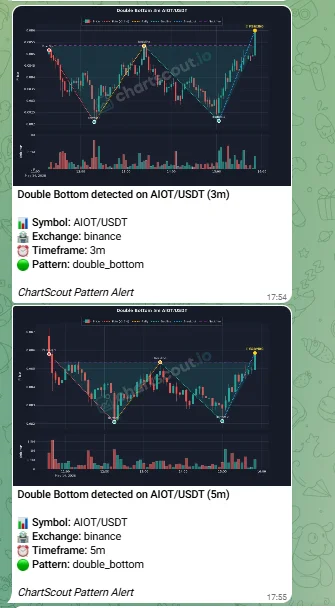
Here is the fractal nature in one screenshot. On 14 May 2026, ChartScout fired two alerts on AIOT/USDT a minute apart: the same double bottom, on the 3m then the 5m. The pattern is real on both charts. What it is not, yet, is multi-timeframe confluence. The next section draws that line, because telling an echo apart from genuine confluence is exactly the skill that makes multi-timeframe analysis pay.
The same pattern across timeframes: echo vs confluence
One pattern showing up on the 3m, the 5m and the 15m at the same time is not a flaw. It is the fractal structure of price, and it is the entire reason multi-timeframe analysis works: if patterns did not repeat across scales, there would be nothing to align in the first place. ChartScout runs an independent scan per timeframe, so when a real structure forms, several watchers catch it within minutes of each other. The grids below are that effect in live data.
Here is the distinction that turns it into an edge. Two adjacent timeframes lighting up seconds apart is an echo: one structure your scanner saw twice. Genuine confluence is when a higher timeframe has independently completed its own pattern, over its own longer formation window, pointing the same way. A 4h double bottom sitting under a 1h double bottom is confluence, two structures with hours of independent price action behind each, and it is the highest-probability setup in this guide. A 3m and a 5m double bottom 58 seconds apart is an echo. The wall-clock gap is the tell: real higher-timeframe confirmation takes hours to build, not seconds. Echo tells you where to look. Confluence tells you to act.
Recent patterns detected across multiple timeframes
| Pair | Exchange | Pattern | Timeframes hit | Detection timing |
|---|---|---|---|---|
| KMNO/USDT | Binance | Descending triangle | 15m, 30m, 1h | August 3-4, 2026 |
| OPG/USDT | Binance | Double bottom | 15m, 30m | 2s |
| BANK/USDT | Binance | Double top | 15m, 30m | 5s |
| JTO/USDC | Hyperliquid | Double top | 3m, 15m | 5s |
| CYS/USDT | Binance | Double top | 5m, 15m | 32s |
| LTC/USDC | Hyperliquid | Falling wedge | 3m, 5m | 58s |
| PENDLE/USDC | Hyperliquid | Ascending triangle | 3m, 5m | ~2 min |
| ZEC/USDT | Binance | Head and shoulders | 3m, 5m | ~4 min |
| TRB/USDT | Binance | Symmetrical triangle | 3m, 5m | ~4 min |
Sample from ChartScout's live alert log, 13 to 15 May 2026. Each row is the same pattern detected by separate per-timeframe watchers within minutes of each other.
Here is what six of those look like. Each block is one pattern, the same structure ChartScout rendered on each timeframe it fired on. Notice the shape repeats while the candle count and wall-clock duration change. That is the fractal property, the foundation the whole top-down workflow is built on.
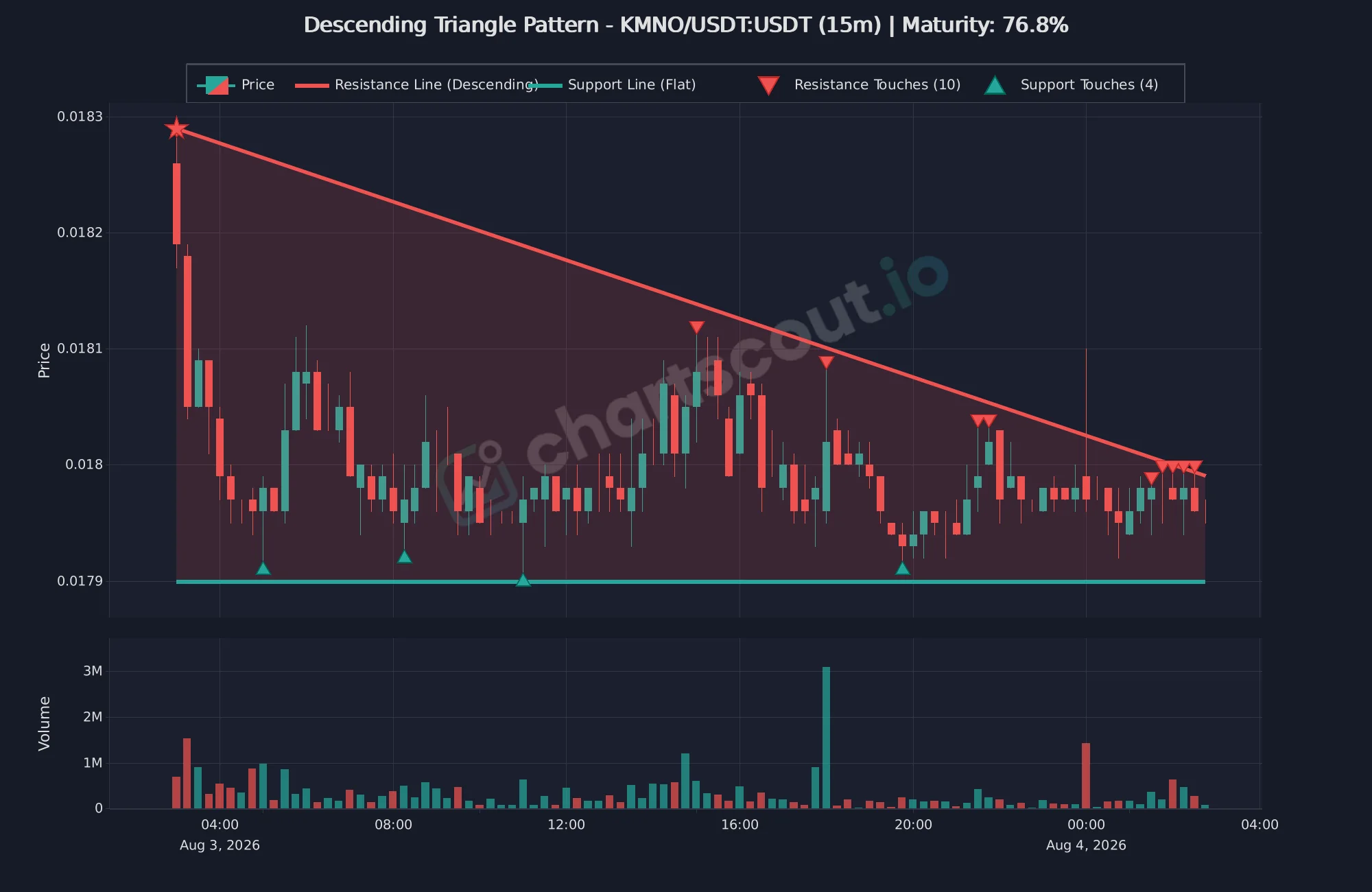
KMNO/USDT 15m on Binance. Descending resistance compresses price into flat support; detected August 4, 2026.
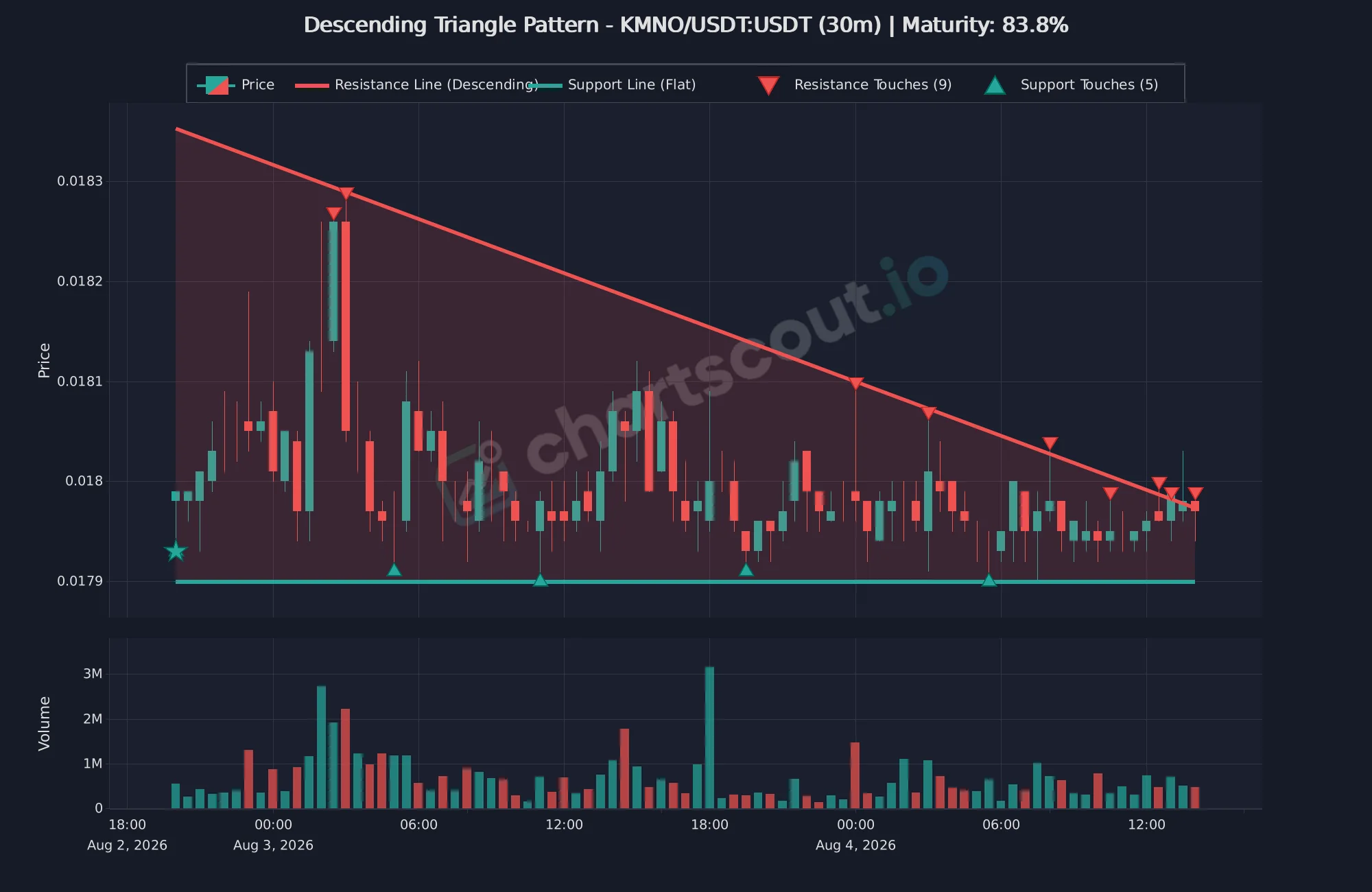
KMNO/USDT 30m on Binance. The same descending triangle remains visible with fewer candles; detected August 4, 2026.
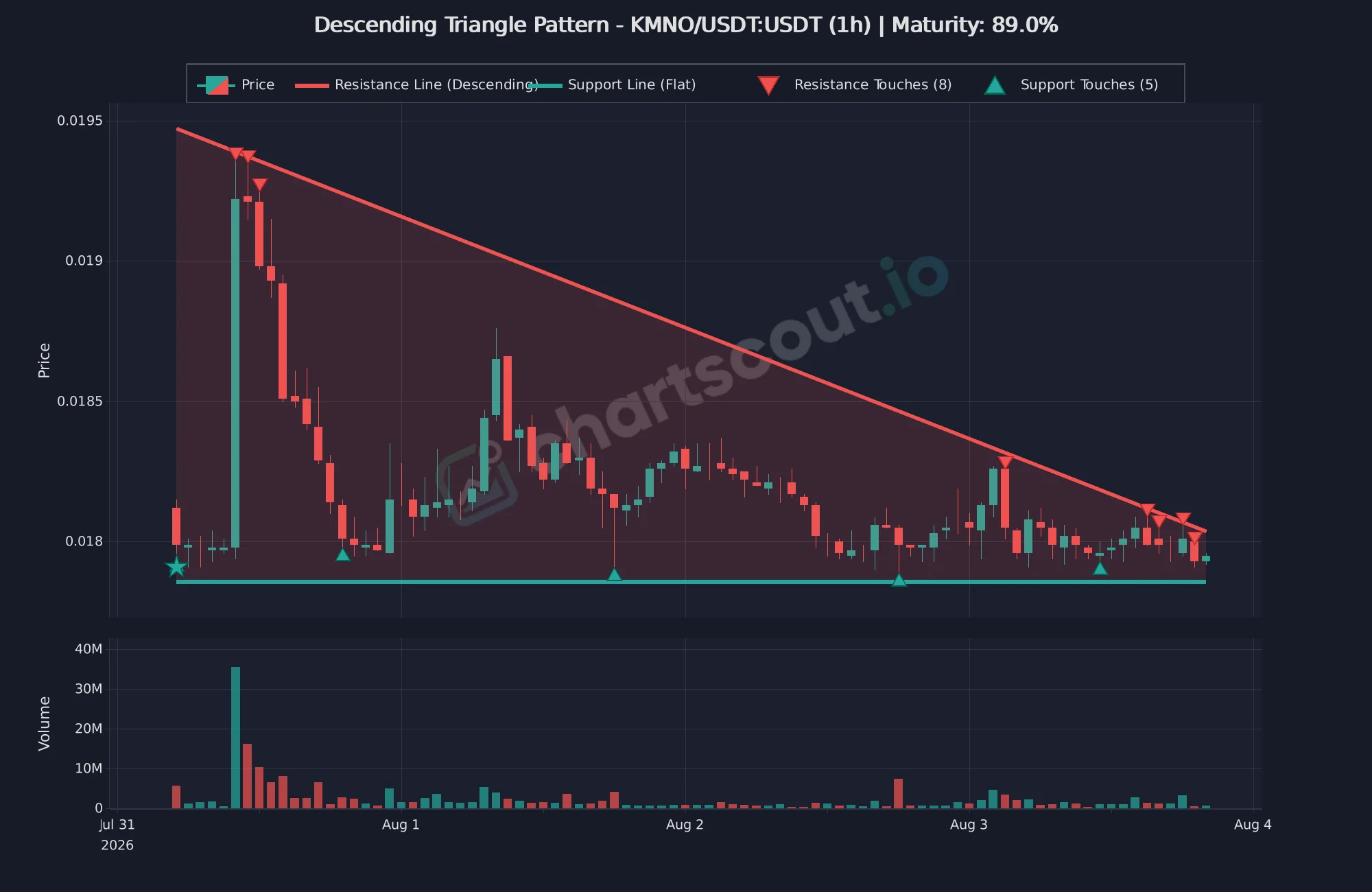
KMNO/USDT 1h on Binance. Flat support and the higher-timeframe resistance slope remain aligned; detected August 3, 2026.
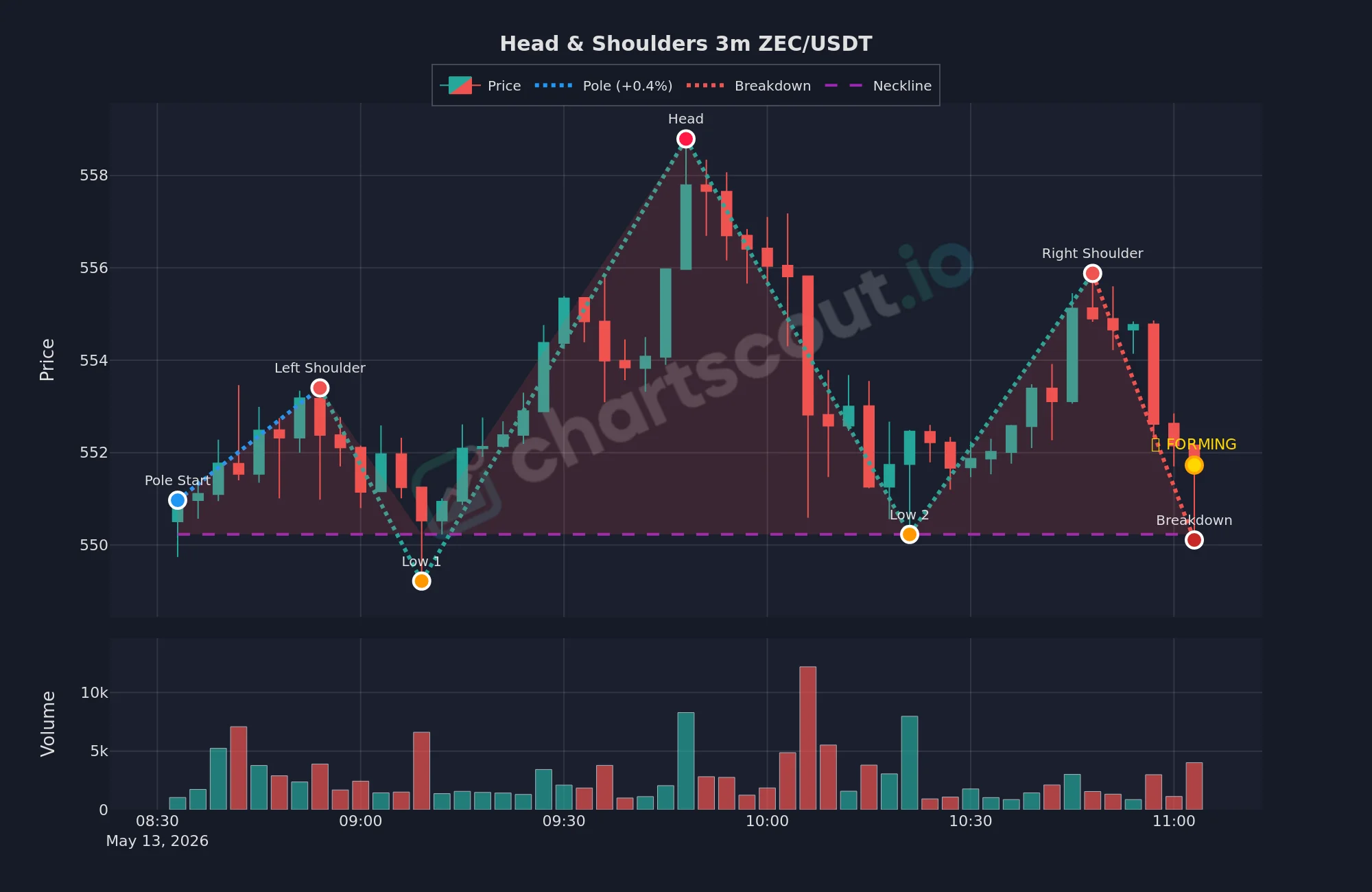
3m chart
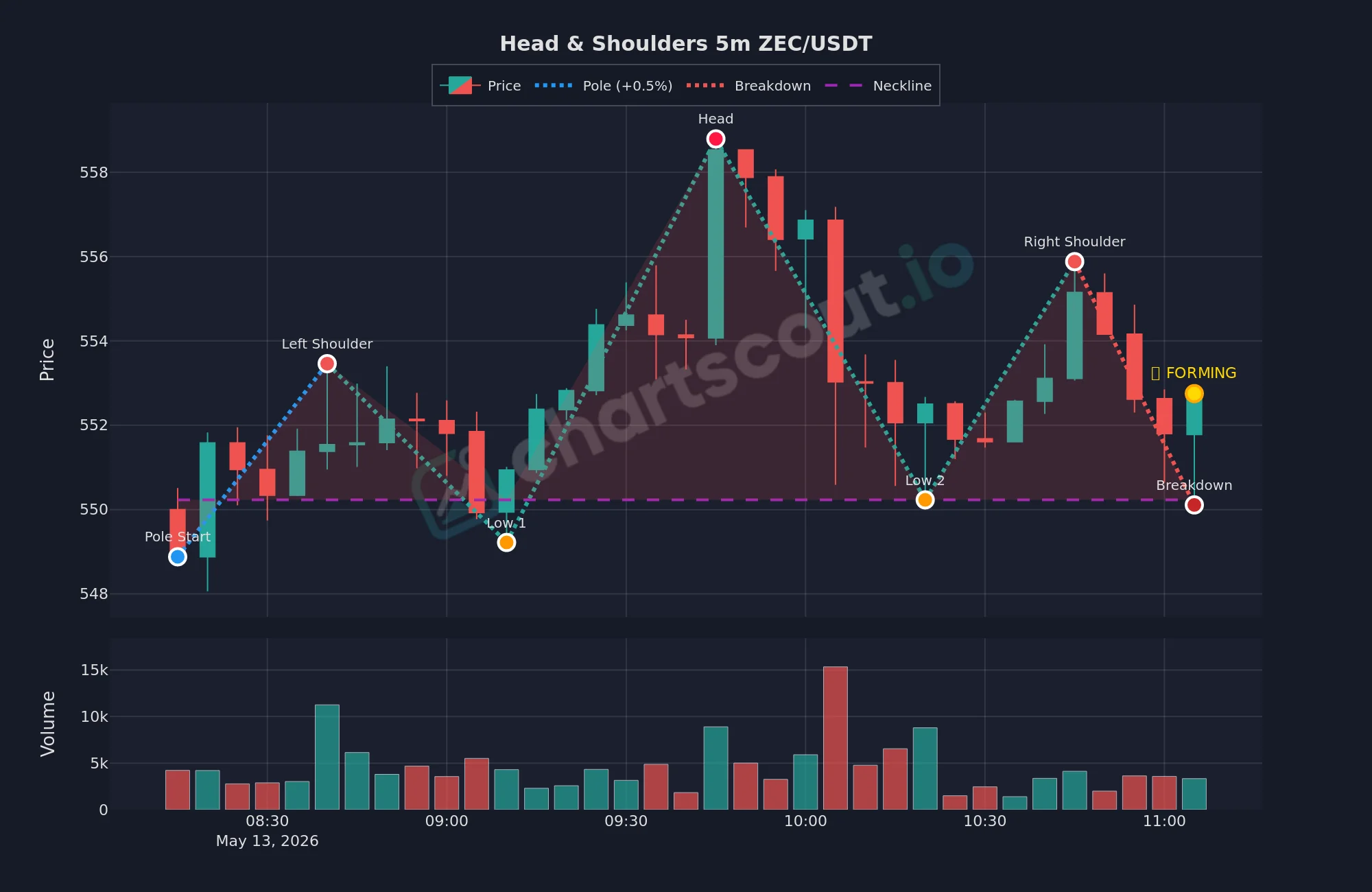
5m chart
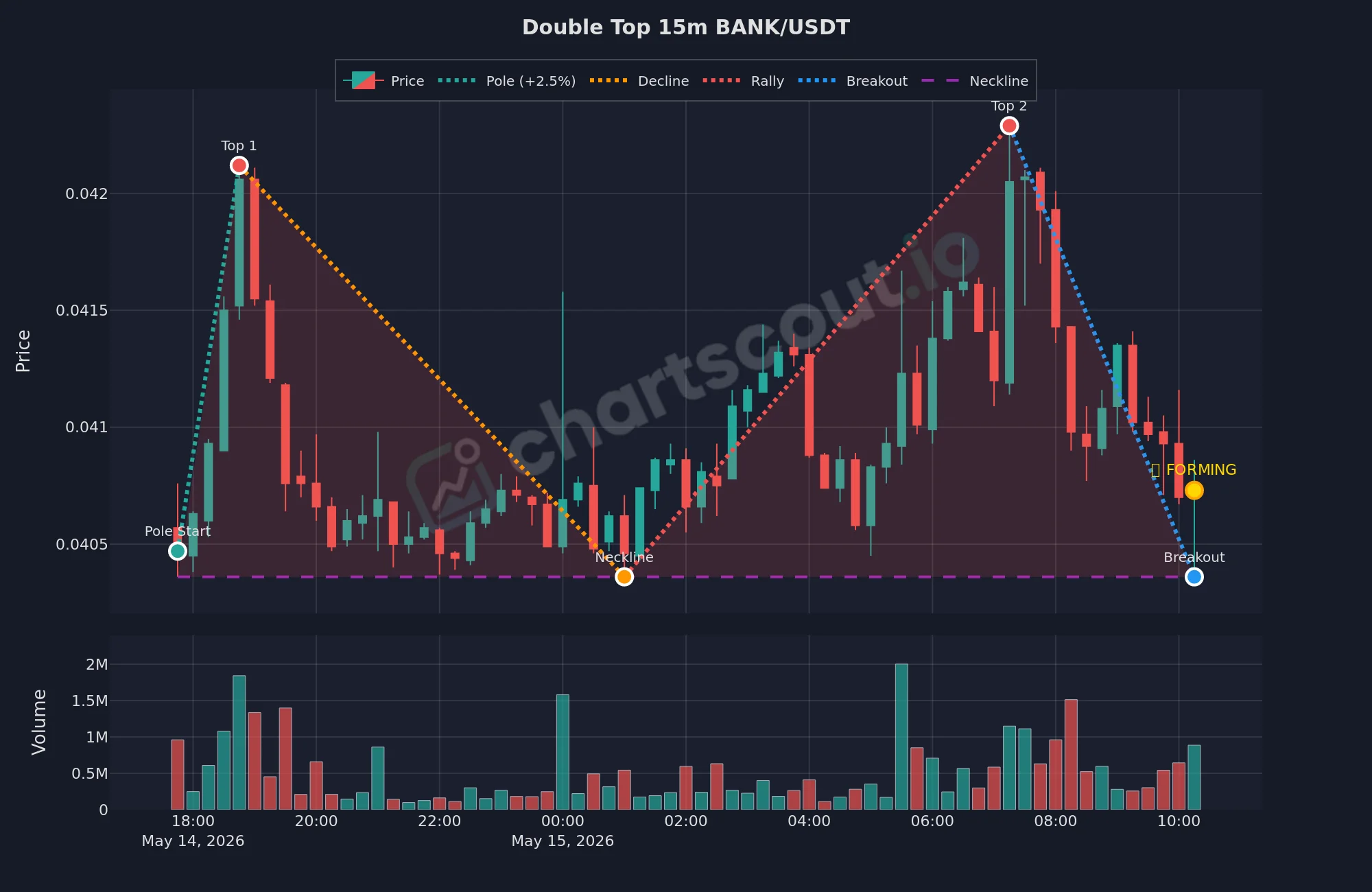
15m chart
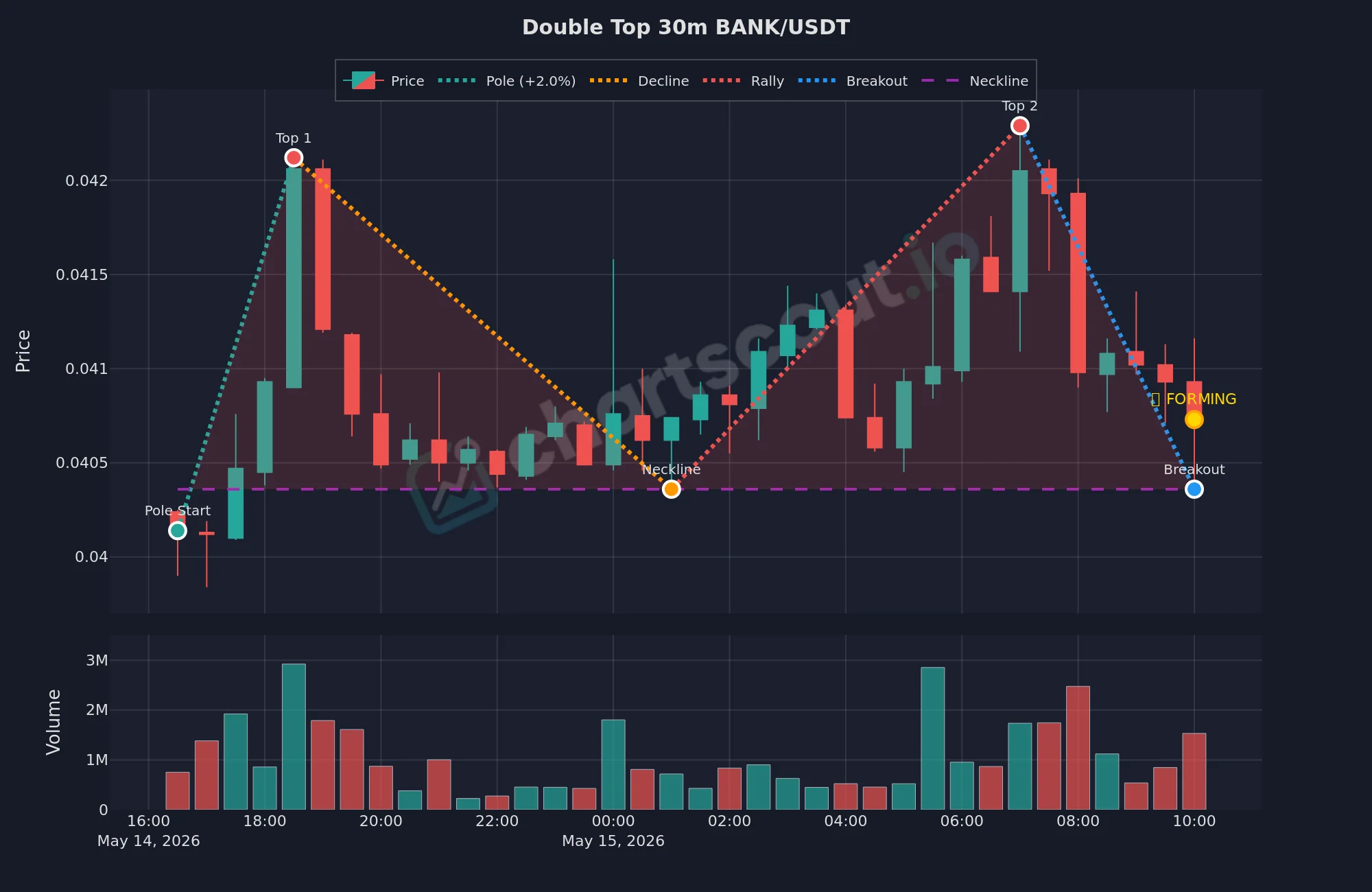
30m chart
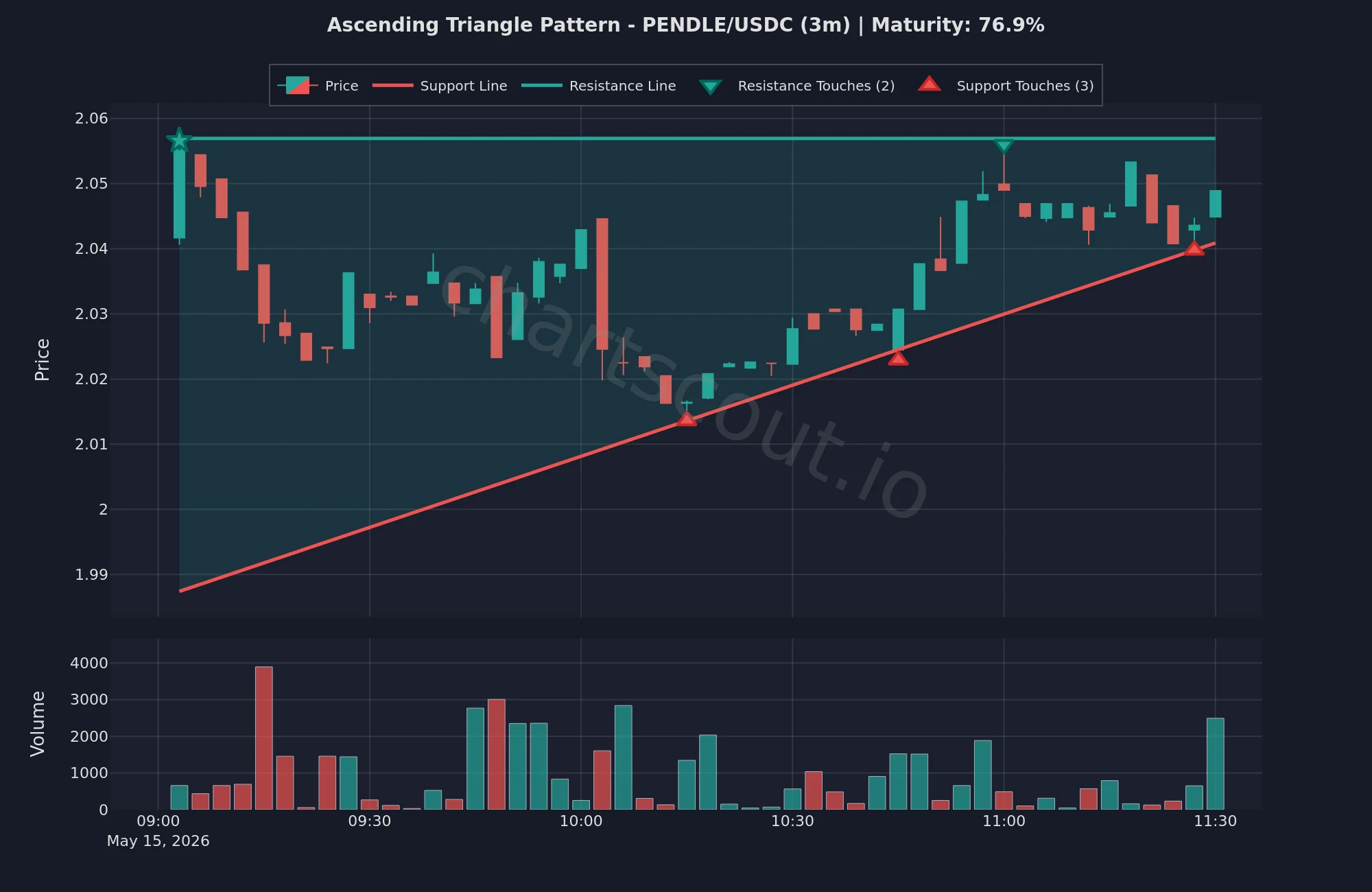
3m chart
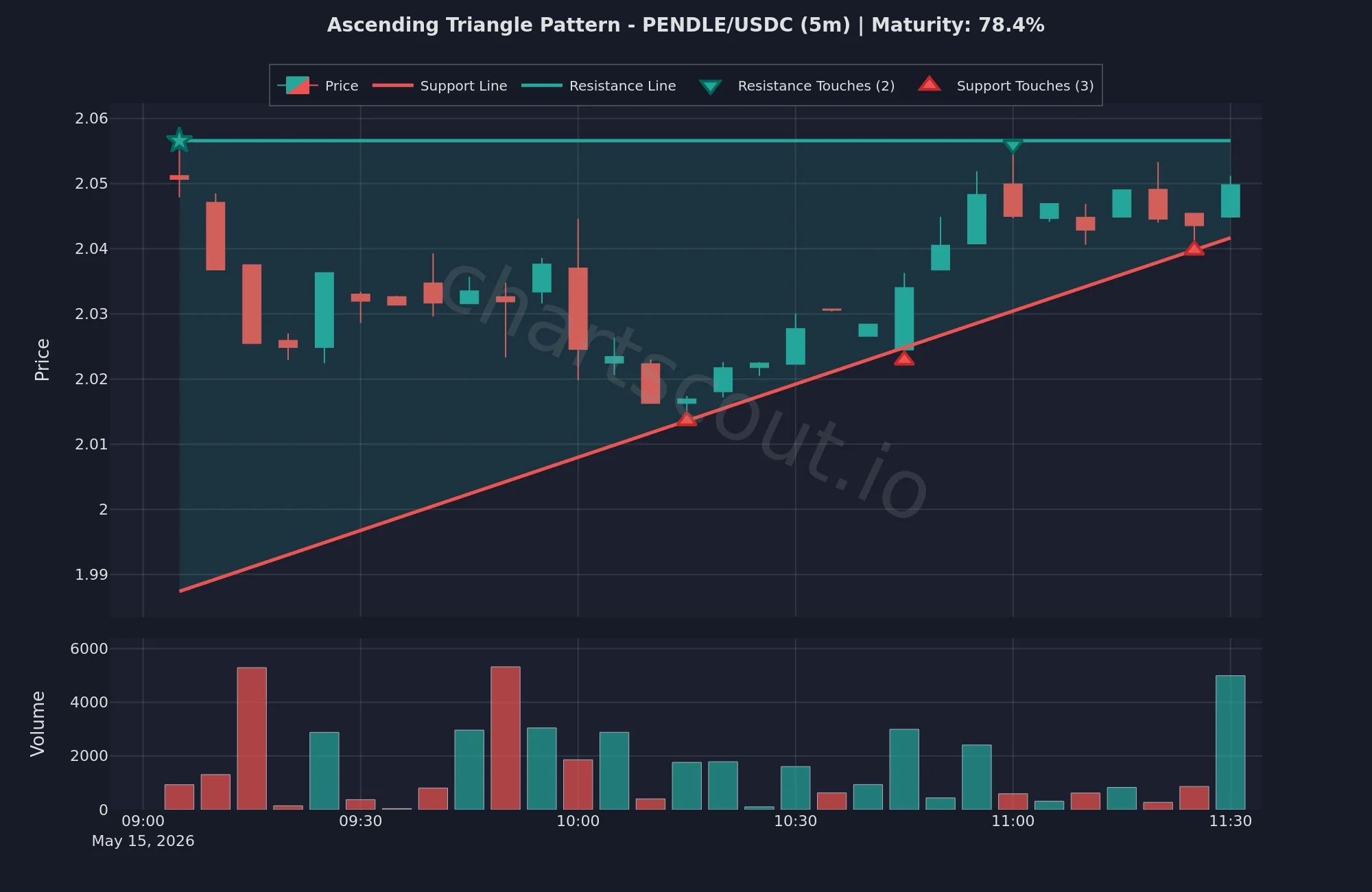
5m chart
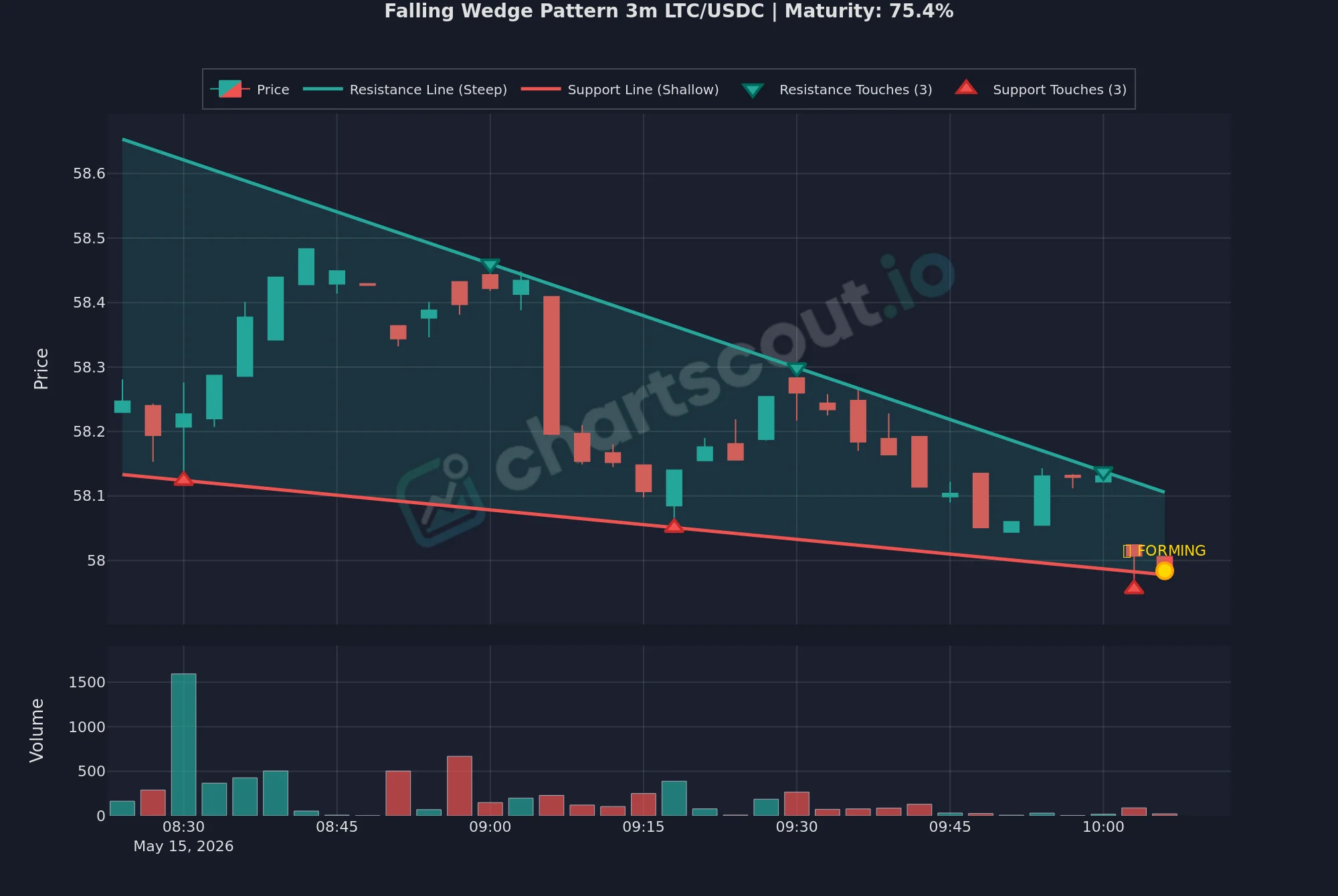
3m chart
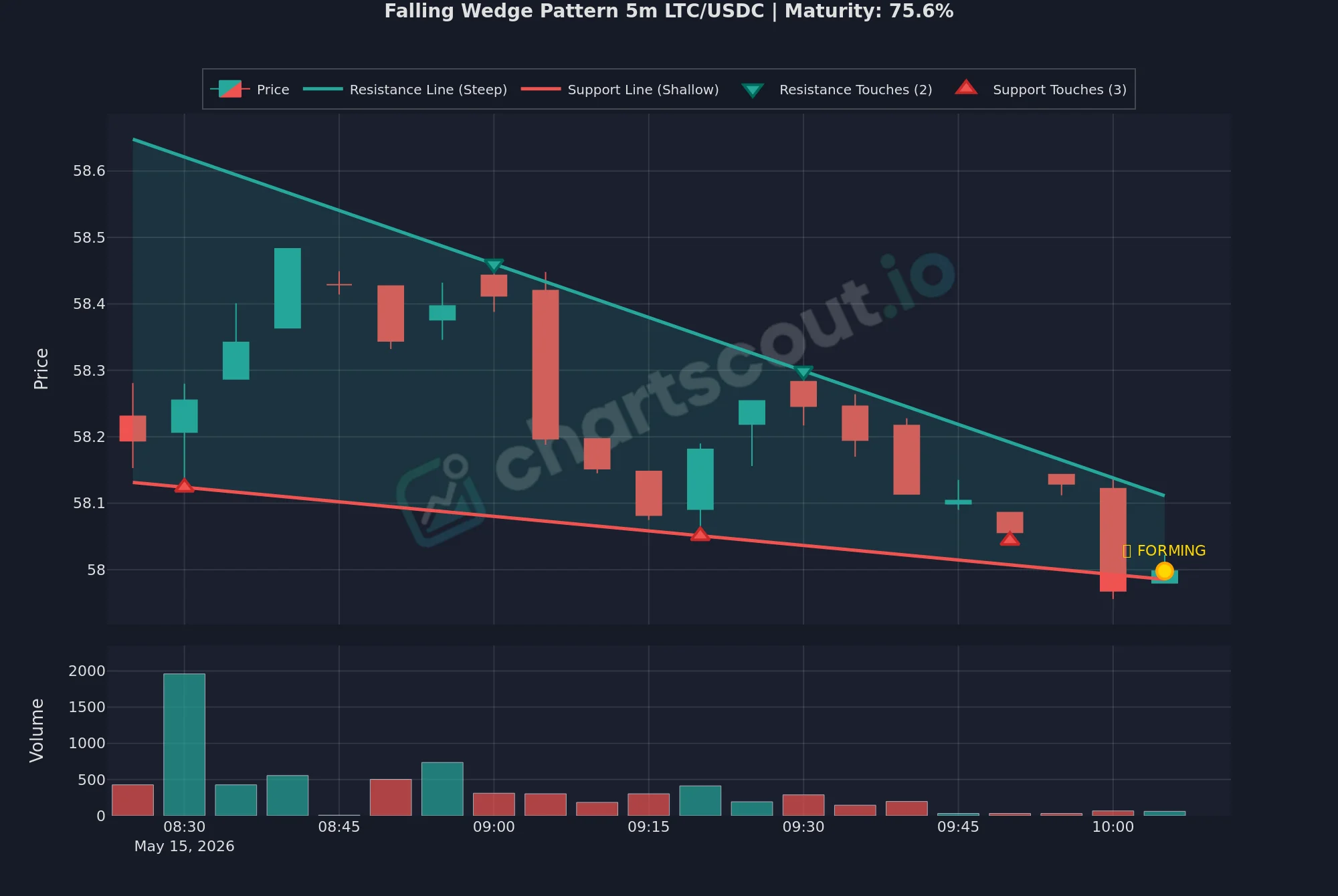
5m chart
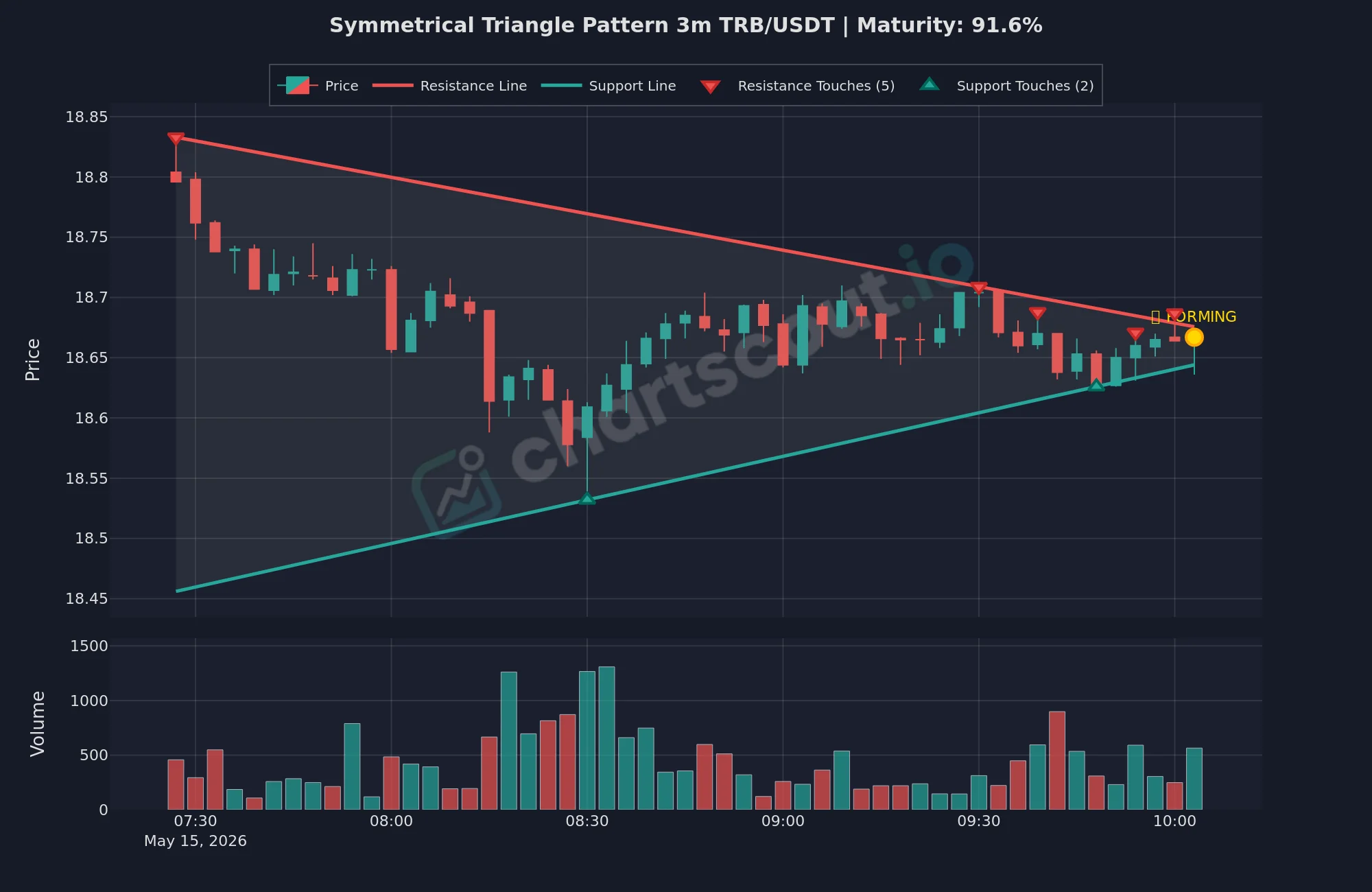
3m chart
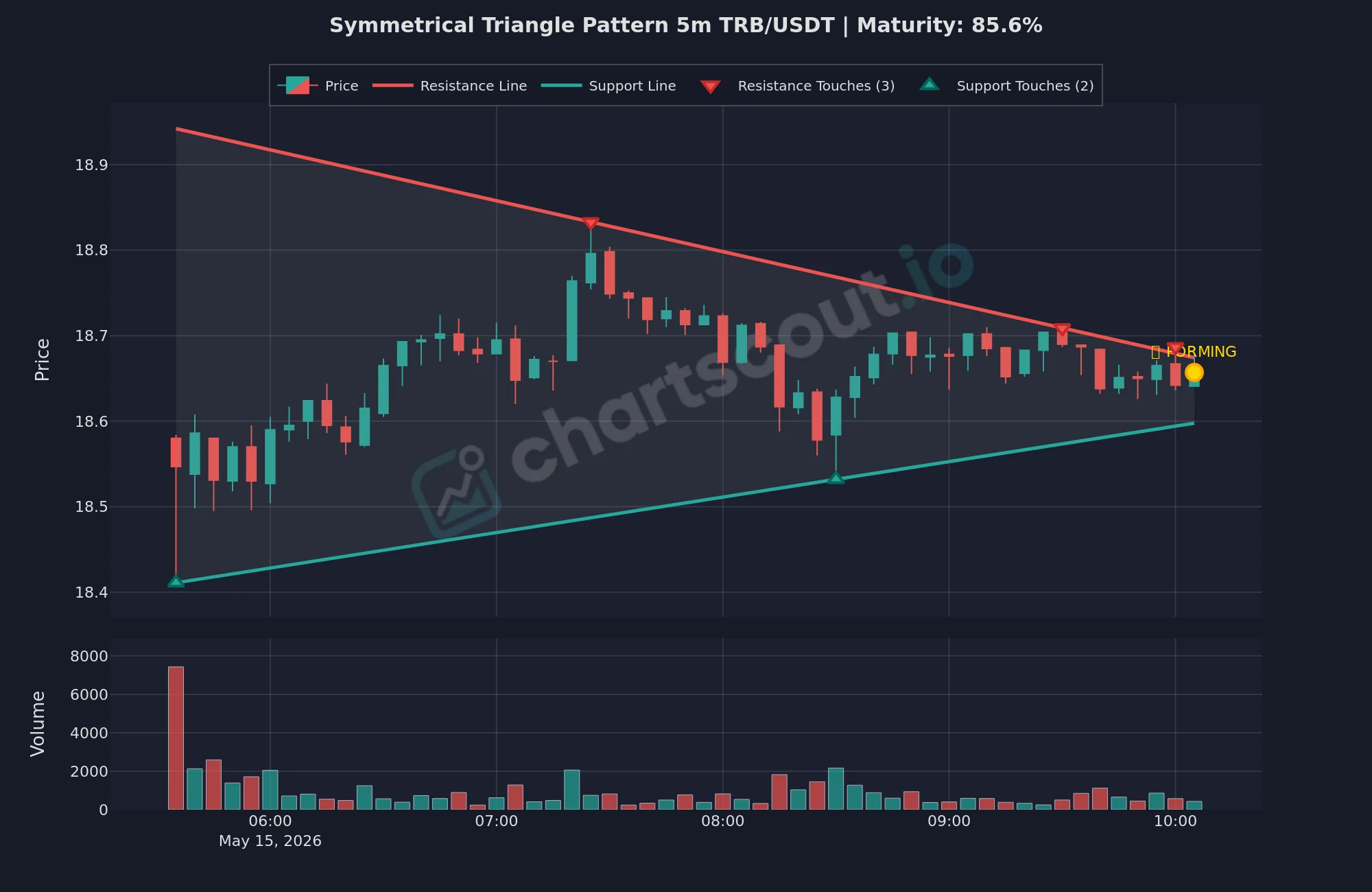
5m chart
Each block above is a genuine heads-up: something is forming on that pair, and the scanner found it across every timeframe you would care about. That is exactly what you want a scanner to do. The next move is yours: open the 1h or 4h, confirm the trend direction, and look for an independent higher-timeframe structure. When you find one, that is real confluence, and that is the trade. The echo tells you where to look. The top-down check tells you whether to act.
Market regime matters more than timeframe choice
In a strong trending market (BTC making higher highs, rising total market cap), continuation patterns complete reliably even on 15m charts. In a ranging, choppy market, even 4h patterns have elevated fakeout rates. The table above represents average conditions, not regime-adjusted performance. When BTC is consolidating in a tight range, size down across every timeframe.
Best timeframes by pattern
Different patterns trade well on different timeframes. The table below combines Bulkowski's equity break-even rates with the qualitative crypto ranking from the section above. Bulkowski numbers are from thepatternsite.com, updated 2020.
| Pattern | Bulkowski break-even | Best timeframes | Avoid |
|---|---|---|---|
| Bull flag | 56% (HTF variant 85%) | 15m to 1h | 5m, 1d |
| Bear flag | 55% | 15m to 1h | 5m, 1d |
| Ascending triangle | 83% | 1h to 4h | Below 15m |
| Descending triangle | 77% | 1h to 4h | Below 15m |
| Symmetrical triangle | 75% | 1h to 4h | 5m to 15m |
| Cup and handle | 95% (61% target hit) | 4h, 1d | Below 1h |
| Head and shoulders | 81% | 4h and above | Below 1h |
| Inverse head and shoulders | 74% | 4h to 1d | Below 1h |
| Double top | 75% | 4h to 1d | Below 1h |
| Double bottom | 84% | 4h to 1d | Below 1h |
| Rising wedge | 49% (ranked 36/36 bearish) | 1h to 4h | 5m to 15m |
| Falling wedge | 74% | 1h to 4h | 5m to 15m |
| Channel up / down | Bulkowski did not study channels | 1h to 4h | 5m to 15m |
Flags work on lower timeframes
Bull and bear flags are the only major patterns that trade cleanly on 15m, because they are inherently short-duration setups. They form after a sharp flagpole move and resolve quickly. The 1h is often the right setup timeframe with 15m for entry timing. The full breakdown is in our bull flag pattern guide.
Reversal patterns need 4h or higher
Head and shoulders, double tops and bottoms, and cup and handle formations all require multiple visits to the same support/resistance level and significant formation time. On the 1h and below, the “patterns” are usually compressed shapes that do not meet the structural requirements for reliable identification. The head and shoulders guide and the cup and handle guide both walk through the timeframe-specific rules in detail.
Triangles need 1h minimum
A symmetrical triangle needs at least 5 alternating contact points. On the 15m, that might form in 3 hours. On the 4h, it might take weeks. The 4h version has seen more participants, more institutional order flow, and more genuine S/R tests. It is a higher-quality pattern at the same shape. The ascending triangle guide has the structural rules.
Timeframe alignment rules
Not every setup requires perfect 3-of-3 alignment. The practical rules:
3-of-3 alignment: full size
HTF in an uptrend, MTF showing a bullish pattern, LTF entry candle at support. This is the highest-probability category. Use your full position size (whatever your risk-per-trade maximum is, typically 1%).
2-of-3 alignment: reduced size
HTF and MTF aligned, LTF entry imperfect (e.g., you chased the breakout candle instead of waiting for a retest). Take the trade but reduce size by half. Imperfect entries get imperfect risk allocation.
HTF disagrees with MTF: skip
MTF shows a bullish ascending triangle. HTF shows a clear downtrend. Trading long means fighting the HTF, which is what gets traders stopped out repeatedly even when the MTF setup looked perfect. Either skip the trade or wait for the HTF trend to change before entering. The one exception: a very strong reversal signal on the MTF (clear inverse head and shoulders, for example) that forms exactly at a major HTF support level. Even then, reduce size by 50% and tighten the stop.
The HTF override is non-negotiable
When the HTF trend disagrees with a trade direction, that trade is lower quality no matter how perfect the MTF setup looks. No single lower-timeframe pattern overrides the higher-timeframe trend context. This is the single rule that, applied consistently, will eliminate most of your worst losses.
Crypto-specific timeframe quirks
The standard MTF framework was developed for equity markets. These four crypto-specific factors change how you apply it.
UTC midnight pseudo-close
Most charting tools construct daily candles using UTC midnight as the open and close. This creates a “session close” in crypto that does not represent an actual market event, unlike the NYSE 4pm close which genuinely ends a trading session. Daily candle patterns in crypto can behave differently from Bulkowski's equity daily patterns because the “close” is artificial. Don't weight UTC-midnight candle behavior the same as a true session close.
Weekend liquidity drops
Saturday and Sunday see roughly 20 to 40% lower trading volume on majors and more on altcoins. Patterns that include Friday/Saturday candles on the daily chart have lower-quality building blocks. Weekend S/R tests carry less weight than weekday tests, and weekend breakouts have a higher fakeout rate than weekday breakouts. For more on this, see how to spot fake breakouts.
8-hour funding windows on perps
Binance, Bybit, and KuCoin perpetuals have funding-rate windows at 00:00, 08:00, and 16:00 UTC. Large funding payments can cause sharp, brief price movements at those boundaries that look like significant candles on 1h and 4h charts but are mechanical, not technical. A “breakout” precisely at 00:00 UTC on a perp pair is much more likely to be funding-driven noise than a genuine pattern resolution.
Practical adjustment
On perpetual pairs, apply skepticism to 1h or 4h candles that close exactly at funding windows, especially if the move reverses within 1 to 2 candles. These are not reliable MTF signals. Wait for the next candle to confirm direction before treating it as a pattern trigger.
BTC session overlaps drive liquidity
US and Asian session overlaps (roughly 13:00 to 17:00 UTC) produce the highest liquidity in crypto. Patterns that complete during those windows have more genuine price discovery behind them than patterns completing at 02:00 to 06:00 UTC, which is the low-liquidity dead zone. A 4h candle that closes at 16:00 UTC carries more weight than the same candle at 04:00 UTC.
Common multi-timeframe mistakes
Trading lower timeframes without a tighter rule set
The mistake is not scalping the 1m or 5m, it is scalping them with day-trader rules. Lower timeframes punish loose stops, late entries, and weak HTF discipline at a much faster rate than 1h setups do. If you are trading 5m, your HTF check is non-negotiable, your stop has to be in the order book before the entry fills, and you exit on plan, not on hope. Traders who blow up scalping accounts almost always do it by applying swing-trade tolerances to a scalping timeframe, not by picking the wrong timeframe in the first place.
Using four or more timeframes
Four or more timeframes simultaneously creates analysis paralysis. If you are checking 6 timeframes before every trade you will find reasons to hesitate on every setup. Pick 3 and stick to them.
Switching timeframes mid-trade
If you entered based on a 1h setup, manage the trade on the 1h. Don't start checking 4h candles when the trade goes against you and finding “reasons to hold.” That is using MTF to rationalize a losing trade, not to manage it. Your stop-loss placement is set on the entry timeframe, and the exit should respect that.
Ignoring the HTF for textbook setups
“This bull flag is textbook” is not a reason to go long when the 4h chart is in a clear downtrend. The quality of the LTF or MTF setup is irrelevant if the HTF opposes it. The setup is real. The trade direction is wrong.
Timeframe-hopping after a losing streak
If your 1h setups had a losing streak, the solution is not to move to 4h setups. That is changing your timeframe to escape a bad sample, but the bad sample may just be variance. Analyze why the 1h setups failed before abandoning the timeframe. Most of the time the fix is in process, not in chart resolution.
Two case studies: one win, one loss
Win: SOL/USDT ascending triangle on 1h, confirmed by 4h uptrend
- 4h context: SOL in a clear uptrend, higher highs and higher lows. Recent retest of the 4h rising trendline held. HTF bias: bullish.
- 1h setup: Ascending triangle over 14 candles. Flat resistance at $157.40 tested 3 times. Rising support with 3 touches. Pattern reaches ~78% maturity.
- 15m entry: 1h breakout candle closes above $157.40 with elevated relative volume. Price pulls back on the 15m to retest $157.40 (role reversal confirmed). Entry: $157.60. Stop: $155.80 (1.2x 15m ATR below the entry candle low = 1.14% risk).
- Targets: Triangle height = $157.40 minus $148.70 = $8.70. TP1 at $162.75 (50% of height). TP2 at $166.10 (full target, +5.4% from entry).
- Result: TP1 hit in 6 hours. Stop trailed to $159.00 after TP1. TP2 hit at $166.10 in 18 hours total. Clean 3-of-3 alignment.
Loss: AVAX/USDT bull flag on 1h, against 4h trend
- 4h context: AVAX in a descending channel. Lower highs, lower lows on the 4h. HTF bias: bearish.
- 1h setup: After a sharp rally on the 1h (the “flagpole”), AVAX forms a tight bull flag. Parallel trendlines, clean structure. The MTF setup looks textbook.
- The mistake: Entering long on the 1h flag breakout without weighting the 4h descending channel. 2-of-3 alignment at best (LTF and MTF agree, HTF disagrees). Per the alignment rules: this trade should have been skipped or sized down to 0.25%.
- What happened: Within 3 candles, a 4h bearish engulfing prints exactly at the 4h descending channel upper resistance. AVAX reverses sharply. Stop hit at -1.5%.
- Lesson: The 1h bull flag was a real pattern. It was still the wrong trade, because it formed against the 4h trend. The quality of the LTF/MTF setup does not override HTF context. Skip is a position too.
Realtime multi-timeframe analysis with ChartScout
Everything above is the manual version of the workflow. Here is the part no human can actually do at scale. Manual top-down means watching three timeframes on a handful of pairs while you happen to be awake. Genuine multi-timeframe coverage means watching every timeframe, 1m through 1w, on every pair, around the clock. For 1,000+ pairs that is thousands of pair-and-timeframe combinations monitored continuously: roughly 100 to 150 hours of chart-reading per single pass. That is not a workflow you optimise. It is a workflow you automate, and realtime multi-timeframe analysis is the entire reason ChartScout exists.
ChartScout watches the timeframe ladder so you do not have to. It runs an independent scan on every timeframe you set a watcher for and alerts within 20 seconds of a pattern forming on any of them. The manual workflow does not change; it just runs continuously instead of whenever you sit down at the screen.
- Receive the alert. The scanner fires on a pair-pattern-timeframe combination you configured. This is your bottom-up discovery: the scanner found the MTF-level setup.
- HTF context check (2 minutes). Open the pair on your charting tool. Look at the next higher timeframe. Is the HTF trend aligned with the pattern direction? If yes, proceed. If no, skip or reduce size dramatically.
- Confirm the MTF pattern. Visually verify the pattern the scanner identified. Check contact points, trendline quality, and volume behavior inside the pattern. Algorithms detect, humans validate.
- Plan the LTF entry. Drop to the LTF. Plan the specific entry: breakout close or retest. Calculate the stop from LTF structure. Calculate the target from the MTF measured move.
- Execute and manage. Enter. Manage on the MTF chart. Take TP1 when hit. Trail the rest using HTF structure.
The honest split: ChartScout runs the realtime multi-timeframe monitoring, watching every timeframe you care about and surfacing patterns the instant they form. What it does not do is make the alignment call for you. That stays human: the 2-minute top-down check on each alert, deciding whether the higher timeframe genuinely backs the setup. The machine runs multi-timeframe analysis at a scale and speed you cannot match; you run the judgment. That division of labour is what alert-driven trading looks like in practice.
To use ChartScout as realtime multi-timeframe analysis, set watchers across your whole stack on the pairs you care about: a 4h, a 1h and a 15m watcher on BTC/USDT, for example. The scanner then monitors your entire timeframe stack on that pair continuously, across Binance, Bybit, KuCoin, MEXC, and Hyperliquid, and alerts you the moment a pattern forms on any of them. That is the top-down workflow from this guide, running 24/7 without you at the screen.
Credit card required to start. Not charged if you cancel before day 8, if the workflow is not for you.
Frequently asked questions
What is the best timeframe for crypto trading?
There is no universal best timeframe. Day traders typically use 1h setups with 4h context. Swing traders use 4h setups with daily context. Pattern signal quality becomes practically meaningful at 1h and improves through 4h and daily. Lower timeframes have elevated fakeout rates in crypto due to 24/7 trading, funding windows, and thin weekend liquidity.
What is the 1:4 rule in multi-timeframe analysis?
Each timeframe in your stack should be 4 to 6 times the duration of the one below it. Common crypto stacks are 15m/1h/4h for day trading and 1h/4h/daily for swing trading. The ratio ensures each timeframe provides genuinely different perspective instead of showing the same price action at a slightly different resolution.
Should I use top-down or bottom-up analysis in crypto?
Top-down. Start on the HTF to establish trend bias, then drop to the MTF for setup, then to the LTF for entry. This is the professional standard because it prevents confirmation bias from creeping into your lower-timeframe reading. Bottom-up is acceptable only when a scanner like ChartScout is the discovery layer and you treat the HTF as a hard validation gate.
How many timeframes should I use for crypto?
Three: HTF for context, MTF for setup, LTF for entry. More than three creates analysis paralysis. Fewer than three means you are missing either trend context or entry precision.
Which timeframes work best for chart patterns in crypto?
Bull and bear flags trade cleanly on 15m to 1h. Ascending, descending, and symmetrical triangles need 1h or higher. Head and shoulders, double tops, double bottoms, and cup and handle patterns are most reliable on 4h and daily. Each pattern needs enough candles to develop genuine contact points and support/resistance structure.
Is the 1-minute chart usable for pattern trading in crypto?
Yes, for high-frequency scalpers running a 15m / 5m / 1m stack with strict HTF alignment and tight execution. Per-setup reliability on the 1m is lower than on the 1h, but the volume of setups is much higher. Most pattern traders should not start on the 1m. Experienced scalpers who already know how to size and stop a fast trade can run it productively. ChartScout covers 1m and 3m on the Enterprise tier for exactly that audience.
What is Alexander Elder's triple screen trading system?
Triple screen is the canonical multi-timeframe framework, developed by Dr. Alexander Elder in 1985. It uses three timeframes (long-term for trend, intermediate for setup, short-term for entry), each separated by approximately a factor of five. Elder's core rule: examine the long-term chart first and trade only in the direction of that trend.
Does multi-timeframe analysis work in 24/7 crypto markets?
Yes, with adjustments. Account for weekend liquidity drops (lower-quality S/R tests), perpetual funding windows at 00:00, 08:00, and 16:00 UTC (mechanical noise on 1h candles), and BTC correlation events that can override individual coin patterns at any timeframe. The principle holds: higher timeframes filter noise better.
How does ChartScout help with multi-timeframe analysis?
ChartScout is realtime multi-timeframe analysis. It monitors every timeframe from 1m to 1w on 1,000+ pairs continuously and alerts within 20 seconds when a pattern forms on any of them. Set watchers across your whole HTF, MTF and LTF stack on a pair and the scanner runs your top-down coverage 24/7. You still make the alignment call: the 2-minute top-down check on each alert.
Sources & references
Data source note: Bulkowski statistics in this article come from thepatternsite.com (updated 2020, 40,000+ trades on equity charts). Crypto qualitative ranking is observational, not a controlled statistical study. Quotes are verbatim from the cited print editions; minor punctuation has been normalized for HTML rendering.
- Elder, Alexander. The New Trading for a Living: Psychology, Discipline, Trading Tools and Systems, Risk Control, Trade Management. John Wiley & Sons, 2014. ISBN: 978-1118443927.
Chapter 33 (Trading Timeframes), Chapter 39 (Triple Screen Trading System). Canonical source for the “factor of five” ratio rule and the top-down workflow framework. - Bulkowski, Thomas N. ThePatternSite.com - Chart Pattern Statistics. Updated 8/26/2020. thepatternsite.com.
Primary statistical source. Break-even rates, average moves, and performance ranks for every pattern in the pattern x timeframe matrix. - Bulkowski, Thomas N. Encyclopedia of Chart Patterns, 2nd Edition. John Wiley & Sons, 2005. ISBN: 978-0471668268.
Canonical print reference for chart pattern structure rules and weekly-vs-daily timeframe guidance. - Brooks, Al. Trading Price Action: Trends. Technical Analysis of Price Charts Bar by Bar for the Serious Trader. John Wiley & Sons, 2012. ISBN: 978-1118066515.
Glossary entry on fractal pattern structure across timeframes. Quoted in the “Why higher timeframes are more reliable” section.
Related guides
How to read crypto charts
Candlestick anatomy, chart types, and the 8 patterns you will see everywhere. Required reading before applying MTF.
How to spot fake breakouts
Volume, retest, order book. Three checks that pair naturally with the HTF-MTF-LTF workflow above.
Alert-driven trading
How pattern alerts replace screen-watching and let you trade on your schedule, not the market's.
Risk-reward ratio per pattern
The math behind sizing each timeframe alignment tier. Expectancy, breakeven win rates, and the half-target rule for flags.
Crypto chart patterns cheat sheet
all 23 ChartScout detectors with Bulkowski break-even rates, volume rules, and timeframe playbooks.
How to find breakouts before they happen
The scanner side of MTF: how pattern maturity tracking flags setups inside the pre-breakout zone.

Stjepan Ivanović
Founder of ChartScout · Crypto Trader Since 2013
Trading crypto since 2013 with his first Bitcoin bought at ~$200. Four complete bull/bear market cycles, traded on early exchanges like Mt.Gox and BTC-e, on-chain trading on IDEX and EtherDelta, and ~70 crypto project investments. Built ChartScout after 23+ months of development to automate what no trader can do manually. Watch hundreds of charts 24/7.